Home Renovation Planning and Execution
By Housey · Last reviewed 11th of May 2026

Home Renovation Planning and Execution
Whether you are extending a 1930s semi, reconfiguring the layout of a Victorian terrace, or converting a loft in a 1990s estate house, renovation projects in the UK rarely unfold exactly as planned. Regulatory requirements, procurement challenges, and the realities of older construction all create decision points that are easier to navigate with a clear framework in place before work begins.
Key points
- Planning permission is required for most extensions beyond permitted development limits; those limits vary by property type, location (conservation area, Article 4 direction, listed building status), and what has already been built on the plot.
- Building Regulations approval — via a full plans application or building notice — is required for almost all structural work, extensions, loft conversions, and changes to drainage, insulation, or heating systems, separately from and in addition to any planning permission.
- A contingency budget of 15–20% is standard practice for UK renovation projects; older properties commonly reveal unexpected structural, damp, or asbestos-related issues once work begins.
- The Construction (Design and Management) Regulations 2015 (CDM 2015) impose specific duties on domestic clients who appoint more than one contractor, including designating a Principal Contractor and Principal Designer.
- Written contracts should be agreed before any work begins; the JCT Minor Works and JCT Homeowner Contract suites are widely used for domestic renovation projects in England and Wales.
Defining the scope before you start
The first step in any renovation is also the hardest: being precise about what you want to achieve. Scope creep — the gradual addition of tasks once a contractor is on site — is the most common cause of budget and programme overruns in domestic projects. Before approaching any professional or contractor, define your requirements in three tiers:
- Must-have: The non-negotiable outcomes the project must deliver.
- Should-have: Improvements you would make if the budget allows.
- Could-have: Nice-to-haves that could be deferred to a future phase.
This distinction gives contractors a realistic brief to price against and gives you a clear basis for evaluating quotes and managing any changes during the build.
Planning permission and permitted development
Many domestic improvement projects fall within permitted development (PD) rights, meaning no planning application is required. However, PD rights have limits — and those limits depend on the property's location, its planning history, previous extensions, and whether an Article 4 direction or conservation area designation restricts PD in that area.
Projects that often (but not always) fall within permitted development in England:
- Single-storey rear extensions up to 3 m (attached houses) or 4 m (detached) beyond the original rear wall
- Loft conversions adding no more than 40 m³ (attached) or 50 m³ (detached) of additional volume
- Most internal alterations with no change to external appearance
Projects that usually require planning permission:
- Two-storey extensions
- Side extensions on corner plots or in conservation areas
- Any works to a listed building (listed building consent is also required)
- Changes of use — converting a house into flats, or commercial to residential
If you are uncertain about your position, apply for a Lawful Development Certificate (LDC) from your local planning authority before starting work. An LDC provides legal confirmation and protects you if questions arise at the point of sale.
Building Regulations: separate from, and additional to, planning
Even when planning permission is not required, Building Regulations approval almost certainly is for any structural, energy, drainage, or fire-safety-related work. Building control can be handled through your local authority's building control team or a registered private approved inspector.
A Full Plans application (submitted and approved before work starts) is generally preferable to a Building Notice (served shortly before commencement), because it gives you the engineer's and building control officer's review of the design in advance — reducing the risk of costly changes mid-build.
Choosing how to manage your project
Approach | Best for | Not ideal for | Cost overhead | Key risk if wrong |
|---|---|---|---|---|
Self-managed by homeowner | Simpler single-trade projects; confident homeowners with available time | Multi-trade projects with complex sequencing; full-time employed homeowners | Minimal (your own time) | Programme overruns, trade disputes, quality gaps |
Part-managed (homeowner manages contractors; designer leads design) | Projects needing planning input and complex design | Multiple concurrent trades or tight deadlines | 5–10% of build cost | Same risks as self-managed, partly offset by better design quality |
Fully managed by project manager | Large extensions, multi-phase projects, listed buildings, time-poor homeowners | Small single-trade projects where the fee is hard to justify | 10–20% of build cost | Higher cost; accountability shifts to the professional |
Design-and-build by extension builder | Standard extension types; cost certainty a priority | Unusual or listed building situations needing bespoke design | Varies; often competitive total cost | Less design flexibility; single point of contract |
Which professional do you need?
- Choose an architect or architectural technologist if your project requires a planning application, listed building consent, or significant bespoke design input.
- Choose a structural engineer if the project involves removing or altering load-bearing elements, new foundations, or structural spans over 4 m.
- Appoint a project manager if you are coordinating multiple trades and lack the time to manage the programme and quality directly.
- Consider a design-and-build extension builder if your project is a standard extension type and you want a single party responsible for both design and construction.
- Speak to building control early — a pre-application discussion can confirm what structural calculations, energy compliance details, and drainage submissions will be required before you commit to a designer or contractor.
A practical renovation timeline
Most UK domestic renovation projects follow a broadly similar sequence:
- Brief and feasibility — define scope, budget, and constraints (planning history, listed status, lease covenants, known structural issues).
- Design and planning — appoint a designer; prepare and submit any planning or listed building consent application.
- Technical design — structural calculations, building control submission, specification of materials and finishes.
- Procurement — obtain at least three written quotes against the same detailed scope; check references, insurance, and accreditations; agree a written contract before work begins.
- Mobilisation — site setup; serve party wall notices if applicable (at least 2 months before work begins); confirm the building control inspection schedule.
- Build stage — regular site visits; programme tracking; stage payments tied to agreed milestones, not to dates alone.
- Completion and snagging — produce a snagging list before releasing final payment; obtain the building control completion certificate, EIC, and Gas Safe certificate where applicable.
- Post-completion — file all certificates and documentation; update buildings insurance to reflect any change in rebuild cost.
Homeowner checklist: before signing a contract
When to get professional help
Renovation projects benefit from professional input at the earliest stage — before planning applications, before procurement, and well before anyone breaks ground. Even where you intend to manage contractors yourself, an initial consultation with an architect, structural engineer, or project manager can surface constraints and regulatory requirements that would be far more costly to discover mid-build.
Professional involvement is not optional where the project involves:
- A listed building or a property in a conservation area
- Structural alterations or new foundations
- Discovery of suspected asbestos once work has begun
- Disputes with contractors over payment, quality, or scope
- A neighbouring owner who objects to or fails to respond to party wall notices
How Housey can help
Whether you need a project manager to take the day-to-day coordination of a complex renovation off your hands, or an extension builder to manage a standard rear extension from design through to handover, Housey connects you with qualified local professionals who can quote on your project.
Frequently asked questions
Do I need an architect for a home extension in the UK?
You are not legally required to use a registered architect, but a designer of some kind is almost always advisable. An architectural technologist, registered architect, or experienced designer prepares planning drawings, structural briefs, and specifications that give contractors a clear scope to price and build to. For larger or complex projects, the design fee is usually more than recovered through better contractor pricing, fewer variations, and smoother building control sign-off.
How much contingency should I allow for a home renovation?
A contingency of 15–20% of the estimated build cost is standard industry guidance for UK renovation projects. Older properties — particularly Victorian, Edwardian, and interwar homes — commonly reveal hidden issues once work begins: substandard previous repairs, unexpected drainage configurations, asbestos-containing materials, or deteriorating timberwork. Keep the contingency ring-fenced and do not pre-commit it to optional extras or upgrades before the project is complete.
What is the Party Wall etc. Act 1996 and when does it apply?
The Party Wall etc. Act 1996 requires homeowners to serve formal notice on neighbours before undertaking work on or near a shared boundary — including excavations within 3 m or 6 m of a neighbouring foundation depending on depth, work on a shared party wall, or building at the boundary line. If a neighbour dissents, both parties appoint surveyors to agree a party wall award, a legal document defining how work is to proceed and who bears the cost of any resulting damage.
How do I avoid rogue builders?
Check that any contractor holds valid public liability insurance (minimum £2m for residential work) and, where relevant, is registered under a competent person scheme or a recognised trade body such as the Federation of Master Builders. Ask for at least two references from comparable recent projects and follow them up with a call. Always use a written contract. Be wary of contractors who demand large upfront payments, cannot provide insurance documentation, or are unwilling to commit to a fixed scope in writing.
Sources and further reading
- Planning Practice Guidance: when is permission required? — GOV.UK
- Building Regulations approval — GOV.UK
- Party Wall etc. Act 1996 — legislation.gov.uk
- Construction (Design and Management) Regulations 2015 — legislation.gov.uk
- JCT Homeowner Contracts — Joint Contracts Tribunal
- Federation of Master Builders: find a builder — Federation of Master Builders
Useful next reads
 Improvement & Build
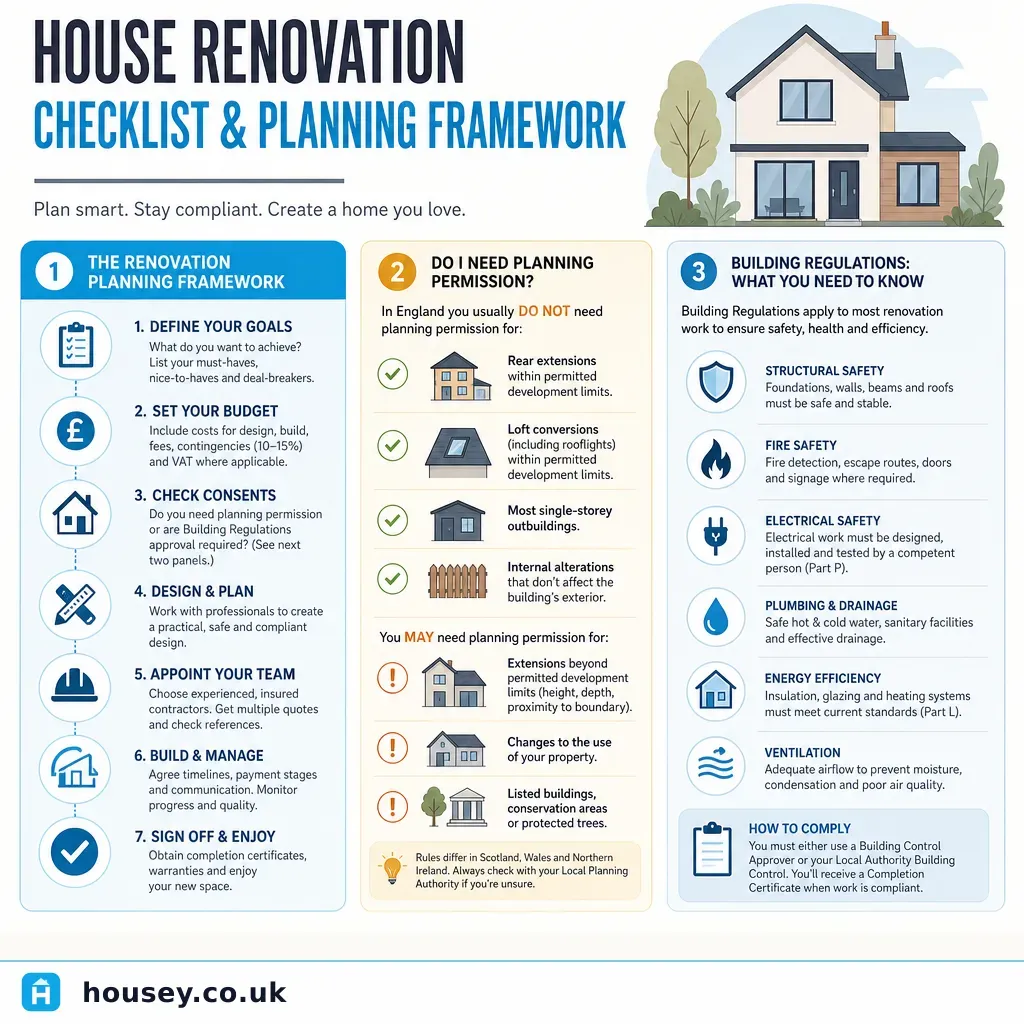
House Renovation Checklist and Planning Framework
A UK house renovation needs clear planning across five stages: defining scope and budget, obtaining consents (planning permission, building regulations, party wall), appointing professionals, managing the build sequence, and snagging.
 Improvement & Build
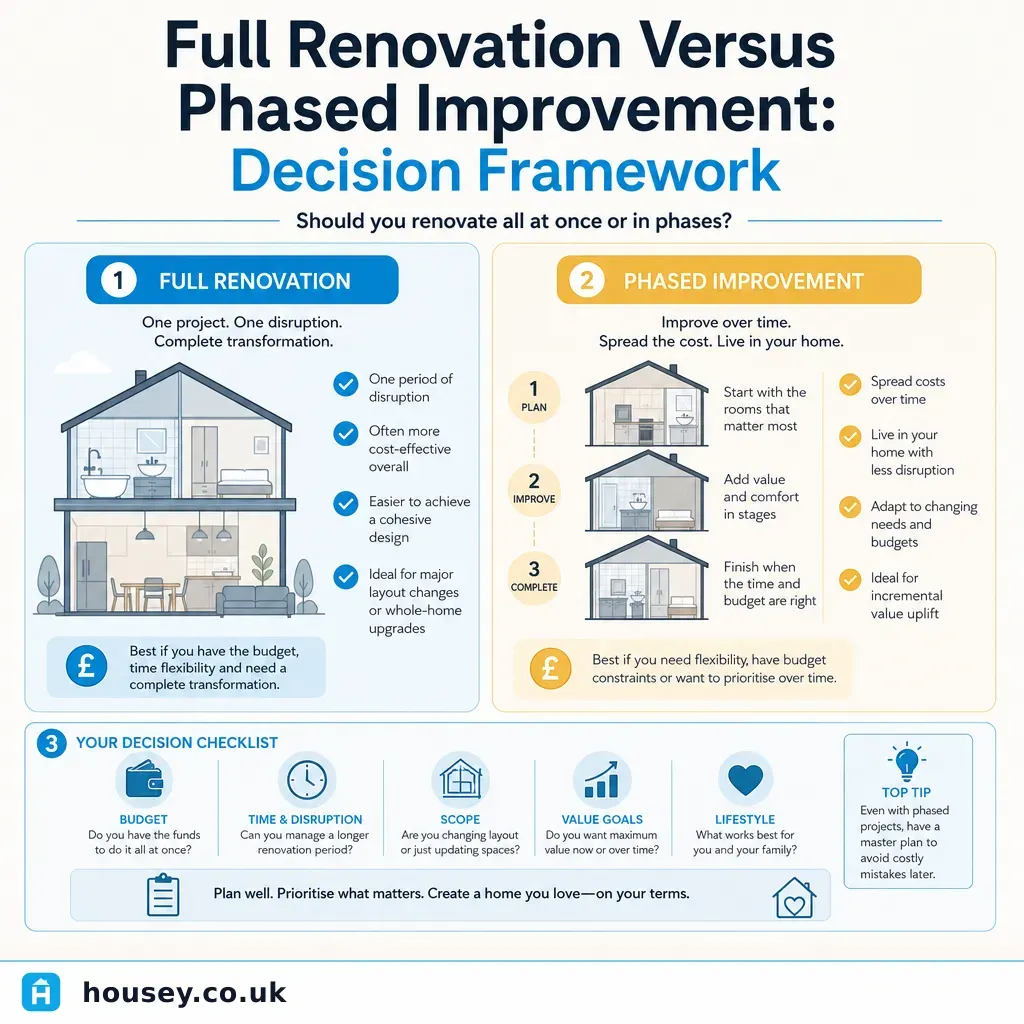
Full Renovation Versus Phased Improvement: Decision Framework
A full renovation suits properties needing comprehensive structural, thermal, or layout changes where repeated disruption would cost more than doing everything once.
 Improvement & Build
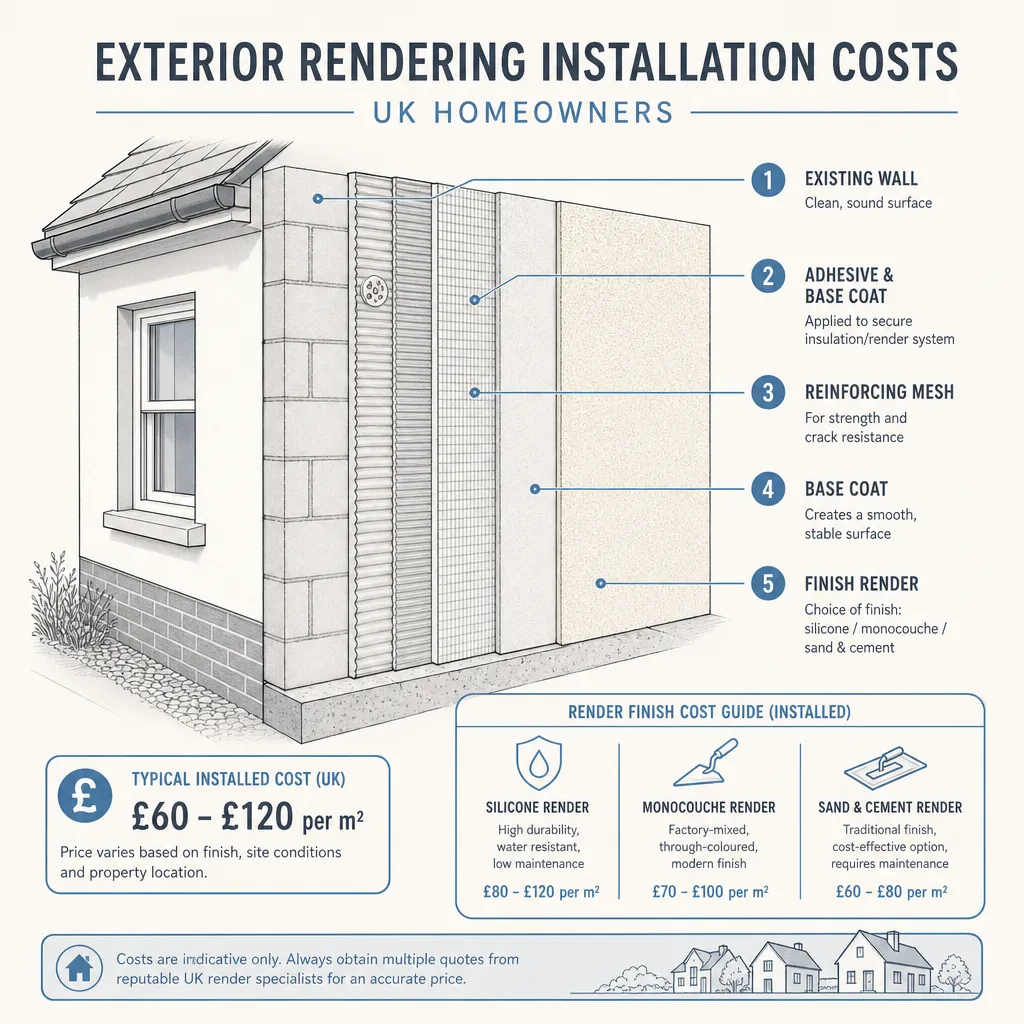
Exterior Rendering Installation Costs
Exterior rendering in the UK typically costs £20–£60 per square metre for standard render systems, or £80–£150 per square metre for External Wall Insulation with a render finish.
 Improvement & Build
Designing an outdoor kitchen for entertaining and garden living
An outdoor kitchen in a UK garden needs a stable, level base — typically a concrete slab or quality paving — with weather-rated materials such as stainless steel grade 316 or frost-rated porcelain.
 Improvement & Build
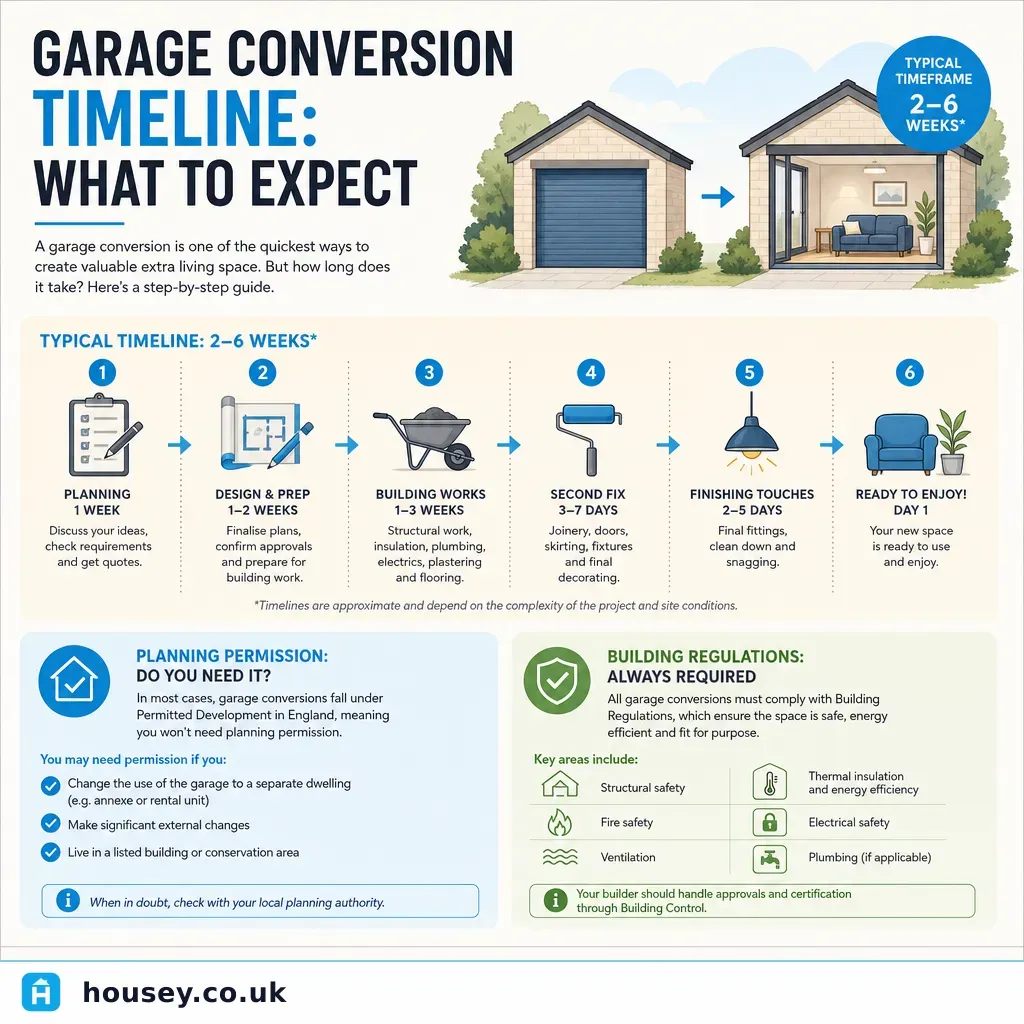
Garage Conversion Timeline: What to Expect
A straightforward attached garage conversion in England usually takes 4–8 weeks of construction, plus pre-start time for building control approval (5 working days for Full Plans).