House Renovation Checklist and Planning Framework
By Housey · Last reviewed 11th of May 2026
House Renovation Checklist and Planning Framework
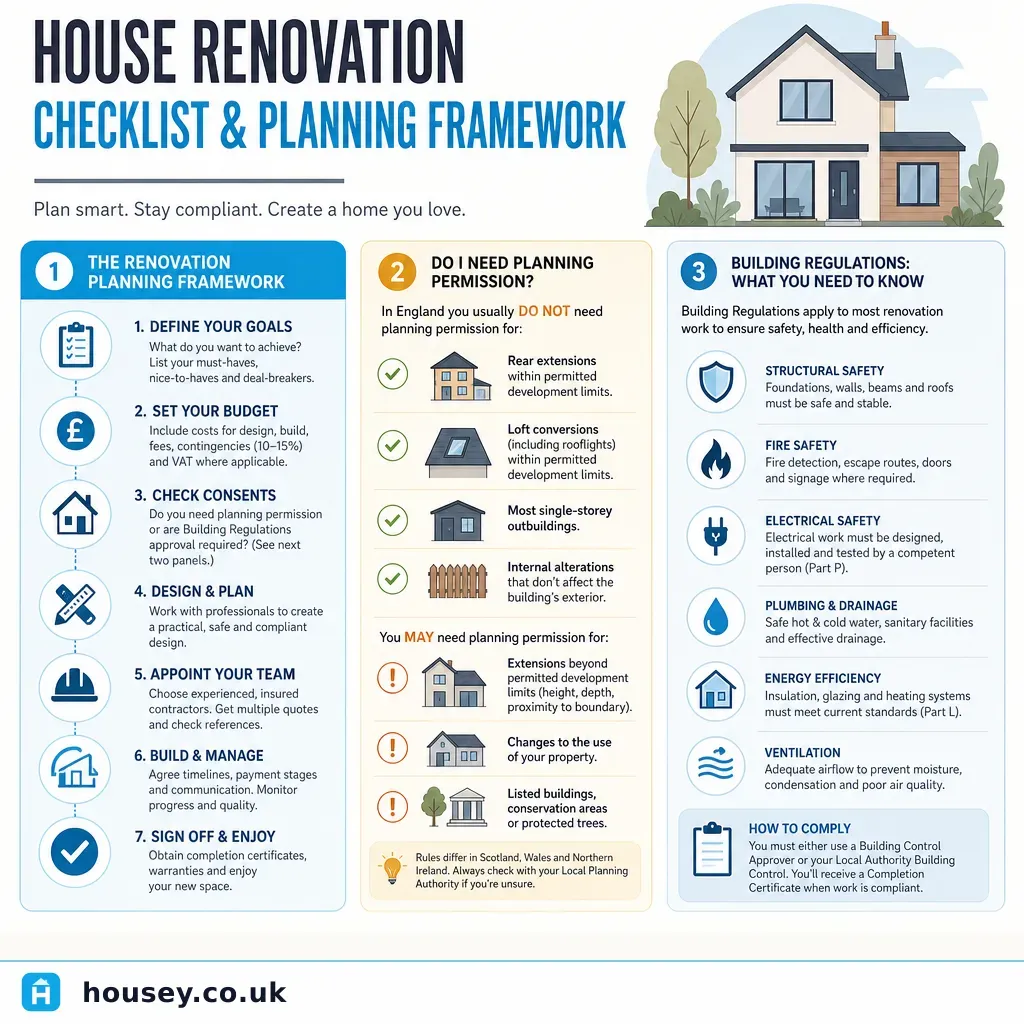
Whether you are reconfiguring a 1930s semi or extending a Victorian terrace, a UK house renovation involves overlapping legal, structural, and logistical processes that can catch homeowners off guard when approached in isolation. Planning applications, building regulations approvals, party wall notices, and professional appointments each have their own timelines — starting any of them late can add weeks or months to a project and, in some cases, expose you to enforcement risk or unforeseen cost.
Key points
- Planning permission and building regulations approval are entirely separate processes: some work needs both, some only building regulations, and some permitted development work needs neither — but which applies must be confirmed before starting.
- The Party Wall etc. Act 1996 requires written notice to adjoining owners before work on or near a shared wall, party floor, or within 3–6 metres of a neighbour's foundations.
- A contingency budget of 10–20% of the total build cost is standard industry practice for UK renovation projects; older properties typically warrant the higher end of that range.
- Building Regulations approval is required for structural changes, loft conversions, extensions, notifiable electrical work, gas installations, and alterations to drainage — local authority building control or an approved inspector must be involved before certain works begin.
- The Construction (Design and Management) Regulations 2015 (CDM 2015) apply to domestic projects involving more than one contractor and impose duties on the homeowner as a domestic client, including appointing a principal designer.
Phase 1: Project definition and feasibility
Before appointing professionals or requesting quotes, define the project clearly:
- Scope: What does the finished project look like? List every room affected, structural changes, new or upgraded systems (heating, electrical, plumbing, ventilation), and finish standards.
- Budget ceiling: What is the maximum you can spend, including professional fees, VAT, and contingency? Be realistic — UK renovation costs vary significantly by region, property type, and specification.
- Timeline: Is there a hard deadline (a school start date, a lease end, a planned sale)? Identify what can be phased and what cannot.
- Constraints: Is the property listed? In a conservation area? Leasehold (which may require freeholder consent for structural work)? These constraints affect what you can do, what approvals are needed, and what costs to anticipate.
This phase prevents abortive professional fees and design work on projects that are not financially or legally viable.
Phase 2: Consents and approvals — what you need and in what order
Misunderstanding the consents regime is one of the most common and costly renovation mistakes. The table below sets out the main approval types for UK residential renovation.
Approval | What it covers | Who grants it | Timing |
|---|---|---|---|
Planning permission | External changes, extensions beyond permitted development limits, changes of use | Local planning authority (LPA) | Apply before work starts; decisions typically within 8 weeks |
Certificate of Lawful Development | Confirms permitted development rights apply — not mandatory but strongly advisable | Local planning authority | Apply proactively to protect yourself on sale |
Building regulations | Structural integrity, fire safety, energy efficiency, drainage, gas, notifiable electrical | Local authority building control or approved inspector | Submit before or during works depending on route |
Party Wall Agreement | Works on or near shared walls and within 3–6 m of neighbour's foundations | Agreed between owners; surveyor appointed if disputed | Serve notice at least 1–2 months before work starts |
Listed building consent | Any works affecting a listed building's character, including internal alterations | Local planning authority | Before any works — proceeding without consent is a criminal offence |
Freeholder or management company consent | Structural and major internal works in leasehold properties | Freeholder or managing agent | Check the lease; obtain consent before works begin |
What not to assume
- Do not assume permitted development applies without checking. Article 4 Directions, conservation area designation, and prior extensions on the same property can all remove permitted development rights.
- Do not assume building regulations approval means planning permission is in place — they are entirely separate regimes with different processes and decision-makers.
- Do not assume your contractor will manage all consents — legal responsibility for obtaining approvals typically sits with the property owner unless contractually transferred.
Phase 3: Appointing the right professionals
Professional | When you need them | Typical regulated body |
|---|---|---|
Architect or architectural technician | Design, planning drawings, building regulations drawings | RIBA (architects), CIAT (architectural technicians) |
Structural engineer | Load-bearing wall removal, beams, foundations, loft conversions | IStructE or ICE |
Party wall surveyor | Serving and receiving party wall notices, resolving disputes | RICS or Pyramus & Thisbe Club |
Project manager | Coordinating trades, managing programme and procurement | CIOB or RICS |
Gas Safe engineer | Gas pipework, boiler installation, gas appliance commissioning | Gas Safe Register |
Part P electrician | Notifiable electrical work — rewiring, consumer units, new circuits | NICEIC, NAPIT, or ELECSA |
CDM principal designer | Health and safety coordination where more than one contractor is involved | RIBA, CIOB, RICS, or other competent professional |
Phase 4: The five build stages
Most UK renovation projects follow five sequential phases, though in practice some overlap:
- Strip-out and enabling works: Demolition of non-structural elements, asbestos survey before disturbing any material in homes built before 2000, removal of fixtures, and temporary protection of retained finishes.
- Structural works: Beam and lintel installations, underpinning, party wall works — building control inspection at key stages is required before proceeding.
- First fix: Rough-in of new electrical wiring, plumbing, heating pipework, and ventilation ducts before walls are boarded or plastered.
- Second fix: Installation of consumer units, sockets, switches, sanitaryware, radiators, and kitchen units — carried out after plastering and before decoration.
- Fit-out and snagging: Decoration, floor finishes, external works, and a final snagging list checked against the agreed contract specification.
Renovation planning checklist
Consents and legal
Design and professionals
Finance and insurance
On site and completion
When to get professional help
Appoint a qualified professional before proceeding if:
- You are uncertain whether any element of the proposed works requires planning permission, building regulations approval, or party wall notices
- The project involves removing or modifying load-bearing walls, chimney breasts, or structural floor joists
- The property is listed, in a conservation area, or subject to an Article 4 Direction
- You discover unexpected materials during strip-out (asbestos-containing materials, lead pipework, or deteriorated structural timbers)
- The scope changes substantially after work has begun — this may require revised approvals
How Housey can help
Housey can connect you with experienced project managers who specialise in UK residential renovation, as well as professionals who can produce the building regulations drawings required for structural and compliance-sensitive works before approvals are submitted.
Frequently asked questions
Do I need planning permission for internal renovation work?
Most purely internal works — removing non-load-bearing walls, fitting a new kitchen, or replacing windows like-for-like — do not require planning permission. Building regulations may still apply to structural changes, new electrics, and drainage. If the property is listed, listed building consent is required for almost any alteration, including internal works.
Can I manage a renovation myself without a project manager?
Yes, for straightforward single-trade projects many homeowners manage the process directly. For larger multi-trade projects, a project manager or CDM principal designer can reduce programme risk and coordinate building control inspection stages. CDM 2015 requires a principal designer to be appointed on domestic projects involving more than one contractor.
How long does a typical house renovation take?
Timelines vary considerably. A kitchen and bathroom renovation in a 3-bedroom home might take 4–8 weeks on site. A full refurbishment with structural works and an extension could take 6–18 months, with planning and building regulations approvals typically adding 8–13 weeks before physical work begins. Always build programme contingency into your timeline.
What contract should I use with my builder?
For UK domestic renovation, the JCT Minor Works Building Contract or the JCT Home Owner Contract are widely used standard forms. Both set out payment terms, variation procedures, practical completion, and defects liability periods. Always use a written contract — verbal agreements are difficult to enforce and leave both parties exposed.
Sources and further reading
- Planning Portal — permitted development and planning permission — Planning Portal
- Building Regulations Approved Documents — GOV.UK
- Party Wall etc. Act 1996 — explanatory booklet — GOV.UK
- CDM Regulations 2015 — advice for domestic clients — HSE
- RICS guidance on building contracts and professional services — RICS
Useful next reads
 Improvement & Build
Home Renovation Planning and Execution
Successful home renovation in the UK requires a clear scope definition, a realistic budget with 15–20% contingency, confirmed planning permission or permitted development status, and a written contract before work starts.
 Improvement & Build
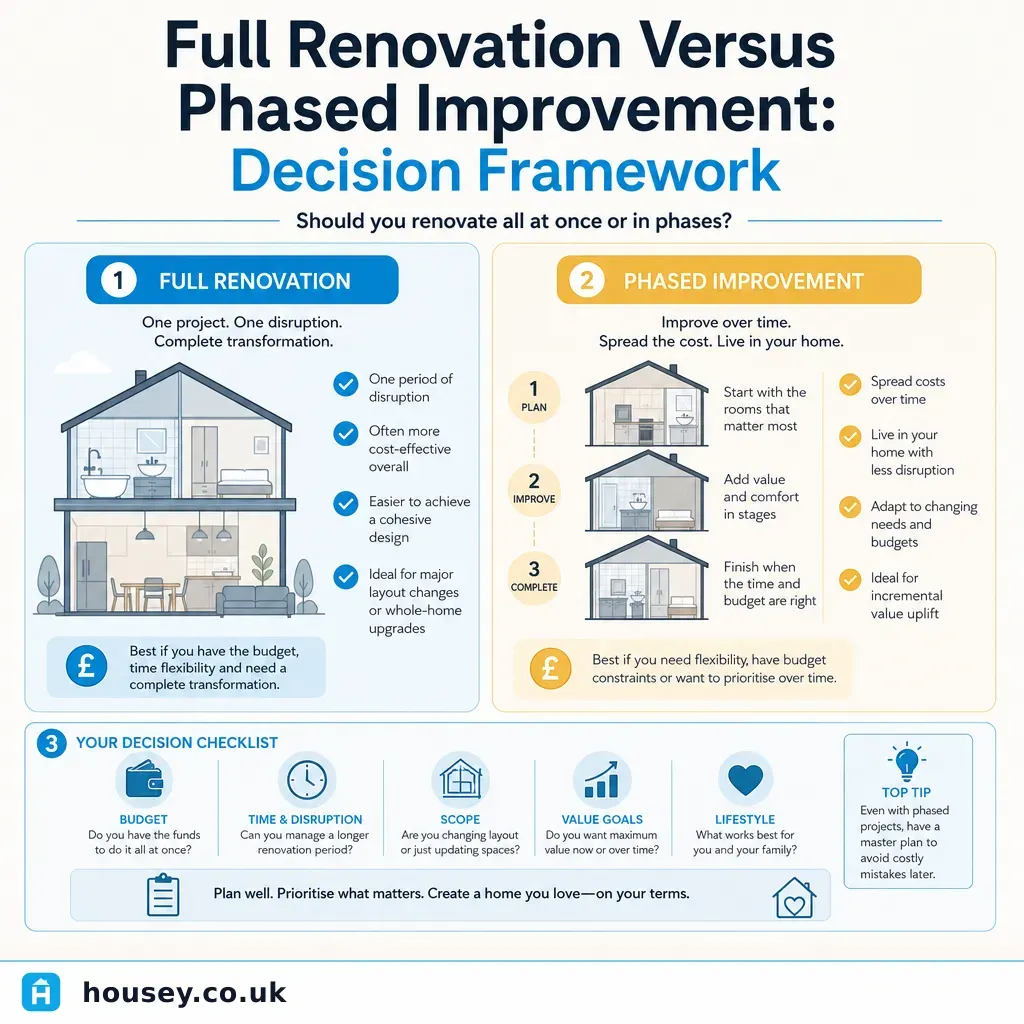
Full Renovation Versus Phased Improvement: Decision Framework
A full renovation suits properties needing comprehensive structural, thermal, or layout changes where repeated disruption would cost more than doing everything once.
 Improvement & Build
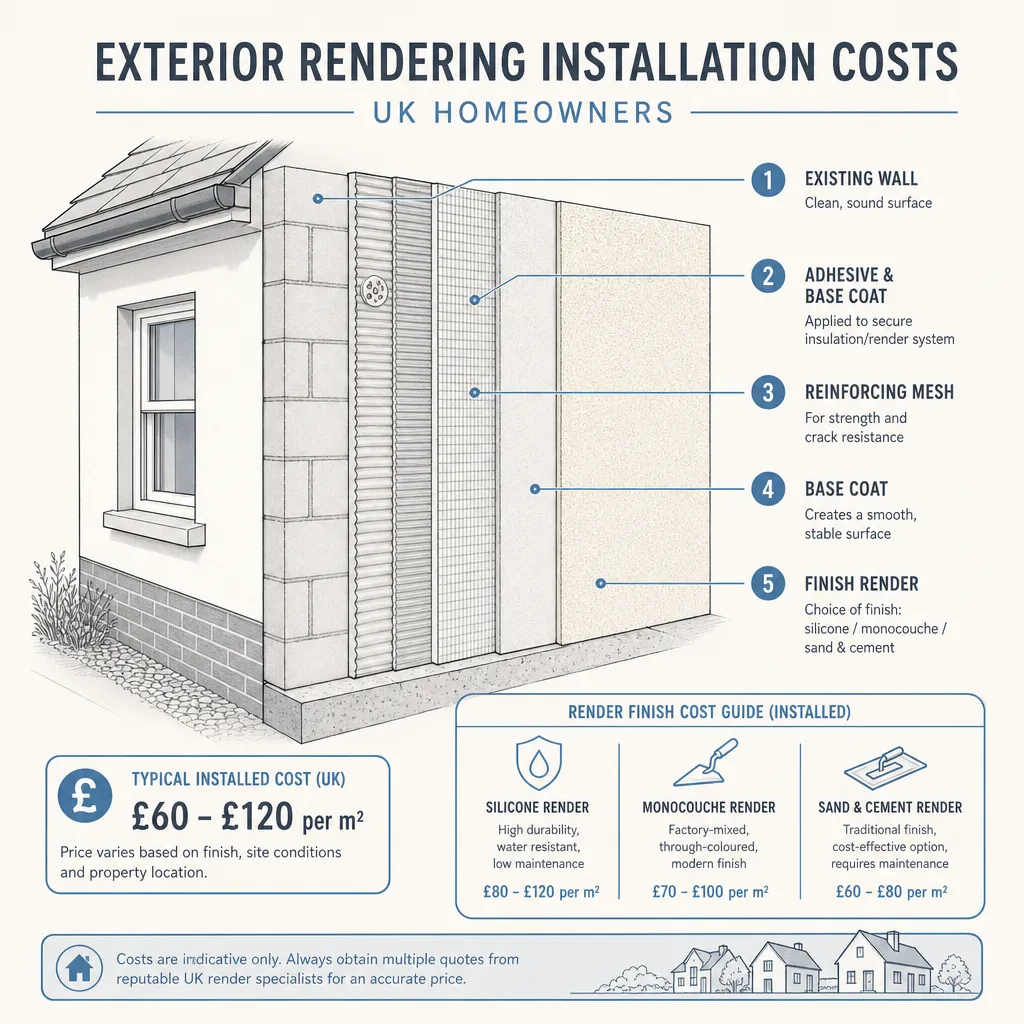
Exterior Rendering Installation Costs
Exterior rendering in the UK typically costs £20–£60 per square metre for standard render systems, or £80–£150 per square metre for External Wall Insulation with a render finish.
 Improvement & Build
Designing an outdoor kitchen for entertaining and garden living
An outdoor kitchen in a UK garden needs a stable, level base — typically a concrete slab or quality paving — with weather-rated materials such as stainless steel grade 316 or frost-rated porcelain.
 Improvement & Build
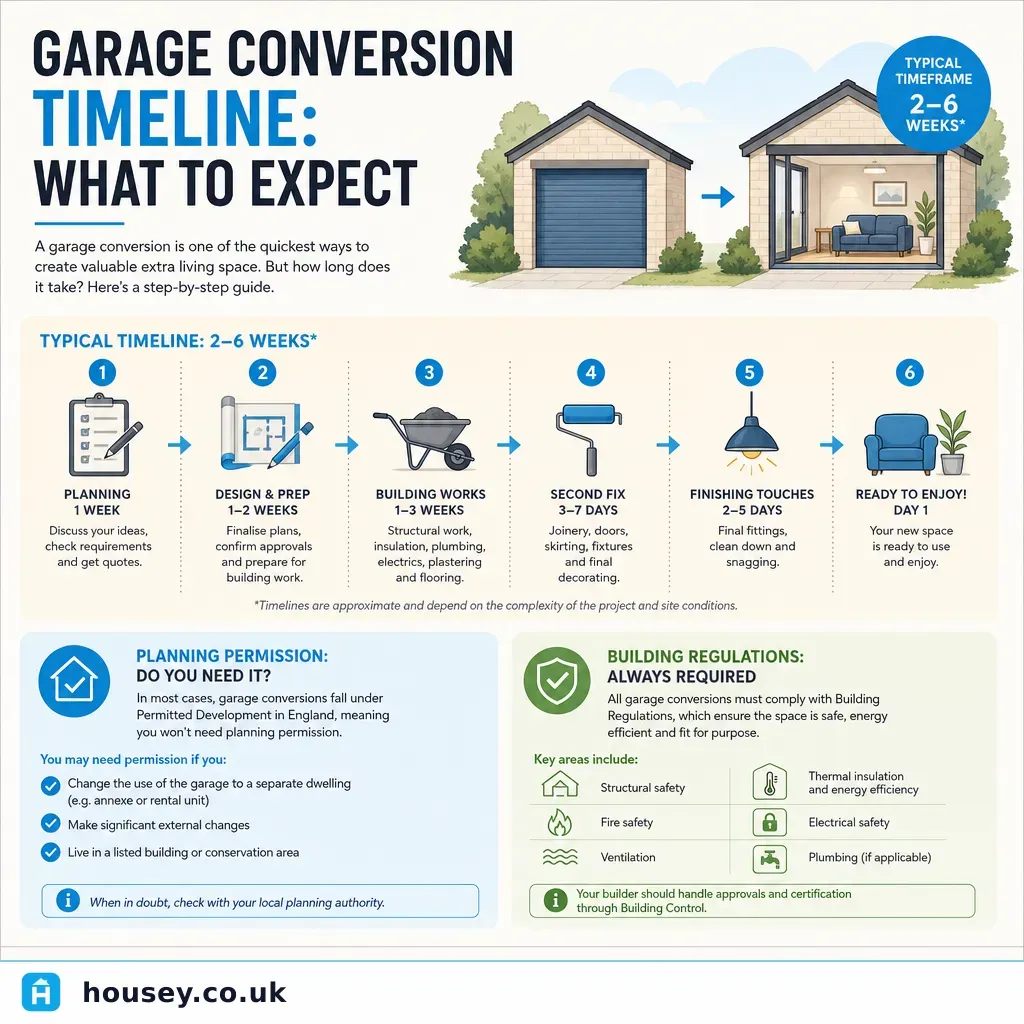
Garage Conversion Timeline: What to Expect
A straightforward attached garage conversion in England usually takes 4–8 weeks of construction, plus pre-start time for building control approval (5 working days for Full Plans).