Garage Door Blocking and Conversion Costs
By Housey · Last reviewed 6th of May 2026
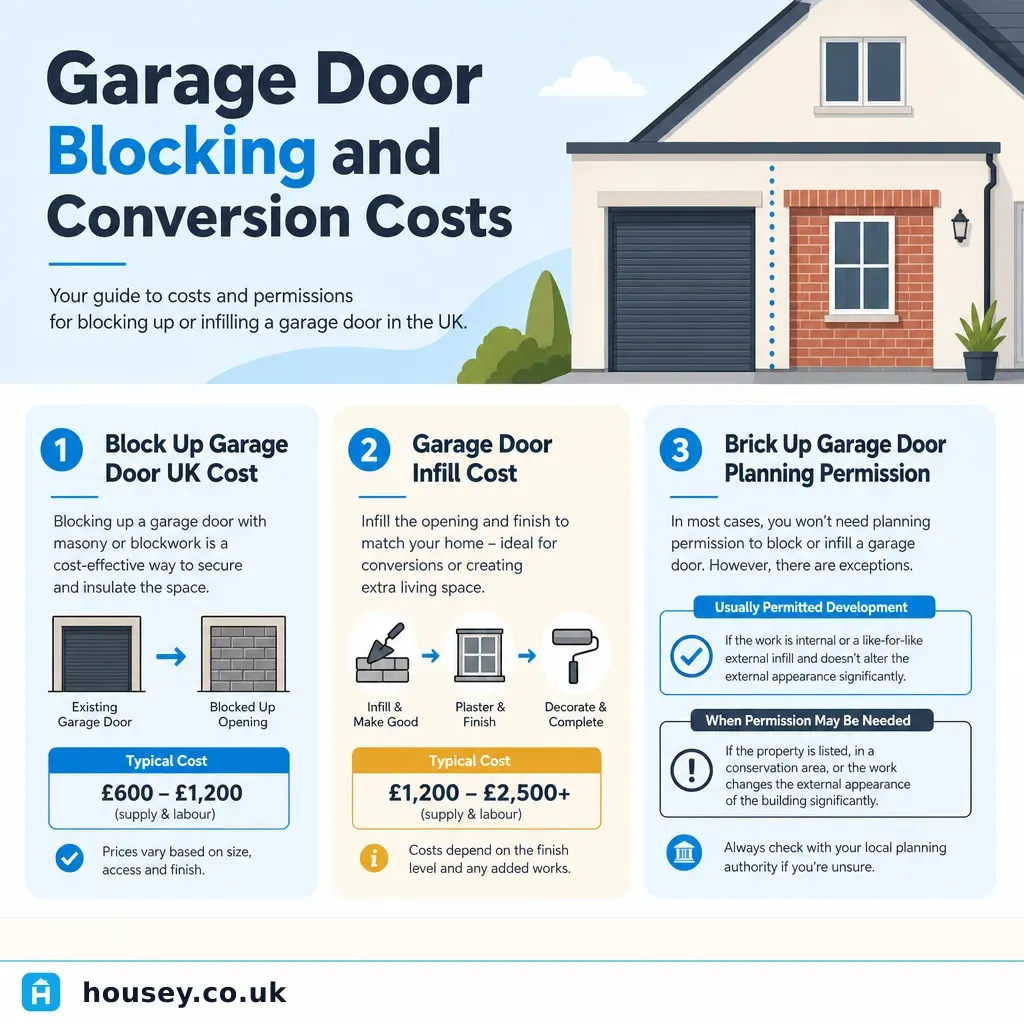
Garage Door Blocking and Conversion Costs
Blocking up a garage door comes up at various stages of homeownership — when converting a garage into a habitable room, bringing an integral garage under the main house footprint, or simply wanting to add usable wall space. Getting the scope and budget right before work begins avoids costly surprises, especially when building regulations or local planning rules apply.
Key points
- Building Regulations approval is required when blocking up a garage door as part of converting the space to habitable use — thermal performance, ventilation, and structural integrity must meet Approved Document Part L and Part F requirements.
- Most houses (excluding flats and listed buildings) can block up a garage door under permitted development rights without a planning application, but conservation areas and Article 4 Directions can remove that right.
- Indicative costs for a brick or block infill range from £800 to £3,000+, depending on opening size, chosen material, finish, and whether a window or door is added within the infill.
- The structural lintel above the opening must be assessed; if it is inadequate for the revised loading, a structural engineer will need to specify a replacement before work proceeds.
- FENSA or CERTASS registration is required if a new window is fitted as part of the infill, unless a local authority building control inspector approves the installation under the full plans or building notice route.
What does blocking up a garage door involve?
Blocking up a garage door means removing the door and its frame, then infilling the opening with masonry, a timber-framed panel, or another material to match or complement the existing wall. Most contractors follow this sequence:
- Remove the existing door, frame, and threshold.
- Build up the sill to the correct damp-proof course (DPC) level.
- Construct the infill — typically brick or blockwork, or a timber-framed panel with cladding.
- Tie the new masonry into the existing wall using wall ties or stitch bonding.
- Inspect and, if necessary, replace the lintel above the opening.
- Apply render, cladding, or pointing to match the existing facade.
- Fit any new window or door if included in the scope.
The work can usually be completed in one to three days by an experienced bricklayer or small building team.
How much does it cost to block up a garage door?
Costs vary significantly depending on material choice, opening width, and finish. The table below summarises the most common approaches.
Infill method | Typical cost (indicative, UK) | Best for | Main consideration |
|---|---|---|---|
Brick infill to match existing | £1,500–£3,000+ | Period or facing-brick houses | Matching brick can be costly; toothing-in requires skill |
Blockwork with external render | £800–£1,800 | Rendered or pebble-dashed properties | Fastest and most affordable option |
Timber-framed panel with cladding | £1,000–£2,500 | Modern or timber-clad homes | Lighter; suitable where lintel is marginal |
Infill plus new window | Add £400–£1,200 to above | Garage converted to habitable room | FENSA or CERTASS registration required |
Infill plus new part-glazed door | Add £800–£2,000 to above | Retaining side or front access | FENSA registration required for any glazed elements |
Indicative UK costs, last reviewed 2026-05-06. Quotes vary by region, property type, and specification. Always request at least three itemised quotes.
What drives the cost?
- Opening size. Standard single-garage doors are typically 2.1–2.4 m wide; double-garage doors can be 4.2–5 m wide, roughly doubling material and labour costs.
- Lintel condition. An inadequate or corroded lintel may need replacing — adding approximately £300–£1,500 depending on span and access.
- Brick matching. Sourcing reclaimed or close-match brick for a period property is often more expensive than buying new commons.
- Internal and external finish. Rendering, internal plastering, and repointing all affect the final cost.
- Building Regulations fees. A building notice or full plans application typically costs £100–£350 for a small domestic project, payable to your local authority building control (LABC) or an Approved Inspector.
Do you need planning permission or building regulations approval?
Planning permission
For most houses, blocking up a garage door falls under permitted development rights and does not require a planning application. You will likely need planning permission if:
- The property is in a conservation area or subject to an Article 4 Direction that removes permitted development rights for changes to the front elevation.
- The property is a listed building — listed building consent is required for any external alteration.
- The property is a flat — permitted development rights do not apply to flats.
- Your title deeds or a prior planning condition restricts external alterations.
Check with your local planning authority (LPA) before assuming permitted development applies. The Planning Portal's interactive house tool provides a general guide to what is and is not permitted.
Building regulations
Building Regulations approval is almost always required when blocking up a garage door as part of a habitable conversion. Even for a non-habitable block-up, approval is advisable where structural or thermal elements are affected. Relevant Approved Documents include:
- Part A (Structure): The infill must be structurally adequate and the lintel must safely span the opening.
- Part C (Dampness): The damp-proof course must be correctly continued into the new infill.
- Part L (Conservation of Fuel and Power): If the space is to be heated, the new wall must meet current U-value requirements under the 2021 Building Regulations.
- Part F (Ventilation): Adequate ventilation is required for any habitable room.
You can submit a building notice (allowing work to start quickly without full drawings) or a full plans application (requiring drawing approval before work begins). Your contractor or a structural engineer can advise on which route is appropriate.
Which approach is right for you?
- Converting to a habitable room (bedroom, study, playroom): Use brick or block infill with a window; comply with Parts A, C, L, and F; obtain Building Regulations approval; check planning if in a conservation area.
- Converting to a utility room or workshop (non-habitable): A basic infill is usually sufficient; Building Regulations advice is still recommended for structural and damp elements.
- Retaining some vehicle access: Consider a part-infill with a pedestrian door, but note that reducing off-street parking may require a planning application in areas where the LPA restricts this.
- Double garage, infilling one bay only: Requires careful structural detailing at the new internal pier; seek input from a builder or structural engineer before pricing the work.
Homeowner checklist before work starts
Red flags when comparing quotes
Watch out for these signs that a quote may be incomplete or the contractor inexperienced with regulated work:
- No mention of building regulations or lintel assessment anywhere in the quote.
- A contractor who cannot confirm whether planning permission applies to your property.
- No itemisation of materials versus labour costs.
- A notably low price that excludes the external finish, pointing, or internal plastering.
- No written schedule, no confirmation of waste disposal, or no mention of who manages the building control relationship.
Worked example: 1990s semi-detached with integral single garage
A homeowner in Leicester wants to block up the front-facing single-garage door (2.1 m wide) and convert the space into a home office. The house is not in a conservation area, so permitted development applies.
- Scope: Block infill with a UPVC casement window (900 × 1,050 mm), internal insulated dry-lining to meet Part L, new DPC tray, external render to match the existing pebble-dash finish.
- Indicative cost: £2,200–£3,500 all in, including the building control fee.
- Timeline: Two to three days on site; one building control inspection at practical completion.
- Key document obtained: Building Regulations completion certificate — important for any future sale or remortgage.
When to get professional help
For most straightforward infills, a competent bricklayer or small building team can manage the work. Seek specialist input if:
- The lintel is visibly corroded, cracked, deflecting, or of unknown specification.
- The property is listed or in a conservation area.
- The garage ceiling forms part of a structural floor or is adjacent to a party wall.
- Damp is already present around the existing door frame or threshold.
- The project involves electrical rewiring, new drainage, or a significant internal fit-out.
In these cases, a structural engineer may need to confirm the lintel specification before work proceeds, and a building control surveyor will inspect at key stages.
How Housey can help
Housey connects homeowners with trusted garage conversion specialists and extension builders who are familiar with building regulations, planning rules, and the structural detailing required for a compliant infill. Request quotes and compare proposals in one place.
Frequently asked questions
Do I always need building regulations approval to block up a garage door?
If the garage is being converted to habitable use, building regulations approval is required. For a simple block-up where the space remains unheated storage, approval may still be advisable — particularly for the structural and damp elements. Contact your local authority building control to confirm before starting work.
How long does it take to block up a garage door?
Most single-garage infills take one to three days on site, excluding drying time for render or mortar and any building control inspections. More complex projects involving a double garage, brick matching, or a window installation may take longer.
Will blocking up my garage door affect my property's value?
Blocking up a garage door and converting the space to habitable use can add usable square footage, which may increase value. However, losing off-street parking in areas where parking is scarce can offset this. A local estate agent or RICS-registered valuer can advise on the likely impact for your specific property and location.
Do I need a FENSA certificate if I add a window to the infill?
Yes. If a new window is installed, the installer must be registered with FENSA or CERTASS (or an equivalent competent person scheme), or the installation must be covered by building control approval. Without this, the installation may flag as a compliance issue when you come to sell.
What is the difference between a building notice and a full plans application?
A building notice allows work to proceed quickly without submitting full drawings upfront; the building control officer inspects at stages during construction. A full plans application requires drawings to be approved before work begins, giving greater certainty and a formal approval notice — often preferred by mortgage lenders. Both result in a completion certificate on satisfactory completion.
Sources and further reading
- Permitted development rights for householders — Planning Portal
- Building Regulations Approved Document A (Structure) — GOV.UK
- Building Regulations Approved Document L (Conservation of Fuel and Power) — GOV.UK
- Building Regulations Approved Document C (Site Preparation and Resistance to Contaminants and Moisture) — GOV.UK
- What is FENSA? — FENSA
Useful next reads
 Improvement & Build
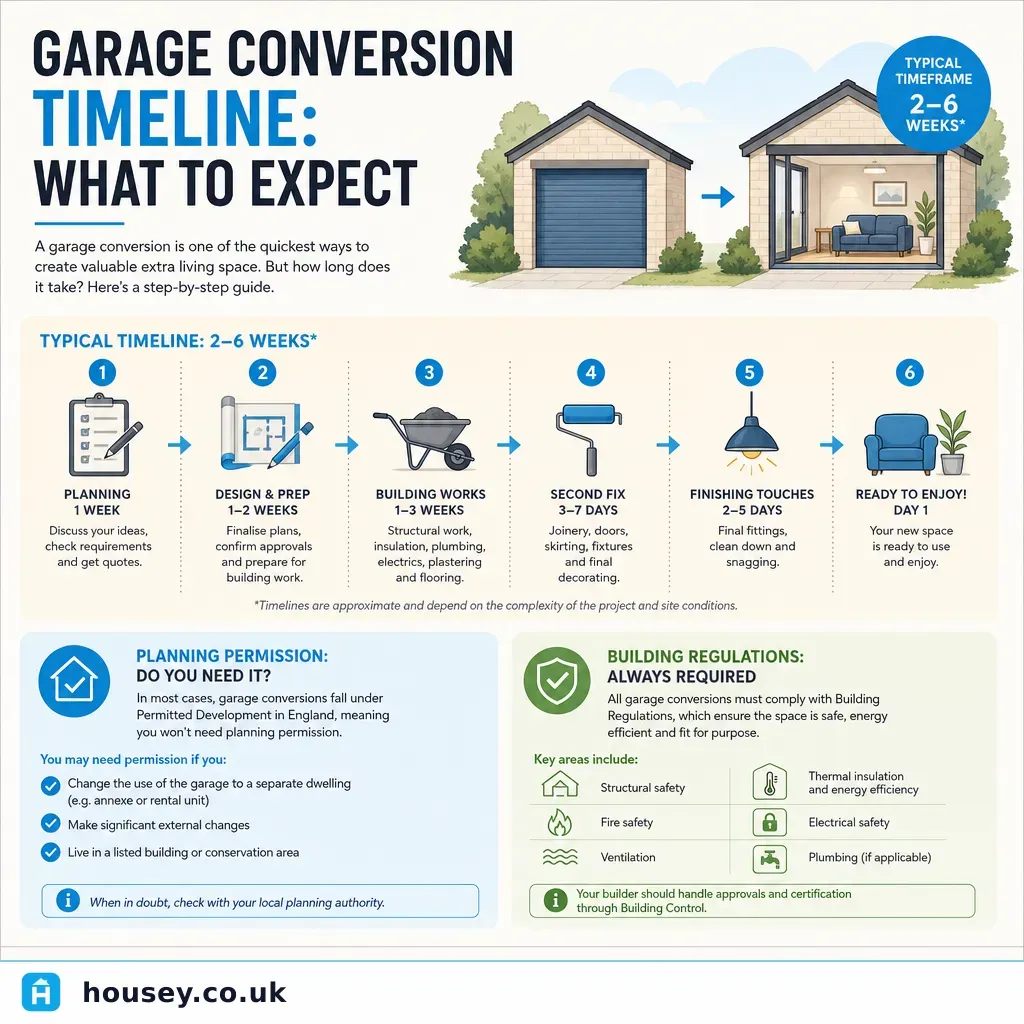
Garage Conversion Timeline: What to Expect
A straightforward attached garage conversion in England usually takes 4–8 weeks of construction, plus pre-start time for building control approval (5 working days for Full Plans).
 Improvement & Build
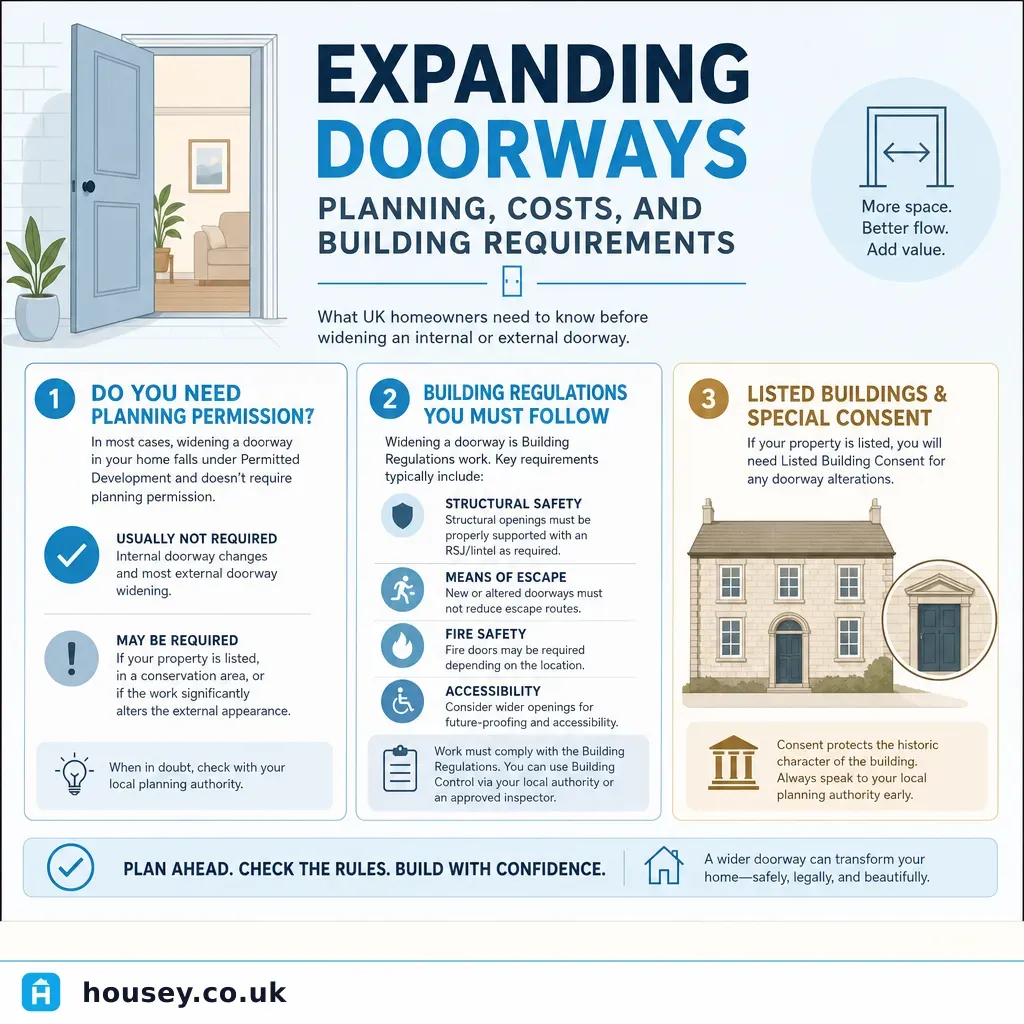
Expanding Doorways: Planning, Costs, and Building Requirements
Expanding a doorway in a load-bearing wall requires Building Regulations Part A approval and a structural engineer's lintel design.
 Improvement & Build
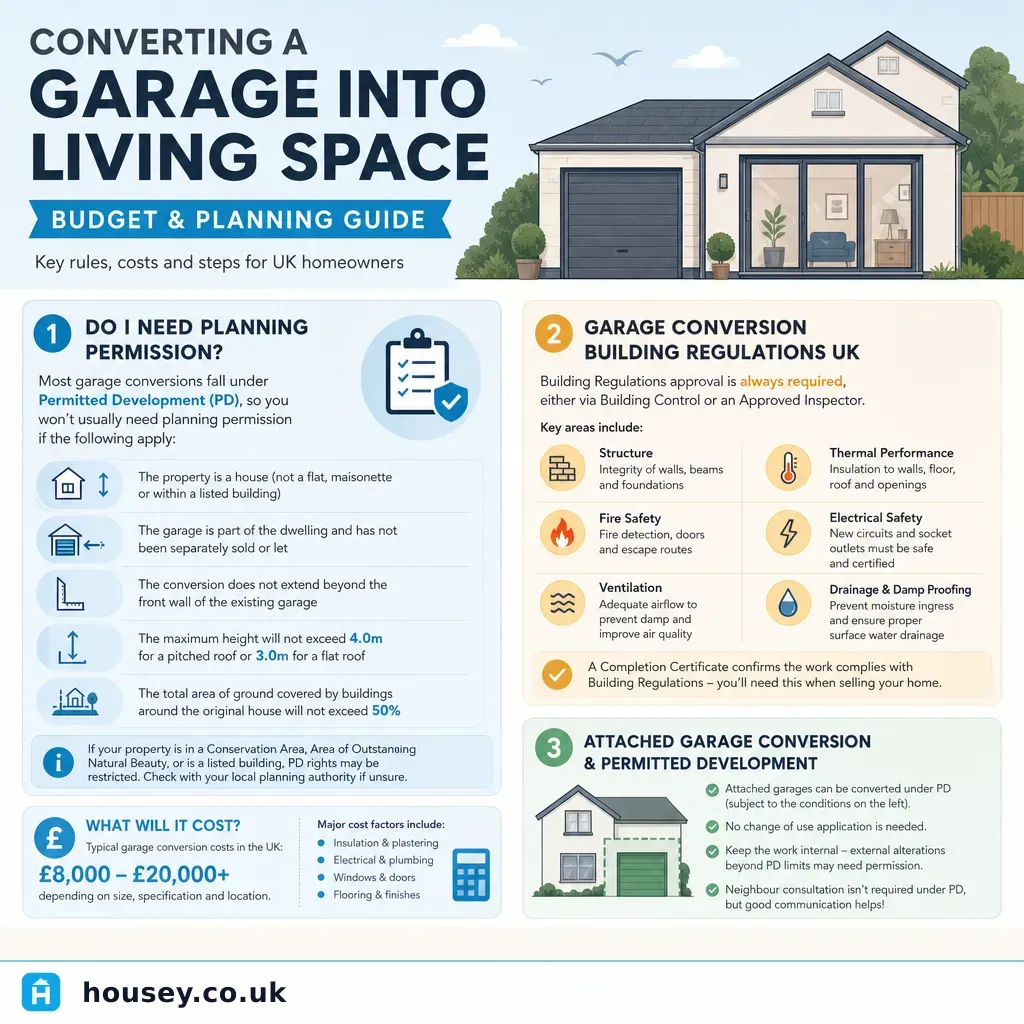
Converting a Garage into Living Space: Budget and Planning Guide
A single-garage conversion typically costs £8,000–£20,000 in the UK.
 Improvement & Build
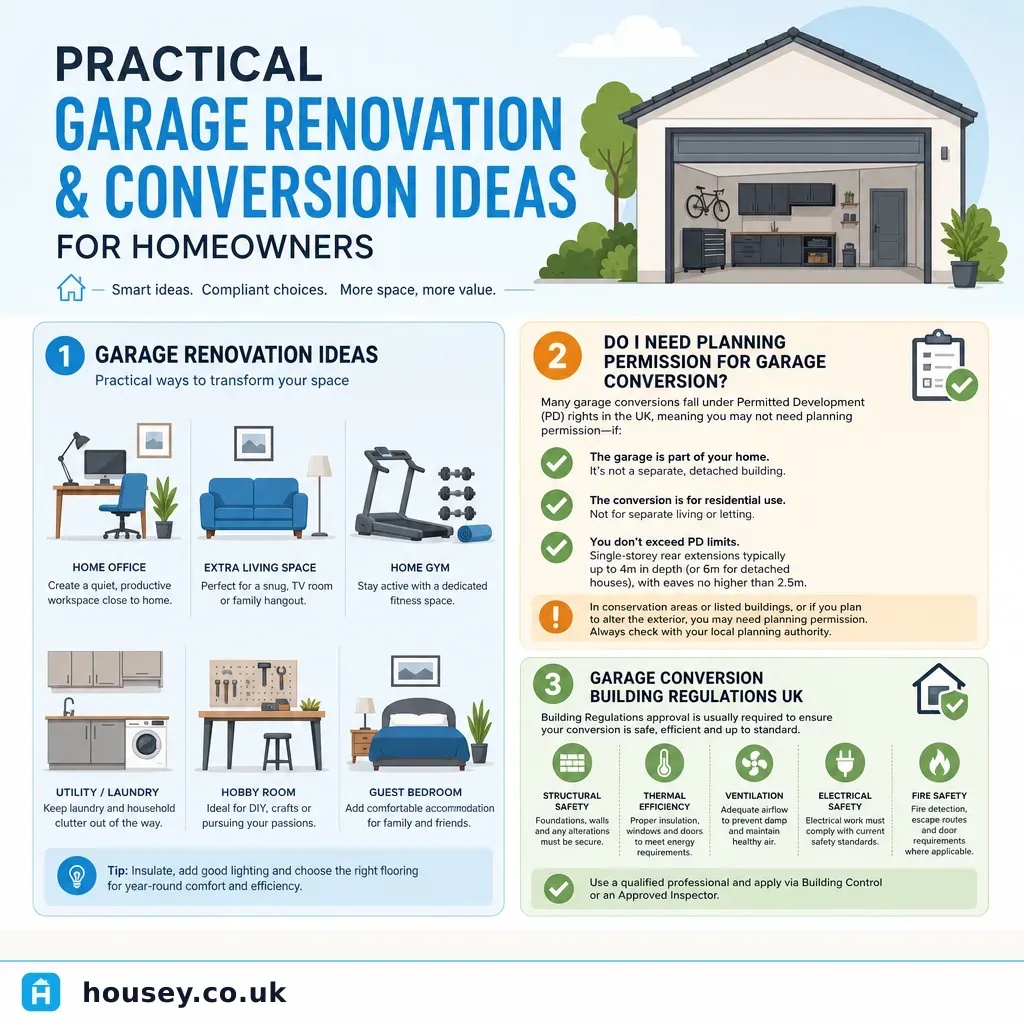
Practical Garage Renovation and Conversion Ideas for Homeowners
A full garage conversion to habitable use almost always requires Building Regulations approval in the UK, even if planning permission is not needed.
 Improvement & Build
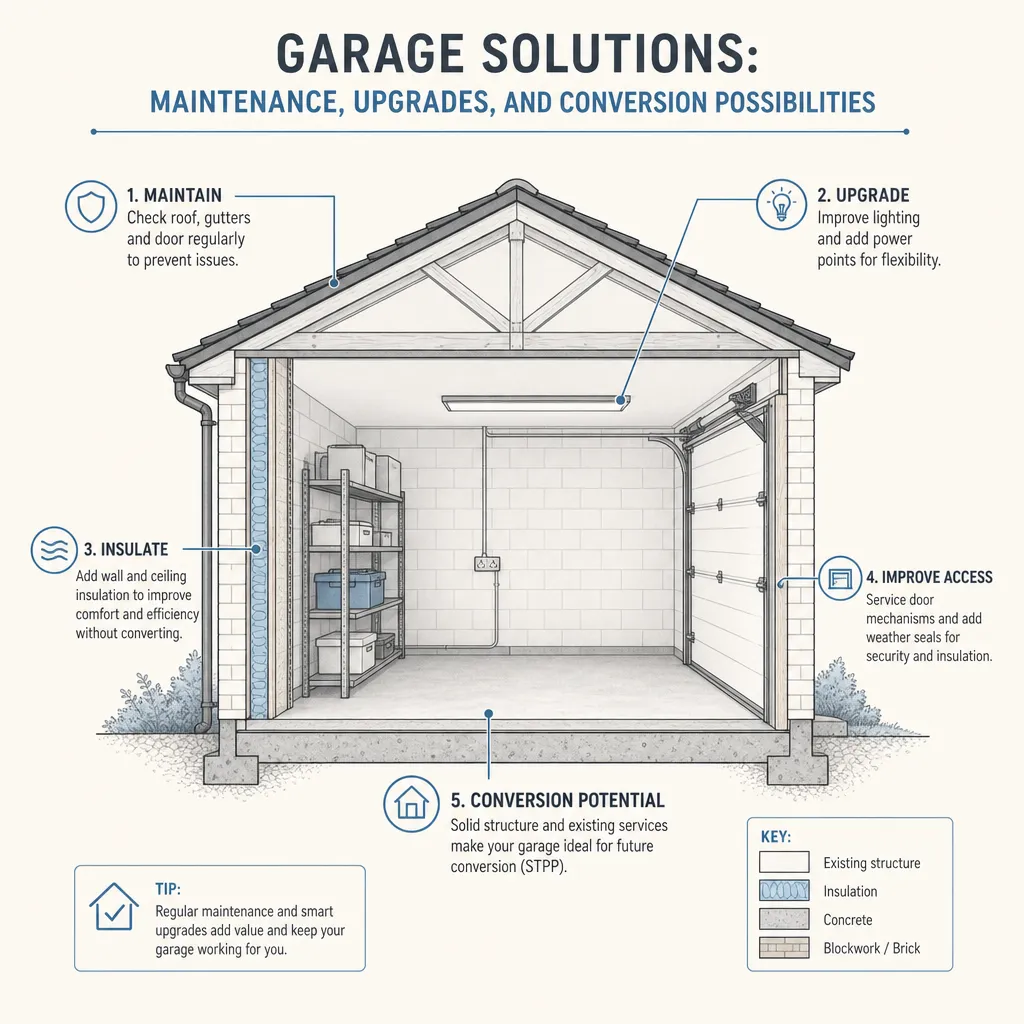
Garage Solutions: Maintenance, Upgrades, and Conversion Possibilities
Your garage can serve many functions — storage, workshop, hobby space, or a full habitable room conversion.