Garage Door Installation and Repair: A UK Homeowner's Guide
By Housey · Last reviewed 31st of May 2026
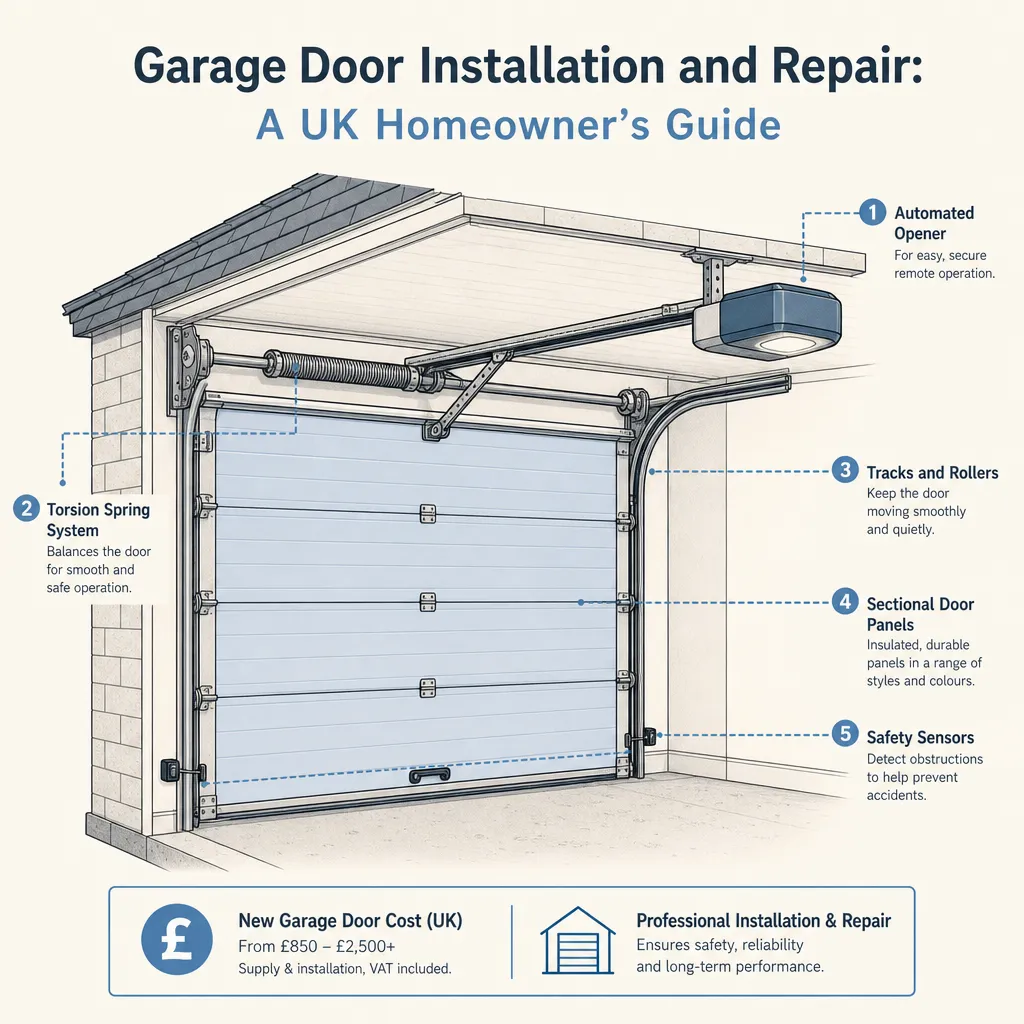
Garage Door Installation and Repair: A UK Homeowner's Guide
Garage doors are among the hardest-working components of any home — opened and closed hundreds of times each year, exposed to weather, and vulnerable to impact damage. Questions about installation arise when an existing door reaches the end of its life, a garage conversion is being reversed, or a new extension with an integral garage is nearing completion. Repair queries most commonly follow a sudden failure: a door stuck mid-travel, a motor that will not respond, or the tell-tale bang of a broken spring.
Key points
- Five door types dominate the UK residential market: up-and-over (canopy and retractable variants), roller, sectional, and side-hinged — each with different headroom, driveway space, and automation requirements.
- Automated garage doors must comply with BS EN 13241 (product standard) and BS EN 12453 (force limitation and safety in use); installers are required to provide a Declaration of Conformity on completion.
- Torsion springs — used on roller and most sectional doors — store extreme mechanical energy; broken torsion spring replacement must only be carried out by a trained engineer.
- If the garage is integral to the house (sharing a wall or ceiling with the habitable space), Building Regulations Parts B (fire separation) and L (thermal performance) may apply when the door or structure is altered.
- Indicative UK supply-and-fit costs range from approximately £500 for a basic manual up-and-over to over £2,500 for an insulated, automated sectional door; quotes vary by size, material, and specification (Indicative UK costs, last reviewed 2026-05-31).
Choosing the right garage door type
The door type determines headroom requirements, how much driveway space is used when opening, insulation performance, and how easily the door can be automated. The table below compares the five main options.
Door type | Operation | Best for | Not ideal for | Automation |
|---|---|---|---|---|
Up-and-over (canopy) | Swings outward and up; panel partially protrudes | Low-cost replacement, standard openings | Short driveways — door protrudes ~300 mm on opening | Limited |
Up-and-over (retractable) | Panel retracts fully into the garage | Better automation fit, longer driveways | Lower headroom garages | Common |
Roller | Coils into a compact drum above the opening | Maximum headroom, flush opening | Spring tension critical — failure risk higher | Very common |
Sectional | Horizontal panels rise vertically on tracks | Flush with garage front, good insulation | Requires 100–200 mm clearance above lintel | Very common |
Side-hinged | Traditional hinged panels swing outward | Period properties, frequent pedestrian use | Needs clear space on both sides of opening | Less common |
Materials at a glance
Steel and GRP (glass-reinforced plastic) dominate residential installation because of their low maintenance and weather resistance. Timber suits period and rural homes but requires periodic painting or treating. Insulated steel or GRP sectional and roller doors deliver the strongest thermal performance — important where the garage adjoins a heated space.
Common garage door repairs
Broken springs
Spring failure is the most frequent cause of a suddenly immovable door. Up-and-over doors usually use extension springs along each side of the door; roller and sectional doors use a single torsion spring across the top of the opening. Extension springs can be replaced by a competent engineer using appropriate tools and safety procedures. Torsion springs store extreme mechanical energy and must only be handled by a trained specialist — do not attempt to release, wind, or replace them yourself.
Cable and drum failures
Cables balance the door weight and guide its travel. Frayed or snapped cables cause the door to drop unevenly, jam, or create an uneven gap at the base. Cables are usually replaced as a pair rather than individually.
Motor and automation faults
Automated door faults commonly involve the drive unit, remote receiver, safety beam, or limit switches. Most are electrical rather than mechanical. The original installer or an authorised service engineer is the best first point of contact.
Panel damage
Sectional doors allow individual damaged panels to be replaced without changing the full door — useful after a vehicle impact. Check whether the damaged panel is a standard dimension before accepting a full-door replacement quote.
Finding a competent installer or repair engineer
Garage door installation is not covered by a statutory competent person scheme in the same way as gas (Gas Safe Register) or certain electrical work, but there are reliable quality indicators.
What to look for
- AGD membership: The Association of Garage Door Specialists (AGD) is the principal UK trade body; members follow a code of practice.
- Manufacturer accreditation: Major manufacturers including Hormann, Garador, SWS, and Carteck operate authorised installer networks with product-specific training.
- Declaration of Conformity: Required for automated doors under UK Machinery Regulations; the installer should provide this document on completion.
- Public liability insurance: Ask for evidence of cover before agreeing to any work.
- Written quotation: Insist on a detailed written quote covering supply, installation, removal and disposal of the old door, and any associated electrical work.
What to ask before accepting a quote
- Does the price cover supply, installation, and removal of the old door — and is VAT included?
- For insulated doors: what is the U-value, and is it appropriate for an integral garage?
- For automated doors: does the installation comply with BS EN 13241 and BS EN 12453, and will you provide a Declaration of Conformity?
- Who will carry out the installation — your own employed engineers or subcontractors?
- What warranties apply to the door, the frame, and the automation unit separately?
- What is your process if the lintel, frame, or masonry is found to need additional work on the day?
When to get professional help
Most garage door repairs should go to a specialist rather than a general tradesperson. Seek qualified help immediately if:
- A torsion spring has snapped or you hear unusual cracking sounds from the spring mechanism.
- The door has dropped suddenly, is off its tracks, or the cables appear frayed.
- An automated door does not stop when it meets an obstruction — this may indicate a safety beam or force-limitation fault that does not comply with BS EN 12453.
- The lintel above the opening shows cracking, deflection, or visible movement.
- The garage is integral to your home and you are uncertain whether fire separation and insulation still meet Building Regulations after any alterations.
How Housey can help
Housey connects UK homeowners with vetted local specialists for garage door installation and repair. Describe your job, receive quotes from experienced contractors in your area, and compare credentials — all in one place.
Frequently asked questions
Do I need planning permission to replace a garage door in the UK?
Usually no — replacing a like-for-like garage door is typically permitted development in England. In conservation areas or for listed buildings, permitted development rights may be restricted and planning permission could be required. Check with your local planning authority before ordering a new door if your property is in a designated area.
Is a FENSA certificate required for a new garage door?
No. FENSA and CERTASS certification applies only to windows and external doors forming part of the dwelling's thermal envelope — typically entrance, back, and patio doors. Garage doors fall under a separate regulatory framework and do not require FENSA certification.
How long does a garage door installation take?
A straightforward like-for-like replacement typically takes four to eight hours. Structural repairs to the frame or lintel, or new automation wiring, may extend the job. A specialist should survey the opening before confirming a schedule.
Can an existing manual garage door be automated?
In many cases, yes. Retractable up-and-over and sectional doors are most easily automated. Older canopy-action doors may require a compatible retrofit kit or a full door replacement. A specialist can assess compatibility at the survey stage and advise on the most cost-effective approach.
Sources and further reading
- Approved Documents — Building Regulations — Part B (fire) and Part L (thermal) for integral garages — GOV.UK
- UK Machinery Regulations guidance — post-Brexit machinery safety compliance for automated doors — HSE
- Association of Garage Door Specialists (AGD) — UK trade body, code of practice and member search — AGD
- BSI Standards — BS EN 13241 and BS EN 12453 — automated door product and safety standards — BSI Group
Useful next reads
 Improvement & Build
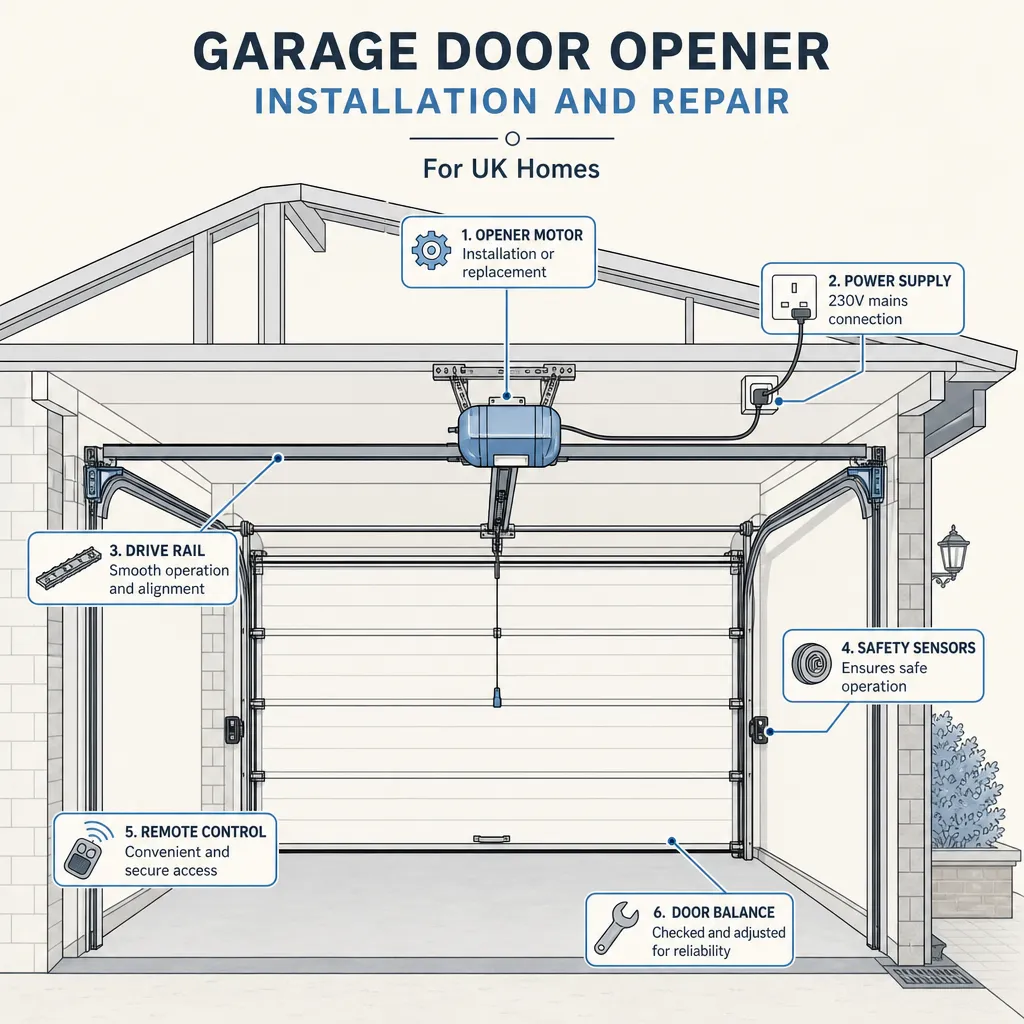
Garage Door Opener Installation and Repair
A garage door opener automates raising and lowering a garage door via an electric motor, drive rail, and remote or keypad control.
 Improvement & Build
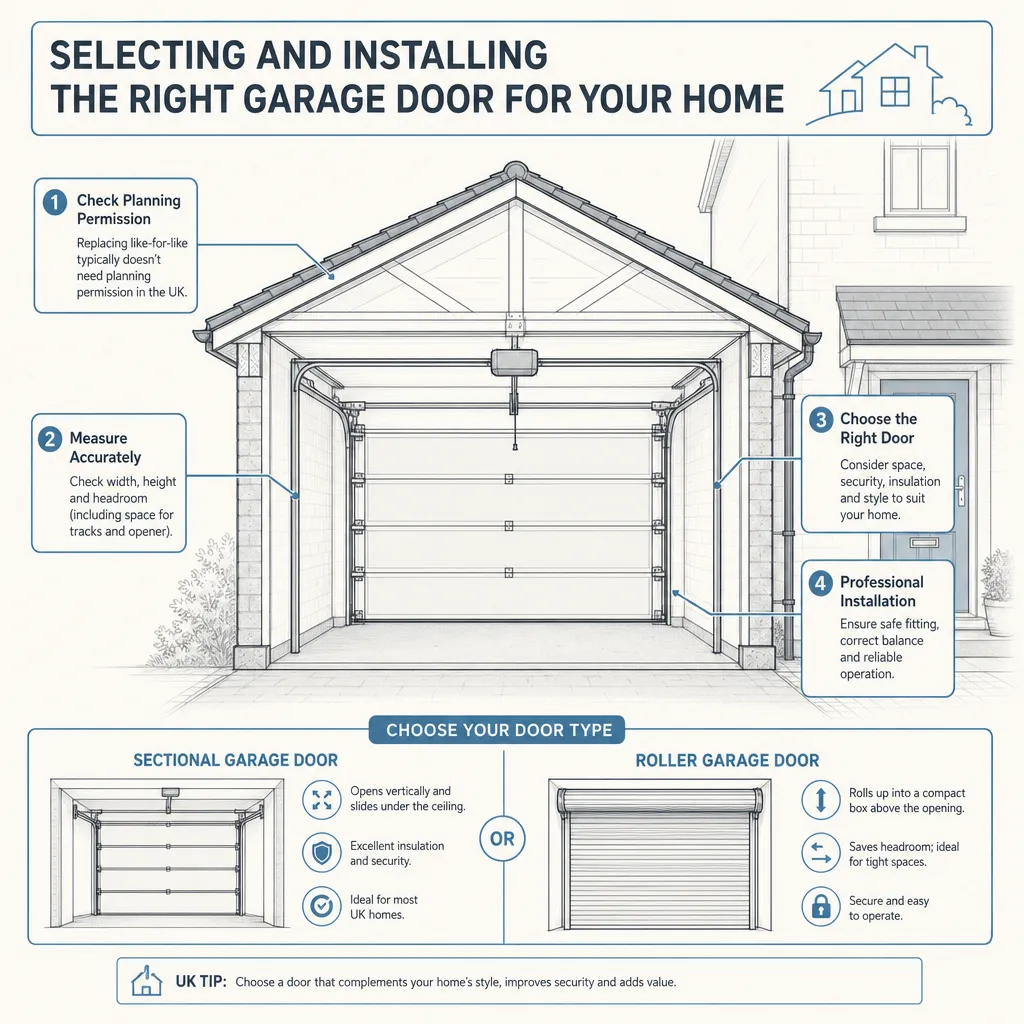
Selecting and Installing the Right Garage Door for Your Home
Choosing the right garage door depends on available headroom, opening width, security needs, and budget.
 Improvement & Build
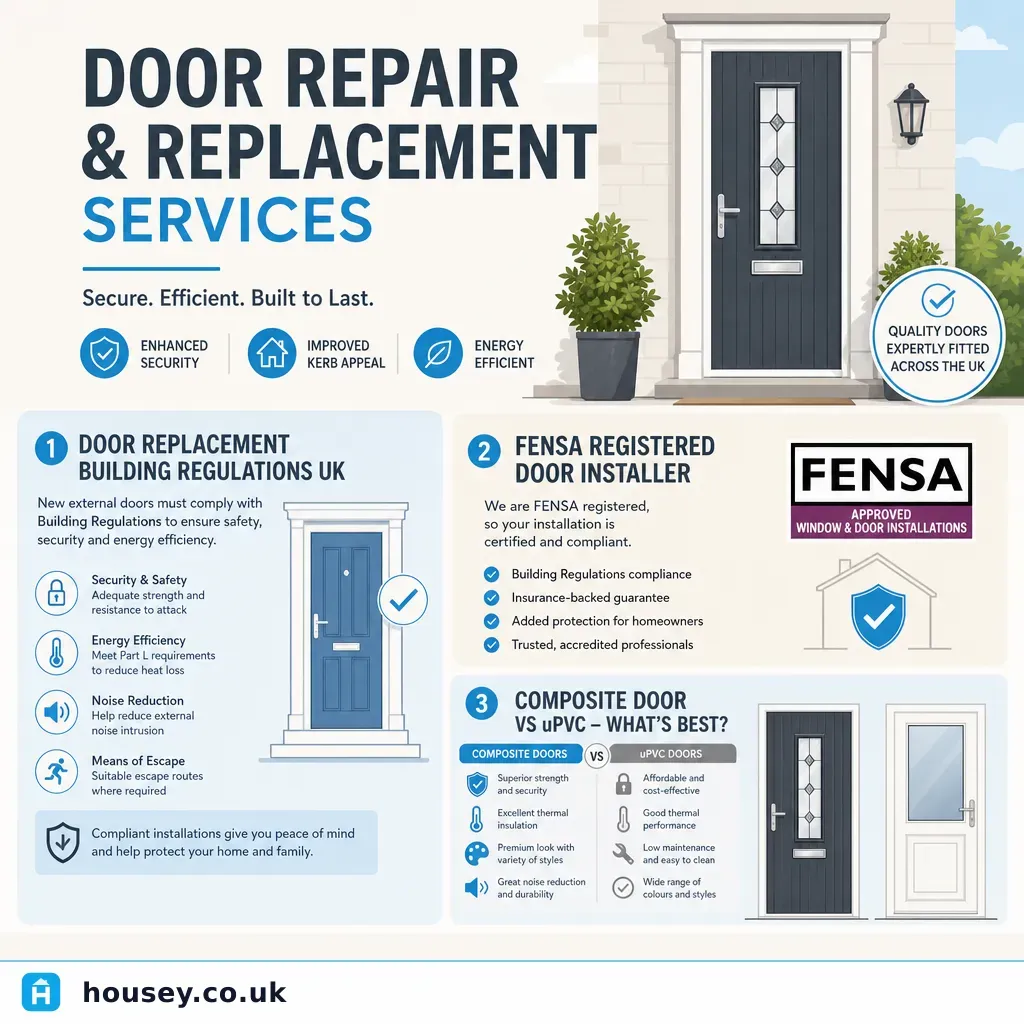
Door Repair and Replacement Services
For most UK homes, door repair is cost-effective when the frame is sound and the fault is mechanical.
 Improvement & Build
Fixing Leaking Back Doors and Water Ingress
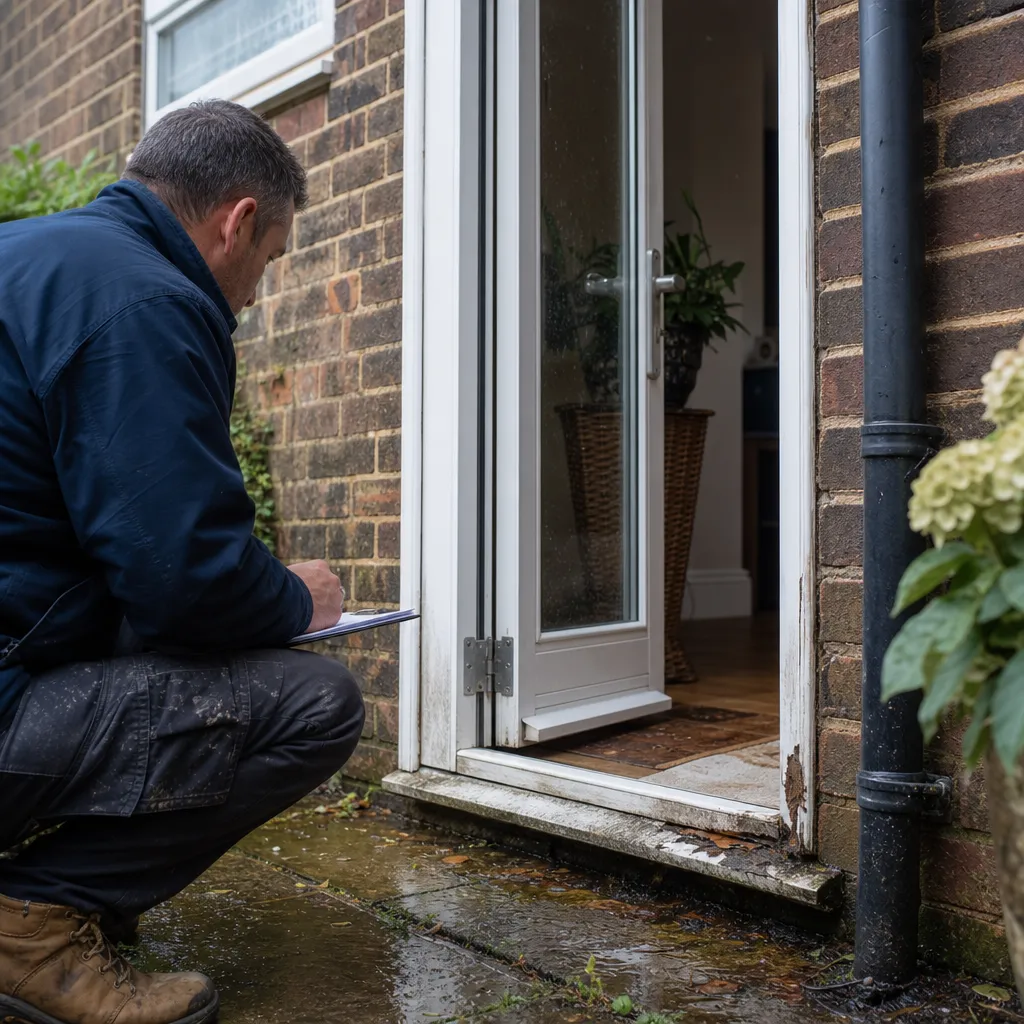
Most leaking back doors in UK homes fail at one of three points: the threshold or door sill joint, the frame-to-masonry mastic seal, or the door weatherstrip.
 Improvement & Build
Who Provides House Demolition Services
House demolition in the UK is carried out by specialist demolition contractors, often members of the National Federation of Demolition Contractors (NFDC).