Is Your Garage Door Safe? Safety Checks and Maintenance
By Housey · Last reviewed 31st of May 2026
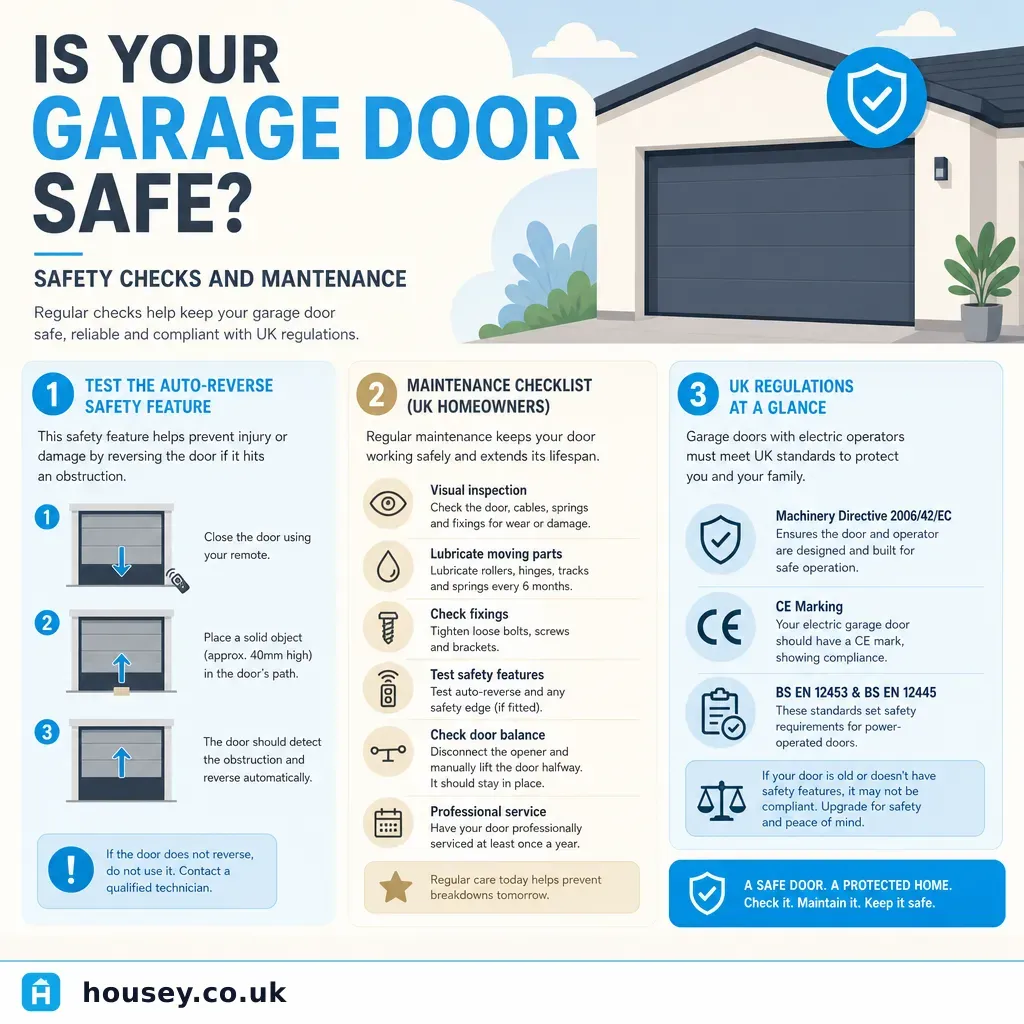
Is Your Garage Door Safe? Safety Checks and Maintenance
Garage doors are often the largest moving part of a UK home and, when correctly maintained, are reliable for decades. However, a door that has not been serviced in years — or one that was poorly installed — can pose real risks: crush injuries, snapped springs under extreme tension, and automatic mechanisms that fail to reverse on contact with an obstruction. This is a particular concern for households with children, and for older up-and-over models where the counterbalance mechanism deteriorates over time. Understanding what to check, how often, and when to call a qualified technician is straightforward once you know what to look for.
Key points
- Powered garage doors in the UK must incorporate automatic reversal and safety sensing features under the Supply of Machinery (Safety) Regulations 2008, which implemented the EU Machinery Directive and was retained in UK law after Brexit.
- Torsion springs above the door and extension springs along the sides store substantial mechanical energy — their adjustment or replacement must only be carried out by a trained technician and is never a safe DIY task.
- The Door and Hardware Federation (DHF) recommends annual professional servicing for automated garage doors; manual doors with spring mechanisms benefit from professional inspection every one to two years.
- BS EN 13241 is the harmonised standard covering industrial, commercial, and garage doors in the UK, setting performance requirements including mechanical endurance, wind resistance, and thermal properties.
- New or replacement garage doors installed in dwellings must comply with Building Regulations Approved Document Q, which sets minimum requirements for resistance to manual attack.
How automatic garage door safety systems work
Modern powered doors must incorporate several safety features under the Supply of Machinery (Safety) Regulations 2008:
Auto-reverse: the door must automatically reverse direction if it encounters an obstruction while closing. The standard homeowner test is to place a 50mm x 50mm piece of timber flat on the ground in the door's path — the door must reverse on contact without requiring the obstruction to be held in place. If it does not reverse, the sensitivity requires adjustment; do not continue using the automatic function until a technician has rectified the fault.
Photocell (infrared) sensors: a beam across the opening triggers reversal if broken while the door is closing. Check that sensors are clean, undamaged, and correctly aligned. Test by waving your hand through the beam during closing — the door should reverse immediately.
Manual release: all automatic doors must have an emergency manual release, typically a cord or handle visible inside the garage, for use during power cuts or motor failure. Test this at least once a year.
Edge pressure switches: some older roller and sectional doors use contact-sensitive bottom edges rather than photocells. Test these using the timber block method described above.
Annual maintenance checklist for UK homeowners
Carry out these checks every 6 to 12 months and note the date for your records.
Visual inspection
Lubrication
Safety tests (automatic doors only)
Weather and security
Which garage door type and what to watch for
Door type | Common UK use | Main maintenance concern | Safe for homeowner DIY? | Recommended service interval |
|---|---|---|---|---|
Up-and-over (canopy or retractable) | Older homes and detached garages | Counterbalance spring wear; alignment drift | Visual checks and lubrication only | Every 1–2 years |
Sectional (overhead panels) | Modern homes; automated installations | Roller and hinge wear; cable tension | Visual checks and lubrication only | Annually |
Roller (coiling) | Restricted headroom situations | Spring condition; slat integrity | Visual checks and lubrication only | Annually |
Side-hinged | Traditional detached garages | Hinge and frame condition; weatherstripping | Full homeowner inspection feasible | Every 1–2 years |
Automated (any type) | Increasingly standard in new builds | Safety sensor alignment; auto-reverse function | Safety tests only; springs strictly off-limits | Annually (minimum) |
Red flags: when to stop using the door immediately
Stop using the door and contact a qualified garage door technician without delay if you notice any of the following:
- A loud bang or crack — this often indicates a snapped torsion or extension spring. A broken spring retains residual tension and can cause serious injury if the door is operated; do not use the door until the spring is professionally replaced.
- The door has suddenly become significantly heavier to lift manually than usual.
- Cables are visibly frayed, kinked, or have come off their drums.
- The automatic door fails the auto-reverse test — it does not reverse when the timber block is placed beneath it.
- The door drops quickly when released during manual operation, suggesting counterbalance failure.
- Rollers are visible outside their track, or the door sits visibly crooked in the frame.
- A burning or electrical smell from the motor unit.
- Growing gaps at the door frame — this may indicate lintel deflection or structural movement requiring separate investigation.
When to get professional help
Annual servicing by a DHF-member technician or a manufacturer-authorised engineer is the safest approach for any automated door. For manual doors with spring mechanisms, professional inspection every one to two years is recommended.
Never attempt to adjust or replace torsion or extension springs yourself — these store an enormous amount of energy and can cause severe or fatal injury if released suddenly. This applies even if you are confident with general DIY tasks.
If you are planning a garage conversion and need to remove the door and make good the opening, building control consent is likely required under Building Regulations for the structural alteration and for meeting thermal performance requirements under Part L.
How Housey can help
If your plans extend beyond door maintenance into a full garage conversion or structural alteration, Housey can connect you with experienced extension builders who understand building control requirements, structural considerations, and thermal performance obligations under Building Regulations.
Frequently asked questions
How do I test whether my automatic garage door is safe?
Place a 50mm x 50mm piece of timber flat on the floor in the path of a closing automatic door. The door must reverse on contact — if it does not, stop using the automatic function and arrange a service. Also wave your hand through the photocell (infrared) beam while the door is closing; the door must reverse. If either test fails, a qualified technician should adjust or repair the system before you use it again.
How often should a garage door be professionally serviced?
For automatic (powered) doors, annual servicing is recommended by the Door and Hardware Federation and most manufacturers. For manual doors with torsion or extension spring mechanisms, professional inspection every one to two years is sensible. More frequent checks are advisable if the door is used heavily — multiple times a day — or if you notice any change in operation, weight, or alignment.
Can I replace a broken garage door spring myself?
No. Torsion springs and extension springs are under extreme mechanical tension. Replacing or adjusting them without specialist tools and proper training risks severe injury. The energy stored in a snapped spring releases suddenly and without warning. Always use a qualified garage door technician — ideally a member of the Door and Hardware Federation — for any spring replacement or adjustment work.
Do UK garage doors have to meet specific regulations?
Yes. Powered garage doors must comply with the Supply of Machinery (Safety) Regulations 2008, requiring automatic reversal and an emergency manual release. New-build and replacement doors in domestic dwellings must comply with Building Regulations Approved Document Q (security). The harmonised standard BS EN 13241 covers performance and safety requirements for commercial and garage doors. Doors predating these regulations should be assessed by a qualified technician.
Sources and further reading
- Supply of Machinery (Safety) Regulations 2008 — legislation.gov.uk
- Approved Document Q: Security — dwellings — GOV.UK
- Door and Hardware Federation — Door and Hardware Federation
- Building Regulations approval — GOV.UK
Useful next reads
 Improvement & Build
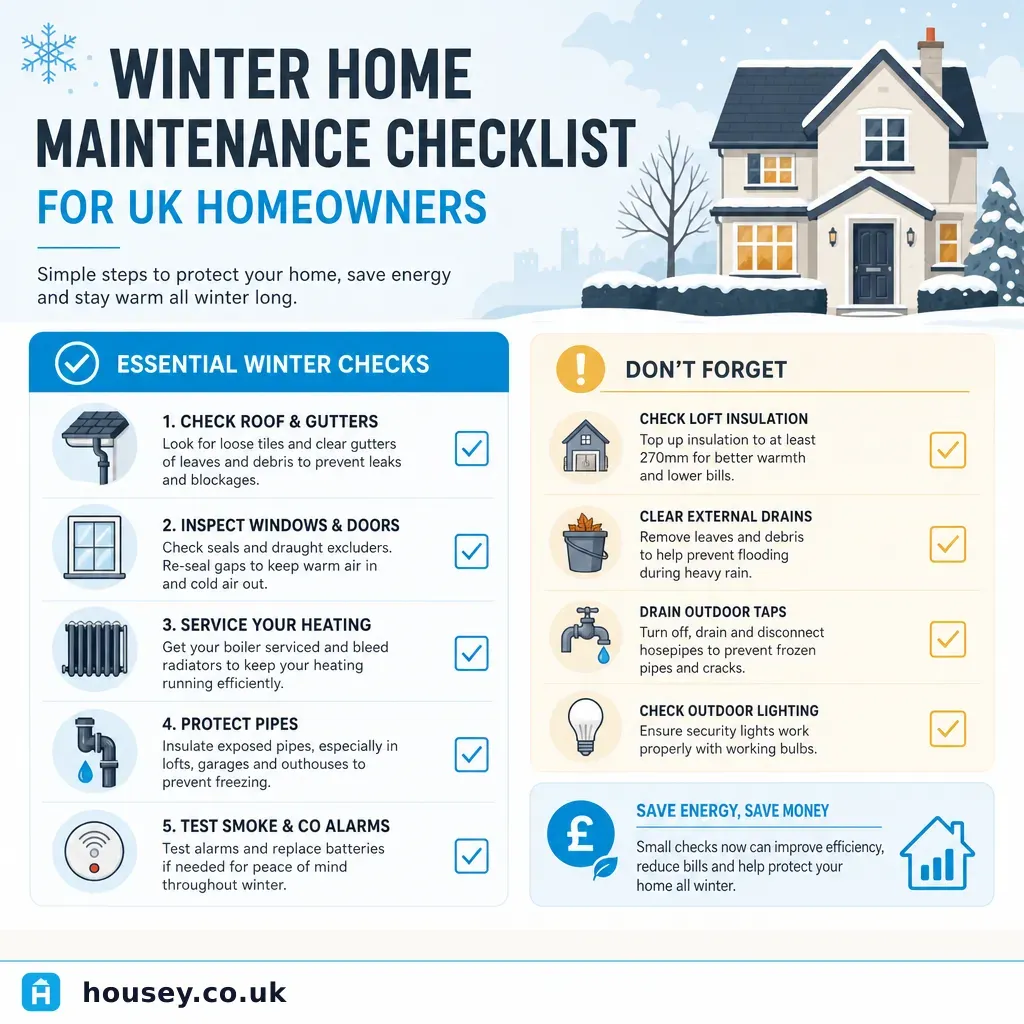
Winter home maintenance checklist for UK homeowners
UK homeowners should carry out winter maintenance in October and November, before the first frost.
 Improvement & Build
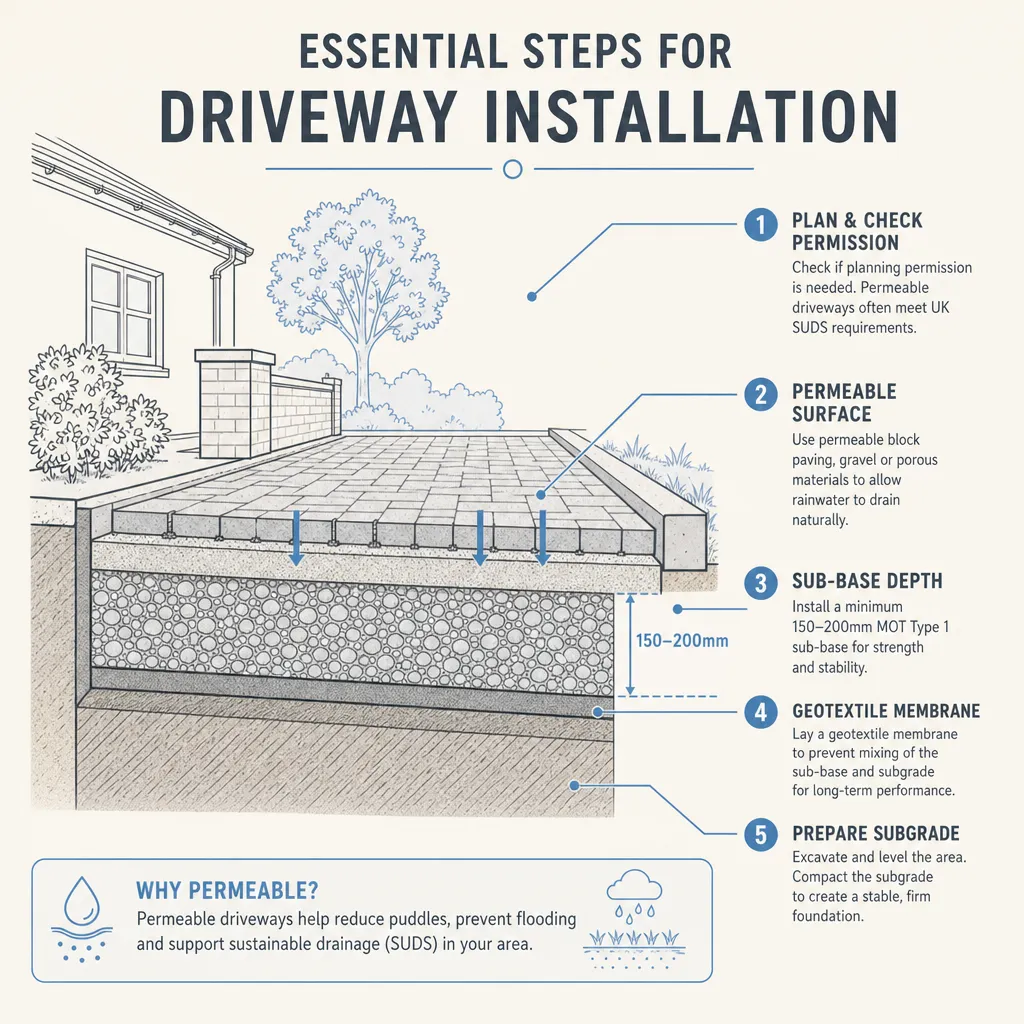
Essential Steps for Driveway Installation
Installing a driveway in England requires planning permission only when using an impermeable surface (standard tarmac, concrete, or block paving) on a front garden area over 5 m².
 Improvement & Build
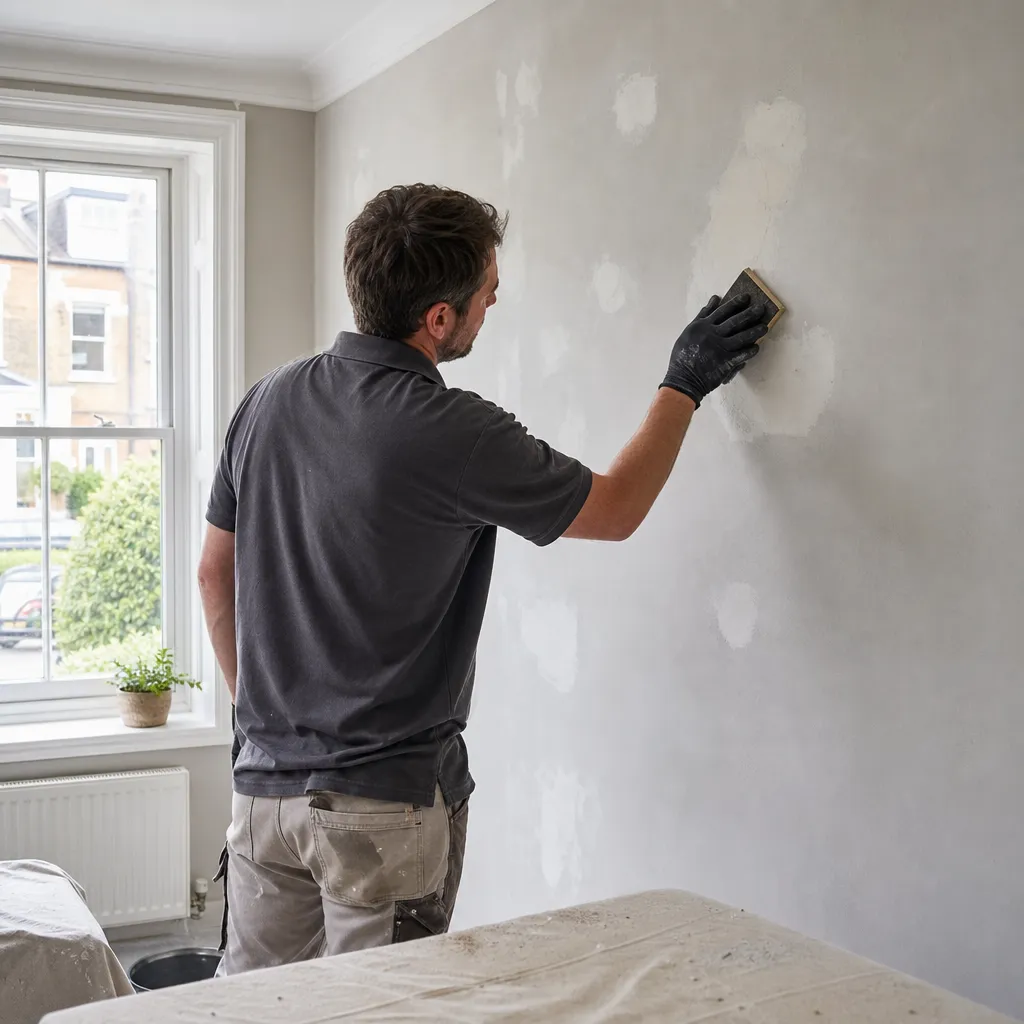
Preparing Walls for Patching: Surface Preparation Best Practice
Durable wall patching starts with removing all loose material, cutting back to a clean and stable edge, cleaning the substrate, and priming with a construction-grade PVA bonding agent before applying any filler or plaster.
 Improvement & Build
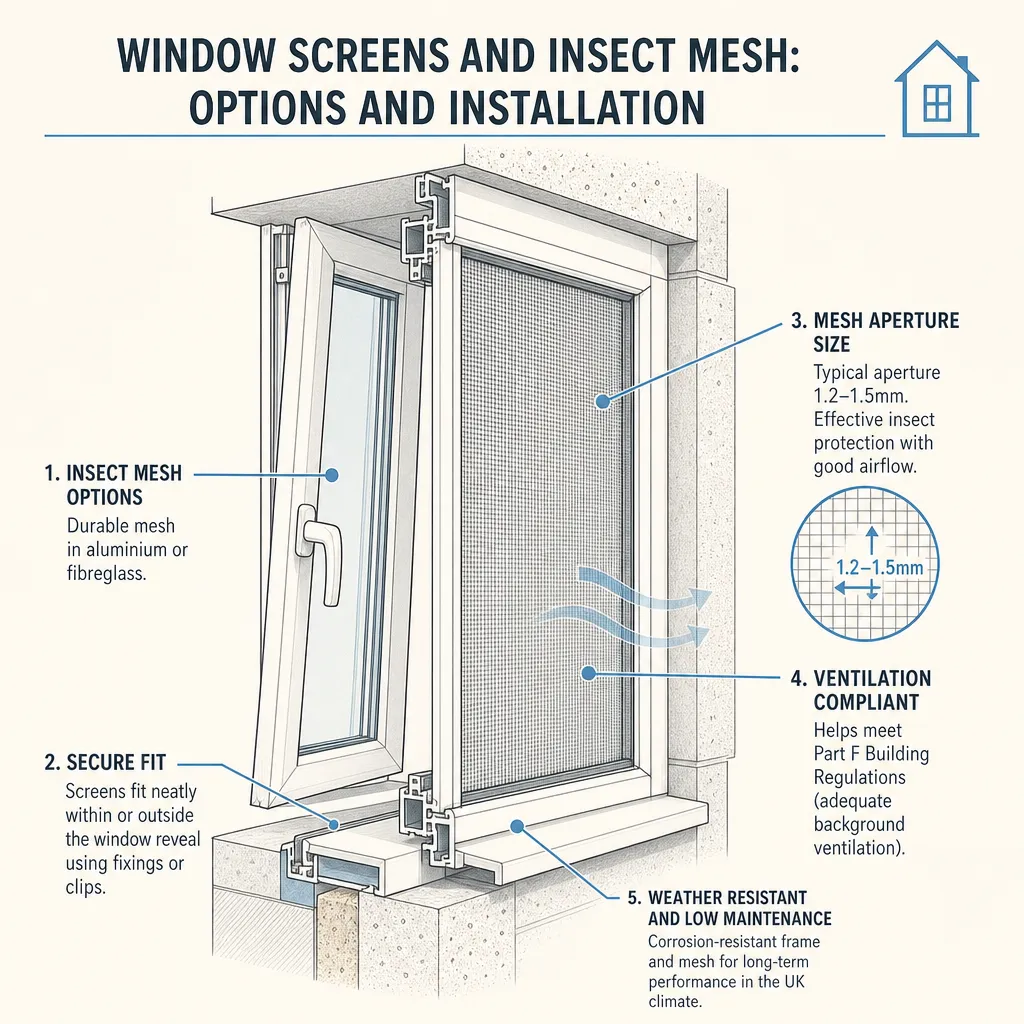
Window Screens and Insect Mesh: Options and Installation
UK window screens fall into four main types: fixed frame, roller retractable, pleated folding, and magnetic snap-fit.
 Improvement & Build
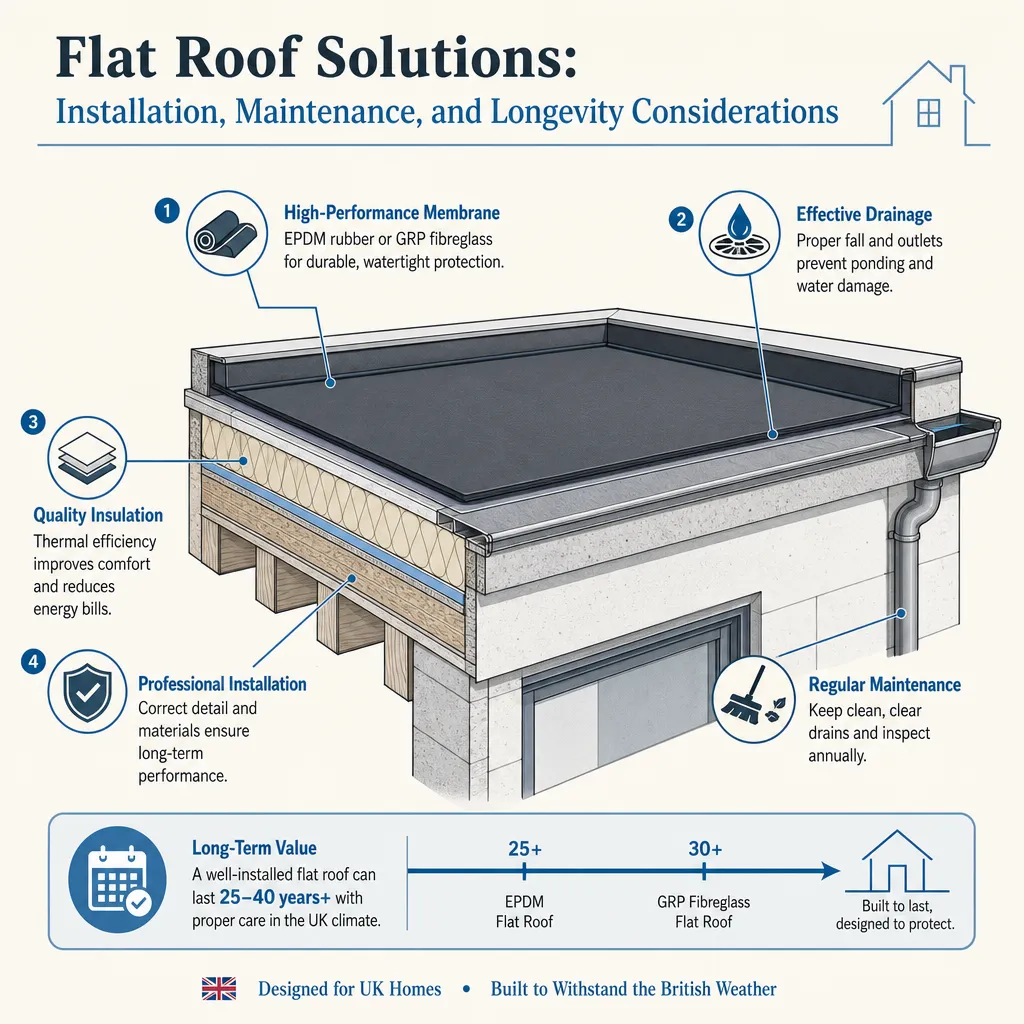
Flat Roof Solutions: Installation, Maintenance, and Longevity Considerations
Flat roofs use several waterproofing systems — EPDM rubber, GRP fibreglass, liquid-applied coatings, modified bitumen felt, lead, and zinc — each with different lifespans and installation requirements.