Winter home maintenance checklist for UK homeowners
By Housey · Last reviewed 19th of May 2026
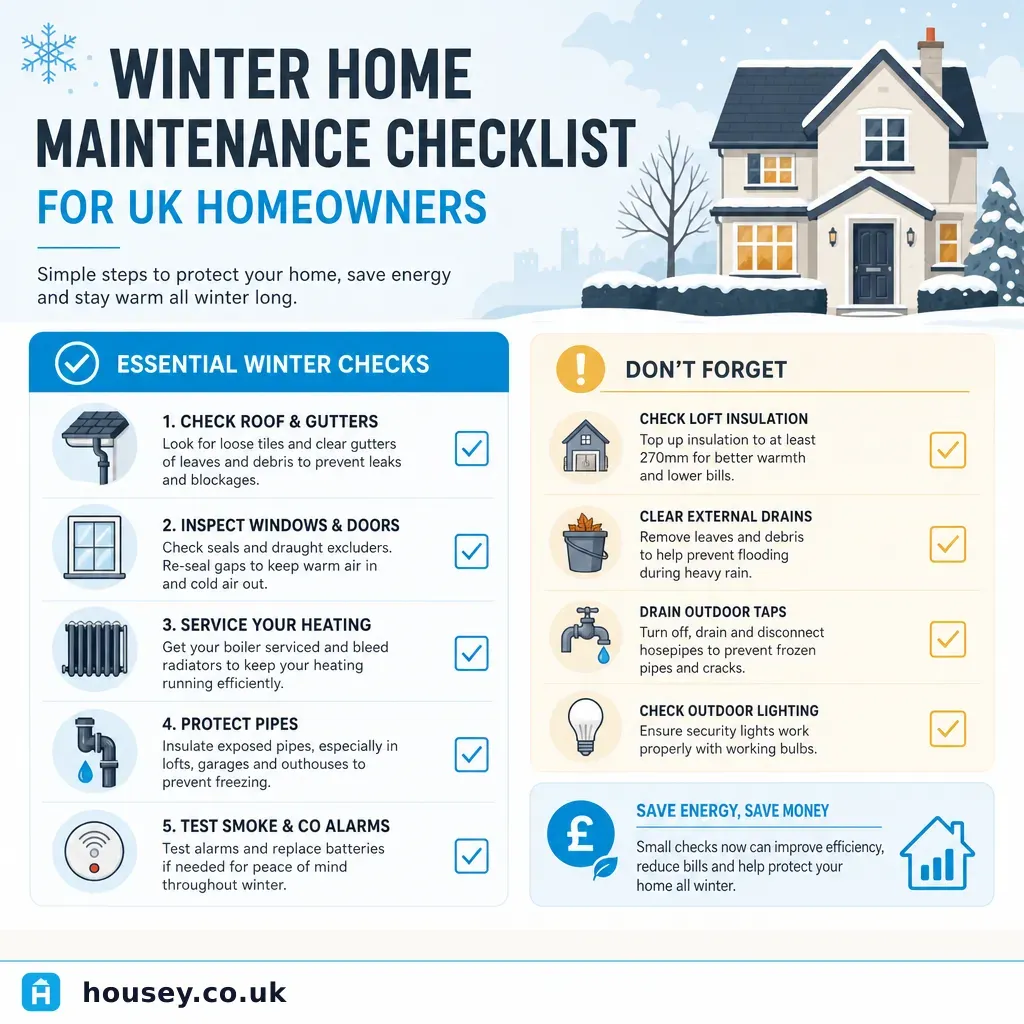
Winter home maintenance checklist for UK homeowners
The UK's weather pattern — mild and wet through autumn, punctuated by sharp frosts from November onwards — gives homeowners a narrow window in which to carry out essential maintenance before cold weather makes problems far more expensive to address. Frozen pipes, blocked gutters, and a failing boiler are among the most common emergency call-outs each January, and most are preventable. Knowing which tasks to prioritise — and which to hand to a qualified professional — can make the difference between a comfortable winter and a costly emergency.
Key points
- Gas boiler servicing must be carried out by a Gas Safe registered engineer; only registered engineers may legally work on gas appliances under the Gas Safety (Installation and Use) Regulations 1998.
- Carbon monoxide alarms are legally required in rooms containing a fixed combustion appliance in England under the Smoke and Carbon Monoxide Alarm (Amendment) Regulations 2022.
- Gutters and downpipes should be cleared of debris before the first heavy autumn rainfall — blocked gutters are a leading cause of penetrating damp and fascia rot in UK properties.
- Pipes in unheated spaces such as the loft, garage, and outbuildings should be lagged; BS 5422 provides guidance on insulation thickness for different pipe sizes and temperature ranges.
- A single displaced roof tile or failed ridge mortar joint can admit significant water ingress during a storm and should be identified and repaired before winter.
October and November: priority tasks
These should be completed before the first frost, ideally in October.
Heating system
- Book and complete an annual boiler service with a Gas Safe registered engineer if not done within the past 12 months.
- Bleed radiators to remove airlocks — use a radiator key and a cloth to catch drips.
- Check the boiler pressure gauge reads within the normal operating range (typically 1–1.5 bar cold); top up via the filling loop if low, following the manufacturer's instructions.
- Test the thermostat and any smart heating controls to confirm they respond correctly.
- If you have a solid fuel stove or open fire, arrange a HETAS-registered sweep before the heating season; creosote build-up is a fire risk.
Roof and gutters
- Clear gutters and downpipes of leaves, moss, and debris.
- Check gutter fixings and joints for sagging or leaks, particularly at fascia brackets.
- Inspect the roof from the ground using binoculars for displaced tiles, cracked ridge pointing, and lifted flashing at chimneys, dormers, and skylights.
- Check flat roof surfaces and drainage outlets for ponding water or debris blocking grating.
Pipes and plumbing
- Lag exposed pipes in the loft, garage, and under suspended floors using foam or mineral wool insulation.
- Locate and test your stopcock — it should turn freely and close fully.
- If you have an outside tap, fit a tap cover or isolate it at the indoor service valve and drain the exposed section.
- Note the locations of your stopcock and any secondary isolation valves, and share this information with anyone else who has access to the property.
Windows, doors, and draught-proofing
- Check window seals and door draught-strips for compression failure or visible gaps; replace foam strips that are no longer sealing effectively.
- Inspect the caulking around external door and window frames at the junction with brickwork or render.
- Check for cracked or missing putty on single-glazed windows.
December and January: ongoing checks
Task | Who | Notes |
|---|---|---|
Keep heating on low when away from home | Homeowner | 12–15 °C minimum; inform your insurer if leaving for more than a few days |
Test smoke and carbon monoxide alarms | Homeowner | Test monthly; replace batteries annually |
Check loft hatch seal | Homeowner | Warm air rising into a cold loft increases condensation and moisture risk |
Inspect roof after storms | Homeowner or roofer | Look for displaced tiles or fallen ridge caps from ground level |
Clear gully gratings and yard drains | Homeowner or drainage contractor | Leaf-filled gratings cause surface flooding close to the building |
Check flat roof drainage | Homeowner or roofer | Ponding water that freezes can cause structural stress on flat roofs |
Deciding who carries out each task
- Carry out yourself if the task is clearing gutters from a stable ladder, bleeding radiators, topping up boiler pressure from the filling loop, fitting foam pipe lagging in accessible spaces, or testing alarms.
- Instruct a Gas Safe registered engineer for any work on gas appliances, boiler servicing, or gas pipe issues — it is a legal requirement under the Gas Safety Regulations, not simply a recommendation.
- Instruct a HETAS-registered engineer or approved sweep for solid fuel appliances, biomass boilers, or flue inspections.
- Instruct a qualified electrician (NICEIC or NAPIT registered) for any faults involving the consumer unit, outdoor electrics, or wiring in damp or exposed locations.
- Instruct local roofers if access to the roof is needed, tiles are displaced, or flashing is lifted — working at height above 2 m without appropriate training and equipment carries a significant risk of serious injury.
- Instruct a drainage contractor if gully drains or downpipes cannot be cleared from ground level, or if surface water is pooling persistently close to the building.
Red flags that need urgent attention before winter
Address these findings before the first hard frost:
- A boiler that cuts out repeatedly, loses pressure without explanation, or displays a persistent error code — do not wait for it to fail completely in January.
- Gutters that overflow in moderate rain — sustained overflow soaks the wall behind it, leading to penetrating damp and potentially saturating timber wallplates or lintels.
- A visibly displaced tile, slate, or ridge cap — a single gap can allow significant water ingress during a storm.
- Peeling paint on external joinery combined with soft or spongy timber — rot in door or window frames accelerates rapidly through a wet winter.
- A stopcock that cannot be turned or does not close fully — a pipe burst needs immediate water isolation.
- New cracks in external render or brickwork — water entering a crack freezes, expands, and forces the crack wider through repeated freeze-thaw cycles.
When to get professional help
Most routine winter maintenance tasks are homeowner-friendly. Seek professional help without delay if:
- The boiler is not responding to basic bleeding or pressure adjustment — do not attempt internal repairs to the appliance.
- You smell gas or see blue or yellow flames from a gas appliance — leave the building immediately and call the National Gas Emergency Service on 0800 111 999.
- Roof damage requires access above 2 m — instruct local roofers for a safe inspection and repair quote.
- Surface water is not clearing after rain and drainage close to the building appears compromised — contact drainage contractors to assess whether the drainage system is functioning correctly.
How Housey can help
Housey connects UK homeowners with vetted local professionals for seasonal maintenance work. Whether you need local roofers for a pre-winter roof inspection or drainage contractors to clear gutters, downpipes, and yard drains before the weather breaks, Housey makes it straightforward to compare quotes from tradespeople working in your area.
Frequently asked questions
When is the best time to start winter home maintenance in the UK?
October and early November are generally the best months — leaves have largely fallen, allowing gutters to be cleared properly, but hard frosts have not yet arrived. Boiler servicing and roof inspections are harder to book once the heating season is fully under way, so late September is not too early for those tasks.
How do I prevent pipes freezing in winter?
Keep the heating set to at least 12–15 °C even when the property is unoccupied. Lag pipes in unheated spaces — loft, garage, under suspended floors — with foam or mineral wool insulation. Ensure the loft hatch is well-sealed to prevent warm air condensing in the cold loft. Know where your stopcock is so you can isolate the water supply quickly if a pipe bursts.
Do I have to have my boiler serviced every year?
Annual boiler servicing is strongly recommended by manufacturers, Gas Safe, and most home insurers. There is no legal requirement for homeowners — unlike landlords, who must arrange an annual gas safety check under the Gas Safety Regulations — but most manufacturers require annual servicing to maintain the product warranty, and insurers may decline claims on unserviced appliances.
What does a winter roof check involve?
A basic visual check from the ground — binoculars are useful — can identify displaced tiles, missing slates, and cracked ridge pointing. A thorough inspection covers flashing at chimneys and dormers, flat roof membranes and edge trims, and gutter and soaker condition. A qualified roofer should carry out any inspection requiring access above 2 m.
Sources and further reading
- Gas Safety (Installation and Use) Regulations 1998 — legislation.gov.uk
- Smoke and Carbon Monoxide Alarm (Amendment) Regulations 2022 — legislation.gov.uk
- Gas Safe Register: find a registered engineer — Gas Safe Register
- HETAS: registered heating engineers and sweeps — HETAS
- Draught-proofing your home — Energy Saving Trust
Useful next reads
 Improvement & Build
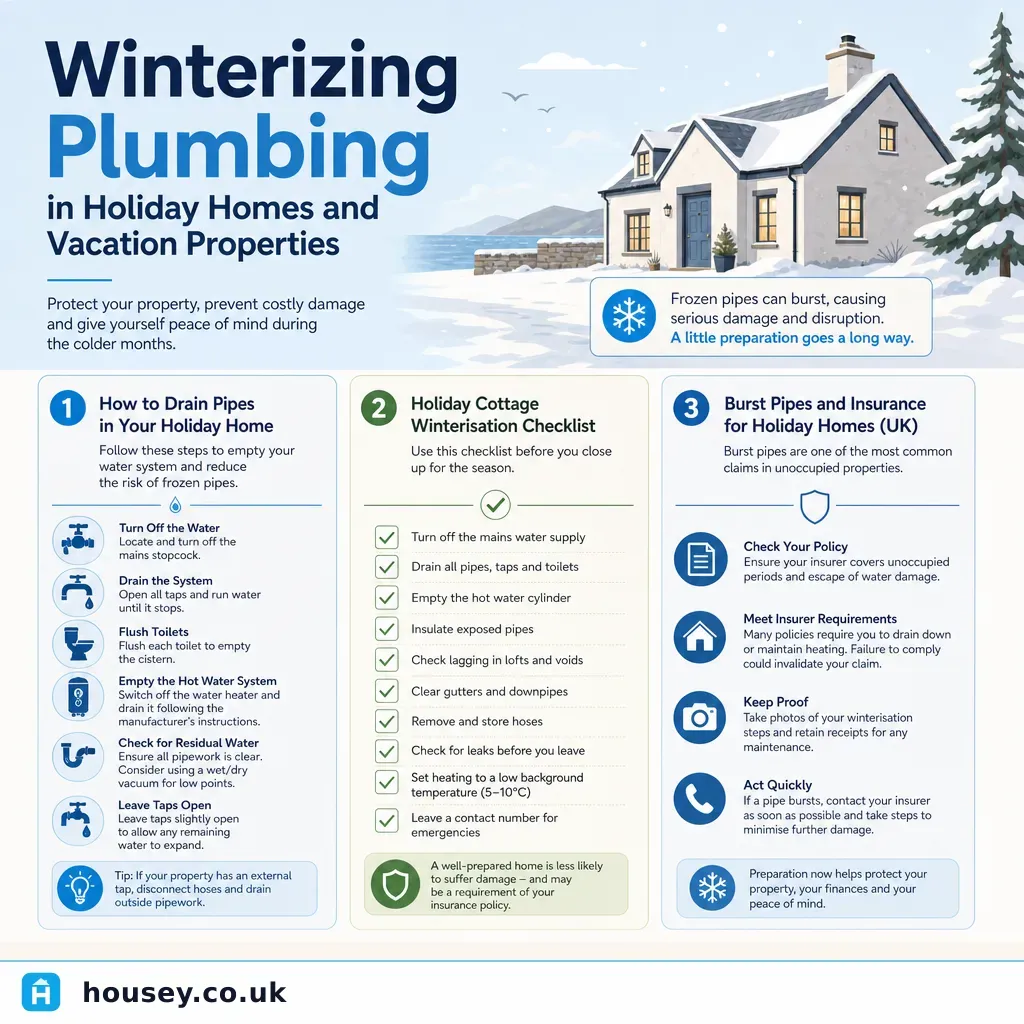
Winterizing Plumbing in Holiday Homes and Vacation Properties
Holiday homes left unheated face serious burst-pipe risk in UK winters.
 Improvement & Build
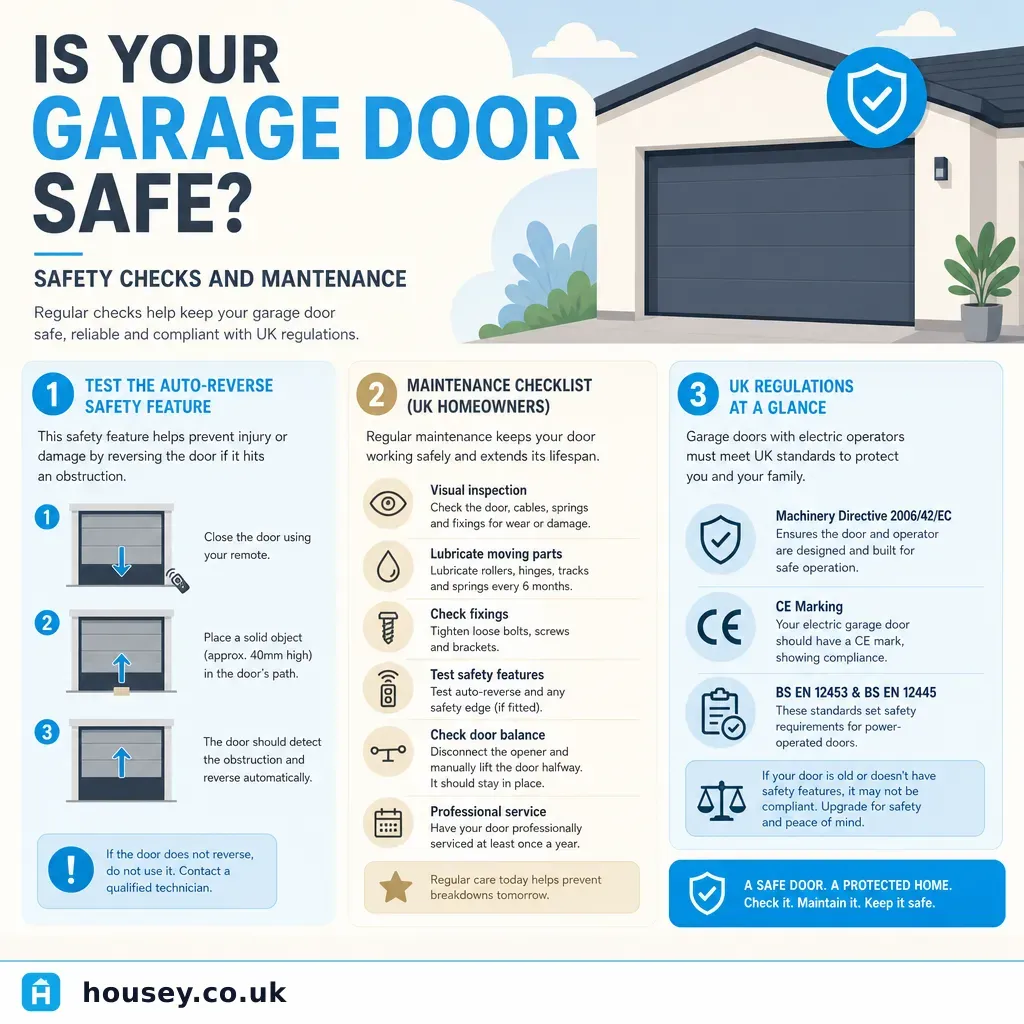
Is Your Garage Door Safe? Safety Checks and Maintenance
UK automatic garage doors must have auto-reversal and photocell safety sensors under the Supply of Machinery (Safety) Regulations 2008.
 Improvement & Build
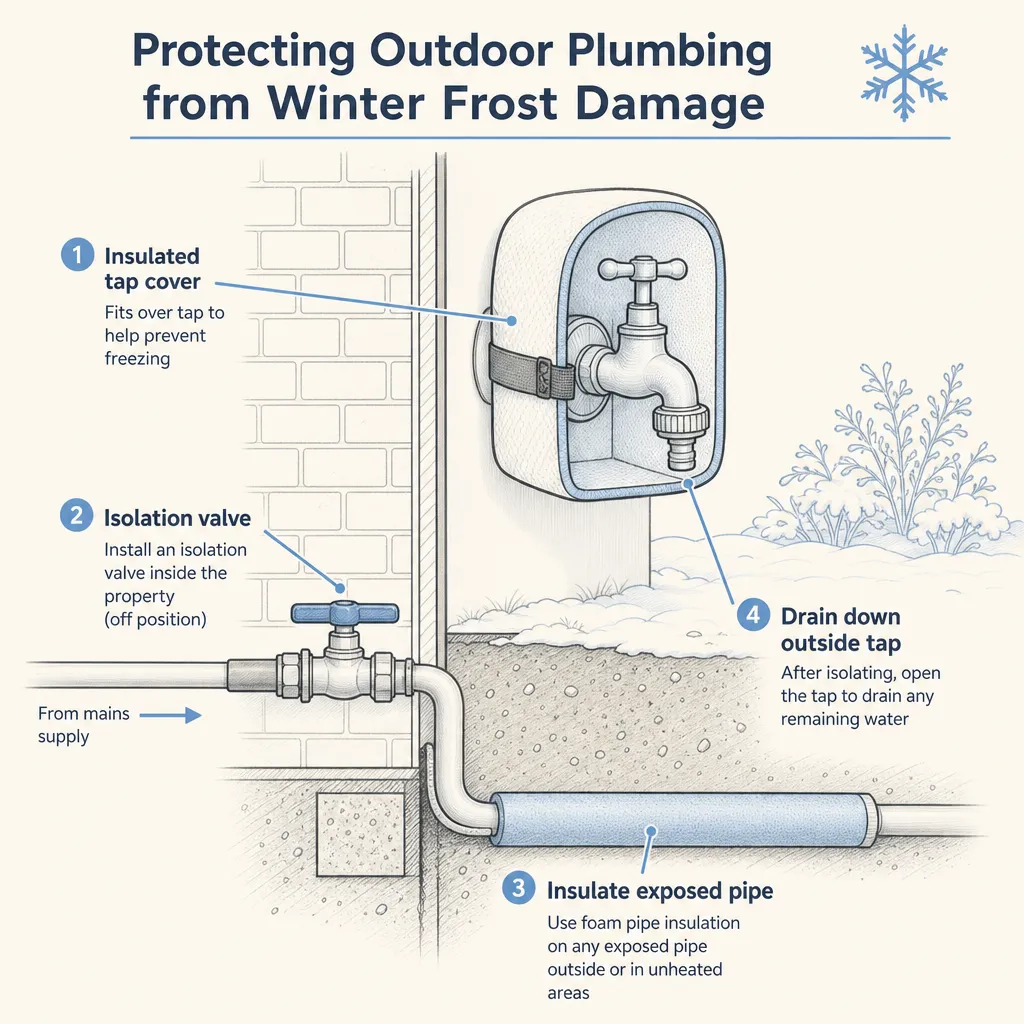
Protecting Outdoor Plumbing from Winter Frost Damage
The most reliable way to protect an outdoor tap from frost is to turn off its dedicated indoor isolation valve, drain the connecting pipe, and leave the tap open over winter so any remaining water can escape without building pressure.
 Improvement & Build
Heated Driveways: Is the Investment Worth Considering?
A heated driveway uses electric resistance cables or hydronic water pipes beneath the surface to prevent ice and snow build-up.
 Improvement & Build
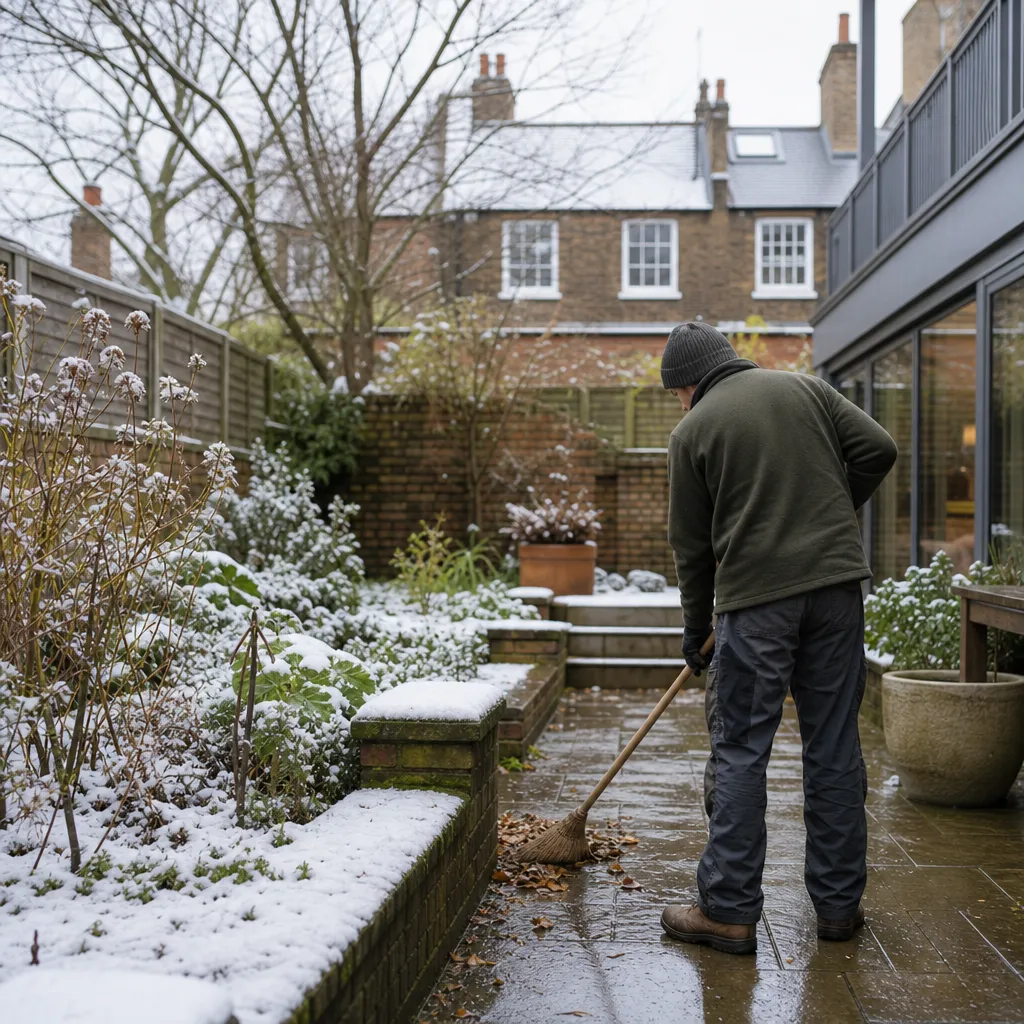
Managing Garden Tasks Through Winter Weather: Practical Strategies
Most UK winter garden tasks can be carried out during mild, dry spells — pruning dormant shrubs, clearing debris, and improving soil structure are all suitable when the ground is not frozen or waterlogged.