Garage Door Spring Repair: When Springs Fail and What It Costs
By Housey · Last reviewed 12th of May 2026
Garage Door Spring Repair: When Springs Fail and What It Costs
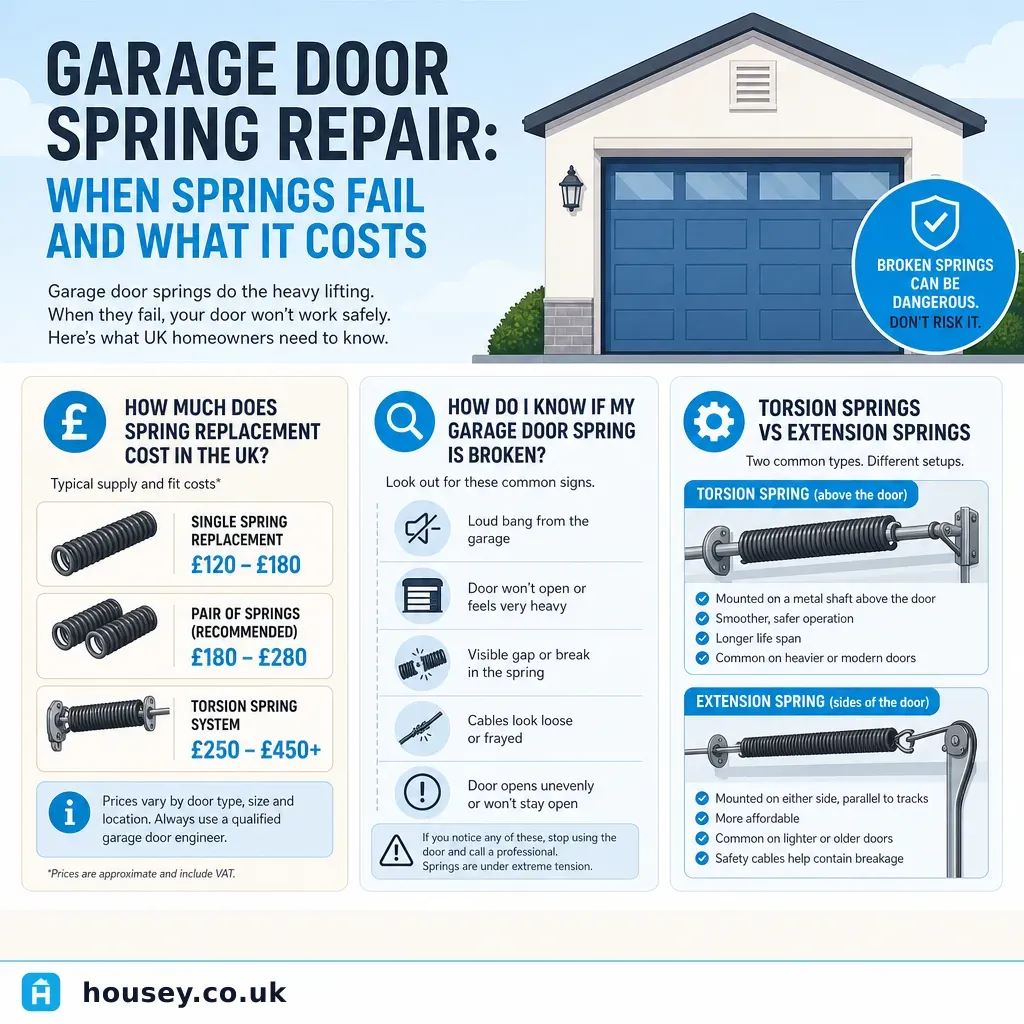
Garage door springs are among the most failure-prone components on any residential property — and when they go, the door becomes impossible to operate safely. Most UK homeowners only discover a spring fault when the door refuses to open, drops unexpectedly, or produces an unfamiliar bang or grinding noise. Getting the diagnosis and repair right matters both for daily convenience and safety: springs work under significant mechanical tension and require specialist handling from diagnosis through to fitting.
Key points
- Garage door springs typically last 7,000–15,000 operating cycles, roughly equivalent to 7–10 years of residential use at 3–4 operations per day.
- There are two main spring types used in UK homes: torsion springs (mounted horizontally above the door opening) and extension springs (running along the side tracks); replacement technique and cost differ significantly between the two.
- UK spring replacement typically costs £80–£250 for springs and labour (Indicative UK costs, last reviewed 2026-05-12), though worn cables, drums, or motorised operator adjustments add to this figure.
- Most garage door engineers recommend replacing both springs simultaneously — even when only one has failed — to avoid uneven loading and rapid re-failure.
- Springs operate under extreme stored energy; attempting a DIY replacement without specialist winding bars and a proper safe-release technique carries a significant risk of serious injury.
How to tell if a garage door spring has broken
Spring failure often announces itself with a loud snap — sometimes audible from inside the house. After that, the door typically becomes very heavy or completely immovable. Other signs to look for include:
- The door opens only a few centimetres and then halts (motorised doors may flash an error code or beep)
- A visible gap or kink in the coil of a torsion spring mounted above the door
- Lifting cables hanging slack or fallen off the winding drums
- The door tilts noticeably to one side when partially open
- The motor runs and strains, then cuts out without completing the open cycle
A door showing any of these symptoms should not be operated — manually or with the motor — until the springs have been assessed and replaced by a qualified engineer.
Torsion springs vs extension springs: which type do you have?
Feature | Torsion spring | Extension spring |
|---|---|---|
Location | Mounted horizontally above the door | Run along side tracks, either side of the door |
Common door type | Modern sectional and roller doors | Older up-and-over doors |
Lifespan (cycles) | 10,000–15,000 | 7,000–10,000 |
Replacement risk | Very high — specialist only | High — specialist only |
Typical UK replacement cost | £120–£250 (pair) | £80–£180 (pair) |
Visible sign of failure | Gap or separation in coil above door | Spring hanging loose or visibly snapped |
Indicative UK costs, last reviewed 2026-05-12. Quotes vary by region, door size, door weight, and brand.
What does a professional spring repair involve?
A qualified garage door engineer will:
- Inspect the full mechanism — spring, cables, drums, bearings, and bottom bracket — before touching any tensioned component.
- Safely release any remaining tension in an intact spring using specialist winding bars or a controlled safe-release process.
- Remove the failed spring(s) and any damaged cables.
- Fit matched replacement springs rated to the correct tension for the door's weight and size.
- Test the door balance: a correctly balanced door should hold itself open at the halfway point without drifting up or down.
- Adjust the motorised operator's limit settings if fitted, and test several full open/close cycles before signing off the job.
The work typically takes 1–2 hours. If cables, drums, or bearings are also worn, expect additional parts costs on top of the spring replacement.
Red flags: when a spring repair is not enough
Look out for these signs that a wider assessment is needed:
- Repeated spring failure within 2–3 years — springs rated for 10,000 cycles should not fail this quickly. The door may be improperly balanced, or the spring specification may be wrong for the door weight.
- Fraying, kinked, or rusted lifting cables — replacing the spring alone while leaving damaged cables creates a safety hazard; cables should be replaced at the same time.
- Bent bottom panel or derailed tracking — a door that has dropped suddenly due to spring failure may have damaged the lowest panel or forced the rollers out of the tracks, requiring additional repair.
- Motorised operator showing persistent faults — a motor that continued to run after a spring failed may have sustained internal damage; always test it fully after any spring work.
- Door over 20 years old with discontinued spring sizes — older doors may use non-standard spring dimensions that are difficult to source; a full door replacement can be more economical than commissioning bespoke springs.
What to ask before accepting a quote
- Is the quote for both springs, or just the one that has failed?
- Does the price include new lifting cables and any worn bearings or drums?
- What spring specification — wire gauge, inside diameter, length — will be fitted, and how is it matched to the door's weight?
- Is VAT included in the quoted price?
- Will you carry out a post-repair balance test and, if motorised, adjust the limit settings?
- What warranty is provided on parts and labour?
- Are you a member of the Door and Hardware Federation (DHF) or an approved engineer for my door brand?
When to get professional help
Garage door spring replacement is not a safe DIY task. Torsion springs in particular store enough mechanical energy to cause severe hand, wrist, or facial injuries if released incorrectly or with improvised tools. If your spring has failed:
- Do not attempt to operate the door — manually or with the motor — until the mechanism has been inspected by a qualified engineer.
- Do not attempt to wind or unwind the spring coil using makeshift tools such as screwdrivers.
- If the door has dropped suddenly, inspect visually that the tracks and bottom panel appear intact, but do not attempt any adjustment yourself.
Contact a member of the Door and Hardware Federation or a manufacturer-approved service engineer for your door brand.
How Housey can help
If a failed spring has made you reconsider how your garage is used — or whether a full conversion might make better use of the space — our garage conversion specialists can advise on feasibility, planning requirements, and likely costs before any works begin.
Frequently asked questions
How long do garage door springs last?
Most springs are rated to between 7,000 and 15,000 operating cycles, equating to roughly 7–10 years at normal residential use of 3–4 operations per day. Springs on heavily used doors may fail sooner. Failure well within this range can indicate an incorrectly specified spring or an imbalanced door that is placing excessive stress on the mechanism.
Can I repair a garage door spring myself?
No. Garage door springs — particularly torsion springs — operate under extreme mechanical tension and can cause serious injury without specialist tools and training. UK trade bodies and manufacturers consistently advise that spring replacement should only be carried out by a trained garage door engineer using proper winding bars and safe-release procedures.
Do I need to replace both springs at the same time?
Yes, in most cases. When one spring fails, its partner has usually accumulated similar wear. Replacing only the broken spring leaves an unevenly loaded door, which shortens the new spring's life and increases the risk of a second failure shortly after. Most engineers recommend a paired replacement as standard practice.
Will a broken spring affect my home insurance?
Home insurance typically covers sudden accidental damage rather than mechanical wear-and-tear. A spring that has simply reached the end of its service life is unlikely to be covered. If the failure caused collateral damage to the door structure or property contents, check your policy wording carefully — some policies include accidental damage as an optional add-on.
Sources and further reading
- Door and Hardware Federation guidance — Door and Hardware Federation (DHF): safe garage door installation and repair
- Health and Safety at Work etc. Act 1974 — legislation.gov.uk
- Working safely at height — Health and Safety Executive (HSE)
- Consumer rights when buying services — GOV.UK
Useful next reads
 Improvement & Build
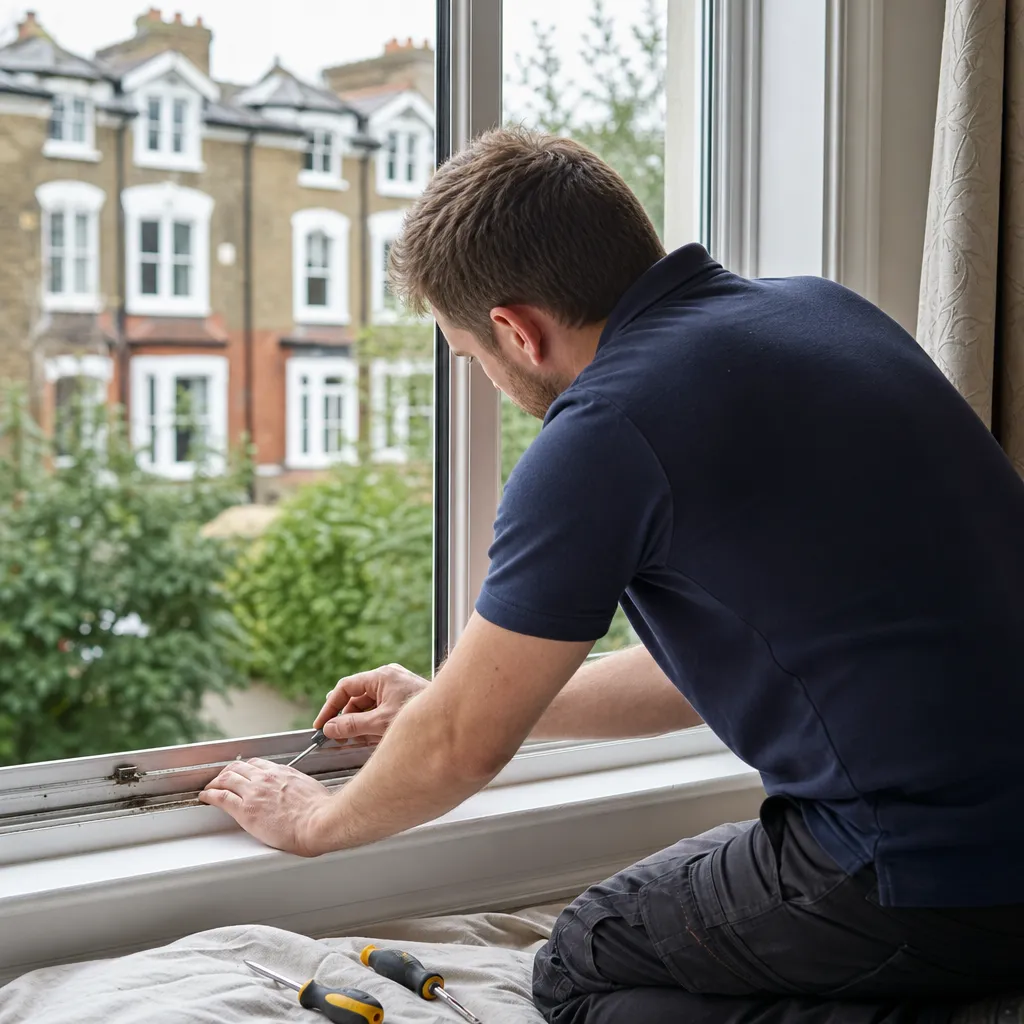
How to Repair Window Tracks
Most window track problems — stiffness, grinding, or failure to slide — stem from debris build-up, worn rollers, or dried seals.
 Improvement & Build
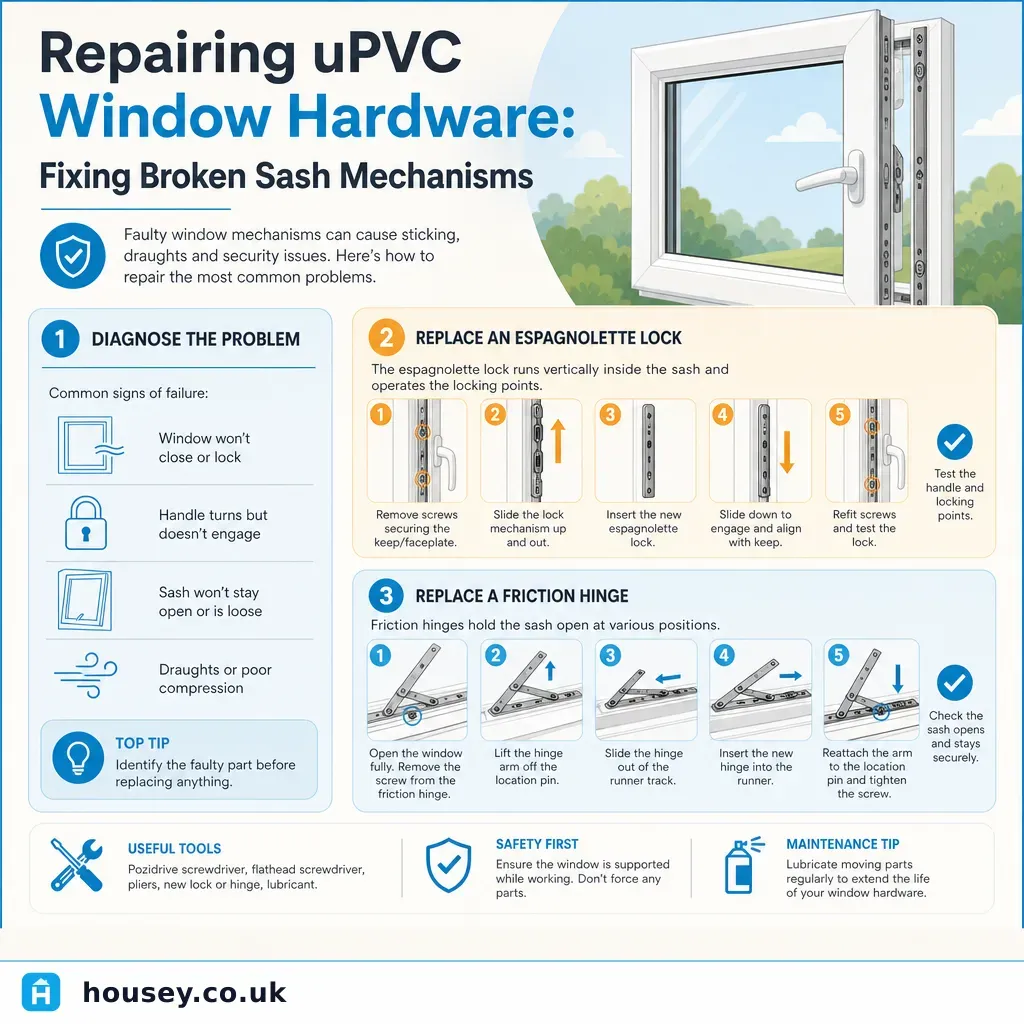
Repairing uPVC Window Hardware: Fixing Broken Sash Mechanisms
Most uPVC window sash mechanisms — handles, espagnolette locks, and friction hinges — can be replaced as individual components without replacing the full window frame.
 Improvement & Build
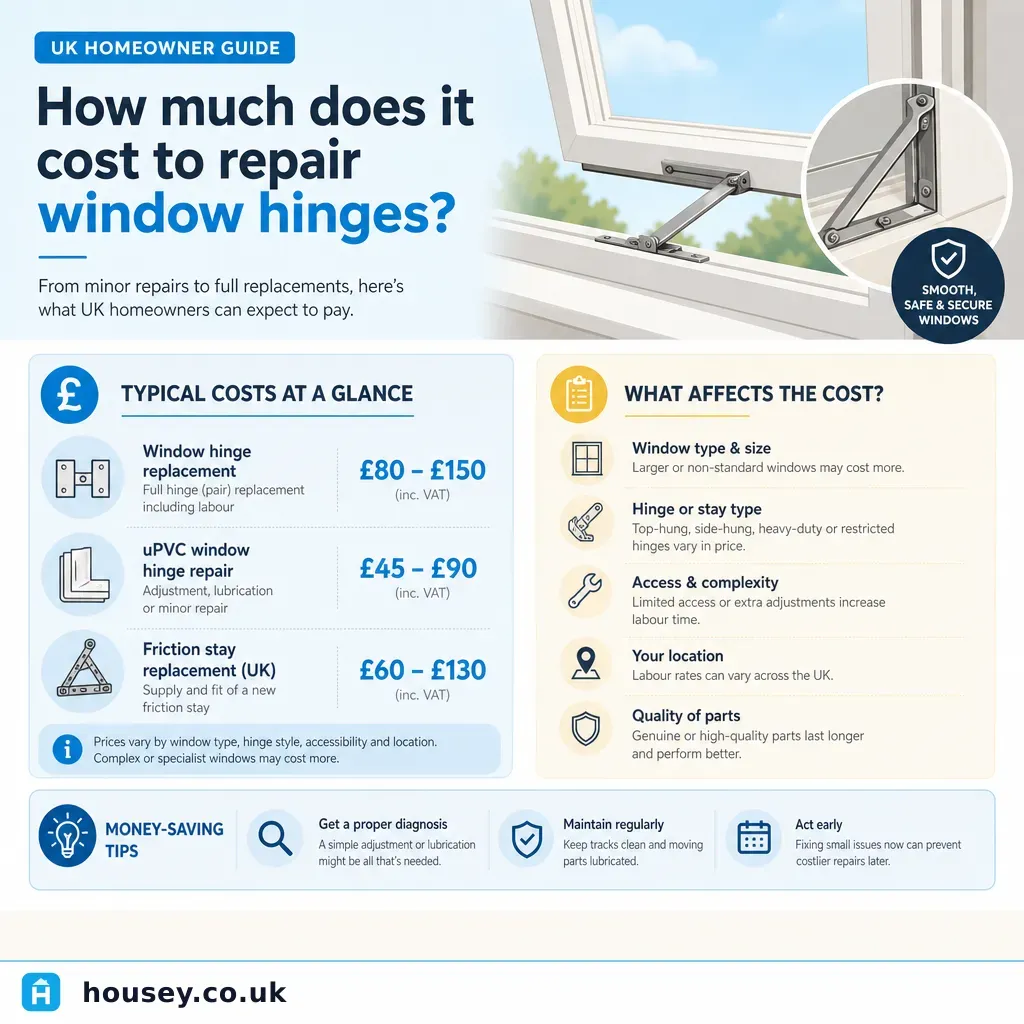
How much does it cost to repair window hinges?
Window hinge repair in the UK typically costs £60–£150 per window for a uPVC friction stay replacement, including parts and labour.
 Improvement & Build
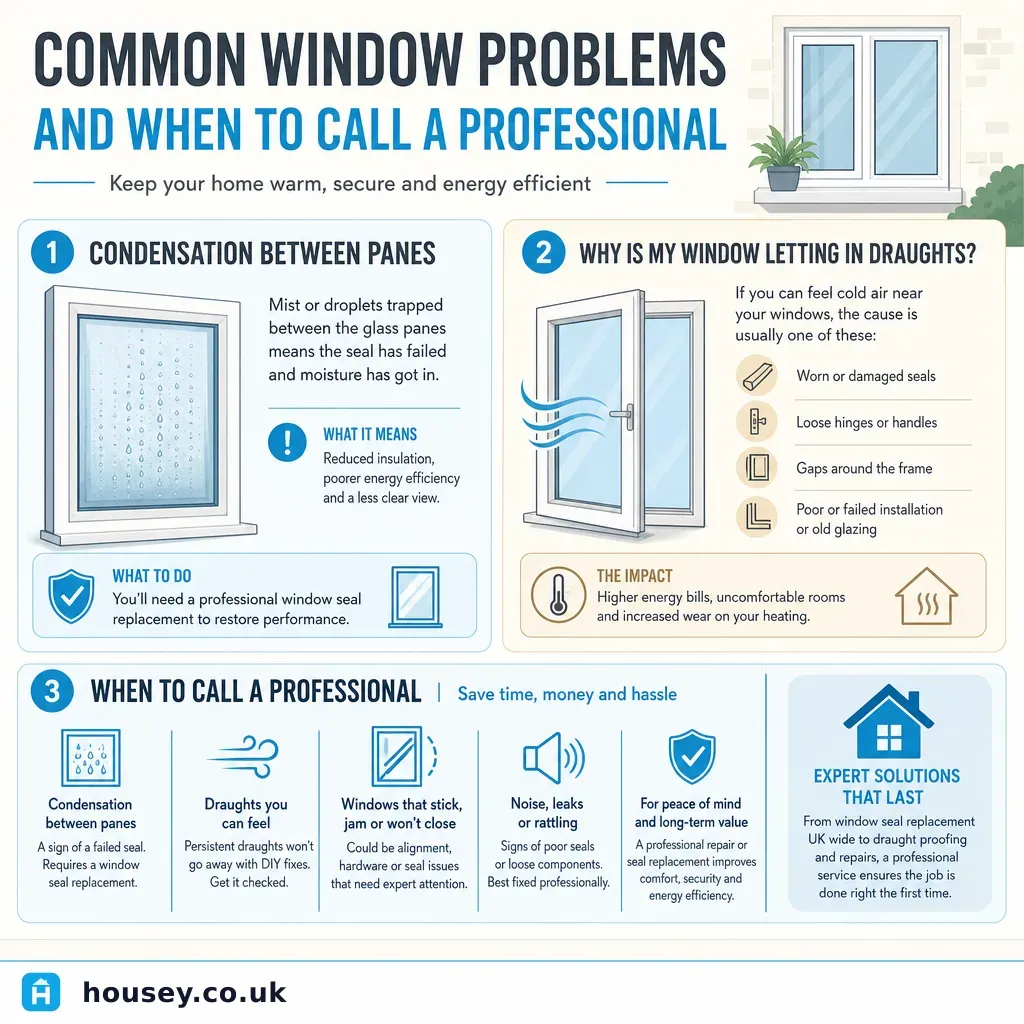
Common Window Problems and When to Call a Professional
The most common window problems in UK homes are condensation between panes (failed sealed unit), draughts from worn seals or warped frames, stiff or broken hardware, and rotting timber frames.
 Improvement & Build
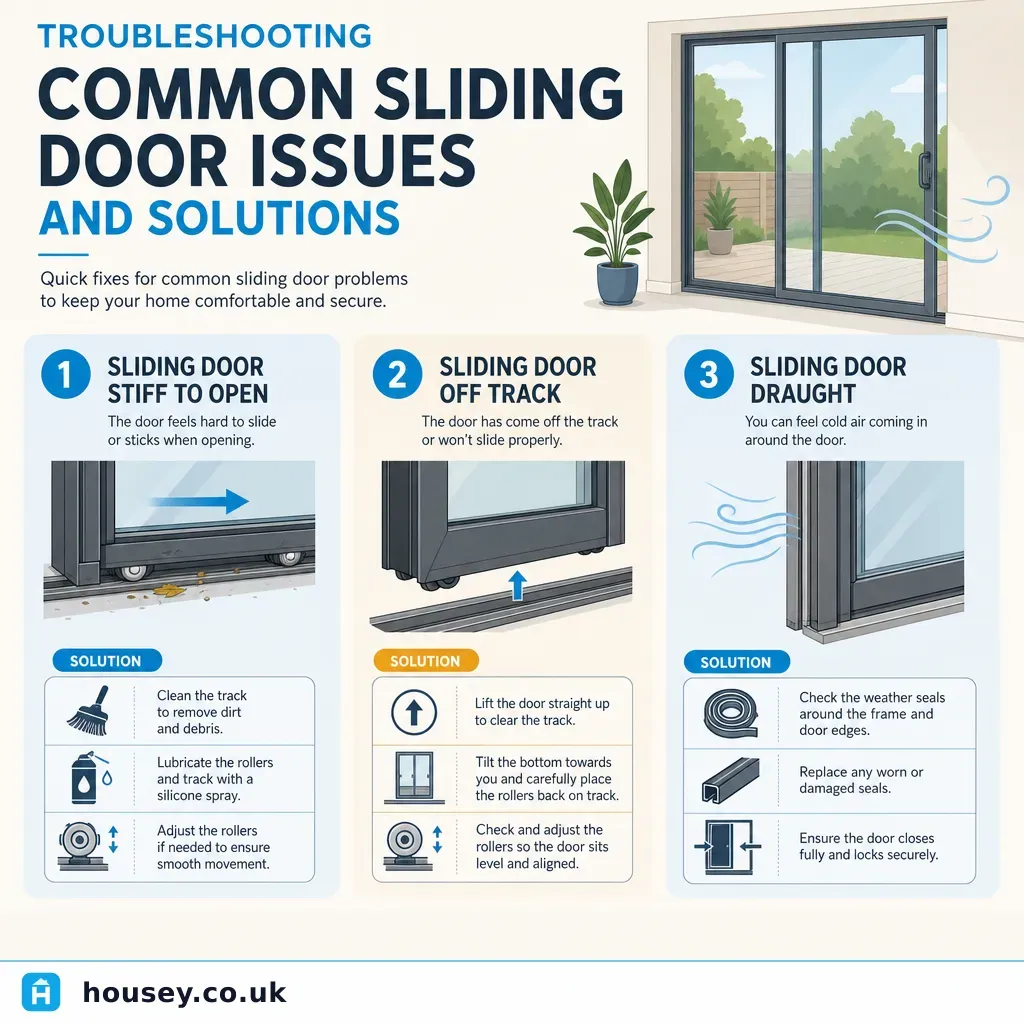
Troubleshooting common sliding door issues and solutions
Most sliding door problems — stiff operation, draughts, misalignment, or a faulty lock — have straightforward fixes.