Garage Insulation: Benefits and Installation Options for Energy Savings
By Housey · Last reviewed 18th of May 2026
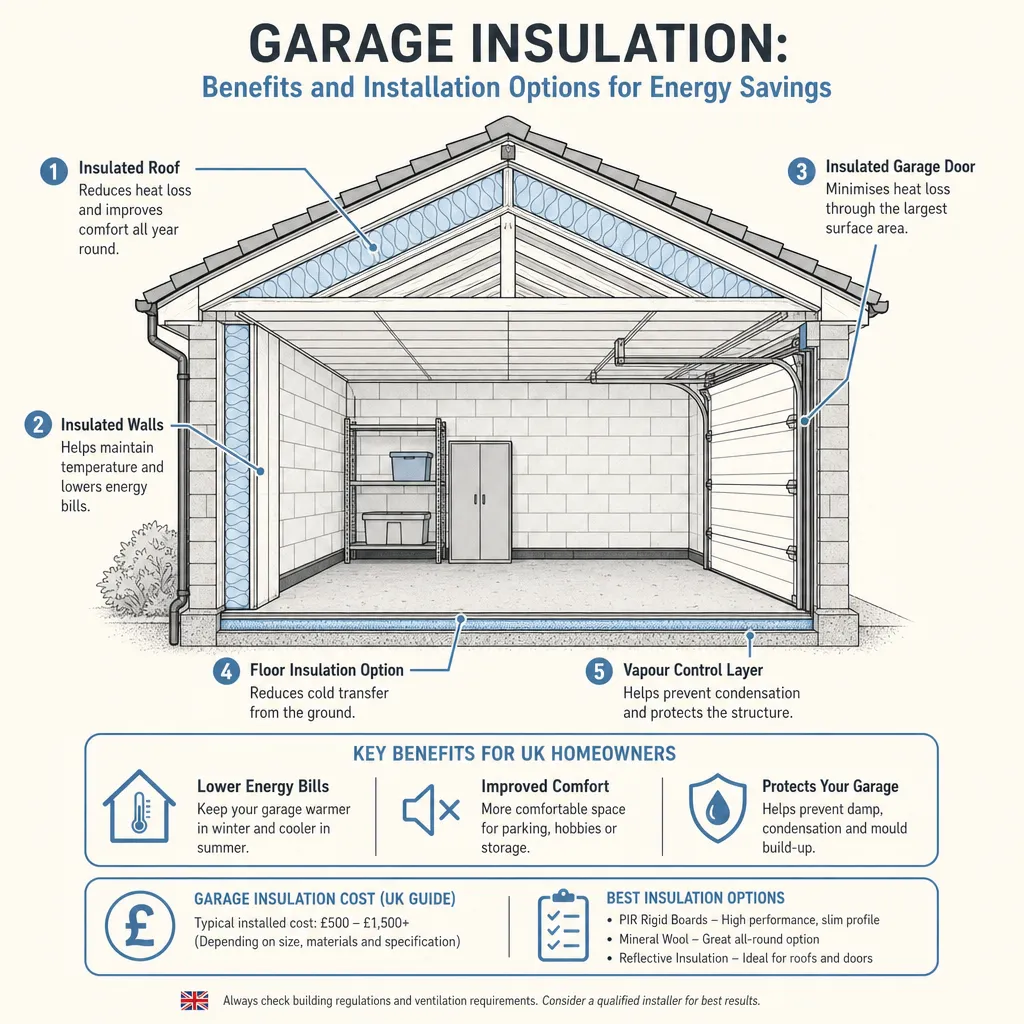
Garage Insulation: Benefits and Installation Options for Energy Savings
Garages are among the most thermally leaky parts of a UK home, yet they are often the last place homeowners consider when improving energy performance. Whether your garage is integral to the house, attached to a side wall, or a detached block at the end of the drive, inadequate insulation affects the warmth of adjacent rooms, your heating bills, and — if you plan to convert it — whether the space meets Building Regulations.
Key points
- An uninsulated wall shared between an integral garage and a heated living room creates a direct thermal bridge, increasing heat loss from the home.
- Building Regulations Part L (England, 2022 uplift) requires converted garages used as habitable rooms to meet minimum U-values: typically 0.28 W/m²K for walls, 0.16 W/m²K for roofs, and 0.18 W/m²K for floors.
- The three most common insulation product families for garages are rigid PIR/PUR boards, mineral wool batts, and spray foam — each with different performance, cost, and installation profiles.
- The ECO4 scheme and the Great British Insulation Scheme (GBIS) may fund insulation measures for eligible low-income or vulnerable households — check current eligibility on GOV.UK.
- Spray foam insulation in a mortgaged property can complicate future sales and remortgages; seek independent advice before proceeding.
Why garage insulation matters
An integral garage — one built into the main body of the house — shares walls, floor, and sometimes ceiling with heated rooms. Without insulation at these junctions, warmth migrates from living areas into the unheated garage. Cold spots form near shared partitions and the heating system works harder than it needs to.
For detached or semi-detached garages used as workshops, home offices, or hobby rooms, insulation is primarily about occupant comfort rather than whole-house energy performance. However, if a gas boiler or heat pump is located in a detached garage, pipework routing and any habitable use may bring the space within the scope of Building Regulations.
The Energy Saving Trust advises that insulating all elements of a building's thermal envelope — not just the loft and cavity walls — is necessary to achieve meaningful reductions in heat loss. For mid-century and more modern homes, the garage is often the weakest link in that envelope.
Comparing garage insulation types
Insulation type | Approx. R-value per 100mm | Best for | Main limitation | Typical installer |
|---|---|---|---|---|
Rigid PIR/PUR board | ~4.5 m²K/W | Walls, roof, floor (slim profile needed) | Requires careful edge sealing and vapour control layer | Insulation installer; competent DIYer for simple applications |
Mineral wool (glass or rock) | ~2.5–3.0 m²K/W | Stud-framed walls, rafter spaces | Needs vapour control layer; susceptible to moisture if poorly fitted | General builder or insulation specialist |
Spray foam (open or closed cell) | 2.5–3.9 m²K/W | Irregular surfaces, flat garage roofs | Mortgage lenders may object; removal is costly and difficult | Specialist spray foam contractor only |
Insulated plasterboard (dot-and-dab) | Varies by thickness | Upgrading a masonry wall with limited internal depth | Not suitable for damp walls | Drylining specialist |
Insulated garage door | Low–moderate | Reducing cold ingress and draughts | Modest performance improvement only | Garage door specialist; DIY kits available |
Indicative values based on typical product specifications. Actual performance depends on thickness, installation quality, and thermal bridging at junctions. Seek written specifications from your installer. Indicative UK costs, last reviewed 2026-05-18.
Which insulation approach is right for your garage?
- Choose rigid PIR/PUR boards if you need maximum thermal performance in a slim profile — common in garages where every centimetre of internal space matters.
- Choose mineral wool between timber studs if you are building out a stud partition on a masonry wall and can accommodate a 100mm or greater frame.
- Approach spray foam with caution — it performs well on awkward surfaces but can create difficulties with mortgage lenders on resale. Ensure the contractor holds a TrustMark-backed warranty and seek independent advice before proceeding.
- Choose an insulated garage door if your primary goal is reducing draughts rather than achieving habitable-room thermal standards.
- Consult a retrofit assessor first if your garage is damp, shows signs of condensation, or forms part of a broader whole-house energy improvement — incorrect sequencing of insulation measures can worsen existing moisture problems.
Garage conversions and Building Regulations
If you intend to convert a garage into a habitable room — a study, bedroom, or playroom — Building Regulations apply regardless of whether planning permission is required. Most straightforward garage conversions fall within permitted development rights, but building control approval is always necessary.
Part L requires the converted space to meet current U-value standards. You will also need to satisfy Part F (ventilation), Part B (fire safety), and Part A (structural) as applicable. A building control application — through your local authority building control or an approved inspector — must be submitted before work starts, not after.
Skipping building control is a common mistake. When you come to sell, solicitors and mortgage lenders will request a completion certificate or regularisation certificate for any conversion. Retrospective regularisation is possible but more expensive and requires making elements accessible for inspection.
Homeowner pre-installation checklist
Before appointing an insulation installer, work through these questions:
When to get professional help
Most garage insulation projects can be managed by a competent builder or specialist installer. However, professional input is advisable when:
- The garage is part of a whole-house retrofit — a PAS 2035-compliant retrofit coordinator should specify sequencing and check for interstitial condensation risk.
- The garage has existing damp or condensation issues that have not been diagnosed and resolved.
- You are considering spray foam and the property is mortgaged or will be sold within ten years.
- The conversion requires structural changes to the roof structure, floor slab, or load-bearing walls.
- The garage houses a gas appliance — a Gas Safe registered engineer should verify that combustion ventilation remains adequate after insulation is installed.
How Housey can help
If you are unsure which insulation approach suits your garage, a professional insulation assessment can identify the most cost-effective options and flag any moisture or ventilation concerns before work starts. When you are ready to proceed, Housey connects you with vetted insulation installers who can specify and fit the right solution for your property.
Frequently asked questions
Does garage insulation require planning permission in the UK?
Insulating a garage generally does not require planning permission. If you are converting it into a habitable room and the works alter the external appearance, permitted development rules may apply. In conservation areas or for listed buildings, check with your local planning authority before starting any works.
Can I insulate a garage myself?
Garage door insulation kits and basic mineral wool installations in stud walls are within the scope of a competent DIYer. For rigid PIR board, spray foam, or any work forming part of a Building Regulations application for a conversion, professional installation is strongly advisable to ensure correct specification, vapour control detailing, and building control sign-off.
How much does garage insulation cost in the UK?
Indicative UK costs, last reviewed 2026-05-18: insulating the walls, ceiling, and floor of a standard single integral garage typically ranges from £800 to £2,500 depending on materials and access. Insulated garage door replacements range from approximately £600 to £1,800 supply-and-fit. Always request itemised written quotes from at least two or three installers.
Does the ECO4 scheme cover garage insulation?
ECO4 focuses on the primary building envelope — lofts, cavity walls, and external walls. Garage-specific insulation is less commonly funded, but if your garage forms part of the heated envelope, a retrofit assessment may identify it as eligible. Check current eligibility on GOV.UK and speak to your energy supplier about what measures qualify.
Sources and further reading
- Approved Document L: Conservation of Fuel and Power — GOV.UK
- Energy Company Obligation (ECO4) — GOV.UK
- Great British Insulation Scheme — GOV.UK
- Home insulation guidance — Energy Saving Trust
- PAS 2035: Retrofitting dwellings for improved energy efficiency — BSI Group
Useful next reads
 Energy & Retrofit
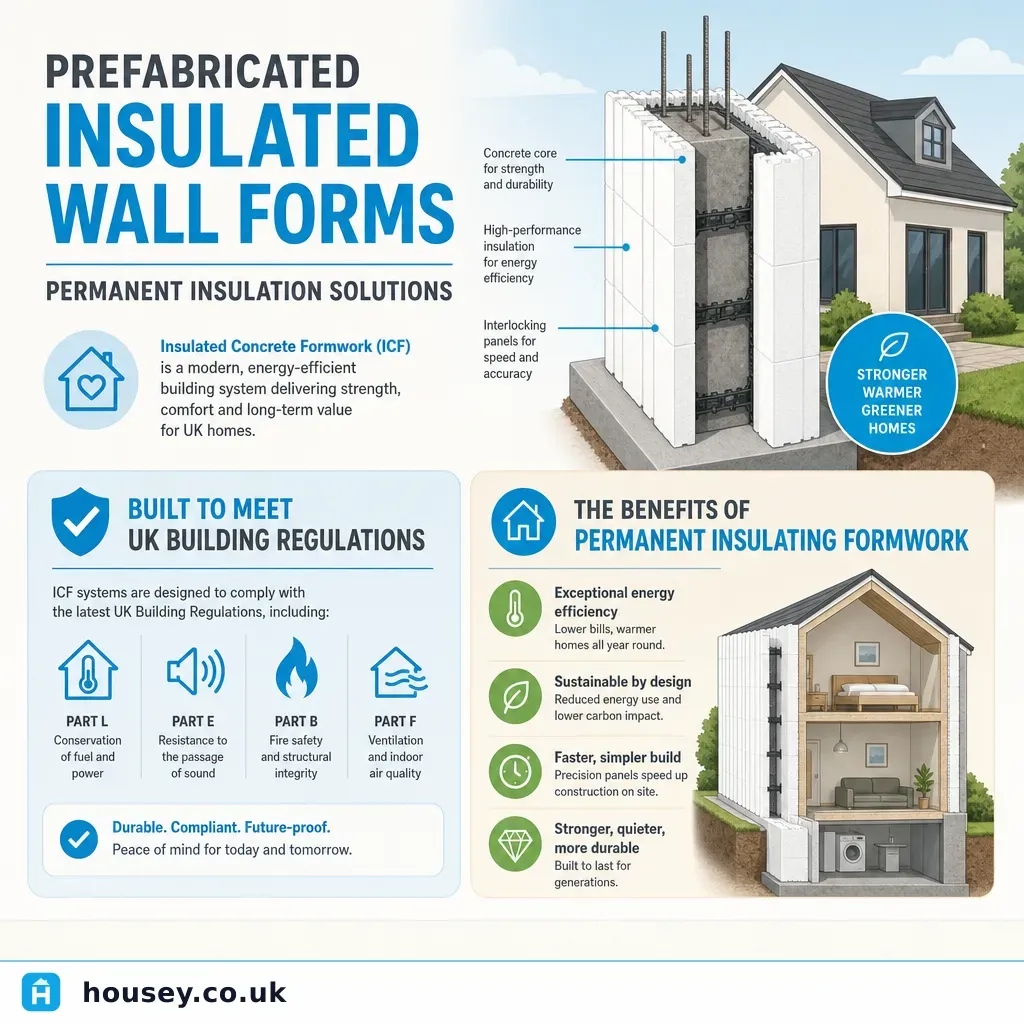
Prefabricated Insulated Wall Forms: Permanent Insulation Solutions
Prefabricated insulated wall forms — including ICF and SIPs systems — deliver high thermal performance by combining permanent insulation with structural concrete or timber in a single wall assembly.
 Energy & Retrofit
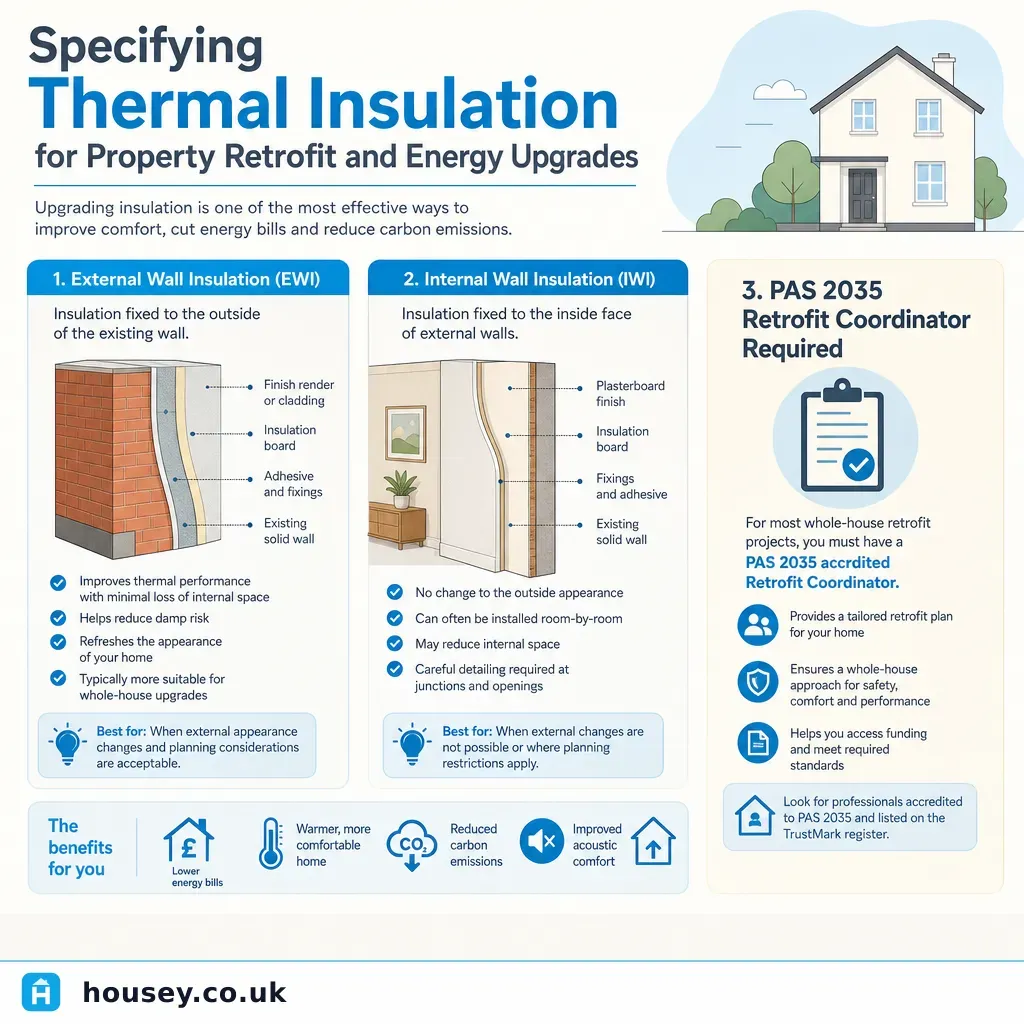
Specifying Thermal Insulation for Property Retrofit and Energy Upgrades
Specifying thermal insulation for UK retrofit requires matching the product to your property's construction, moisture conditions, and heating system.
 Energy & Retrofit
Smart Glass Windows: How Dynamic Glazing Works and Its Benefits
Smart glass changes its optical properties through one of four physical mechanisms: electrochromic glass tints gradually when a small voltage is applied and holds that state without continuous power; PDLC glass aligns liquid crystals to become transparent when mains voltage is applied; SPD glass aligns particles under voltage; and thermochromic glass responds passively to heat.
 Energy & Retrofit
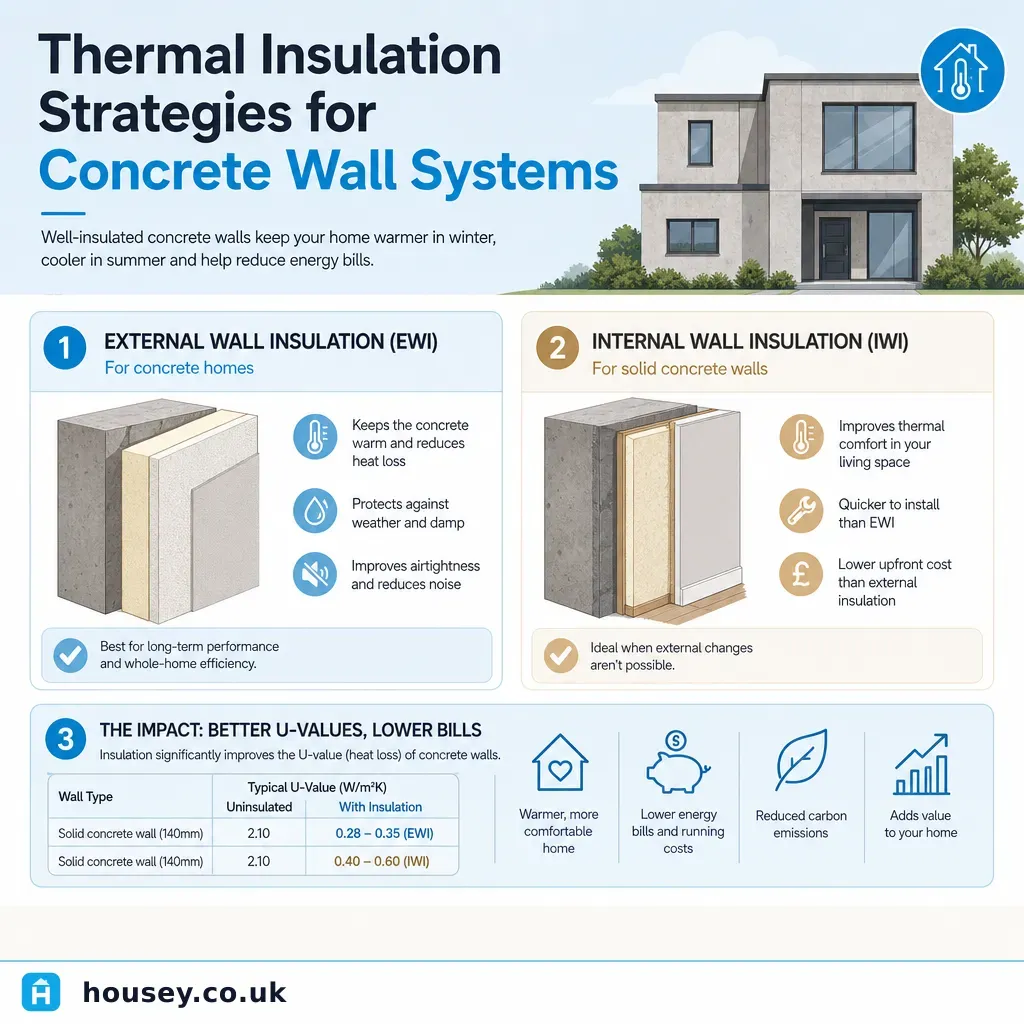
Thermal Insulation Strategies for Concrete Wall Systems
Concrete walls can be insulated using three main approaches: external wall insulation (EWI), internal wall insulation (IWI), or — where a cavity exists — cavity fill.
 Energy & Retrofit
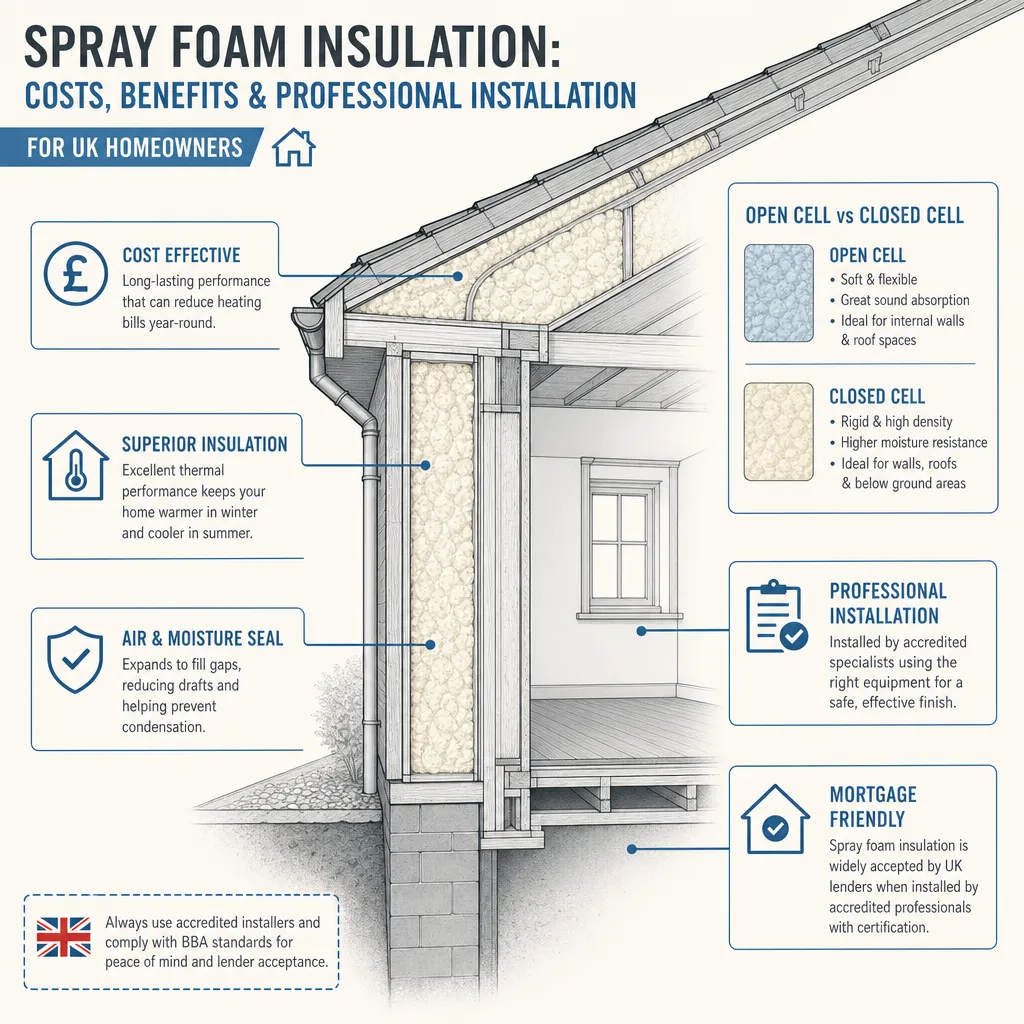
Spray foam insulation: costs, benefits and professional installation
Spray foam insulation costs between £15 and £60 per square metre installed in the UK, depending on whether open-cell or closed-cell foam is used.