Improving Garage Door Insulation for Energy Efficiency
By Housey · Last reviewed 30th of May 2026
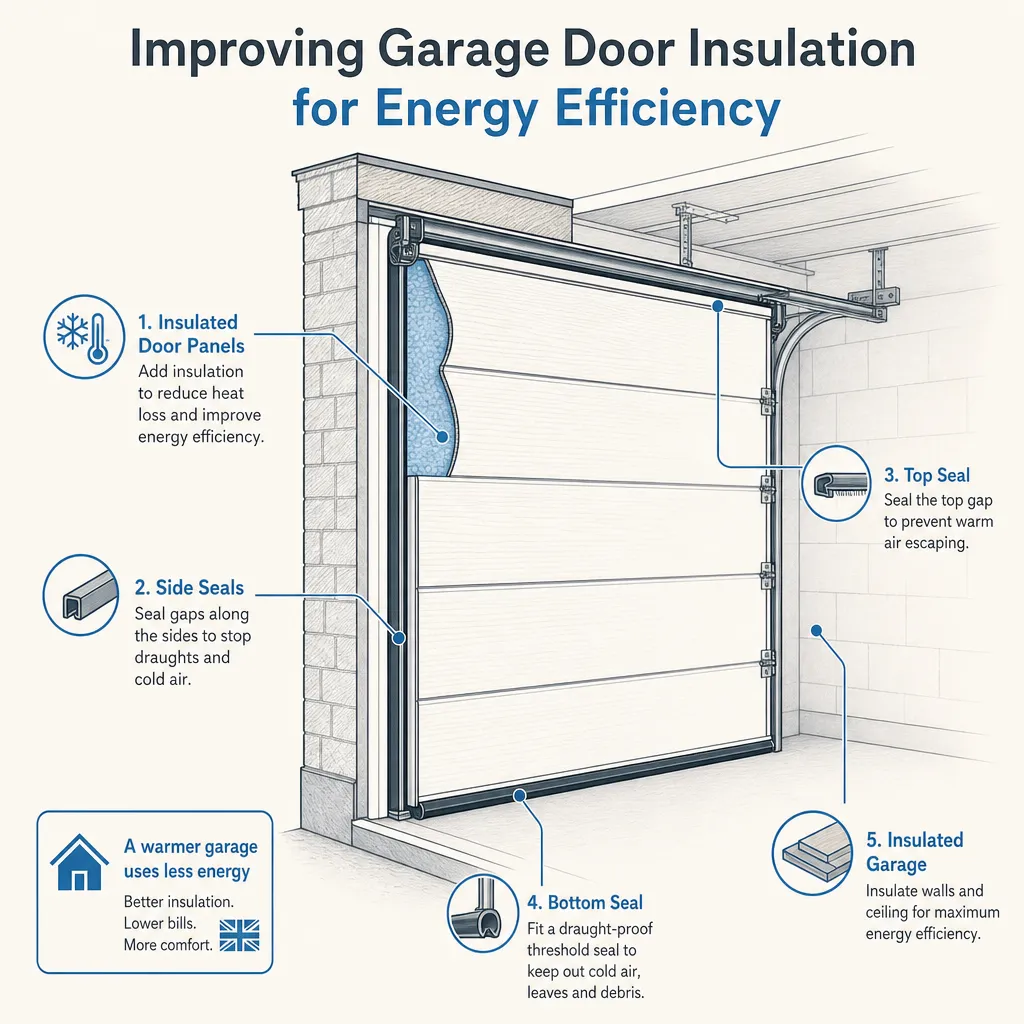
Improving Garage Door Insulation for Energy Efficiency
Garages account for a surprising share of heat loss in British homes, particularly where the garage is attached or integral to the main house — a common arrangement in 1970s and 1980s new builds and many 1930s semi-detached properties. The large external door facing the driveway is often the weakest point in the thermal envelope, and yet improving it is one of the more straightforward upgrades to consider during a retrofit programme.
Key points
- Uninsulated single-skin steel garage doors can have a U-value of 6 W/m²K or worse — far above the 1.8 W/m²K maximum set for new doors under Building Regulations Approved Document L (England, 2021 edition).
- Retro-fit insulation panels using rigid PIR (polyisocyanurate) or EPS (expanded polystyrene) board are available from roughly £30–£150 for most standard door sizes (indicative UK costs, last reviewed 2026-05-30; prices vary by supplier and door dimensions).
- Draught-sealing the door perimeter with brush seals or compressible foam strip can reduce cold-air infiltration without any structural change to the door.
- Replacing an uninsulated door with a thermally broken, insulated sectional or roller door typically costs £800–£3,000 supplied and fitted (indicative UK costs, last reviewed 2026-05-30; quotes vary by manufacturer, size, and installer).
- Where a garage forms part of the building envelope adjacent to a heated room, the separating wall and any connecting internal door into the house should meet minimum thermal performance standards under Part L.
What counts as a garage door in thermal terms?
Not all garage doors lose heat at the same rate. A single-skin pressed steel up-and-over door has virtually no insulation value — it behaves more like a large sheet of slightly weathered metal. By contrast, a modern insulated sectional door with a polyurethane foam core and thermally broken frame can achieve U-values of 1.0–1.4 W/m²K, comparable to a reasonably efficient external wall.
The amount of heat lost through a garage door depends on:
- The door's construction and thickness (single skin vs. insulated panel)
- The quality of perimeter and base seals
- Whether the garage is heated, unheated, or ventilated to outside
- Whether the garage directly adjoins a heated living space
For attached garages that share a wall with a living room or bedroom, improving the garage door is one step in a wider envelope assessment — the separating wall and any connecting internal door into the house matter too.
Comparing insulation options
Option | Best for | Typical U-value achievable | Approximate cost (indicative, 2026-05-30) | Main consideration |
|---|---|---|---|---|
Retro-fit PIR/EPS panel kit | Existing up-and-over doors in reasonable condition | 1.5–2.5 W/m²K (estimate) | £30–£150 + DIY time | Adds weight; reduces door travel clearance; check spring tension |
Draughtsealing only (brush/foam perimeter seals) | All door types as a first-pass measure | Minimal U-value change; reduces infiltration | £20–£80 + DIY time | Cheapest option; limited thermal benefit on its own |
Replacing with insulated sectional door | Old, failing, or poorly sealed doors | 1.0–1.4 W/m²K | £800–£3,000 installed | Best long-term thermal performance; requires professional installation |
Replacing with insulated roller door | Where overhead headroom is limited | 1.2–1.8 W/m²K | £900–£2,500 installed | Good for tight spaces; insulation values vary by product |
Indicative UK costs, last reviewed 2026-05-30. Obtain multiple quotes; prices vary by supplier, region, and door dimensions.
Do you need building regulations approval?
Like-for-like replacement of a garage door — same size, same position — generally falls under permitted development and does not require a building regulations application in England, provided the replacement door meets minimum thermal standards. However:
- If you are carrying out a regulated renovation affecting more than 25% of the building envelope, Part L continuity requirements may apply.
- In conservation areas or on listed buildings, external alterations including door replacements may require planning consent or listed building consent from your local planning authority.
- If you are converting a garage into a habitable room, building regulations approval is required for the full conversion, and any new façade element must meet current thermal standards.
Check with your local planning authority and a building control officer before starting work if you are uncertain.
How to draught-seal a garage door
Draught sealing is usually the most accessible first step and the least disruptive. The main areas to address are:
- Base seal: A rubber or brush threshold seal fitted to the bottom of the door panel prevents cold air from entering under the door. Many older doors have no base seal, or a perished one.
- Side and top seals: Compressible foam or brush seals fitted to the door frame reduce infiltration around the edges.
- Panel joints: On sectional doors, worn or absent seals between panels allow air infiltration; replacement seals are available from most door manufacturers.
Most draught-sealing is straightforward for a competent DIYer with basic tools. However, fitting a new base seal on a heavy up-and-over door may require adjusting the door springs — which store significant tension and should only be adjusted by a qualified door engineer or experienced professional.
Homeowner checklist: assessing your garage door
Use this list before deciding which improvement is right for your property.
When to get professional help
Draught sealing is usually manageable as a DIY task. Consider professional help if:
- The door springs are worn, misaligned, or need adjustment — spring tension can cause injury if incorrectly handled.
- You want to replace the door with a new insulated model, which typically requires a qualified door installer or manufacturer-approved fitter.
- You are considering a full garage conversion, which requires building regulations approval and a qualified contractor.
- You need an accurate U-value assessment to include in an EPC update or retrofit plan.
- The property is listed or in a conservation area.
How Housey can help
If you would like a professional view on the most cost-effective insulation upgrade for your garage door and the wider building envelope, Housey can connect you with local specialists offering insulation assessments and qualified insulation installers. For a broader look at your home's energy performance, energy-efficiency consultants can help you prioritise improvements and identify any available support schemes.
Frequently asked questions
Will insulating my garage door make a noticeable difference to heating bills?
It depends on whether your garage is attached to a heated room and how draughty the existing door is. Draught-sealing reduces cold-air infiltration noticeably, but the thermal benefit is modest unless you also address the door panels. Replacing a single-skin door with an insulated sectional model is more likely to produce a measurable saving, particularly in an integral or attached garage.
Can I fit a retro-fit insulation kit to any garage door?
Most retro-fit panel kits are designed for up-and-over sectional doors with flat or lightly profiled surfaces. They are less suited to side-hinged or roller doors. Before purchasing, check the kit's compatibility with your door profile and ensure the added weight will not strain the door springs or automation motor.
Is garage door insulation eligible for government grants?
Garage door insulation is not currently listed as a qualifying measure under main UK grant schemes such as ECO4 or the Great British Insulation Scheme, which focus on loft, cavity, and solid-wall insulation. However, a whole-home energy assessment may identify a package of qualifying measures — an energy efficiency consultant can advise on current eligibility.
Do I need planning permission to replace a garage door?
In most cases, replacing a like-for-like garage door on a house in England is permitted development and does not require planning permission. Exceptions apply in conservation areas, on listed buildings, and for flats or maisonettes. Always check with your local planning authority if you are unsure.
Sources and further reading
- Approved Document L: Conservation of fuel and power — GOV.UK
- Insulation and energy efficiency in the home — Energy Saving Trust
- Great British Insulation Scheme eligibility — GOV.UK
- Planning permission guidance — Planning Portal
Useful next reads
 Energy & Retrofit
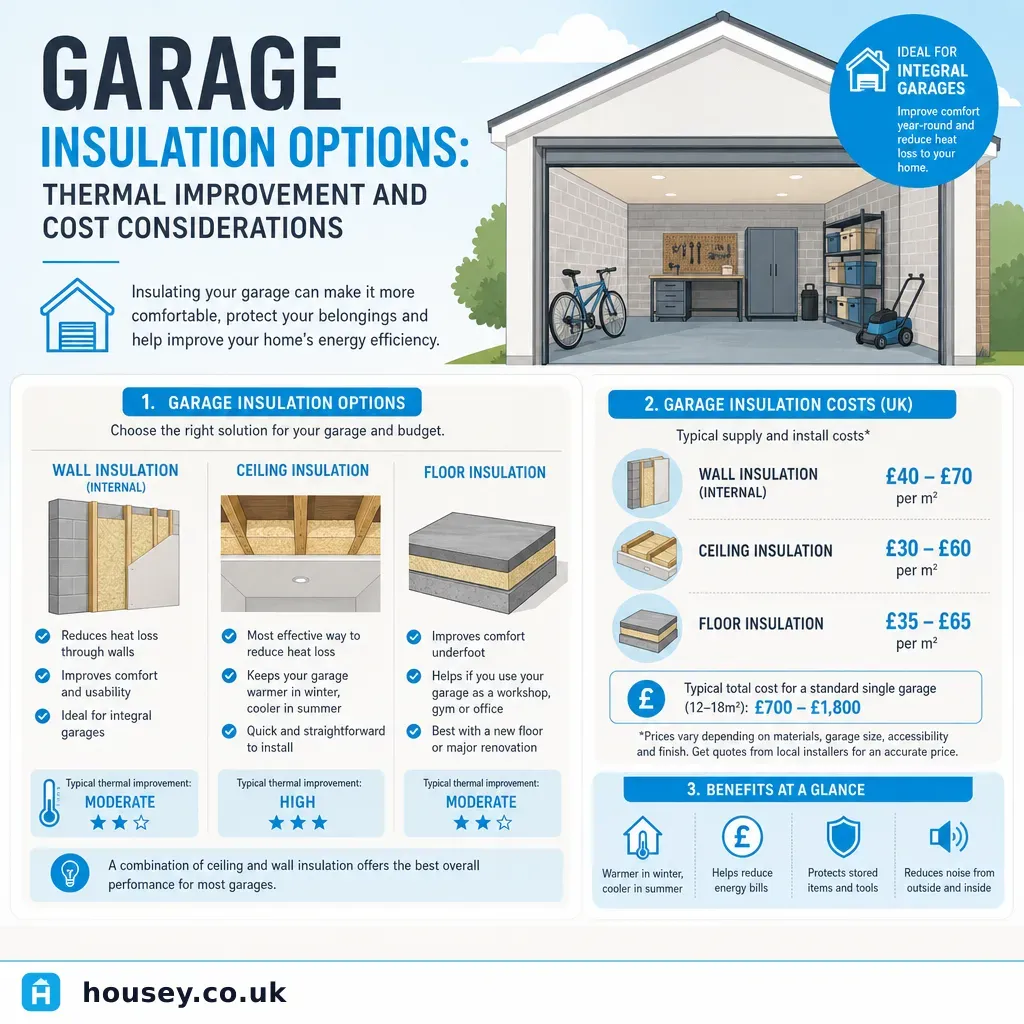
Garage Insulation Options: Thermal Improvement and Cost Considerations
Garage insulation options in the UK include mineral wool batts, rigid foam boards (PIR or EPS), and insulated garage doors.
 Energy & Retrofit
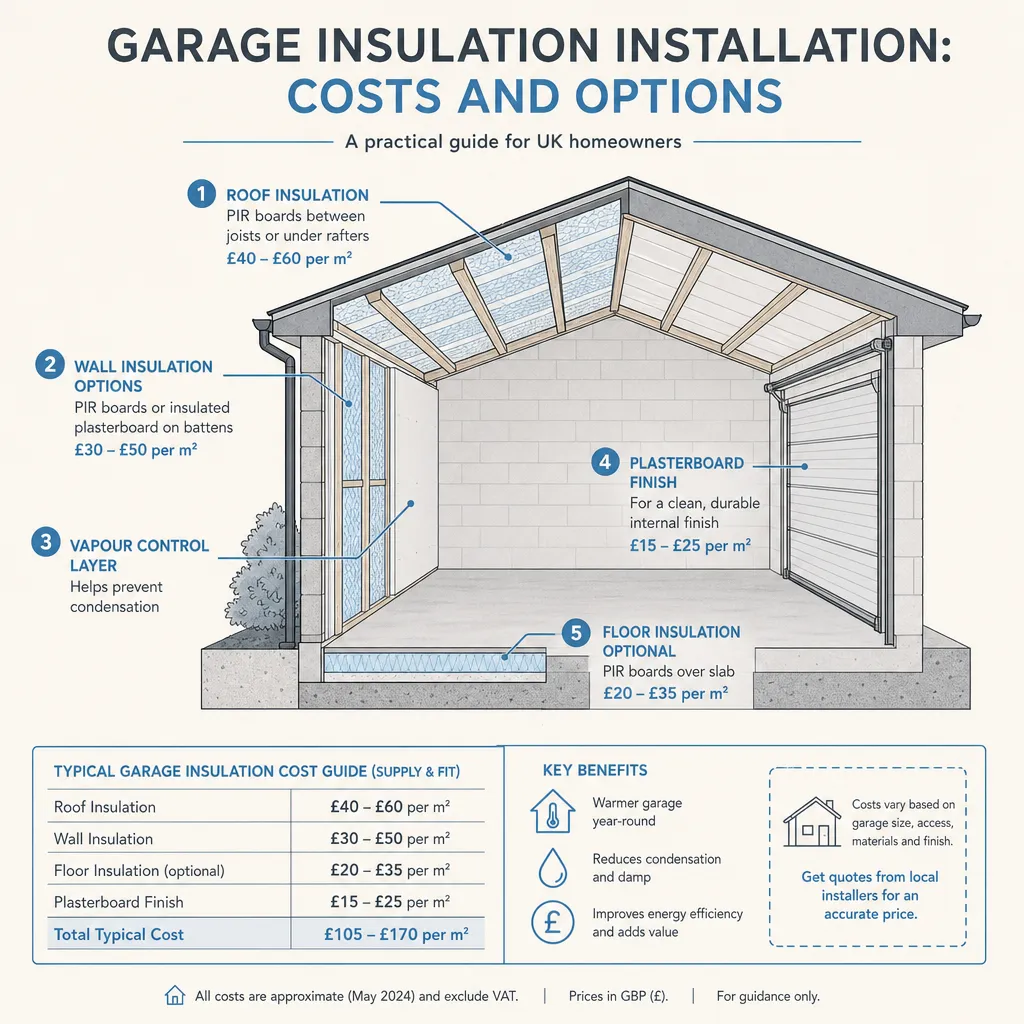
Garage Insulation Installation: Costs And Options
Garage insulation costs and methods depend on whether you are converting to habitable space or improving a working garage.
 Energy & Retrofit
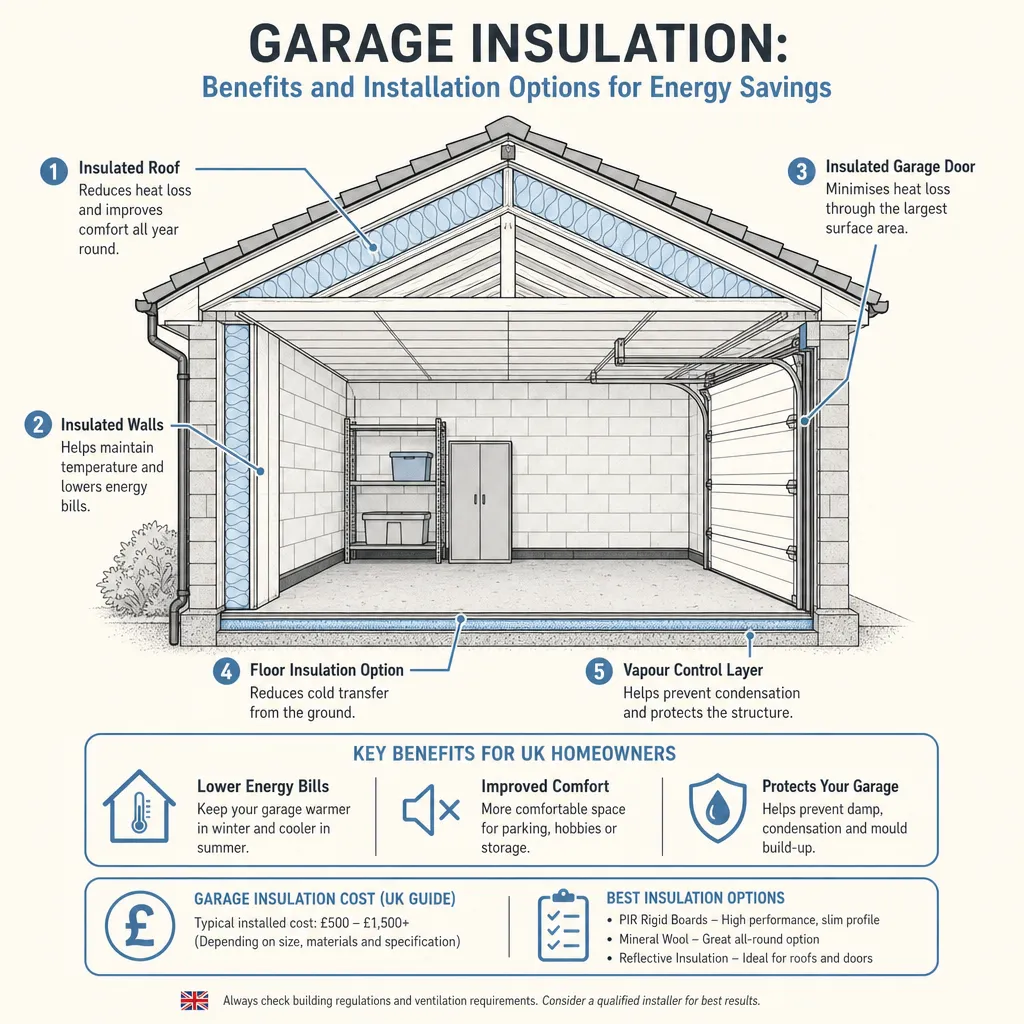
Garage Insulation: Benefits and Installation Options for Energy Savings
Insulating a garage reduces heat loss, lowers energy bills, and makes an attached garage more comfortable year-round.
 Energy & Retrofit
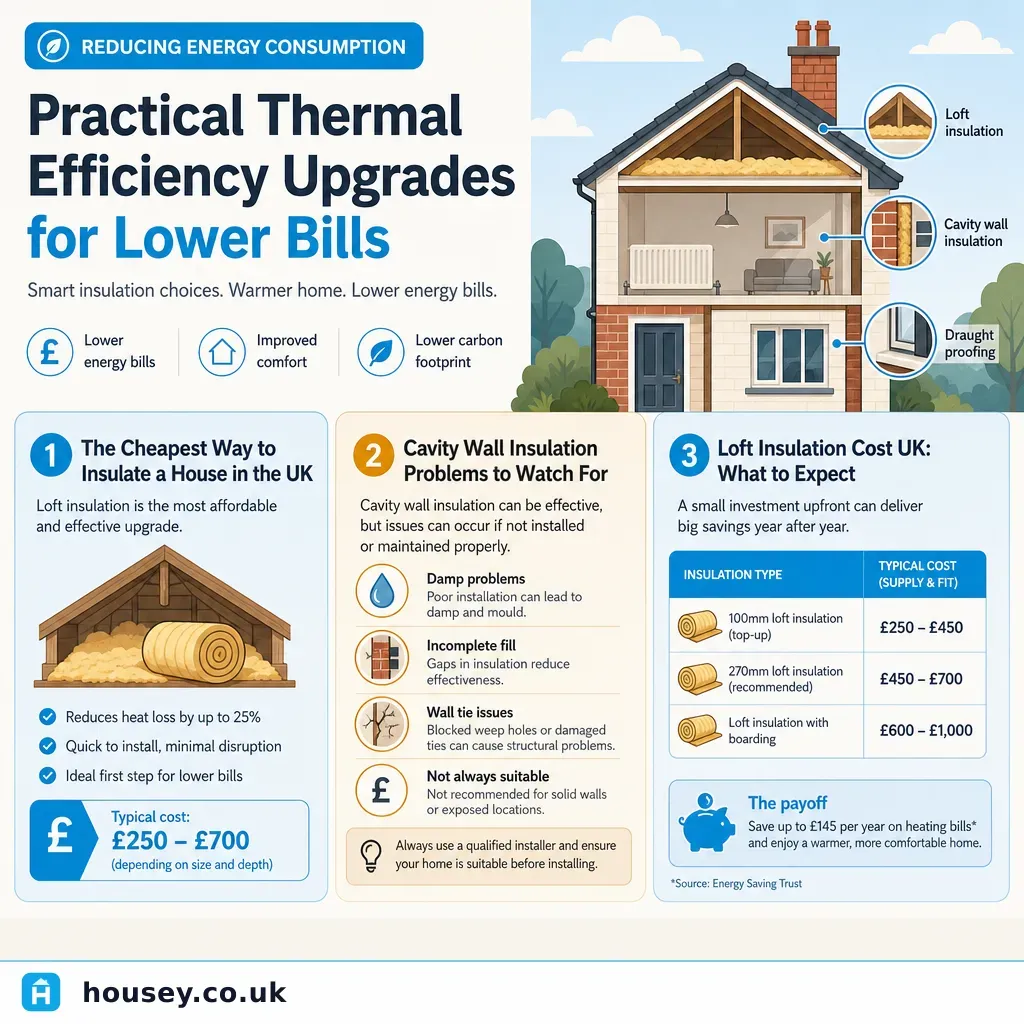
Reducing Energy Consumption: Practical Thermal Efficiency Upgrades for Lower Bills
Improving your home's thermal performance typically starts with the cheapest, fastest-payback measures: draught-proofing gaps at doors, windows, and floors, then loft insulation to 270 mm.
 Energy & Retrofit
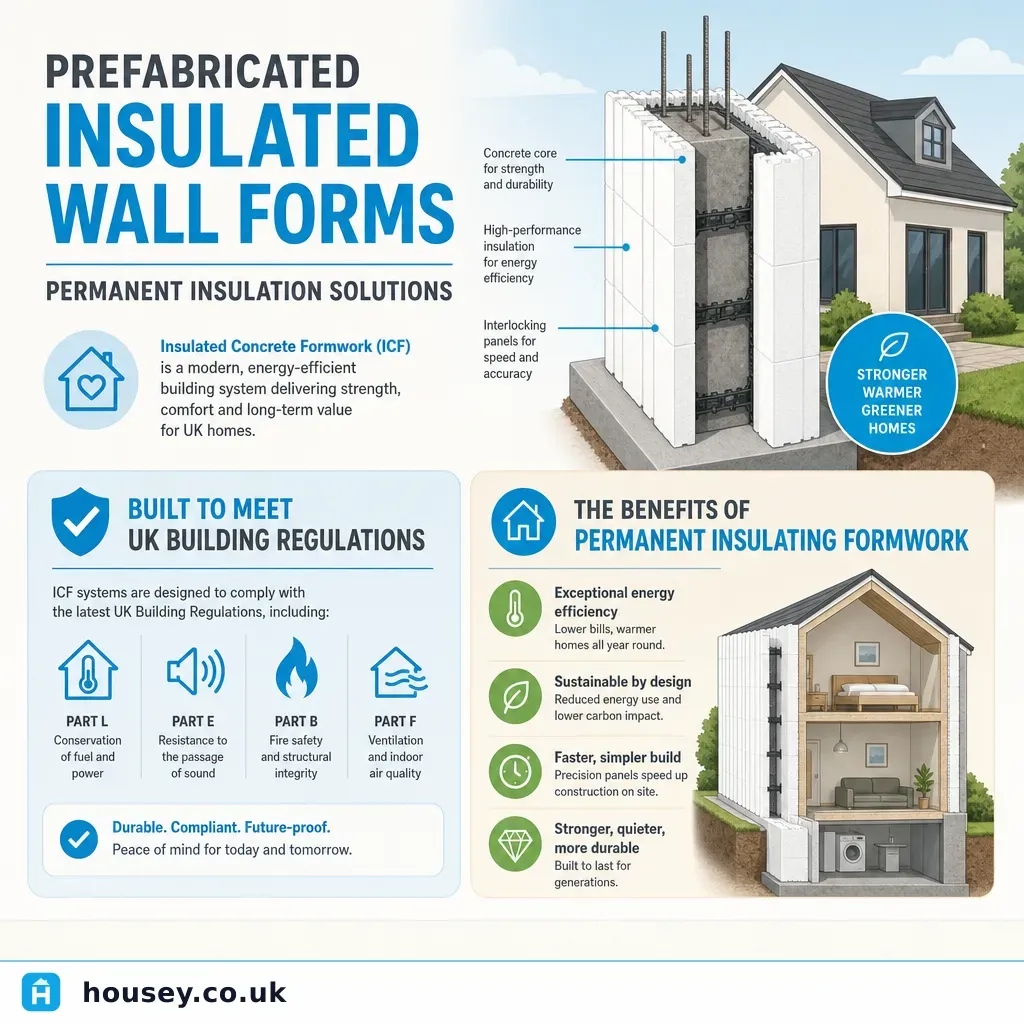
Prefabricated Insulated Wall Forms: Permanent Insulation Solutions
Prefabricated insulated wall forms — including ICF and SIPs systems — deliver high thermal performance by combining permanent insulation with structural concrete or timber in a single wall assembly.