Garden Improvement Ideas: Creating and Enhancing Outdoor Spaces
By Housey · Last reviewed 10th of May 2026
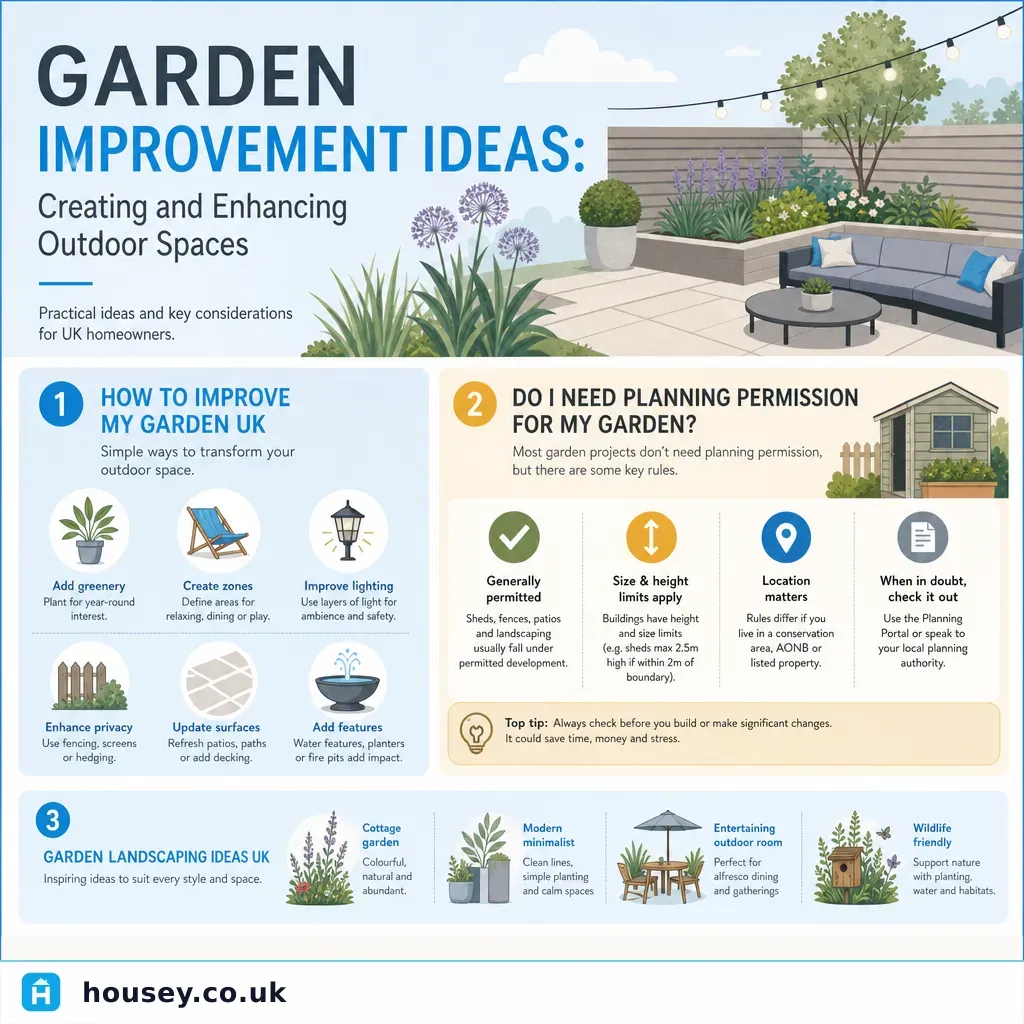
Garden Improvement Ideas: Creating and Enhancing Outdoor Spaces
The outdoor space attached to a UK home can significantly affect how the property functions day-to-day — as well as its value and appeal to future buyers. Whether you have a compact urban courtyard, a mature suburban plot, or a larger rural garden, most improvements divide into three broad categories: hard landscaping (surfaces, structures, and boundaries), soft landscaping (planting, lawns, and trees), and infrastructure (drainage, lighting, and irrigation). Knowing which projects suit DIY, when to bring in a professional, and what planning rules may apply helps you invest sensibly and avoid costly mistakes.
Key points
- Most garden works in England are permitted development, but boundary walls over 1 metre adjacent to a highway — or over 2 metres elsewhere — require planning permission under the Town and Country Planning Act 1990.
- Tree Preservation Orders (TPOs) protect specific trees; local council consent is required before pruning or felling a TPO tree, and works to trees in conservation areas require six weeks' advance notification to the council under Section 211 of the Town and Country Planning Act 1990.
- Front garden hard-standing over 5 square metres must use permeable surfacing or drain to a soakaway to avoid triggering a planning application.
- The Party Wall etc. Act 1996 may apply to works on or near a shared boundary — a party wall notice may be required before certain construction projects begin.
- The RHS recommends rain gardens and drought-tolerant species for new planting schemes as UK weather patterns become more variable.
Planning your garden project: where to start
Before spending on materials or contractors, a brief site assessment saves time and money. Consider soil type and drainage (clay soils compact and crack; sandy soils drain quickly), sun and shade distribution at different times of day, and any existing features — mature trees, level changes, outbuildings, drainage gullies — that will shape the design. A phased approach, tackling hard landscaping first and planting later, allows spending to be spread across one or two seasons.
Which approach suits your project?
- Choose DIY if the work involves planting new borders, seeding or re-turfing a lawn, painting fences, or laying a small area of gravel.
- Hire a landscaper if the project involves regrading levels, constructing retaining walls, laying a patio larger than approximately 20m², or installing drainage.
- Hire a garden designer first if you want a cohesive long-term scheme for a large or complex plot, or if you are preparing the garden as part of a sale.
- Hire a tree surgeon if any trees require pruning above ground level, show signs of disease, are subject to a TPO, or need felling safely near structures or boundaries.
- Check with your local planning authority if you are in a conservation area, a listed building, or if any proposed structure is close to a highway boundary.
Hard landscaping: surfaces, structures, and boundaries
Hard landscaping — patios, paths, steps, decking, driveways, and boundary walls — defines the structure and usability of a garden. These projects require careful attention to drainage falls, load-bearing capacity, and sub-base depth.
Project | DIY viable? | Professional recommended? | Key consideration |
|---|---|---|---|
Gravel path or border | Yes | Optional for large areas | Weed membrane and edging determine longevity |
Patio (paving slabs, up to 15m²) | Possible with preparation | Recommended for drainage accuracy | Incorrect falls cause pooling; sub-base depth is critical |
Driveway (permeable surface) | Rarely practical | Yes — confirm permeability standard | Planning rules apply; sustainable drainage (SUDS) required |
Timber decking (elevated) | Possible at low heights | Recommended above 30cm | Elevated decking may need building control notification; joist sizing matters |
Boundary wall over 1 metre (adjacent highway) | No | Yes — planning permission likely required | Check local authority rules and Party Wall etc. Act 1996 for shared boundaries |
Garden steps | Possible for single-level changes | Yes for retaining or structural steps | Riser and going dimensions affect long-term safety |
Indicative guidance only. Rules vary by location, property type, and structure size.
Soft landscaping: planting, lawns, and trees
Planting and lawn improvements are the most accessible garden improvement category for most homeowners, with few regulatory constraints — though trees are an important exception.
Lawns: Re-turfing gives faster results than seeding but costs more. Ground preparation — removing old growth, aerating, and levelling — matters more than turf quality alone. Seeding is cheaper but requires consistent watering for six to eight weeks during dry weather to establish.
Border planting: Mixed borders combining shrubs, perennials, and bulbs provide multi-season interest with lower ongoing maintenance than annual bedding. Matching plant choices to your soil pH and aspect reduces future replacement costs and watering needs.
Trees: Planting new trees generally requires no planning permission. Removing or significantly pruning an existing mature tree may, however. Check whether a tree carries a TPO by contacting your local authority's planning portal or tree officer. In a conservation area, you must give the council six weeks' notice under Section 211 of the Town and Country Planning Act 1990 before carrying out works to any tree with a trunk diameter above 75mm measured at 1.5 metres height.
What to ask before hiring a garden professional
- What does the quote include, and what is explicitly excluded?
- Who will carry out the work — is it your own team or subcontractors?
- Can you provide examples of similar projects completed and references from past clients?
- How will drainage falls be managed on paved or hard-standing areas?
- Do you carry public liability insurance, and to what level of cover?
- What will happen to waste material, excavated soil, and any felled material?
- Is VAT included in the quoted price?
- What maintenance will the finished planting scheme or surface require in the first year?
Garden improvement checklist
Before starting any garden project of significant scale:
When to get professional help
Garden works affecting drainage, structural elements, protected trees, or neighbouring properties should involve a qualified professional. Consider calling a professional when:
- A large or mature tree requires felling or significant pruning — particularly near structures, boundaries, or overhead lines.
- A retaining wall is planned where the level difference exceeds approximately 600mm.
- Any work will disturb a shared boundary or an adjoining property's foundations.
- Significant hard-standing is planned in a front garden.
- A tree is showing signs of disease, structural failure, or significant root damage.
- You are in a conservation area and unsure whether notification is required.
How Housey can help
If your garden project has moved beyond DIY scope, Housey can help you request quotes from qualified professionals. Find a landscaper for paving and structural planting, connect with a garden designer for a full-plot scheme, or locate a qualified tree surgeon for established tree work safely carried out.
Frequently asked questions
Do I need planning permission to build a garden room or summerhouse?
Most garden outbuildings are permitted development in England, provided they do not cover more than 50% of the curtilage, are not used as sleeping accommodation, are single-storey, and have a maximum ridge height of 4 metres (or 2.5 metres if within 2 metres of the boundary). Conservation areas, listed buildings, and Areas of Outstanding Natural Beauty have stricter rules — check the Planning Portal outbuilding guidance for your specific situation.
How much does garden landscaping typically cost in the UK?
A natural stone patio of around 20m² typically costs £2,500–£6,000 including labour and materials, depending on stone type and ground conditions. Full garden redesign and landscaping for a medium-sized UK plot can range from £10,000 to £40,000 or more. Planting-only projects are considerably lower. Indicative UK costs, last reviewed 2026-05-10. Always obtain at least three quotes for your specific project and site conditions.
What is a Tree Preservation Order?
A Tree Preservation Order (TPO) is a legal protection placed by a local planning authority on a specific tree or group of trees considered to have significant amenity value. Carrying out work on a TPO tree without council consent can result in an unlimited fine. Check whether a tree is protected by searching your local authority's planning portal or contacting the council's tree officer directly before any works begin.
Does laying artificial grass require planning permission?
In most cases, no. However, if artificial grass in a front garden is laid over an impermeable membrane that prevents drainage to ground, planning permission may be required — or a permeable sub-base must be used to comply with permitted development rules. Some local authorities are updating supplementary planning guidance on artificial turf given environmental concerns. Check with your local planning authority if the project involves a front garden or a conservation area property.
Sources and further reading
- Outbuildings: permitted development — Planning Portal
- Tree Preservation Orders and trees in conservation areas — Ministry of Housing, Communities & Local Government
- Householder permitted development rights: technical guidance — Ministry of Housing, Communities & Local Government
- Climate Ready Gardening — Royal Horticultural Society
- Party Wall etc. Act 1996 — legislation.gov.uk
Useful next reads
 Improvement & Build
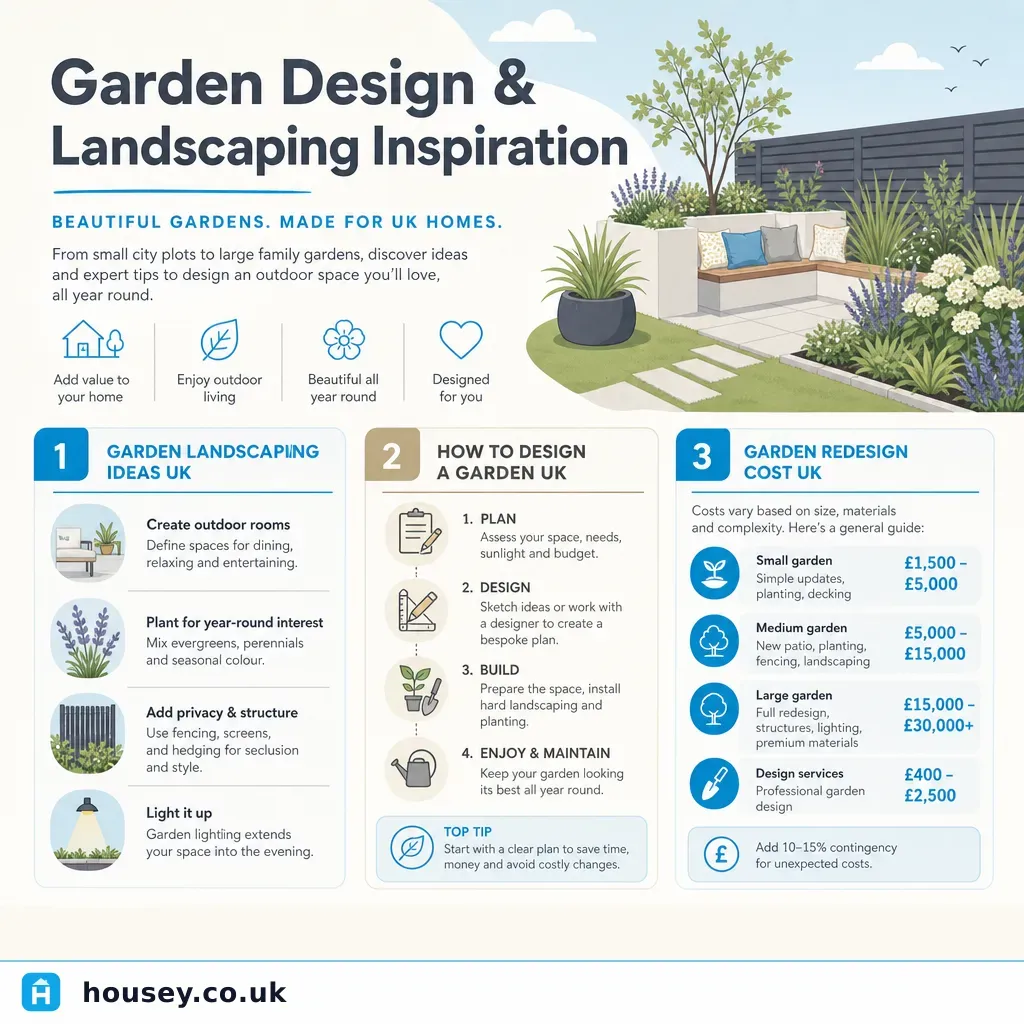
Garden Design and Landscaping Inspiration
Effective garden design starts with assessing your aspect, soil type, and existing features before commissioning any planting or hard landscaping.
 Improvement & Build
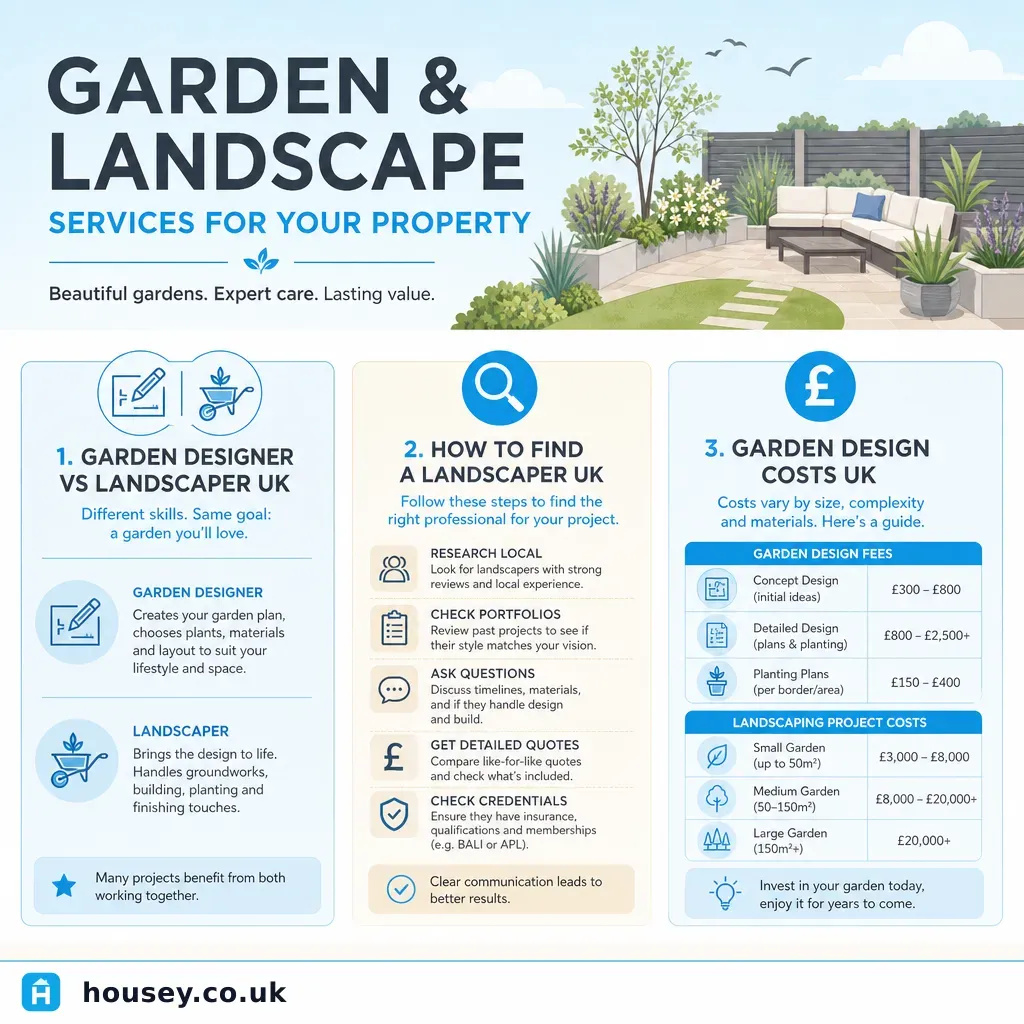
Garden and Landscape Services for Your Property
Garden designers and landscapers both improve outdoor spaces but offer different services.
 Improvement & Build
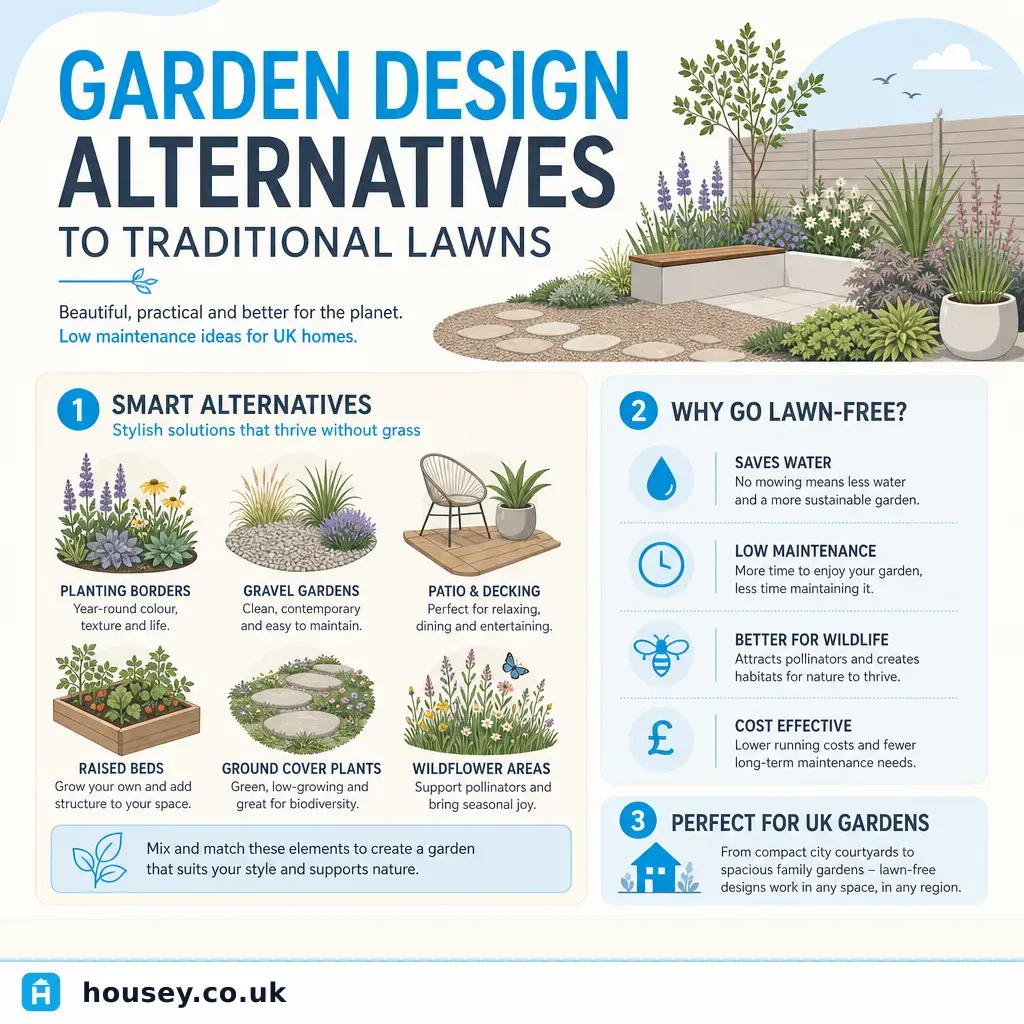
Garden Design Alternatives to Traditional Lawns
Popular alternatives to a traditional grass lawn in UK gardens include gravel, wildflower meadow planting, permeable paving, and ground-cover plants.
 Improvement & Build
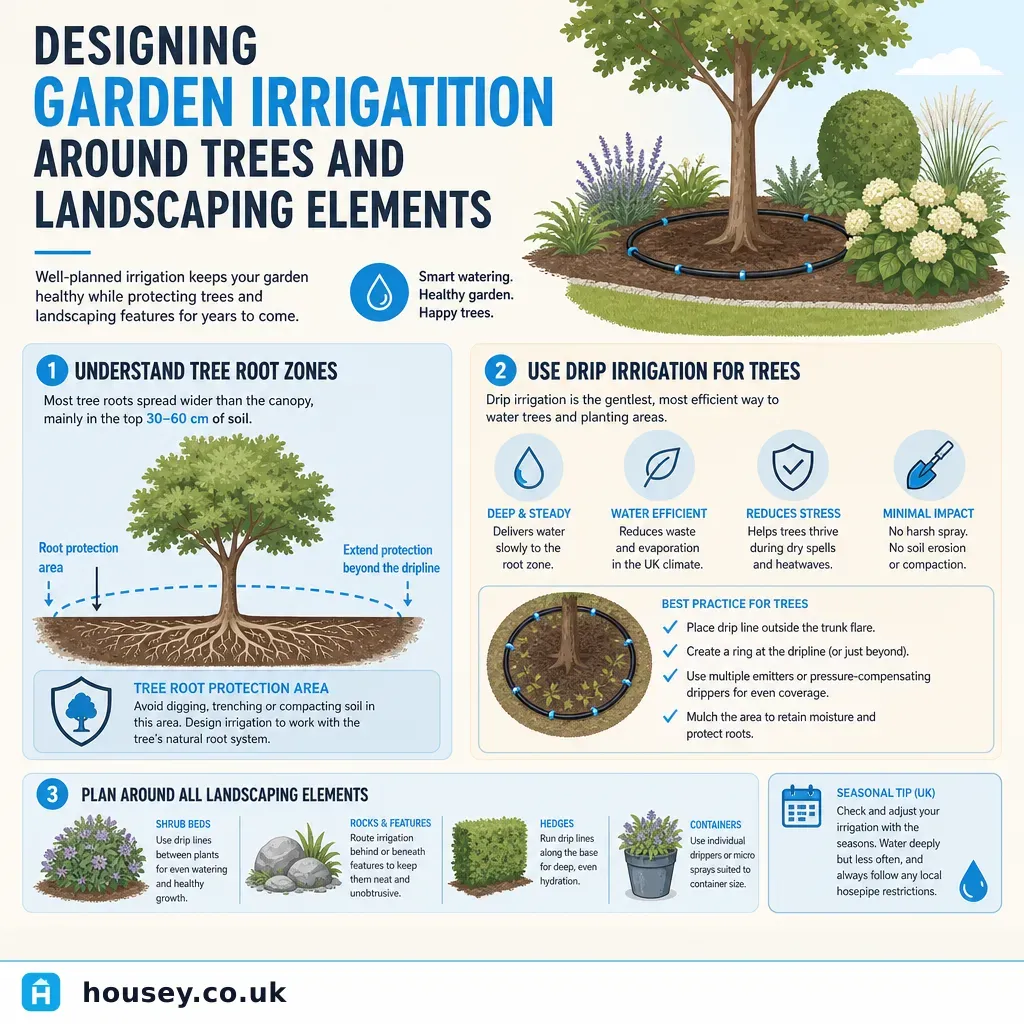
Designing Garden Irrigation Around Trees and Landscaping Elements
Design irrigation around trees by respecting the root protection area defined under BS 5837:2012, using drip or leaky pipe delivery rather than spray heads, and putting the tree zone on its own circuit.
 Improvement & Build
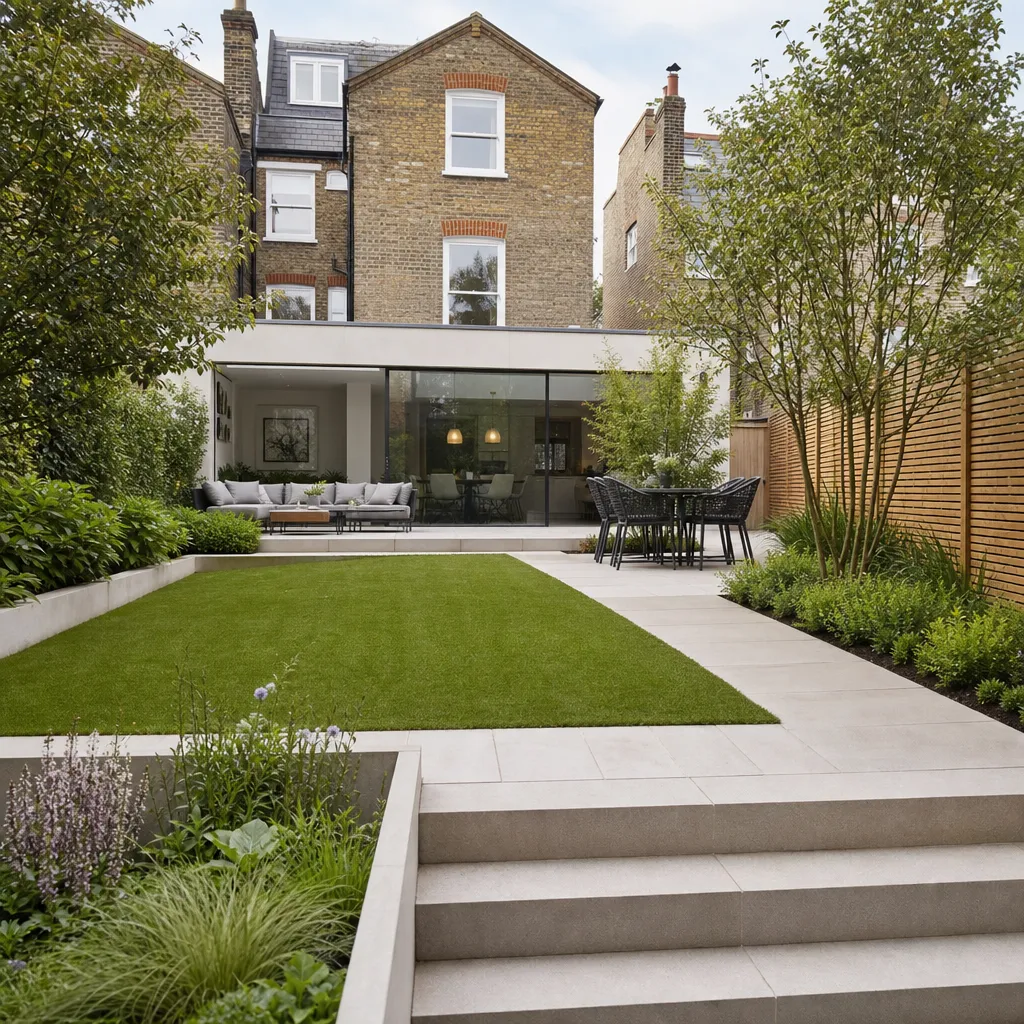
Garden Design Trends and Contemporary Landscaping Ideas
Contemporary UK garden design centres on low-maintenance naturalistic planting, multi-functional outdoor spaces, sustainable hard landscaping materials, and wildlife-friendly rewilded areas.