Garden and yard drainage solutions: ideas and implementation
By Housey · Last reviewed 19th of May 2026
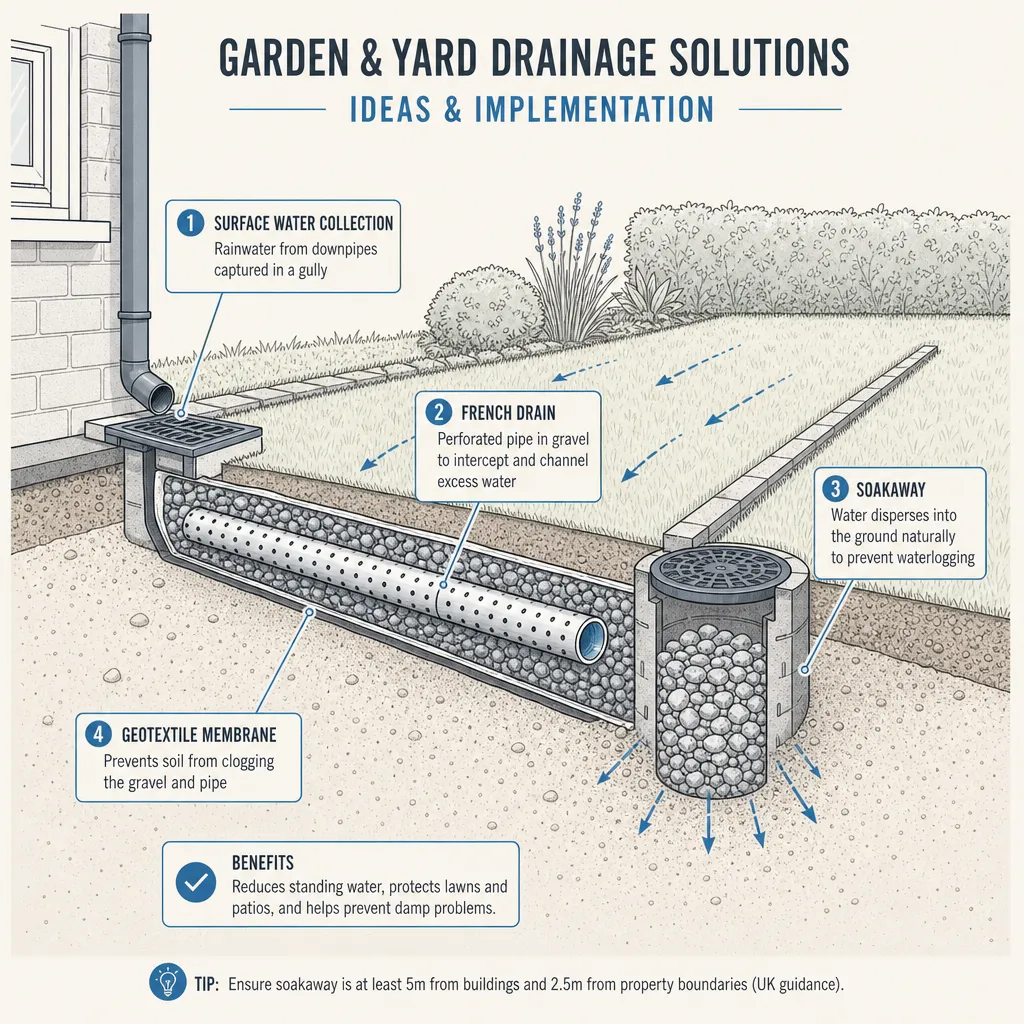
Garden and yard drainage solutions: ideas and implementation
Persistent wet patches, waterlogged lawns, and flooded patios are among the most common maintenance frustrations for UK homeowners — and among the most frequently misdiagnosed. Poor drainage has many different root causes, and the right solution in one garden may be entirely ineffective in another. Understanding the options before committing to installation is essential, particularly given the involvement of soil science, building regulations, and water-company consents.
Key points
- The principal drainage solutions for UK gardens are French drains, soakaways, channel (linear) drainage, permeable paving, and surface re-grading.
- Under the Water Industry Act 1991, surface water from private land generally cannot be connected to a public sewer without prior consent from the local sewerage undertaker.
- Soakaways must be sited at least 5 metres from a building's foundations and 2.5 metres from a boundary, per Building Regulations Approved Document H.
- On clay soils a soakaway is likely to be ineffective; a drainage contractor should carry out a percolation test (BRE Digest 365 method) before one is specified.
- Culverting or diverting an ordinary watercourse may require consent from the Lead Local Flood Authority (LLFA) under the Flood and Water Management Act 2010.
Why UK gardens waterlog
UK soils range from free-draining sandy loam to dense clay with very low permeability. Clay-based soils — prevalent across the London clay belt, the Midlands, parts of East Anglia, and the South West — can hold excess water near the surface for days after heavy rain. Compaction from foot traffic, construction plant, or prolonged heavy use compounds the problem by destroying the macro-pore structure through which water naturally drains.
Additional causes include:
- Positive grading toward the house — if the garden slopes toward the building, water pools against the foundations.
- Blocked or insufficient gutters and downpipes — these discharge large volumes of roof water onto the plot; if the soil cannot absorb it fast enough, ponding follows.
- Failed land drains — Victorian clay-pipe systems are present beneath many older UK gardens; they block with root intrusion and collapse over time.
- Impermeable surfacing — concrete, standard block paving, and dense lawn turf reduce infiltration and increase surface runoff.
Which drainage solution is right for your garden?
- Choose hollow-tine lawn aeration if the lawn is compacted but drains adequately within a day or two; compaction rather than poor subsoil drainage is the likely cause.
- Choose a soakaway if the waterlogging comes from roof or hard-standing runoff, the soil percolation test is satisfactory, and the garden is large enough to site the installation compliantly.
- Choose a French drain if there is a natural fall or outlet for collected water, or if a soakaway is not viable due to soil type or plot constraints.
- Choose channel drainage if water gathers at a hard surface — a driveway, patio, or path — rather than across the lawn generally.
- Choose permeable paving if you are re-surfacing a driveway or patio and want to prevent the problem recurring at source.
- Ask a drainage contractor if the water source is unclear, previous remediation has failed, or overland flow could affect a neighbouring property.
Drainage solutions compared
Solution | Best for | Not ideal for | Indicative installed cost (2026-05-19) | Professional required? |
|---|---|---|---|---|
Hollow-tine lawn aeration | Mildly compacted lawn | Severe waterlogging or clay subsoil | £80–£200 | Often DIY-able |
Soakaway (plastic crate) | Roof and hard-standing runoff | Clay soils; small or constrained plots | £400–£1,200 | Recommended |
French drain (perforated pipe in gravel trench) | High groundwater or slope drainage | Flat sites with no outlet | £500–£1,500 | Recommended |
Channel drainage (linear) | Driveways, patios, paths | Large lawn areas | £300–£1,000 | Recommended |
Permeable paving | New or replacement hard surfacing | Slopes above 1:20 without engineered sub-base | £1,500–£5,000+ | Yes |
Re-grading and raised beds | Positive slope toward the building | Major underlying waterlogging | Variable | Depends on scale |
All costs are indicative UK estimates. Quotes vary by region, access, soil type, and material specification.
How each solution works
French drains
A French drain is a trench — typically 300–600 mm wide and 500 mm to 1 m deep — filled with angular gravel and containing a perforated or slotted pipe at its base. Water infiltrates through the gravel, travels along the pipe, and is directed to an outlet: a soakaway, a watercourse, or a drainage channel. French drains are versatile and work across most soil types provided a suitable outlet exists.
Soakaways
A soakaway allows collected water to percolate slowly into the surrounding subsoil. Modern installations use prefabricated plastic crate systems, which are more hydrologically efficient than traditional rubble-filled pits. They are sized using rainfall intensity data from the Flood Estimation Handbook, and a percolation test must be carried out before installation to confirm the surrounding ground can absorb water at the required rate.
Channel drainage
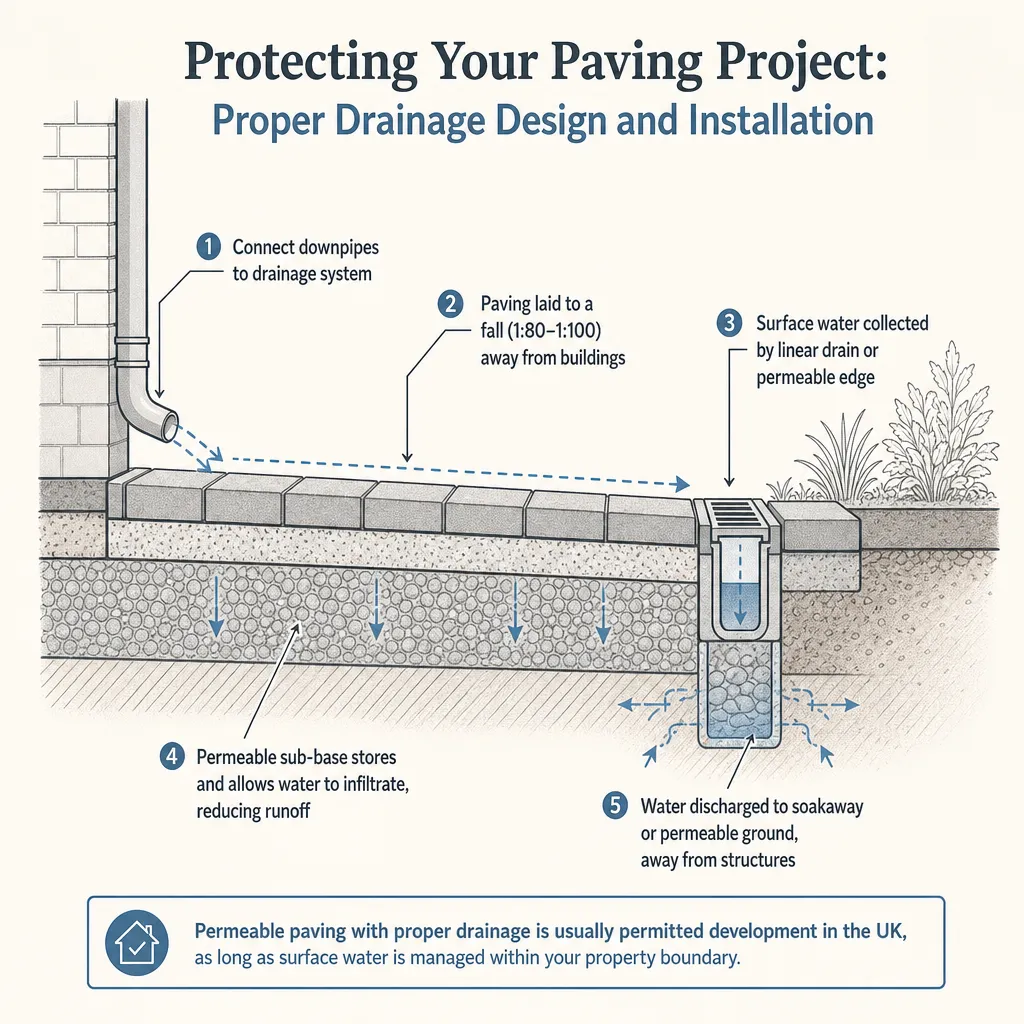
Linear channel drains are set flush with a hard surface to intercept water before it pools, directing it via a lateral pipe to an outlet. They are the standard solution for driveways and pathways. Connecting a new channel drain to a public surface water sewer requires the sewerage undertaker's consent under the Water Industry Act 1991.
Permeable paving
Permeable block paving and porous asphalt allow surface water to pass through the pavement layer into a granular sub-base, from which it infiltrates gradually into the subsoil. Under the Town and Country Planning Act 1990 (as amended), resurfacing a front garden with a permeable material does not require planning permission; replacing it with an impermeable surface over 5 m² does.
Planning and regulatory considerations
Most garden drainage works are permitted development and require no planning permission. Key exceptions:
- Connecting to a public sewer — requires sewerage undertaker consent under the Water Industry Act 1991.
- Culverting or diverting a watercourse — requires Lead Local Flood Authority consent under the Flood and Water Management Act 2010.
- Discharging to a watercourse — may require an environmental permit from the Environment Agency.
- Listed buildings and conservation areas — works affecting the curtilage may need additional consent; check with your local planning authority.
When to get professional help
Seek professional input from a drainage contractor or groundworker when:
- Standing water is within 3 metres of the building's foundations — water near the building can cause damp, and in expansive clay soils may contribute to subsidence or heave.
- A previous drainage installation has failed or proved insufficient.
- The water source is unclear and a CCTV drain survey is needed to trace the origin.
- Any drainage works could affect a neighbouring property — this can give rise to civil liability.
How Housey can help
Housey connects you with vetted drainage contractors and groundworkers who carry out garden and yard drainage installations across the UK. Describe your drainage problem and up to four local specialists will submit competitive quotes.
Frequently asked questions
Does garden drainage work need building regulations approval?
Most garden drainage improvements do not require formal building regulations approval. However, any work connecting to or affecting a public sewer, drainage running under a new extension, or the creation of new manholes within a building falls under Building Regulations Part H and requires compliance with those provisions.
How deep should a French drain be?
Depth depends on the purpose. To intercept surface water, 500 mm is often adequate. To manage groundwater or sub-surface flow, 1 metre or more may be needed. A drainage contractor should assess the local water table depth and soil profile before specifying the trench depth and pipe level.
What is a soakage test?
A soakage test (percolation test) measures how quickly water drains through the subsoil. The BRE Digest 365 method involves filling a test pit with water and timing the rate of drawdown. The result determines whether a soakaway is viable and is used to calculate the correctly sized installation.
Can I install garden drainage myself?
Simple channel drainage and minor French drains are within the capability of a competent DIYer. However, connections to mains drainage, soakaways near buildings, and significant ground excavation near structures should be handled by a qualified drainage contractor to ensure both safety and regulatory compliance.
Sources and further reading
- Building Regulations Approved Document H: Drainage and waste disposal — GOV.UK
- Flood and Water Management Act 2010 — legislation.gov.uk
- Water Industry Act 1991 — legislation.gov.uk
- When is planning permission required? — GOV.UK
- CIRIA SuDS Manual — CIRIA
Useful next reads
 Improvement & Build
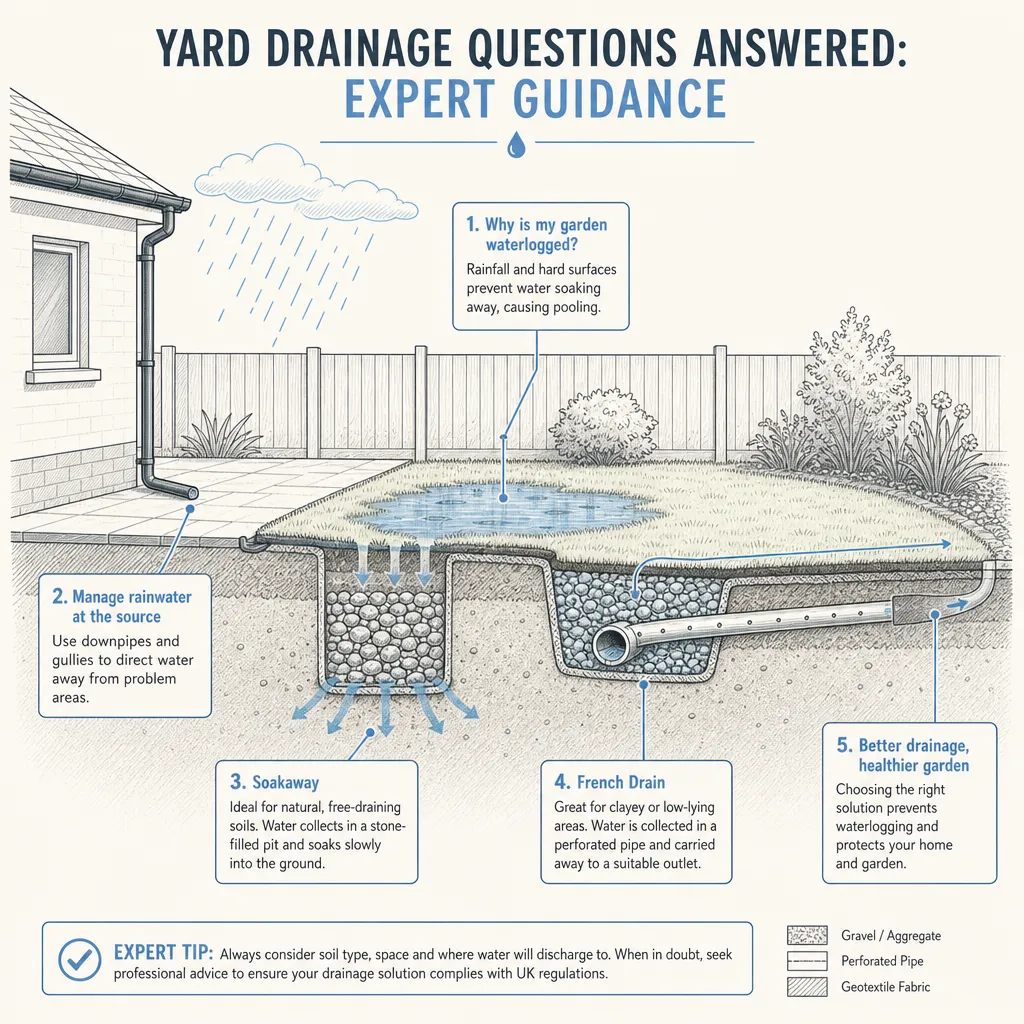
Yard drainage questions answered: expert guidance
Most garden drainage problems in the UK stem from compacted or clay-heavy soil, blocked gutters or downpipes, or insufficient surface fall.
 Improvement & Build
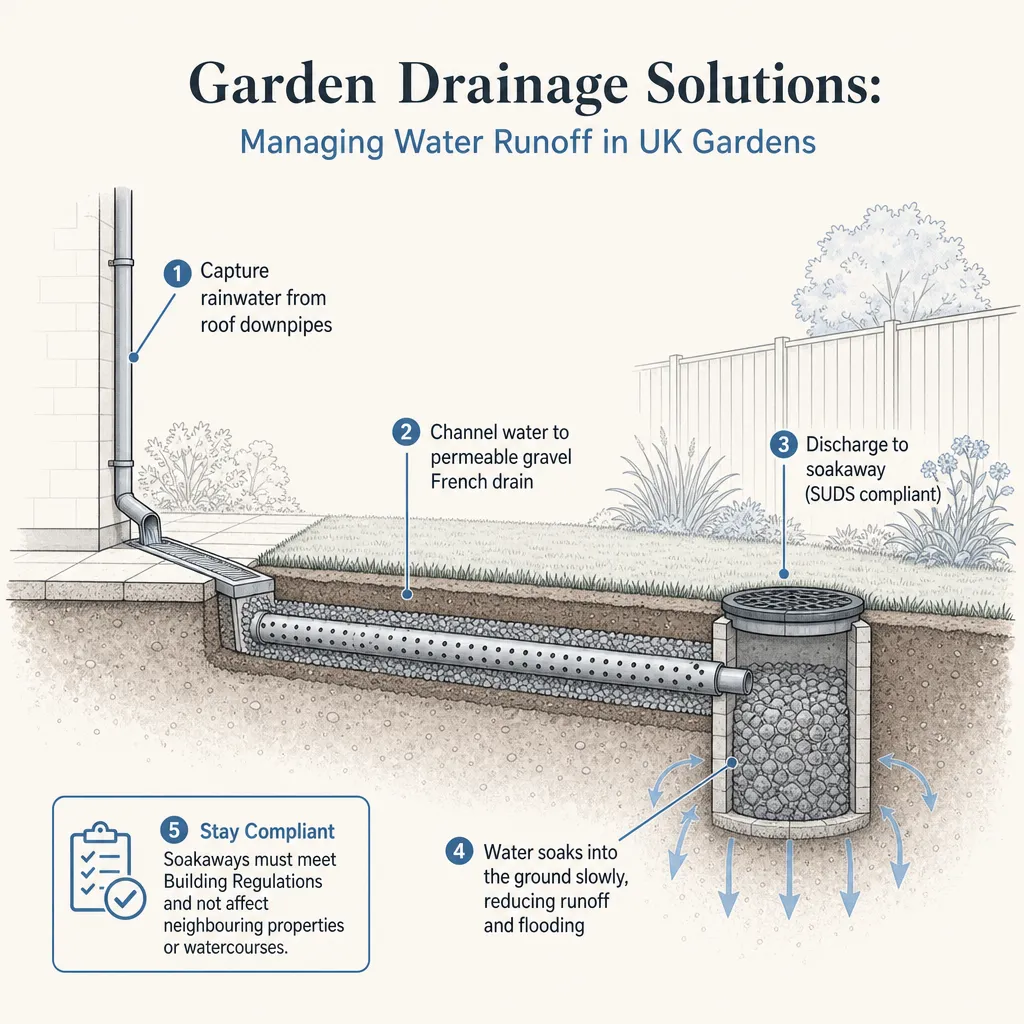
Garden Drainage Solutions: Managing Water Runoff in UK Gardens
Poor garden drainage in the UK is usually caused by clay soil, surface compaction, or too much hard-standing.
 Improvement & Build
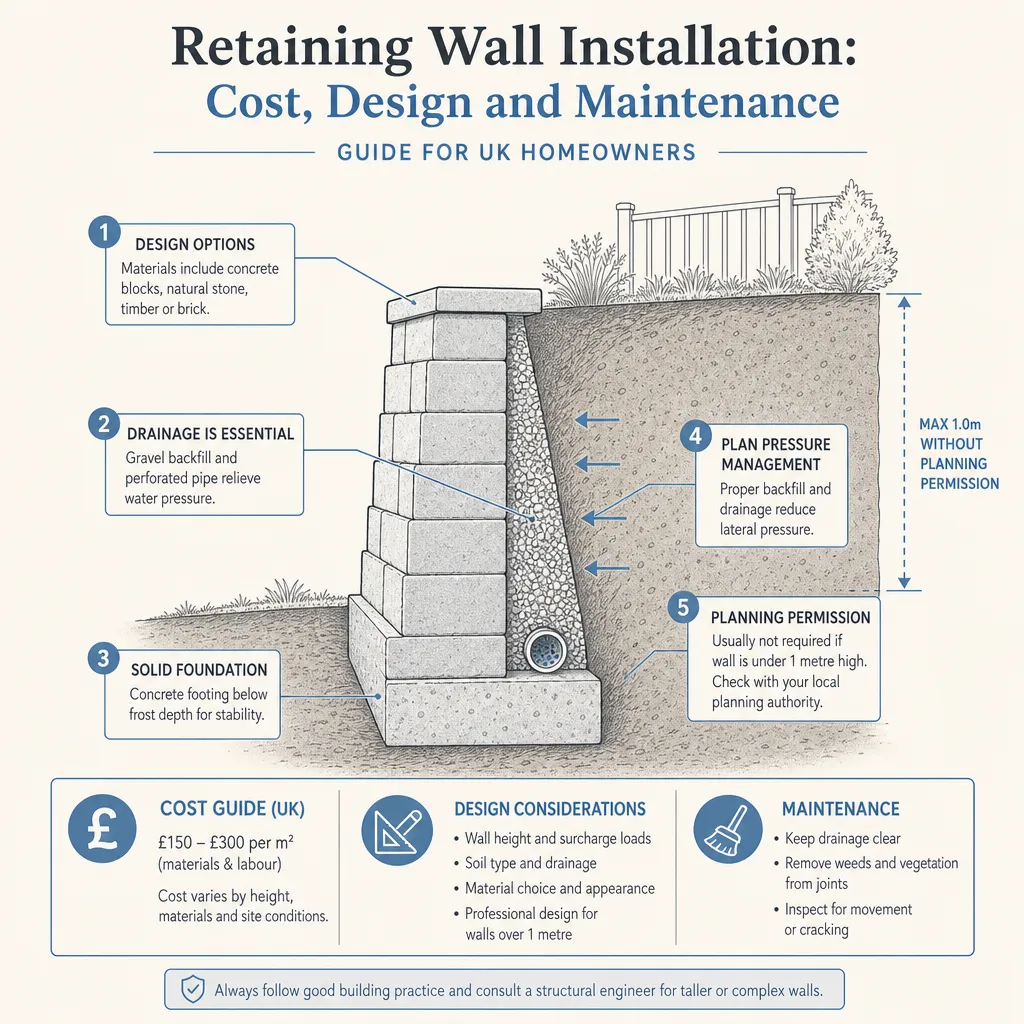
Retaining Wall Installation: Cost, Design and Maintenance
A retaining wall holds back soil on a sloped or banked site.
 Improvement & Build
Seasonal Garden Transformations and Outdoor Design Ideas
A successful garden transformation in the UK works with the seasons rather than against them — establishing structure and hard landscaping in autumn or winter, planting in spring, and enjoying the results through summer.
 Improvement & Build
Protecting Your Paving Project: Proper Drainage Design and Installation
Good paving drainage starts with a minimum fall of 1:60 to 1:80 away from buildings, a correctly specified sub-base, and a clear outlet for surface water.