Yard drainage questions answered: expert guidance
By Housey · Last reviewed 19th of May 2026
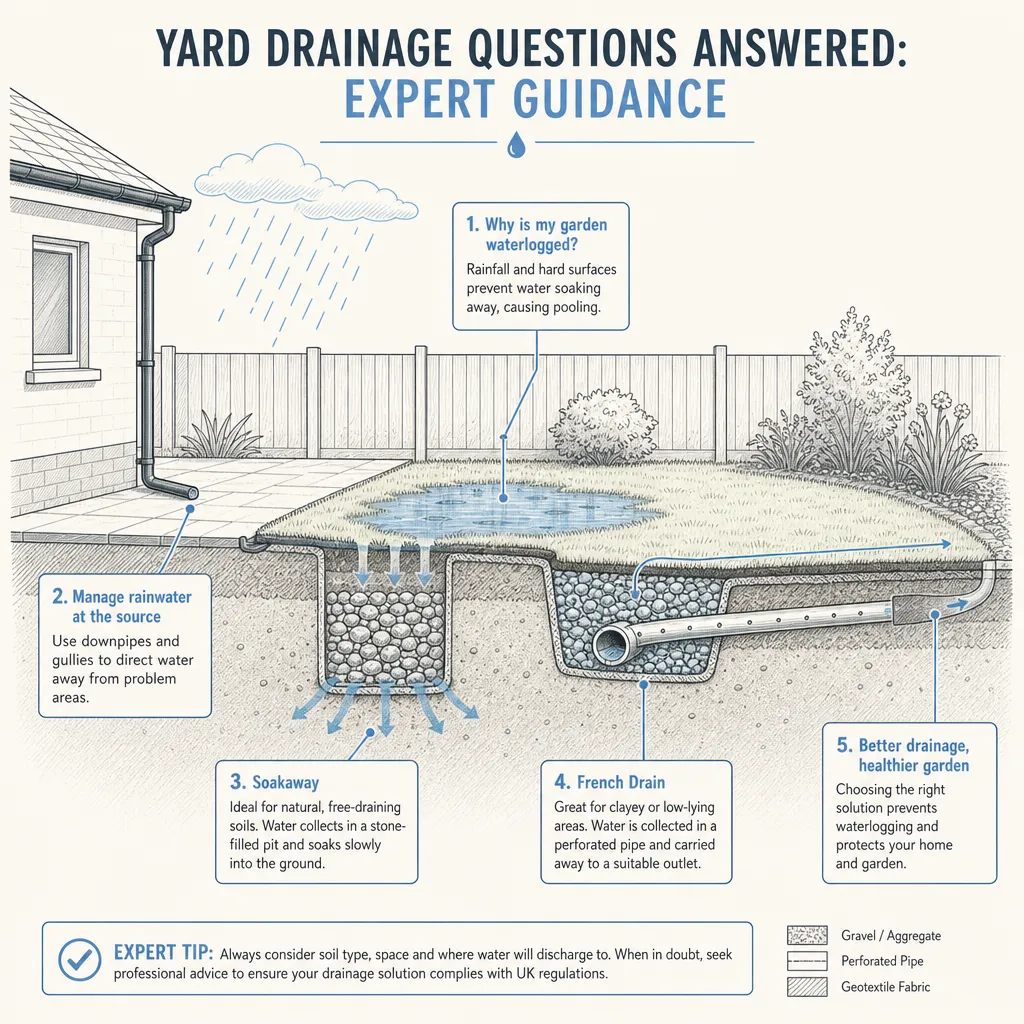
Yard drainage questions answered: expert guidance
Drainage questions arise at every stage of property ownership — before a patio is laid, after an unusually wet winter, or when a buyer's surveyor flags standing water in a viewing report. The answers matter: choosing the wrong drainage solution, connecting to the wrong outlet, or missing a regulatory consent can be expensive to undo. UK-specific rules around watercourses, soakaways, and sewer connections add a layer of complexity that is easy to overlook.
Key points
- Standing water that persists for more than 24–48 hours after heavy rain usually indicates a soil drainage or site-grading problem requiring active intervention.
- Connecting garden drainage to a public sewer requires prior consent from the relevant sewerage undertaker under the Water Industry Act 1991.
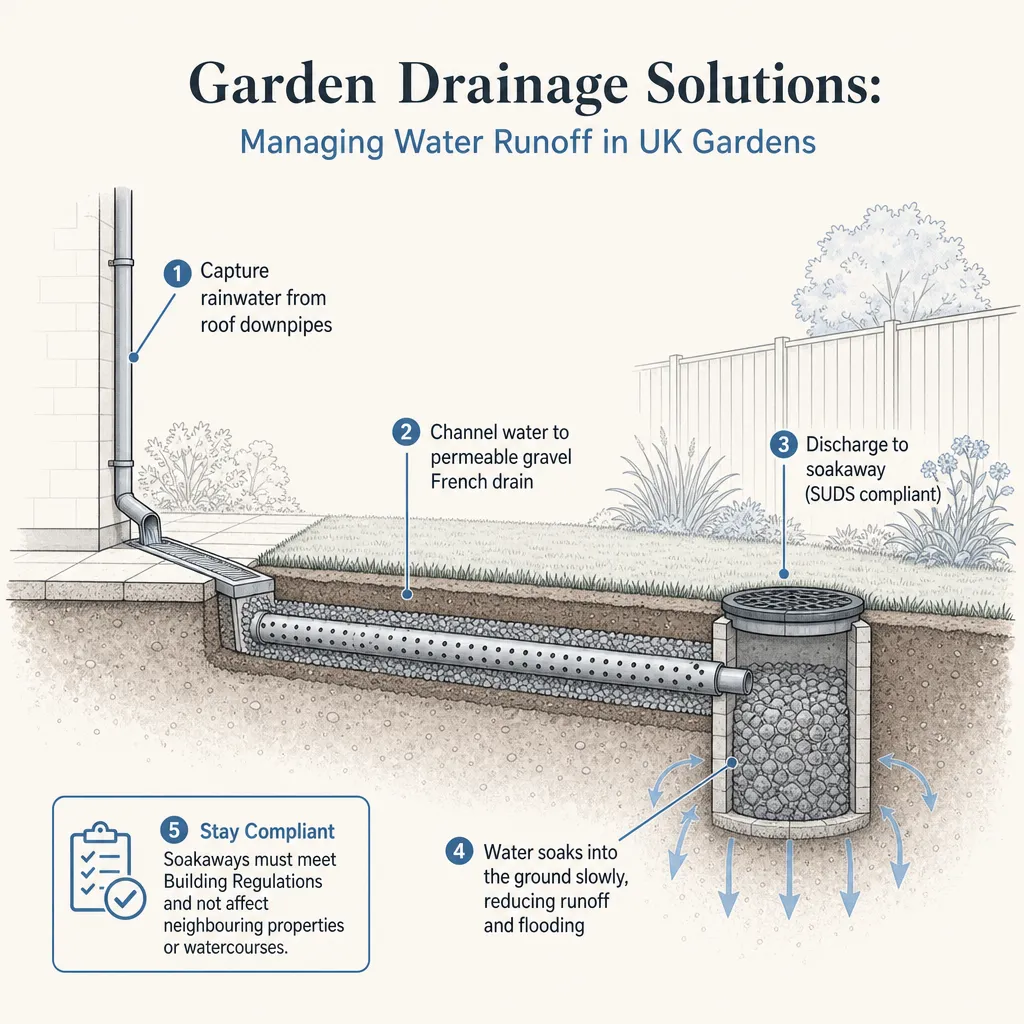
- Soakaways must be at least 5 metres from any building and 2.5 metres from a boundary under Building Regulations Approved Document H.
- The Lead Local Flood Authority (usually the county or unitary council) oversees ordinary watercourses; culverting or diverting one may require consent under the Flood and Water Management Act 2010.
- Drainage problems that direct water onto a neighbouring property can give rise to civil liability; professional advice is important before undertaking remediation in these cases.
Why is my garden always wet after rain?
The most common causes of persistent waterlogging in UK gardens:
Clay soil — much of the London clay belt, large parts of the Midlands, and sections of the South West sit on clay with very low permeability. Water cannot drain away quickly enough and remains near the surface.
Soil compaction — foot traffic, construction vehicles, and heavy garden furniture compact the top 200–300 mm of soil, destroying the pore structure through which water infiltrates. Lawns on former building plots are particularly susceptible.
Surface grading — if the garden slopes toward the house, or if low spots have no outlet, water will naturally pool there after rain.
Failed land drains — many pre-1960s properties have Victorian clay-pipe land drainage beneath the garden. These systems block with root intrusion or collapse with age, leaving water with nowhere to go.
Guttering and downpipe discharge — a blocked or poorly sited downpipe outlet can deposit large volumes of roof water in a small area faster than the soil can absorb it.
What are the signs I need a drainage contractor?
Not every wet patch requires professional drainage work. Consult a drainage contractor if:
- Water stands in the same location after every rainfall and the problem has persisted across multiple seasons.
- The ground remains wet to the touch more than a week after rain has stopped.
- Water is tracking toward the building and damp is appearing on internal walls.
- A patio, path, or driveway regularly floods and water runs toward the house.
- Previous drainage work has been carried out but has not resolved the problem.
Red flags: signs that warrant prompt action
The following signs require professional assessment — do not rely solely on a general guide:
- Damp on internal walls or floors at ground level coinciding with wet weather — possible foundation drainage failure or tanking failure requiring a damp specialist or RICS-registered structural surveyor.
- Cracks in external walls or sticking doors and windows alongside persistent wet ground in clay-soil gardens — clay shrinks and swells with moisture changes; a chartered building surveyor or structural engineer should inspect.
- Sewage smell at ground level — possible sewer defect; contact a qualified drainage contractor or your sewerage undertaker without delay.
- Overland flow crossing into a neighbouring property — this can create civil liability; professional assessment before any remediation works is advisable.
Does garden drainage work require planning permission?
Usually not. Most garden drainage improvements fall within permitted development. The main exceptions:
- Connecting to a public sewer requires the sewerage undertaker's prior consent (Water Industry Act 1991).
- Culverting or diverting a watercourse (stream, ditch) requires Lead Local Flood Authority consent under the Flood and Water Management Act 2010.
- Replacing a front garden surface with an impermeable material over 5 m² requires planning permission under the Town and Country Planning Act 1990 (as amended).
- Works affecting a listed building or a property in a conservation area may require additional consent — check with your local planning authority.
How much does garden drainage cost?
Indicative UK costs, last reviewed 2026-05-19. Actual quotes vary by region, access, soil conditions, and system specification.
Work type | Typical installed cost |
|---|---|
CCTV drain survey (diagnosis) | £100–£300 |
Channel drain (single run, driveway or patio) | £300–£800 |
French drain (20–30 m trench) | £500–£1,500 |
Soakaway (plastic crate, correctly sized) | £400–£1,200 |
Full garden drainage system | £1,500–£5,000+ |
Always check whether quotes include spoil disposal, reinstatement of lawn or hard surfaces, and VAT.
What to ask a drainage contractor before hiring
Before accepting a quote or signing a contract, ask:
- What is causing the drainage problem, and how have you diagnosed this? A reputable contractor should explain their reasoning before recommending a solution.
- Have you carried out a percolation test or CCTV survey to confirm the proposed specification?
- Does the proposed work involve a connection to a public sewer, and if so, who obtains the necessary consent?
- What public liability insurance do you hold, and for what amount?
- Who will carry out the physical work — your own employees or a subcontractor?
- What reinstatement of lawn, paving, or planting is included in the quote?
- Will you provide documentation or a completion warranty?
- Is VAT included in the quoted price?
Can I fix garden drainage myself?
Some drainage work is within reach of a capable DIYer:
- Hollow-tine lawn aeration — effective for compacted lawns where the subsoil drains reasonably well.
- Re-grading a small area using topsoil to redirect water away from the building.
- Installing a simple channel drain on a patio, connected to an existing surface water gully.
Leave the following to a qualified contractor:
- Any work involving a connection to, or near, a public sewer.
- Soakaways within 5 metres of a building.
- French drains requiring significant excavation near foundations.
- Any situation where redirected water might affect an adjacent property.
When to get professional help
A CCTV drain survey is often the most efficient starting point when the cause of waterlogging is unclear. A drainage contractor can then specify and install the right solution. Where structural movement is suspected alongside drainage problems, involve a RICS-registered chartered building surveyor or structural engineer — drainage works alone will not address structural causes.
How Housey can help
Housey connects UK homeowners with vetted drainage contractors for CCTV surveys, French drains, soakaways, channel drainage, and full garden drainage systems. Post your project details and receive quotes from up to four local specialists.
Frequently asked questions
Can a soakaway work in clay soil?
Rarely. Clay has very low permeability, meaning water cannot infiltrate the surrounding ground fast enough. A drainage contractor should carry out a percolation test before specifying a soakaway on any clay-heavy site. A French drain with an outlet to a watercourse or surface water sewer is usually more effective in these conditions.
What is the difference between a French drain and a soakaway?
A French drain intercepts and conveys water through a perforated pipe to a suitable outlet elsewhere. A soakaway collects water and allows it to percolate into the surrounding subsoil on-site. French drains move water; soakaways dispose of it in place. The two are often combined, with the French drain feeding into a correctly sited soakaway.
Should I tell my insurer about drainage works?
It is good practice to notify your home insurer of significant ground works near the building, particularly if they alter drainage patterns close to the foundations. Some policies include conditions relating to alterations affecting the structure or its drainage. Check your policy wording or speak to your insurer before works begin.
Who is responsible for a shared drain at the boundary?
Each property owner is generally responsible for drains within their own boundary. Shared drains serving more than one property and located under a highway may be the responsibility of the local sewerage undertaker. Check with your water company — such as Thames Water, Yorkshire Water, or Severn Trent — for a definitive answer about any specific drain.
Sources and further reading
- Building Regulations Approved Document H: Drainage and waste disposal — GOV.UK
- Flood and Water Management Act 2010 — legislation.gov.uk
- Water Industry Act 1991 — legislation.gov.uk
- Ordinary watercourse consent — GOV.UK
- Sustainable drainage guidance — GOV.UK
- CIRIA SuDS Manual — CIRIA
Useful next reads
 Improvement & Build
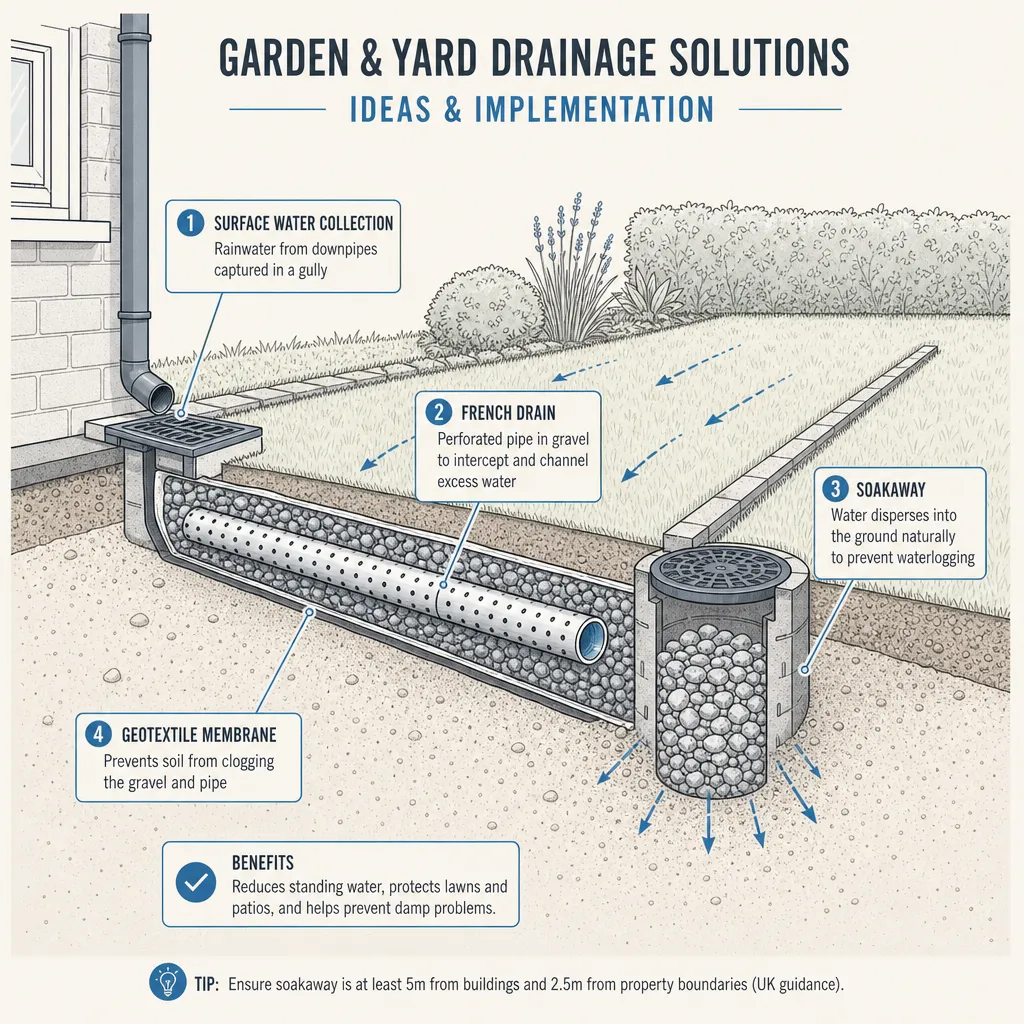
Garden and yard drainage solutions: ideas and implementation
Garden drainage problems — from standing water to waterlogged lawns — are usually resolved with French drains, soakaways, channel drainage, permeable paving, or improved grading.
 Improvement & Build
Outdoor lighting problems: solutions for common issues in gardens and driveways
Outdoor lighting problems in UK gardens commonly stem from water ingress, incorrect IP ratings, faulty transformers, poor earth connections, or corroded contacts.
 Improvement & Build
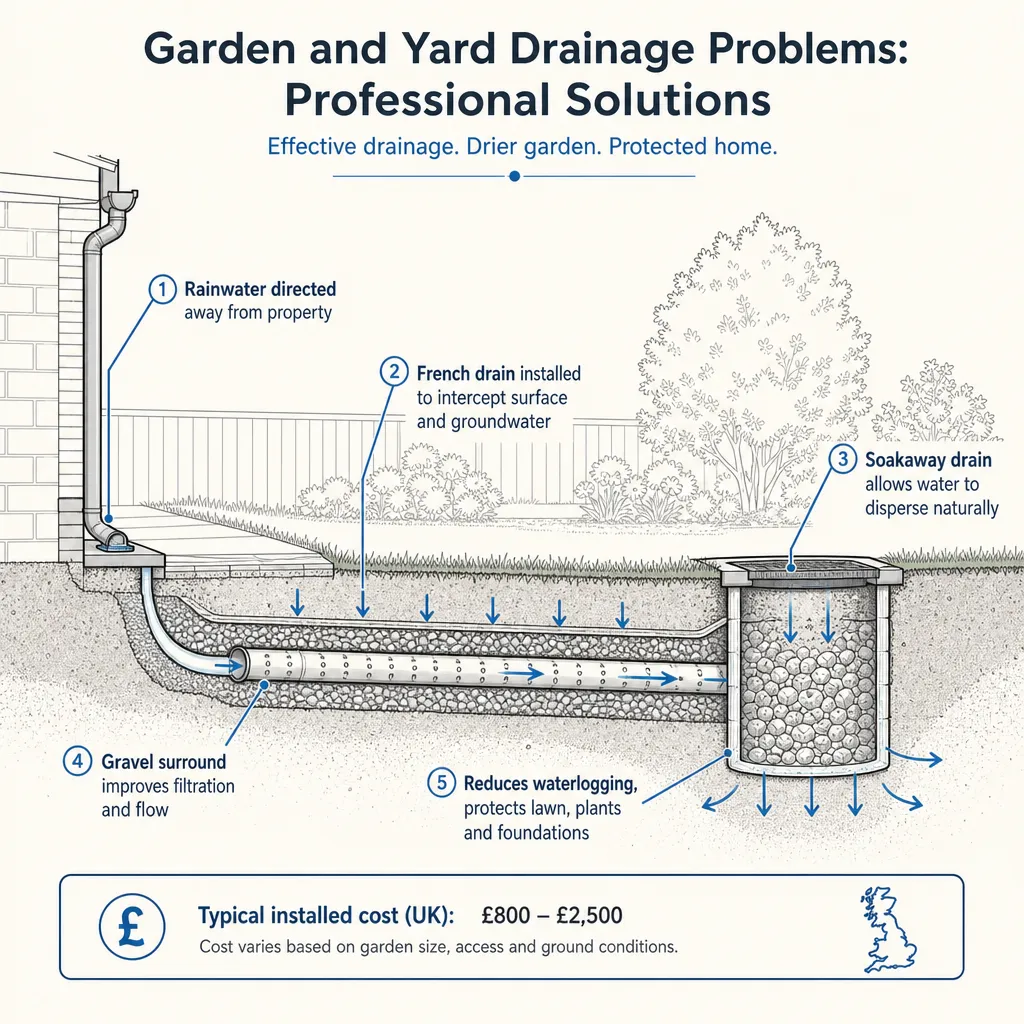
Garden and Yard Drainage Problems: Professional Solutions
Garden drainage problems in the UK are most often caused by clay soil, impermeable surfacing, or insufficient ground fall.
 Improvement & Build
Garden Drainage Solutions: Managing Water Runoff in UK Gardens
Poor garden drainage in the UK is usually caused by clay soil, surface compaction, or too much hard-standing.
 Improvement & Build
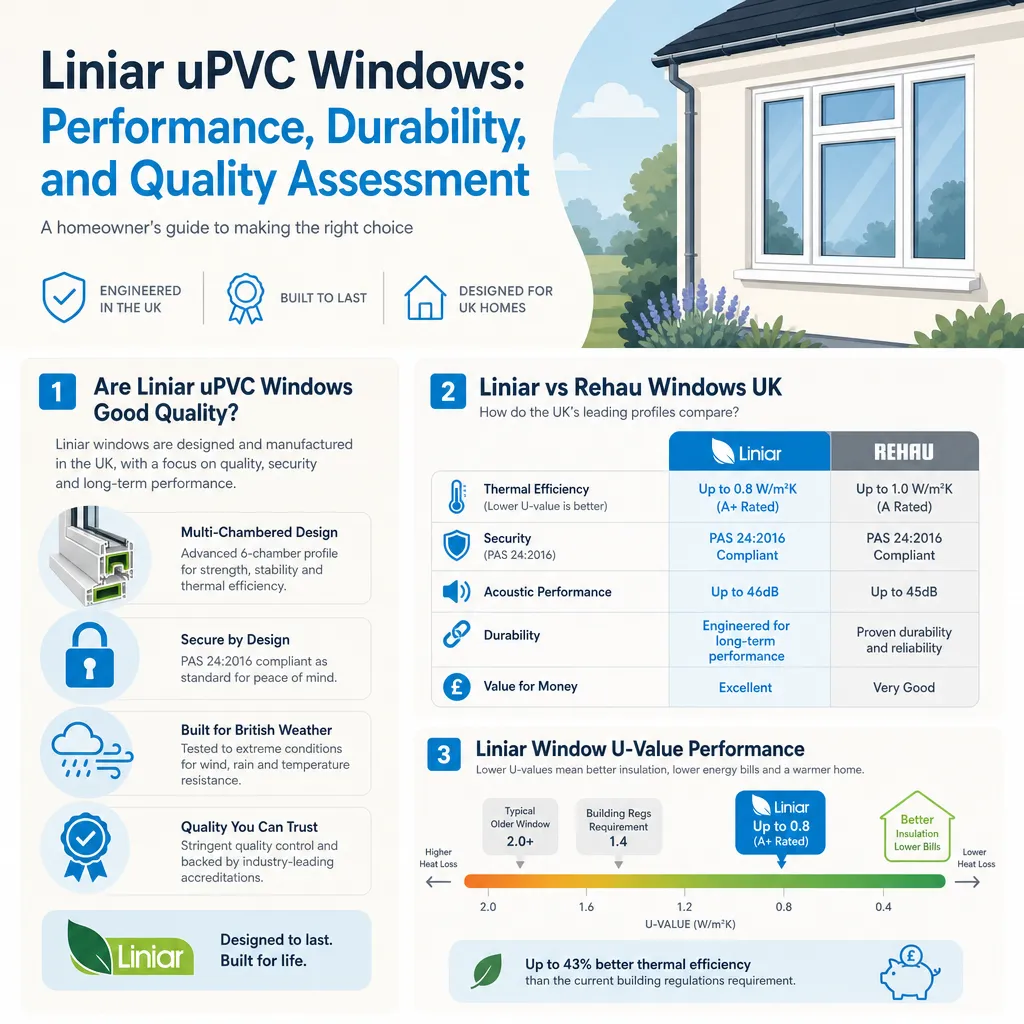
Liniar uPVC Windows: Performance, Durability, and Quality Assessment
Liniar uPVC window profiles are manufactured in the UK using multi-chambered, foamed frames.