Garden Drainage Solutions: Managing Water Runoff in UK Gardens
By Housey · Last reviewed 10th of May 2026
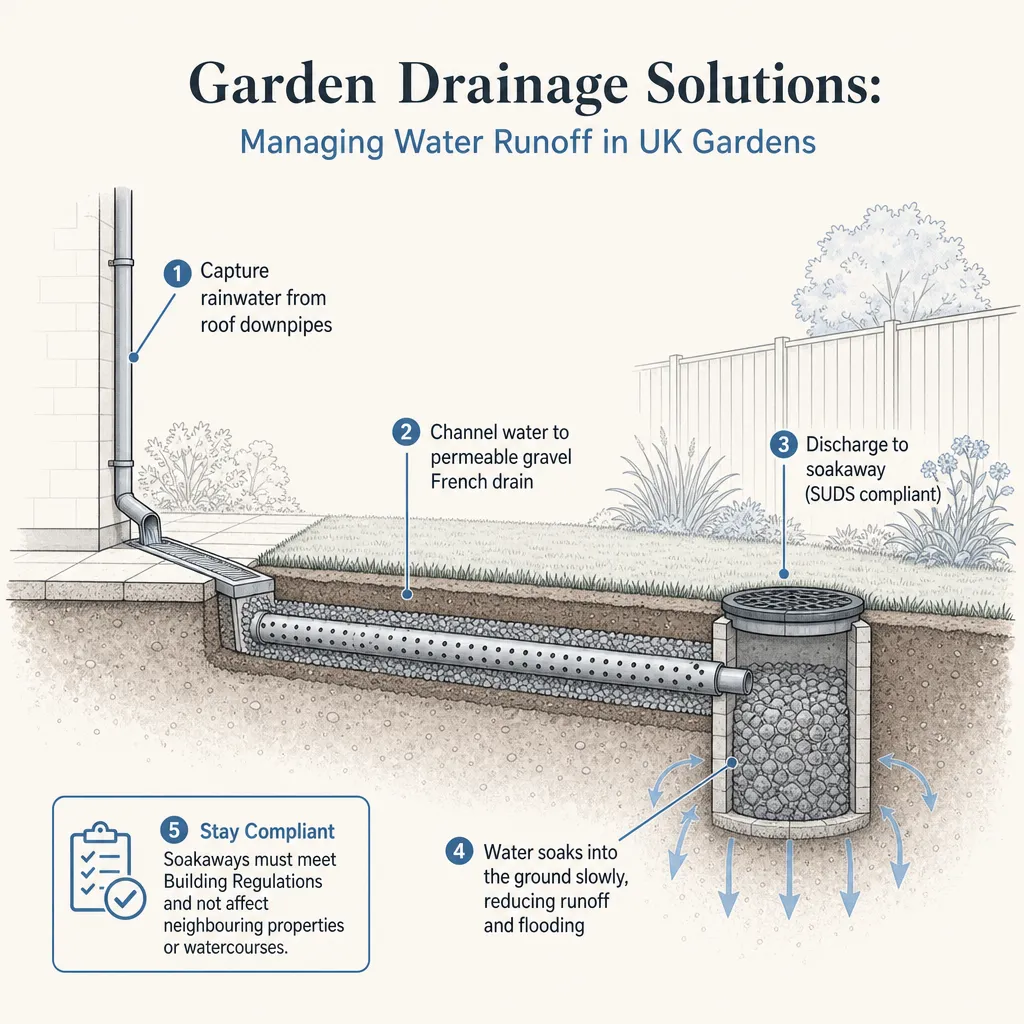
Garden Drainage Solutions: Managing Water Runoff in UK Gardens
Waterlogged gardens are a common problem across the UK, where high annual rainfall, clay-heavy soils in many regions, and increasingly intense weather events create conditions that surface runoff alone cannot manage. The issue typically becomes urgent after a wet winter leaves lawns saturated for days, patios pooling with standing water, or outbuildings at risk of damp ingress. Choosing the right drainage solution depends on diagnosing the cause of the problem, not merely treating the visible symptom.
Key points
- Waterlogged soil for more than 48 hours causes root damage to most lawn grasses and garden plants, according to horticultural guidance.
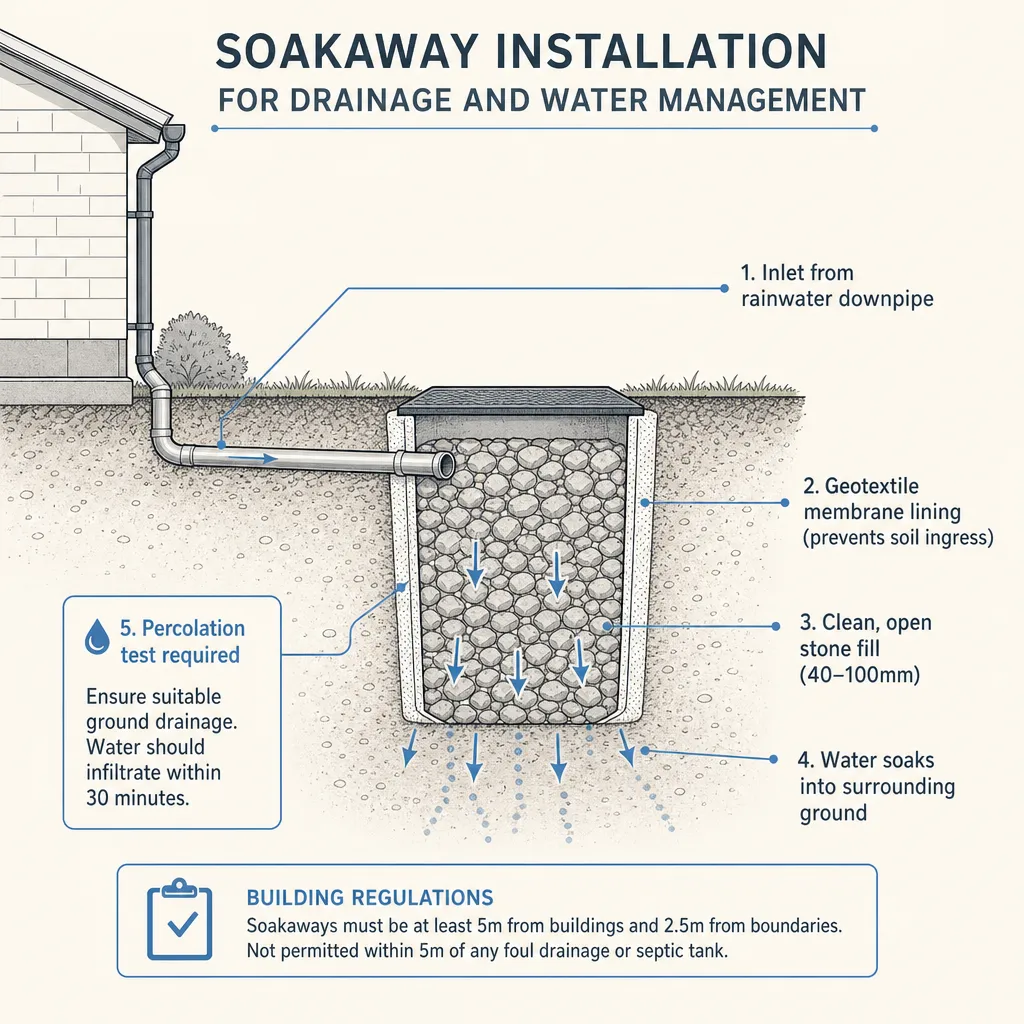
- Soakaways must be positioned at least 5 metres from a building and 2.5 metres from a boundary under Building Regulations Approved Document H.
- Connecting any new drainage run to the public surface water sewer requires prior written approval from your water authority under the Water Industry Act 1991.
- Replacing an impermeable driveway surface greater than 5m² with permeable paving is classified as permitted development, avoiding the need for a planning application under 2008 householder rules.
- French drains suit sites with a natural fall and permeable subsoil; flat sites or those with clay subsoil typically require a sump pump or a piped system with a positive outfall.
What causes poor drainage in UK gardens?
Before choosing a solution, it helps to understand why water is not draining. The most common causes are:
- Clay soil: Clay particles hold water rather than allowing it to percolate. Gardens in the Midlands, East Anglia, and much of the South East frequently sit on heavy clay subsoil.
- Compaction: Heavy foot traffic, vehicles on lawns, or construction activity compact soil, closing the air gaps that allow drainage.
- Excessive hard-standing: Patios, driveways, and extensions reduce the permeable surface area available to absorb rainfall, concentrating runoff onto remaining planted areas.
- Low-lying position: Gardens at the base of a slope collect runoff from higher ground; neighbouring properties' paving can contribute significantly to the problem.
- Blocked or failing existing drainage: Older clay pipe systems may have collapsed or silted; roof downpipes may discharge directly onto the garden without any attenuation.
- High water table: In low-lying areas near rivers or on flood plains, the water table may rise seasonally to near the surface regardless of drainage provision.
Identifying the actual cause determines the appropriate solution. A garden that pools only during heavy rain on otherwise free-draining soil needs a different approach from a garden that remains wet throughout winter on a heavy clay site.
Comparing garden drainage solutions
Solution | Best for | Not ideal for | Typical installed cost | Requires professional? |
|---|---|---|---|---|
French drain (perforated pipe in gravel trench) | Gardens with a moderate slope and permeable subsoil | Flat sites; clay subsoil that prevents percolation | £50–£150/m | Often yes for connections |
Soakaway (rubble or crate system) | Permeable subsoil, well clear of buildings | High water table; clay subsoil; near boundaries | £800–£2,500 installed | Yes, for Building Regs compliance |
Surface channel drain | Patios, paths, driveways with concentrated runoff | Large areas; insufficient as sole solution | £30–£80/m | DIY possible for simple runs |
Sump and pump system | Flat sites; high water table; no natural outfall | Areas prone to power cuts without battery backup | £1,500–£5,000 | Yes |
Permeable paving | Replacing impermeable hard-standing on driveways and patios | High-traffic vehicle areas without robust sub-base | £60–£120/m² | Recommended for large areas |
Land drainage (piped system across garden) | Large or severely waterlogged gardens | Small urban plots | £2,000–£8,000+ | Yes |
Indicative UK costs, last reviewed 2026-05-10. Costs vary significantly by site conditions, access, depth of excavation, and region.
Which drainage solution should you choose?
- Choose a surface channel drain if water pools on hard surfaces — patio, path, or driveway — after rain but the garden itself drains reasonably well.
- Choose a French drain if water accumulates along a fence line, at the base of a slope, or around the perimeter of a lawn, and your subsoil is not solid clay throughout.
- Choose a soakaway if you have a suitable installation point at least 5 metres from the house and a percolation test confirms your subsoil will accept water at an adequate rate.
- Choose a sump and pump system if your garden is flat, the subsoil is impermeable, and there is no viable gravity outfall — common in low-lying areas near river valleys.
- Choose permeable paving if hardstanding is contributing significantly to runoff and you are replacing the surface anyway.
- Ask a drainage contractor if you suspect a collapsed drain, if the problem affects a neighbour's property, or if water is entering a building — these scenarios require professional diagnosis before any solution is chosen.
Soakaways: rules and installation requirements
A soakaway is a buried pit — either rubble-filled or containing a plastic crate system — into which drainage water flows and then percolates slowly into the surrounding subsoil. In England and Wales, soakaways are covered by Building Regulations Approved Document H and must be sized using BRE Digest 365 methodology.
Key legal and technical requirements:
- Minimum 5 metres from any building
- Minimum 2.5 metres from a boundary
- Must not be installed where the water table is within 1 metre of the soakaway base
- A percolation test is required before sizing — this involves digging a trial hole and measuring the rate at which water drains, expressed in seconds per millimetre (s/mm)
- Soakaways receiving surface water from roofs must be sized for a 1-in-10 year rainfall event under BRE Digest 365
If a soakaway is not viable — clay subsoil, high water table, or insufficient distance from buildings — a connection to the public surface water sewer may be necessary. This requires written approval from your water authority and must meet their adoption standards before any connection is made.
French drains: installation principles
A French drain is a trench — typically 300–600mm wide and 600–900mm deep — filled with angular gravel and containing a perforated pipe that collects water and directs it to an outfall. Key principles:
- The trench must fall consistently towards the outfall — a minimum gradient of 1:100 (1cm of fall per metre run) is typical.
- Perforated pipe (100mm diameter is standard for domestic gardens) sits in the bottom third of the trench.
- The pipe and gravel are wrapped in geotextile membrane to prevent fine soil particles silting up the pipe over time.
- Connecting the outlet to a watercourse requires consent from the Environment Agency or the local Lead Local Flood Authority (LLFA) under the Flood and Water Management Act 2010.
French drains in clay soil require particular care: if the surrounding subsoil cannot absorb water, the French drain simply becomes a buried reservoir. In these cases, the pipe must connect positively to an outfall — a soakaway in a more permeable area, a watercourse, or the surface water sewer — that can accept the volume of water collected.
Runoff from neighbouring properties and shared boundaries
Water running from a neighbouring property onto yours is a common cause of garden drainage problems in the UK. Under English and Welsh common law, a landowner is generally not obliged to accept surface water runoff from a neighbour's land, and deliberately increasing runoff — for example, by covering a lawn with impermeable paving — may constitute a legal nuisance.
If water from a neighbour's hard-standing is entering your garden:
- Document the problem with photographs and dated notes before approaching anyone.
- Write to the neighbour explaining the issue before taking any formal action.
- Contact your local authority if the neighbour's drainage appears to breach planning conditions on a recently approved development.
- Seek advice from Citizens Advice or a solicitor if informal resolution is not possible.
Do not install drainage that redirects water onto a third party's land — this itself may constitute a nuisance or trespass at common law, regardless of the original source of the problem.
Red flags: when drainage problems signal something more serious
Some drainage issues indicate a deeper problem that requires professional assessment before any excavation or installation work begins:
- Water pooling next to or inside a building after rain — may indicate a drain failure (blocked gully, collapsed pipe) rather than a general drainage issue requiring new infrastructure.
- Persistent damp on internal walls or floors in basements or ground-floor rooms following heavy rain — requires a damp specialist or structural engineer to assess the building before any external drainage work.
- Sewage smell from any part of the garden — suggests a drain breach and requires urgent investigation; contact your water authority if you suspect the fault lies in a public sewer.
- Subsidence signs (cracking, doors or windows sticking) near trees in persistently waterlogged soil — roots and saturated clay can both contribute to ground movement.
- Repeated flooding at the same point despite previous drainage work — indicates a design or sizing failure that requires professional re-assessment rather than a repeat of the same approach.
When to get professional help
Garden drainage is often manageable with appropriate professional input, but some situations specifically require specialist assessment:
- You suspect a collapsed or blocked drain — a CCTV drain survey from a drainage contractor will locate the problem before expensive excavation.
- Water is entering a building or causing structural concern — a structural engineer or damp specialist should assess before external drainage work begins.
- You need to connect to a public sewer — this requires water authority approval and must meet adoption standards.
- Your property is in or near a flood zone — check the Environment Agency Flood Map for Planning and seek bespoke assessment before installing any drainage system.
- The problem persists despite previous attempts — a drainage contractor or groundworker can carry out a site survey and propose a correctly sized solution.
How Housey can help
Housey connects UK homeowners with vetted drainage contractors and groundworkers who can assess waterlogging problems, carry out CCTV drain surveys, and install French drains, soakaways, sump systems, and permeable paving. Request quotes from local specialists through Housey to compare costs and approaches before committing to any solution.
Frequently asked questions
Do I need planning permission to install a French drain in my garden?
Installing a French drain within your own garden boundary does not generally require planning permission. However, if the drain connects to a public sewer or ordinary watercourse, you will need approval from your water company or Lead Local Flood Authority. If you live in a conservation area or the work affects a listed building, check with your local planning authority before starting.
How do I know if my garden drains into a soakaway or the public sewer?
Check your property's drainage plan, often available from your house sale documents or from your water authority for a small fee. Alternatively, a drainage contractor can use CCTV survey or dye testing to trace where surface water goes. Some older properties have separate soakaways for surface water that may have failed or become silted over the years.
What is a percolation test and do I need one?
A percolation test measures how quickly water drains through your subsoil — essential for sizing a soakaway correctly. You dig a trial hole, fill it with water, and time the drainage rate in seconds per millimetre. Building Regulations Approved Document H requires this test before sizing any soakaway. A rate slower than 1 s/mm or faster than 800 s/mm means a soakaway is not appropriate for that location.
Can I connect my garden drainage to the road gulley?
Road gullies are owned by the highway authority and intended for highway surface water only. Connecting private drainage to a road gulley without consent from the local highway authority is not permitted and may result in enforcement action. Contact your local council's highways department if you believe a road drain connection may be the appropriate solution for your situation.
How long does a French drain last?
A well-installed French drain with correctly laid geotextile membrane typically lasts 20–30 years before significant silting affects performance. Drains installed without membrane, or in fine silty soils, may silt up within 10 years. A drainage contractor can jet-wash perforated pipes to restore flow, and occasional flushing with a garden hose can help prolong effective life.
Sources and further reading
- Building Regulations Approved Document H: Drainage and Waste Disposal — GOV.UK
- Sustainable drainage: overview — GOV.UK
- Flood and Water Management Act 2010 — legislation.gov.uk
- Flood Map for Planning — Environment Agency
Useful next reads
 Improvement & Build
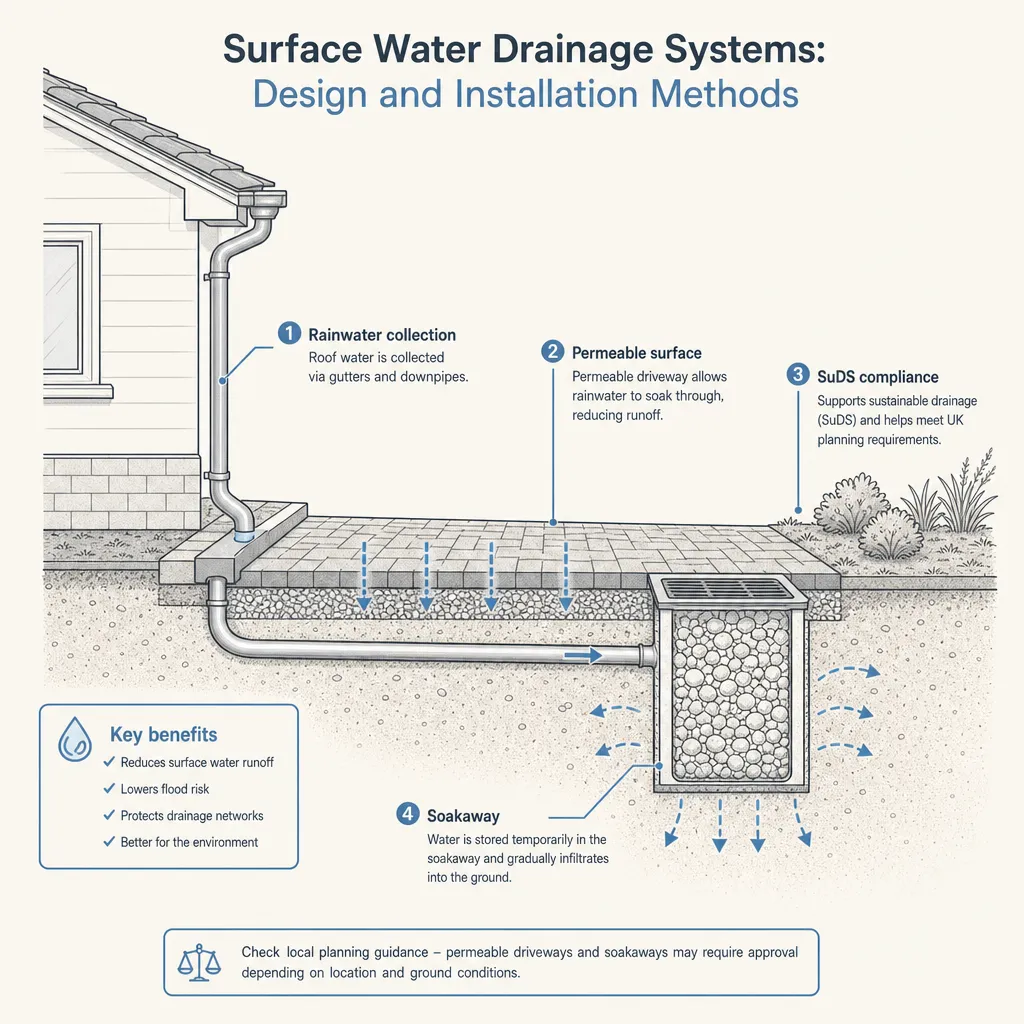
Surface Water Drainage Systems: Design and Installation Methods
Surface water drainage manages rainwater run-off from roofs, driveways, and hard standing.
 Improvement & Build
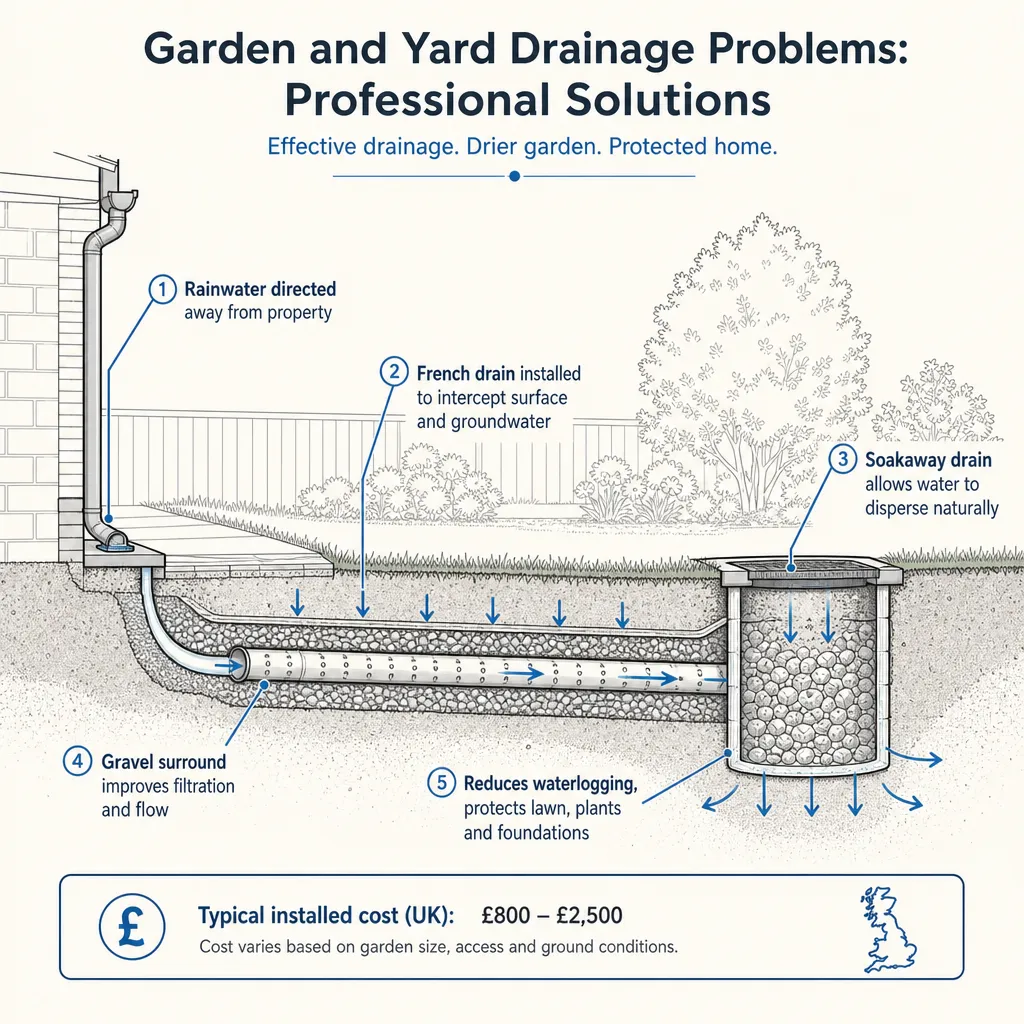
Garden and Yard Drainage Problems: Professional Solutions
Garden drainage problems in the UK are most often caused by clay soil, impermeable surfacing, or insufficient ground fall.
 Improvement & Build
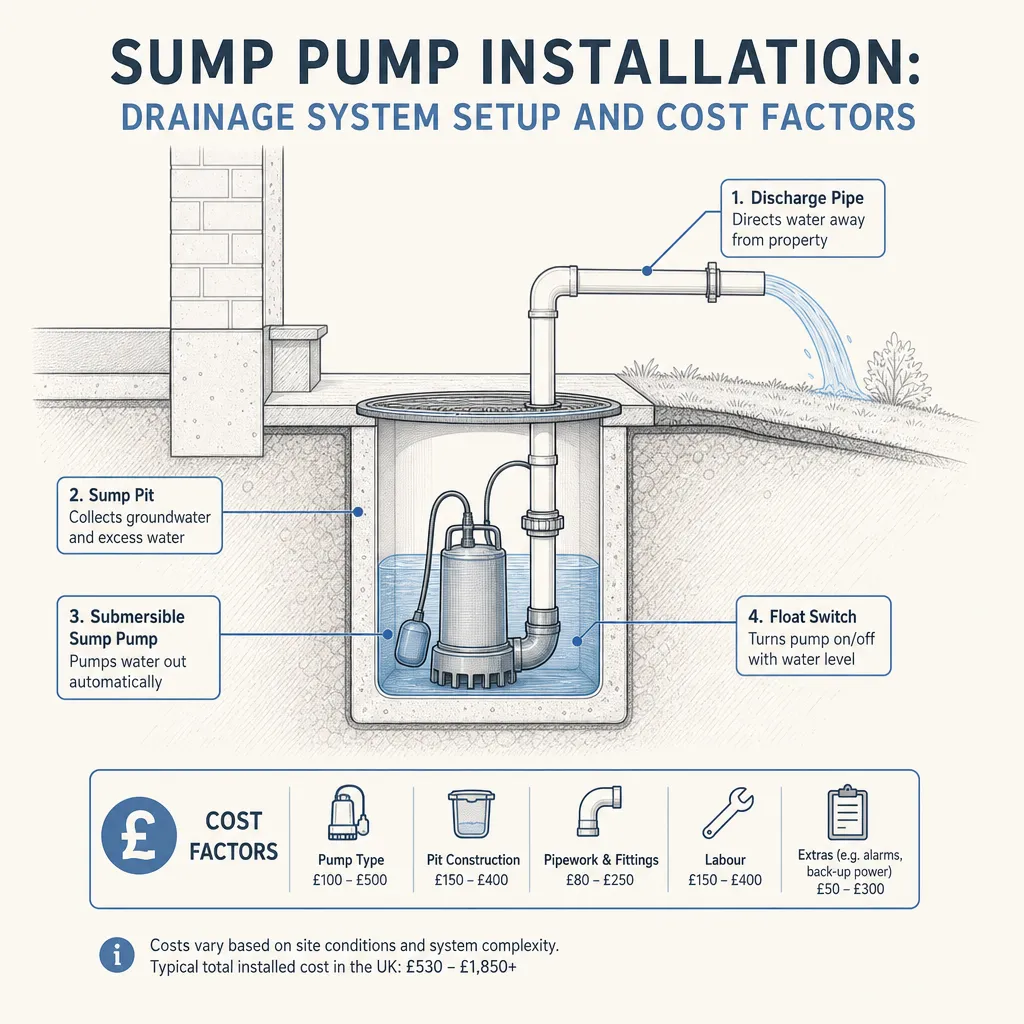
Sump Pump Installation: Drainage System Setup and Cost Factors
Sump pump installation in the UK typically costs £800–£2,500 for a submersible pump in a new or existing pit, including excavation, liner, discharge pipework, and connection to a suitable outlet.
 Improvement & Build
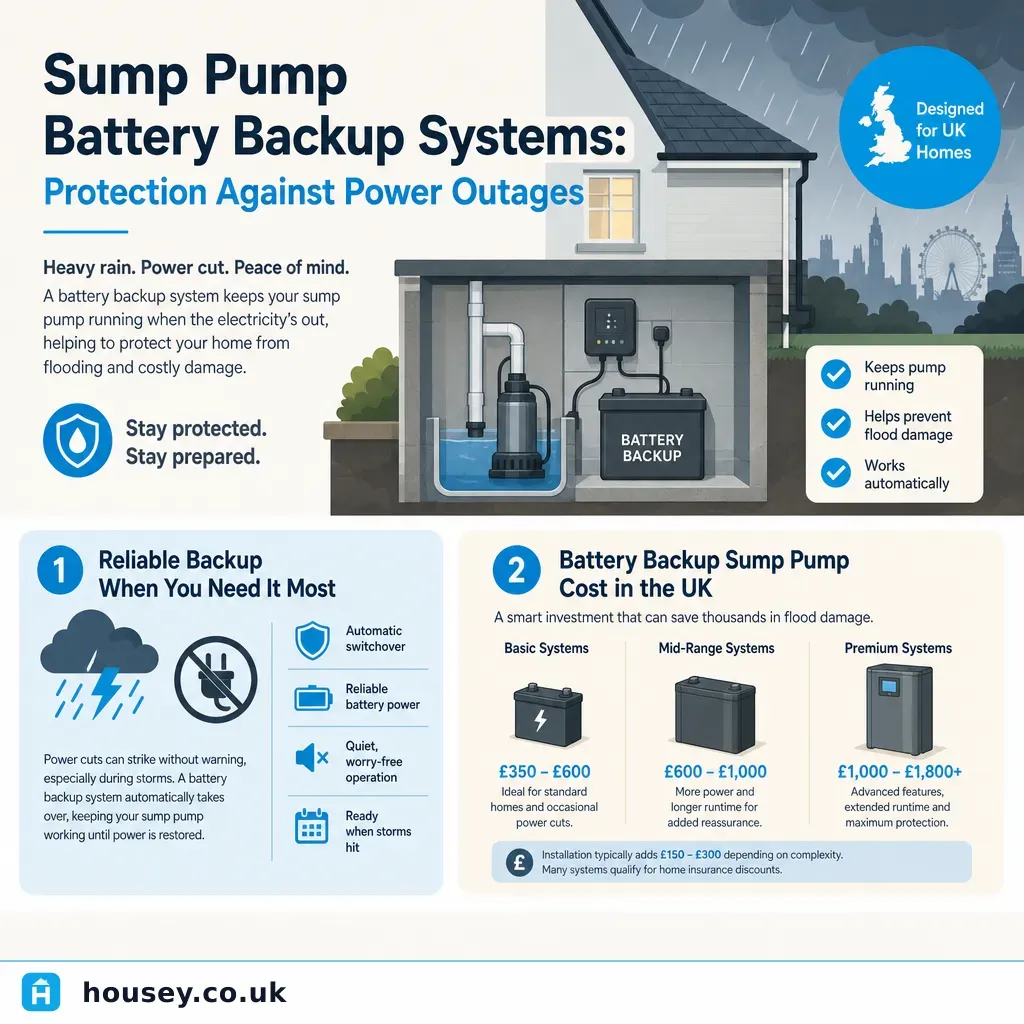
Sump Pump Battery Backup Systems: Protection Against Power Outages
A sump pump battery backup activates automatically when mains power fails, continuing to pump water from your sump pit to protect against flooding.
 Improvement & Build
Soakaway Installation for Drainage and Water Management
A soakaway collects surface water or roof drainage and allows it to disperse slowly into the surrounding ground.