Garden Design Inspiration and Professional Landscaping Ideas
By Housey · Last reviewed 9th of May 2026
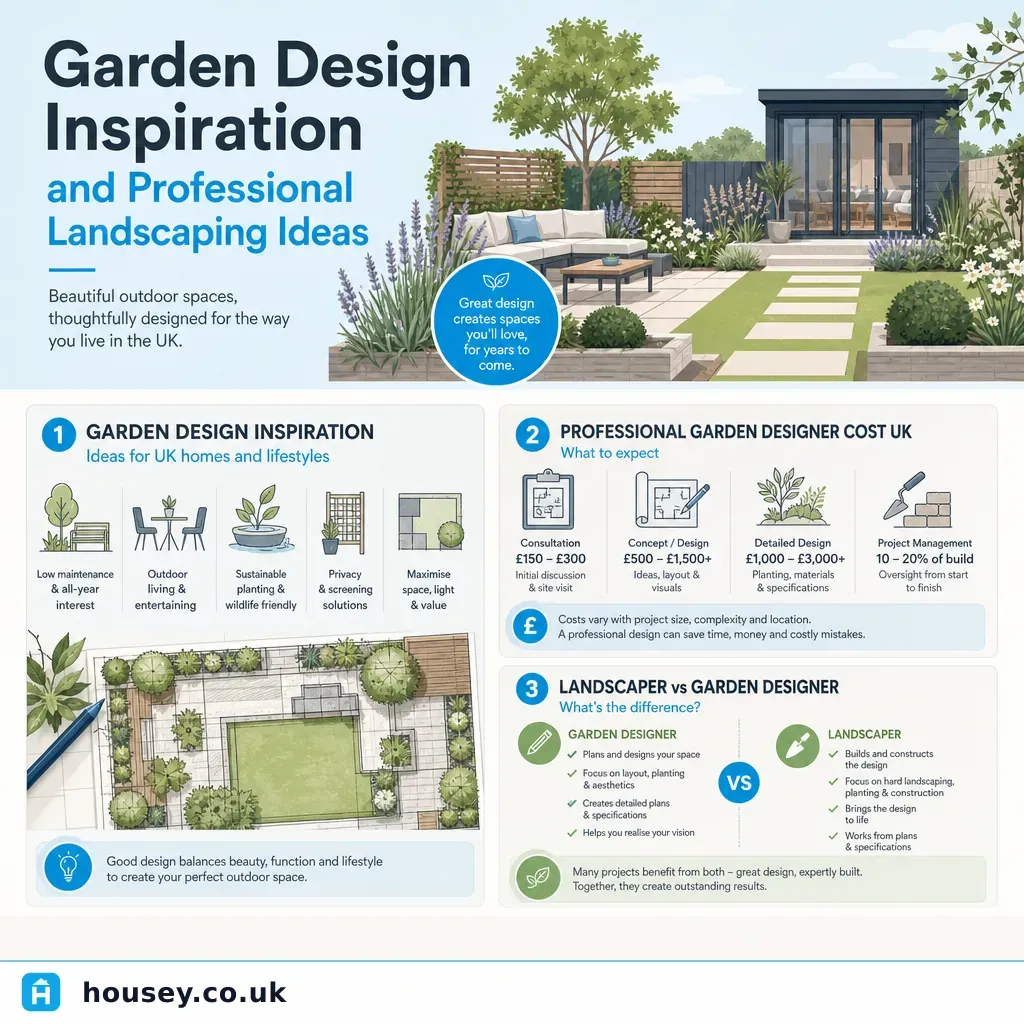
Garden Design Inspiration and Professional Landscaping Ideas
Planning a garden transformation is often triggered by moving into a new home, completing a house extension, or simply deciding that an underused outdoor space should work harder for the household. In the UK, where garden sizes range from narrow city courtyards to generous suburban plots, the range of design options — and the professionals who deliver them — can feel overwhelming. Getting the approach right from the outset saves time and money, particularly when hard landscaping, drainage, or planting near boundaries is involved.
Key points
- Covering more than 5m² of a front garden with non-permeable materials requires planning permission, following changes to Permitted Development rights introduced in October 2008 (Planning Portal).
- Garden designers may hold professional qualifications through the Society of Garden Designers (SGD) or the Royal Horticultural Society (RHS), which carry recognised accountability standards.
- Soil type — clay, sandy, chalky, or loamy — directly determines which plants will thrive and whether drainage improvements are needed before any planting begins.
- Hard landscaping close to a boundary, including retaining walls over 600mm in height, may require Building Regulations approval or notification under the Party Wall etc. Act 1996.
- Trees covered by a Tree Preservation Order (TPO) cannot be pruned or removed without prior written consent from the local planning authority.
Garden designer vs landscaper: which do you need?
A garden designer focuses on the concept, planting plan, and spatial layout of an outdoor space. A landscaper (or landscape contractor) focuses on implementation — building patios, laying turf, installing water features, and carrying out groundworks. Many projects need both: a designer to create the brief and a landscaper to execute it.
Professional | What they do | Best for | Not ideal for |
|---|---|---|---|
Garden designer | Concept plans, planting schemes, material palettes, lighting design | Projects where layout, plant selection, and visual coherence matter | Projects that simply need turf laid or paving installed |
Landscaper | Hard landscaping, groundworks, planting installation, irrigation | Executing an approved design; practical earthworks | Creative design decisions, detailed plant knowledge, drainage strategy |
Landscape architect | Comprehensive planning, ecology, drainage, and access design | Large or complex sites; residential developments | Small domestic gardens where cost would be disproportionate |
Garden maintenance contractor | Ongoing pruning, mowing, seasonal planting | Post-design upkeep and year-round care | Initial design or major structural restructuring |
For most UK homeowners, a garden designer produces a concept or detailed planting plan, and a landscaper carries out the build phase.
Key design considerations for UK gardens
Soil and climate
UK soils vary considerably by region. Clay soils are common across the Midlands and south-east; chalky soils occur across the South Downs and Cotswolds; sandy soils are typical in East Anglia. A simple soil test — available from most garden centres — indicates pH and texture, both of which influence plant choice and fertiliser needs. The RHS offers detailed guidance on soil types and suitable plants.
Light and aspect
A south-facing garden receives the most direct sun; a north-facing plot needs shade-tolerant species. Document where shade falls at different times of year before committing to a seating area position or finalising a planting plan.
Drainage
Poorly drained gardens become waterlogged during wet winters, which is increasingly common across many UK regions. French drains, soakaways, or permeable paving can address drainage at the design stage. Retrofitting drainage after hard landscaping is installed is significantly more expensive and disruptive.
Planning rules for front gardens
Since October 2008, covering a front garden with non-permeable materials — concrete, tarmac, or most standard block paving — without planning permission is no longer permitted if the area exceeds 5m². Permeable or porous surfaces, or surfaces draining to a lawn or planted border, are exempt. The Planning Portal has clear guidance on front garden paving rules.
How to brief a garden designer
A clear brief helps a designer produce useful concept drawings first time and avoids costly revisions. Most designers offer a paid initial consultation; preparing the following before that visit maximises the time.
Homeowner checklist: preparing for a garden design appointment
What to ask before hiring a garden designer or landscaper
Before accepting a quote, ask the following questions:
- Are you a member of the Society of Garden Designers (SGD), the British Association of Landscape Industries (BALI), or the Association of Professional Landscapers (APL)?
- Does this quote cover design drawings only, or does it include full project management of the build phase?
- Who will physically carry out the work, and do they hold public liability insurance?
- What happens if buried services, tree roots, or poor drainage are discovered during groundworks?
- Does the quote include VAT, skip hire, and disposal of existing materials?
- How long will works take, and what is the payment schedule?
- Can you provide references or photographs from comparable completed projects?
- What aftercare or planting guarantee is included?
Typical stages of a professional garden project
- Initial site survey — the designer visits to measure, photograph, and assess soil, aspect, and drainage.
- Concept design — a sketch layout showing zones, materials palette, and approximate planting areas.
- Detailed design — scaled drawings, a planting plan with named species, and a construction specification.
- Contractor tender — obtaining landscaper quotes based on the detailed design.
- Construction phase — hard landscaping, drainage installation, topsoil preparation, structural planting.
- Soft landscaping — turf laying, border planting, mulching.
- Aftercare — first-season maintenance visits or written maintenance guidance.
Not all projects require every stage. A straightforward lawn-and-border refresh may need only a planting plan and a single landscaper visit.
When to get professional help
Most domestic garden projects can proceed without professional design input. However, consider hiring a qualified garden designer or landscape architect if:
- The garden is large, steeply sloping, or has complex drainage requirements
- You are working near trees that may carry a Tree Preservation Order — check with your local planning authority before any pruning or felling
- Works might affect a neighbour's property or a shared boundary wall
- The project involves retaining walls over 600mm or structural elements affecting ground-floor levels
- You are in a conservation area and are unsure about planning consent requirements
- The budget is significant and design errors would be costly to reverse
For any works near underground services — gas pipes, electricity cables, water mains, or drainage runs — contact your utility providers before excavation begins.
How Housey can help
If you are ready to move your garden project forward, Housey connects you with vetted professionals in your area. Whether you need a concept plan from an experienced garden designer or a contractor to carry out hard landscaping and planting through our landscapers service, you can request and compare quotes side by side.
Frequently asked questions
Do I need planning permission for a new patio or decking?
In most cases, patios at ground level do not require planning permission under permitted development rights. However, raised decking over 30cm above ground level may require consent, as may works in a conservation area or affecting a listed building. Check with your local planning authority if you are unsure of your property's planning status before work begins.
How much does a garden designer cost in the UK?
Indicative UK costs, last reviewed 2026-05-09. Garden designer fees typically range from £500 to £2,000 for a concept or planting plan for an average domestic plot, rising for detailed construction drawings and project management. Landscaping contractor costs vary widely by region and scope. Obtain at least three itemised quotes before committing to a contractor.
Can I carry out my own landscaping without a professional?
Yes — most garden landscaping is unregulated. However, any electrical work such as outdoor lighting or garden sockets must comply with Part P of the Building Regulations and should be carried out or certified by a registered electrician. Any gas installation, including outdoor heating, must be completed by a Gas Safe registered engineer.
How long does a professional garden design project take?
A straightforward domestic garden can be designed and built within 4 to 12 weeks from initial brief to completion of hard landscaping, depending on contractor availability and plant sourcing. Complex projects involving significant groundworks, drainage installations, or bespoke structures may take 3 to 6 months from design sign-off to handover.
What is a planting plan and do I need one?
A planting plan is a scaled drawing showing which plants go where, with named species, spacings, and maintenance notes. It is most useful on larger plots or where a specific aesthetic is required. For smaller gardens, a designer may provide a plant list instead. It is particularly helpful if different contractors or gardeners will work on the space over time.
Sources and further reading
- Front gardens and driveways: planning guidance — Planning Portal
- Soil types and improving your soil — Royal Horticultural Society
- Society of Garden Designers: find a designer — Society of Garden Designers
- Permitted development rights for householders: technical guidance — GOV.UK
- Tree Preservation Orders and trees in conservation areas — GOV.UK
Useful next reads
 Improvement & Build
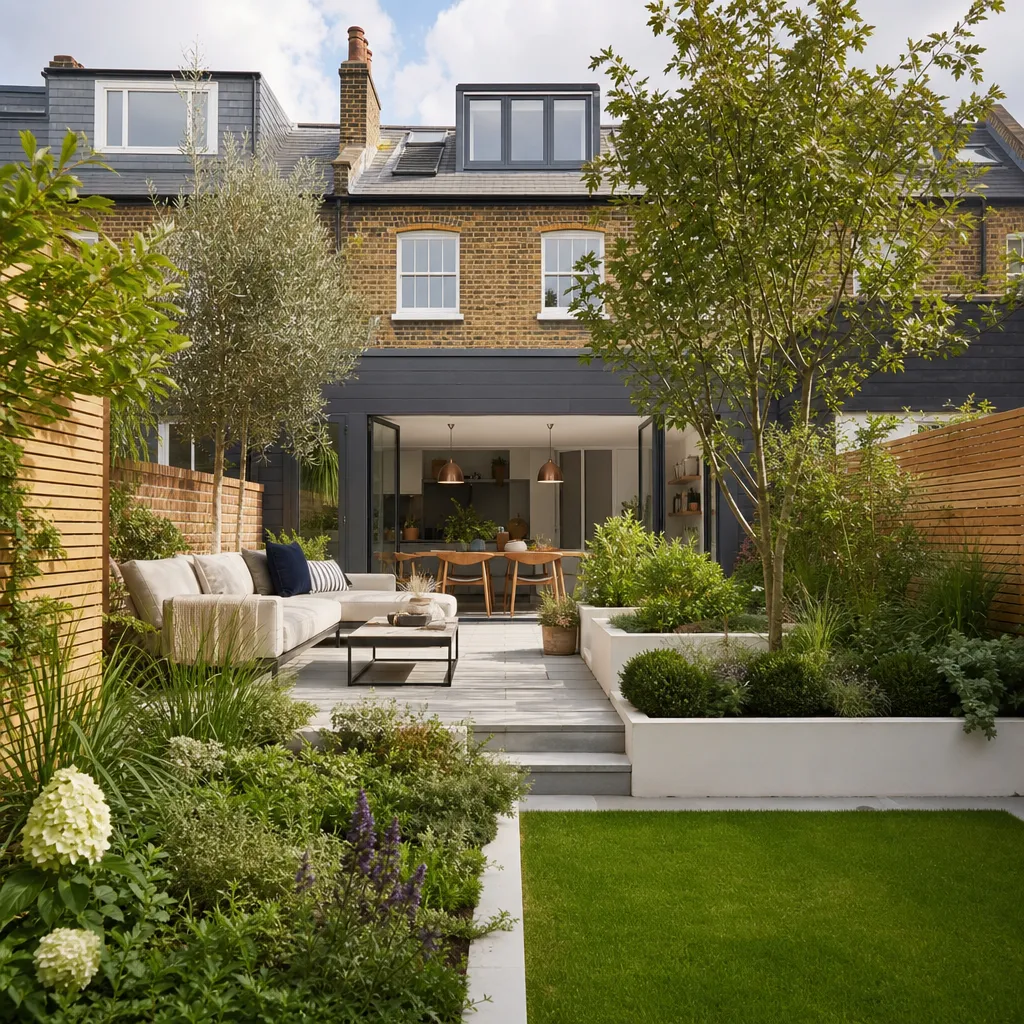
Seasonal Garden Transformations and Outdoor Design Ideas
A successful garden transformation in the UK works with the seasons rather than against them — establishing structure and hard landscaping in autumn or winter, planting in spring, and enjoying the results through summer.
 Improvement & Build
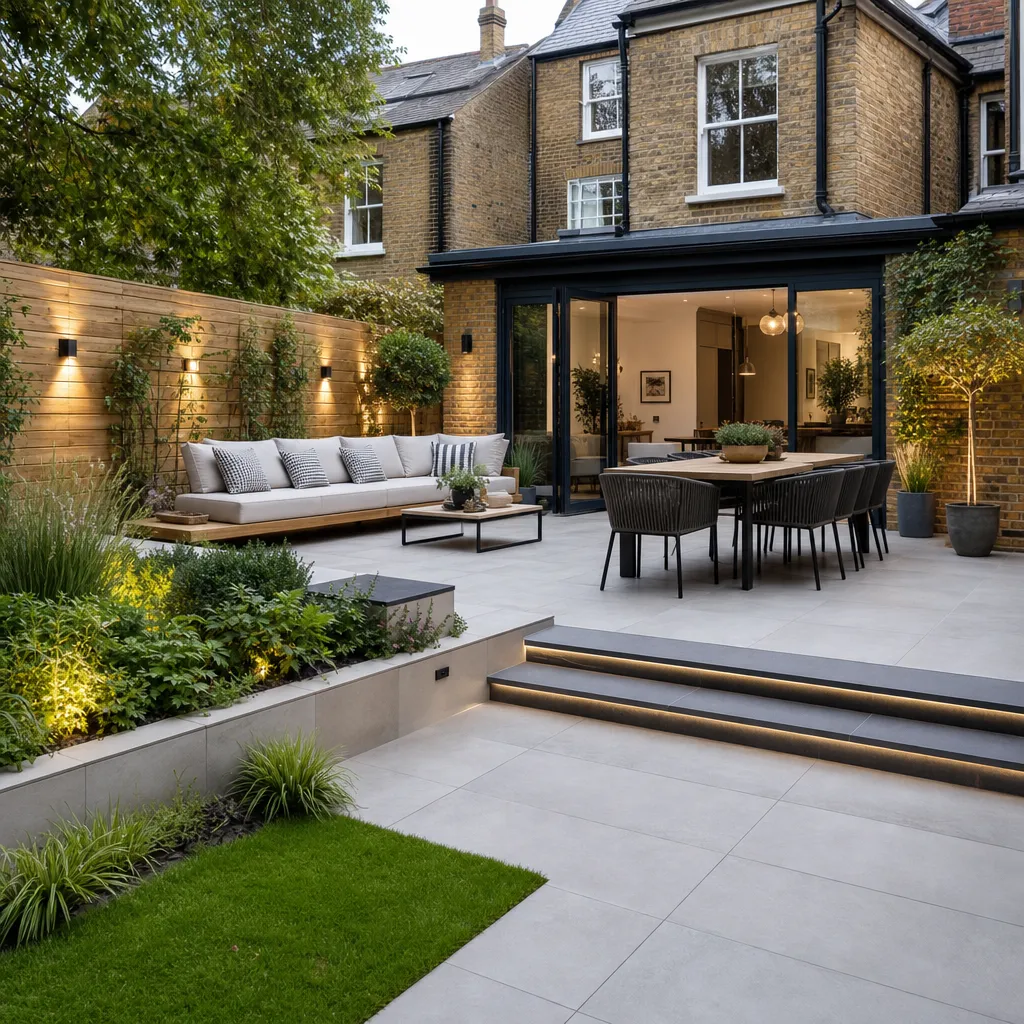
Creating Functional and Attractive Outdoor Entertainment Areas
A well-planned outdoor entertainment area combines a level surface — patio, decking, or gravel — shelter or shade, appropriate lighting, and power access if needed.
 Improvement & Build
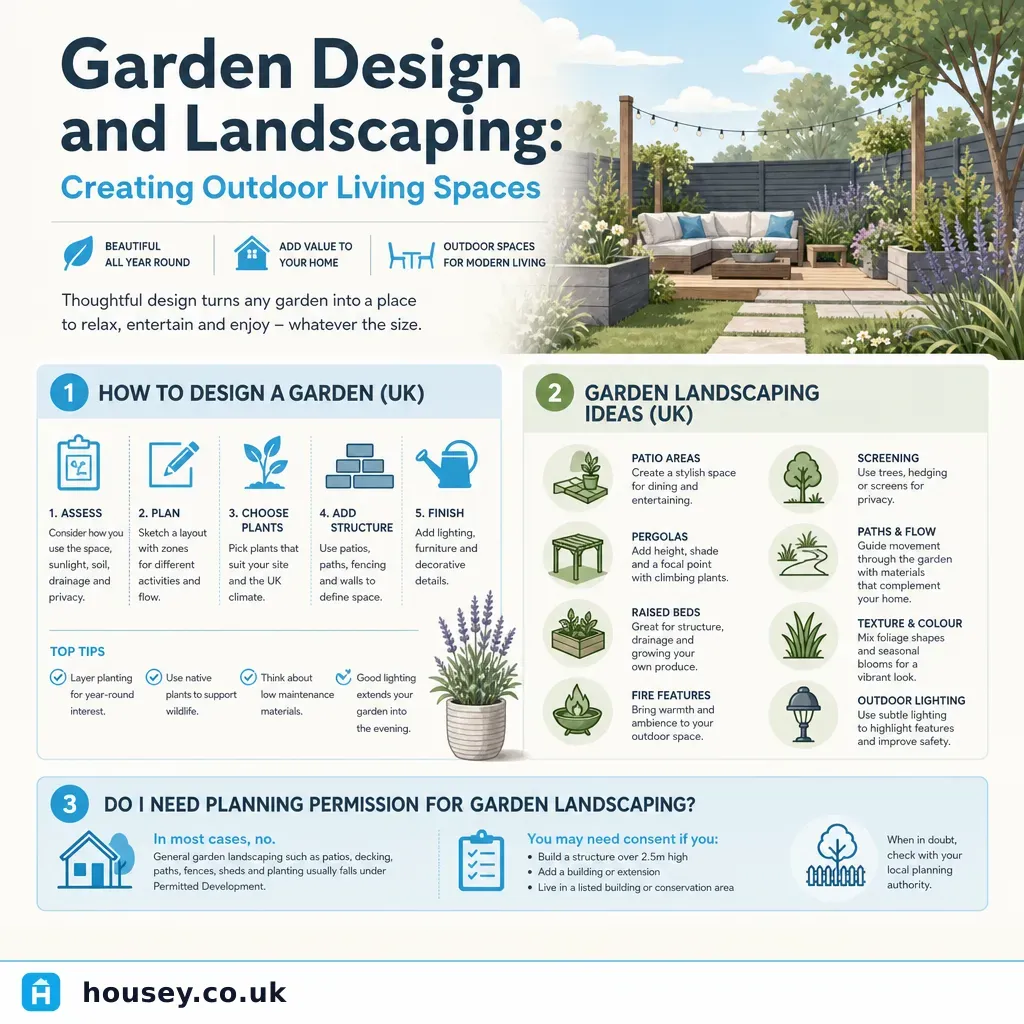
Garden Design and Landscaping: Creating Outdoor Living Spaces
Garden design creates functional outdoor living spaces through a combination of hard landscaping such as paving and decking, soft landscaping including planting and lawns, and structures such as pergolas or raised beds.
 Improvement & Build
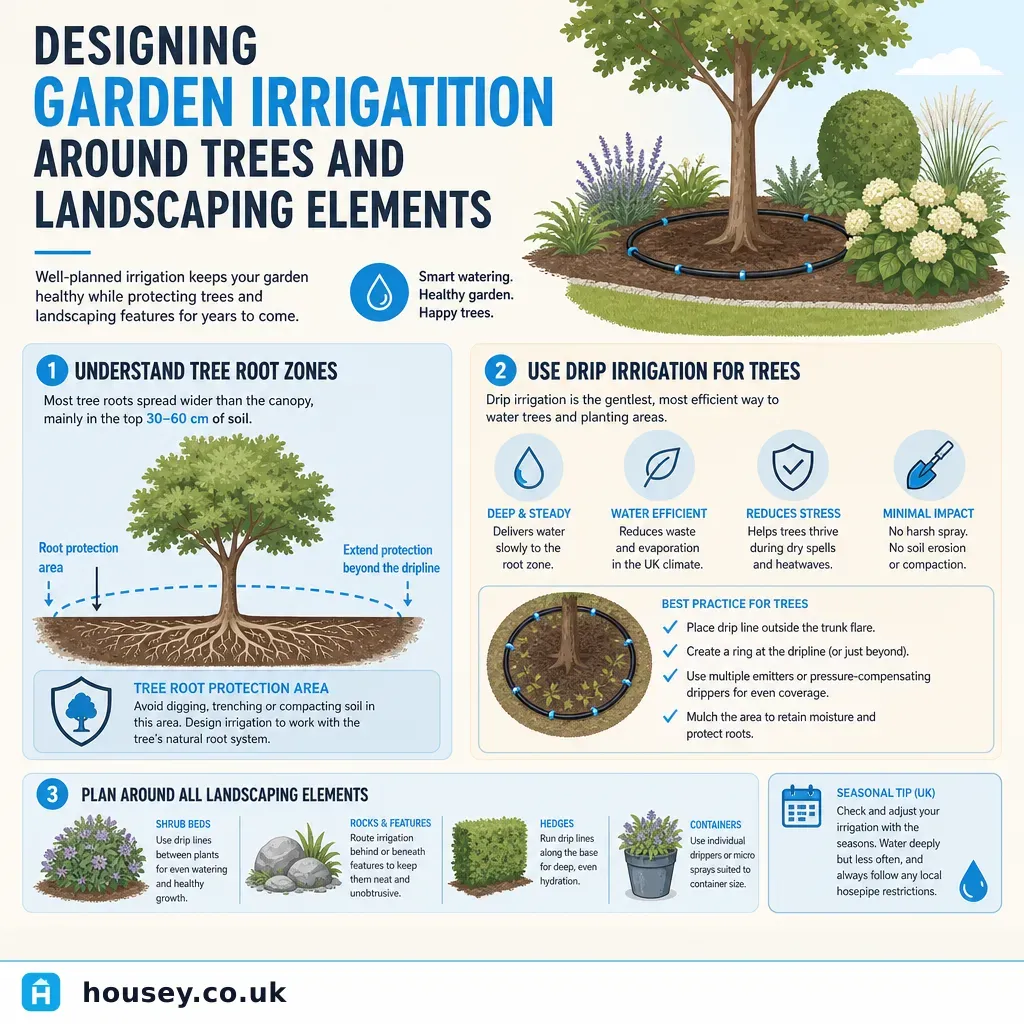
Designing Garden Irrigation Around Trees and Landscaping Elements
Design irrigation around trees by respecting the root protection area defined under BS 5837:2012, using drip or leaky pipe delivery rather than spray heads, and putting the tree zone on its own circuit.
 Improvement & Build
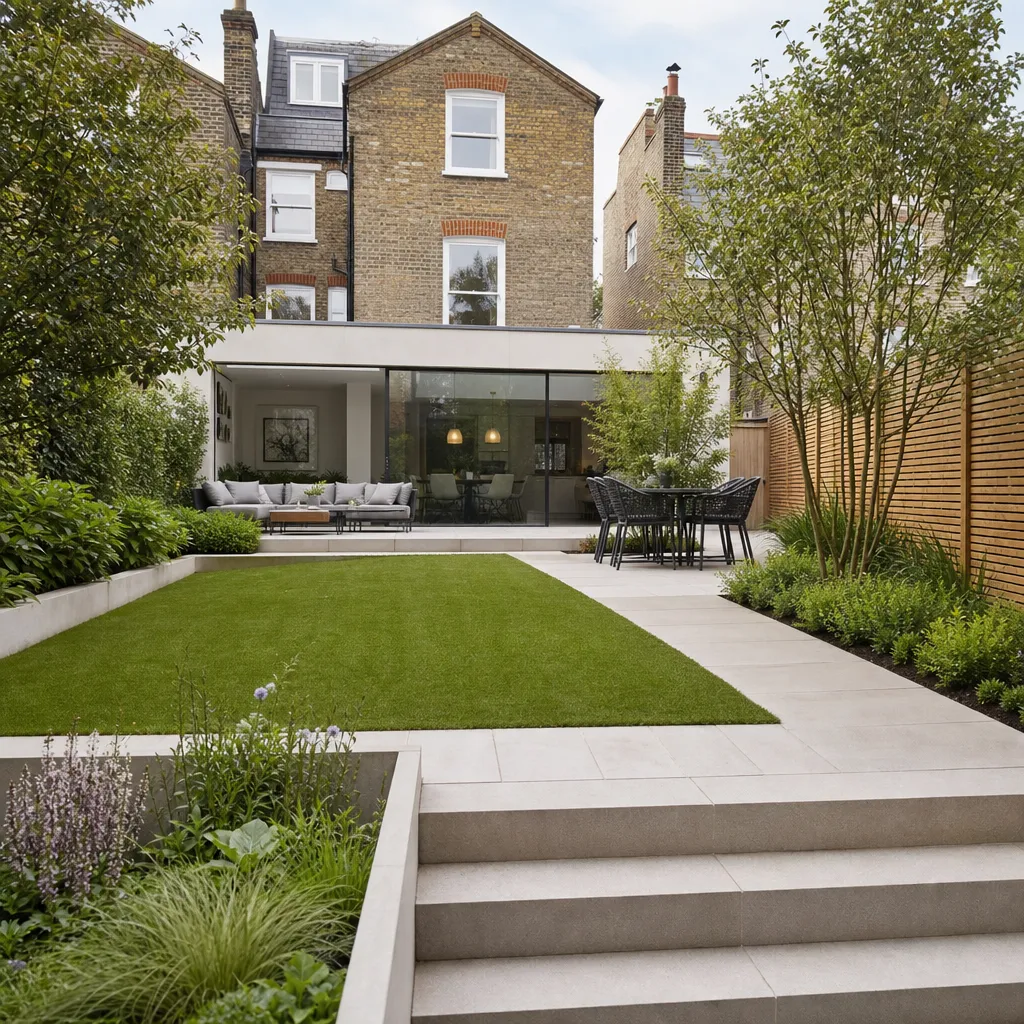
Garden Design Trends and Contemporary Landscaping Ideas
Contemporary UK garden design centres on low-maintenance naturalistic planting, multi-functional outdoor spaces, sustainable hard landscaping materials, and wildlife-friendly rewilded areas.