Retaining Wall Drainage: Preventing Water Damage and Failure
By Housey · Last reviewed 10th of May 2026
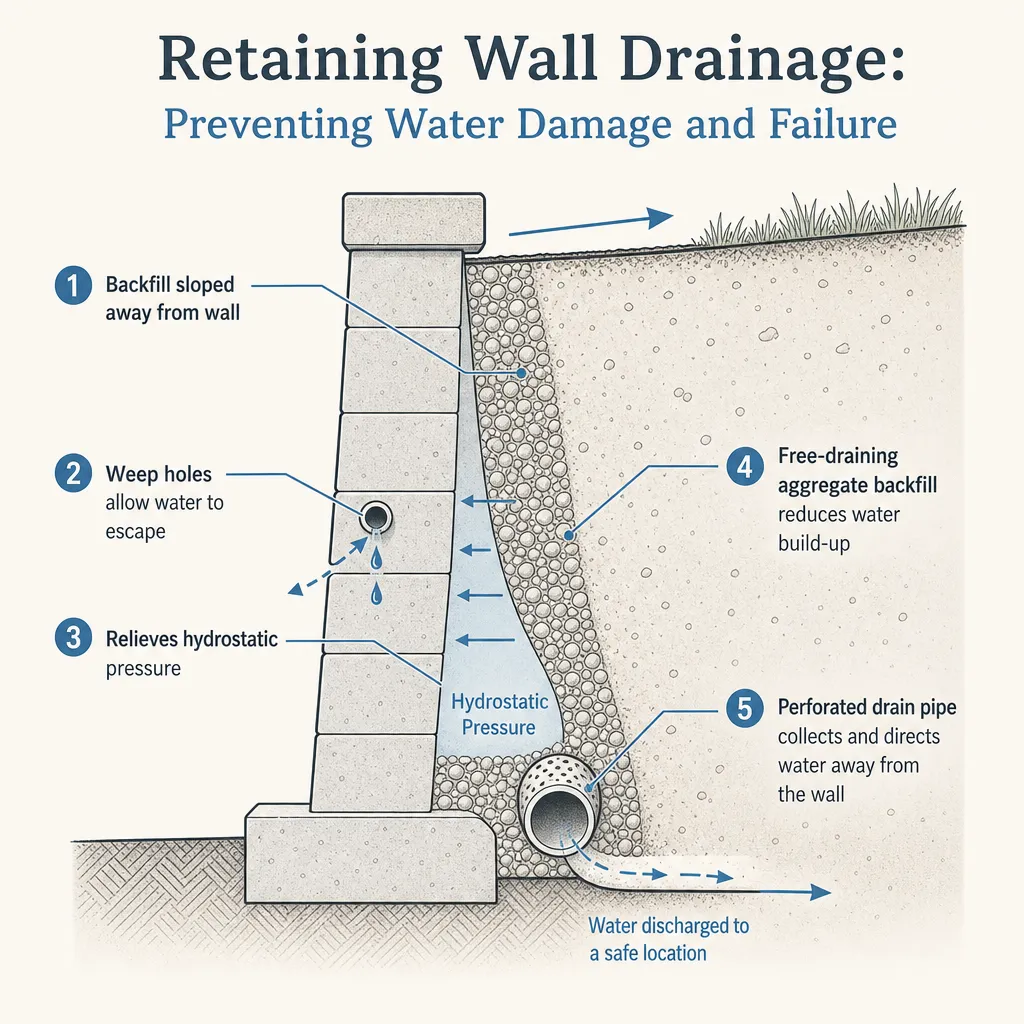
Retaining Wall Drainage: Preventing Water Damage and Failure
Retaining walls across the UK — from railway embankments to garden terracing in hilly towns — face a constant, invisible enemy: water. Whether you're building a new wall to manage a sloping garden or trying to understand why an existing structure is bulging or cracking, drainage is almost always the central issue. The consequences of poor drainage range from cosmetic cracking to sudden collapse, and getting this right involves engineering decisions that go beyond brickwork or blockwork.
Key points
- Hydrostatic pressure — water building up behind a retaining wall — is the leading cause of structural failure in garden and civil retaining walls.
- Weep holes, French drains, and geocomposite drainage blankets are the three main drainage approaches; each suits different wall types and site conditions.
- Retaining walls over approximately 1 metre in retained height typically require structural engineering input; those over 2 metres may need Building Regulations approval under Part A.
- Geotextile filter fabric prevents fine soil particles from clogging drainage layers over time — its omission is a common reason drainage systems fail prematurely.
- British Standard BS 8002:2015 covers the design of earth-retaining structures; CIRIA Report C760 provides detailed practical guidance on embedded retaining wall design.
Why water is the primary threat to retaining walls
When soil retains water — after heavy rain, a blocked gutter, or irrigation — it becomes significantly heavier and exerts lateral pressure against the back of a wall. This is hydrostatic pressure. Saturated clay, common across much of lowland England, can exert far greater lateral force than dry soil. Without an effective drainage system to intercept and redirect that water, the pressure accumulates until the wall cracks, tilts, or fails.
A secondary threat is frost heave: water in the retained soil freezes and expands, repeatedly pushing against the wall's rear face each winter. Over years, this cyclic movement can cause progressive cracking and displacement even in walls that appeared well-built at the time of construction.
The main drainage methods for retaining walls
Weep holes
Weep holes are gaps or short pipes left through the base of a wall — typically at 1–1.5 metre centres — to allow water to escape before pressure builds. For masonry walls, weep holes are straightforward to incorporate during construction. For existing walls, they can be retrofitted by carefully removing individual blocks or bricks.
Limitation: Weep holes alone do not capture water efficiently. They must be paired with a granular or geocomposite drainage layer behind the wall to channel water towards the holes.
French drain and granular backfill
A French drain — a perforated pipe laid in gravel backfill — placed at the base of the retained soil is one of the most reliable drainage solutions for garden retaining walls. Water percolates through the granular layer, enters the perforated pipe, and is directed to a soakaway, storm drain, or open channel.
Key considerations:
- Granular aggregate (typically 20 mm clean stone to BS EN 12620) must surround the pipe.
- A geotextile filter membrane should wrap the gravel to prevent soil migration and pipe silting over time.
- The outfall must have somewhere legal and functional to discharge — consent may be required under the Land Drainage Act 1991 if it connects to a watercourse.
Geocomposite drainage blankets
Modern geocomposite sheets — a plastic drainage core bonded to a geotextile filter fabric — can be placed against the back face of a wall before backfilling. They are faster to install than granular fills in confined sites and offer consistent drainage performance. They are commonly specified on engineered walls where available space behind the wall is limited.
Surface water interception
On terraced gardens, surface water running across the uphill ground can overwhelm even well-drained walls. A channel drain or interceptor trench at the top of the retained slope catches runoff before it enters the soil. This is particularly important on hard-landscaped terraces where water cannot soak away naturally.
Comparison: Retaining wall drainage methods
Method | Best for | Installation timing | Retrofit possible? | Main risk if omitted |
|---|---|---|---|---|
Weep holes | Masonry walls, modest retained heights | During build or retrofit | Yes — individual block removal | Hydrostatic pressure build-up |
French drain with gravel backfill | Most garden walls, free-draining soils | During construction | Partial — excavation required | Pipe silting without geotextile |
Geocomposite drainage blanket | Engineered walls, tight sites | During construction | No — requires full excavation | — |
Surface water channel drain | Paved terraces, high-runoff sites | During or after build | Yes | Surface flooding and soil saturation |
Granular layer + pipe + geotextile combined | All wall types over 1 m | During construction | Partial | Long-term silting if fabric omitted |
Common mistakes that lead to drainage failure
- No geotextile membrane: Fine soil particles migrate into granular drainage layers, gradually reducing permeability until the drain becomes ineffective within a few years.
- Inadequate outfall: Water collected must discharge somewhere legal and functional. Draining towards a neighbour's land or into a watercourse without consent creates both practical and legal problems.
- Impermeable backfill: Using clay-rich excavated spoil as backfill traps water rather than allowing it to drain to the pipe or weep holes.
- Blocked weep holes: Debris, mortar droppings, and vegetation routinely block weep holes within the first few years. Annual inspection is needed.
- Underestimating retained height effects: A 600 mm garden wall may need no engineering input; a 1.5 m wall on saturated clay retaining a waterlogged bank is a fundamentally different structural situation.
Red flags that suggest your retaining wall has a drainage problem
- Horizontal cracking in blockwork or brickwork, particularly at mid-height
- The wall leaning or bulging outward
- Water seeping through the face of the wall (other than from functioning weep holes)
- Efflorescence — white mineral staining — spread across large areas of the wall face
- Ground subsidence or hollowing at the base on the downhill side
- Cracking or lifting of paving immediately behind the top of the wall
- Weep holes that remain dry even after heavy rain, suggesting blockage within the drainage layer
If you observe bulging, leaning, or cracking that has appeared or worsened recently, treat this as urgent and arrange a professional inspection before loading the ground behind the wall further.
Important limitations
This article provides general information about retaining wall drainage principles. Retaining wall performance depends on factors including soil type, groundwater level, wall construction and materials, loading conditions, and the proximity of buildings, trees, and underground services. General guidance cannot substitute for a site-specific engineering assessment. Rules on when Building Regulations approval is required vary depending on the location, use, height, and loading geometry of the structure.
What to ask a qualified professional
- What retained height and soil conditions are we working with, and do these require formal structural design?
- Which drainage system do you recommend for this site, and why?
- What geotextile specification are you proposing, and is it suited to the soil particle size distribution on site?
- How will the drainage outfall be managed, and does it require consent under the Land Drainage Act 1991?
- Will the design comply with BS 8002:2015 or other relevant standards?
- Will the works require Building Regulations approval, and if so, who will manage building control?
- What maintenance will the drainage system need, and at what intervals?
When to get professional help
For any retaining wall over approximately 1 metre in retained height — or shorter walls retaining heavy loads, clay soils, or waterlogged ground — consult a structural or geotechnical engineer before building or significantly altering the structure. If an existing wall is showing signs of movement or failure, arrange an inspection promptly and avoid loading the ground immediately behind the wall until it has been assessed.
Signs that need immediate professional attention:
- Any wall that is visibly leaning, bulging, or has cracked significantly
- Cracking that has appeared or worsened after a period of heavy rain
- Ground subsidence adjacent to or downhill of the wall
- Any wall within 3 metres of a building, boundary, or public path that shows signs of distress
How Housey can help
Housey connects you with vetted professionals across the UK. If you need a structural or drainage assessment for a retaining wall, you can find a structural engineer, specialist drainage contractor, or experienced groundworker through Housey to evaluate your site and design or remediate your drainage system.
Frequently asked questions
Do retaining walls need planning permission?
Most garden retaining walls do not require planning permission under permitted development rights, provided they are no more than 1 metre adjacent to a highway or 2 metres elsewhere. Restrictions apply in conservation areas, on listed building curtilages, and on Article 2(3) land. Always confirm with your local planning authority before starting work.
When do retaining walls need Building Regulations approval?
Building Regulations Part A (Structure) may apply depending on the wall's height, proximity to buildings, and loading conditions. Walls built as part of a wider construction project — such as a basement or extension — are likely to need Building Control approval. Contact your LABC or an Approved Inspector to confirm what is required for your project.
How often should retaining wall drainage be inspected?
A visual inspection of weep holes, the wall face, and drainage outfalls once or twice a year — particularly after heavy rain — is appropriate for most garden walls. More formal inspection by a qualified engineer is advisable every five to ten years for walls over 1.5 metres, or sooner if any deterioration is observed.
Can I retrofit drainage to an existing retaining wall?
In many cases, yes. Weep holes can be inserted into masonry walls by carefully removing individual blocks or bricks. Adding a French drain requires excavating the retained backfill, which is more disruptive and typically requires professional equipment. Full drainage retrofits on walls over approximately 1 metre should be designed by a qualified engineer or drainage contractor.
Sources and further reading
- Building Regulations Approved Document A: Structure — GOV.UK
- Land Drainage Act 1991 — legislation.gov.uk
- CIRIA Report C760: Guidance on embedded retaining wall design — CIRIA
- Planning Portal: Fences, gates and garden walls — Planning Portal
- GOV.UK: Planning permission for householders — GOV.UK
Useful next reads
 Improvement & Build
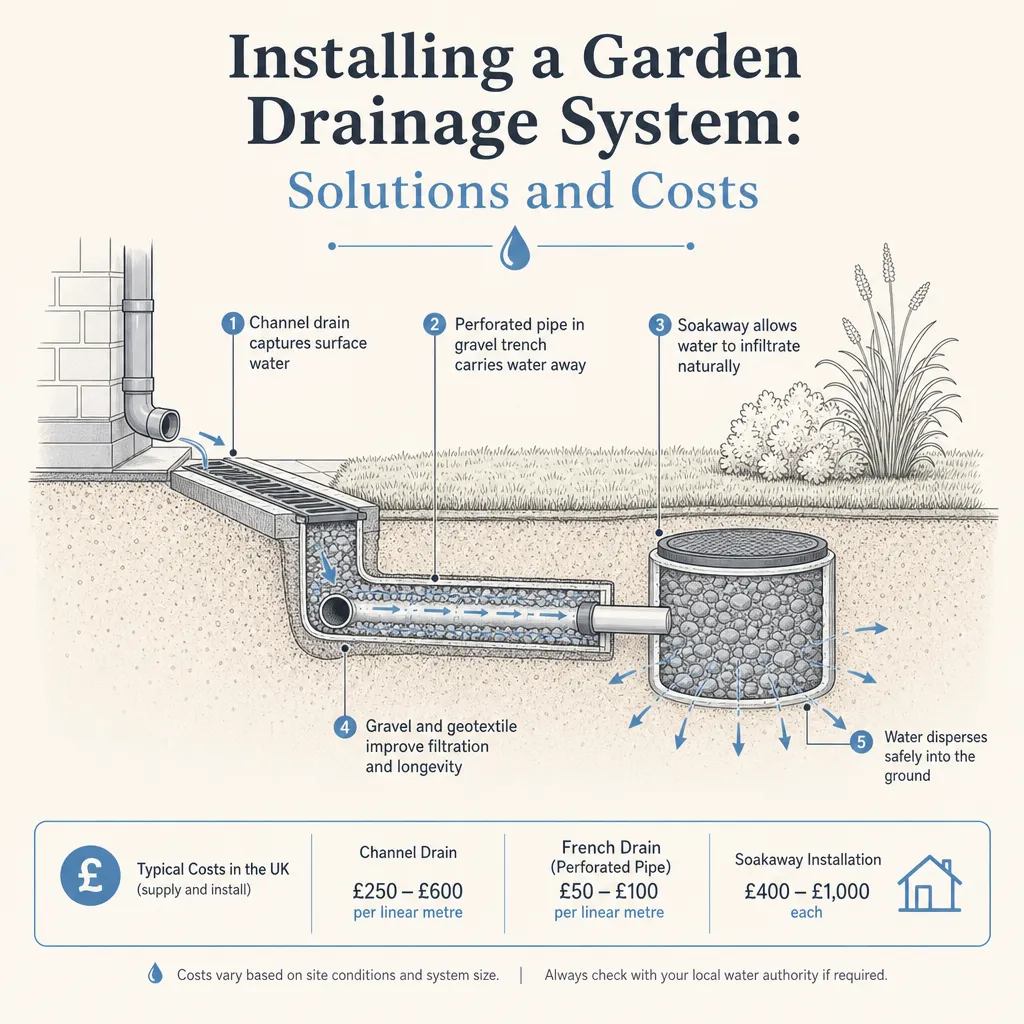
Installing a Garden Drainage System: Solutions and Costs
Garden drainage problems in UK homes usually stem from clay soil, compacted ground, poor gradient, or failed existing pipes.
 Improvement & Build
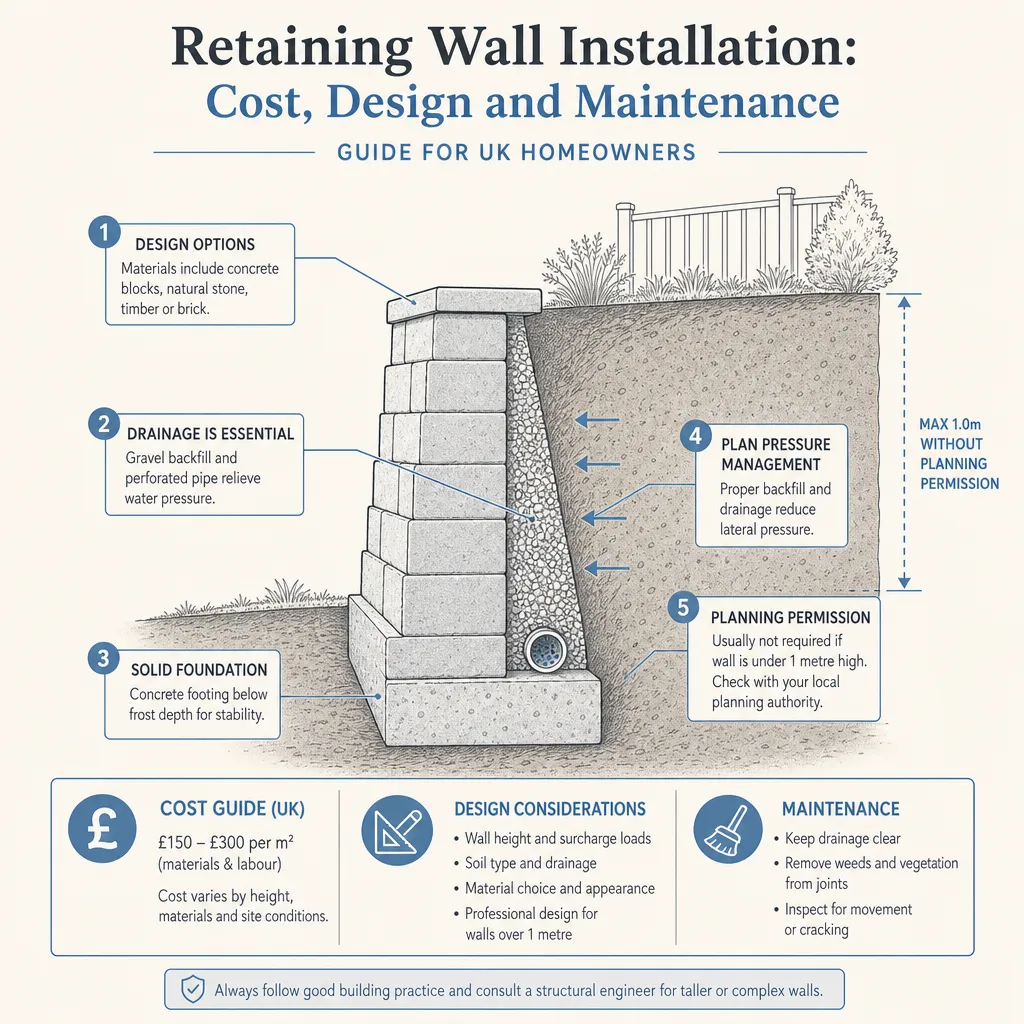
Retaining Wall Installation: Cost, Design and Maintenance
A retaining wall holds back soil on a sloped or banked site.
 Improvement & Build
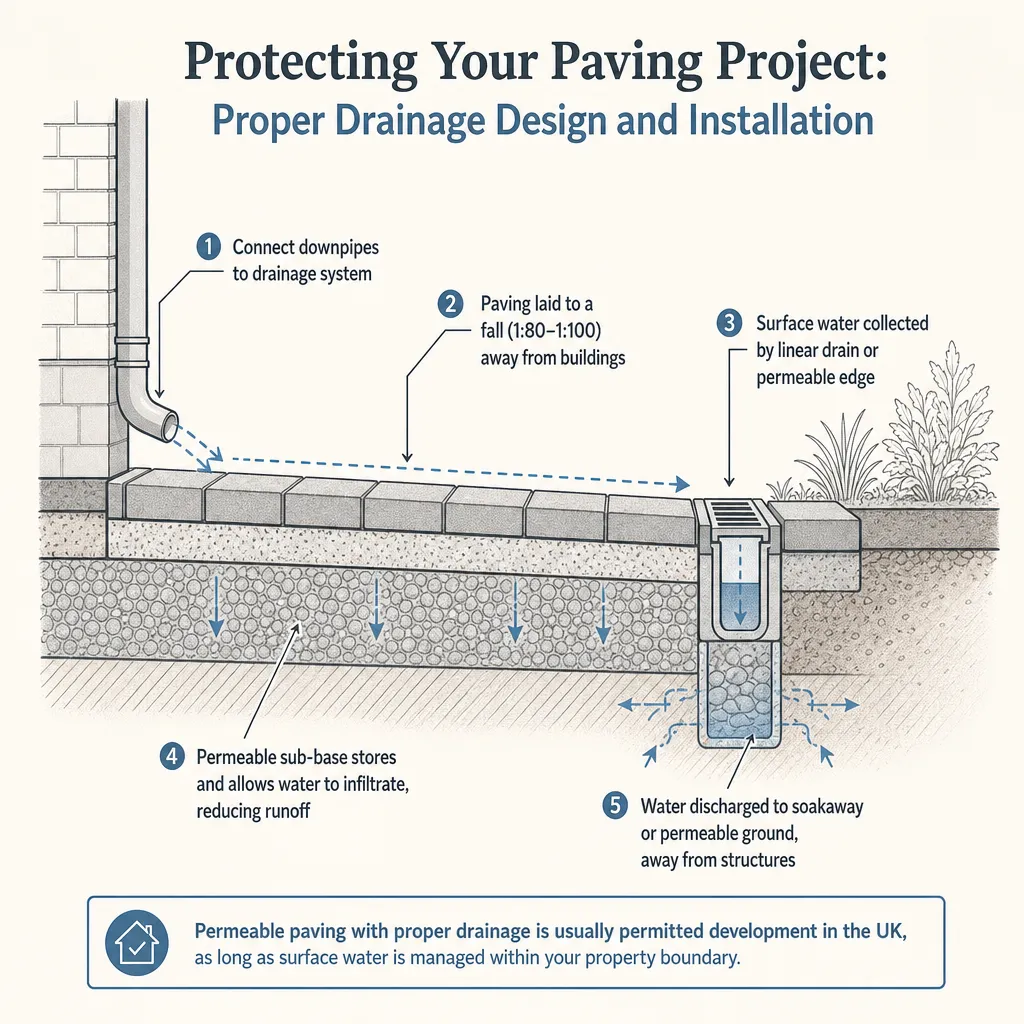
Protecting Your Paving Project: Proper Drainage Design and Installation
Good paving drainage starts with a minimum fall of 1:60 to 1:80 away from buildings, a correctly specified sub-base, and a clear outlet for surface water.
 Improvement & Build
Roof Truss System Installation and Repair Costs
Roof truss installation in the UK typically costs £3,000–£7,000 for a standard semi-detached house, covering manufacture, delivery, crane hire, and erection but excluding roofing materials.
 Improvement & Build
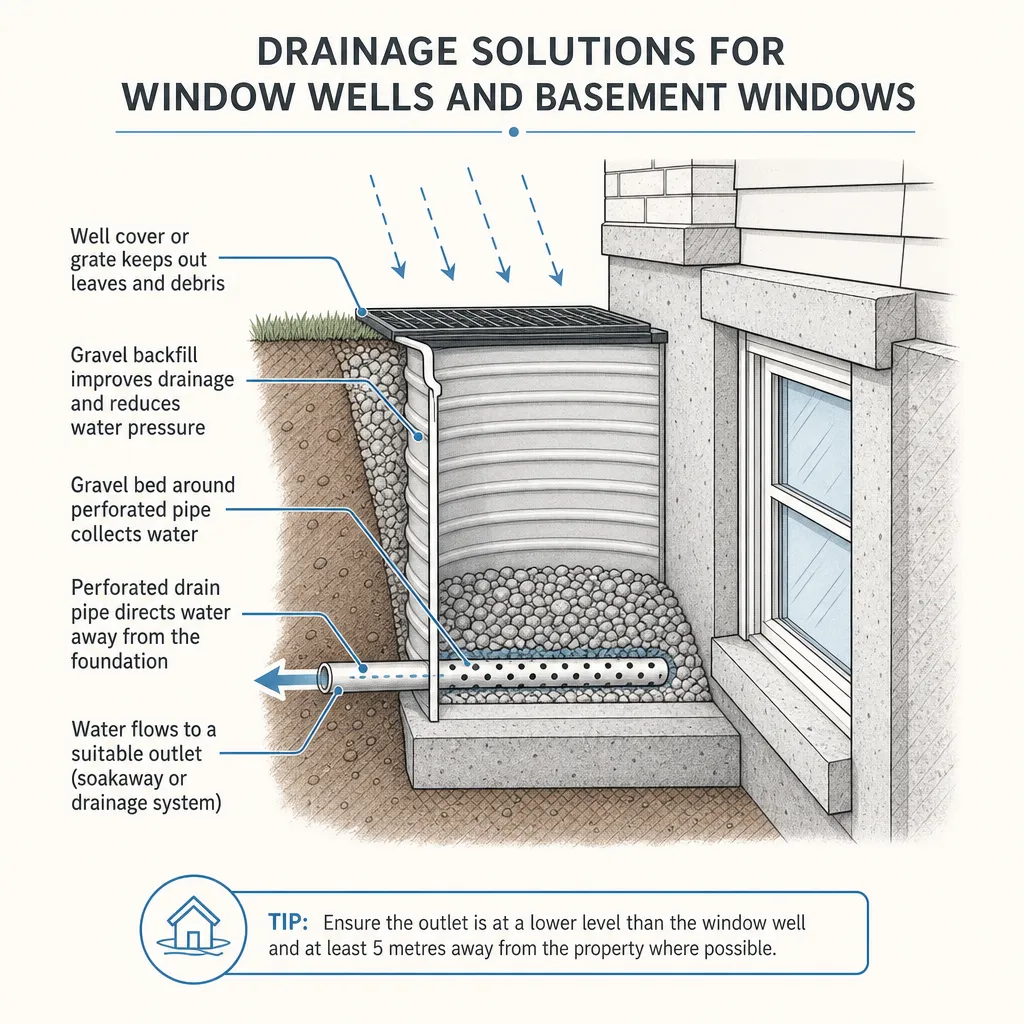
Drainage solutions for window wells and basement windows
Most UK window wells manage water through a gravel-filled sump at least 200 mm deep or a plastic liner fitted with a drain outlet connected to a soakaway or drainage system.