Garden Makeovers: Refreshing Your Outdoor Space with Professional Help
By Housey · Last reviewed 19th of May 2026
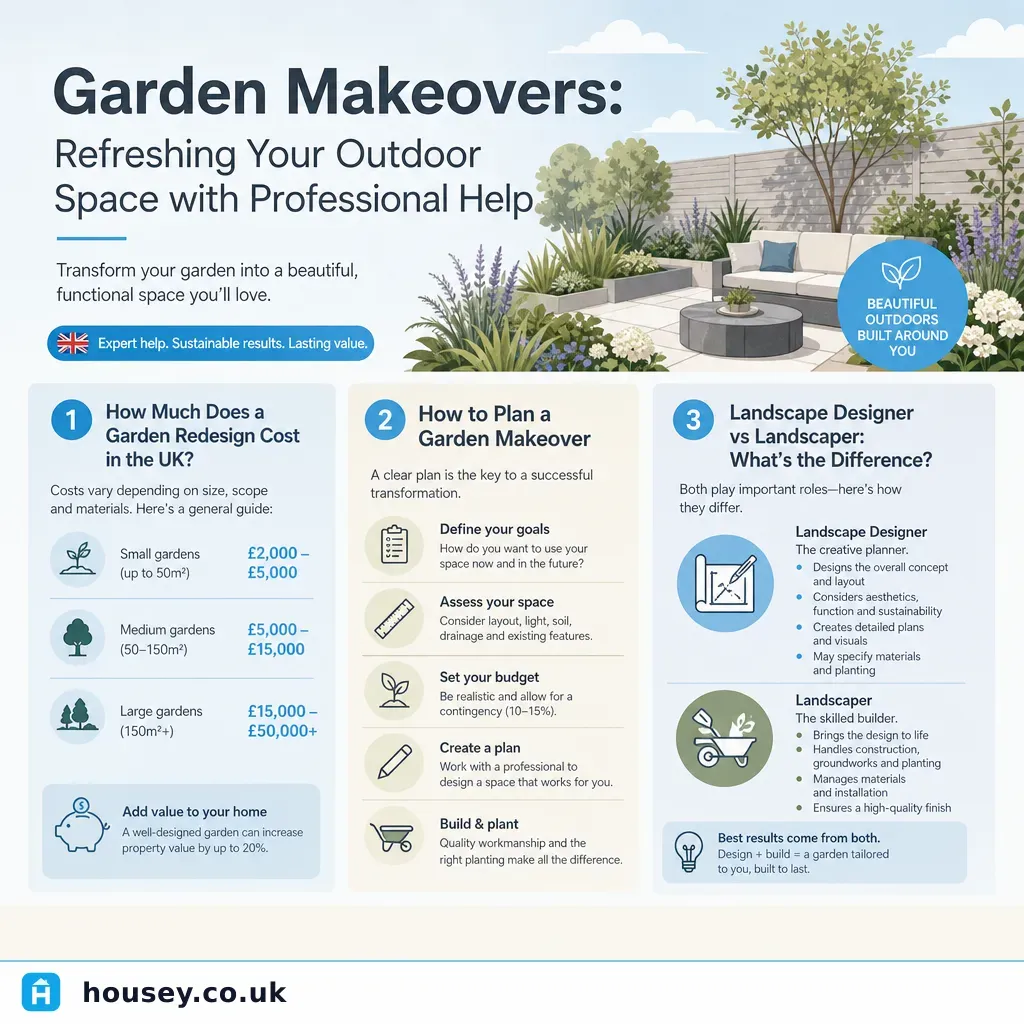
Garden Makeovers: Refreshing Your Outdoor Space with Professional Help
Whether you've just moved into a property with an unloved plot or your existing garden has gradually lost its appeal, a professional makeover can transform how you use and value your outdoor space. The decision to involve a designer or landscaper typically arises when DIY improvements feel inadequate, when you're preparing a home for sale, or when a major change — new patio, replanting scheme, drainage works — requires skills and equipment beyond the domestic toolkit. In the UK, where gardens range from compact terraced courtyards to spacious suburban plots, getting the right professionals involved early makes a significant difference to both the process and the result.
Key points
- Planning permission is not usually required for standard garden landscaping, but boundary walls over 1 metre adjacent to a highway, or over 2 metres elsewhere, may require consent under the Town and Country Planning Act 1990.
- A landscape designer and a landscaper are distinct professionals: designers produce concept plans and planting schemes, while landscapers carry out the physical construction and planting works.
- Hard landscaping (patios, paths, raised beds, retaining walls) typically accounts for 60–70% of a makeover budget; soft landscaping (turf, planting) is lower cost upfront but carries ongoing maintenance requirements.
- The Landscape Institute accredits landscape architects; the Association of Professional Landscapers (APL) accredits landscape contractors — checking membership helps verify credentials and professional standards.
- Indicative UK costs for a mid-sized garden makeover (60–100 m²) range from £5,000 to £20,000+, depending on scope, materials, and region. Indicative UK costs, last reviewed 2026-05-19.
What does a professional garden makeover involve?
A professional makeover typically runs through four stages: consultation and design, preparation and groundworks, hard landscaping, and soft landscaping.
Consultation and design usually begins with a site visit. A garden designer will assess aspect, soil type, existing features worth retaining, drainage characteristics, and your priorities — low maintenance, entertaining space, wildlife planting, or a combination. A concept plan and planting scheme follow.
Preparation and groundworks include clearing existing vegetation, breaking up old surfaces, addressing drainage problems, and grading levels. This stage often reveals hidden issues — compacted subsoil, buried rubble, or established root systems — that can affect programme and cost.
Hard landscaping covers all structural elements: paving, patios, pathways, steps, walls, pergolas, raised beds, and water features. Material choices — natural stone, porcelain, brick, timber — drive both cost and longevity. Natural stone typically costs more than concrete-based alternatives but ages well in UK conditions.
Soft landscaping includes turf laying or seed sowing, tree and shrub planting, herbaceous borders, and bulbs. Most planting is best done in autumn or spring to reduce establishment watering and improve survival rates.
Landscape designer vs landscaper: which do you need?
Professional | What they provide | Best for | Limitations |
|---|---|---|---|
Garden designer | Design concept, planting plans, material specifications, project management | Complex redesigns, unusual plots, high-value schemes | Usually does not carry out the physical works |
Landscaper / landscape contractor | Physical construction and planting, groundworks, hard and soft landscaping | Straightforward installations, single-trade works | May not produce detailed design drawings |
Landscape architect (Landscape Institute chartered) | Full design, planning submissions, project management, technical drawings | Large projects, planning-sensitive sites | Higher professional fees; may be over-specified for small gardens |
For most UK homeowners planning a significant redesign, a combined approach works well: a garden designer produces the brief and plans, and an accredited landscaper delivers the works.
A worked UK property scenario
Scenario: A 1950s semi-detached property in South Manchester with a 70 m² rear garden — overgrown lawn, cracked concrete patio, and tired close-board fencing. The owners want a low-maintenance space suitable for entertaining, with some wildlife planting.
Approach: A garden designer visits and produces a concept plan: a 20 m² porcelain patio, a reduced lawn of around 25 m², mixed native-shrub borders along two sides, a small raised herb bed, and a replacement close-board fence. A local APL-member landscaper is engaged for the construction works. Indicative total project cost: £9,500–£13,000 depending on stone specification and fence grade. Indicative UK costs, last reviewed 2026-05-19.
Timeline: Design phase: 2–3 weeks. Groundworks and hard landscaping: 3–5 working days. Soft landscaping: 1–2 days. Total on-site time: approximately 10–14 working days, spread across 3–4 weeks to allow for material lead times.
Garden makeover checklist
Before instructing a designer or landscaper, work through these points:
When to get professional help
A professional landscaper or garden designer is appropriate for most garden makeovers that go beyond basic tidying. Seek professional input when the project involves significant groundworks or level changes, when hard landscaping requires specialist cutting and jointing skills, or when you want a planting scheme suited to your specific soil type and aspect. Always use an Arboricultural Association-approved contractor for any tree surgery or root management work.
Red flags that suggest professional advice is needed before proceeding:
- Pooling water that drains onto a neighbouring property — this may carry a legal liability under common law.
- Retaining walls over 1 metre, which carry structural implications if they fail.
- Suspected Tree Preservation Order on existing trees — check with your local planning authority before any removal or pruning.
- Significant groundworks proposed within 2 metres of a shared boundary or near drainage infrastructure.
How Housey can help
Housey connects you with vetted professional landscapers and experienced garden designers working in your area. Describe your project, receive quotes from local professionals, and compare them side by side — without the hassle of cold-calling.
Frequently asked questions
Do I need planning permission for a garden makeover?
Most garden landscaping work — patios, planting, paths, raised beds — does not require planning permission. Exceptions include boundary walls or fences over 1 metre adjacent to a highway, or over 2 metres elsewhere, and structures that could be classed as outbuildings. If your property is in a conservation area or is listed, additional restrictions apply. Check with your local planning authority before starting work if you are uncertain.
How long does a professional garden makeover take?
A mid-sized rear garden makeover typically takes 10–20 working days on site, depending on scope and complexity. Design and planning may add 3–6 weeks before work begins, especially if materials have long lead times. Natural stone and bespoke joinery are common causes of delay. Allow additional time for post-planting establishment and the settling of new surfaces.
Should I hire a landscape designer or a landscaper?
If you want a detailed design concept, planting scheme, and someone to coordinate the project, start with a garden designer. If you have a clear brief and need skilled physical delivery of the works, a landscaper is the primary professional. For complex or higher-value projects, using both is common — the designer specifies, the landscaper builds.
What time of year is best for a garden makeover?
Hard landscaping can proceed year-round in most UK weather, though frost and waterlogged ground can cause delays in winter. Soft landscaping — turf, planting, and sowing — is generally most successful in autumn (September–November) or spring (March–May), when soil moisture and temperature support establishment without intensive watering.
Sources and further reading
- Permitted development rights for householders: technical guidance — GOV.UK
- Association of Professional Landscapers — APL
- Find a landscape architect or practice — Landscape Institute
- Garden design guidance — Royal Horticultural Society
Useful next reads
 Improvement & Build
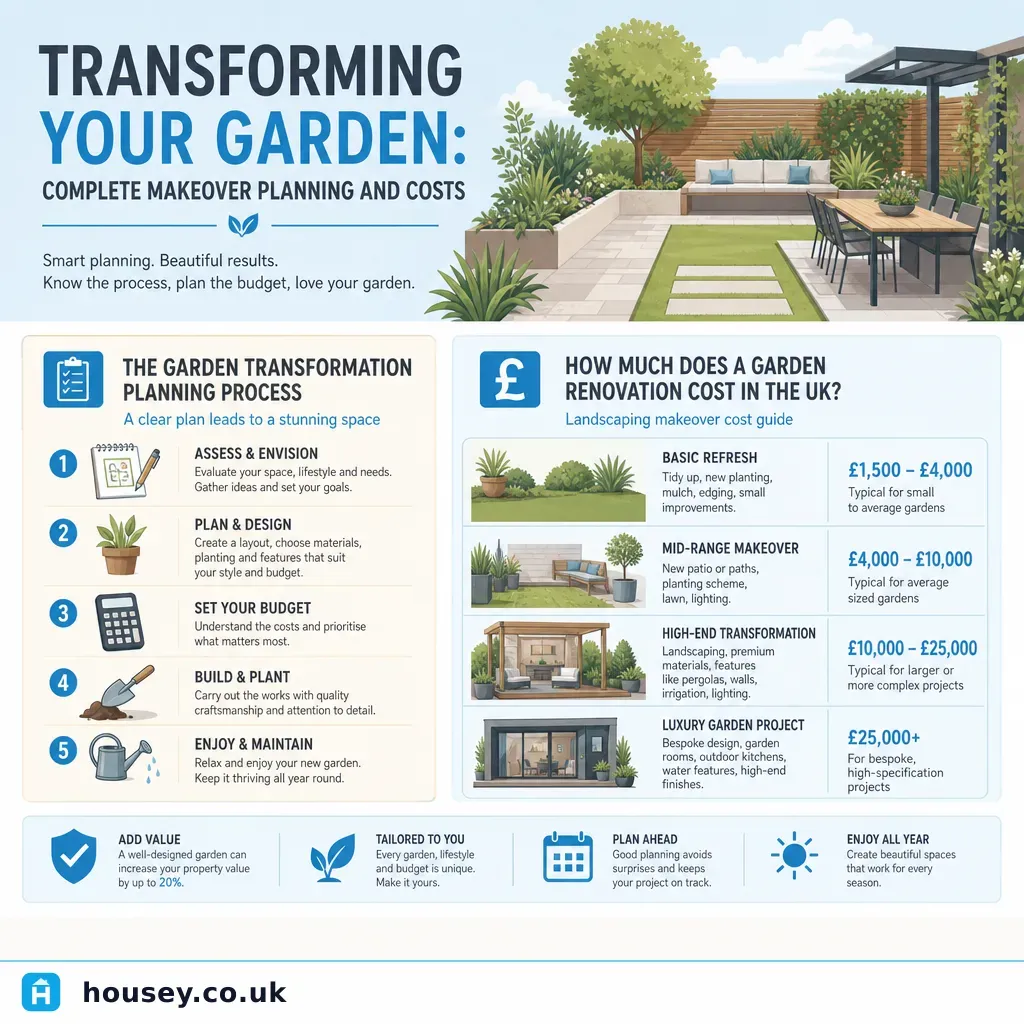
Transforming Your Garden: Complete Makeover Planning and Costs
A garden makeover in the UK typically costs £8,000–£18,000 for a medium suburban garden covering a new patio, lawn, planting, and fencing.
 Improvement & Build
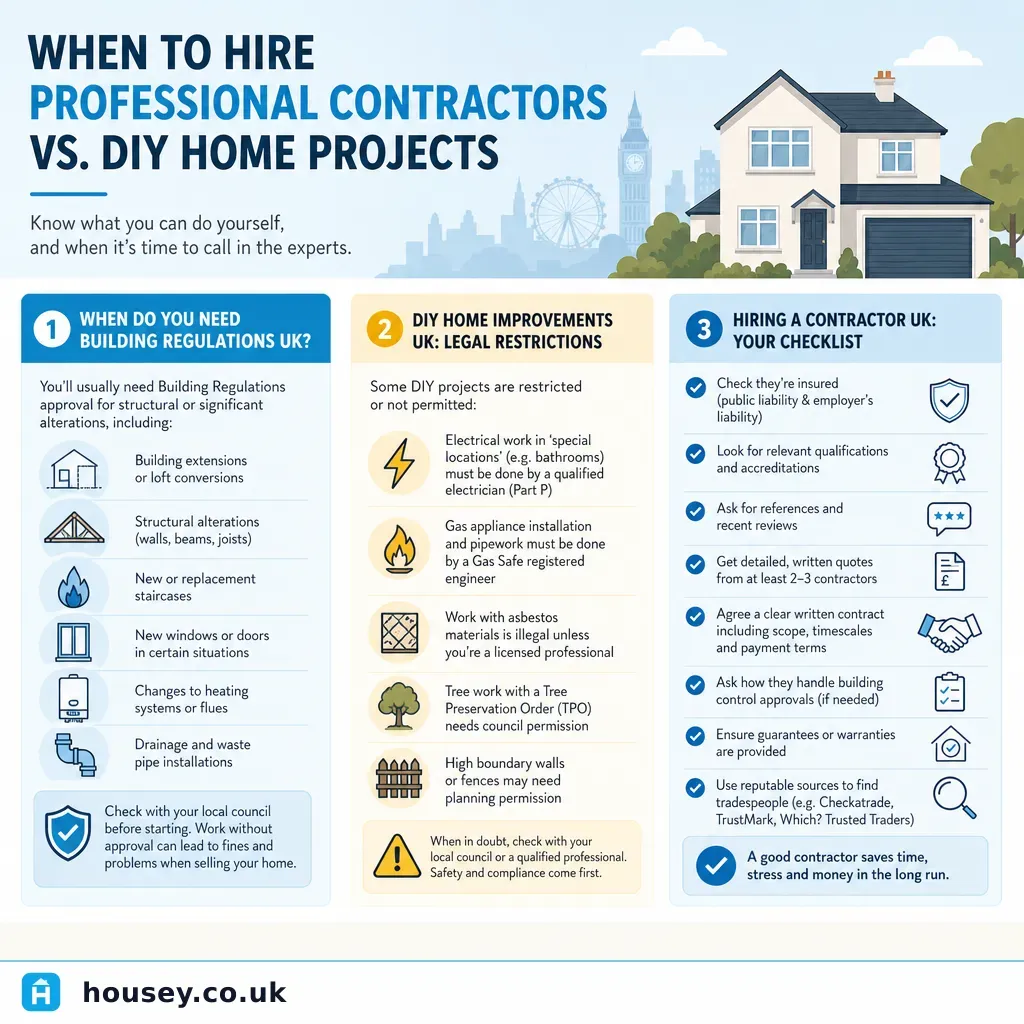
When to Hire Professional Contractors vs. DIY Home Projects
Some home improvement work — including gas fitting, consumer-unit electrical work, structural alterations, and asbestos removal — is legally restricted to qualified professionals in the UK.
 Improvement & Build
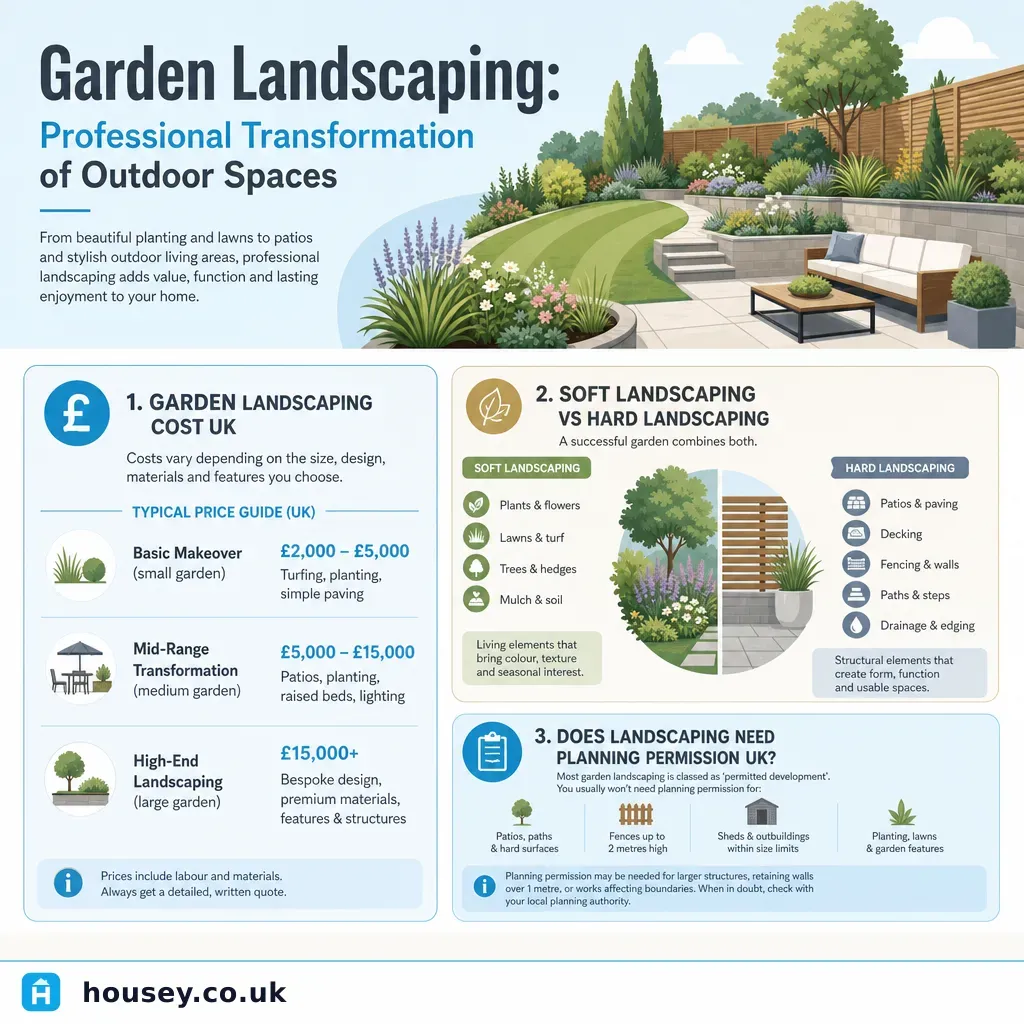
Garden Landscaping: Professional Transformation of Outdoor Spaces
Garden landscaping covers all physical works to reshape and improve an outdoor space, from earthworks and hard landscaping such as patios, paths, and walls, to planting, drainage, and lawn installation.
 Improvement & Build
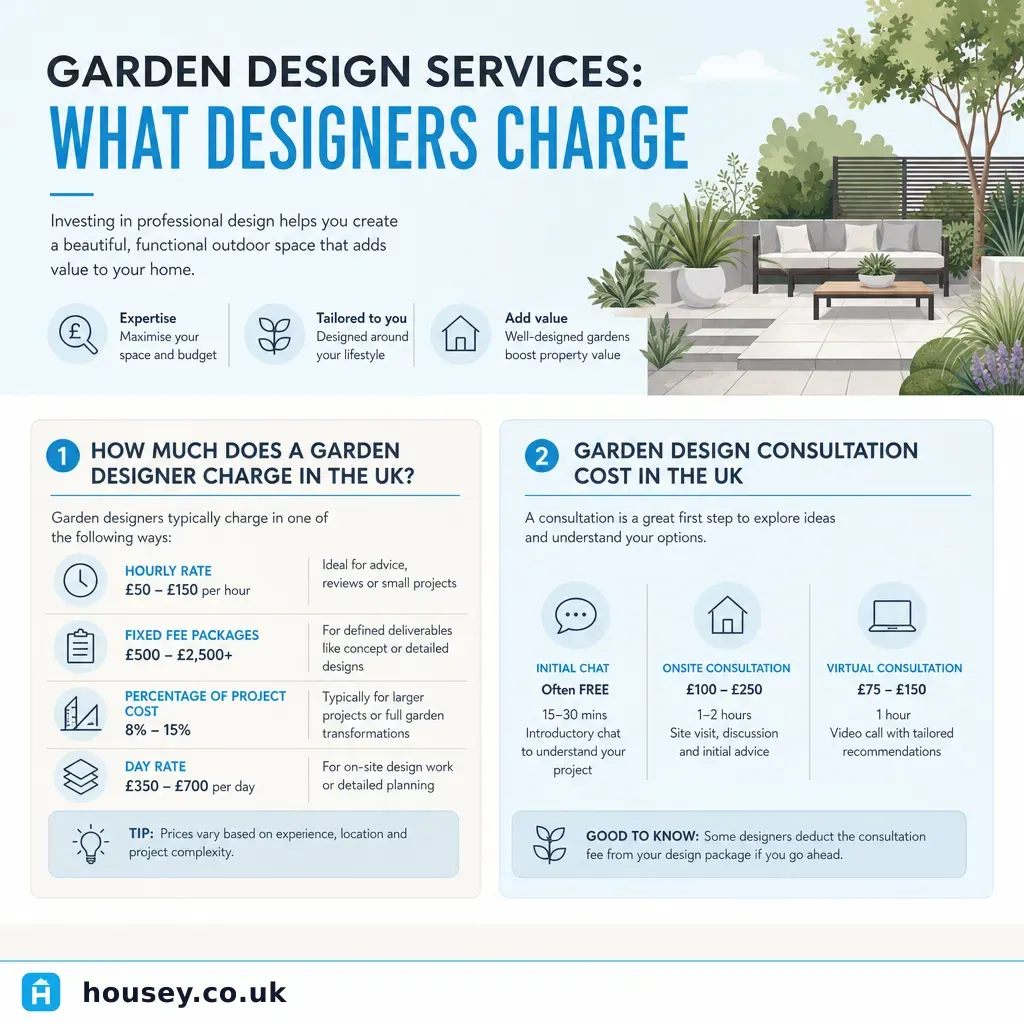
Garden Design Services: What Designers Charge
UK garden designers typically charge £50–200+ per hour, or fixed fees from around £200 for an initial consultation to £3,000–5,000+ for a full design package on a medium garden.
 Improvement & Build
How to Find and Vet Professional Roofing Contractors
Professional roofing contractors should carry public liability insurance of at least £2m, provide a written workmanship guarantee, and hold accreditation from a recognised body such as the NFRC or the Competent Roofer scheme.