When to Hire Professional Contractors vs. DIY Home Projects
By Housey · Last reviewed 19th of May 2026
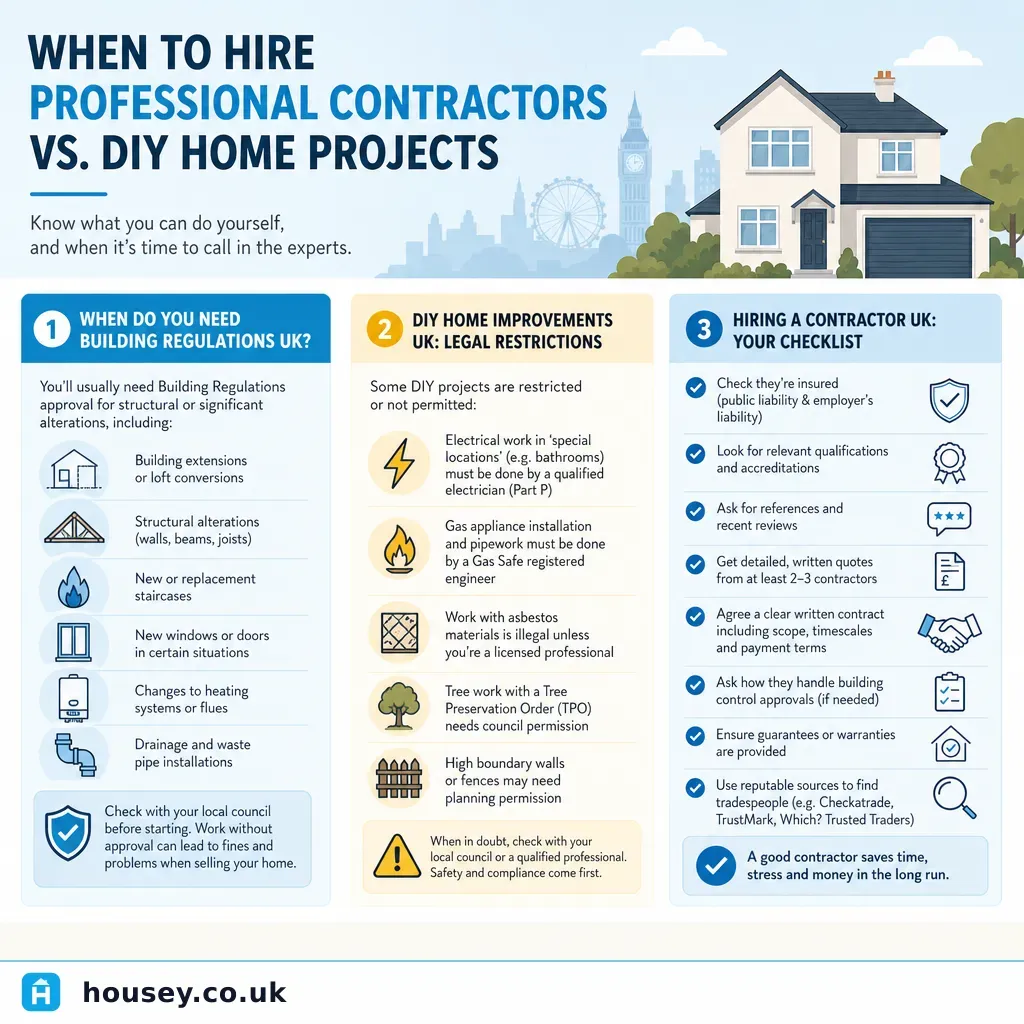
When to Hire Professional Contractors vs. DIY Home Projects
Deciding whether to tackle a home improvement yourself or bring in a professional is one of the most frequent judgement calls UK homeowners face. The decision is not just about cost — it involves safety, insurance, legal compliance, building regulations, and the long-term value of your property. Some work is legally restricted to qualified professionals regardless of your skill level, confidence, or experience.
Key points
- Gas fitting of any kind must be carried out by a Gas Safe registered engineer under the Gas Safety (Installation and Use) Regulations 1998 — unlicensed gas work is a criminal offence.
- Notifiable electrical work (defined under Building Regulations Approved Document P) must either be done by a competent person registered with NICEIC, NAPIT, or a similar scheme, or separately inspected by a building control body.
- Asbestos-containing materials — common in UK homes built before 2000 — must be assessed professionally; licensed removal is required for high-risk work under the Control of Asbestos Regulations 2012.
- Householders' insurance policies typically limit or exclude claims arising from unapproved DIY work, particularly for structural or electrical elements.
- Competent persons schemes — Gas Safe, NICEIC, NAPIT, FENSA, CERTASS — allow registered tradespeople to self-certify work without a separate building control application.
What the law actually restricts
Some home improvement work is not a matter of preference — it must be carried out, or at minimum certified, by a qualified professional:
- Gas work: any work on gas appliances, pipework, flues, or boilers must be carried out by a Gas Safe registered engineer. Unlicensed gas work is a criminal offence under the Gas Safety (Installation and Use) Regulations 1998 and carries serious safety risk.
- Notifiable electrical work: work in kitchens, bathrooms, outdoors, and at consumer unit level is notifiable under Building Regulations Part P. It must either be done by a registered competent person (NICEIC, NAPIT, or similar) or inspected and certified by a local building control body.
- Asbestos: materials containing asbestos — found in floor tiles, ceiling tiles, pipe lagging, artex, and roof products in many pre-2000 UK homes — must be assessed professionally. Licensed removal is required for high-risk asbestos work, regulated by the HSE under the Control of Asbestos Regulations 2012.
- Structural alterations: removing or modifying load-bearing walls, altering the roof structure, or underpinning requires structural engineering input and building regulations approval; the physical work is typically carried out by an experienced contractor.
Proceeding with this work unlicensed, or without building control inspection where required, may invalidate your buildings insurance, create problems at the point of sale, and carry legal liability.
Decision tree: contractor or DIY?
- DIY is generally appropriate if the work is purely decorative (painting, wallpapering, non-structural tiling), involves low-risk assembly (flat-pack furniture, basic garden landscaping at ground level), or changes like-for-like fixtures without any structural, gas, or notifiable electrical elements.
- Hire a contractor if the work is structural, involves gas or notifiable electrical systems, requires a building regulations application, or if you have no relevant experience with the trade involved.
- Always hire a registered specialist for any gas work (Gas Safe), high-risk electrical work (NICEIC or NAPIT), asbestos assessment or removal (HSE licensed contractor), structural alterations, or any work on a listed building.
- Consider a design-and-build firm if the project involves multiple trades, a planning application, and structural elements — self-managing multiple subcontractors without experience significantly increases programme and cost risk.
- Check with your local planning authority before starting any external alterations, outbuildings, or extensions, even if you plan to self-manage the build.
Comparison table: project types and professional requirements
Project type | DIY possible? | Professional required? | Regulatory trigger | Risk if DIY goes wrong |
|---|---|---|---|---|
Interior painting and decorating | Yes | No | None | Cosmetic only |
Replacing kitchen units (no structural or notifiable electrical change) | Possible | Plumber or electrician for connections | Part P (electrical), Water Fittings Regs | Water damage, unsafe connections |
Loft conversion | No | Builder, structural engineer, building control | Building regs, possibly planning | Structural failure, insurance void |
Single-storey rear extension | No | Builder or extension specialist | Building regs, possibly planning | Structural, insurance, resale issues |
Boiler replacement | No | Gas Safe registered engineer | Gas Safety Regs 1998, Approved Document J | Risk of death or serious injury |
Consumer unit or rewiring work | No | NICEIC or NAPIT registered electrician | Part P Building Regulations | Fire risk, insurance void |
Replacing windows (non-FENSA self-certified) | DIY possible | Or FENSA/CERTASS registered installer | Part L (thermal performance) | Building control inspection needed if DIY |
Garden landscaping (at ground level) | Yes | Optional | None for most | Low |
Reroofing | Generally no | Qualified roofer | Part L if significantly altering insulation | Falls, water ingress, structural load |
New drainage or groundworks | No for new drains | Groundworker or drainage specialist | Building Regulations Part H | Flooding, structural damage, legal liability |
What to consider before starting any project
The full cost of DIY
DIY appeals most strongly when the upfront labour saving seems significant. The full cost calculation should include your time at a realistic hourly rate, materials (including waste and errors), hire of specialist tools or equipment, building regulations fees where applicable, and the cost of professional remediation if something goes wrong. Failed DIY that requires a professional to undo and redo the work is frequently more expensive than hiring professionally from the outset.
Indicative UK costs, last reviewed 2026-05-19: a single-storey rear extension by a professional builder typically ranges from £1,500–£2,500 per square metre for a turnkey package, varying significantly by region, specification, and groundwork complexity. Obtain at least three quotes from qualified contractors to establish a realistic range for your project.
What to ask before accepting a contractor quote
- What is included and excluded from the price?
- Who will carry out the work — the quoting contractor directly, or subcontractors?
- Are you registered with Gas Safe, NICEIC, NAPIT, FENSA, CERTASS, or another competent persons scheme?
- What building regulations approvals are needed, and who is responsible for obtaining them?
- What documentation — completion certificate, building regulations sign-off, FENSA or NICEIC certificate — will I receive at the end of the project?
- Is VAT included in the quoted price?
- What could change the price or programme once work has started?
- Do you carry public liability insurance, and employers' liability insurance if you employ others?
Why quotes vary widely
Variation of more than 30–40% between quotes usually indicates differing scope assumptions, specification differences, or a quote that excludes significant costs such as building control fees, structural engineer input, or groundwork contingencies. Always compare like for like by confirming what each quote specifically includes and excludes before making a decision.
Red flags when hiring a contractor
- No verifiable registration with Gas Safe, NICEIC, NAPIT, TrustMark, FENSA, or CERTASS — always check independently on the official registers, not solely from a card or verbal claim.
- Request for a large upfront cash deposit (more than 10–25% is unusual for most residential projects).
- No written contract, specification of works, or programme.
- Pressure to start immediately without time to check credentials or take references from recent comparable projects.
- No evidence of public liability insurance.
- Unwillingness to apply for building regulations approval or to discuss competent persons scheme certification.
When to get professional help
If any of the following apply, consult a professional before proceeding:
- The project involves structural walls, foundations, or roofline alterations.
- Gas, consumer-unit electrical, or asbestos work is required.
- The property is listed or within a conservation area.
- You have begun DIY work and it is not going as expected — stopping early and seeking professional advice is always cheaper than continuing into a deeper problem.
How Housey can help
Housey connects you with vetted local professionals across a range of home improvement trades. Whether you need extension builders for a rear addition, a design-and-build firm to manage a complex project end to end, specialist groundworkers for drainage and foundations, or experienced roofers for a retile or full reroof, Housey matches you with contractors who carry appropriate accreditation and insurance.
Frequently asked questions
Do I need building regulations approval for a DIY kitchen renovation?
A straightforward kitchen refurbishment — swapping units and worktops without structural changes — does not usually need building regulations approval. However, new electrical circuits are notifiable under Part P and significant plumbing changes may need notification under the Water Supply (Water Fittings) Regulations 1999. Contact your local building control body if you are unsure before starting work.
What happens if I sell a property with unverified DIY electrical or gas work?
Buyers' solicitors typically request electrical installation certificates and gas safety records during conveyancing. If self-certified work cannot be evidenced, you may need a retrospective inspection, causing delays, additional cost, and potentially requiring the work to be redone. This can also affect your negotiating position on price.
Can I self-manage an extension project without a main contractor?
Homeowners can act as their own principal contractor for their own home, with some exceptions for notifiable projects under CDM Regulations 2015. However, doing so effectively requires knowledge of build sequencing, subcontractor management, building regulations compliance, and site safety. Most homeowners underestimate the time and coordination involved; a design-and-build firm often delivers better overall value.
Sources and further reading
- Gas Safety (Installation and Use) Regulations 1998 — legislation.gov.uk
- Approved Document P: Electrical Safety in Dwellings — GOV.UK
- Control of Asbestos Regulations 2012 — legislation.gov.uk
- Gas Safe Register — Gas Safe Register
- TrustMark: find government-endorsed tradespeople — TrustMark
Useful next reads
 Improvement & Build
Painting Interior Doors: Preparation and Technique
Painting interior doors well depends on preparation rather than paint choice.
 Improvement & Build
Installing Replacement Windows in Your Home
Replacing windows in the UK requires compliance with Building Regulations Part L — a minimum centre-pane U-value of 1.
 Improvement & Build
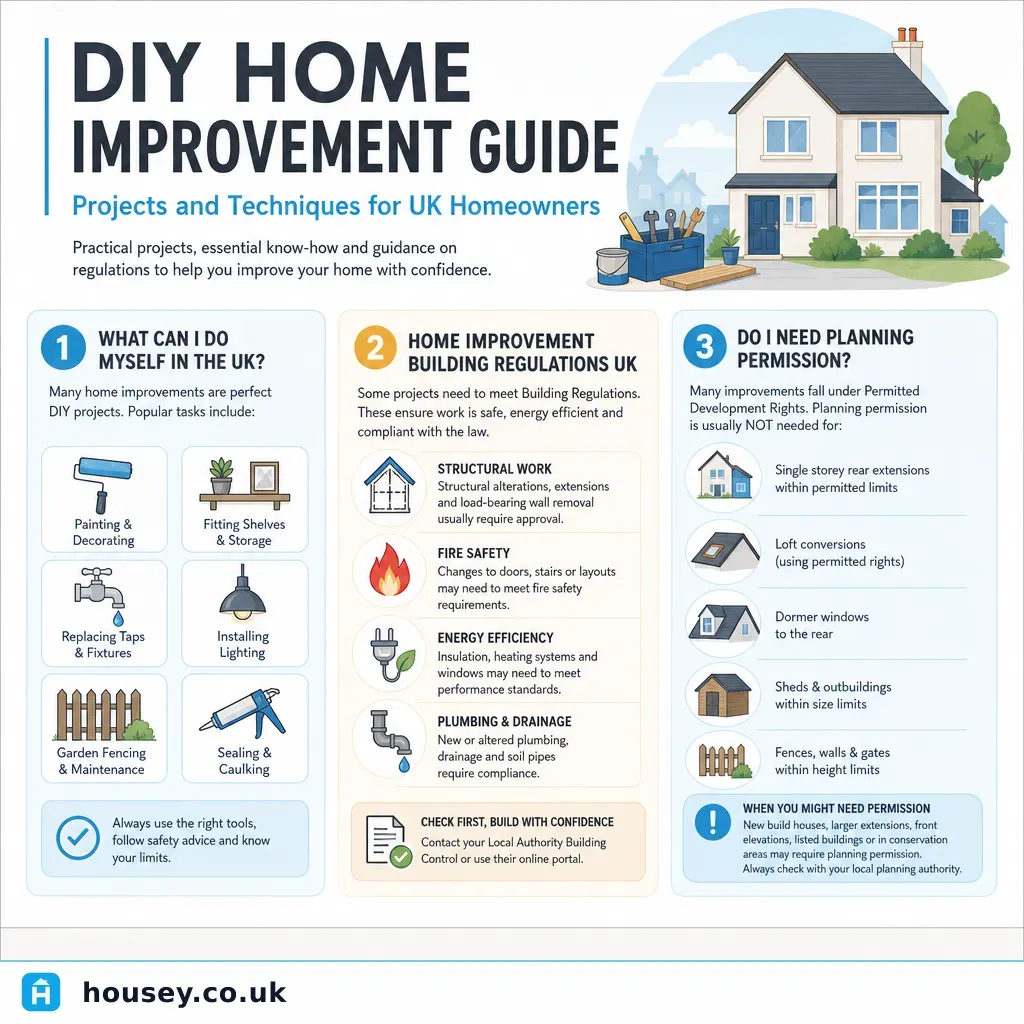
DIY Home Improvement Guide: Projects and Techniques for UK Homeowners
Most internal decorating, flooring, and basic maintenance sits within DIY reach for a competent UK homeowner.
 Improvement & Build
Small kitchen renovation: budgeting for costs and planning your project
A small kitchen renovation in the UK typically costs £5,000–£15,000 for a full refresh including new units, worktops, tiling, and appliances, though costs vary widely by specification, region, and whether structural changes or rewiring are involved.
 Improvement & Build
Conservatories and Garden Extensions: Design and Building Guide
Most conservatories qualify as permitted development in England if they are single-storey, within 50% of original curtilage, and meet dimensional limits.