Garden Rooms: Planning, Design, and Regulatory Considerations
By Housey · Last reviewed 12th of May 2026
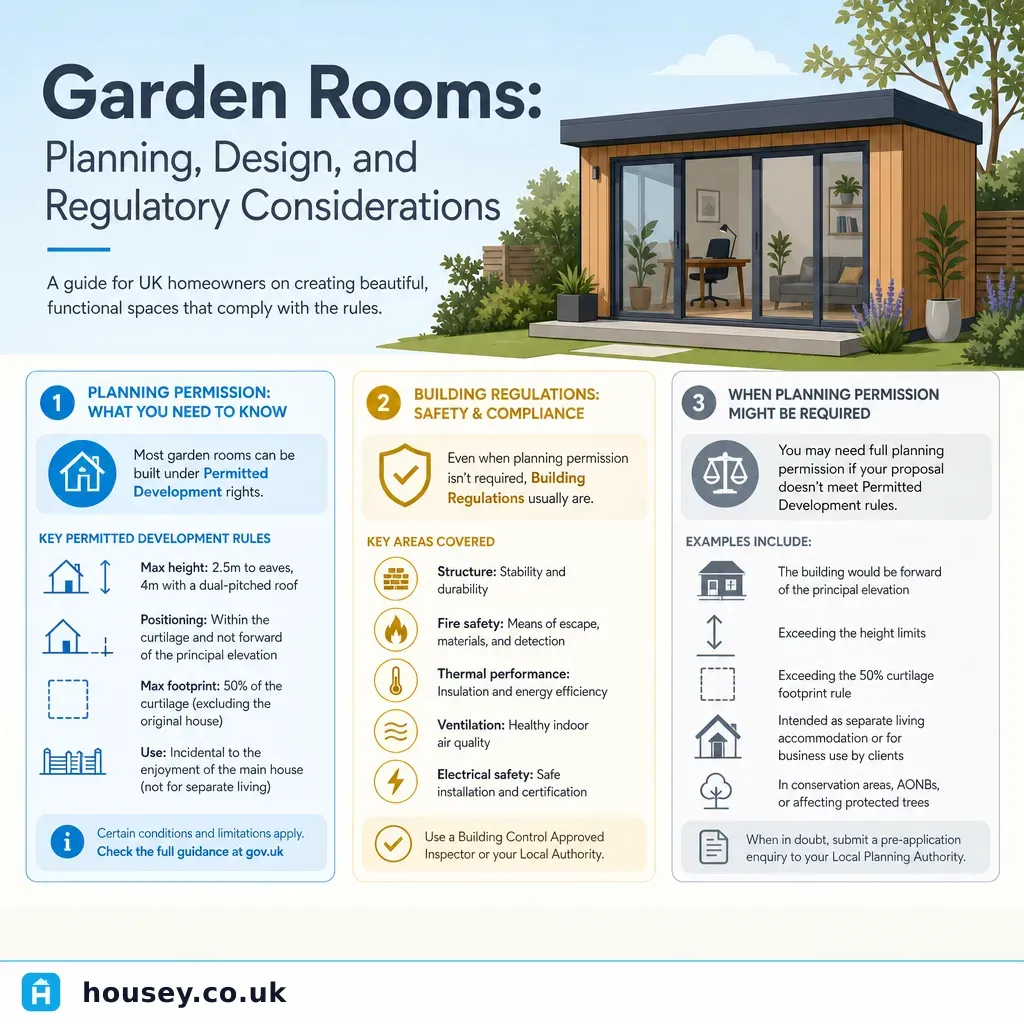
Garden Rooms: Planning, Design, and Regulatory Considerations
Garden rooms have become one of the most popular home improvement projects in the UK, driven by demand for dedicated home offices, hobby spaces, and additional living areas without the disruption of a full house extension. But the regulatory position is more nuanced than many suppliers suggest: permitted development rights carry important size, height, and use conditions; building regulations may apply even when planning permission is not needed; and some properties — listed buildings, conservation areas, flats — fall outside permitted development rights altogether.
Key points
- Under Schedule 2, Part 1, Class E of the Town and Country Planning (General Permitted Development) (England) Order 2015, a garden room may be permitted development if it meets specific size, height, location, and use conditions.
- Permitted development rights for outbuildings do not apply to listed buildings, flats, or maisonettes — planning permission is required for these property types.
- The combined footprint of all outbuildings and extensions must not exceed 50% of the original curtilage of the dwelling (excluding the house footprint itself).
- A Lawful Development Certificate from the local planning authority provides legally binding confirmation of permitted development status and is recommended before committing significant budget.
- Even where planning permission is not needed, building regulations apply to garden rooms used as sleeping accommodation, to any garden room over 30 m², and to all electrical and gas installations within the structure.
Does a garden room need planning permission?
In England, planning permission is not automatically required for a garden room, provided it falls within permitted development rights under Class E of the Town and Country Planning (General Permitted Development) (England) Order 2015. However, permitted development is conditional: all criteria must be met simultaneously, and it is the homeowner's responsibility to ensure compliance.
The principal conditions in England are:
- The structure must be within the curtilage of a dwelling house (not a flat, maisonette, or listed building).
- Maximum eaves height of 2.5 m if the structure is within 2 m of any boundary.
- Maximum overall height of 4 m for a dual-pitch roof, or 3 m for any other roof form.
- The structure must not be positioned forward of the principal elevation facing a highway.
- All outbuildings and extensions combined must not cover more than 50% of the original curtilage (excluding the house footprint).
- The structure must not be used as a separate dwelling.
- In designated land (National Parks, AONBs, conservation areas, World Heritage Sites), outbuildings to the side of the dwelling are not permitted development, and a 10 m² footprint limit applies within the curtilage.
Note: Planning rules differ between England, Scotland, Wales, and Northern Ireland. This article focuses on England. Scottish homeowners should consult the Town and Country Planning (General Permitted Development) (Scotland) Order 1992; Welsh homeowners should refer to Welsh Government planning guidance.
Decision tree: do you need planning permission for your garden room?
- Is the property a listed building? → Permitted development does not apply. Planning permission and listed building consent are required.
- Is the property a flat or maisonette? → No permitted development rights for outbuildings. Full planning permission required.
- Is the property in a conservation area, AONB, or National Park? → Stricter restrictions apply. Check with your local planning authority before proceeding.
- Will the garden room be used for sleeping? → Building regulations apply and use affects permitted development position. Seek professional advice.
- Does the combined outbuilding footprint exceed 50% of the original curtilage? → Planning permission is required.
- Is the eaves height above 2.5 m and within 2 m of a boundary? → Planning permission is required.
- Does an Article 4 direction apply to your area? → Permitted development rights may have been removed locally. Check with your local planning authority.
- All conditions appear to be met? → The garden room is likely permitted development, but consider a Lawful Development Certificate for legal certainty.
When do building regulations apply to a garden room?
Building regulations are a separate question from planning permission, and many homeowners assume the two are linked. They are not.
Scenario | Building regulations required? |
|---|---|
Garden room under 15 m², not for sleeping | Not required |
Garden room 15–30 m², not for sleeping, at least 1 m from all boundaries | Not required |
Garden room over 30 m² | Required — treat as a habitable building |
Any garden room used for sleeping | Required |
Electrical installation within the structure | Part P applies — must be certified by a competent person or notified to building control |
Gas or oil heating installed | Gas Safe or OFTEC regulations apply |
Structure under 15 m² but within 1 m of a boundary | Fire safety provisions may apply — check with building control |
Even where building regulations are not strictly required, building to a good standard of structural integrity, weatherproofing, and insulation protects your investment and may affect insurance cover.
Homeowner checklist: before you commission a garden room
Design considerations for year-round use
Beyond the regulatory framework, the following design decisions affect whether your garden room is genuinely usable in a UK climate:
Insulation: A lightweight, poorly insulated structure will be cold in winter and overheated in summer. For year-round comfort, aim for wall, roof, and floor insulation that approaches Building Regulations Part L standards, even if not strictly required. Effective insulation significantly reduces heating costs.
Glazing: Large glazed areas increase natural light but lose heat rapidly through poor-quality glass. Thermally broken aluminium or high-performance timber frames with low-emissivity double glazing improve energy performance considerably.
Foundations: Screw-pile or ground-beam foundations are common for garden rooms. Foundation choice depends on ground conditions, proximity to trees (root zones), drainage, and the supplier's structural system. Inadequate foundations lead to movement, distorted frames, and failed finishes.
Services: Electrical supply from the house must be installed by a Part P-competent electrician. If a water supply is planned, a qualified plumber should make the connection. Any gas installation requires a Gas Safe registered engineer.
Important limitations
This article provides general guidance on planning and building regulations as they apply to garden rooms in England. Permitted development rights depend on individual property characteristics, local authority policies, site history, and the precise design of the proposed structure. Rights can be removed or modified by Article 4 directions, by conditions attached to previous planning consents, or by site-specific designations that may not be obvious from public mapping tools. Nothing in this guide substitutes for advice from a qualified planning consultant, architect, or your local planning authority.
What to ask a qualified professional
Before instructing a garden room supplier or planning consultant:
- Is my property or area subject to an Article 4 direction removing outbuilding permitted development rights?
- Are there any conditions attached to existing planning consents on my property that affect outbuildings?
- Does the intended use — including any occasional overnight stays — affect permitted development status?
- Would you recommend a Lawful Development Certificate before construction begins?
- What foundation specification is appropriate for my specific ground conditions and tree proximity?
- Is the electrical installation included in the quote self-certified under Part P, and will I receive a certificate to keep with the property?
- What insulation specification is included, and what U-values does it achieve?
When to get professional help
Seek advice from a planning consultant, architect, or your local planning authority if:
- Your property is listed, in a conservation area, AONB, or National Park.
- You are unsure whether an Article 4 direction applies to your postcode or road.
- The proposed structure sits at or near the 50% curtilage limit.
- The structure is large (over 30 m²), complex, or is intended for sleeping accommodation.
- You want a Lawful Development Certificate for legal certainty before committing to a significant budget.
- A neighbour has raised concerns or contacted the local planning authority about the proposal.
How Housey can help
Housey connects you with qualified planning consultants who can assess your permitted development position and manage Lawful Development Certificate applications, architects experienced in garden room design, specification, and building regulations drawings, and vetted extension builders who can deliver construction to a high standard.
Frequently asked questions
Can I use a garden room as a home office without planning permission?
In most cases, yes — a garden room used purely as a home office that meets the permitted development criteria in England does not require planning permission. However, if your property is listed, is a flat, is in a conservation area, or sits within an Article 4 direction area, you will need to check with your local planning authority before proceeding.
How big can a garden room be without planning permission?
There is no single maximum size, but all outbuildings and extensions combined must not cover more than 50% of the original curtilage (excluding the house footprint). Height is also limited: maximum 2.5 m eaves if within 2 m of any boundary; maximum overall height of 4 m (dual-pitch roof) or 3 m (any other roof form). Any structure not meeting all conditions requires planning permission.
Will a garden room affect my council tax?
A garden room used purely as a home office, gym, or hobby space is unlikely to attract council tax in its own right, as it would not constitute a separate dwelling. However, if equipped with sleeping accommodation and independent services such as a kitchen or bathroom, the Valuation Office Agency may assess it separately. Notify your local council and insurer before construction begins.
Do I need a Lawful Development Certificate for a garden room?
A Lawful Development Certificate is not compulsory but is strongly recommended where any permitted development criteria are borderline, the site has a complex planning history, or you intend to sell in the near future. It is a legally binding document from the local planning authority confirming the development is lawful. Without one, your permitted development claim may be challenged by a buyer's solicitor or mortgage lender.
Sources and further reading
- Town and Country Planning (General Permitted Development) (England) Order 2015, Schedule 2, Part 1 — legislation.gov.uk
- Planning permission: when you need it — GOV.UK
- Permitted development rights for householders: technical guidance — GOV.UK / MHCLG
- Apply for a Lawful Development Certificate — GOV.UK
- Building regulations approval — GOV.UK
- Listed buildings and planning — Historic England
Useful next reads
 Planning & Pre-Build
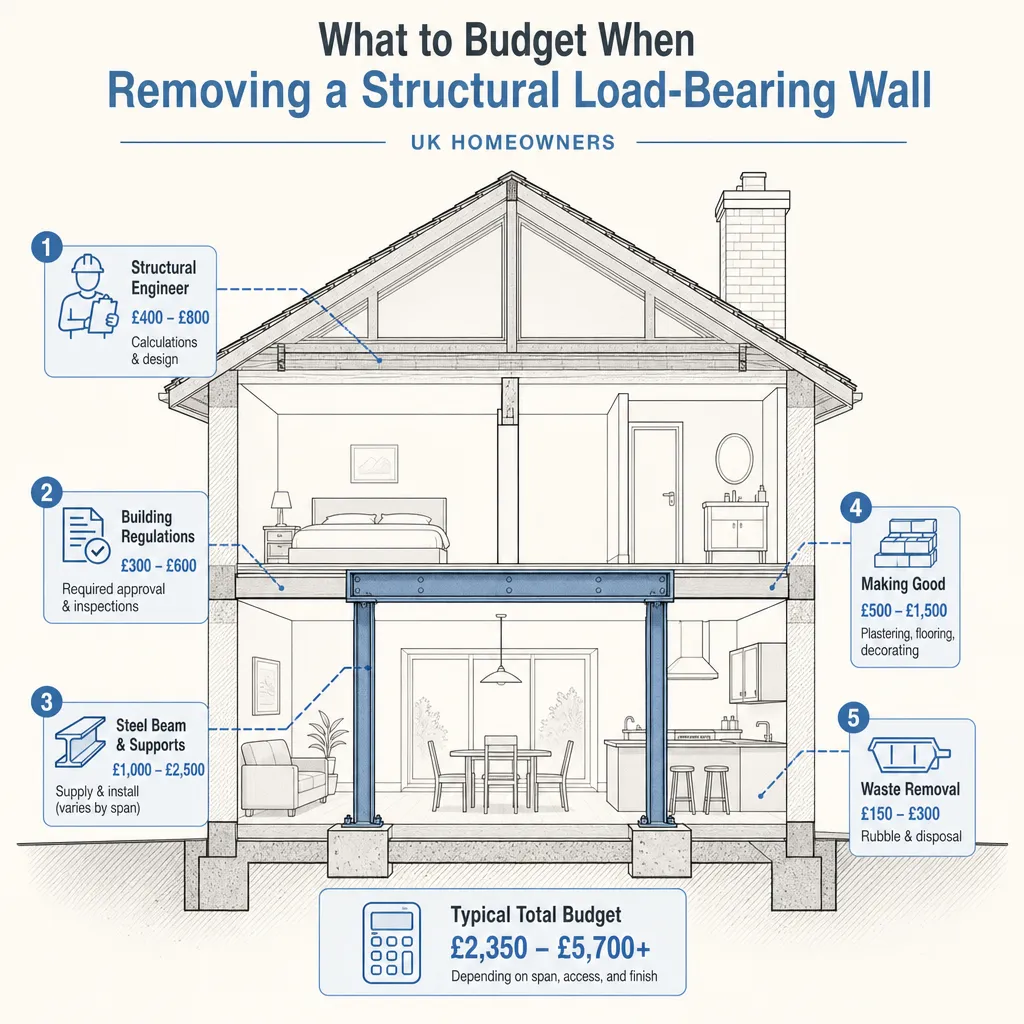
What to Budget When Removing a Structural Load-Bearing Wall
Removing a load-bearing wall in a typical UK home costs £2,500–£8,000 or more in total, covering a structural engineer's calculations, Building Regulations approval, the steel beam, builder's labour, and replastering.
 Planning & Pre-Build
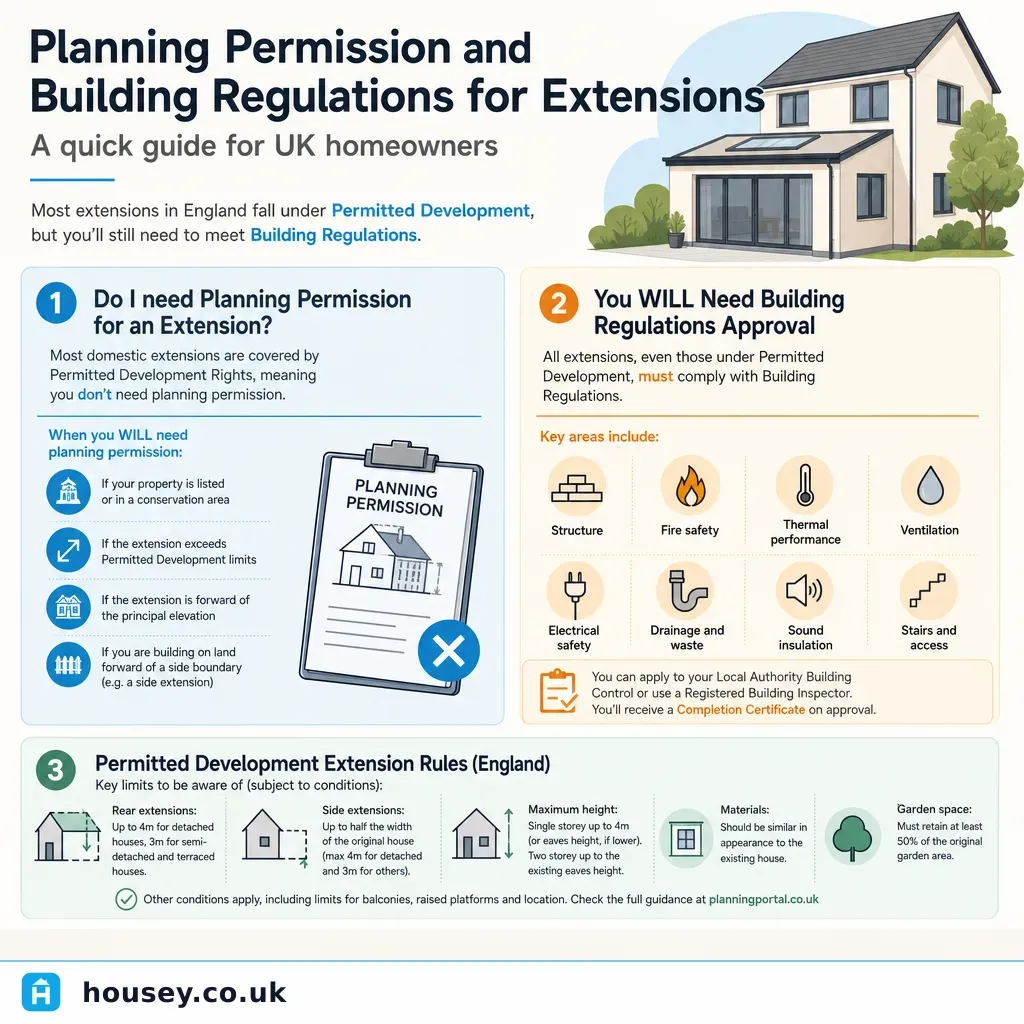
Planning Permission and Building Regulations for Extensions
UK home extensions usually require both planning permission and Building Regulations approval, though most smaller rear extensions qualify as Permitted Development under the GPDO 2015 and need no planning application.
 Planning & Pre-Build
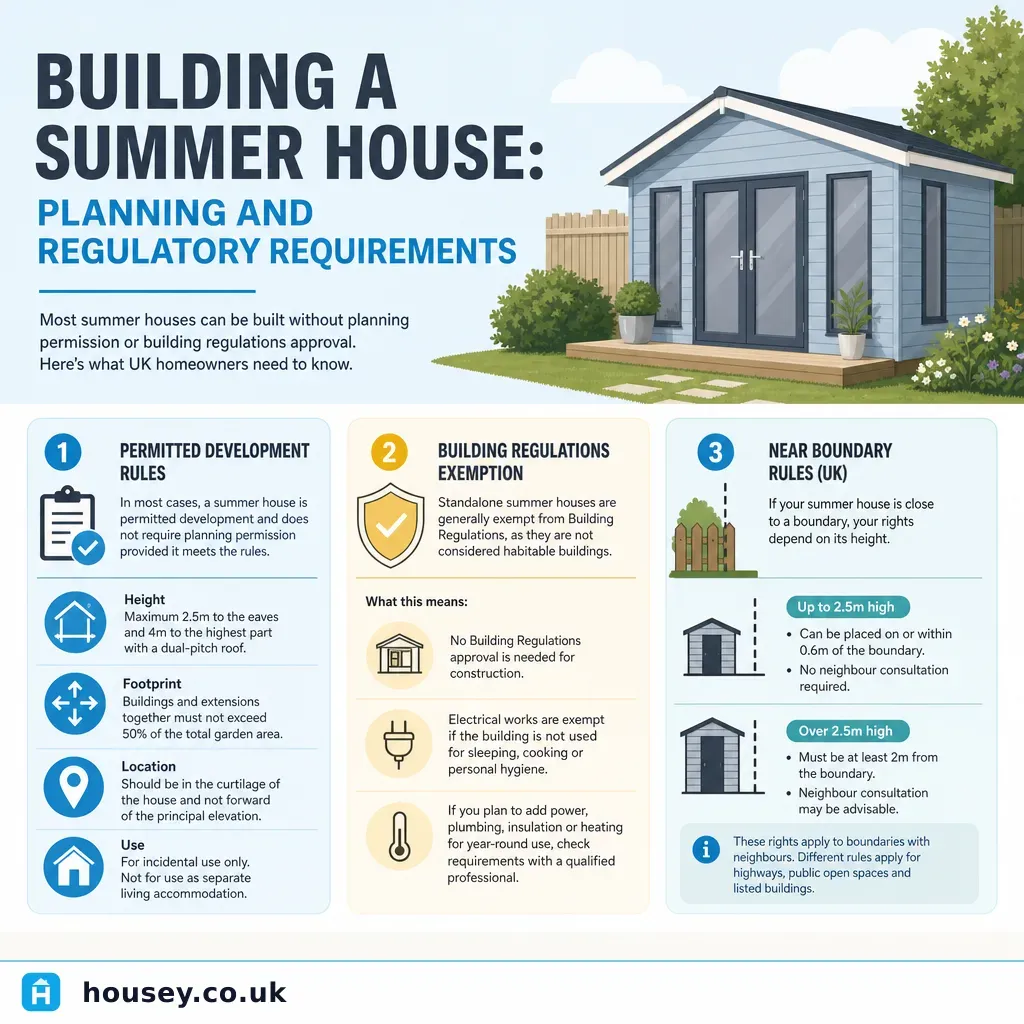
Building a Summer House: Planning and Regulatory Requirements
Most garden summer houses in England fall under Class E permitted development and need no planning permission, provided they are single-storey, within height limits, and not used for sleeping.
 Planning & Pre-Build
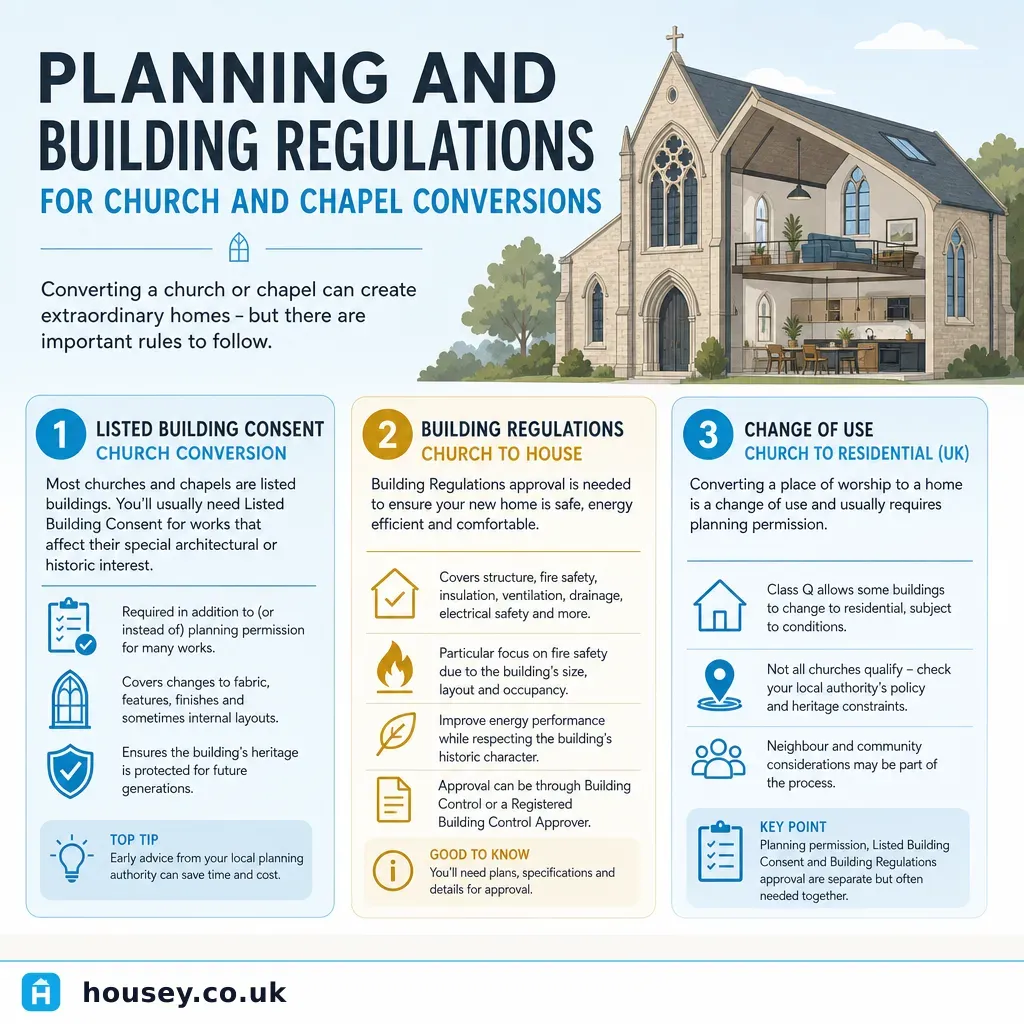
Planning and Building Regulations for Church and Chapel Conversions
Converting a church or chapel to residential use requires planning permission for change of use from Class F1 to Class C3, and listed building consent if the building is listed.
 Planning & Pre-Build
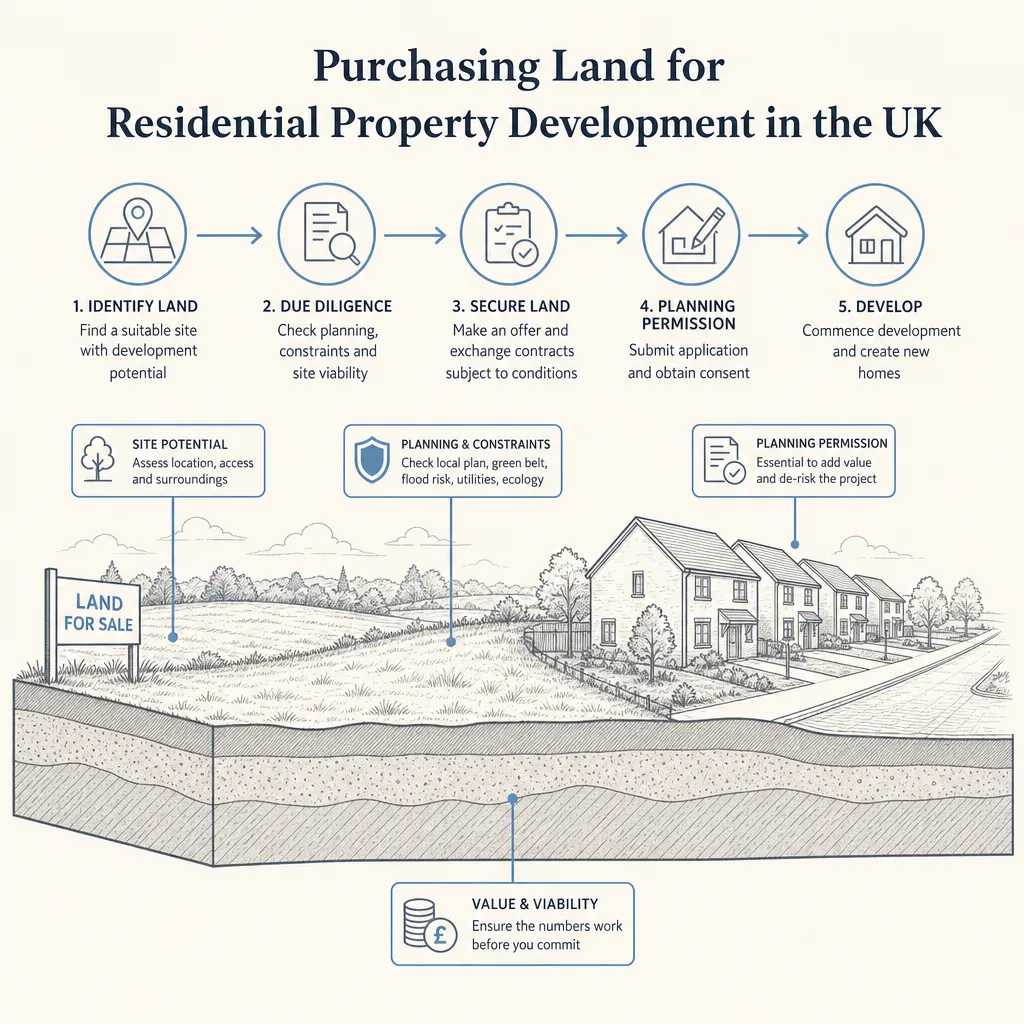
Purchasing Land for Residential Property Development in the UK
Buying development land in the UK involves due diligence on planning status, ground conditions, legal title, and utilities access before exchange.