Removal and Disposal of a Garden Shed
By Housey · Last reviewed 6th of May 2026
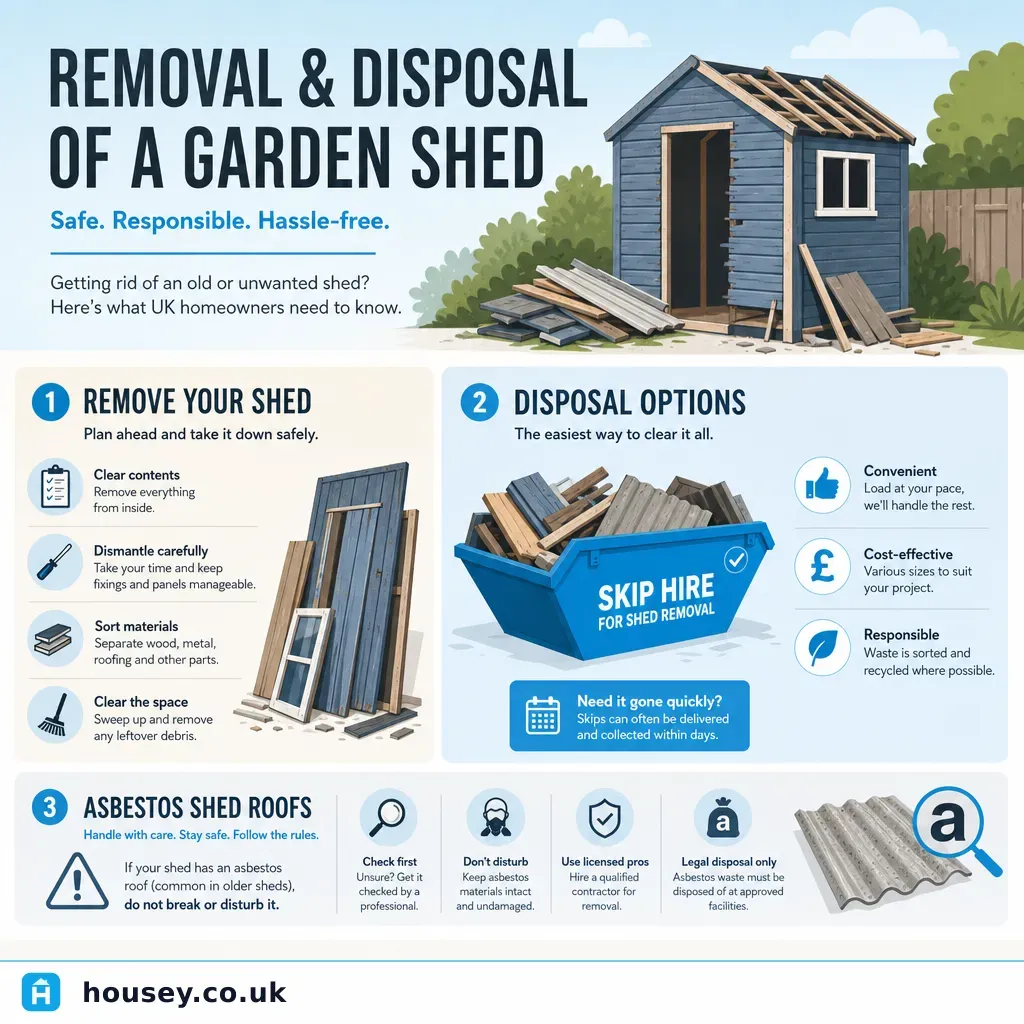
Removal and Disposal of a Garden Shed
Garden sheds get replaced, inherited, or simply abandoned — and when the time comes to clear one, homeowners often underestimate what is involved. Whether you are reclaiming space ahead of an extension, dealing with an estate clearance, or replacing a rotting structure, the process touches on waste regulations, potential asbestos hazards, and disposal routes that vary considerably in cost and effort across the UK.
Key points
- No planning permission is required to demolish a garden shed, but check permitted development rules if you plan to replace it.
- Sheds built before approximately 1980 may contain asbestos cement sheets in the roof or walls — always test before handling any material.
- Timber from an intact shed can often be sold, donated, or repurposed rather than sent to landfill.
- Skip hire for a typical shed clear-out costs roughly £150–£350 in most UK regions (indicative UK costs, last reviewed 2026-05-06; quotes vary by location and skip size).
- Asbestos-containing materials must go to a licensed asbestos waste facility — general skip hire is not an option.
Do you need planning permission to remove a shed?
No planning permission is needed to demolish a garden shed. Demolition of domestic outbuildings at this scale does not require prior approval under the Town and Country Planning (Demolition — Description of Buildings) Direction 2021. However, if you plan to replace the shed, the new structure may be subject to permitted development rules — particularly in conservation areas, on Article 4 land, or on listed buildings. Check with your local planning authority before starting work on a replacement.
Check for asbestos before you start
This is the single most important step for sheds erected before around 1980. Asbestos cement — sometimes called AC sheet or corrugated fibre-cement sheeting — was widely used for shed roofing and wall cladding throughout the mid-20th century. It typically appears as grey corrugated sheeting and may be fragile or visibly crumbling.
If you suspect asbestos:
- Do not break, drill, saw, or pressure-wash the material.
- Arrange a visual survey or sample analysis from a UKAS-accredited asbestos surveyor.
- Removal and disposal of friable (loosely bound) asbestos must be carried out by a licensed contractor. Intact AC sheet can be handled as non-licensable work by a competent person following HSE guidance, but disposal still requires a licensed facility.
- All asbestos waste must go to a licensed asbestos disposal facility — it cannot be placed in a general skip.
HSE publishes detailed guidance on non-licensed asbestos work, including the handling and disposal of asbestos cement sheet, on its website.
How to dismantle a timber shed
For sheds confirmed to be asbestos-free, the general sequence is:
- Clear the interior — remove all stored items, garden chemicals, and debris first.
- Isolate any electrics — if the shed has a wired supply, have a qualified electrician disconnect it at the consumer unit before starting any dismantling work.
- Remove the roof covering — felt, corrugated plastic, or timber panels come off first.
- Take down the walls — work panel by panel to avoid large unsupported sections falling.
- Remove the floor (if any) — treated timber floors can be heavy; cut them into manageable sections.
- Clear the base — a concrete base can be broken up for hardcore use elsewhere, or removed by a groundworks contractor.
For metal or plastic flatpack sheds, the original assembly instructions often serve as a useful guide in reverse.
Disposal options for shed materials
Material | Disposal route | Notes |
|---|---|---|
Timber in good condition | Sell, donate, or repurpose | Many homeowners sell sheds intact for the buyer to dismantle and collect |
Rotten or treated timber | General skip or household tip | Some treated timber has HWRC restrictions — check before travelling |
Felt, plastic sheeting | General skip or tip |
|
Metal panels or framework | Scrap metal dealer | Often free collection or paid by weight |
Asbestos cement sheets | Licensed asbestos waste contractor only | Cannot go in a general skip under any circumstances |
Concrete base rubble | Rubble skip or recycling centre | Must be separated from general waste |
Skip hire
A 4-yard skip is usually sufficient for a small to medium timber shed. Indicative UK costs: £150–£280 for a 4-yard skip, £220–£350 for a 6-yard skip (last reviewed 2026-05-06; prices vary significantly by region and supplier). If the skip is placed on a public road, most skip hire companies require a permit from the local authority — confirm this when booking.
Council collections and household tips
Most UK councils offer a bulky waste collection service, and timber panels or metal can often be taken in multiple loads to a household waste recycling centre (HWRC). Some HWRCs restrict commercial loads, so confirm your eligibility before making a trip.
Hiring a contractor to remove the shed
If you would rather not dismantle and dispose of the shed yourself, several types of contractor can help:
- Garden clearance companies — handle dismantling, loading, and disposal as a combined service.
- Man-and-van clearance firms — suited to smaller timber sheds that are already partly dismantled.
- Specialist asbestos contractors — essential if any asbestos-containing materials are involved.
- Groundworks contractors — needed if the concrete base is to be broken out and removed.
Get at least two or three quotes and confirm that waste disposal is included in the price. Check that any contractor you hire is registered as a waste carrier with the Environment Agency — you can verify this on the public register on GOV.UK.
Homeowner checklist before shed removal
Red flags — when to stop and seek advice
- Corrugated grey sheeting in the roof or walls of a pre-1980 shed — do not disturb until professionally tested.
- Crumbling or powdery wall panels, which may indicate damaged asbestos cement.
- An electrical supply to the shed that cannot be traced to a clear isolation point at the consumer unit.
- A large concrete raft or deep footings that may sit over underground drainage, cables, or service runs.
- A shed on a listed property or within a conservation area — confirm with the local planning authority whether any consent is required before demolition begins.
When to get professional help
Most timber shed removals are manageable as DIY or light contractor work. Call a professional when:
- Asbestos-containing material is present or suspected in any part of the shed structure.
- The shed has a permanent wired electrical connection that needs formal isolation by a qualified electrician.
- The concrete base is substantial or may overlie underground services.
- The shed is large or structurally complex, such as a workshop with a heavy mono-pitch roof or mezzanine.
- You are clearing a property as part of an estate or sale and need clear documentation of proper disposal for legal purposes.
How Housey can help
Housey connects UK homeowners with vetted local contractors for garden clearance, groundworks, and specialist services. If you need quotes for shed removal, asbestos testing, or concrete base clearance, you can request and compare quotes from providers in your area through the Housey marketplace.
Frequently asked questions
Do I need to tell my council before removing a shed?
No notification is generally required to demolish a domestic garden shed. Planning permission applies to building or extending structures, not to removing them. If the shed is on a listed building or in a conservation area, it is worth confirming with your local planning authority, but in most cases no consent is needed.
Can I put an old shed in a skip?
Generally yes, if the shed is timber or metal and free from asbestos. Asbestos-containing materials cannot go in a standard skip under UK waste regulations. Your skip hire company should ask about asbestos before delivery; if they do not, raise it yourself before any loading begins.
How long does shed removal take?
A typical timber shed (6 ft x 8 ft to 10 ft x 12 ft) can be dismantled and loaded in half a day to a full day for one person, or a few hours with two people. A contractor team will usually complete the same job in one to three hours, excluding skip collection.
What happens to the concrete base?
Concrete bases are usually broken up with a sledgehammer or electric breaker and removed as rubble. A small base can often be taken to a household recycling centre if it accepts rubble. Larger or thicker slabs may need a separate rubble skip or a groundworks contractor with a mini-digger.
Can I sell my old shed instead of disposing of it?
Yes — intact timber sheds in reasonable condition often sell for £50–£300 or more on platforms such as Facebook Marketplace or Gumtree. The buyer usually dismantles and collects it, saving you the disposal cost entirely. Condition, size, and local demand all affect the achievable price.
Sources and further reading
- HSE: Asbestos — non-licensed work — Health and Safety Executive
- GOV.UK: Planning permission — GOV.UK
- Environment Agency: Register as a waste carrier, broker or dealer — Environment Agency / GOV.UK
- GOV.UK: Find your nearest household waste recycling centre — GOV.UK
Useful next reads
 General property advice
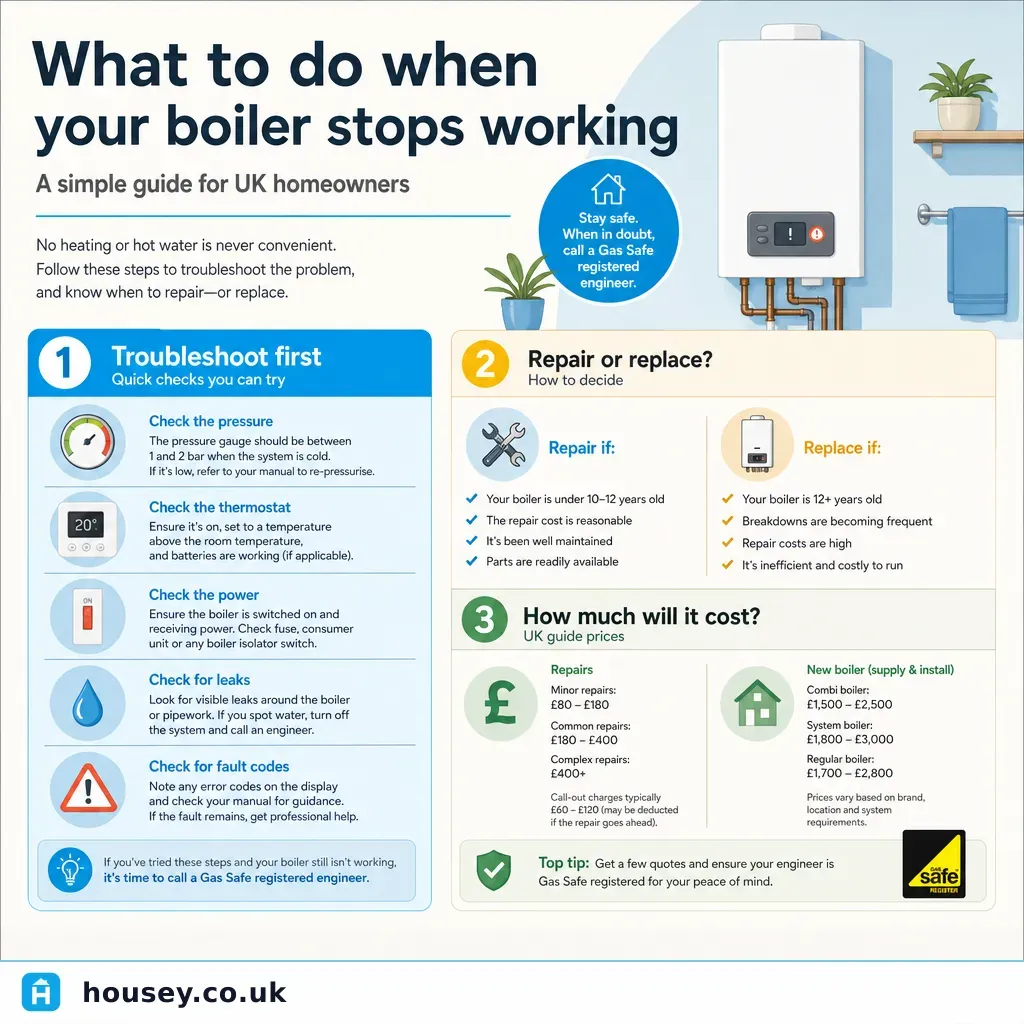
What to do when your boiler stops working
When your boiler stops working, check the pressure gauge (should read 1–1.
 General property advice
Property Market Trends: Activity Growth and Price Movements
UK property market activity is measured through completed sale registrations (HM Land Registry), lender mortgage data, and transaction volumes from HMRC.
 General property advice
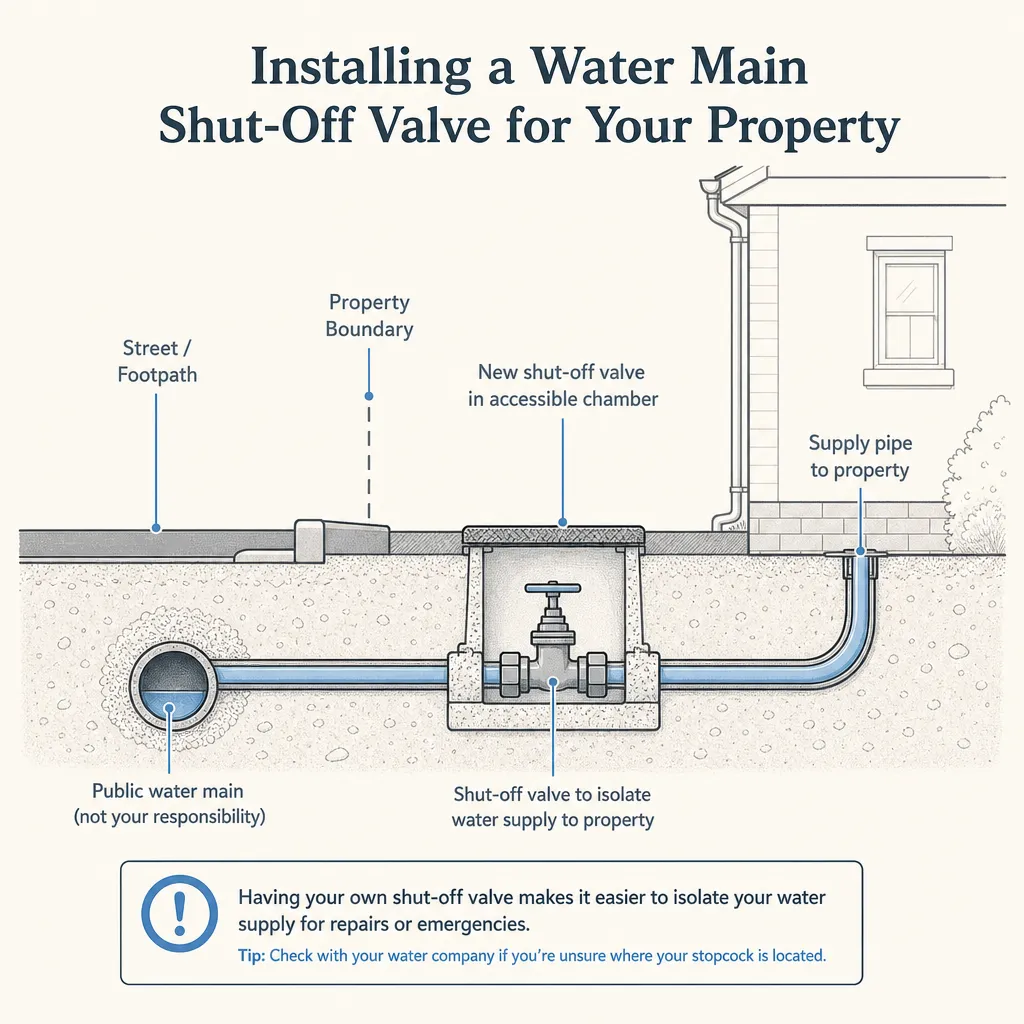
Installing a water main shut-off valve for your property
A water main shut-off valve — commonly called a stopcock — controls all water entering your home from the mains.
 General property advice
Monthly House Price Index: August Market Report and Analysis
The UK House Price Index is published monthly using completed Land Registry transaction data, meaning August figures typically reflect sales agreed months earlier.
 General property advice
Scottish Property Market: Activity and Regional Trends
Scotland's property market operates under distinct legal rules: sellers must provide a Home Report before marketing, transactions become legally binding at conclusion of missives rather than exchange of contracts, and Land and Buildings Transaction Tax replaces Stamp Duty.