Garden Winterisation: How to Prepare Your Garden for Winter
By Housey · Last reviewed 12th of May 2026
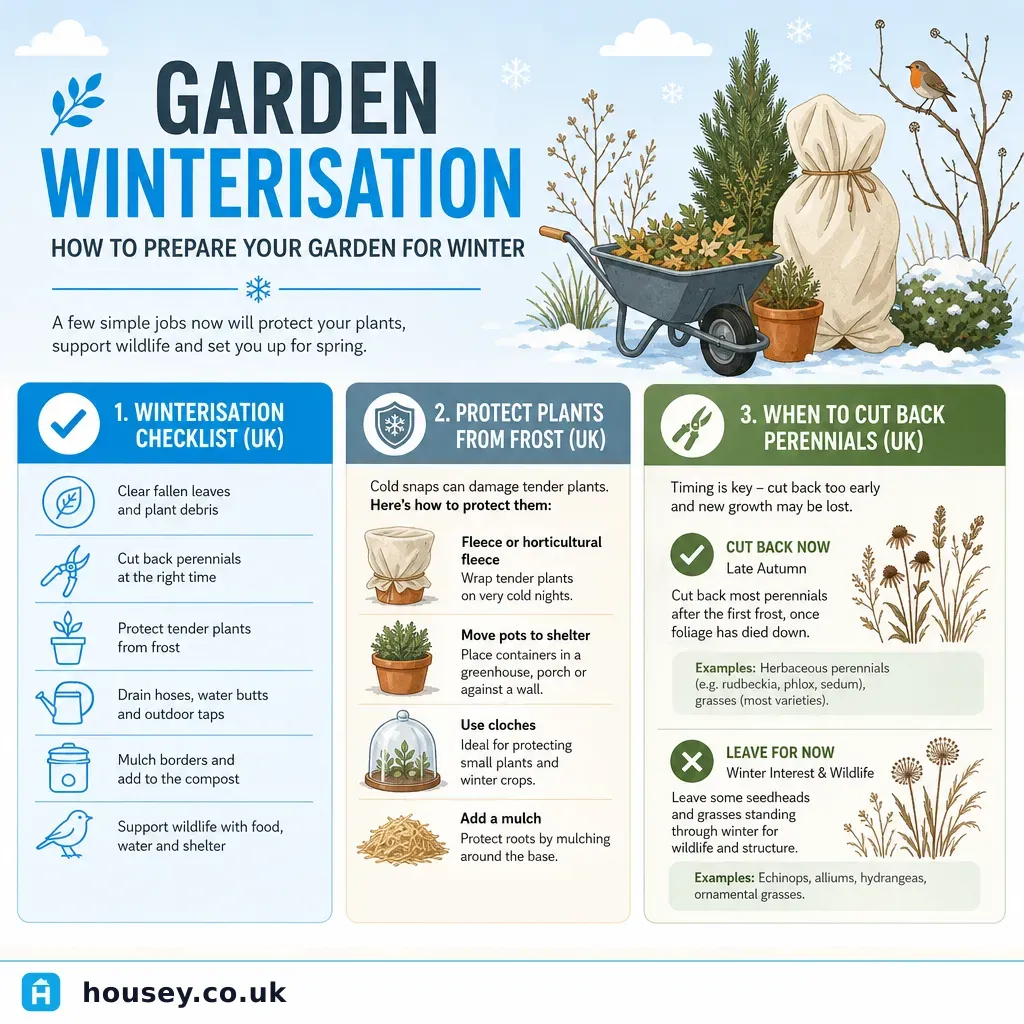
Garden Winterisation: How to Prepare Your Garden for Winter
As the growing season draws to a close and the first frosts approach, autumn presents a narrow but important window for UK homeowners to protect their gardens. The tasks you complete between September and November largely determine how well your plants, lawn, and hard landscaping survive the coldest months and how quickly everything recovers in spring. For gardens ranging from a modest terraced-house border to a large suburban plot, the priorities are similar — the scale just changes.
Key points
- The RHS recommends completing most winterisation tasks before the first hard frost, which typically falls between late October and late November in central England, and earlier in Scotland and northern regions.
- Hardy perennials should be cut back to 5–10 cm above soil level; tender or half-hardy plants (dahlias, cannas, salvias) need lifting, drying, and storing frost-free before temperatures consistently drop below 0°C.
- Applying a 7–10 cm mulch layer of well-rotted compost, bark chippings, or straw to borders insulates root systems and suppresses winter weeds.
- Terracotta and glazed pots are vulnerable to frost fracturing; move them under cover or wrap with bubble wrap and horticultural fleece before temperatures fall consistently below freezing.
- Outdoor taps and exposed garden pipework should be insulated or drained by October in most UK regions to prevent burst pipes.
When to start winterisation in the UK
The timing depends on your location and the specific task. In Scotland and northern England, first frosts can arrive in September; in the south-west, tender plants may survive well into November. As a practical guide:
- September–October: Lift tender bulbs and perennials. Plant spring-flowering bulbs (tulips, alliums, hyacinths). Rake leaves from lawns. Apply an autumn lawn feed.
- October–November: Mulch borders. Insulate or drain outdoor taps. Move vulnerable containers under cover. Clean and store garden furniture.
- November–December: Net ponds to catch fallen leaves. Prune roses to two-thirds height to prevent wind rock. Check tree stakes and ties.
The Met Office UK climate averages can help you understand first-frost dates typical for your region.
Which plants need protection — and how much?
Different plant types carry different frost risk. Use this table to decide what action is needed:
Plant type | Frost hardiness | Action needed |
|---|---|---|
Hardy perennials (hostas, sedums, rudbeckias) | Survives UK winters in the ground | Cut back to 5–10 cm; mulch around crowns |
Hardy shrubs (cornus, viburnum, native hedging) | Survives in the ground | Minimal; check ties and stakes |
Half-hardy perennials (salvias, penstemons) | Tolerates light frost only | Mulch heavily; fleece in exposed spots |
Tender perennials (dahlias, cannas, agapanthus) | Damaged by frost | Lift, dry, and store frost-free |
Mediterranean plants (olives, tree ferns, bananas) | Vulnerable below –5°C | Wrap stems with fleece; pot up if possible |
Annual bedding | Killed by frost | Clear beds and compost foliage |
The RHS hardiness ratings (H1 to H7) are a reliable guide when buying plants — H7 means fully hardy in the UK, H1 means tender and frost-free conditions are needed year-round.
Lawn care in autumn and winter
Grass growth slows significantly below 5°C and stops below 2°C. Before the ground freezes:
- Scarify to remove thatch build-up using a rake or mechanical scarifier (September–October).
- Aerate compacted areas by spiking with a garden fork or hollow-tine aerator.
- Overseed bare patches by mid-October to allow germination before cold sets in.
- Apply an autumn lawn feed — high in potassium and phosphorus, low in nitrogen — to harden grass before cold weather.
- Stop mowing when growth ceases, usually from November in most of the UK.
Avoid walking on frozen or waterlogged lawns where possible. Repeated compaction on saturated ground damages root structure and leaves wear marks that can take months to recover.
Garden winterisation checklist
Use this checklist to track your seasonal tasks:
What not to assume about winter garden preparation
- Don't assume all perennials need cutting back immediately. Hollow stems of plants such as echinacea and sedums provide overwintering habitat for beneficial insects. Leaving a proportion of seed heads also adds winter structure and feeds birds.
- Don't assume mulching means burying the plant. Mulch should sit around the crown, not directly on top of it — moisture trapped on crowns encourages fungal rot.
- Don't assume a mild autumn means no action is needed. UK temperatures can drop rapidly in November; by the time a cold spell arrives, the window for safely lifting tender plants may have already closed.
- Don't assume one frost date applies nationally. The north of Scotland can see ground frosts six weeks earlier than the Isles of Scilly. Check local averages and respond to your own garden's microclimate.
When to get professional help
Most winterisation tasks are manageable for an active homeowner. Consider using a professional if:
- You have large, established trees with overhanging branches or visible dead wood that could become a hazard — this is specialist work requiring assessment and appropriate equipment.
- Your garden contains a complex irrigation or automated watering system that needs professional draining and winterisation.
- You have extensive planting schemes, topiary, or heritage landscaping that requires expert knowledge to protect correctly.
- Working-at-height tasks are needed — such as hedge cutting above 2 m or structural tree work — which should be carried out by qualified professionals holding public liability insurance.
How Housey can help
If your garden requires seasonal maintenance beyond what you can manage alone — whether that's a full winterisation programme, structural pruning, or preparation for a spring planting scheme — Housey connects you with vetted landscapers and garden designers who can provide competitive quotes tailored to your property and situation.
Frequently asked questions
When should I stop mowing my lawn for winter in the UK?
Most UK lawns stop actively growing below 5°C, typically from mid-October to November depending on region. Give the lawn a final cut at around 25–30 mm before growth ceases, then store the mower until spring — usually February or March in the south, later further north.
Can I leave dahlias in the ground over winter in the UK?
In mild, well-drained areas of southern England, dahlias can often survive with a thick mulch layer over the crown. In most of the UK, the risk of a hard freeze makes it safer to lift tubers in October or November, dry them, and store frost-free in a cool shed or garage. The RHS provides regional overwintering guidance.
Does mulching need to be done every year?
Yes. Mulch breaks down over time, improving soil structure as it does, but it needs topping up each autumn to maintain the 7–10 cm depth that provides effective root insulation and weed suppression through winter.
Should I prune all shrubs in autumn?
No. Shrubs that flower on old wood — such as lilac, philadelphus, and wisteria — should be pruned after flowering in summer; autumn pruning removes next year's buds. Shrubs that flower on new growth, such as buddleia and late-flowering clematis, are better cut back in late winter or early spring.
Sources and further reading
- RHS – Autumn garden jobs — Royal Horticultural Society
- RHS – Winter garden tasks — Royal Horticultural Society
- RHS – Hardiness ratings — Royal Horticultural Society
- Met Office – UK climate averages and frost data — Met Office
Useful next reads
 Improvement & Build
Creating a New Garden Design for Your Property
Creating a new garden design involves assessing your space, setting a realistic budget, deciding on hard and soft landscaping, and choosing a planting scheme suited to your soil and aspect.
 Improvement & Build
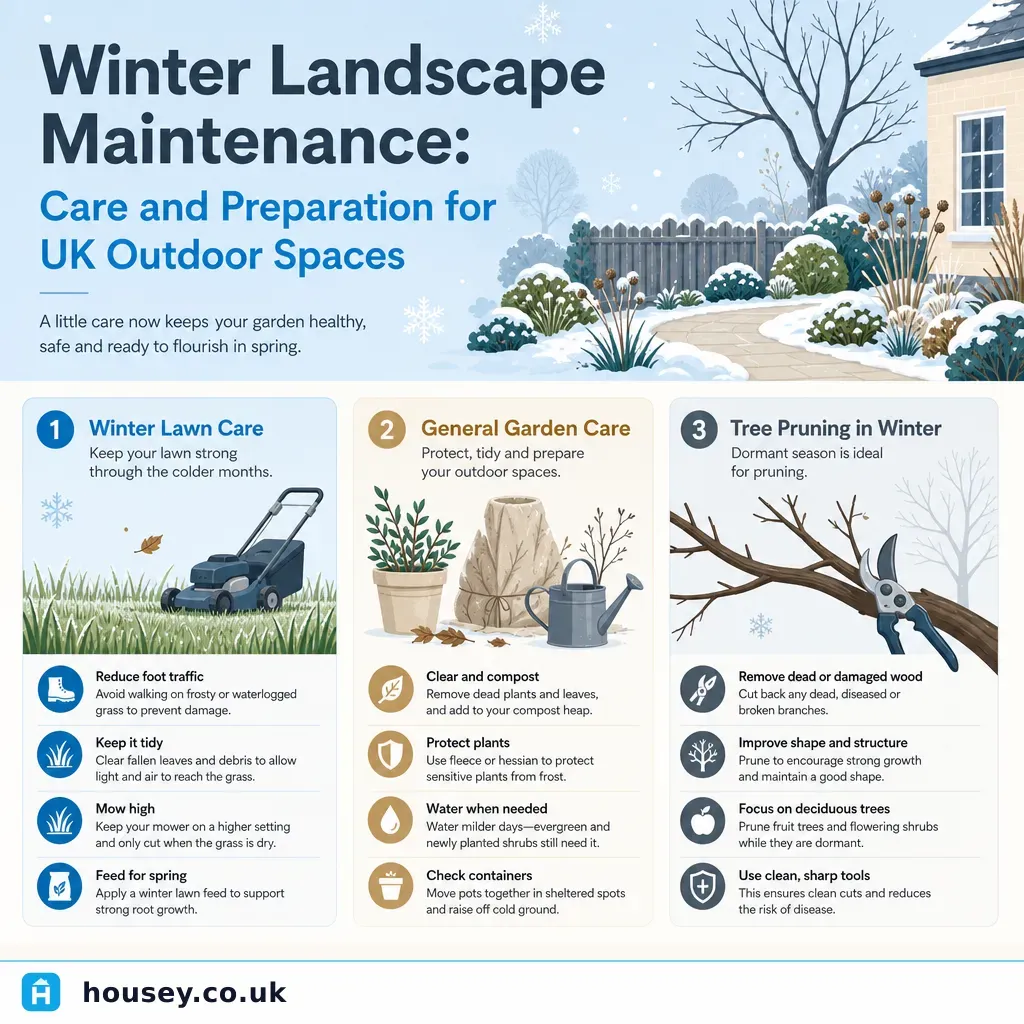
Winter Landscape Maintenance: Care and Preparation for UK Outdoor Spaces
During UK winters, landscape maintenance means avoiding foot traffic on frozen lawns, inspecting dormant trees for dead wood, clearing algae from hard surfaces, and monitoring ponds to prevent full freezing.
 Improvement & Build
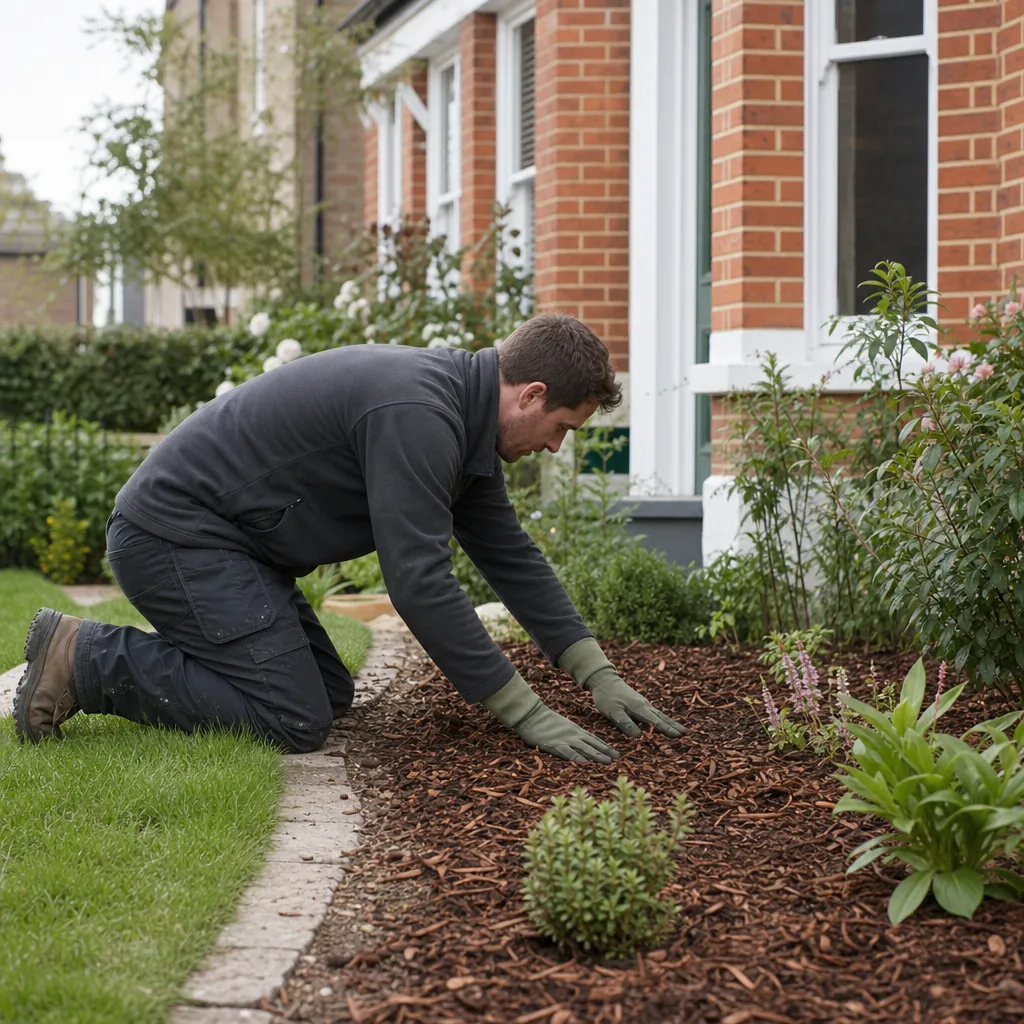
Preparing Your Garden with Mulch: Ground Preparation Guide
Mulching involves spreading a layer of organic or inorganic material over bare soil to retain moisture, suppress weeds, moderate soil temperature, and improve structure over time.
 Improvement & Build
Installing a Fire Pit: Garden Features and Outdoor Space Design
Installing a garden fire pit in the UK is generally permitted, but Smoke Control Area rules prohibit open wood-burning in most towns and cities.
 Improvement & Build
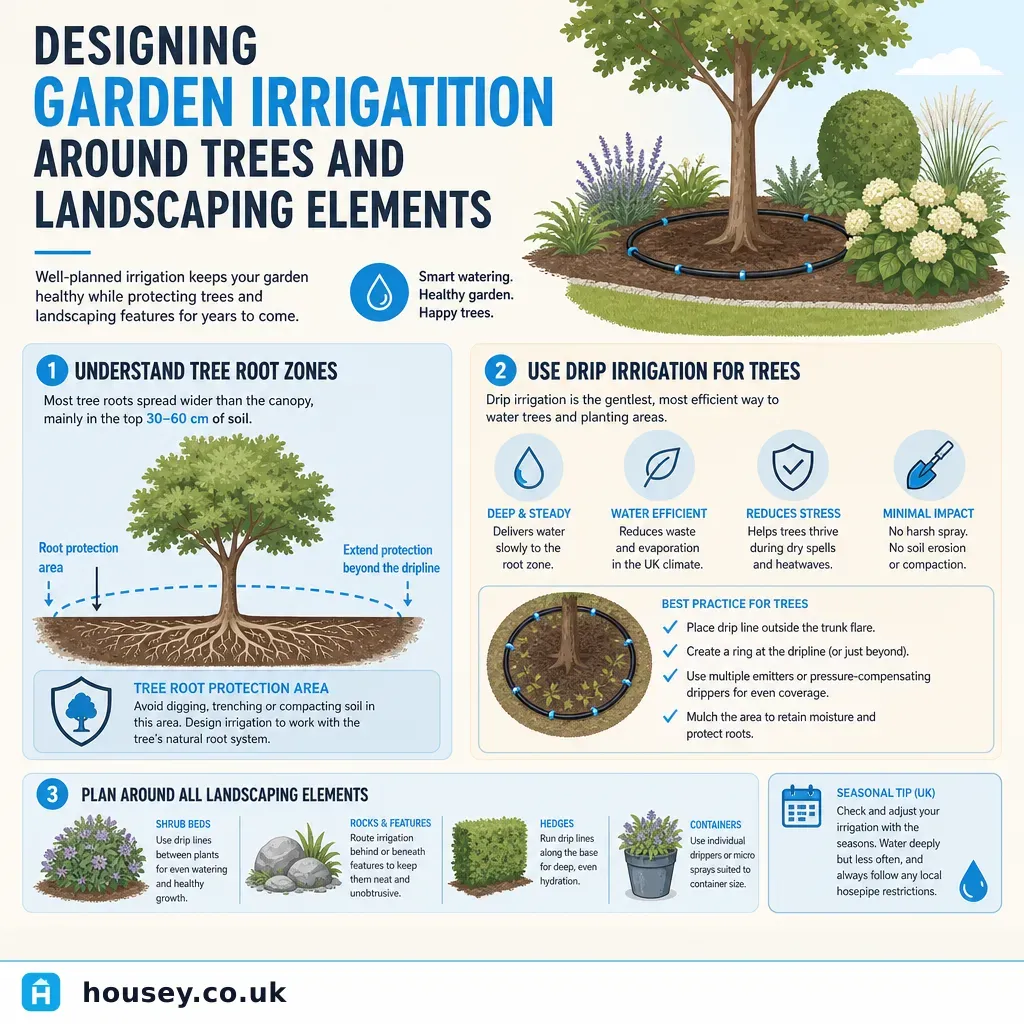
Designing Garden Irrigation Around Trees and Landscaping Elements
Design irrigation around trees by respecting the root protection area defined under BS 5837:2012, using drip or leaky pipe delivery rather than spray heads, and putting the tree zone on its own circuit.