Winter Landscape Maintenance: Care and Preparation for UK Outdoor Spaces
By Housey · Last reviewed 12th of May 2026
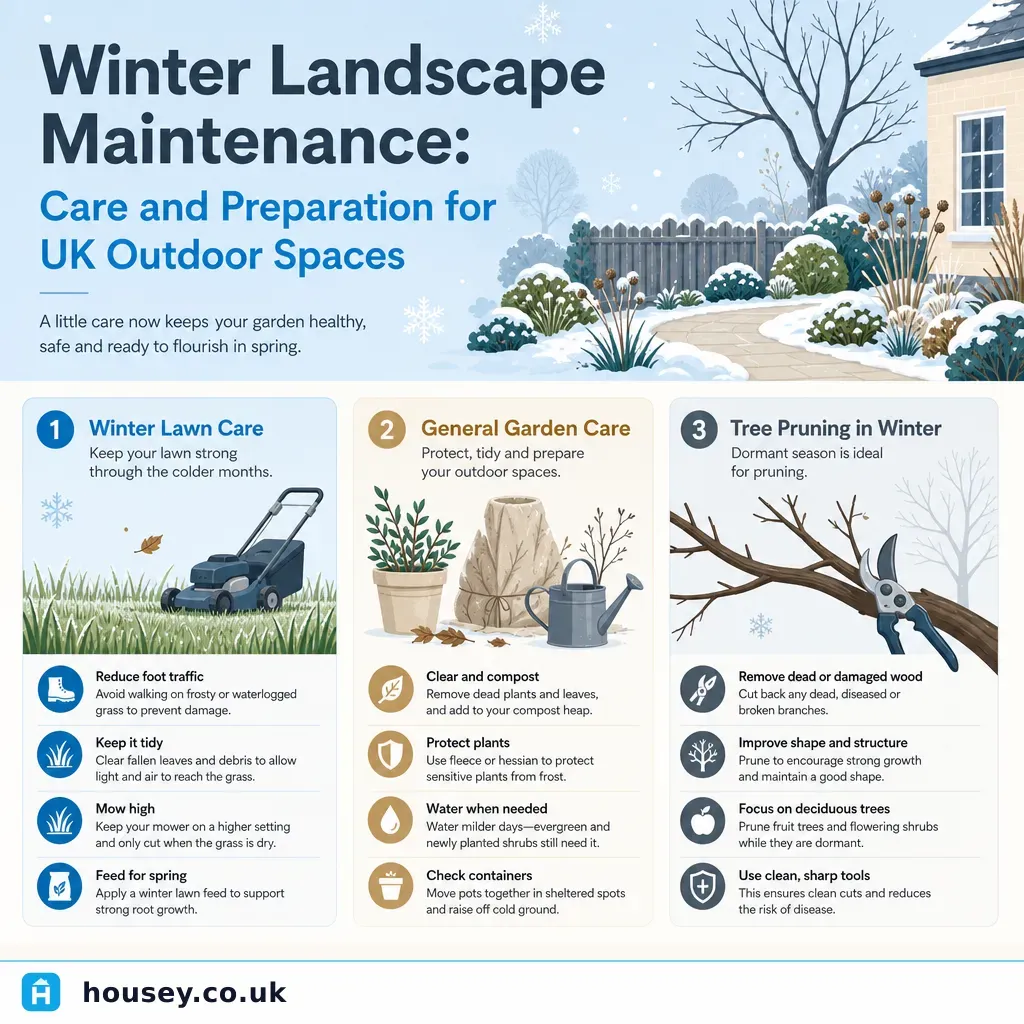
Winter Landscape Maintenance: Care and Preparation for UK Outdoor Spaces
Once autumn preparation is complete, many UK homeowners assume their garden can be left untouched until spring. In practice, winter brings its own maintenance demands — from managing the impact of frost, ice, and waterlogged ground on hard landscaping to carrying out structural pruning during dormancy and protecting outdoor features from cumulative cold-weather damage. Understanding what needs attention through the colder months helps avoid costly repairs and a significantly heavier workload when growth resumes.
Key points
- Deciduous trees and shrubs should be inspected during winter dormancy when foliage is absent — crown dieback, crossing branches, and structural weakness are far easier to spot between October and February.
- Hard winter pruning of certain shrubs (buddleia, cornus, late-flowering clematis) is best carried out in late winter (February–March) when the risk of the worst frosts has passed, to avoid encouraging soft growth that is then damaged by cold.
- Decking, paving, and pathways need regular clearing of ice, algae, and moss — wet, cold surfaces develop algae and moss growth faster in winter than in summer, making them a slip hazard.
- Waterlogged soil should not be walked on or worked during winter; compaction in saturated ground damages soil structure and smothers root systems.
- A frozen pond surface should not be broken by force — the shock waves can stress or kill fish; use a pan of hot water to thaw a hole gently, or fit a floating pond heater.
Managing lawns through winter
Grass in the UK is largely dormant below 5°C, but it is not inert. Several common winter mistakes can cause lasting damage:
- Avoid foot traffic on frozen or waterlogged grass. The grass plant is alive in dormancy; heavy traffic compacts the root zone and leaves wear marks that take months to recover.
- Do not apply nitrogen fertiliser in winter. Autumn or winter nitrogen applications encourage soft, disease-prone growth. Leave feeding until February or March when growth resumes.
- Monitor drainage. If standing water persists for more than a day after heavy rain, note the area for hollow-tine aeration in spring rather than attempting drainage work in wet winter conditions.
- Mow only if growth occurs. In mild southern regions, grass can make intermittent growth even in January. A light pass at a high setting (40–50 mm) prevents matting — never cut wet or frosted grass.
Hard landscaping: winter checks and maintenance
Paving, decking, paths, and boundary walls need specific attention in cold, wet conditions:
Surface type | Winter risk | Maintenance action |
|---|---|---|
Timber decking | Algae and moss growth, frost damage to coatings, board movement | Brush with a stiff brush and deck cleaner; check for loose boards or fixings |
Natural stone paving (sandstone, slate) | Algae and lichen growth, frost spalling on porous stone | Clean with a specialist stone cleaner; avoid pressure washing in cold conditions |
Resin-bound or tarmac driveways | Surface cracking at freeze-thaw interfaces | Clear debris and leaves; seal new cracks before water ingress worsens |
Garden walls (brick or stone) | Freeze-thaw mortar damage, efflorescence, spalling | Check for loose pointing; schedule repointing for spring (mortar fails below 5°C) |
Fencing | Wind damage, post movement in saturated ground | Check post depth; tighten fixings; treat exposed timber end grain |
A note on pressure washing paving in winter: high pressure drives water into stone and grout joints. When that water freezes, it expands and accelerates spalling. Wait until spring if possible.
Tree and shrub inspection during dormancy
Winter dormancy is the ideal time to inspect trees and woody shrubs. With foliage absent, you can identify:
- Crown dieback (dead branches) clearly visible against the sky.
- Crossing or rubbing branches that can be removed before they cause bark damage or create entry points for disease.
- Structural weakness at branch unions — particularly narrow V-shaped forks in older trees — where a split becomes more likely under snow or wind load.
- Cankers, fungal brackets, and bark splitting that are more visible without leaf cover.
For trees over approximately 6 m in height, or those near buildings, fences, or overhead lines, use a qualified arborist (look for ISA-certified or LANTRA-qualified professionals via the Arboricultural Association) for inspection and pruning. Crown work at height carries significant safety risk and should not be attempted without appropriate equipment and training.
Roses can have their remaining growth reduced to around 60 cm in early winter to prevent wind rock, with the full hard prune completed in February once the risk of the worst frosts has passed.
Pond and water feature management
Water in UK winters requires active management, not abandonment:
- Do not allow a pond to freeze entirely. Fish and other pond life need gas exchange through the surface. Maintain an open area using a floating pond heater or by floating a ball in the water — the movement prevents full icing over.
- If the surface freezes: Do not break ice by force — the shock waves can stress or kill fish. Place a pan of hot water on the surface to melt a hole gently.
- Turn off submersible pumps if temperatures are consistently below 0°C — water freezing in pump mechanisms causes damage. Resume once temperatures stabilise above freezing.
- Remove and store UV clarifiers for winter, as UV bulbs are damaged by prolonged cold exposure.
What to check after a hard frost or storm
After significant winter weather events, carry out a prompt walk-around inspection.
After hard frost:
- Check terracotta and ceramic pots for cracking or flaking caused by frost fracturing.
- Inspect greenhouse glazing for breakage or frame movement.
- Check newly planted trees and shrubs for frost heave — frost can push young root balls partially out of the ground; firm these back in gently once soil thaws.
After storm or high winds:
- Inspect fencing for post movement or panel damage.
- Check tree stakes and ties — ties cutting into bark should be loosened immediately.
- Look for broken or hanging branches in established trees — a dead hanging branch is a serious safety hazard; call a qualified arborist immediately if found.
- Clear drains and gullies of wind-blown debris to prevent waterlogging of borders and lawns.
Red flags: when to act immediately
Some winter landscape conditions need prompt attention rather than being left to spring:
- A broken or hanging branch above a path, patio, or neighbouring property — this is both a safety risk and a potential liability issue; do not leave it until spring.
- A garden wall showing significant bulging, leaning, or large sections of loose mortar — a collapsing boundary wall is a safety hazard; have it assessed before failure occurs.
- Persistent flooding of a lawn or border lasting more than three days after rain — this may indicate a blocked drain, soakaway failure, or a drainage problem that will worsen through winter.
- Frost heave that has lifted newly installed paving or steps — raised edges and uneven surfaces are a trip hazard that should be made safe promptly.
When to get professional help
Consider using a professional landscaper or arborist if:
- Trees on your property require structural pruning or crown reduction — work at height above 2 m should always be carried out by qualified professionals with appropriate equipment and insurance.
- Your hard landscaping has sustained significant damage (major cracking, sunken paving, a collapsed retaining wall) that you cannot safely assess or repair.
- Your garden has a complex irrigation or water feature system requiring specialist draining and winterisation.
- You are unsure whether a crack in a boundary wall, retaining wall, or garden structure is cosmetic or structural — a RICS surveyor or structural engineer can advise.
How Housey can help
For winter maintenance programmes or inspection work beyond DIY scope, Housey connects you with vetted landscapers who can carry out seasonal maintenance, tree inspection, hard landscaping repairs, and ongoing care for your outdoor space through the winter months.
Frequently asked questions
Can I prune trees in winter in the UK?
Winter is generally a good time to prune most deciduous trees and shrubs, as they are dormant and pests are less active. However, avoid pruning cherry, plum, and other Prunus species in winter — they are susceptible to silver leaf disease entering through winter pruning cuts. Wait until summer for these. Always use clean, sharp, sterilised tools.
Is it safe to use a pressure washer on paving in winter?
High-pressure washing in cold conditions can force water into stone, grout, and mortar joints. When that water freezes, it expands and can accelerate spalling or joint failure. If cleaning is necessary, use a stiff brush and a suitable surface cleaner rather than a jet washer from October through February.
Should I be worried about a cracked garden wall in winter?
Small hairline cracks in mortar are usually caused by seasonal movement and are not immediately structural. Bulging brickwork, large sections of loose or missing mortar, leaning walls, or cracks that widen after frost deserve inspection. A RICS-registered building surveyor or structural engineer can advise if you are unsure.
How do I prevent slips on icy paths and steps?
Apply a path-safe salt or grit before temperatures drop rather than after ice has formed. Avoid rock salt on natural stone or near plants — it can cause surface damage and harm root systems. Use non-slip mats on decking and steps, and clear ice gently rather than by force.
Sources and further reading
- RHS – Winter garden jobs — Royal Horticultural Society
- RHS – Pond maintenance in winter — Royal Horticultural Society
- Arboricultural Association – Find an arborist — Arboricultural Association
- HSE – Tree work safety — Health and Safety Executive
- GOV.UK – Trees and hedges near a boundary — GOV.UK
Useful next reads
 Improvement & Build
Garden Winterisation: How to Prepare Your Garden for Winter
To prepare a UK garden for winter, lift tender bulbs and perennials before the first frost, mulch borders to 7–10 cm depth, move vulnerable containers under cover, drain outdoor taps, and cut back hardy perennials.
 Improvement & Build
Installing a Fire Pit: Garden Features and Outdoor Space Design
Installing a garden fire pit in the UK is generally permitted, but Smoke Control Area rules prohibit open wood-burning in most towns and cities.
 Improvement & Build
Designing Garden Irrigation Around Trees and Landscaping Elements
Design irrigation around trees by respecting the root protection area defined under BS 5837:2012, using drip or leaky pipe delivery rather than spray heads, and putting the tree zone on its own circuit.
 Improvement & Build
Garden Design Trends and Contemporary Landscaping Ideas
Contemporary UK garden design centres on low-maintenance naturalistic planting, multi-functional outdoor spaces, sustainable hard landscaping materials, and wildlife-friendly rewilded areas.
 Improvement & Build
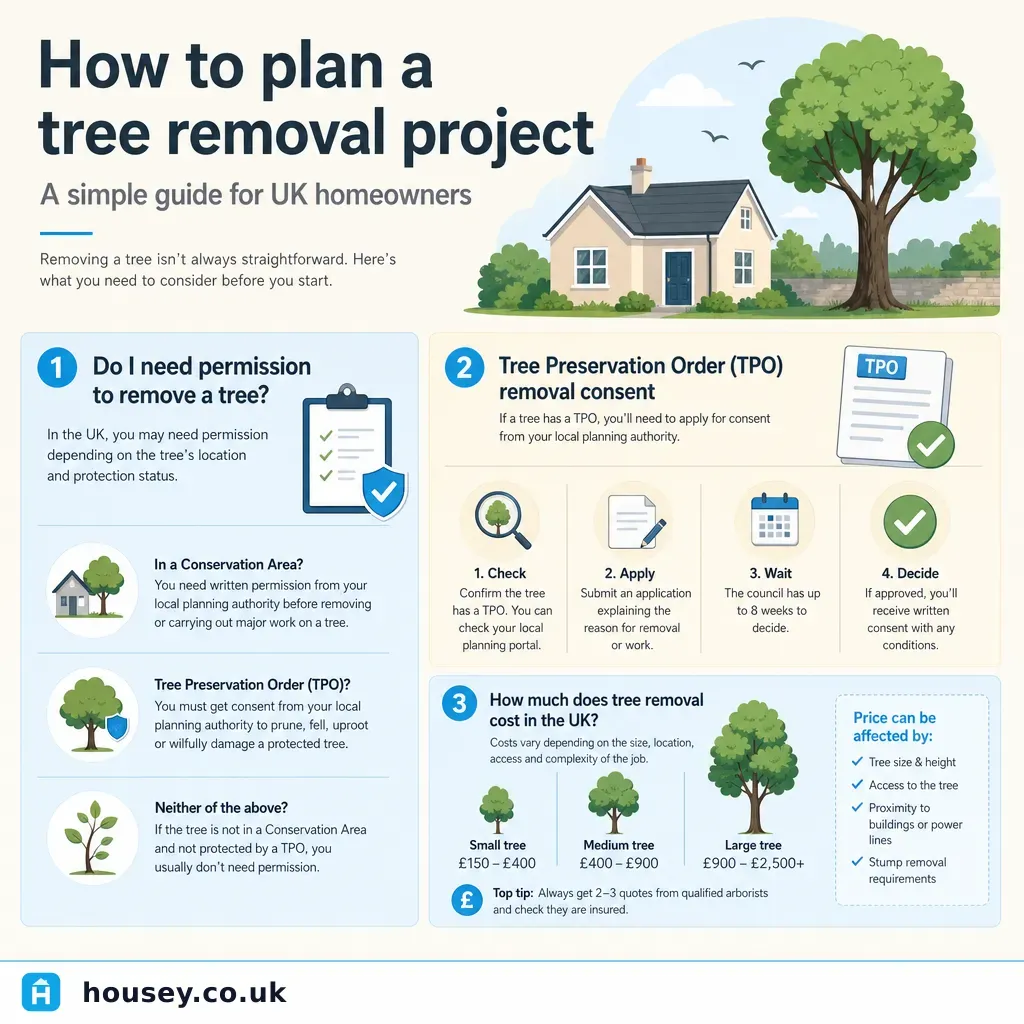
How to plan a tree removal project
Planning a tree removal project starts with checking whether the tree is protected by a Tree Preservation Order or sits in a conservation area, as both require council consent before any work begins.