Professional Electrical Services: Quality Installations and Compliance
By Housey · Last reviewed 24th of May 2026
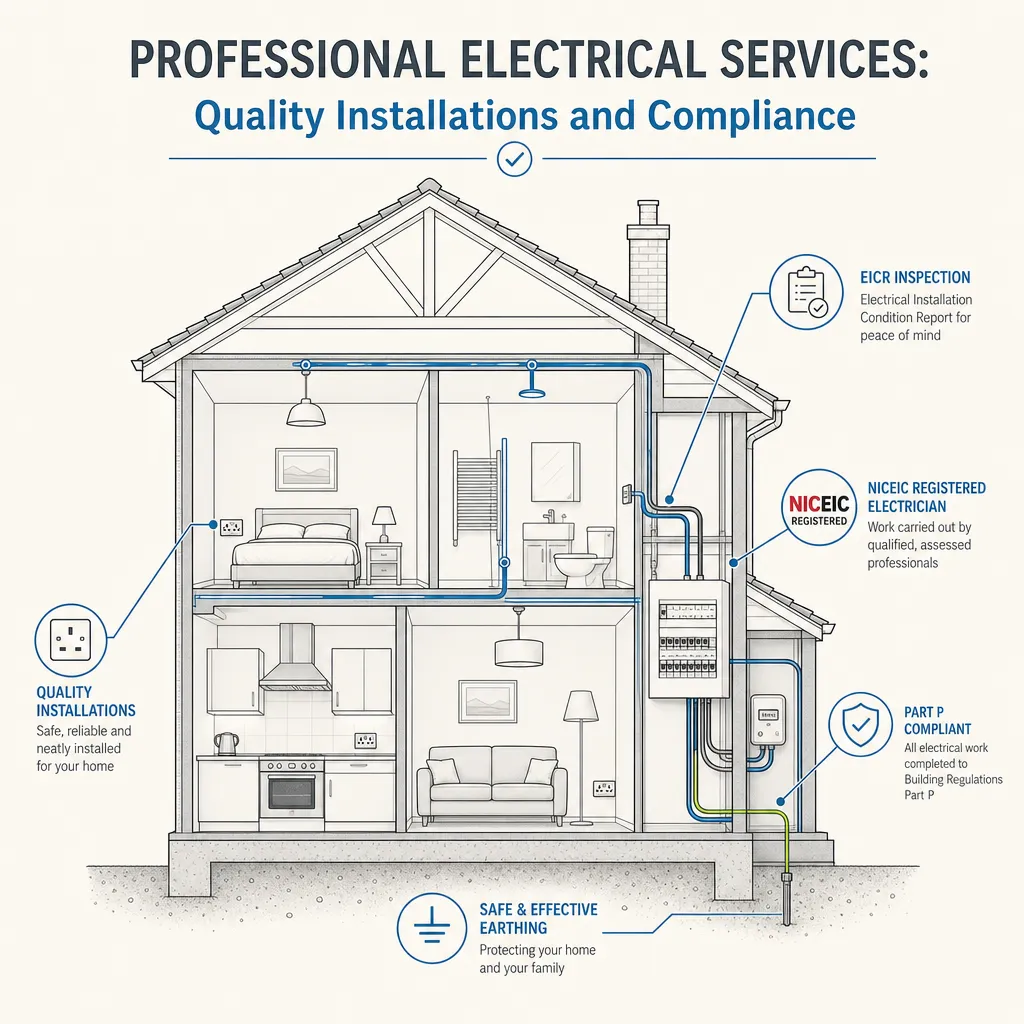
Professional Electrical Services: Quality Installations and Compliance
Electrical work in UK homes sits at the intersection of safety, building regulations, and legal liability — and the rules governing who can do what, and what certification results, have tightened considerably since the introduction of Part P in 2005. Whether you are planning a rewire, replacing a consumer unit, adding circuits for an extension, or simply want reassurance that an inherited installation is safe, understanding the compliance framework helps you make a better-informed decision before instructing anyone.
Key points
- Part P of the Building Regulations (England) requires that most electrical installation work in dwellings — including new circuits, consumer unit replacements, and work in kitchens, bathrooms, and outdoors — is either carried out by a registered competent person or separately notified to local authority building control.
- BS 7671 (Requirements for Electrical Installations, 18th Edition, currently Amendment 2) is the UK wiring standard — the IET Wiring Regulations — and all compliant electrical installation work must satisfy it.
- An Electrical Installation Condition Report (EICR) is legally required at least every five years for all privately rented properties in England under the Electrical Safety Standards in the Private Rented Sector (England) Regulations 2020.
- Only contractors registered with a government-authorised Part P competent person scheme — such as NICEIC, NAPIT, or ELECSA — can self-certify notifiable domestic electrical work without triggering a separate building control inspection.
- Minor works such as replacing a socket, switch, or light fitting like-for-like outside a special location may not be notifiable under Part P; new circuits, consumer unit replacements, and work in kitchens, bathrooms, and outdoor locations generally are.
Understanding Part P and notifiable electrical work
Part P was introduced into the Building Regulations for England in January 2005 and exists to reduce the risk of electrical fires, electrocution, and defective wiring in homes. It defines which domestic electrical work must be carried out or certified by a competent person.
What is generally notifiable under Part P in England?
Generally notifiable:
- Installation of a new circuit from the consumer unit
- Replacement of a consumer unit (fuse box)
- Any work within a special location: kitchen, bathroom, shower room, or outdoors — within the zones defined by BS 7671
- Significant alterations or additions to existing circuits in special locations
Generally not notifiable:
- Like-for-like replacement of accessories (sockets, switches, luminaires) outside special locations
- Repair of existing circuits not in special locations
- Adding a spur to an existing ring circuit outside a special location, subject to the circuit being adequate
Scotland operates under the Building (Scotland) Regulations with a distinct framework administered by local authorities; Wales and Northern Ireland also have their own requirements. Always confirm with the relevant building standards body for your location.
Registered competent person schemes for domestic electrical work
Scheme | Scope | Key feature | How to verify |
|---|---|---|---|
NICEIC (National Inspection Council for Electrical Installation Contracting) | Full domestic and commercial Part P | UKAS-accredited; one of the largest UK schemes; installers assessed before registration | niceic.com/find-a-contractor |
NAPIT (National Association of Professional Inspectors and Testers) | Full domestic Part P; also covers gas, plumbing, solid fuel | Government-authorised multi-trade scheme | napit.org.uk/find-a-member |
ELECSA | Full domestic Part P | Part of the NICEIC Group; same technical standards | elecsa.co.uk |
SELECT | Scotland only | Accreditation body for electricians in Scotland | select.org.uk |
After completing notifiable work, a registered contractor issues an Electrical Installation Certificate (EIC) or a Minor Electrical Installation Works Certificate (MEIWC). These documents should be retained in the property file and produced on request by a buyer's solicitor or a local authority.
What an Electrical Installation Condition Report involves
An EICR is a formal inspection of an existing electrical installation by a qualified and competent person. It tests wiring, accessories, the consumer unit, and earthing and bonding arrangements against the current edition of BS 7671.
The inspector assigns coded observations to any defects:
- C1 (Danger present): Immediate remedial action required — the installation presents a direct danger.
- C2 (Potentially dangerous): Urgent remedial action required — the installation could become dangerous.
- C3 (Improvement recommended): Not immediately dangerous but below current standards; improvement is advisable.
- FI (Further investigation): A condition cannot be fully assessed without additional investigation.
A C1 or C2 code results in an unsatisfactory classification for the whole installation. Landlords in England are legally required to carry out all C1 and C2 remedial works within 28 days of receiving an unsatisfactory report (or sooner if specified) and to provide written evidence to the tenant and local authority within 28 days of completing those works.
Owner-occupiers are not legally required to obtain an EICR, but it is strongly recommended before purchasing a property, after a flood or fire, if the installation has not been inspected in over ten years, or if you suspect a wiring defect.
Red flags in an electrical installation
Do not ignore these warning signs — each indicates a potentially dangerous installation that needs professional assessment without delay:
- Persistent tripping of circuit breakers or residual current devices (RCDs) without an obvious cause
- Burning smell or scorch marks around sockets, switches, or the consumer unit
- Flickering lights that are not caused by the lamp or LED driver
- Old-style rewirable fuses rather than modern MCBs and RCDs in the consumer unit
- Round-pin sockets, or very old brown-and-green earth cable insulation indicating pre-1970s wiring
- No RCD protection on circuits serving sockets, bathrooms, or outdoor areas
- Visible signs of amateur or unfinished wiring: cables pinned haphazardly, double-adaptors in permanent use, or improvised connections
Important limitations
This article provides general information about the UK electrical compliance framework. Rules and their application vary by property type, construction date, tenure, and local authority. Do not attempt notifiable electrical work yourself unless you are registered under a competent person scheme. For any safety concern, consult a qualified, registered electrician promptly. Nothing in this article constitutes legal or professional electrical advice specific to your property or installation.
What to ask a qualified professional
Before instructing an electrician for any significant work, ask:
- Are you registered with a Part P competent person scheme (NICEIC, NAPIT, ELECSA, or equivalent), and can I verify this on the scheme's website?
- What certification will I receive on completion — an EIC, MEIWC, or EICR?
- Will the work be notified to building control, and how?
- Is your quote based on a site visit and visual inspection of the existing installation?
- What does the quote include regarding any remedial work identified during installation?
- Is VAT included in your quoted price?
- Are you covered by public liability insurance, and can you provide evidence?
- If providing an EICR, which circuits, distribution boards, and special locations are within scope?
When to get professional help
Electrical work leaves little room for delay. Seek a registered electrician immediately if:
- You can smell burning from a socket, switch, or consumer unit
- An RCD or breaker trips repeatedly without an obvious cause
- You are buying a property and no EICR is available, or the most recent one is more than five years old
- You want to install EV charging equipment, add a new circuit, or replace your consumer unit
- The property has experienced a flood, fire, or water ingress near electrical components
- The property was built before 1970 and has never been rewired
How Housey can help
An Electrical Installation Condition Report (EICR) from a qualified, NICEIC or NAPIT-registered electrician gives you a clear picture of your installation's safety and compliance — whether you are a landlord meeting your legal obligations under the Electrical Safety Standards in the Private Rented Sector (England) Regulations 2020 or an owner-occupier buying peace of mind. Housey connects you with vetted electricians who can carry out the EICR and any resulting remedial work under a single instruction.
Frequently asked questions
How often should an EICR be carried out?
For private rented properties in England, the law requires an EICR at least every five years or at change of tenancy if sooner. For owner-occupied homes there is no statutory frequency, but most electricians and bodies such as NICEIC recommend an inspection every ten years, or at change of occupancy. Properties with older wiring or recent flood or fire damage may warrant more frequent inspection.
What happens if an EICR is unsatisfactory?
A landlord with an unsatisfactory EICR must carry out all C1 and C2 remedial work within 28 days and provide written evidence to the tenant and local authority within 28 days of completing the work. Failure to comply can result in the local authority issuing a remedial notice and a financial penalty. For owner-occupiers there is no legal enforcement mechanism, but remedial work is strongly advisable.
Can I do my own electrical work in my home?
A homeowner may carry out minor electrical work that is not notifiable under Part P — such as replacing a like-for-like socket or light fitting in a non-special location. Notifiable work including new circuits, consumer unit replacements, and work in kitchens, bathrooms, and outdoors must be carried out by a registered competent person or separately notified to local authority building control. Unapproved work can affect home insurance and complicate future property sales.
What is the difference between an EIC and an EICR?
An Electrical Installation Certificate (EIC) is issued by the installer when new electrical work is completed, certifying that the specific work meets BS 7671 at the point of installation. An Electrical Installation Condition Report (EICR) inspects an existing installation and assesses its current condition against current standards. Both are important documents for the property file; neither replaces the other.
Sources and further reading
- Part P of the Building Regulations: electrical safety — GOV.UK
- Electrical Safety Standards in the Private Rented Sector (England) Regulations 2020 — GOV.UK
- EICR guidance for landlords and homeowners — Electrical Safety First
- Find a registered NICEIC contractor — NICEIC
- NAPIT: find a registered member — NAPIT
- BS 7671 IET Wiring Regulations 18th Edition — Institution of Engineering and Technology
Useful next reads
 Surveys & Inspections
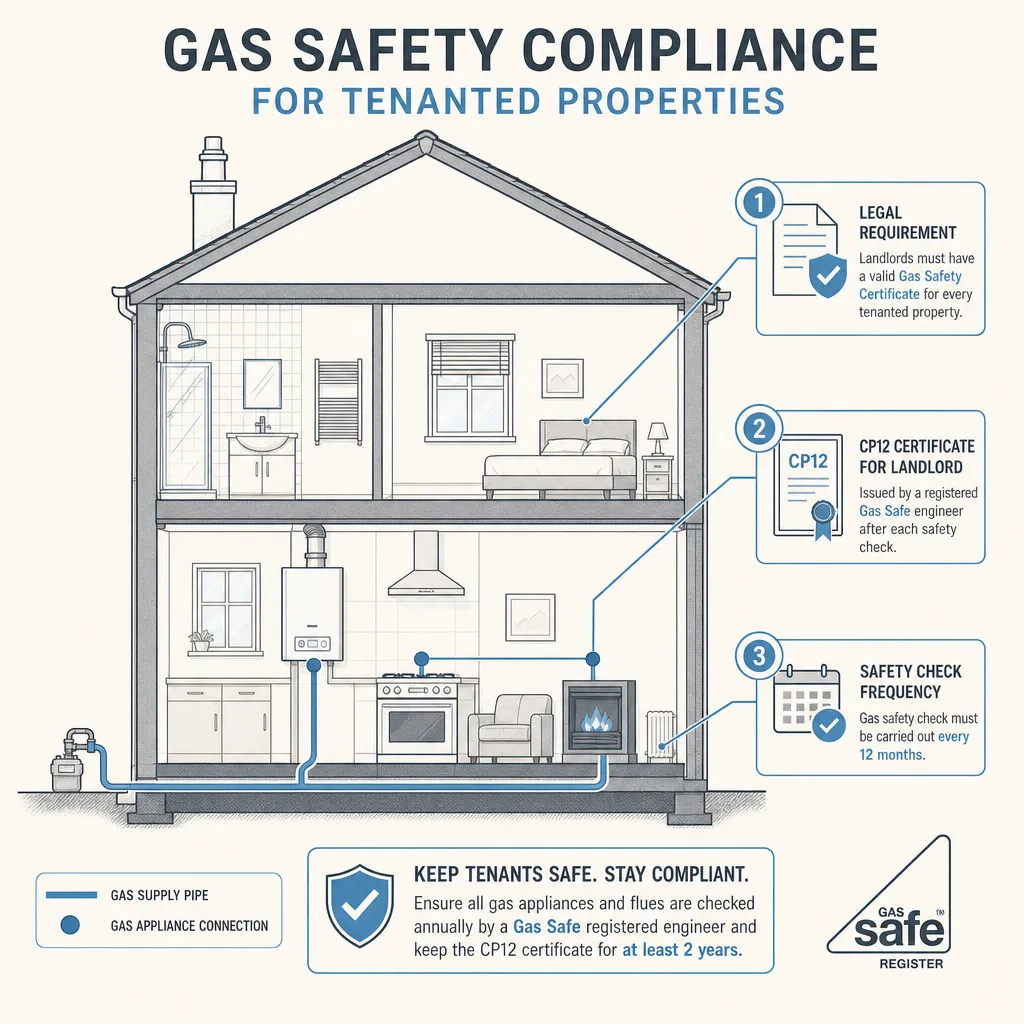
Gas Safety Compliance for Tenanted Properties
UK landlords are legally required to arrange an annual gas safety check by a Gas Safe registered engineer for every tenanted property with a gas appliance.
 Surveys & Inspections
Gas Safety Week: Information for Homeowners and Landlords
Gas Safety Week, run each September by Gas Safe Register, highlights the risks of unsafe gas appliances and unlicensed gas work.
 Surveys & Inspections
Verifying Gas Engineer Credentials: Qualifications, Certifications, and Legal Requirements
All gas engineers working on domestic properties in Great Britain must be Gas Safe registered — a legal requirement under the Gas Safety (Installation and Use) Regulations 1998.
 Surveys & Inspections
Identifying Asbestos Insulation: What You Need to Know for Your Property
Asbestos insulation was widely used in UK properties built before 2000, commonly found in pipe lagging, ceiling tiles, loose-fill loft insulation, and around boilers.
 Surveys & Inspections
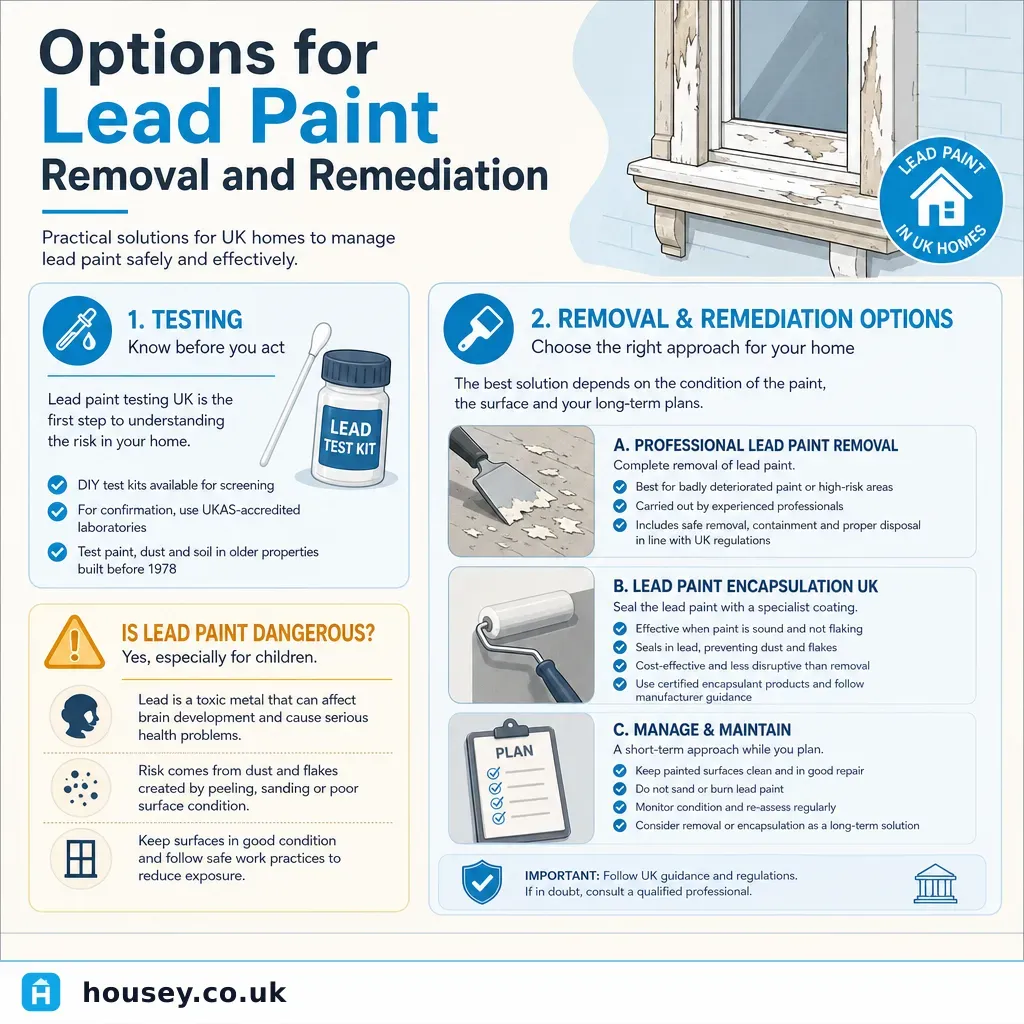
Options for Lead Paint Removal and Remediation
Lead paint in UK homes built before 1960 is common and not automatically hazardous if in good condition.