Verifying Gas Engineer Credentials: Qualifications, Certifications, and Legal Requirements
By Housey · Last reviewed 18th of May 2026
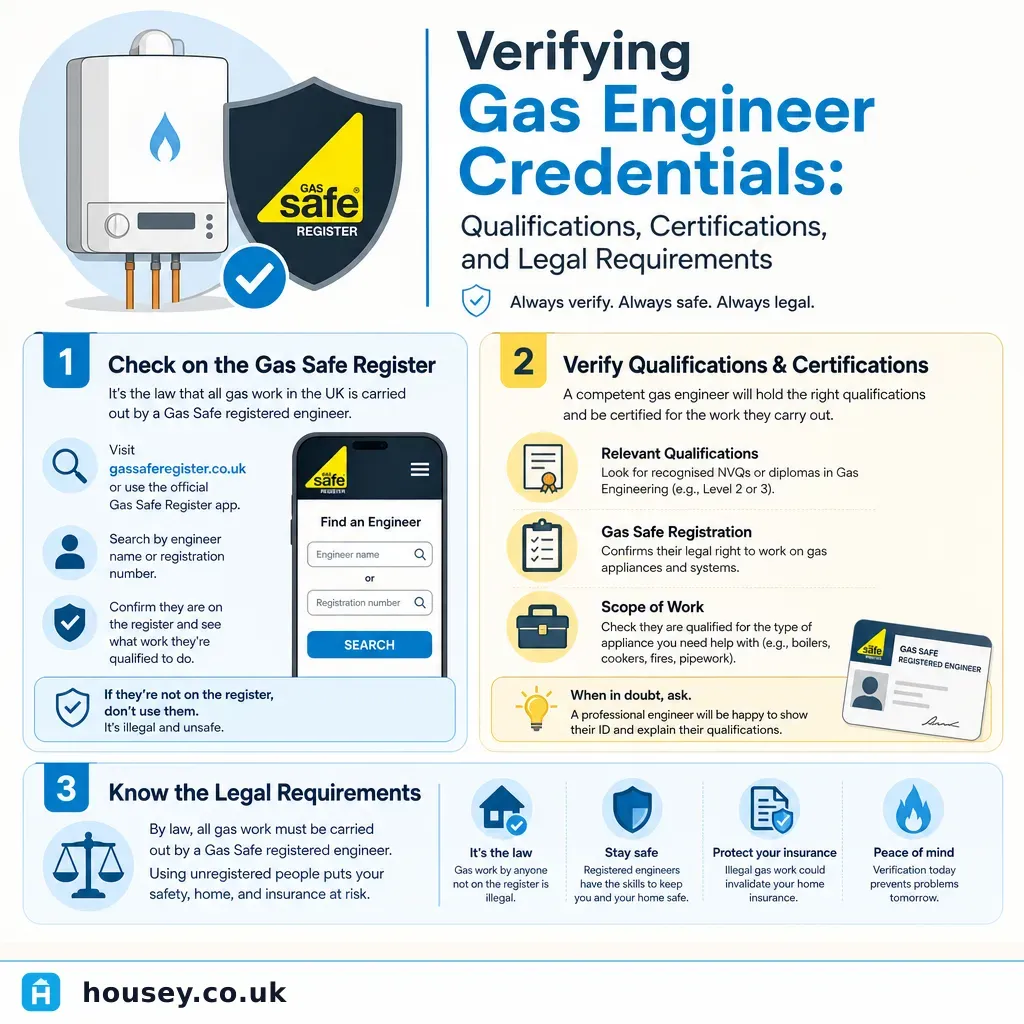
Verifying Gas Engineer Credentials: Qualifications, Certifications, and Legal Requirements
Gas work in UK homes carries serious safety implications — a poorly installed boiler, gas fire, or cooker connection can cause carbon monoxide poisoning, fire, or explosion. Anyone commissioning gas work on their property, whether a new boiler installation, an annual safety check, or an appliance service, has a legal and practical responsibility to confirm that the engineer holds the correct credentials before work begins. Understanding what to check — and what red flags to watch for — takes only a few minutes but could prevent a life-threatening outcome.
Key points
- All engineers carrying out gas work on domestic properties in Great Britain must be registered with the Gas Safe Register under the Gas Safety (Installation and Use) Regulations 1998 (SI 1998/2451).
- Every registered engineer carries a Gas Safe ID card showing their registration number, photograph, expiry date, and — on the reverse — the specific appliance categories and gas types they are qualified to work on.
- Landlords must arrange an annual Gas Safety Check by a Gas Safe registered engineer and provide tenants with a copy of the Gas Safety Record (CP12) within 28 days of the check, or before a new tenancy begins.
- Using an unregistered gas engineer is a criminal offence; penalties under the Health and Safety at Work etc. Act 1974 can include unlimited fines and imprisonment.
- The ACS (Accredited Certification Scheme) is the qualification framework underpinning Gas Safe registration; engineers must hold current ACS certificates covering the specific appliance types and gas types relevant to the work being carried out.
What is the Gas Safe Register?
The Gas Safe Register is the official statutory list of gas businesses and engineers legally permitted to carry out gas work in Great Britain. It replaced CORGI registration in April 2009 and is the registration body appointed by the Health and Safety Executive (HSE). Membership is not voluntary — any business or individual undertaking gas work in Great Britain must be registered.
The register is publicly searchable at gassaferegister.co.uk, where you can check any engineer's registration number, their employer, and the categories of work they are authorised to carry out. A separate register covers Northern Ireland.
How to verify an engineer's credentials
Step 1: Ask to see the Gas Safe ID card before work starts
Before any gas work begins, ask the engineer to show their Gas Safe ID card. Legitimate engineers carry it and expect to be asked. Check:
- Name: does it match the person in front of you?
- Photograph: does it match?
- Expiry date: is the card currently valid?
- Appliance categories (reverse of card): are the appliances the engineer is about to work on listed?
An engineer may be Gas Safe registered but not hold the specific qualification for a particular appliance type — registration alone is not sufficient. Always check the reverse.
Step 2: Verify the registration number online
Visit gassaferegister.co.uk or call 0800 408 5500 to confirm:
- The registration number printed on the card is current and matches the engineer's name.
- The business they work for is also registered (both the business and the individual must hold registration).
Step 3: Confirm the business registration separately
Whether hiring a sole trader or a gas company, the business entity must also be registered with Gas Safe. When booking through a company rather than directly with a named engineer, check the company's registration and ask which specific individual will attend — then verify that person's card on the day.
Which professional do I need?
Gas work type | Required credential | Key notes |
|---|---|---|
Boiler installation or replacement | Gas Safe registered, domestic boilers ACS category | New installations must be notified to Building Control via Competent Person Scheme |
Annual boiler service | Gas Safe registered, domestic boilers ACS category | Keep records for manufacturer warranty and insurance purposes |
Gas Safety Check — landlord CP12 | Gas Safe registered, relevant appliance categories | Must be renewed annually; landlords must retain records for at least 2 years |
Gas fire installation or service | Gas Safe registered, gas fires ACS category | Open-flued and room-sealed fires require separate ACS categories — check card |
Gas cooker or hob connection | Gas Safe registered, cooking appliances ACS category | Moving a cooker and reconnecting it still requires a registered engineer |
Gas meter installation or relocation | Gas Safe registered with meter ACS category, or your gas transporter | Contact your gas supplier first — some meter work is the transporter's responsibility |
LPG appliances | Gas Safe registered with LPG-specific ACS category | A separate category from natural gas — verify the card carefully |
What to ask before instructing a gas engineer
- Can I see your Gas Safe ID card before you start, and may I note your registration number?
- Are the appliances you are going to work on listed on the reverse of your card?
- Are you employed by a registered gas business, and is that business also on the Gas Safe Register?
- Will you issue a formal Gas Safety Record or installation certificate on completion?
- For a new installation, will you notify Building Control via the Competent Person Scheme, and will I receive a certificate of compliance?
- Does your quote include VAT, and what could cause the price or timeline to change?
- Do you carry public liability insurance, and for what amount?
Red flags: warning signs of an unregistered or under-qualified engineer
- Reluctance or outright refusal to show a Gas Safe ID card before work starts.
- An expired ID card — registration must be current, even if only one day out of date.
- ID card categories on the reverse that do not include the appliance type being worked on.
- A price significantly lower than other quotes with no clear explanation.
- No formal written quote, no completion certificate, and no mention of Building Control notification for new installations.
- Suggestion that the work does not need to be recorded, notified, or officially signed off.
- No evidence of public liability insurance on request.
Important limitations
This article provides general information about Gas Safe registration requirements and how to verify an engineer's credentials. Gas safety regulations are complex, and individual circumstances — particularly those involving landlord compliance disputes, insurance claims, inherited gas installations, or suspected illegal gas work — should be assessed by a suitably qualified professional or the relevant regulator. Rules and responsibilities can vary depending on property tenure, property type, and the specific nature of the work involved. Nothing in this article constitutes legal advice.
When this becomes urgent
Stop and seek immediate professional or emergency help if:
- You smell gas in or around your property — leave immediately without operating any switches, and call the National Gas Emergency Service on 0800 111 999 (free, 24 hours).
- Your carbon monoxide alarm sounds — leave the building immediately and call 999.
- A Gas Safety Check has identified an appliance as Immediately Dangerous (ID) or At Risk (AR) — do not use the appliance until a Gas Safe registered engineer has confirmed it is safe.
- You have reason to believe gas work has been carried out in your property by an unregistered engineer — contact the Gas Safe Register to report it and arrange an inspection by a registered engineer before using the affected appliances.
When to get professional help
For any gas work in a domestic property — no matter how minor it may appear — the law requires a Gas Safe registered engineer. If you are a landlord and have missed an annual Gas Safety Check deadline, contact a registered engineer immediately and seek advice from the HSE or Citizens Advice about your position. If you suspect illegal gas work has been carried out, report it to the Gas Safe Register; they can arrange an independent inspection.
How Housey can help
Housey makes it straightforward to arrange a gas safety certificate from a Gas Safe registered engineer, whether you need an annual landlord CP12, a pre-sale or pre-purchase safety check, or documentation following a new appliance installation. Engineers connected through Housey are verified as Gas Safe registered for the relevant appliance categories.
Frequently asked questions
Is it illegal to use an unregistered gas engineer?
Yes. Under the Gas Safety (Installation and Use) Regulations 1998, only Gas Safe registered engineers may legally carry out gas work in domestic properties in Great Britain. Hiring an unregistered engineer is a criminal offence and could also invalidate your home insurance, void the appliance warranty, and — most critically — put lives at serious risk from carbon monoxide or fire.
What is ACS and how does it relate to Gas Safe registration?
The Accredited Certification Scheme (ACS) is the qualification framework underpinning Gas Safe registration. Engineers must pass ACS assessments covering the specific appliance types and gas types they intend to work on. Gas Safe registration confirms that an engineer holds current, relevant ACS certificates. Always check the back of the ID card to confirm which appliance categories are covered.
Does a Gas Safe registered engineer need to notify Building Control for new boiler installations?
Yes. New gas boiler installations fall under the Competent Person Scheme, and a properly registered engineer will notify Building Control on your behalf. You should receive a certificate of compliance. If an engineer suggests this notification is unnecessary for a new installation, treat that as a clear red flag and do not proceed.
Can a tenant arrange their own gas safety check if the landlord fails to?
The legal duty to arrange an annual Gas Safety Check rests with the landlord under the Gas Safety (Installation and Use) Regulations 1998, not the tenant. Tenants who believe their landlord is non-compliant can report the matter to the Health and Safety Executive (HSE). Citizens Advice provides guidance on tenant rights in relation to gas safety obligations.
Sources and further reading
- Gas Safety (Installation and Use) Regulations 1998 — legislation.gov.uk
- Using a Gas Safe registered engineer — Gas Safe Register
- Landlord gas safety responsibilities — Health and Safety Executive (HSE)
- Gas safety in the home — GOV.UK
- Gas safety and rented homes — Citizens Advice
Useful next reads
 Surveys & Inspections
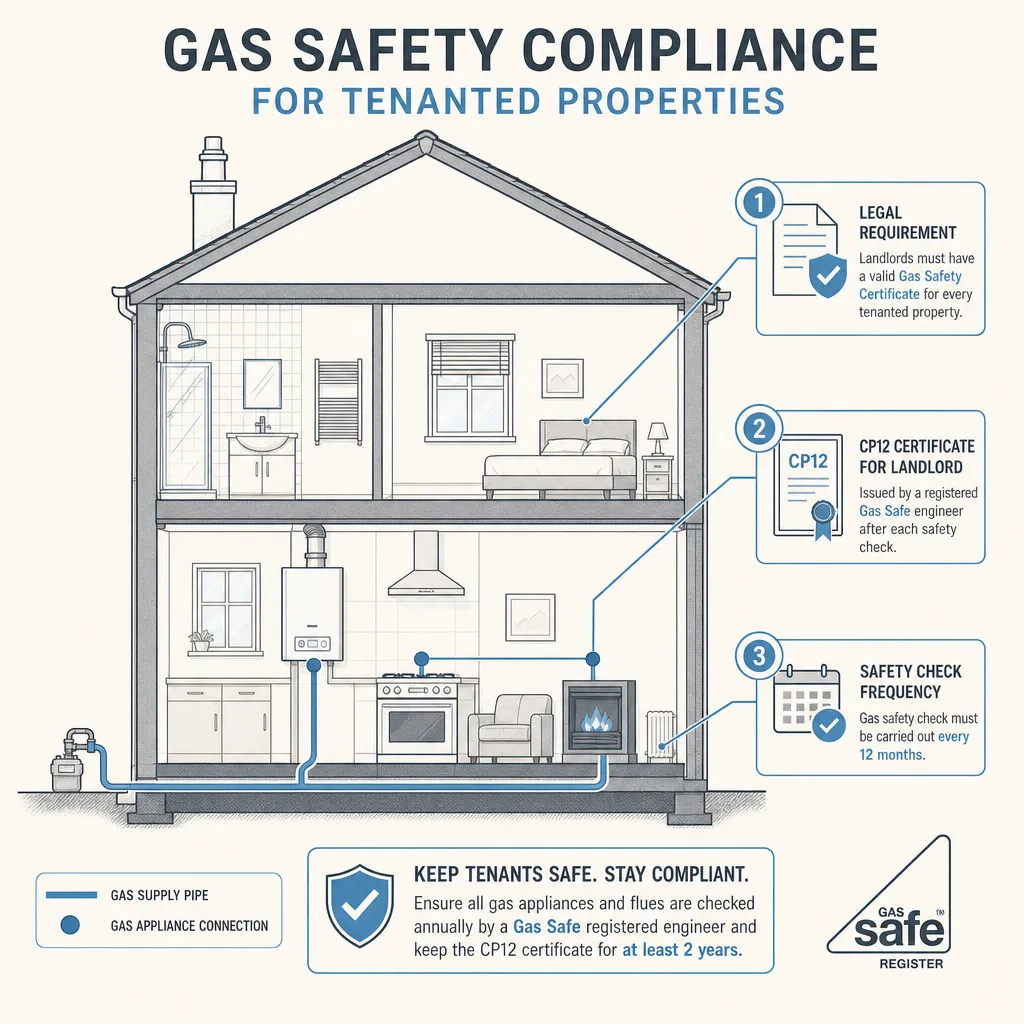
Gas Safety Compliance for Tenanted Properties
UK landlords are legally required to arrange an annual gas safety check by a Gas Safe registered engineer for every tenanted property with a gas appliance.
 Surveys & Inspections
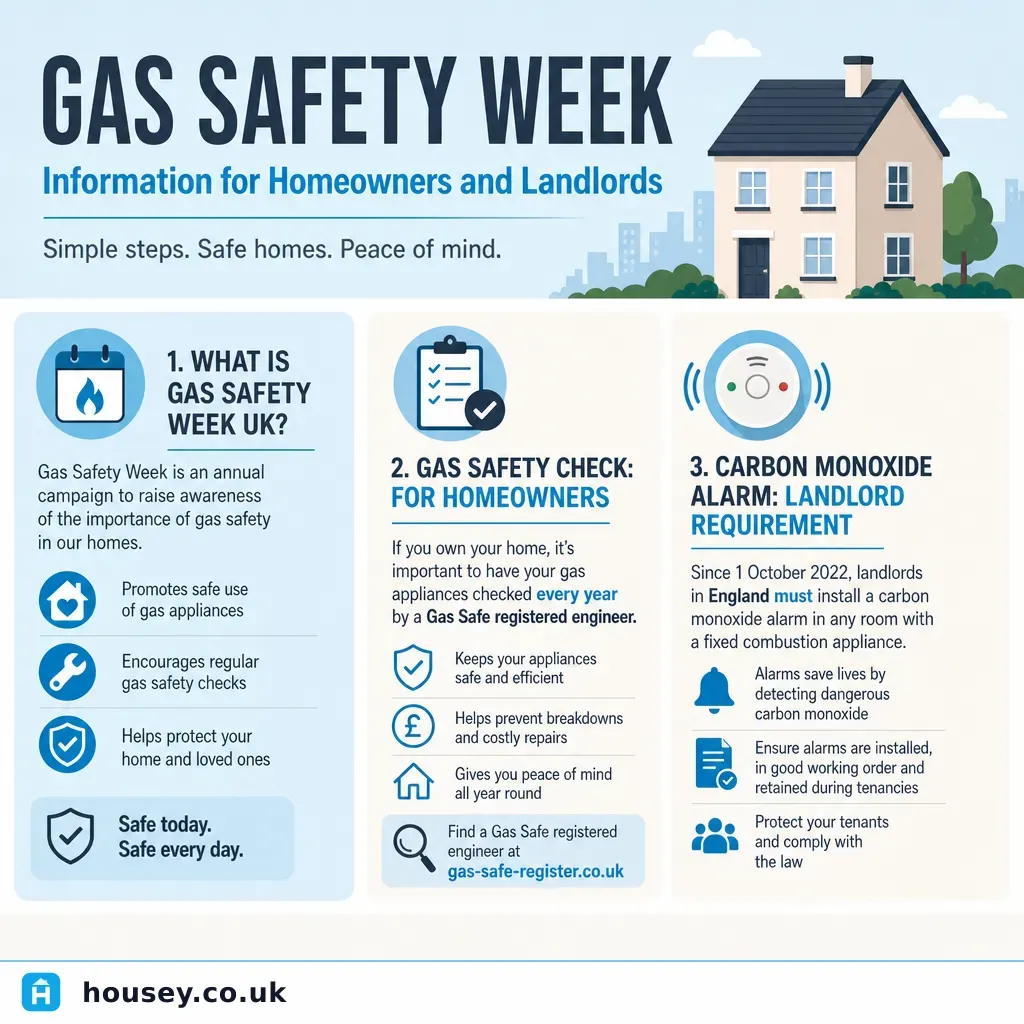
Gas Safety Week: Information for Homeowners and Landlords
Gas Safety Week, run each September by Gas Safe Register, highlights the risks of unsafe gas appliances and unlicensed gas work.
 Surveys & Inspections
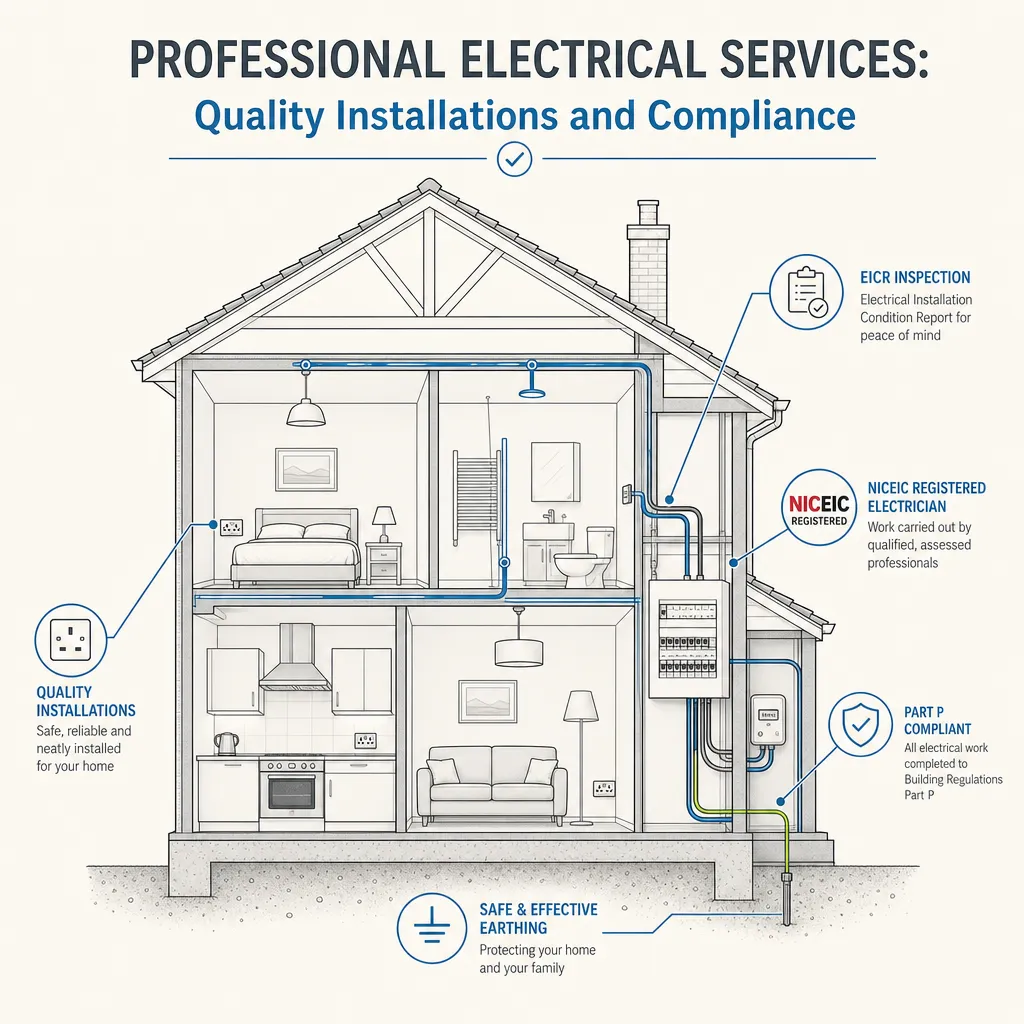
Professional Electrical Services: Quality Installations and Compliance
Professional electrical services in UK homes are governed by Part P of the Building Regulations and BS 7671 (18th Edition).
 Surveys & Inspections
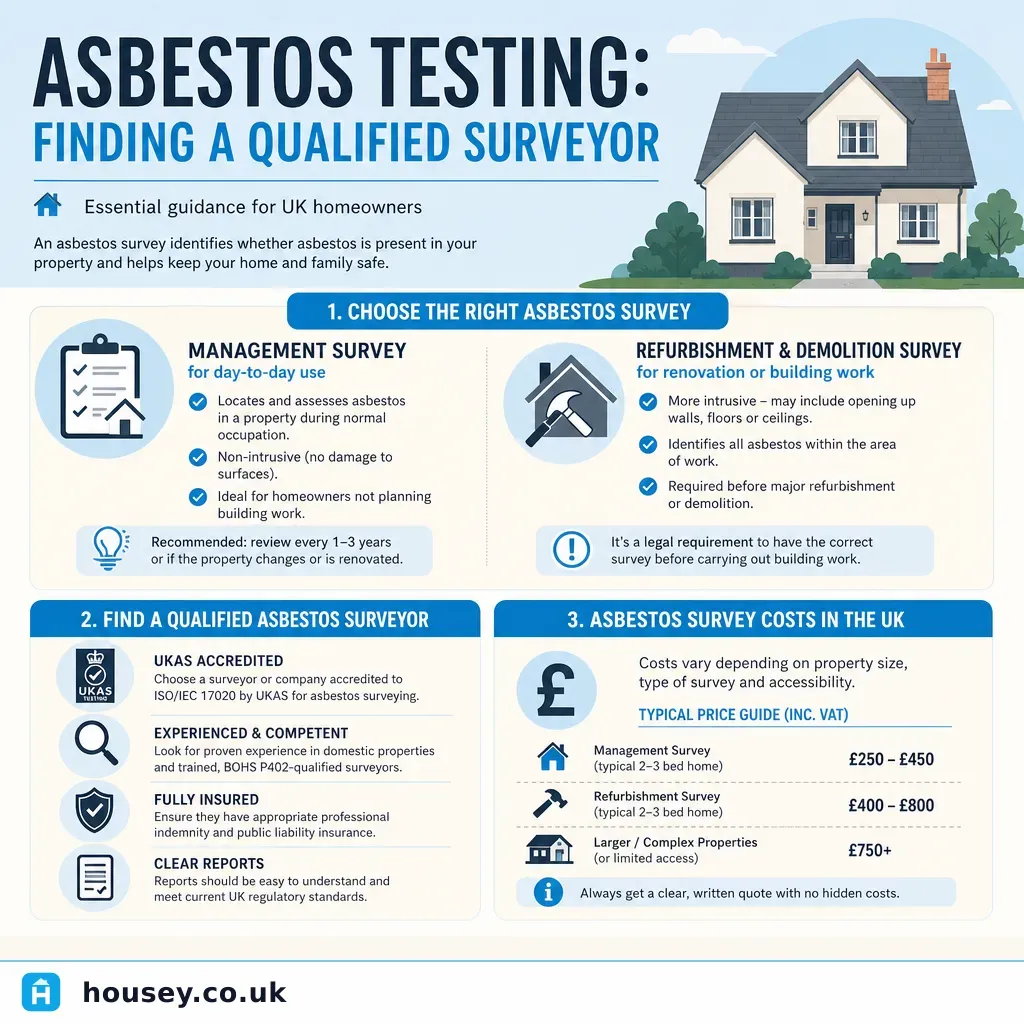
Asbestos Testing: Finding a Qualified Surveyor
Finding a qualified asbestos surveyor means choosing a company accredited by UKAS to ISO/IEC 17020, with analysts holding BOHS P402 or equivalent qualifications.
 Surveys & Inspections
Artex Surfaces and Property Market Perception
Artex applied before 2000 may contain chrysotile asbestos, which is safe when undisturbed but hazardous if sanded or scraped without professional assessment.