Geothermal Energy Systems for Home Heating
By Housey · Last reviewed 11th of May 2026
Geothermal Energy Systems for Home Heating
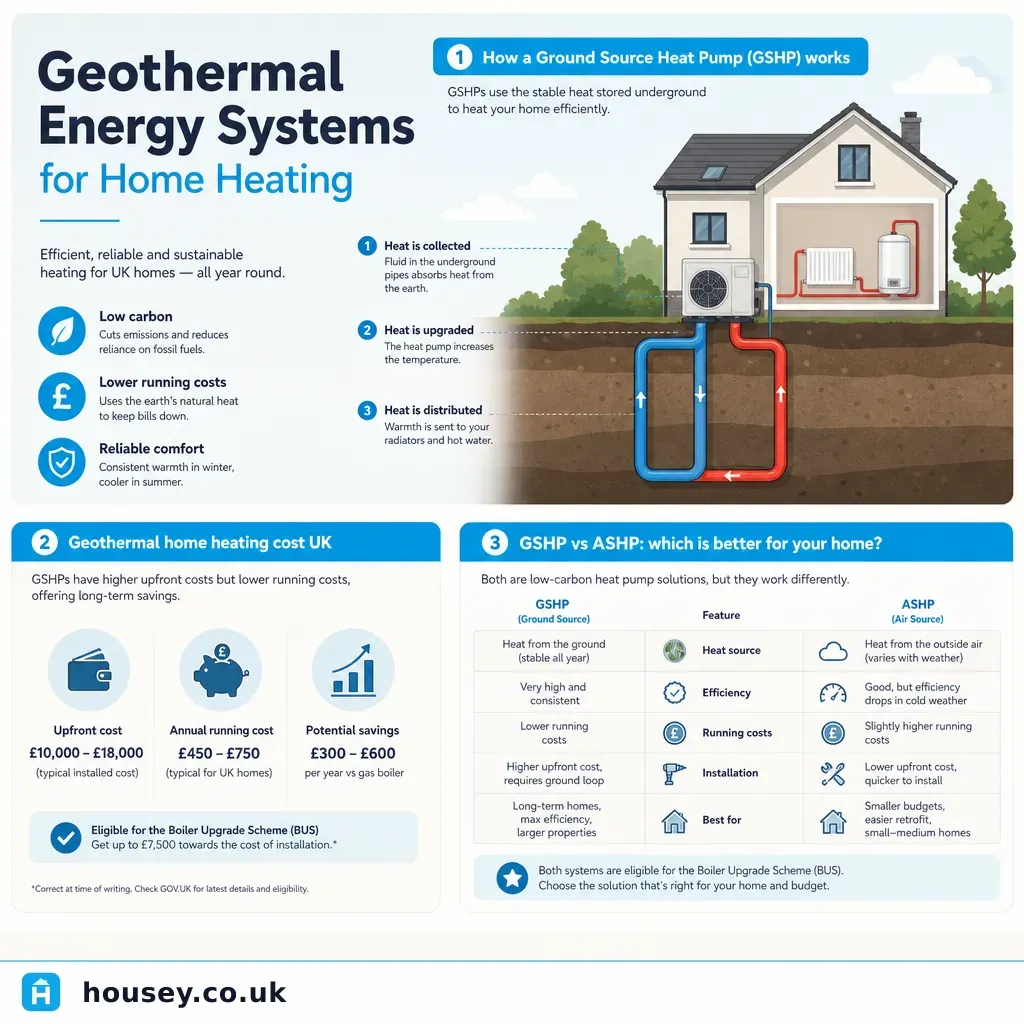
Interest in ground source heat pumps and geothermal-style heating has grown considerably among UK homeowners as gas boiler replacement timelines and renewable heating grants bring low-carbon options into sharper focus. The decision typically arises when a boiler is nearing the end of its service life, when a homeowner is planning a major renovation, or when exploring what qualifies for the Boiler Upgrade Scheme. It is a significant investment that involves ground works, specialist surveys, and careful system sizing — making well-grounded information particularly important before any commitment is made.
Key points
- Ground source heat pumps extract thermal energy from the ground at a stable 8–12°C year-round via buried loops or boreholes, typically achieving a Coefficient of Performance (COP) of 3.0–4.0 — delivering 3–4 units of heat per unit of electricity consumed.
- The Boiler Upgrade Scheme (BUS), administered by Ofgem, offers a £7,500 grant towards an eligible GSHP installation in England and Wales; the installer must hold current Microgeneration Certification Scheme (MCS) certification.
- Horizontal ground loops require a land area roughly two to three times the property's heated floor area; vertical boreholes (typically 50–150 m deep) suit smaller or urban plots.
- An MCS heat pump sizing assessment under MIS 3005 — including a room-by-room heat loss calculation — must be completed before a GSHP is specified, to prevent under- or over-sizing.
- PAS 2035, the UK standard for domestic retrofit assessments, applies when a GSHP forms part of a broader whole-house energy improvement programme.
How ground source heating works
In a domestic UK context, geothermal heating most often refers to ground source heat pump technology rather than deep geological extraction. A GSHP circulates a water-antifreeze mixture through buried ground loops, which absorb solar energy stored in the shallow ground — maintained at roughly 8–12°C throughout the year. This low-grade heat is then compressed to a higher temperature inside the heat pump unit and delivered to the property's wet central heating distribution — typically underfloor heating or oversized radiators — and to the domestic hot water cylinder.
Ground loops can be configured in two main ways:
- Horizontal collectors: Laid in trenches 1–2 m deep across a substantial area of garden or land. As a rough guide, expect to need two to three times the property's heated floor area in available ground — though this varies with soil type and local moisture levels.
- Vertical boreholes: Drilled to 50–150 m depth using specialist equipment, requiring a much smaller surface footprint. More common in constrained or urban plots, and generally more expensive to install than horizontal loops.
A third option — water source heat pumps — draws heat from a nearby lake, river, or aquifer. These are less common for domestic installations and require environmental permitting from the Environment Agency.
Comparison: ground source vs. air source heat pumps
Feature | Ground source heat pump (GSHP) | Air source heat pump (ASHP) |
|---|---|---|
Heat source | Stable ground temperature (8–12°C year-round) | Ambient outdoor air (variable; modern units operate to −15°C or below) |
Typical COP | 3.0–4.0 (consistent across seasons) | 2.5–3.5 (lower in very cold weather) |
Land requirement | Yes — significant for horizontal loops; borehole suits smaller plots | No — external unit only |
Installation complexity | High — ground works or drilling required | Moderate — no groundworks needed |
Indicative installed cost (pre-grant) | £15,000–£35,000+ | £8,000–£18,000 |
BUS grant available | £7,500 | £7,500 |
Noise | Very quiet (all components indoors) | Low-level outdoor unit noise |
Best suited to | Properties with suitable land or borehole access, well insulated | Most property types, especially those without sufficient land for loops |
Indicative UK costs, last reviewed 2026-05-11. Costs vary significantly by property size, soil type, loop configuration, and installer. Obtain multiple comparable quotes.
Which system should you choose?
- Choose horizontal ground loops if you have a large garden — at minimum twice the property's heated floor area — accessible moisture-retaining subsoil, and the budget for excavation.
- Choose vertical boreholes if your plot is limited but you have the budget for drilling, and a geotechnical assessment confirms suitable conditions without significant rock or contamination.
- Choose an air source heat pump if your property lacks sufficient land area, if ground conditions are poor or unknown, or if the budget does not allow for ground works or borehole drilling.
- Consult an MCS-certified heat pump surveyor if your property has solid masonry walls, a high-temperature radiator system, or a poorly insulated hot water cylinder — heat pump suitability is always property-specific.
- Check PAS 2035 requirements if the GSHP forms part of a broader retrofit programme; a Retrofit Coordinator and whole-house assessment may be required before installation proceeds.
Boiler Upgrade Scheme and other grants
The Boiler Upgrade Scheme (BUS) is administered by Ofgem and provides a £7,500 voucher applied directly to the installation cost of an eligible GSHP in England and Wales. Key conditions:
- The installer must hold current MCS certification for ground source heat pump technology.
- The property must have a valid Energy Performance Certificate (EPC) with no outstanding recommendation for loft or cavity wall insulation, unless those measures have already been installed.
- The voucher is claimed by the installer, not the homeowner — the grant is deducted from the total price at the point of sale.
- BUS is subject to government review and budget availability; check the GOV.UK guidance page for current eligibility and scheme status before committing.
Scotland has separate energy efficiency grant programmes through Home Energy Scotland. Homeowners in Northern Ireland should check current NI government schemes, which differ from the BUS.
What a pre-installation survey involves
A proper GSHP survey process should include:
- Room-by-room heat loss calculation: Determines the output required from the heat pump and confirms whether existing radiators or underfloor heating circuits can distribute heat at lower flow temperatures (typically 35–55°C, versus 70–80°C for a gas boiler).
- Ground investigation: An assessment of soil type, moisture content, and available land area for horizontal loops. For vertical boreholes, a desk-based geological review and, in some cases, a test borehole.
- Existing system review: Checking the hot water cylinder volume, pipework condition, and heating controls before specifying the heat pump model and output.
- MIS 3005 documentation: MCS requires heat pump installers to document the heat loss calculation and system design under Installer Standard MIS 3005. Non-compliance can void the BUS grant and MCS certificate.
Pre-installation homeowner checklist
Important limitations
This article provides general information only. Heat pump sizing, ground suitability, and grant eligibility are all property-specific — no general guide can substitute for a site assessment. An incorrectly sized or poorly installed heat pump can result in high running costs, inadequate heat output, and moisture risk in older properties with limited ventilation. All GSHP installations must be carried out by an MCS-certified installer to qualify for the Boiler Upgrade Scheme and to comply with Building Regulations Part L and associated standards. This article does not constitute engineering, planning, or retrofit advice.
When to get professional help
Seek a professional assessment before committing to a GSHP if:
- Your home has solid masonry walls, limited insulation, or significant fabric heat loss — a fabric-first approach is usually recommended before heat pump installation.
- The property is a listed building or in a conservation area — additional planning consent may be required.
- Your existing heating system uses high-temperature radiators designed for gas boiler flow temperatures that have not been assessed for heat pump compatibility.
- Geological information or local knowledge suggests difficult ground conditions such as hard rock, a high water table, or ground contamination.
What to ask a qualified professional
Before instructing a GSHP installer or ground survey engineer:
- Are you MCS-certified for ground source heat pumps, and can you provide your MCS certificate number for verification at mcscertified.com?
- Will the survey include a room-by-room heat loss calculation compliant with MIS 3005?
- Is a geotechnical or ground investigation included in the quoted scope, and what is your procedure if conditions prove unsuitable?
- Will the quote include the BUS grant application, and what documentation will I receive at each stage of the process?
- How will you confirm that my existing radiators and hot water cylinder can work at heat pump flow temperatures, and what are the likely upgrade costs if not?
- What COP do you expect the installed system to achieve, and how is that figure calculated for my property's specific heat loss?
How Housey can help
Housey connects homeowners with MCS-certified surveyors and engineers who carry out heat pump surveys and geotechnical and soil investigations to establish whether your plot and property are suitable for a ground source heat pump. Compare quotes from multiple specialists before committing to ground works.
Frequently asked questions
Does a ground source heat pump need planning permission?
In most cases in England, no. GSHP installations typically qualify as permitted development under the Town and Country Planning (General Permitted Development) (England) Order 2015. However, restrictions apply to listed buildings, conservation areas, and properties with certain prior alterations. Always confirm with your local planning authority before proceeding, particularly if your property carries any of these designations.
How long does a ground source heat pump last?
Heat pump units typically have an expected service life of 20–25 years, with the buried ground loop itself potentially lasting 50 years or more. Annual servicing and periodic refrigerant checks are recommended by manufacturers to maintain performance and preserve warranty validity throughout the system's life.
Can a ground source heat pump heat a Victorian terrace?
Possibly — but it depends heavily on insulation levels, plot size, and the existing heating distribution. Victorian solid-wall terraces often have significant fabric heat loss and may need insulation upgrades before a heat pump can operate efficiently. A thorough heat loss assessment and ground investigation are essential before any commitment is made.
What is the running cost of a ground source heat pump?
Running costs depend on COP achieved, electricity tariffs, and the property's heating demand. A well-sized GSHP in a well-insulated home may offer lower annual running costs than a gas boiler on a heat pump electricity tariff, but this is highly property-specific. The Energy Saving Trust publishes indicative running cost comparisons. Indicative UK costs, last reviewed 2026-05-11.
Is geothermal energy the same as a ground source heat pump?
Not precisely. Deep geothermal energy extracts heat from hot rocks in the earth's crust, used commercially in places such as Cornwall. Ground source heat pumps use the stable shallow ground temperature maintained by absorbed solar energy near the surface. Most UK domestic installations are ground source heat pumps rather than true deep geothermal systems.
Sources and further reading
- Boiler Upgrade Scheme: homeowner guidance — GOV.UK
- Heat pumps: advice and information — Energy Saving Trust
- MCS Installer Standard MIS 3005: Heat pump systems — Microgeneration Certification Scheme (MCS)
- PAS 2035: Retrofitting dwellings for improved energy efficiency — BSI / TrustMark
- Permitted development rights: technical guidance for householders — GOV.UK Planning Practice Guidance
Useful next reads
 Energy & Retrofit
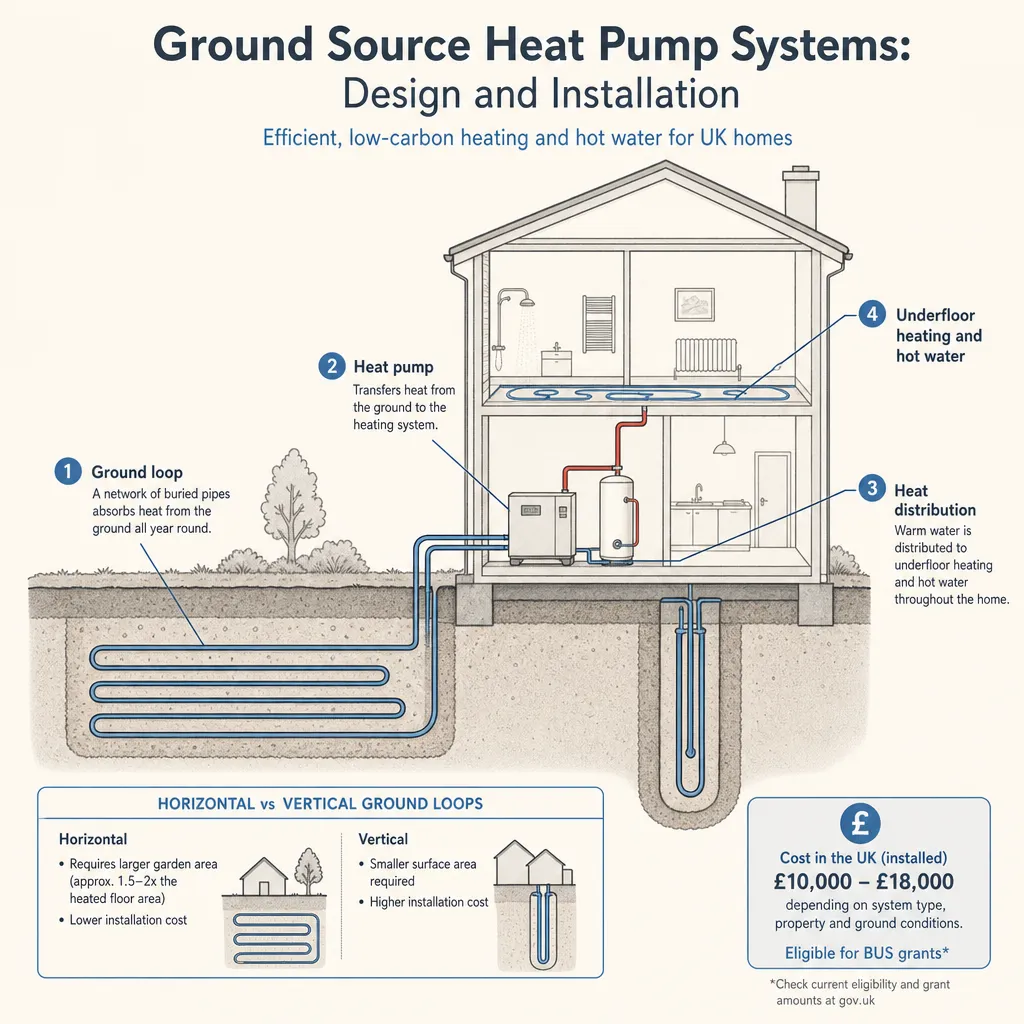
Ground Source Heat Pump Systems: Design and Installation
Ground source heat pumps extract heat from the earth through buried loops or boreholes, then upgrade it for space heating and hot water.
 Energy & Retrofit
Choosing a Heating System for Your Conservatory
The most practical conservatory heating options are electric panel heaters, underfloor heating (electric or wet), infrared panels, and extending an existing central heating circuit.
 Energy & Retrofit
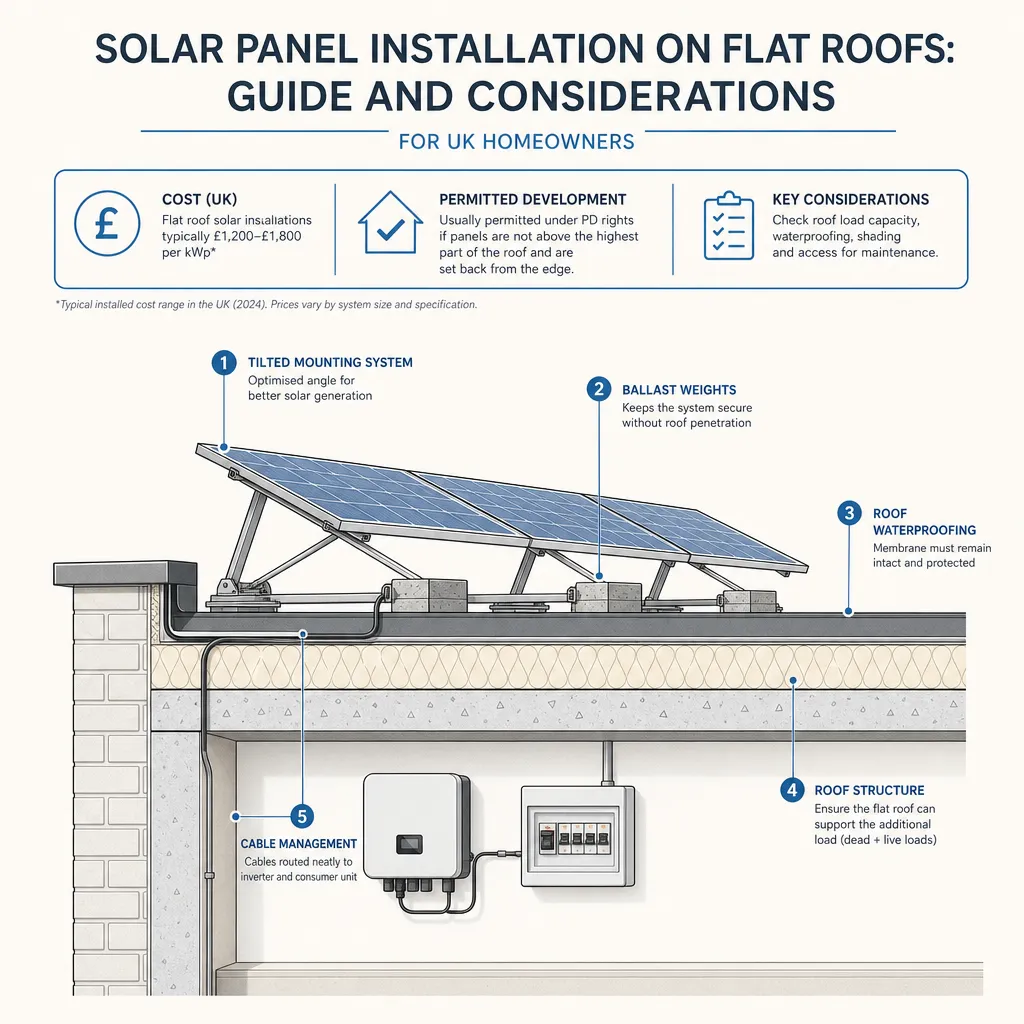
Solar Panel Installation on Flat Roofs: Guide and Considerations
Solar panels can be installed on flat roofs using ballasted or mechanically fixed frames, with the tilt angle optimised for UK latitudes.
 Energy & Retrofit
Practical Energy Saving Tips for Homeowners
Most UK households can meaningfully reduce their energy bills by making targeted changes: lowering the thermostat by 1°C, switching to LED lighting, and draught-proofing doors and windows.
 Energy & Retrofit
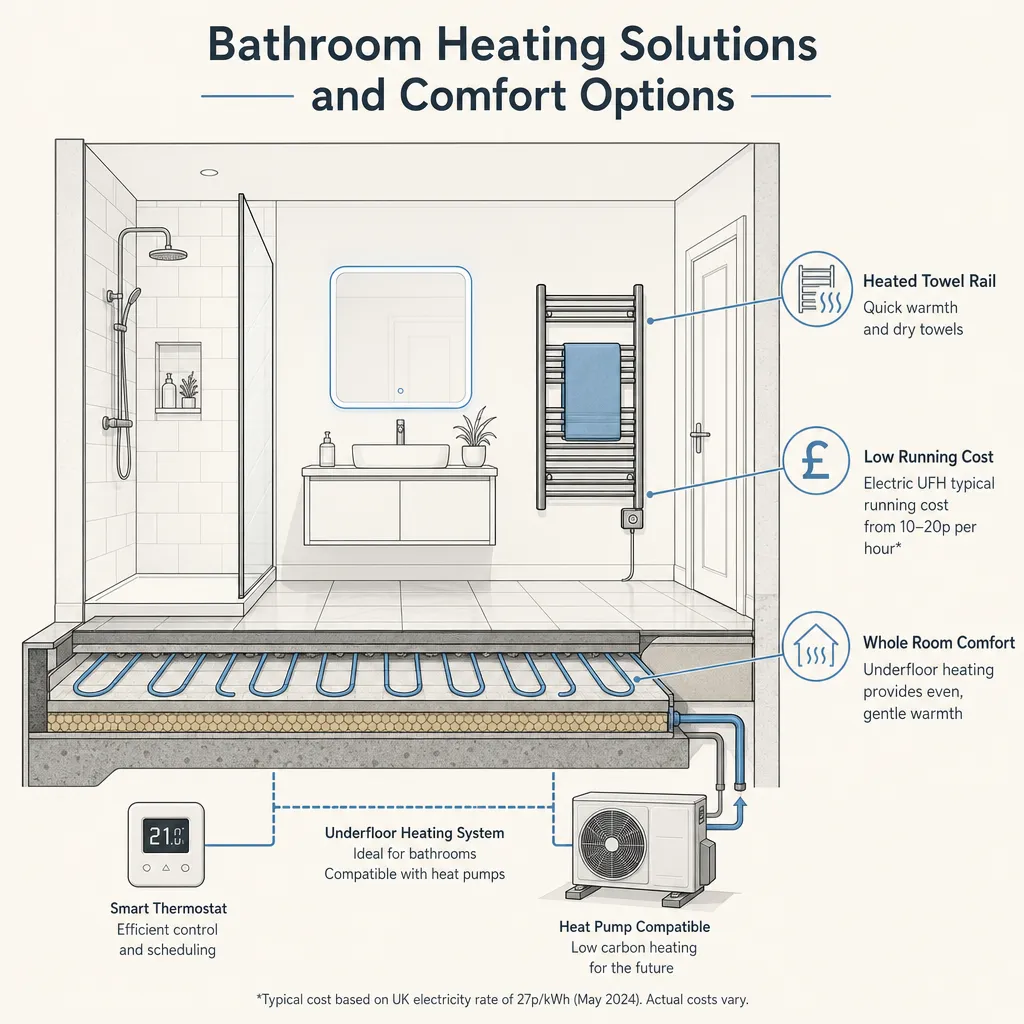
Bathroom Heating Solutions and Comfort Options
UK bathrooms can be heated using electric towel rails, wet radiators on the central heating circuit, electric or wet underfloor heating, or infrared panels.