Solar Panel Installation on Flat Roofs: Guide and Considerations
By Housey · Last reviewed 11th of May 2026
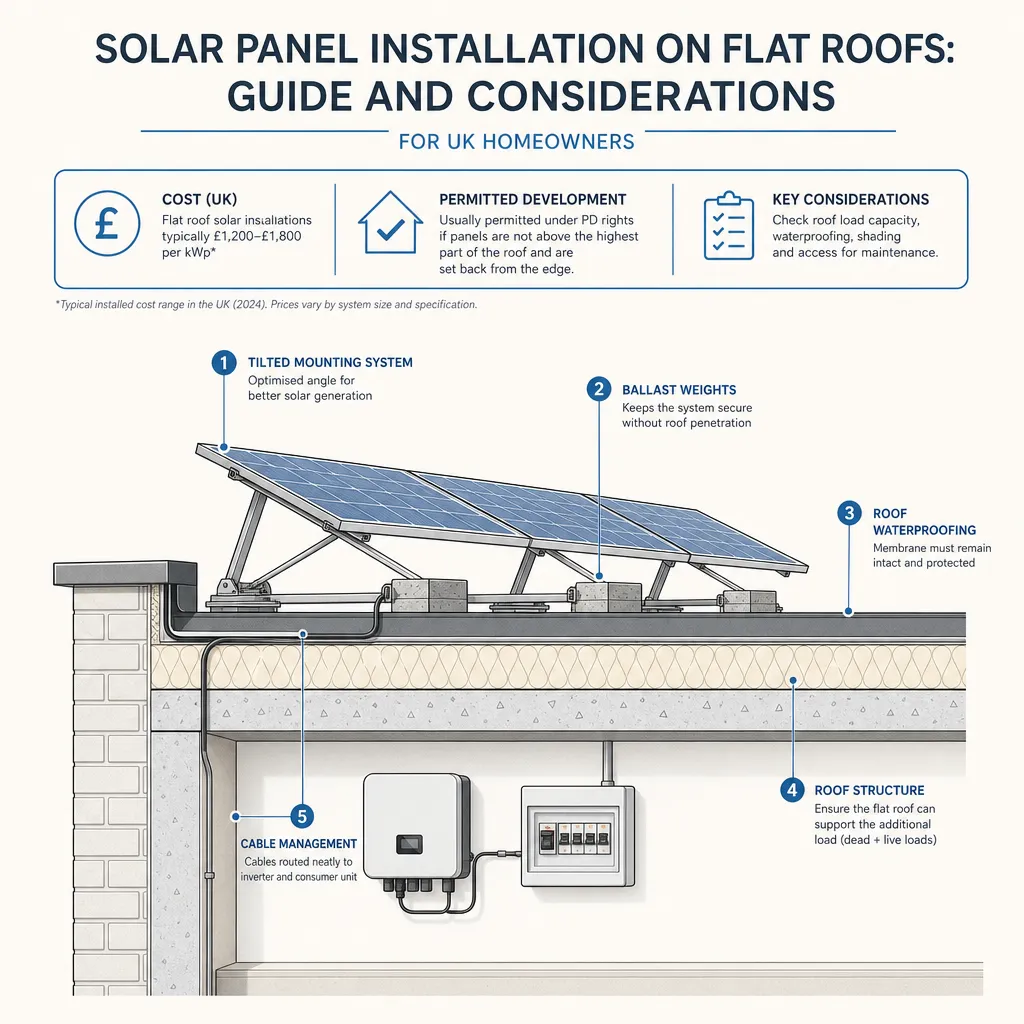
Solar Panel Installation on Flat Roofs: Guide and Considerations
Flat roofs present a practical opportunity for solar photovoltaic (PV) installation on UK homes, extensions, and outbuildings — the mounting angle can be optimised independently of the roof pitch, and panels can often be oriented to maximise solar capture and minimise overshadowing. However, flat roof solar installations involve structural loading, waterproofing compatibility, and in some cases planning considerations that differ significantly from standard pitched-roof systems. Understanding these factors before appointing an installer avoids costly problems with the roof structure, the waterproofing membrane, or planning compliance.
Key points
- Flat roof solar PV installations typically use ballasted mounting frames (no roof penetrations) or mechanically fixed frames; ballasted systems can impose point loads of 15–25 kg/m² or more, requiring a structural assessment before installation proceeds.
- Under Schedule 2, Part 14 of the Town and Country Planning (General Permitted Development) (England) Order 2015, most domestic solar installations are permitted development — panels must not protrude more than 200 mm above the roof surface; listed buildings and designated areas require planning consent.
- MCS (Microgeneration Certification Scheme) certification is required for the installation to qualify for the Smart Export Guarantee (SEG), under which licensed electricity suppliers must offer a tariff for surplus electricity exported to the grid.
- A structural engineer's assessment is strongly recommended before installation on flat roofs over habitable rooms, particularly where the roof is more than 10–15 years old, has a history of leaks, or uses timber-deck cold-roof construction.
- Installations over 3.68 kW single-phase require prior notification to the local Distribution Network Operator (DNO) under Engineering Recommendation G98/G99; an MCS-certified installer should handle this as part of the project.
Flat roof mounting systems: a comparison
Indicative UK costs, last reviewed 2026-05-11. System costs are in addition to solar modules and inverter. Costs vary by roof area, structural findings, access, and installer. Always obtain at least three written quotes.
Mounting system | How it works | Best for | Structural loading | Key risk | Typical additional cost |
|---|---|---|---|---|---|
Ballasted (weighted frames) | Concrete or rubber blocks hold frames without roof penetration | Flat roofs with sound membrane and adequate structural capacity | Higher point loads (15–25 kg/m²+) | Membrane abrasion, concentrated load on deck | £500–£2,000 |
Mechanically fixed (penetrating) | Frames bolted through membrane into deck or structure | Roofs where ballast weight exceeds structural capacity | Lower distributed load | Each penetration must be correctly waterproofed | £800–£2,500 |
Tilt frames (adjustable angle) | Raises panels to 15–35° for improved UK yield | South-facing flat roofs with no overshadowing | As above, plus increased wind uplift forces | Wind loads increase with tilt; requires structural review | Included in above |
Integrated warm-roof system | Panels integrated into new roof build-up at replacement | Roof replacement coinciding with solar project | Lower — distributed across new roof structure | Higher upfront cost; requires coordinated design | £1,500–£4,000+ |
Is your flat roof suitable for solar? A decision guide
- Proceed to a structural assessment if the flat roof covers a habitable room, is more than 10 years old, or has an unknown construction type — this should happen before any purchase decision.
- Appoint an MCS-certified installer for a site survey before committing to a contract — a reputable installer will assess shading, orientation, structural loading, and membrane condition as part of their survey.
- Choose a ballasted system if the structural assessment confirms adequate load capacity and the membrane is in good condition — ballasted installation avoids roof penetrations and is easier to remove in future.
- Choose a mechanically fixed system if the structural assessment finds that ballast weight is not suitable for the deck, or if the roof uses a lightweight timber or steel deck structure.
- Consider combining with a roof replacement if the existing flat roof membrane is near end of life — replacing the roof and installing solar simultaneously avoids disturbing a new membrane later and allows an integrated design.
- Check planning requirements with your local planning authority if the property is listed, in a conservation area, within an Area of Outstanding Natural Beauty, or within the curtilage of a listed building — permitted development rights may not apply.
- Pause and seek specialist advice if a structural survey identifies deficiencies in the roof deck, joists, or parapet — do not proceed with solar installation on a roof with unresolved structural concerns.
Structural considerations in detail
Flat roofs are typically designed to minimum imposed load standards derived from BS EN 1991-1-1 (Eurocode 1): approximately 0.6 kN/m² for inaccessible roofs and 1.5 kN/m² for accessible roofs. Solar panel arrays on ballasted frames typically add 0.15–0.25 kN/m² or more depending on tilt and spacing, and dynamic wind uplift forces must also be accounted for in the design.
On older UK properties — particularly 1960s–1980s extensions with timber joists — the deck may have experienced moisture ingress over the years, reducing its load-bearing capacity. A compromised deck can fail to safely support the concentrated loads from ballasted mounting feet even if the calculated static load appears within limits.
A structural engineering assessment should confirm:
- The roof deck construction type and current condition
- Whether the existing structure can safely support the proposed array weight, including wind loading
- Any remedial works required before installation can proceed safely
- A signed written report for the installer and Building Control to reference
Planning permission and grid connection
Permitted development in England: Domestic solar installations are permitted development under Schedule 2, Part 14 of the Town and Country Planning (General Permitted Development) (England) Order 2015, provided panels do not protrude more than 200 mm above the roof surface (measured perpendicular to the roof) and are removed when no longer in use. Additional restrictions apply in conservation areas, National Parks, Areas of Outstanding Natural Beauty, World Heritage Sites, and on listed buildings.
Wales, Scotland, and Northern Ireland have separate permitted development frameworks. Always verify with the relevant planning authority if the property is not in England.
DNO notification: Installations over 3.68 kW single-phase require prior notification to your Distribution Network Operator under Engineering Recommendation G98 (up to 3.68 kW) or G99 (above 3.68 kW). Your MCS-certified installer should manage this process as part of the project.
Smart Export Guarantee: To receive payment for surplus exported electricity, the installation must be MCS-certified and the system must be registered. Larger energy suppliers (over 150,000 customers) are required to offer a SEG tariff; rates and terms vary between suppliers. Check current tariffs via Ofgem.
Important limitations
This article provides general information about flat roof solar installation in the UK. Structural loading, planning requirements, and waterproofing compatibility depend on the specific property, roof construction, location, and proposed system design. A qualified structural engineer should assess your roof before any installation proceeds, and only an MCS-certified installer should carry out the electrical and mounting work. This article does not constitute structural, planning, or financial advice. Rules and requirements may vary by local authority, property type, and tenure — always verify with the relevant qualified professional or authority before committing to any works.
What to ask a qualified professional
Before instructing an MCS-certified installer or structural engineer, ask:
- Is a structural assessment of the roof deck included in your survey, or do I need to commission one separately from a structural engineer?
- What mounting system do you propose, and why is it appropriate for my roof construction and local wind exposure zone?
- Will the installation require any penetrations through the waterproofing membrane? If so, how will these be waterproofed, and will any existing roof warranty be affected?
- Is my property subject to any planning restrictions that affect permitted development rights for solar equipment?
- Will you manage the DNO notification and grid connection application as part of the project?
- Are you MCS-certified, and will the completed installation be MCS-registered so I can access the Smart Export Guarantee?
- What warranties do you provide for the panels, inverter, mounting system, and your workmanship?
- What happens if the roof membrane is damaged during installation or within the workmanship warranty period?
When to get professional help
You should obtain structural and installation assessments before purchasing any equipment or signing a contract if:
- The flat roof covers a habitable room and you are uncertain of its structural capacity or current condition.
- The roof has a history of leaks, recent repairs, or unknown construction.
- The property is listed, in a conservation area, or in another designated area where permitted development rights may be restricted.
- You plan an array over 3.68 kW single-phase, requiring DNO notification under G99.
- You intend to combine the solar project with a flat roof replacement and need a coordinated design.
A solar survey and a structural engineering assessment are the two key professional inputs needed at the outset of most flat roof solar projects.
How Housey can help
Housey connects you with qualified professionals for every stage of a flat roof solar project. Book a solar survey to assess roof suitability and shading, commission a structural engineering assessment to confirm load capacity, or find a vetted roofer if the flat roof membrane needs attention before panels can be installed safely.
Frequently asked questions
Do flat roof solar panels need planning permission in the UK?
In most cases in England, domestic flat roof solar installations are permitted development and do not require a planning application, provided panels do not protrude more than 200 mm above the roof surface. Listed buildings, conservation areas, National Parks, and Areas of Outstanding Natural Beauty are subject to additional restrictions. Rules differ in Wales, Scotland, and Northern Ireland. Always verify with your local planning authority if you are uncertain.
How much do flat roof solar panels cost in the UK?
Indicative UK costs, last reviewed 2026-05-11. A typical domestic flat roof solar installation (3–5 kWp system) ranges from £6,000 to £12,000 including panels, inverter, mounting system, and installation. Additional costs may arise for a structural survey (£300–£800), waterproofing remediation, or DNO application fees. Costs vary significantly by system size, location, and installer. The Smart Export Guarantee provides income for surplus exported electricity.
Can solar panels damage a flat roof membrane?
Improperly installed ballasted frames can abrade or puncture the waterproofing membrane, particularly if frames shift over time. A reputable MCS-certified installer will use appropriate protection matting under frame feet and design the layout to maintain drainage across the membrane. Ensure your installer provides a workmanship guarantee covering membrane integrity, and check whether any existing roof warranty is voided by the installation.
How much electricity will flat roof solar panels generate?
A typical 4 kWp system in the UK generates approximately 3,400–3,800 kWh per year when optimally tilted, according to Energy Saving Trust estimates for southern England; output is lower further north. Flat roof installations can improve yield by tilting panels at 30–35° facing south, but wind uplift forces increase with tilt angle and must be accounted for in the structural design. A site-specific shading analysis will provide a more accurate projection.
Sources and further reading
- Planning Practice Guidance: renewable and low carbon energy — GOV.UK
- Town and Country Planning (General Permitted Development) (England) Order 2015: Schedule 2, Part 14 — legislation.gov.uk
- MCS: find a certified installer — Microgeneration Certification Scheme
- Smart Export Guarantee: guidance — Ofgem
- Solar panels: costs, savings and returns — Energy Saving Trust
- Engineering Recommendations G98 and G99 — Energy Networks Association
- Working at height: the law — Health and Safety Executive
Useful next reads
 Energy & Retrofit
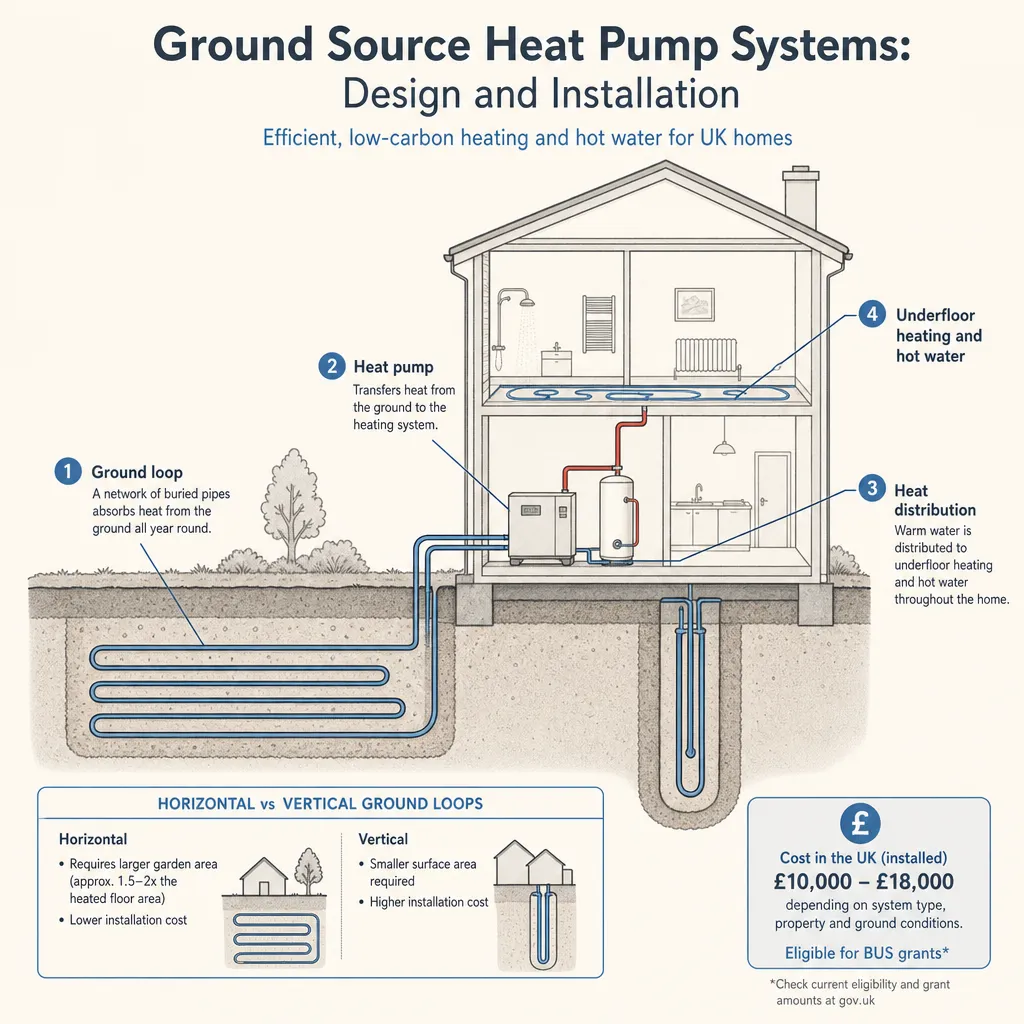
Ground Source Heat Pump Systems: Design and Installation
Ground source heat pumps extract heat from the earth through buried loops or boreholes, then upgrade it for space heating and hot water.
 Energy & Retrofit
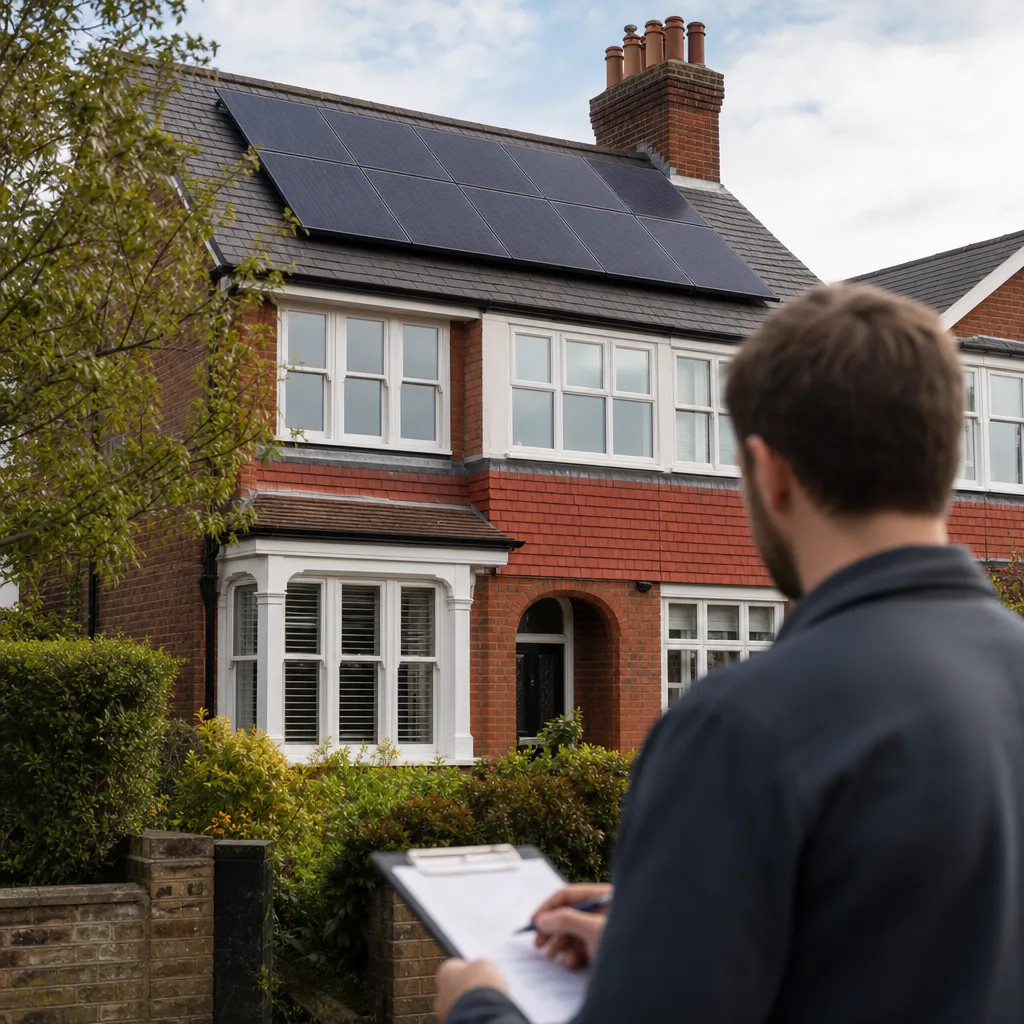
Do Solar Panels Increase Property Value?
Solar panels generally add value to UK properties, with research suggesting an uplift of 0.
 Energy & Retrofit
Geothermal Energy Systems for Home Heating
Ground source heat pumps (GSHPs) extract stable thermal energy from the earth via buried ground loops or boreholes, typically delivering 3–4 units of heat per unit of electricity consumed.
 Energy & Retrofit
Choosing a Heating System for Your Conservatory
The most practical conservatory heating options are electric panel heaters, underfloor heating (electric or wet), infrared panels, and extending an existing central heating circuit.
 Energy & Retrofit
Bathroom Heating Solutions and Comfort Options
UK bathrooms can be heated using electric towel rails, wet radiators on the central heating circuit, electric or wet underfloor heating, or infrared panels.