Geothermal Heating Systems: Installation and Cost
By Housey · Last reviewed 30th of May 2026
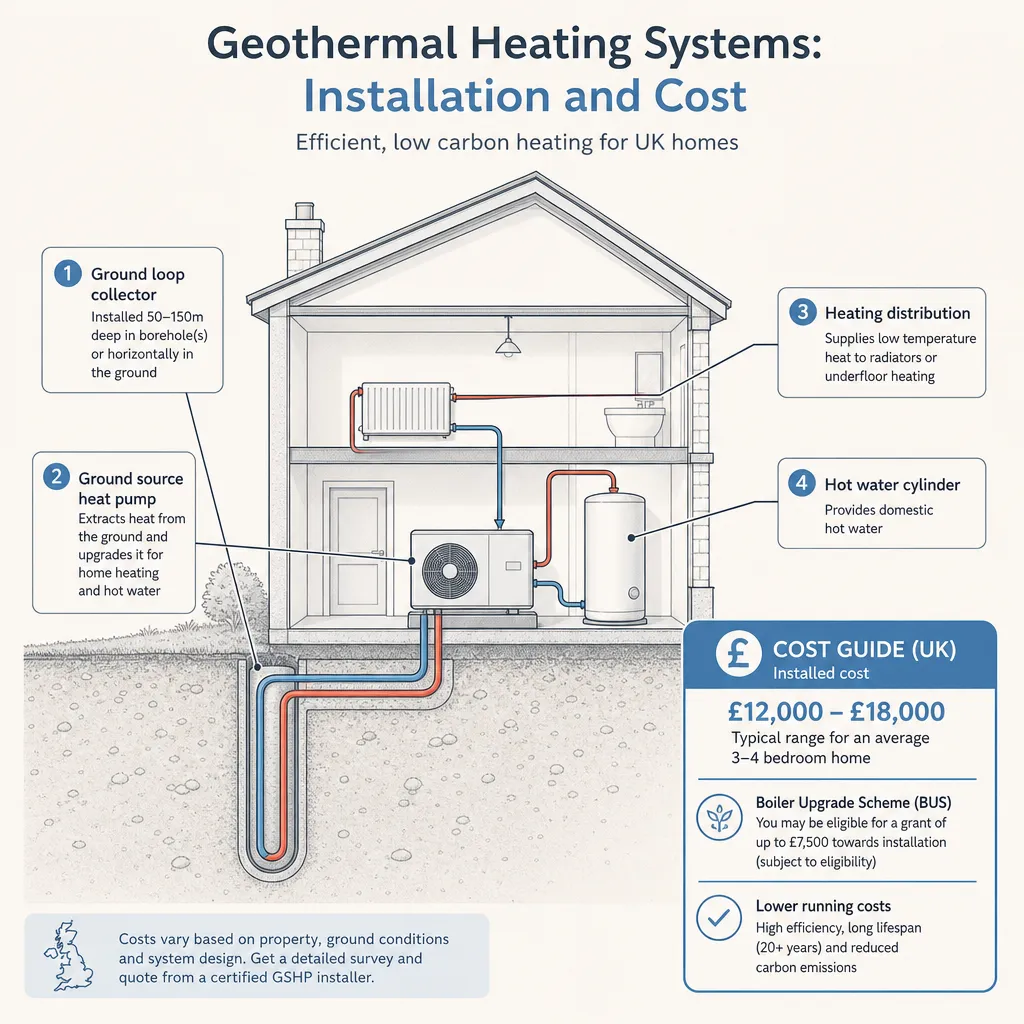
Geothermal Heating Systems: Installation and Cost
Ground source heat pumps — often called geothermal heating systems — are becoming an increasingly realistic option for UK homeowners looking to reduce gas dependence and lower long-term energy bills. The question usually arises when a boiler nears the end of its life, when a significant retrofit is being planned, or when a new build or extension creates the opportunity to install low-carbon heating from the outset. With government grants now available and installation costs more widely published, many households are weighing up whether the investment makes sense for their specific property and situation.
Key points
- The Boiler Upgrade Scheme (BUS), administered by Ofgem, currently offers a £7,500 grant for ground source heat pump installations in England and Wales — the installer must hold MCS certification to apply on your behalf.
- Ground source heat pumps work most efficiently in well-insulated homes; a fabric-first assessment covering walls, floors, and loft is usually recommended before a system is sized.
- There are three main ground loop configurations: horizontal trenches (requires significant garden space), vertical boreholes (suitable for smaller plots), and slinky coils (a compromise between the two).
- A Seasonal Coefficient of Performance (SCOP) above 3 is the benchmark for UK conditions — this means producing at least 3 kWh of heat per 1 kWh of electricity consumed.
- Building Regulations Part L and Part F may apply to a retrofit installation; your installer should confirm compliance and coordinate building control notification where required.
How ground source heat pumps work
A ground source heat pump (GSHP) uses buried pipework — known as a ground loop — filled with a water-antifreeze mixture. This fluid absorbs solar energy stored in the ground, which remains at roughly 8–12°C year-round across most of the UK, and carries it to a heat pump unit installed indoors. The heat pump compresses the fluid to raise its temperature and transfers the heat to the central heating circuit and hot water cylinder.
Because the system amplifies rather than generates heat, it is significantly more efficient than a gas boiler when correctly sized. Electricity consumption is relatively low compared to heat output, making running costs competitive — particularly with a time-of-use electricity tariff such as Economy 7 or a smart tariff from an energy supplier offering off-peak rates.
Ground loop types: which suits your property?
Loop type | How it works | Land requirement | Best for | Main limitation |
|---|---|---|---|---|
Horizontal (trench) | Pipes buried 1–1.5 m in wide trenches | 200–400 m² of usable garden | Larger rural or suburban plots | Significant garden disruption during installation |
Vertical (borehole) | Pipes drilled 50–150 m straight down | Small surface footprint (~4 m²) | Urban plots with limited garden space | Higher drilling cost; may need Environment Agency notification |
Slinky coil | Coiled pipe in shallower, narrower trenches | Moderate — less than horizontal | Mid-size gardens | Slightly less efficient than a full horizontal array |
Water source | Submerged coils in a nearby pond or lake | Access to a suitable water body | Rural properties near water | Seasonal variation; regulatory requirements |
A site survey is essential before choosing a loop type — soil thermal conductivity, water table depth, and available land area all affect which option is feasible and cost-effective.
How much does a ground source heat pump cost in the UK?
Indicative UK costs, last reviewed 2026-05-30. Costs vary significantly by property size, system specification, ground conditions, and installer. Always obtain at least three quotes.
- Horizontal loop system: £15,000–£22,000 fully installed (before grant)
- Vertical borehole system: £18,000–£30,000 fully installed (drilling adds significant cost)
- After Boiler Upgrade Scheme grant (£7,500): effective cost £10,500–£22,500
- Annual servicing: £150–£300 per year
- Running costs: highly variable — depends on home insulation standard, system SCOP, and electricity tariff
Key cost drivers include property size and heat demand (which dictates the required kW rating), ground conditions (rock requires specialist drilling equipment), distance from the indoor unit to the ground loop entry point, whether the existing radiator circuit is compatible or needs upgrading, and hot water cylinder specification.
The Boiler Upgrade Scheme and other financial support
The Boiler Upgrade Scheme offers £7,500 for qualifying ground source heat pump installations in England and Wales. Key eligibility points:
- The property must have a valid EPC with no outstanding recommendations for loft or cavity wall insulation.
- The installer must hold MCS certification and apply for the voucher on your behalf before installation begins.
- Air source heat pumps also qualify under the BUS at a lower grant level; ground source attracts the highest rate.
- Scotland has separate support schemes via the Energy Saving Trust Scotland.
- Some local authorities offer additional top-up funding — check with your council or an independent energy-efficiency consultant.
Is your home suitable? A pre-installation checklist
Before commissioning a full heat pump survey, use this checklist to assess basic suitability:
Important limitations
This article provides general information only. Ground source heat pump suitability, system sizing, and grant eligibility all depend on site-specific factors that cannot be assessed remotely. Grant terms and eligibility criteria are subject to change — always verify the current position directly on GOV.UK. A qualified, MCS-certified heat pump installer or independent assessor should evaluate your property before you commit to any system or expenditure.
When this becomes urgent
Seek professional advice promptly if:
- Your boiler has failed or is approaching end of life and you want to avoid like-for-like gas replacement.
- You are mid-way through a whole-house retrofit and heating decisions are blocking other trades from progressing.
- You have received conflicting advice from different installers about system sizing or ground loop configuration.
- Your BUS grant voucher application has been refused and you need to understand the reason before reapplying.
What to ask a qualified professional
Before instructing an MCS-certified installer for a heat pump survey or full installation:
- What kW output have you calculated for this property, and which heat loss assessment method did you use (e.g., BS EN 12831)?
- Which ground loop configuration do you recommend for my site, and why is it suited to my conditions?
- What SCOP do you project at my property's design flow temperature?
- Is my existing radiator circuit compatible, or will I need upgrades or additional underfloor heating?
- Will you handle the Boiler Upgrade Scheme voucher application, and what happens if the voucher is not confirmed before work starts?
- What Building Regulations notifications are required, and who is responsible for submitting them?
- What does annual servicing involve, and what warranty does the system carry on parts and labour?
When to get professional help
A heat pump survey by an accredited assessor is the essential first step for most homeowners. If the property has unusual characteristics — poor insulation, solid walls with no realistic retrofit option, restricted garden access, or proximity to listed building or conservation area constraints — professional advice early prevents costly mistakes. An independent energy-efficiency consultant can help you approach installer quotes with a clear, comparable specification rather than leaving each contractor to make their own assumptions about your home's heat demand.
How Housey can help
Housey connects you with accredited professionals for heat pump surveys and independent energy-efficiency consultants who can assess your property before you approach installers for quotes. Starting with an independent assessment means installer quotes are based on a clear specification, making it far easier to compare proposals and identify the most appropriate system for your home.
Frequently asked questions
Do I need planning permission for a ground source heat pump in the UK?
In most cases, ground source heat pumps benefit from permitted development rights in England and do not require a full planning application. These rights do not apply universally — listed buildings, flats, and some conservation areas may require consent. Always check with your local planning authority before committing, particularly where borehole drilling is involved.
How long does a ground source heat pump last?
The heat pump unit typically lasts 20–25 years with annual servicing. The buried ground loops can last 50 years or more. Manufacturer warranties vary — check what parts and labour are covered before signing a contract, and ask whether an extended warranty is available from the installer.
What is the Boiler Upgrade Scheme and how much can I get?
The Boiler Upgrade Scheme (BUS) offers £7,500 towards a ground source heat pump in England and Wales. Your MCS-certified installer applies for the grant voucher on your behalf before work begins. Eligibility depends on your EPC rating, property type, and whether outstanding insulation recommendations have been addressed. Check current terms at GOV.UK.
What is SCOP and why does it matter for heat pump efficiency?
Seasonal Coefficient of Performance (SCOP) measures how efficiently a heat pump produces heat across a full year. A SCOP of 3.5 means 3.5 kWh of heat per 1 kWh of electricity consumed. In UK conditions, aim for a system specified to achieve SCOP 3 or above — lower figures may indicate poor sizing or an incompatible heat distribution circuit.
Sources and further reading
- Boiler Upgrade Scheme — GOV.UK
- Ground source heat pumps — Energy Saving Trust
- MCS Certified installers — MCS
- Building Regulations Approved Document L — GOV.UK
Useful next reads
 Energy & Retrofit
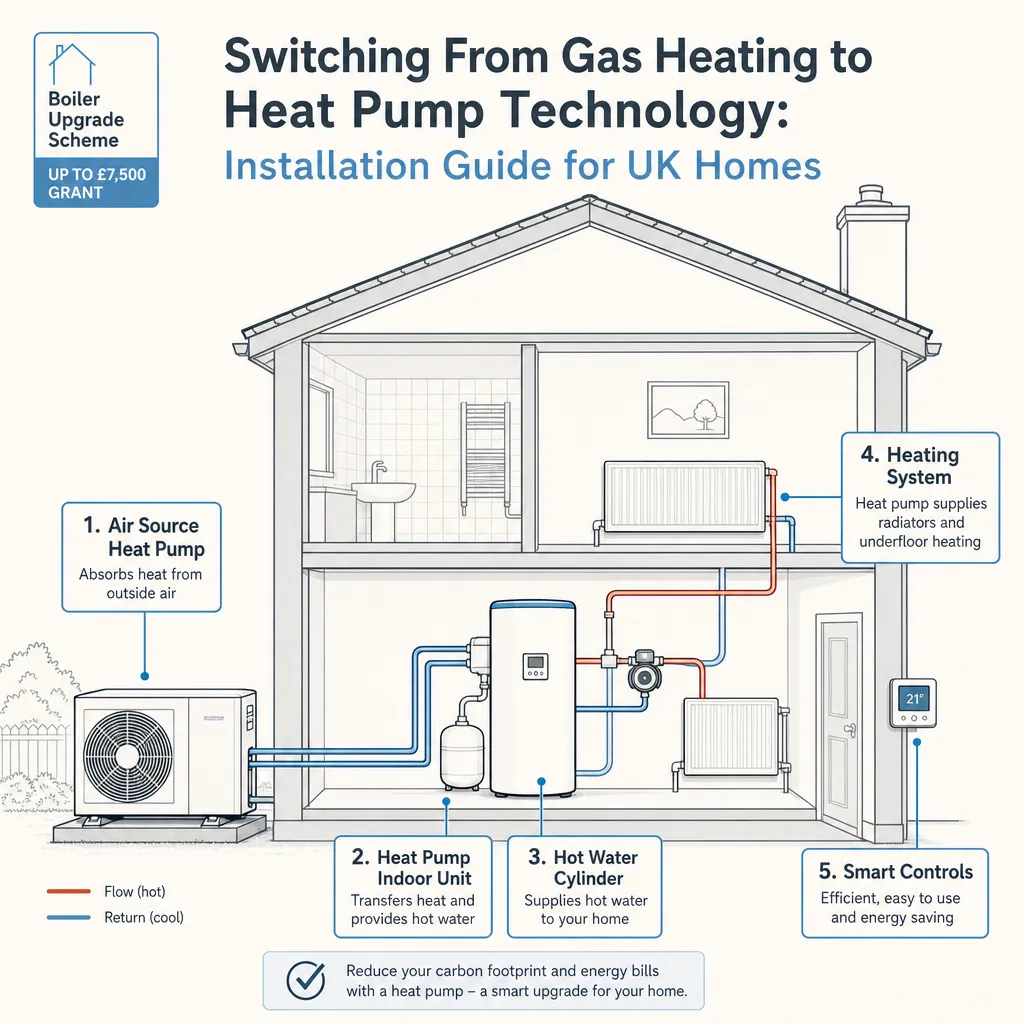
Switching From Gas Heating to Heat Pump Technology: Installation Guide
Switching from gas to a heat pump requires a heat loss calculation, correctly sized equipment, and often radiator upgrades before installation.
 Energy & Retrofit
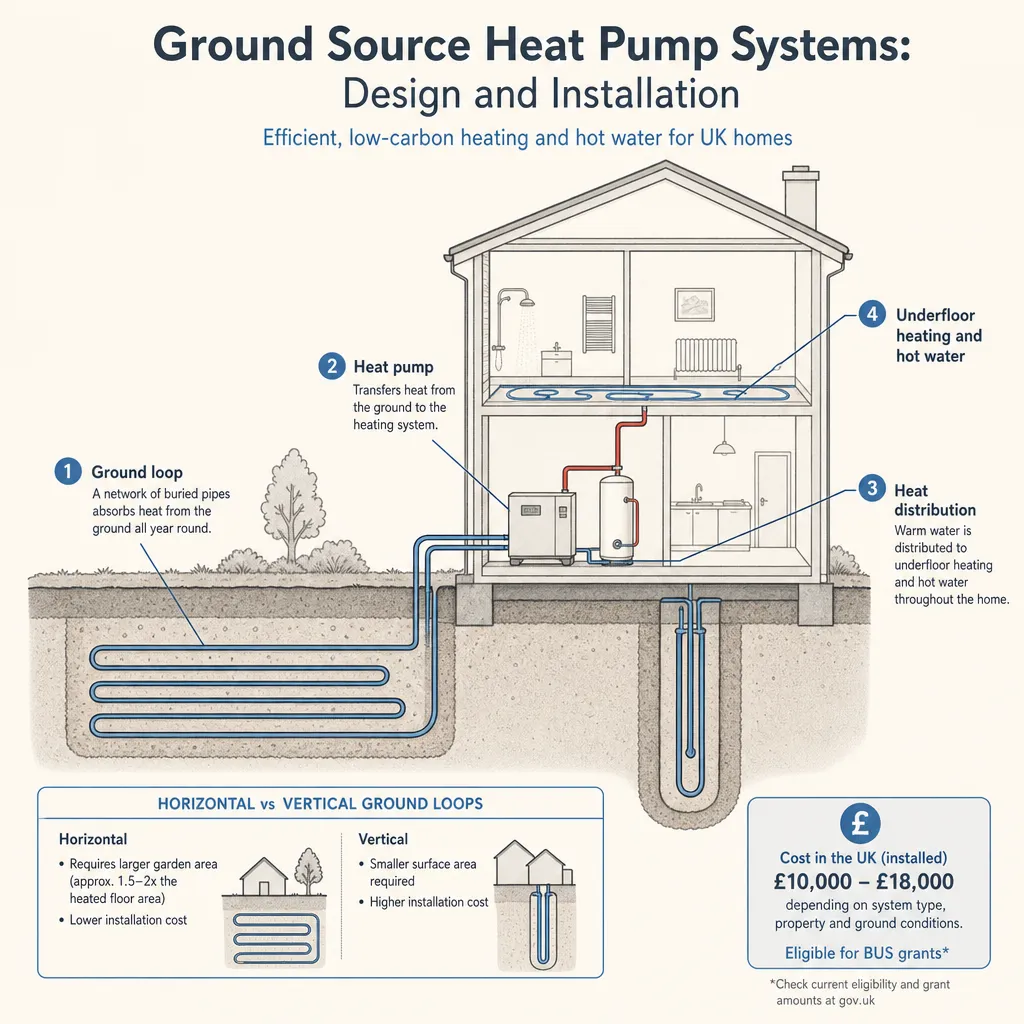
Ground Source Heat Pump Systems: Design and Installation
Ground source heat pumps extract heat from the earth through buried loops or boreholes, then upgrade it for space heating and hot water.
 Energy & Retrofit
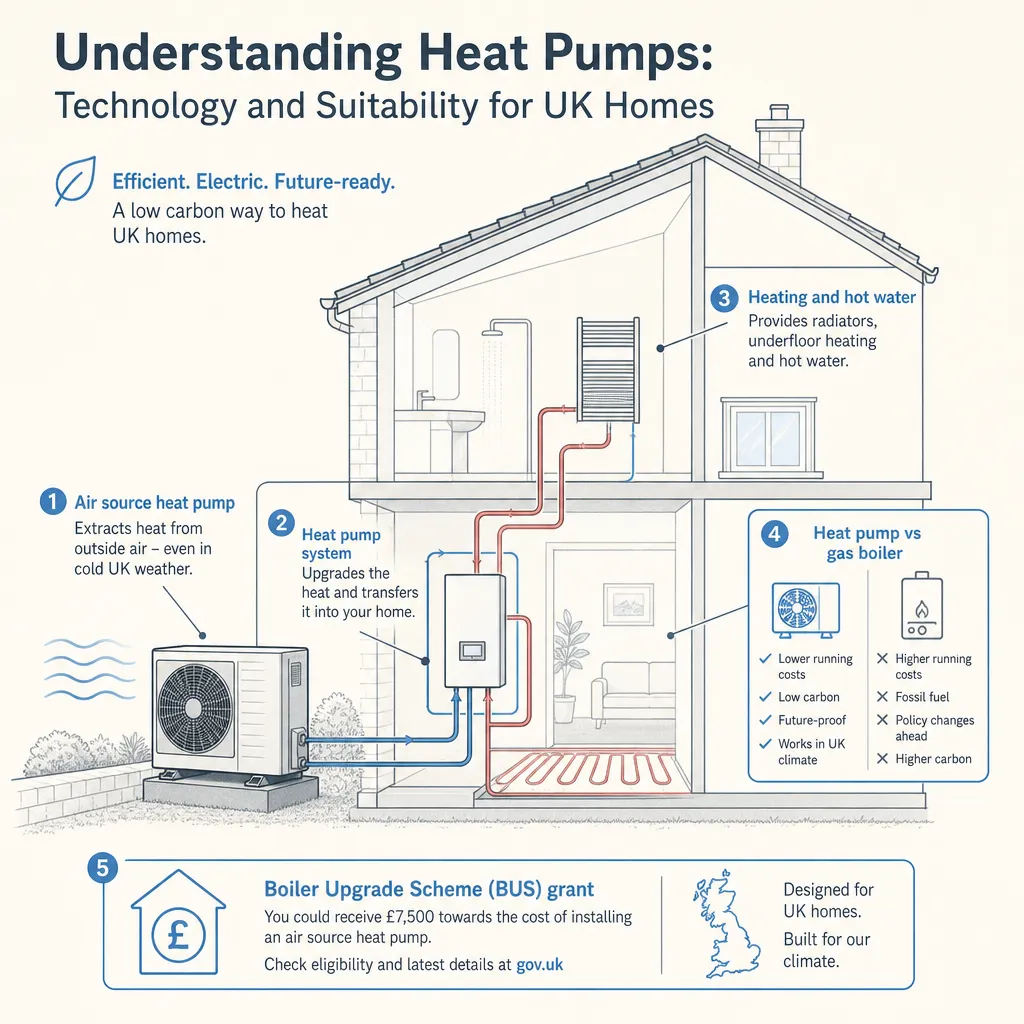
Understanding Heat Pumps: Technology and Suitability for UK Homes
Heat pumps extract heat from the air or ground and transfer it indoors, typically achieving efficiencies of 250–400% compared to a conventional boiler's near 100%.
 Energy & Retrofit
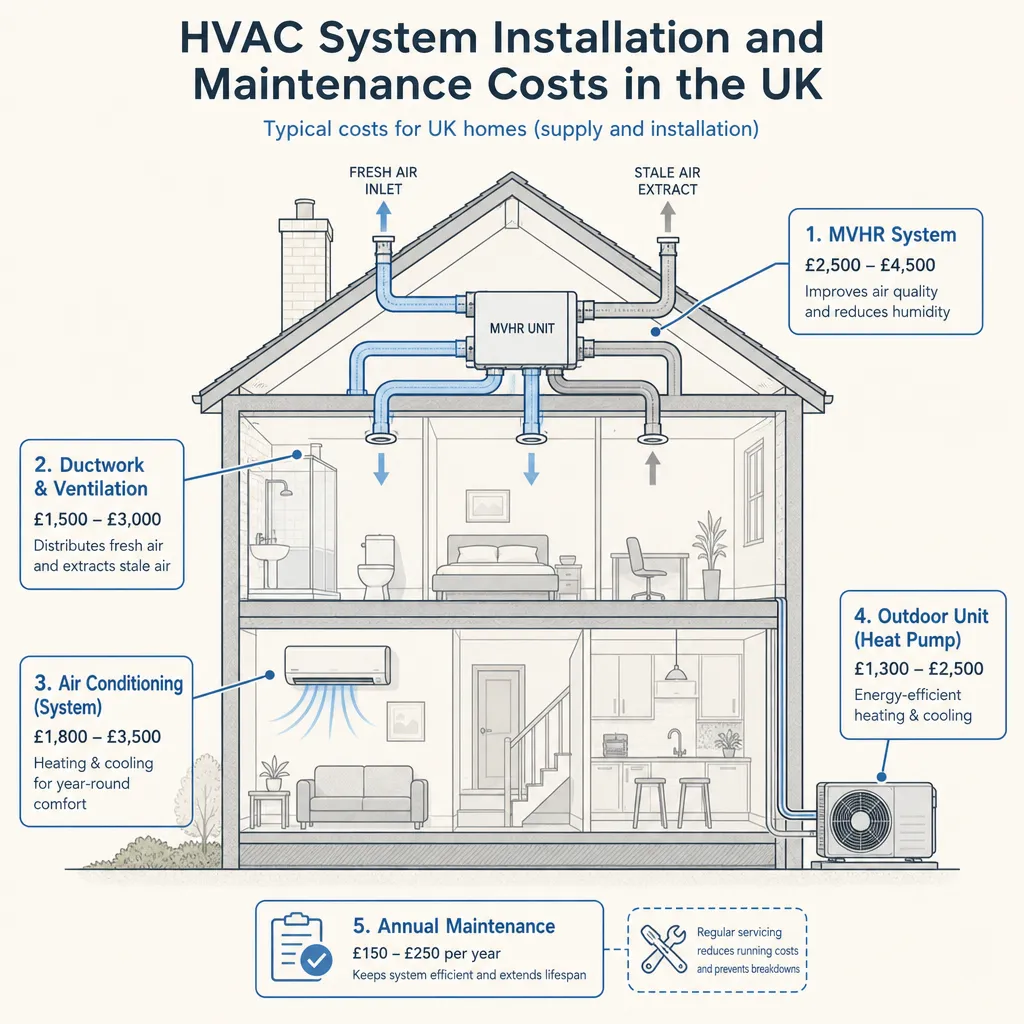
HVAC System Installation and Maintenance Costs in the UK
HVAC costs in UK homes vary by system type.
 Energy & Retrofit
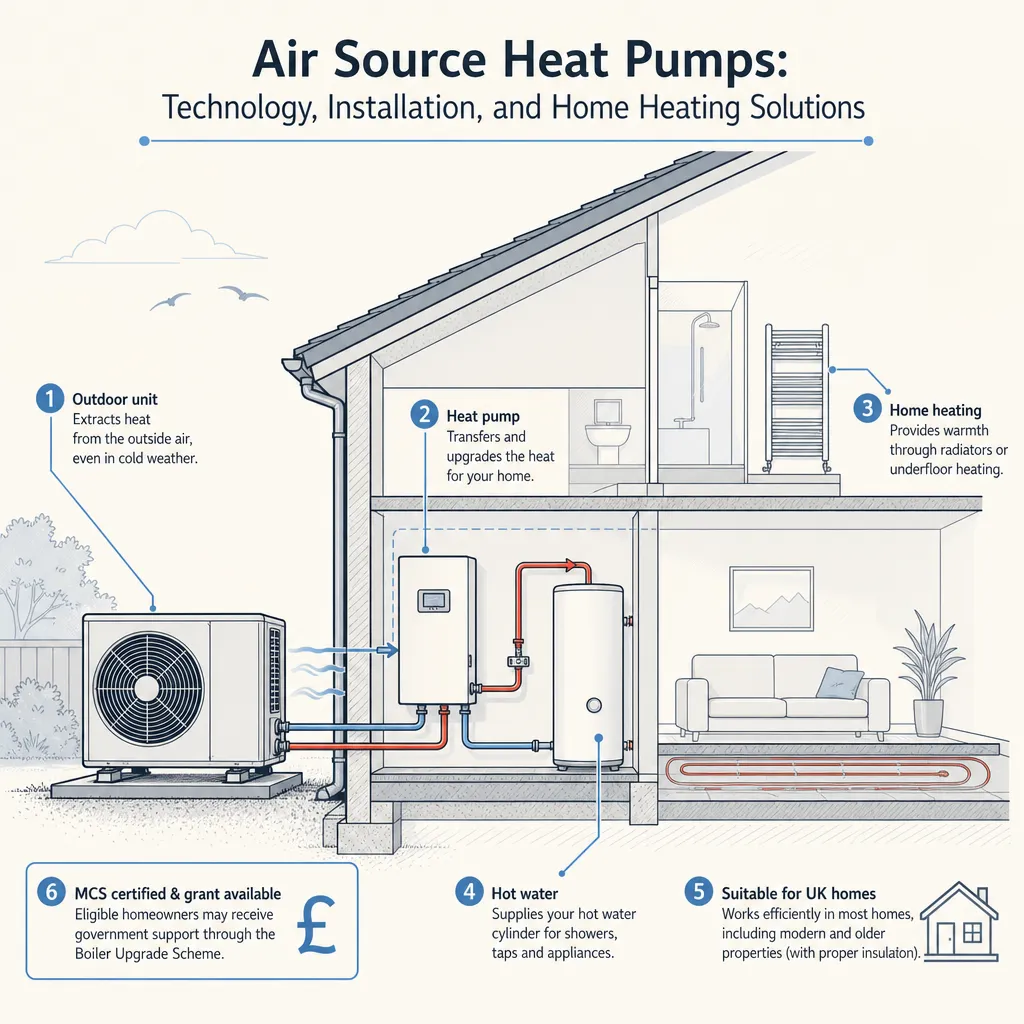
Air Source Heat Pumps: Technology, Installation, and Home Heating Solutions
An air source heat pump extracts heat from outdoor air and transfers it indoors via a refrigerant cycle, typically delivering 2.