Government Support and Grants for Solar Panel Installation
By Housey · Last reviewed 11th of May 2026
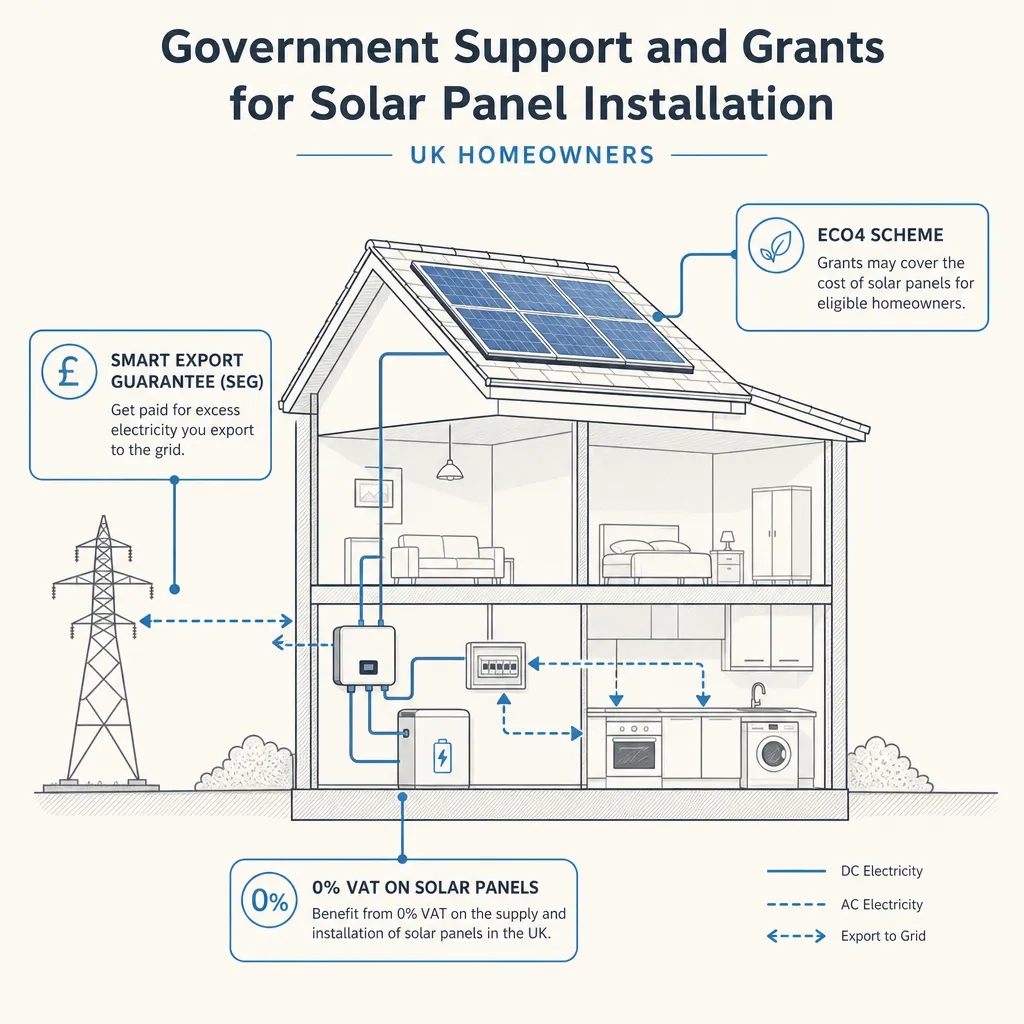
Government Support and Grants for Solar Panel Installation
Solar installations represent one of the larger home improvement investments a UK homeowner can make — typically £5,000–£10,000 for a residential system — so understanding what public support exists before instructing a contractor matters. The landscape of UK solar funding has shifted significantly since the Feed-in Tariff closed to new applicants in 2019; several replacement schemes now operate in parallel, each with different eligibility criteria, income thresholds, and property requirements.
Key points
- VAT on solar panel installation and battery storage is charged at 0% for UK residential properties until at least 31 March 2027, reducing costs compared to the standard 20% rate.
- The Smart Export Guarantee (SEG) obliges licensed electricity suppliers with more than 150,000 customers to offer export tariff payments for surplus electricity fed back to the grid.
- ECO4, managed by Ofgem, targeted solar for households with an EPC rating of D–G and a qualifying low-income status or receipt of certain benefits; check current ECO scheme status with energy suppliers or GOV.UK for successor arrangements.
- The Home Upgrade Grant (HUG) covered solar in off-gas-grid homes in England with an EPC below D; check with your local authority for current programme availability.
- MCS (Microgeneration Certification Scheme) accreditation is required from your installer for SEG eligibility and most capital grant schemes — verify status on the MCS installer database before accepting any quote.
What support is currently available?
UK solar funding sits across four main mechanisms: a VAT relief, an export payment obligation, capital grant schemes for lower-income households, and local authority or supplier-obligation programmes. No universal "free solar" scheme currently exists for owner-occupiers on average incomes, but combining VAT relief with SEG export income and, where eligible, capital grants can substantially reduce payback periods.
Scheme | Who it covers | What it provides | Administrator |
|---|---|---|---|
0% VAT relief | All UK residential properties | Removes VAT from installation and battery costs | HMRC / applied by installer |
Smart Export Guarantee (SEG) | All MCS-certified systems | Variable export payment per kWh sent to grid | Ofgem-licensed suppliers |
ECO4 / successor scheme | EPC D–G + low income or qualifying benefits | Partial or full capital grant for solar | Ofgem via energy suppliers |
Home Upgrade Grant (HUG) | Off-gas-grid homes, EPC below D | Capital contribution for solar and other measures | DESNZ via local authorities |
Great British Insulation Scheme (GBIS) | EPC D–G, income-based | Primarily insulation; bundled solar via Group B | Ofgem via energy suppliers |
0% VAT relief: what it covers
Since April 2022 and confirmed until at least 31 March 2027, residential solar panel systems — including panels, inverters, mounting hardware, and battery storage installed at the same time — attract 0% VAT rather than the standard 20% rate. This applies automatically at point of sale; your installer should quote net of VAT.
The relief covers photovoltaic (PV) panels, battery storage systems, associated electrical work, and mounting hardware. Ground-mounted systems on domestic land are generally also eligible, though you should check with your installer if the property or installation is atypical. GOV.UK guidance on energy-saving materials VAT relief gives the authoritative rules.
Smart Export Guarantee (SEG): ongoing income after installation
The SEG replaced the Feed-in Tariff export element in January 2020. Under Ofgem rules, all licensed suppliers with 150,000 or more domestic customers must offer at least one SEG tariff. Rates vary — typically 3–15p per kWh depending on the supplier and tariff — and some offer time-of-use rates that reward midday generation more generously.
To qualify: the system must be certified under the Microgeneration Certification Scheme (MCS) or equivalent; generation capacity must be 50 kW or below for PV systems; and the property must have a smart meter capable of half-hourly export readings.
SEG payments are ongoing income for exported generation, not a capital grant. Over a typical system's 25-year lifespan, cumulative export income meaningfully reduces the effective cost of installation. The Energy Saving Trust publishes regular comparisons of available SEG tariffs.
ECO4 and the Energy Company Obligation
The Energy Company Obligation (ECO) scheme has required the largest energy suppliers to fund energy-efficiency measures for fuel-poor or lower-income households. ECO4 was the most recent phase; check Ofgem's ECO scheme page for current programme status and any successor scheme running in its place.
Eligibility has typically required an EPC rating of D, E, F, or G, combined with receipt of qualifying benefits (such as Universal Credit, Pension Credit, or Child Tax Credit), a low household income, or referral through a local authority flex mechanism.
The route in is usually through an energy supplier, an ECO-registered installer, or a local authority referral. Check whether your local council operates an ECO Flex scheme, which can extend eligibility beyond the standard benefits list.
Home Upgrade Grant (HUG)
The Home Upgrade Grant has been administered by the Department for Energy Security and Net Zero (DESNZ) through local authorities in England, targeting off-gas-grid homes with a low EPC rating. Solar PV has been eligible as part of a package of measures.
Applications go through your local council, not directly to DESNZ. Availability varies by local authority and funding phase. Contact your local council's energy-efficiency team or check GOV.UK for current HUG programme status in your area.
Which scheme applies to you?
- 0% VAT relief applies automatically to every residential solar installation — no application is needed.
- Apply for SEG after installation via your electricity supplier — available to all MCS-certified systems regardless of income.
- Check ECO/successor scheme eligibility if your EPC is D–G and you receive qualifying benefits or have a low household income — contact your energy supplier or local authority.
- Check HUG availability if you are off-gas-grid in England with a low EPC rating and low income — contact your local authority for current funding status.
- Ask your installer about GBIS Group B if you receive benefits and a bundled solar and insulation package may be appropriate.
- If none of the above schemes apply, the main available support remains 0% VAT and SEG payments, which still represent meaningful savings over a system's lifetime.
Homeowner eligibility checklist
Before contacting a scheme administrator or installer, gather the following:
What to watch out for
Some companies advertise "free solar" or "government grant solar" in ways that conflate SEG income with upfront capital grants, or overstate current eligibility for ECO or HUG. Red flags include:
- Promises of free installation with no mention of eligibility criteria
- Pressure to sign quickly "before the scheme ends"
- Installers who are not MCS-certified, which disqualifies you from SEG and most grants
- Quotes that do not clearly separate equipment, labour, and VAT treatment
Always verify MCS accreditation on the MCS installer database before signing a contract.
When to get professional help
A solar survey will give you an accurate picture of your roof's suitability, realistic generation estimates, and payback calculations before you commit to any purchase. If you are navigating ECO or HUG eligibility, an energy assessor or retrofit coordinator registered under PAS 2035 can help you understand which measures qualify and in what order to apply them.
Contact your local authority energy-efficiency team if you are unsure whether grant funding is currently available in your area.
How Housey can help
Housey connects you with MCS-accredited installers and qualified assessors who can confirm your eligibility for available schemes. Start by booking a solar survey to get an independent assessment of your property's solar potential and an accurate quote that properly applies current VAT rules.
Frequently asked questions
Is there still a feed-in tariff for solar panels in the UK?
The Feed-in Tariff (FiT) closed to new applicants in March 2019. Its export payment element has been replaced by the Smart Export Guarantee (SEG), which requires licensed electricity suppliers with more than 150,000 customers to offer export tariffs. Homeowners who registered under FiT before closure continue to receive payments under their original agreements.
Can I get a grant for solar panels if I own my home outright?
Owner-occupiers may qualify for ECO or Home Upgrade Grant capital support if they meet the income, benefit, and EPC criteria for those schemes. Regardless of income, all owner-occupiers benefit from 0% VAT on installation until at least March 2027. The Smart Export Guarantee provides ongoing export income for all MCS-certified systems after installation.
Does my installer need to be MCS-certified for me to receive SEG payments?
Yes. Ofgem requires that systems claiming Smart Export Guarantee payments are certified under the Microgeneration Certification Scheme (MCS) or an equivalent. Using a non-MCS installer will disqualify you from SEG and from most capital grant schemes. Always verify accreditation on the MCS installer database before signing any contract.
What is the VAT rate on solar panel installation in the UK in 2026?
Solar panel installation and battery storage for domestic properties attracts 0% VAT, confirmed until at least 31 March 2027. This applies to panels, inverters, mounting hardware, and battery storage installed at the same time. Your installer should apply this automatically — if a quote includes 20% VAT, ask for clarification before proceeding.
Sources and further reading
- VAT relief on energy-saving materials and heating equipment — GOV.UK
- Smart Export Guarantee — Ofgem
- Energy Company Obligation (ECO) — Ofgem
- Home Upgrade Grant — GOV.UK
- MCS installer database — Microgeneration Certification Scheme
- Solar panels — Energy Saving Trust
Useful next reads
 Energy & Retrofit
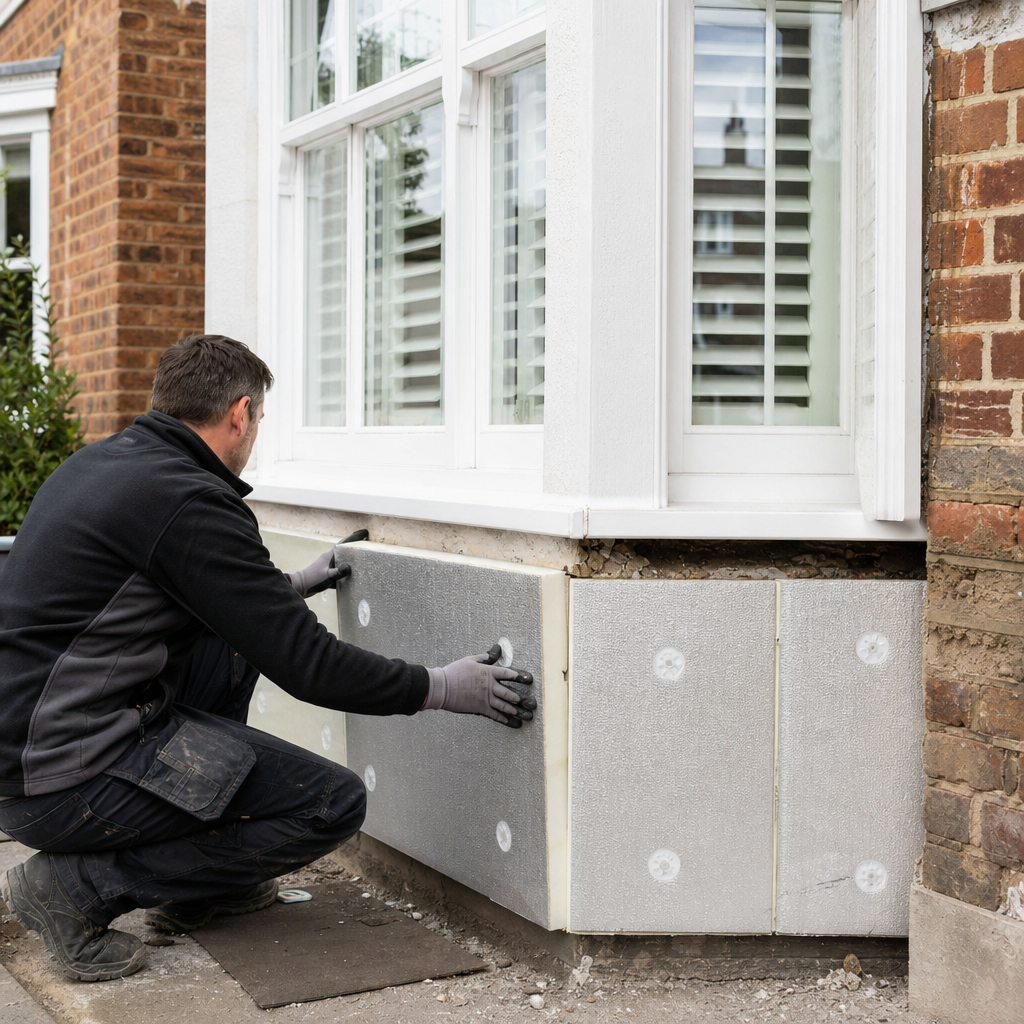
Insulating Solid Masonry Walls Under Bay Windows: Technical Guidance
Insulating solid masonry walls under bay windows requires specialist detailing at angled wall faces, window reveals, and the bay floor and ceiling junctions.
 Energy & Retrofit
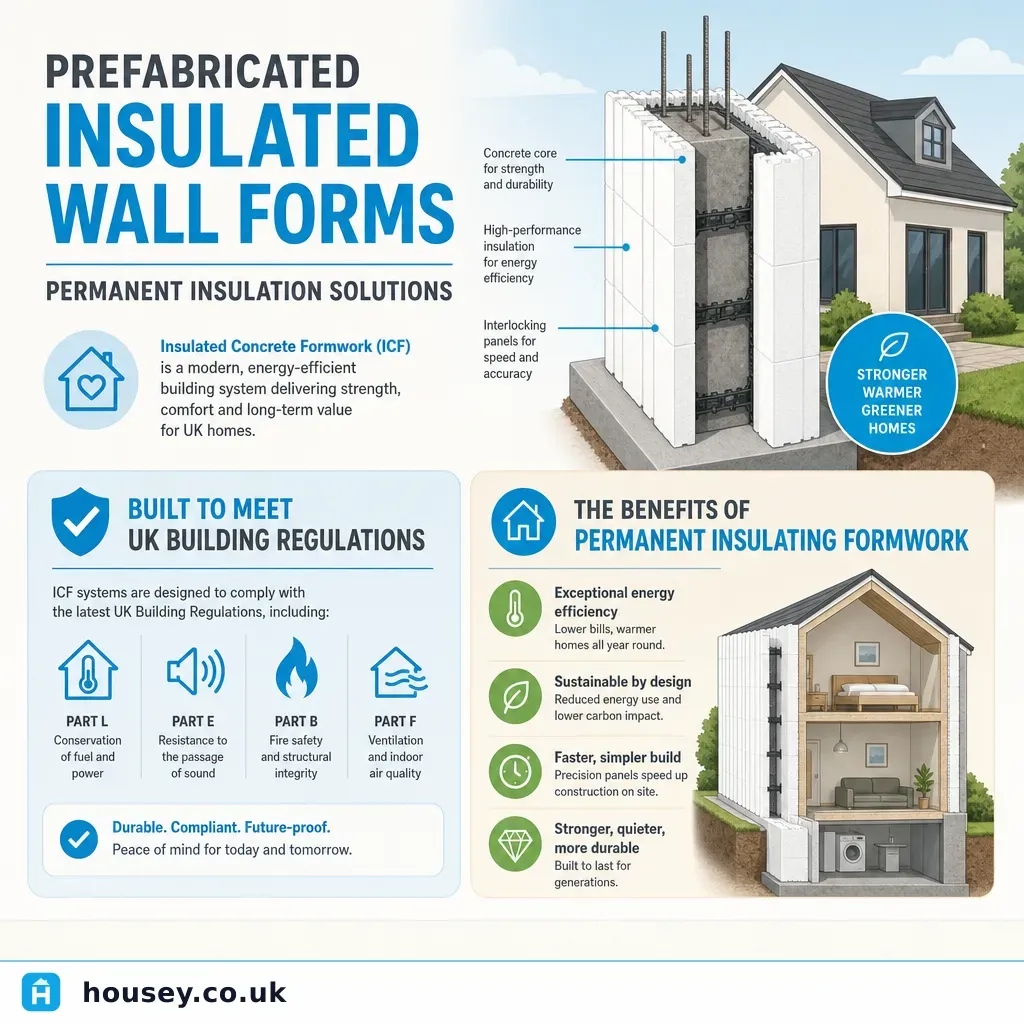
Prefabricated Insulated Wall Forms: Permanent Insulation Solutions
Prefabricated insulated wall forms — including ICF and SIPs systems — deliver high thermal performance by combining permanent insulation with structural concrete or timber in a single wall assembly.
 Energy & Retrofit
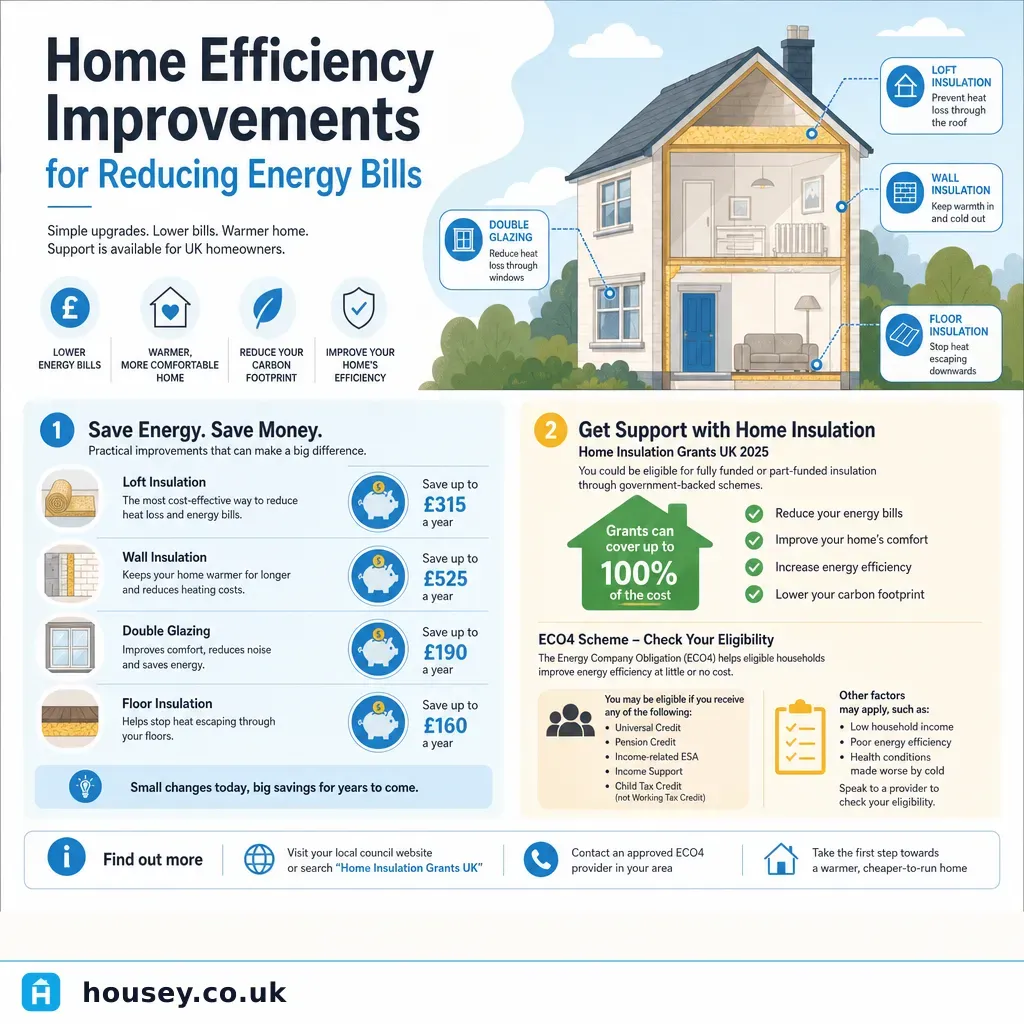
Home Efficiency Improvements for Reducing Energy Bills
The most cost-effective UK home efficiency improvements are usually loft insulation, cavity wall insulation, draught-proofing, and upgrading heating controls.
 Energy & Retrofit
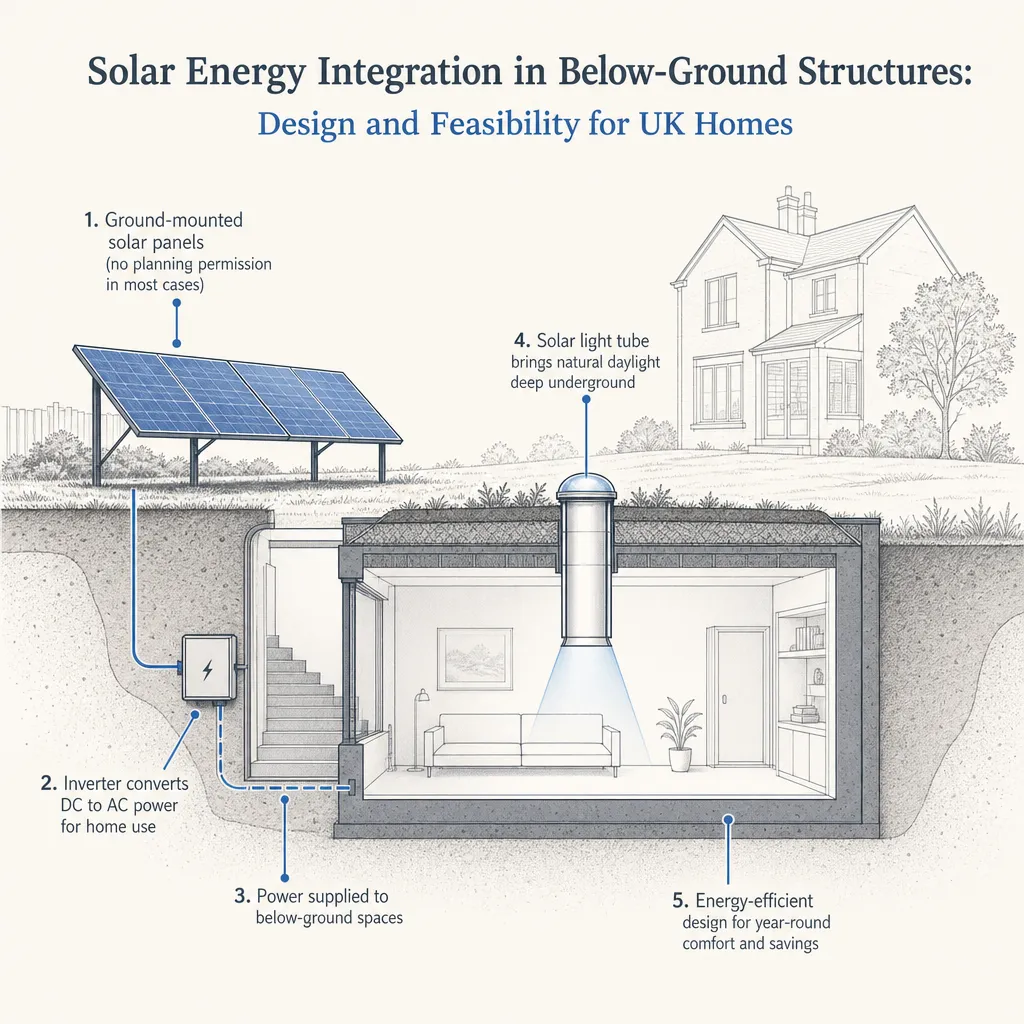
Solar Energy Integration in Below-Ground Structures: Design and Feasibility
Below-ground structures cannot host solar panels on their own roofs but can use surface-mounted panels connected via cable runs, solar light tubes for daylighting, and battery storage.
 Energy & Retrofit
Climate-Ready Home Improvements for the Future
Climate-ready home improvements tackle four main risks for UK properties: overheating, increased rainfall and flooding, storm damage, and energy cost volatility.