Why Government Support Matters for Home Efficiency Improvements
By Housey · Last reviewed 18th of May 2026
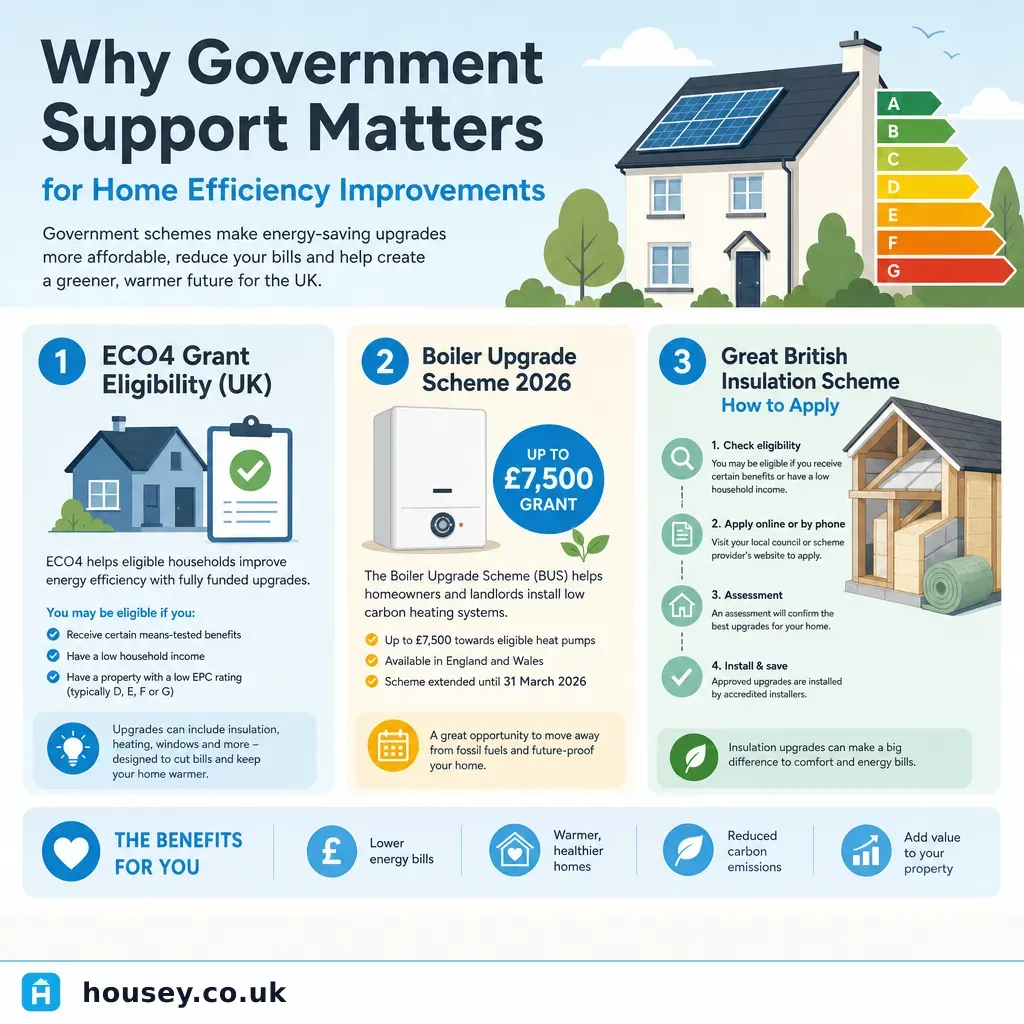
Why Government Support Matters for Home Efficiency Improvements
Energy efficiency improvements have rarely been higher on the political and practical agenda in the UK, yet many homeowners and landlords remain uncertain about which schemes are open to them, what conditions apply, and whether the available funding makes a real difference to the cost of upgrading their property. Getting this right can mean the difference between a heavily subsidised heat pump installation and a missed opportunity to reduce both carbon output and running costs.
Key points
- The ECO4 (Energy Company Obligation 4) scheme, administered by Ofgem, requires energy suppliers to fund insulation and heating improvements for lower-income and vulnerable households — eligibility is primarily based on EPC rating (D to G) or receipt of qualifying benefits.
- The Boiler Upgrade Scheme (BUS) offers a grant of £7,500 for air source heat pumps and £7,500 for ground source or water source heat pumps, applied for by the MCS-accredited installer on the homeowner's behalf.
- The Great British Insulation Scheme (GBIS) targets homes with an EPC rating of D or below (Group 1) and provides partially or fully subsidised insulation through energy suppliers, with Group 2 provisions open more broadly.
- Private landlords in England must achieve a minimum EPC rating of E for all tenancies under the current Minimum Energy Efficiency Standards (MEES); proposed legislation — subject to parliamentary approval as of May 2026 — would raise this requirement to EPC C for new tenancies by 2030.
- Government-funded retrofit work must follow PAS 2035:2019, which requires a qualified Retrofit Assessor to survey the property before measures are installed, particularly important for pre-1919 solid-wall properties where poorly specified insulation can introduce moisture risk.
What schemes are currently available in the UK?
Government-backed support for home energy efficiency falls into several overlapping categories. The following table summarises the main active schemes as of May 2026.
Scheme | Administered by | Who can apply | What it covers | Key condition |
|---|---|---|---|---|
ECO4 | Ofgem / energy suppliers | Low-income households, EPC D–G | Insulation, heating upgrades, first-time central heating | Must meet income or benefit eligibility; property assessed by a TrustMark-registered installer |
Boiler Upgrade Scheme (BUS) | Ofgem | Owner-occupiers in England and Wales | £7,500 grant for air source heat pump; £7,500 for ground or water source | MCS-accredited installer applies; property must have adequate existing insulation |
Great British Insulation Scheme (GBIS) | Ofgem / energy suppliers | EPC D or below (Group 1); broader eligibility via Group 2 | Cavity wall, loft, and solid wall insulation | Group 1 prioritises lower-income households; Group 2 may require a homeowner contribution |
Home Upgrade Grant (HUG2) | Local authorities (England) | Low-income households in off-gas-grid properties | Insulation, heat pumps, solar, ventilation | Delivered through local councils in England only; availability varies by area |
ECO Flex / Local Authority Flex | Local authorities | Broader income range at local authority discretion | Same measures as ECO4 | Local authority must certify eligibility; contact your council to check participation |
Warm Home Discount | DESNZ / energy suppliers | Low-income households | £150 discount on energy bills | Bill support only — not a retrofit or installation grant |
What not to assume about government retrofit schemes
The most costly mistakes homeowners and landlords make when approaching retrofit funding stem from common misunderstandings:
- Do not assume ECO4 covers all properties. Homes with an EPC rating of C or above will generally not qualify unless specific benefit eligibility criteria are met. Check your current EPC on the GOV.UK EPC Register before contacting installers.
- Do not assume the Boiler Upgrade Scheme covers the full installation cost. The £7,500 grant reduces — but does not eliminate — the upfront cost of a heat pump. Installation costs vary significantly depending on property size, the need for radiator upgrades, and ground conditions for ground source systems.
- Do not assume a heat pump will perform well without adequate insulation. Heat pumps operate most efficiently in well-insulated homes. Installing one in a property with significant fabric heat loss may produce disappointing efficiency and higher-than-expected running costs. PAS 2035 requires a whole-house assessment before measures are specified — this sequence matters.
- Do not assume your landlord obligations are unchanged. MEES regulations are subject to ongoing legislative development. Check GOV.UK and the current MEES guidance for the position at the point you are renewing or creating a tenancy rather than relying on information that may be out of date.
- Do not assume any installer can access scheme funding. For the Boiler Upgrade Scheme, the installer must hold current MCS accreditation. For ECO4 and GBIS, they must be TrustMark-registered and working to PAS 2035. Using an unaccredited installer forfeits the grant entirely.
Landlord obligations and the EPC floor
Private landlords in England and Wales must comply with the Minimum Energy Efficiency Standards (MEES). Since April 2020, all new and renewal tenancies must have an EPC rating of at least E. A rating of F or G renders a property unlawful to let unless a valid exemption applies.
Exemptions — registered on the PRS Exemptions Register — include:
- All cost-effective improvements have been made and the property cannot reach E.
- The property is listed or in a conservation area and relevant improvements would unacceptably alter its character.
- A tenant has refused access for improvement works.
- A new-landlord exemption of six months applies.
The government has proposed raising the minimum requirement to EPC C for new tenancies by 2030 (subject to parliamentary approval as of May 2026). Landlords planning long-term property investment should factor likely fabric and heating upgrade costs — particularly solid wall insulation and heat pump feasibility — into business plans now rather than waiting for legislation to be confirmed.
The PAS 2035 process: what homeowners and landlords should expect
Government-funded retrofit increasingly requires compliance with PAS 2035:2019, the UK national standard for domestic retrofit. Understanding the process helps homeowners ask the right questions of installers and scheme administrators.
- Retrofit Assessment — a qualified assessor surveys the property, reviews energy performance data, assesses occupancy patterns and moisture risk, and produces a Retrofit Assessment report.
- Retrofit Design — a plan is prepared specifying which measures should be installed, in which sequence, and to which technical specifications. Sequence matters: fabric-first (insulation and draught-proofing) before mechanical systems (heat pumps, ventilation).
- Installation — carried out by a TrustMark-registered, scheme-accredited installer working to the design specification.
- Handover and monitoring — documentation is provided to the homeowner; some schemes require follow-up assessment to confirm performance.
The assessment stage is particularly critical for pre-1919 solid-wall homes, where adding internal or external wall insulation without correct vapour management can introduce interstitial condensation and mould growth. A qualified assessor will identify these risks before work begins.
Homeowner and landlord checklist: preparing to access retrofit funding
Before contacting an installer or scheme administrator, work through the following:
When to get professional help
Government retrofit schemes involve technical assessments, regulatory compliance, and installer accreditation requirements that can be difficult to navigate independently. Seek professional advice when:
- You are unsure whether your property or household qualifies for a particular scheme.
- Your property is pre-1919 solid-wall construction, where standard insulation solutions carry elevated moisture and ventilation risk.
- You are a landlord approaching a MEES compliance deadline and need to understand the cost and sequencing of required improvements.
- Your EPC recommendations include multiple measures and you are unclear about the correct installation sequence.
- An installer is asking you to sign agreements or authorisations before a PAS 2035 assessment has been completed.
How Housey can help
Housey connects homeowners and landlords with qualified professionals who can navigate the scheme landscape and assess what improvements are appropriate for your property. Start with retrofit assessments to establish your property's baseline and identify the right measures in the correct sequence, or arrange insulation assessments if fabric improvements are the priority. Use our heat pump survey service to check feasibility and Boiler Upgrade Scheme eligibility, or speak to energy-efficiency consultants about the full range of options for your specific situation.
Frequently asked questions
What is the difference between ECO4 and the Boiler Upgrade Scheme?
ECO4 is aimed primarily at low-income or vulnerable households and covers insulation, first-time central heating, and heating upgrades, funded by energy suppliers under Ofgem obligations. The Boiler Upgrade Scheme is open to all owner-occupiers in England and Wales (subject to basic property eligibility) and provides a fixed grant toward installing an air source or ground source heat pump. They have separate eligibility criteria and application routes.
Do I need a PAS 2035 assessment before getting ECO4-funded insulation?
Yes — ECO4-funded insulation must comply with PAS 2035:2019, which requires a Retrofit Assessment before measures are installed. This ensures the improvement is appropriate for the property and does not introduce moisture or ventilation risks. The assessment is usually organised by the registered TrustMark installer as part of the ECO4 delivery process, so you do not typically arrange it independently.
Can landlords access government retrofit grants?
Some schemes are available to landlords. ECO4 can apply where the tenant meets the income or benefits eligibility criteria. Certain local authority-delivered schemes, including the Home Upgrade Grant and ECO Flex, also cover rented properties. The Boiler Upgrade Scheme is generally restricted to owner-occupiers. Landlords should check current scheme guidance on GOV.UK and factor the proposed MEES C standard into their long-term plans.
How does the Boiler Upgrade Scheme grant work in practice?
The MCS-accredited installer applies for the grant on your behalf, typically before or at the point of installation. The grant is paid directly to the installer, reducing the cost you pay. You do not apply directly to Ofgem. Confirm with your installer that the voucher has been applied for and approved before any work begins — the scheme has capacity limits and vouchers must be valid at the time of installation.
What happens if my EPC rating is C or above — can I still get support?
ECO4 primarily targets homes rated D to G, so a C-rated property may not qualify. The Boiler Upgrade Scheme has no EPC floor for eligibility, but properties must have adequate insulation before an installer will proceed. Some Group 2 provisions under the Great British Insulation Scheme are less restrictive on EPC rating. An energy-efficiency consultant can advise on which schemes remain open to better-rated homes.
Sources and further reading
- ECO4 scheme guidance — Ofgem
- Boiler Upgrade Scheme — GOV.UK
- Great British Insulation Scheme — Ofgem
- Minimum Energy Efficiency Standards — landlord guidance — GOV.UK
- PAS 2035:2019 — Retrofitting dwellings for improved energy efficiency — BSI Group
- EPC Register — GOV.UK / Landmark Information Group
- MCS accreditation scheme — MCS
Useful next reads
 Energy & Retrofit
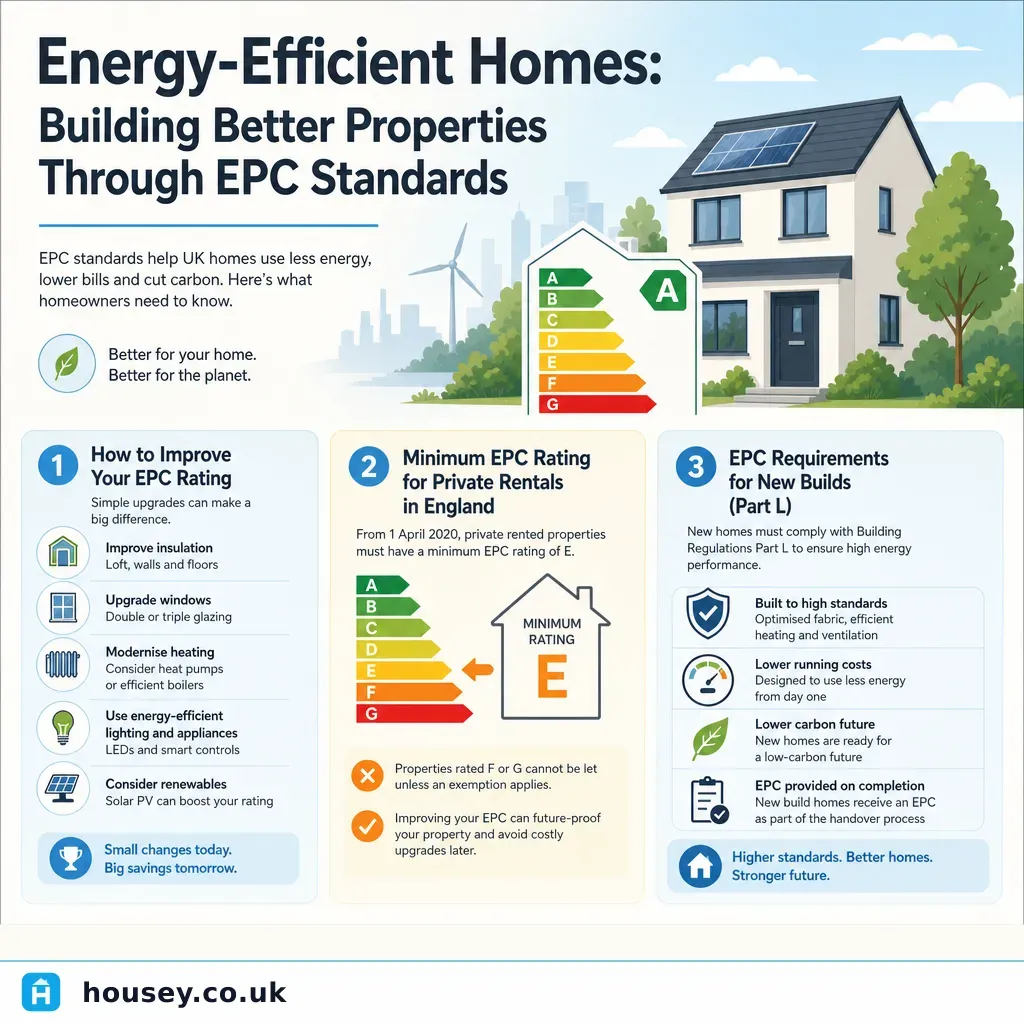
Energy-Efficient Homes: Building Better Properties Through EPC Standards
An EPC rates your home from A (most efficient) to G (least) using the Standard Assessment Procedure.
 Energy & Retrofit
Energy Retrofit Grants and Incentives: Improving Your Home's Efficiency
UK homeowners may be eligible for retrofit grants including ECO4 (insulation and heating for low-income households), the Great British Insulation Scheme, and the Boiler Upgrade Scheme, which provides up to £7,500 toward an air or ground source heat pump.
 Energy & Retrofit
The Scale of Energy Inefficiency: Why UK Homes Need Upgrading
Around 19 million UK homes hold an EPC rating of D or below, and buildings account for approximately 17% of the country's greenhouse gas emissions.
 Energy & Retrofit
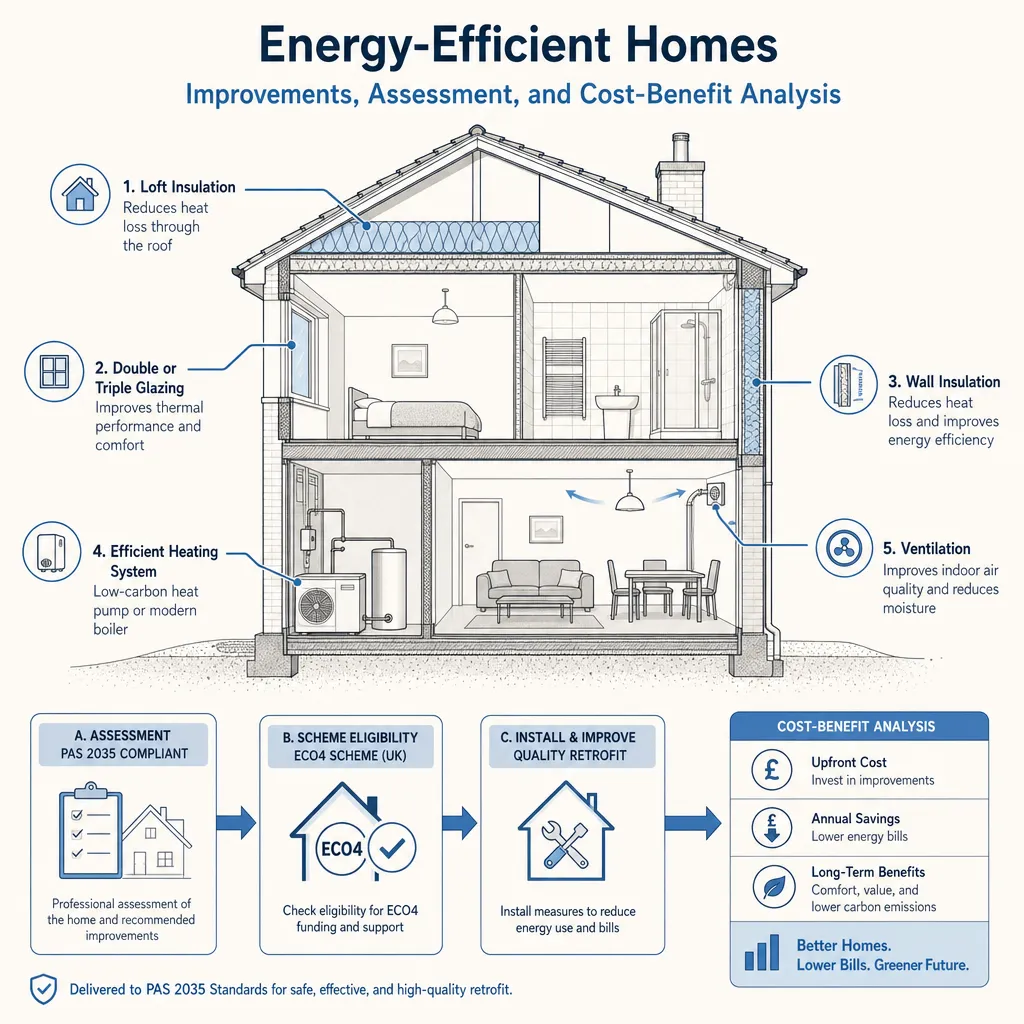
Energy-Efficient Homes: Improvements, Assessment, and Cost-Benefit Analysis
Improving your home's energy efficiency typically starts with loft insulation and draught-proofing, then cavity or solid-wall insulation, before upgrading the heating system.
 Energy & Retrofit
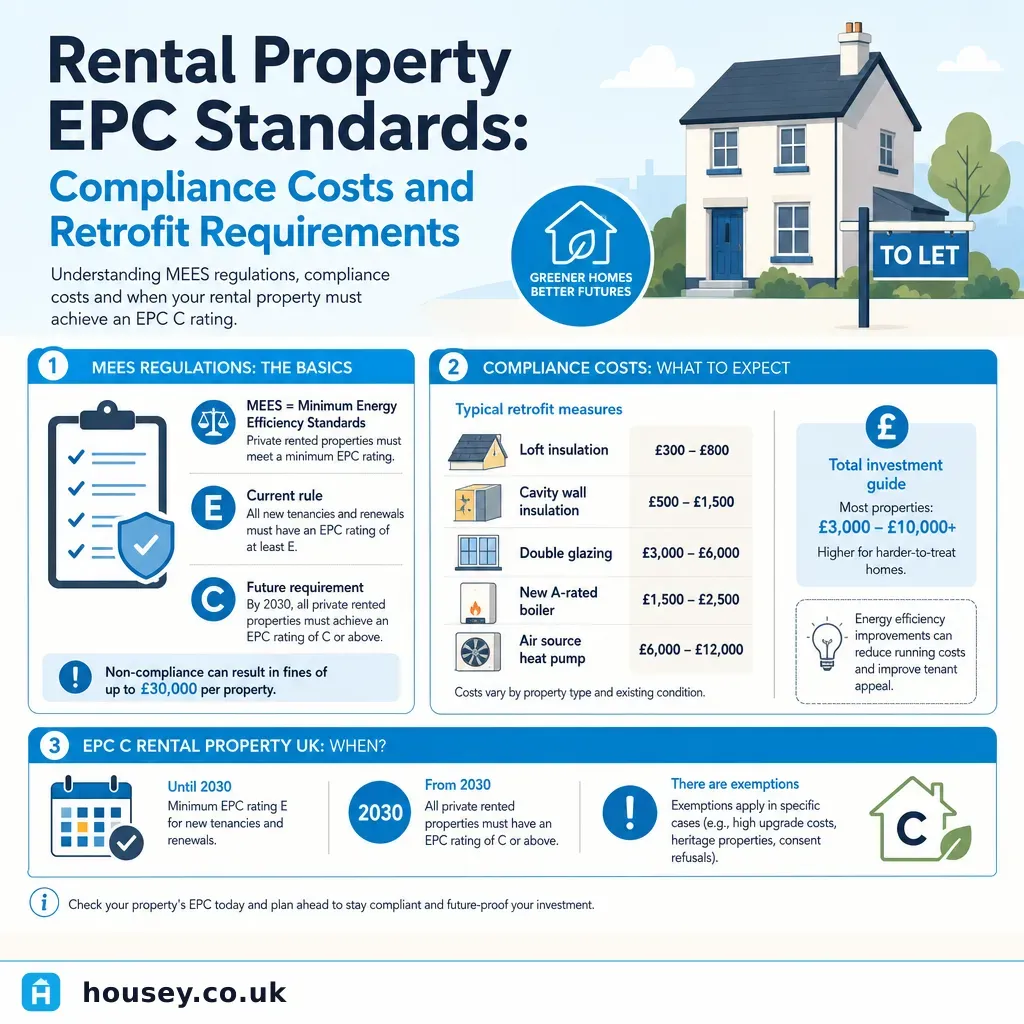
Rental Property EPC Standards: Compliance Costs and Retrofit Requirements
Private landlords in England and Wales must hold a minimum EPC E rating for all residential lettings under the MEES Regulations 2018.