Government Warm Homes Scheme: Energy Upgrades and Support for UK Homeowners
By Housey · Last reviewed 19th of May 2026

Government Warm Homes Scheme: Energy Upgrades and Support for UK Homeowners
The question of how to fund energy improvements has become pressing for millions of UK households — whether you face high heating bills, a cold and draughty property, or a mortgage lender querying your EPC rating before a remortgage. The UK government's Warm Homes Plan, launched in 2024 and rolling out through 2025–2028, consolidates several retrofit and heating upgrade schemes under one policy direction. Understanding which strand applies to your property, and how to access it, can save thousands of pounds on works you may need regardless.
Key points
- The Warm Homes: Local Grant offers eligible private-sector households up to £15,000 for insulation and low-carbon heating, administered by local authorities.
- The Boiler Upgrade Scheme (BUS) provides a £7,500 grant towards an air source or ground source heat pump, extended to March 2028.
- ECO4 (Energy Company Obligation 4) requires energy suppliers to fund insulation and heating upgrades for households on qualifying benefits including Universal Credit and Pension Credit.
- The Great British Insulation Scheme (GBIS) targets homes with an EPC rating of D or below with a single cavity-wall or loft insulation measure.
- Eligibility varies by scheme: income, EPC rating, property type, tenure, and local authority area all affect which support you can access.
What the Warm Homes Plan covers
The Warm Homes Plan is an umbrella policy framework rather than a single application form. It co-ordinates several delivery mechanisms, each with different eligibility criteria, funding levels, and administrators.
Warm Homes: Local Grant
This strand targets fuel-poor households in the private sector — both owner-occupiers and private renters. Local authorities act as scheme administrators, identifying eligible homes and commissioning retrofit works. Typical measures include solid-wall, cavity-wall, and underfloor insulation, loft insulation, air source heat pumps, and improved glazing where existing windows are poor.
Government guidance indicates funding of up to £15,000 per property for the most energy-inefficient homes. Contact your local council or check the Warm Homes: Local Grant guidance on GOV.UK for the current position in your area, as local authorities are at different stages of delivery.
Warm Homes: Social Housing
Social housing landlords — councils and housing associations — receive dedicated funding to upgrade their stock to EPC C or above. Tenants in social housing do not apply directly; their landlord manages eligibility and works.
Boiler Upgrade Scheme (BUS)
The BUS provides an upfront grant to offset the higher purchase cost of a heat pump compared with a gas boiler. Current grant levels are:
- £7,500 towards an air source heat pump (ASHP)
- £7,500 towards a ground source or water source heat pump
- £5,000 towards a biomass boiler (off-gas-grid rural homes only)
The installer applies for the voucher on your behalf — you do not manage the grant paperwork. The installer must be MCS-certified. The scheme runs to March 2028 and is open to homes in England, Wales, and Scotland. Apply via GOV.UK Boiler Upgrade Scheme.
ECO4
The Energy Company Obligation (ECO4) runs until March 2026. Large UK energy suppliers fund retrofit measures for qualifying households. Eligible measures include loft, cavity-wall, and solid-wall insulation, heat pumps, and first-time central heating installations. Eligibility is means-tested, typically linked to qualifying benefits including Universal Credit, Pension Credit, and Child Tax Credit. Contact your energy supplier or check the Ofgem ECO4 guidance to confirm whether you qualify.
Great British Insulation Scheme (GBIS)
GBIS covers one insulation measure per household for homes with an EPC of D or below. It has a broader income eligibility band than ECO4, meaning some moderate-income households qualify under a general group. Cavity-wall and loft insulation are the most common measures installed.
Which scheme could apply to you?
Your situation | Most likely scheme | Who delivers it |
|---|---|---|
Low income, private homeowner, EPC D–G | Warm Homes: Local Grant or ECO4 | Local authority or energy supplier |
Low income, social housing tenant | Warm Homes: Social Housing | Your landlord |
Any homeowner wanting a heat pump | Boiler Upgrade Scheme | MCS-certified installer |
Private homeowner, EPC D or below, moderate income | Great British Insulation Scheme | Energy supplier |
Private landlord with a poor-EPC rental property | ECO4 Flex (landlord contribution required) | Energy supplier |
Schemes can sometimes be combined — for example, ECO4 insulation funding alongside a BUS heat pump grant. A qualified retrofit assessor can advise on sequencing measures correctly under the PAS 2035 retrofit standard.
How to decide which scheme to pursue
- Receiving qualifying benefits (Universal Credit, Pension Credit, Child Tax Credit) → Enquire about ECO4 via your energy supplier first.
- Private homeowner, EPC E, F, or G, income below your local authority's threshold → Contact your local council about the Warm Homes: Local Grant.
- Want to replace a gas boiler with a heat pump → Approach an MCS-certified installer about the Boiler Upgrade Scheme.
- EPC D or below, not on benefits but moderate income → Check GBIS eligibility via your energy supplier.
- Social housing tenant → Speak to your landlord — they access Warm Homes: Social Housing directly.
- Unsure which measures suit your property or how to sequence them → Commission a retrofit assessment under PAS 2035 before committing to any scheme.
Red flags: spotting illegitimate scheme offers
Not every offer of free government insulation or heating comes from a legitimate scheme. Be cautious of:
- Cold-callers claiming you are automatically eligible — legitimate schemes do not cold-call households unsolicited
- Requests for upfront payment before a grant has been confirmed in writing
- Installers who cannot demonstrate TrustMark registration or MCS certification
- Heat pump offers made without a prior heat pump survey or whole-house retrofit assessment
- Claims that ECO4 or BUS funding applies when the installer is not an Ofgem-registered ECO contractor or MCS-certified
Verify installer credentials via the TrustMark register and the MCS installer database before agreeing to any work.
When to get professional help
Most scheme applications are straightforward, but seek independent professional advice before proceeding if:
- You are unsure whether proposed measures suit your property type — particularly solid-wall insulation or heat pumps in older, poorly ventilated homes where retrofit moisture risk is a concern
- Your property is listed or in a conservation area, where some measures may require Listed Building Consent or planning permission before works can proceed
- A retrofit installer proposes several measures without first carrying out a PAS 2035 whole-house assessment
- A heat pump is offered without a proper assessment of your existing heating system's suitability — an incorrectly sized or specified system will underperform
An independent energy-efficiency consultant or insulation assessor can advise on what works are genuinely appropriate for your property before you commit to funded works.
How Housey can help
Housey connects you with qualified, independent professionals across the UK. Whether you need a retrofit assessment to understand which measures suit your home, a heat pump survey before applying for the Boiler Upgrade Scheme, or an insulation assessment to confirm your walls and roof are suitable for funded improvements, Housey can match you with the right specialist for your property type and location.
Frequently asked questions
Can I combine the Boiler Upgrade Scheme with ECO4?
Possibly, but the two schemes cannot fund the same measure. You could, for example, receive ECO4 insulation funding and separately claim a BUS grant for a heat pump. A TrustMark-registered retrofit coordinator can advise on what combinations are permitted for your specific situation and property type.
Does the Warm Homes Plan apply in Scotland, Wales, and Northern Ireland?
The Boiler Upgrade Scheme covers England, Wales, and Scotland. ECO4 and GBIS cover Great Britain. Northern Ireland has separate programmes managed by the Northern Ireland Executive. Wales runs the Nest scheme and Scotland runs Home Energy Scotland, both administered by the Energy Saving Trust on behalf of their respective governments.
My EPC is rated C — am I excluded from all government energy support?
Not necessarily. The Boiler Upgrade Scheme is open to most homes regardless of EPC rating, though the property should be suitably insulated for a heat pump to perform well. ECO4 and GBIS primarily target D–G-rated homes. Check individual scheme eligibility criteria before assuming you do not qualify.
Do I need a new EPC before applying for these schemes?
An up-to-date EPC (under 10 years old) is useful for most schemes and required for some eligibility checks. If your EPC has expired or the property has changed significantly since it was last assessed, commission a new one from an accredited domestic energy assessor before applying.
Sources and further reading
- Warm Homes: Local Grant guidance — GOV.UK
- Boiler Upgrade Scheme — GOV.UK
- ECO4 scheme overview — Ofgem
- Great British Insulation Scheme — Ofgem
- TrustMark: find registered retrofit installers — TrustMark
- Find an MCS-certified installer — MCS Certified
Useful next reads
 Energy & Retrofit
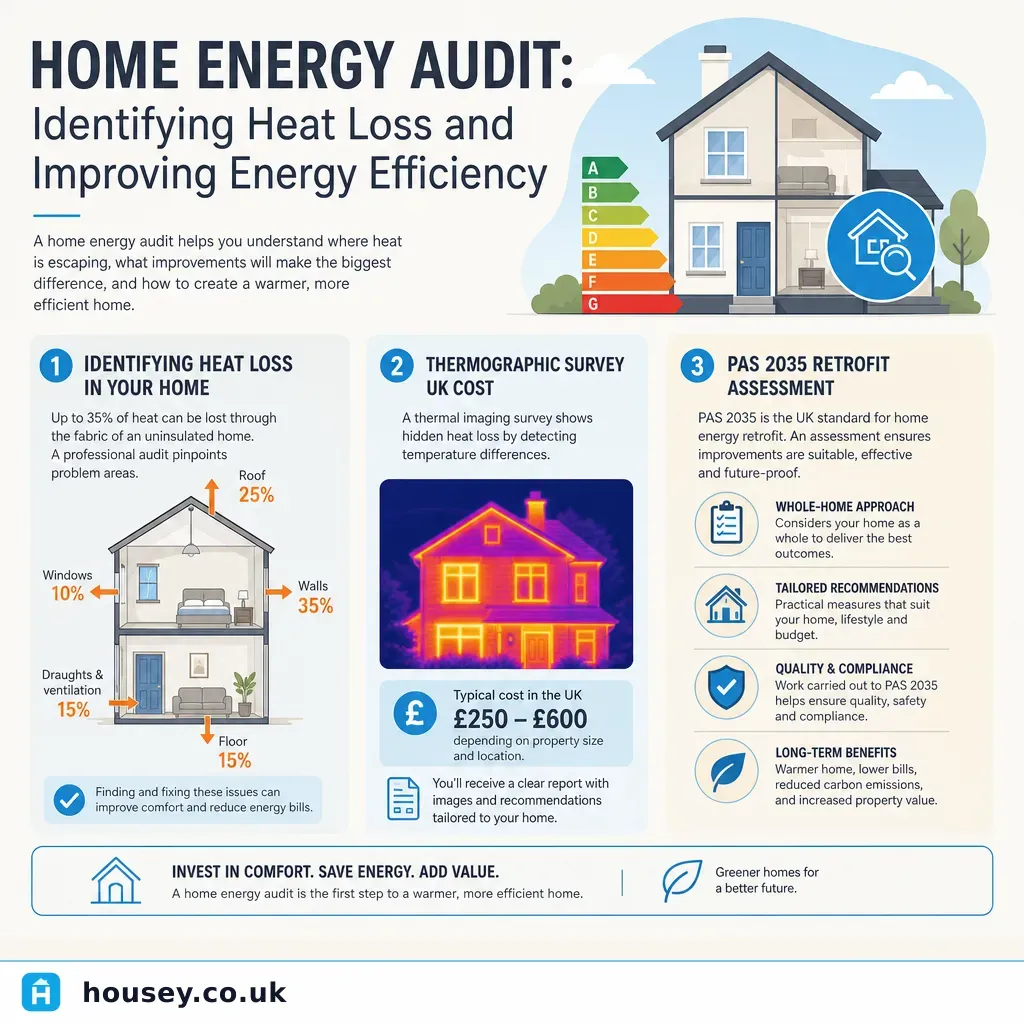
Home Energy Audit: Identifying Heat Loss and Improving Energy Efficiency
A home energy audit is a structured assessment of where your property loses heat and how efficiently it uses energy.
 Energy & Retrofit
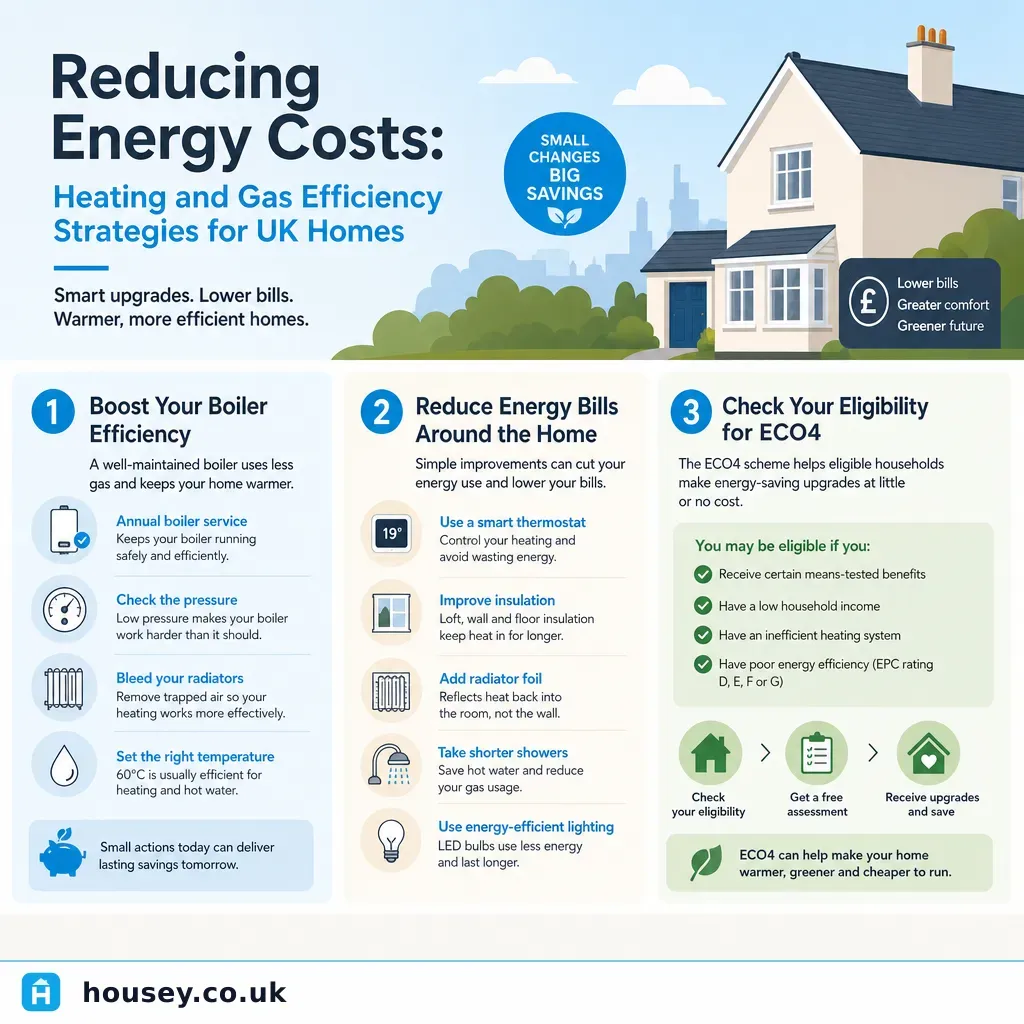
Reducing Energy Costs: Heating and Gas Efficiency Strategies for UK Homes
Most UK households spend around 55–60% of their energy bill on heating.
 Energy & Retrofit
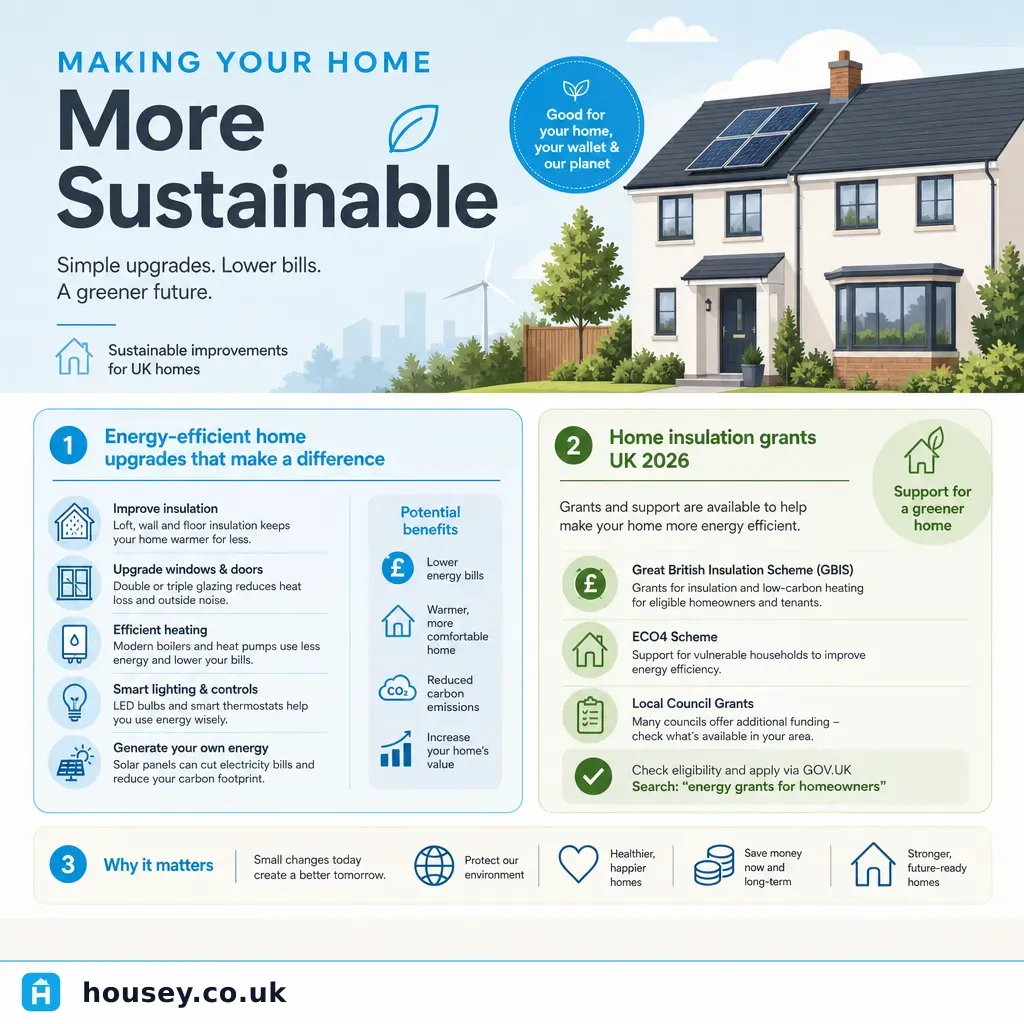
Making your home more sustainable
Making a UK home more sustainable usually starts with fabric-first improvements such as insulation, draught-proofing, and efficient glazing before adding renewable energy systems like solar panels or a heat pump.
 Energy & Retrofit
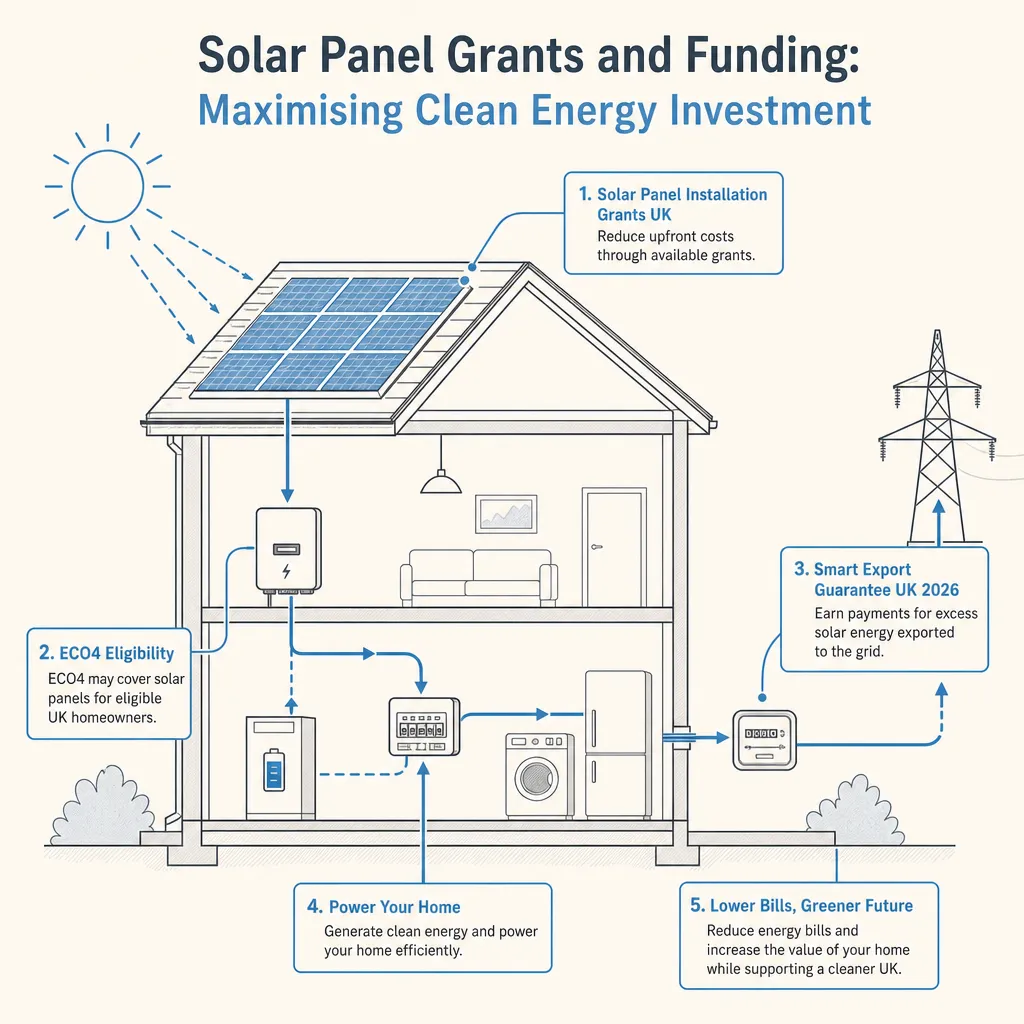
Solar Panel Grants and Funding: Maximising Clean Energy Investment
Several UK solar funding schemes are currently open: the Smart Export Guarantee pays homeowners for surplus electricity exported to the grid, ECO4 can fund free or subsidised panels for eligible low-income households, and 0% VAT on installation applies until at least March 2027.
 Energy & Retrofit
Making Your Home More Energy Efficient and Sustainable
The most effective approach to home energy efficiency is fabric-first: insulate the loft, walls, and floor before upgrading the heating system.