Making your home more sustainable
By Housey · Last reviewed 19th of May 2026
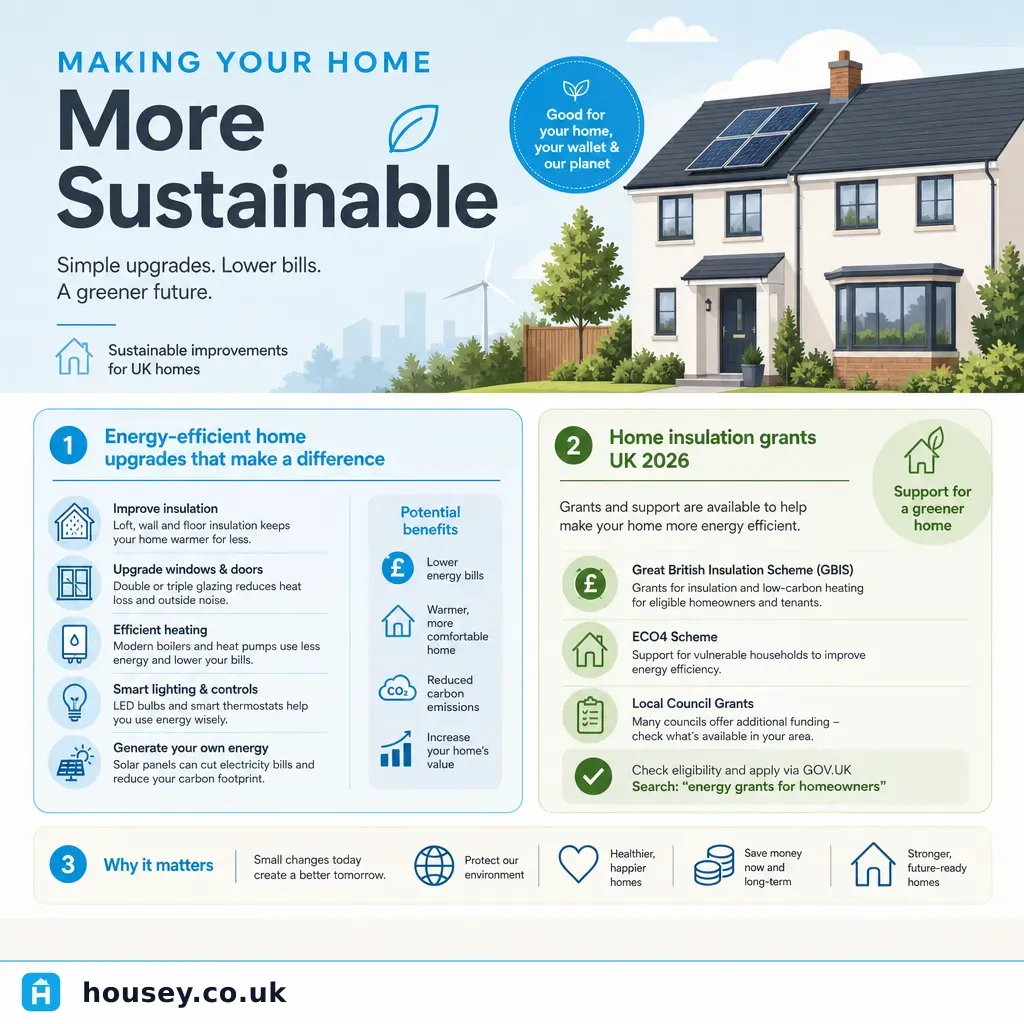
Making your home more sustainable
With UK energy bills remaining high and the country's net-zero targets requiring substantial reductions in residential carbon emissions, homeowners face real pressure to improve their property's energy performance. Choosing the right measures — and installing them in the right order — matters enormously: poorly planned retrofit work can introduce moisture, condensation, or ventilation problems, and some improvements deliver far better returns than others depending on your property's age, construction type, and existing EPC rating.
Key points
- The ECO4 scheme (Energy Company Obligation Phase 4) funds free or heavily subsidised insulation and heating improvements for eligible households — typically those receiving qualifying benefits or with EPC ratings of D or below.
- The Great British Insulation Scheme (GBIS) offers support for a single insulation measure to a broader group, including owner-occupiers and private renters in EPC D–G rated homes or lower council tax bands.
- PAS 2035 is the British Standard governing retrofit: it requires a qualified Retrofit Assessor to assess the property before measures are installed, and a Retrofit Coordinator to oversee medium to large projects.
- A heat pump requires a well-insulated home to operate efficiently — installing one in a poorly insulated property before improving the fabric will result in high running costs and poor performance.
- Solar PV panels installed by an MCS-certified contractor qualify for the Smart Export Guarantee (SEG), which pays a tariff for surplus electricity exported to the grid.
Starting with the fabric: insulation and draught-proofing
The principle of fabric first — reducing heat loss through the building envelope before adding renewable technology — is embedded in PAS 2035 and recommended by the Energy Saving Trust. For most homes, this is both the most cost-effective starting point and a prerequisite for renewable systems to work well.
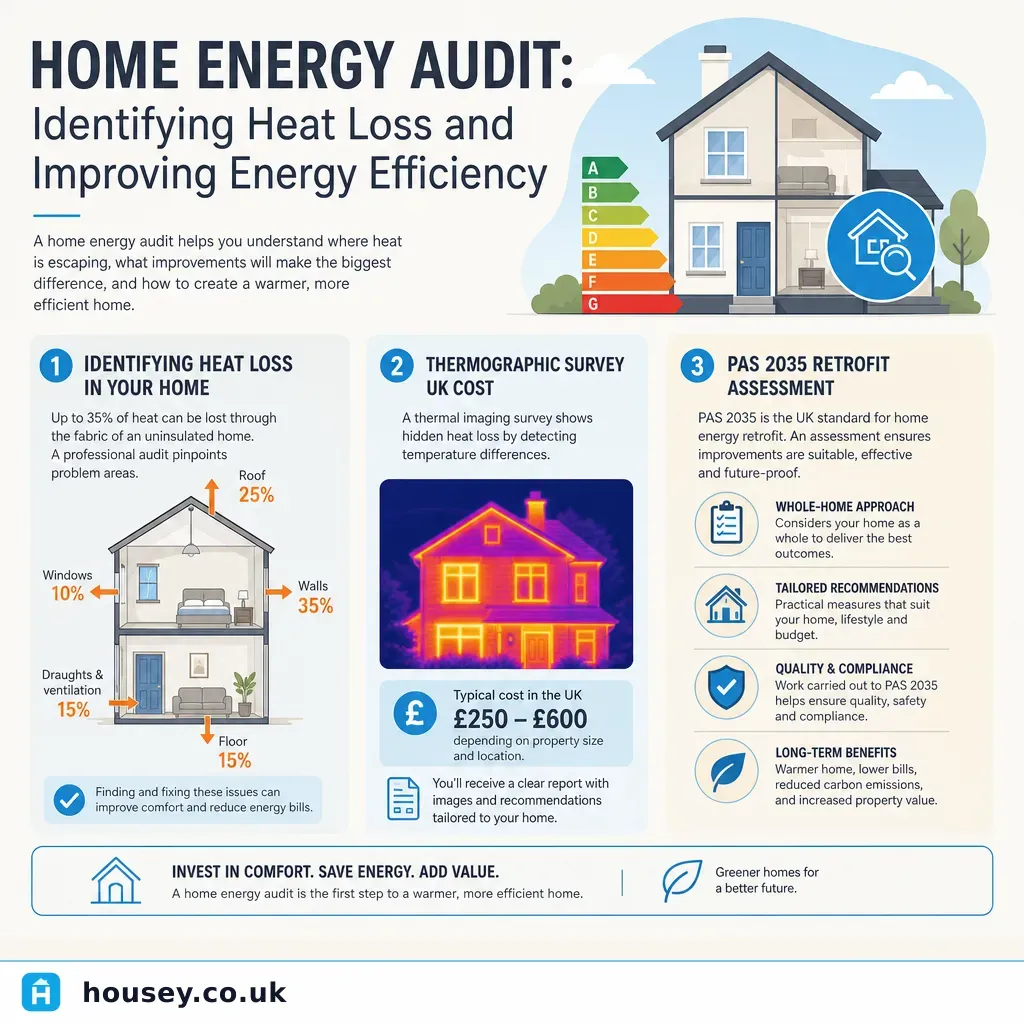
Where heat is typically lost in an unimproved home (approximate, varies by property type):
- Walls: around 33–35%
- Roof and loft: around 25%
- Windows and doors: around 20–25%
- Floors: around 15%
Source: Energy Saving Trust
Loft insulation
For most homes with an accessible loft, 270 mm of mineral wool insulation is the recommended depth. Existing insulation thinner than 100 mm is a priority for top-up. Loft insulation is among the most cost-effective single measures available and is often funded under the GBIS or ECO4 for eligible properties.
Cavity wall insulation
Suitable for homes built approximately from the 1920s onward with unfilled wall cavities. Before installation, a specialist should confirm that the cavity is in good condition — free from significant water penetration, wide enough, and with intact wall ties. Incorrectly installed cavity wall insulation in an unsuitable cavity is a documented cause of damp and moisture problems, which is one reason PAS 2035 requires an assessment first.
Solid wall insulation
Pre-1920 homes — Victorian terraces, Edwardian semis, and similar solid-wall properties — require either internal wall insulation (IWI), applied to the inside face, or external wall insulation (EWI), which clads the outside of the building. EWI changes the property's external appearance and may require planning permission in conservation areas or for listed buildings. Both measures require careful moisture management.
Draught-proofing
Sealing unintentional gaps around windows, doors, letterboxes, and loft hatches is one of the most cost-effective measures available. A note of caution: older homes need some background ventilation to prevent condensation — draught-proofing must not block intentional ventilation paths such as trickle vents or air bricks.
Renewable energy systems
Once fabric improvements are in place — or have been properly assessed — renewable energy systems can significantly reduce bills and carbon emissions.
Solar photovoltaic (PV) panels
Domestic solar PV systems in the UK typically range from 3 kWp to 6 kWp. Key considerations:
- South-facing, unshaded roofs generate the most energy; east- or west-facing installations can still be viable.
- Solar panels on most pitched roofs fall within permitted development, though conservation areas and listed buildings are exceptions — check with your LPA.
- An MCS-certified installer is required to access the Smart Export Guarantee.
- A solar survey should assess roof structural condition, orientation, shading, and any planning constraints before you commit.
Air source and ground source heat pumps
Heat pumps extract heat from outside air (air source heat pumps, ASHPs) or the ground (ground source heat pumps, GSHPs) to provide space heating and hot water. Suitability depends on:
- The property's insulation level and overall heat demand — a heat loss calculation to BS EN 12831 is essential before specifying a unit.
- The existing heat distribution system: heat pumps typically run at lower flow temperatures than gas boilers and work best with appropriately sized radiators or underfloor heating.
- Available outdoor space for the unit or, in the case of GSHPs, a ground loop.
The Boiler Upgrade Scheme (BUS) currently provides a £7,500 grant towards an ASHP or GSHP, claimed through your MCS-certified installer. Sizing a heat pump incorrectly is one of the most common causes of poor system performance — always obtain a full heat loss calculation before any purchase decision.
Comparison: key sustainability measures
Measure | Best for | Indicative cost range (2026-05-19) | Grant available? | Key risk |
|---|---|---|---|---|
Loft insulation (top-up to 270 mm) | Most homes with accessible lofts | £300–£700 (may be free under GBIS or ECO4) | Yes (GBIS, ECO4) | Blocking ventilation paths |
Cavity wall insulation | 1920s–1990s homes with unfilled cavities | £500–£1,500 (may be free under grants) | Yes (GBIS, ECO4) | Moisture problems if cavity is unsuitable |
Solid wall insulation (external) | Pre-1920 solid-wall homes | £8,000–£25,000+ | Partly (ECO4, HUG2) | Planning in conservation areas; moisture management |
Solar PV (3–4 kWp) | South-facing roofs with minimal shading | £5,000–£9,000 | SEG export tariff | Roof structural condition; planning constraints |
Air source heat pump | Well-insulated homes replacing gas or oil heating | £8,000–£15,000 (after £7,500 BUS grant) | Yes (Boiler Upgrade Scheme) | Poor performance if installed before fabric is improved |
Draught-proofing | Almost all older homes | £100–£500 DIY or professional | No | Over-sealing, reducing background ventilation |
Indicative UK costs, last reviewed 2026-05-19. Quotes vary by property size, location, and specification. Always obtain multiple quotes.
Available grants and funding in 2026
- ECO4 (Energy Company Obligation Phase 4): Targeted at lower-income households and those with EPC ratings of D–G; energy suppliers fund insulation and heating improvements. Check eligibility via GOV.UK or your energy supplier.
- Great British Insulation Scheme (GBIS): Wider eligibility than ECO4; funds a single primary insulation measure for homes in EPC D–G or lower council tax bands.
- Boiler Upgrade Scheme (BUS): £7,500 grant towards an ASHP or GSHP; applied for by your MCS-certified installer.
- Home Upgrade Grant Phase 2 (HUG2): For low-income households in off-gas-grid homes; covers insulation and low-carbon heating measures.
- Smart Export Guarantee (SEG): Not a capital grant but a tariff paid for solar electricity exported to the grid; rates vary by energy supplier.
Always verify current eligibility and availability on GOV.UK, as grant schemes open, close, and change their criteria.
Homeowner sustainability checklist
Before commissioning any work:
Important limitations
This article provides general guidance on common sustainability measures for UK homes in England. Rules on grants, permitted development, and technical standards change regularly; always check GOV.UK for current scheme eligibility. The right measures for your property depend on its specific construction, condition, tenure, and location. Moisture and ventilation risks associated with retrofit are real and can be serious — do not proceed with significant fabric improvements without a PAS 2035 assessment from a qualified Retrofit Assessor. Heat pump performance is highly dependent on correct sizing; always obtain a BS EN 12831 heat loss calculation before any purchase decision.
What to ask a qualified professional
When commissioning a retrofit assessment or renewable energy installation:
- Are you TrustMark-registered and, where applicable, MCS-certified for this type of work?
- Will the assessment and installation follow PAS 2035?
- How will you assess and manage moisture and condensation risk, particularly if this is an older or solid-wall property?
- For heat pumps: what heat loss calculation method will you use, and what flow temperature do you anticipate the system will operate at?
- For solar PV: what shading analysis has been carried out, and what annual yield estimate underpins your proposal?
- What warranty or guarantee is provided for both the product and the installation?
- What TrustMark scheme provider will oversee the installation?
When to get professional help
Seek qualified advice before:
- Proceeding with any significant insulation or airtightness measure in an older, solid-wall, or cavity-wall property — especially where there is any existing damp.
- Sizing or specifying a heat pump — incorrect sizing is among the most common causes of poor performance and unexpectedly high running costs.
- Applying for any government-funded grant scheme — an eligible, registered installer must be involved from the outset.
- Installing solar PV on a roof that has not been structurally assessed.
Red flags to watch for: a contractor recommending a heat pump without performing a heat loss calculation; a quote for cavity wall insulation with no pre-installation cavity inspection; any installer not registered with TrustMark for publicly funded work.
How Housey can help
Housey connects you with vetted energy-efficiency consultants and accredited retrofit assessors who follow PAS 2035, as well as specialists who can carry out solar surveys and heat pump surveys to confirm suitability before you commit to any installation.
Frequently asked questions
Where do I start with making my home more sustainable?
Start with a current Energy Performance Certificate and, for significant work, a PAS 2035 retrofit assessment from a qualified Retrofit Assessor. Fabric improvements such as loft insulation, cavity or solid wall insulation, and draught-proofing should typically come before adding renewable energy systems such as solar panels or a heat pump.
What grants are available for home sustainability improvements in 2026?
The main current schemes include ECO4 for eligible lower-income households, the Great British Insulation Scheme for homes in EPC bands D to G, and the Boiler Upgrade Scheme offering £7,500 towards a heat pump. The Smart Export Guarantee pays export tariffs for surplus solar electricity. Check GOV.UK for current eligibility, as schemes change.
Do I need planning permission for solar panels or a heat pump?
Solar panels on a pitched roof usually fall within permitted development for most properties, with exceptions for conservation areas and listed buildings. Air source heat pumps may also qualify under permitted development subject to conditions including noise limits and positioning rules. Always confirm with your local planning authority before commissioning installation.
What is PAS 2035 and why does it matter?
PAS 2035 is the British Standard governing domestic retrofit. It requires a qualified Retrofit Assessor to assess the property before any measures are installed, and a Retrofit Coordinator to oversee medium to large projects. Following PAS 2035 is required for most government-funded schemes and helps prevent moisture and ventilation problems that poorly sequenced retrofit can cause.
Sources and further reading
- Great British Insulation Scheme — GOV.UK
- Boiler Upgrade Scheme — GOV.UK
- Energy Saving Trust: insulation guidance — Energy Saving Trust
- Smart Export Guarantee — Ofgem
- MCS Certification Scheme — MCS
- PAS 2035:2023 Retrofitting domestic buildings — BSI
Useful next reads
 Energy & Retrofit
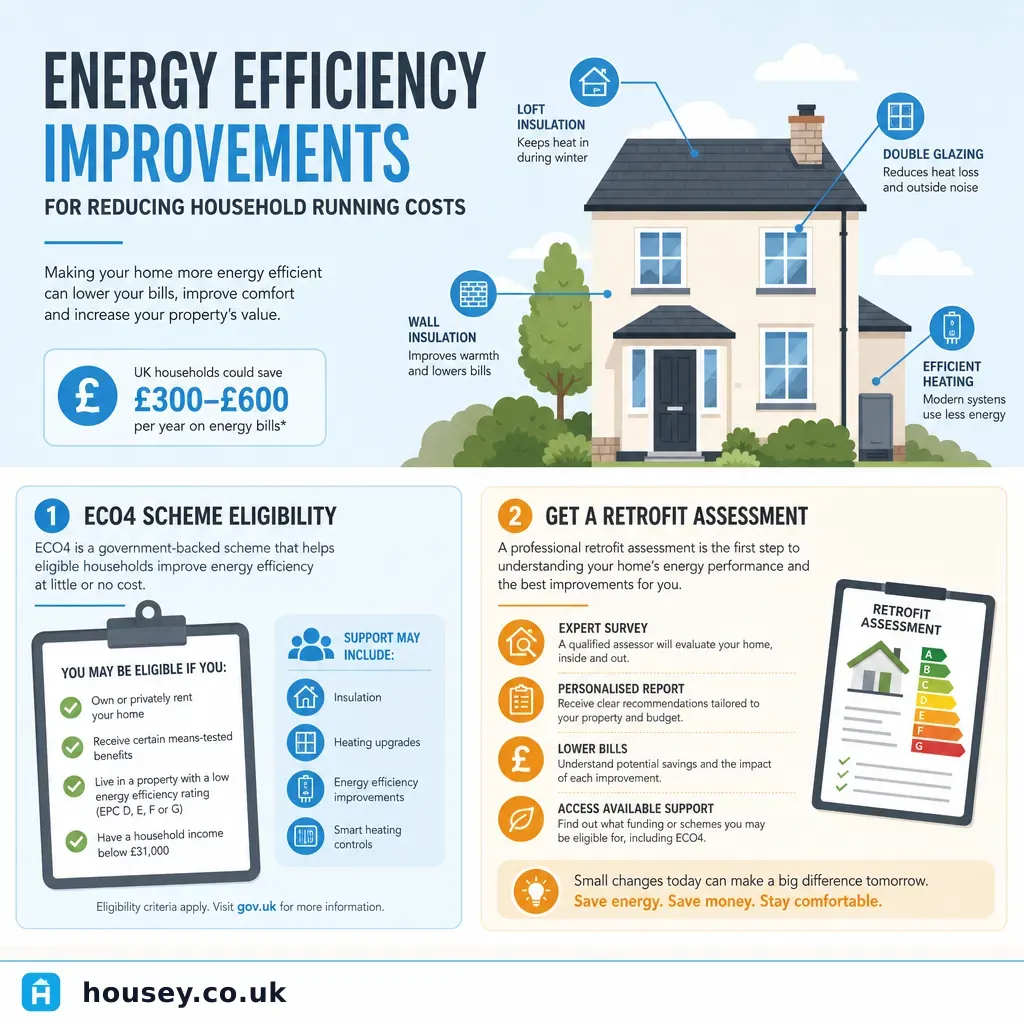
Energy Efficiency Improvements for Reducing Household Running Costs
Reducing household running costs usually starts with draught-proofing and loft insulation — the measures with the best savings-to-cost ratio.
 Energy & Retrofit
Home Energy Audit: Identifying Heat Loss and Improving Energy Efficiency
A home energy audit is a structured assessment of where your property loses heat and how efficiently it uses energy.
 Energy & Retrofit
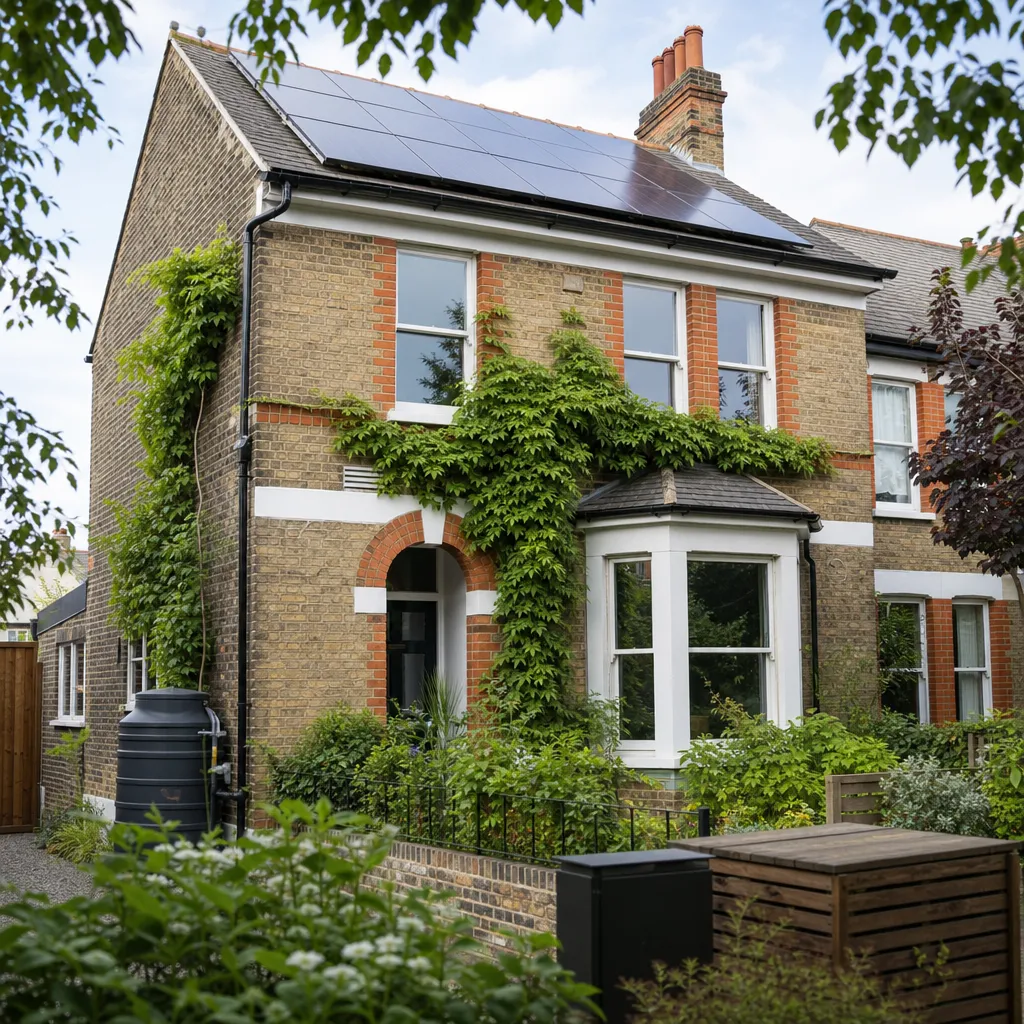
Sustainable Homes: Features That Reduce Environmental Impact
Sustainable homes reduce environmental impact through high levels of insulation, airtight construction, low-carbon heating such as heat pumps, solar energy generation, efficient water use, and responsibly sourced materials.
 Energy & Retrofit
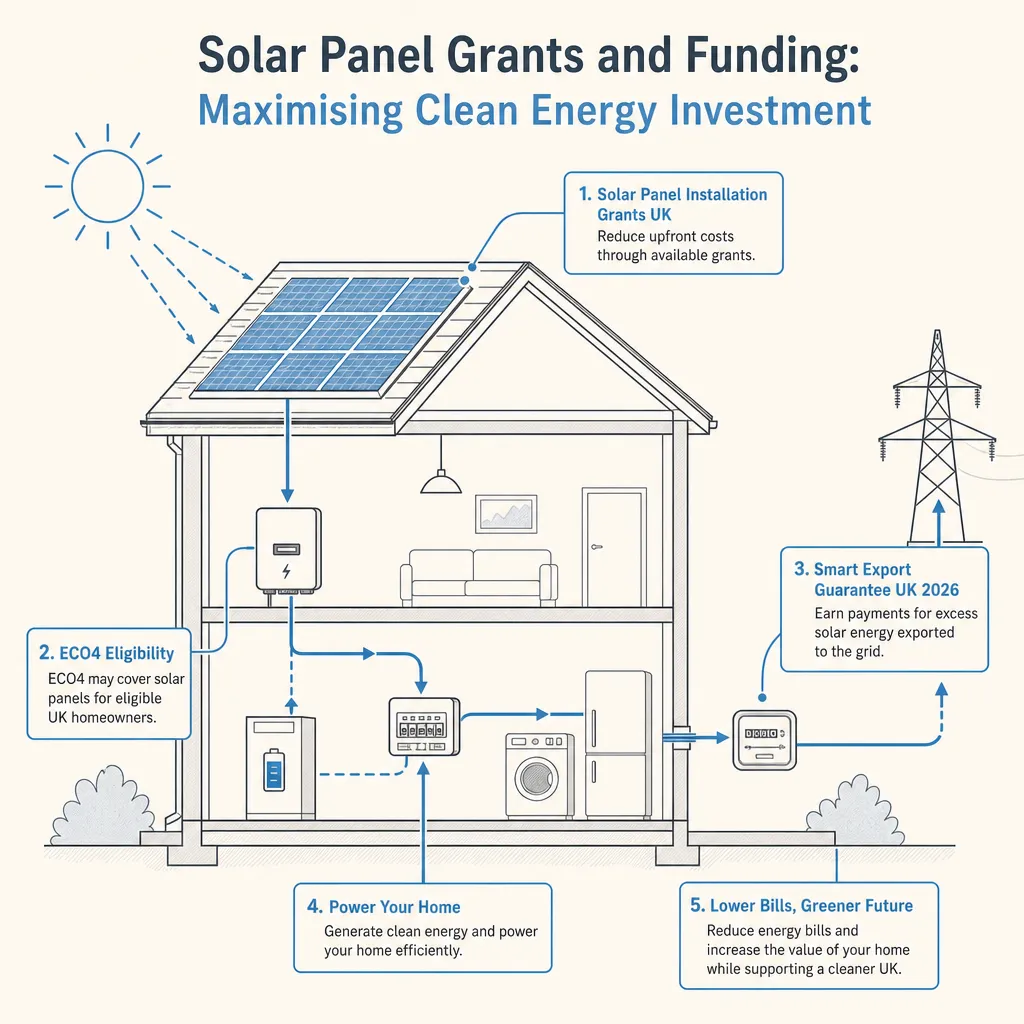
Solar Panel Grants and Funding: Maximising Clean Energy Investment
Several UK solar funding schemes are currently open: the Smart Export Guarantee pays homeowners for surplus electricity exported to the grid, ECO4 can fund free or subsidised panels for eligible low-income households, and 0% VAT on installation applies until at least March 2027.
 Energy & Retrofit
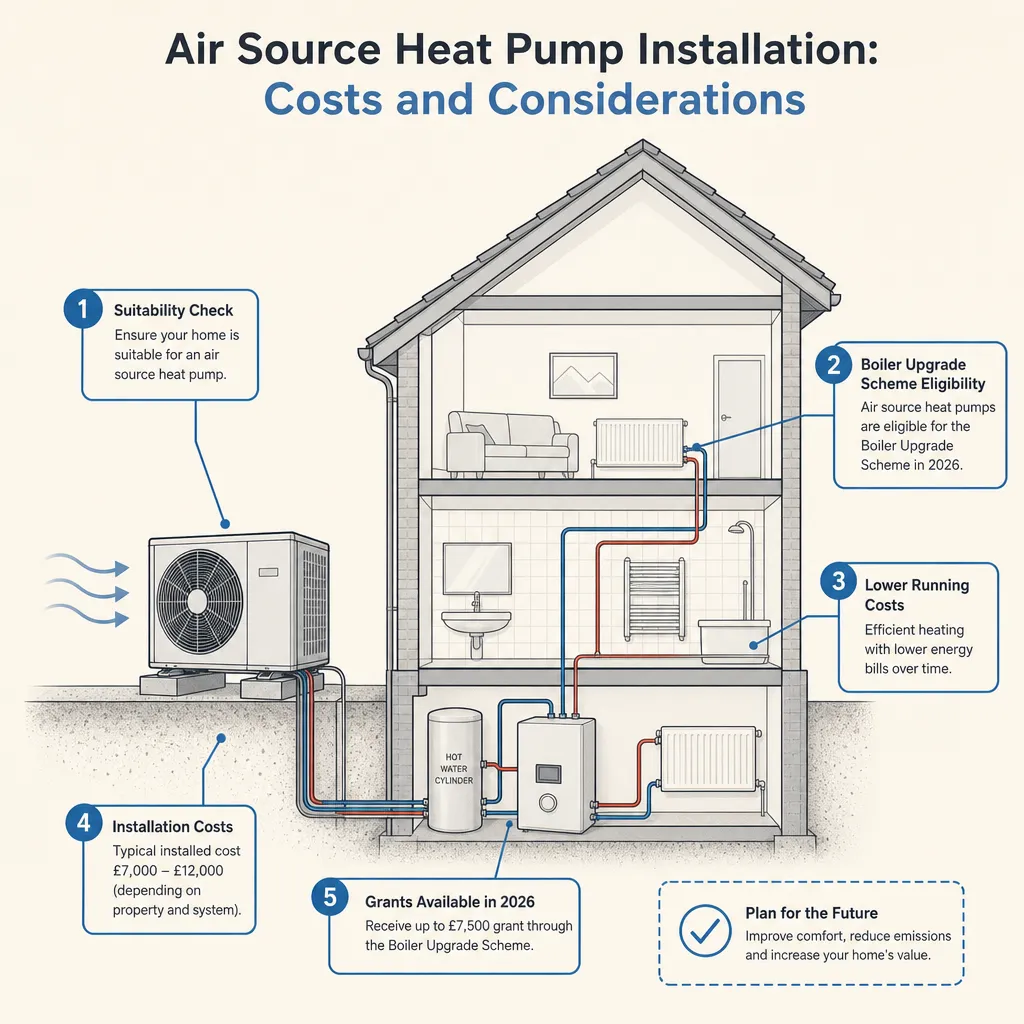
Air Source Heat Pump Installation: Costs and Considerations
Air source heat pump installation in the UK typically costs £8,000–£15,000 before the £7,500 Boiler Upgrade Scheme grant, available through MCS-certified installers in England and Wales.