Making Your Home More Energy Efficient and Sustainable
By Housey · Last reviewed 19th of May 2026
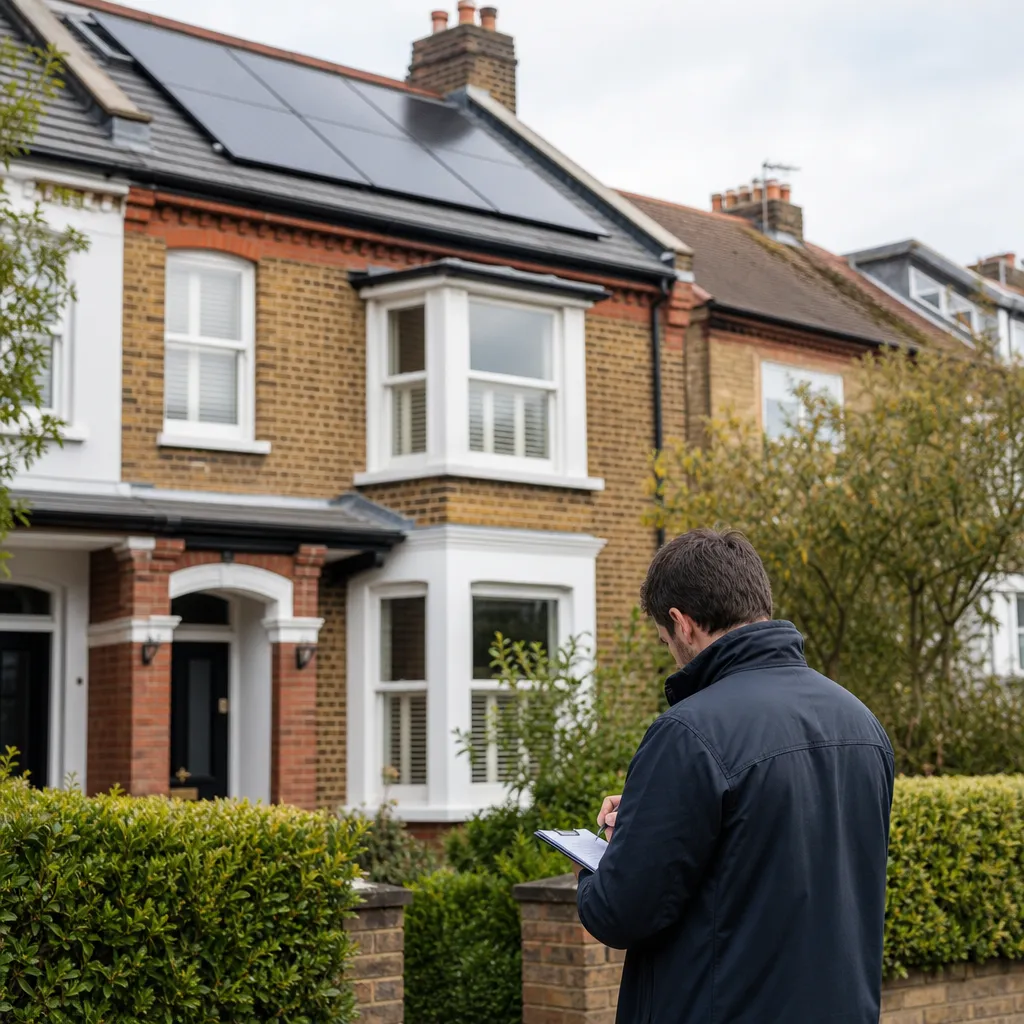
Making Your Home More Energy Efficient and Sustainable
Rising energy bills, tightening rental regulations, and the UK's legally binding commitment to reach net zero by 2050 have brought home energy efficiency to the top of many homeowners' agendas. Whether you own a 1930s solid-wall semi-detached or a 1990s cavity-wall detached, the sequence and specification of improvements matters significantly — poorly planned retrofit can cause moisture damage, void manufacturer warranties, and fail to deliver the savings expected at the outset.
Key points
- PAS 2035 is the British Standard governing whole-house retrofit; works funded under ECO4 and the Great British Insulation Scheme must comply with it, requiring a qualified Retrofit Coordinator to oversee the project.
- The Boiler Upgrade Scheme (BUS) currently offers £7,500 towards an air source or ground source heat pump for eligible owner-occupiers and landlords in England and Wales — check GOV.UK for current scheme status and eligibility criteria.
- Adding solid wall insulation to a pre-1920s solid-brick home can substantially reduce heat loss but introduces interstitial condensation risk if ventilation is not correctly designed; this is a recognised risk addressed directly in PAS 2035.
- Under the Minimum Energy Efficiency Standards (MEES), privately rented homes in England and Wales must hold an EPC rating of E or above; the government has consulted on raising this to C for new tenancies, though legislation has not been confirmed.
- Energy-saving materials including insulation, solar panels, and heat pumps attract 0% VAT in the UK, reduced from 5% in April 2022.
Why the order of improvements matters
A common and costly mistake is installing a heat pump or solar panels before addressing insulation and air tightness. Heat pumps operate at lower flow temperatures — typically 35–55°C — and are most efficient in a well-insulated building with a low heat demand. The widely endorsed "fabric first" approach prioritises the building envelope before heating systems or renewable generation:
- Loft insulation — typically the most cost-effective first measure; current guidance suggests a minimum of 270 mm of mineral wool in an accessible cold loft
- Cavity wall insulation — suitable for most homes built between approximately 1920 and 1995 with an unfilled cavity, after a survey confirming cavity condition and location exposure
- Floor insulation — suspended timber ground floors can be insulated from below; solid concrete floors are harder to treat without raising floor level
- Solid wall insulation — internal or external treatment for pre-1920s solid-brick or stone homes; highest potential impact but most technically complex and moisture-sensitive
- Windows and doors — upgrading single glazing to double or triple; check permitted development and conservation area rules in protected properties before proceeding
- Air tightness — draught-proofing doors, letterboxes, floorboard gaps, loft hatches, and chimney throats
- Heating system and renewables — once fabric is improved, specify the heating system and evaluate solar PV or battery storage based on the reduced demand
Which improvement is right for your home?
The right starting point depends on your property's age, construction type, existing condition, and whether you plan to access grant funding.
Decision guide
- Choose loft insulation first if your loft is accessible and either uninsulated or has less than 100 mm of existing material — it typically offers the shortest payback period of any retrofit measure.
- Choose cavity wall insulation if your home was built between 1920 and 1995 and has unfilled cavities confirmed by a survey — avoid exposed coastal or upland elevations where wind-driven rain risks water penetration.
- Choose solid wall insulation only after a professional Retrofit Assessment under PAS 2035 — this work requires a PAS 2030-certified installer and, under funded schemes, a Retrofit Coordinator.
- Consider a heat pump once the fabric is improved and a room-by-room heat loss calculation (typically following BS EN 12831) has confirmed correct sizing — do not size on existing boiler output.
- Consider solar PV at any stage for south-, east-, or west-facing roofs with limited shading — a solar survey will assess orientation, shading, and structural suitability.
- Consult a Retrofit Assessor or energy-efficiency consultant if you are unsure of the best starting point, have had damp or condensation problems, own a pre-1920s property, or plan to access grant funding.
Comparison of common energy efficiency measures
Measure | Indicative annual saving | Best suited to | Key risk if done incorrectly | Accreditation to look for |
|---|---|---|---|---|
Loft insulation top-up | £150–£300 | Homes with under 100 mm in accessible loft | Low if eaves ventilation baffles maintained | TrustMark-registered installer |
Cavity wall insulation | £200–£400 | 1920–1995 cavity homes, sheltered location | Water penetration if cavity is defective | CIGA-registered installer |
External wall insulation | £300–£600 | Solid-wall homes with good external access | Moisture trap, thermal bridging at junctions | PAS 2030 certified; Retrofit Coordinator required |
Internal wall insulation | £300–£600 | Solid-wall homes with limited external access | Interstitial condensation, cold bridging | PAS 2030 certified; Retrofit Coordinator required |
Air source heat pump | £500–£1,200 post-fabric | Well-insulated homes replacing gas or oil boiler | Poor performance and high bills if home is under-insulated | MCS-certified installer |
Solar PV (4 kWp system) | £300–£500 plus export tariff | South/SW/SE-facing roofs, minimal shading | Structural overload if roof not assessed | MCS-certified installer |
Triple glazing | £100–£200 | Homes replacing single or poor double glazing | Condensation risk if ventilation not reviewed | FENSA or CERTASS-registered installer |
Indicative UK annual savings, last reviewed 2026-05-19. Figures vary significantly by property size, existing condition, occupancy, and energy tariff. Obtain at least three quotes before proceeding.
Grant and funding options
Several government-backed schemes may help fund energy improvements. Scheme terms and eligibility change regularly — verify current availability on GOV.UK or via the Energy Saving Trust before applying.
- ECO4 (Energy Company Obligation): free or heavily subsidised insulation and heating upgrades for lower-income and fuel-poor households; eligibility is income- and property-based
- Great British Insulation Scheme (GBIS): a single insulation measure for homes in council tax bands A–D, or E–G if in fuel poverty; PAS 2035 compliance required where a Retrofit Coordinator is specified
- Boiler Upgrade Scheme (BUS): £7,500 towards an air source or ground source heat pump; requires an MCS-certified installer and a valid EPC with no outstanding loft or cavity insulation recommendations
- Home Upgrade Grant (HUG2): targeted at off-gas-grid lower-income households; administered by local authorities
- 0% VAT on energy-saving materials: applies to insulation, solar panels, heat pumps, and other qualifying measures
Important limitations
This article provides general guidance on home energy efficiency for UK homeowners. The suitability, risk profile, and expected performance of any retrofit measure depends on your individual property — its construction type, age, existing condition, occupancy pattern, and location. Nothing in this article constitutes a recommendation for specific works on your property.
In particular:
- Solid wall insulation and heat pump installation in older or solid-wall homes can cause moisture, condensation, and structural damage if specified or installed without adequate ventilation design. A professional Retrofit Assessment under PAS 2035 should be commissioned before any such works are agreed.
- Heat pump sizing must be based on a calculated heat loss figure, typically following BS EN 12831, and not on existing boiler output. Incorrectly sized heat pumps are a known cause of poor performance and higher-than-expected running costs.
- Grant scheme eligibility and funding availability change regularly. Check directly with GOV.UK or the Energy Saving Trust for current information before relying on scheme details in this article.
What to ask a qualified professional
Before instructing any contractor for energy improvement works, ask:
- Are you TrustMark-registered and, where relevant, MCS-certified or PAS 2030-certified?
- Will this project require a Retrofit Coordinator under PAS 2035, and if so, who will carry out that role?
- Will you carry out a full heat loss calculation before sizing the heating system?
- How will ventilation be maintained or improved once insulation is added, particularly in bathrooms and kitchens?
- What are the specific moisture risks for my property type, and how will they be managed in the specification?
- What insurance-backed guarantees (IBGs) or product warranties will the installation carry?
- Will I receive a copy of the Retrofit Assessment report and all commissioning certificates?
When to get professional help
Seek independent professional advice before starting any works if:
- Your home was built before 1920 with solid brick or stone walls
- You have experienced or currently have damp, condensation, or mould problems
- You are planning to access ECO4, GBIS, or BUS grant funding, where PAS 2035 compliance is required for many measures
- You are considering replacing a gas or oil boiler with a heat pump
- Your property is listed or in a conservation area, where some energy measures may require consent before installation
How Housey can help
Housey connects you with accredited specialists across the full retrofit journey. Start with an energy-efficiency consultant for an independent whole-house assessment, or book a retrofit assessment if you are planning grant-funded works or have a pre-1920s property. For targeted guidance on individual measures, insulation assessments, solar surveys, and heat pump surveys are available to help you choose and specify the right solution for your home.
Frequently asked questions
What EPC rating do I need to rent my property legally?
Under the Minimum Energy Efficiency Standards (MEES), privately rented properties in England and Wales must currently hold an EPC rating of E or above. The government has consulted on raising this to band C for new tenancies, though legislation has not been confirmed at the time of writing. Landlords should check GOV.UK for the current position and any timetable changes.
Does cavity wall insulation always make sense?
No. Cavity wall insulation is unsuitable for homes with defective, partially filled, or very narrow cavities, or for exposed coastal or upland properties where wind-driven rain could carry moisture to the inner leaf. A survey of the cavity's condition by a qualified installer is essential before any work is carried out.
Can I fit a heat pump if my home still has existing radiators?
Possibly, but only after a room-by-room heat loss calculation. Heat pumps operate at lower flow temperatures than gas boilers, meaning existing radiators may not deliver adequate heat output at those lower temperatures. An MCS-certified installer should assess whether your current radiators are adequate or need upsizing before any system is specified or installed.
Is solar PV worth installing in the UK climate?
Generally, yes. Solar PV generates usable electricity year-round in the UK, not only in summer. Payback periods of 8–12 years are typical for a well-sited 4 kWp system, reducing further if paired with a home battery or used to charge an electric vehicle. A solar survey will assess roof orientation, shading, structural condition, and estimated annual generation.
Sources and further reading
- ECO4 and Great British Insulation Scheme — GOV.UK
- Boiler Upgrade Scheme — GOV.UK
- PAS 2035: retrofitting dwellings for improved energy efficiency — BSI Group
- Home insulation advice — Energy Saving Trust
- Minimum Energy Efficiency Standards: landlord guidance — GOV.UK
- Find an MCS certified installer — MCS
- TrustMark: find a registered installer — TrustMark
Useful next reads
 Energy & Retrofit
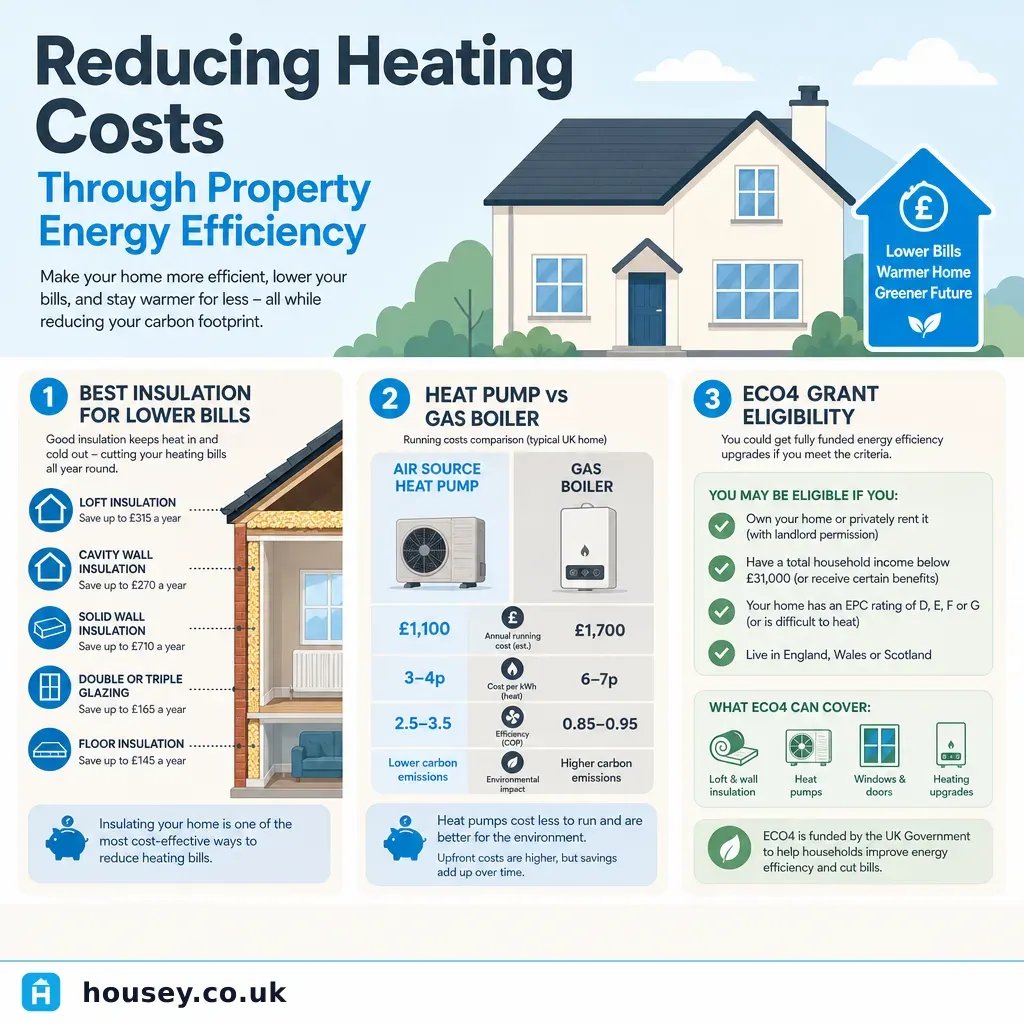
Reducing Heating Costs Through Property Energy Efficiency
Reducing heating costs starts with identifying where heat is lost — typically walls (30–35%), roof (20–25%), and windows.
 Energy & Retrofit
The Rise of Green-Rated Homes: Energy Efficiency, Sustainability, and Long-Term Property Value
Homes with higher EPC ratings typically sell faster and can command a premium of up to 10% over equivalent lower-rated properties.
 Energy & Retrofit
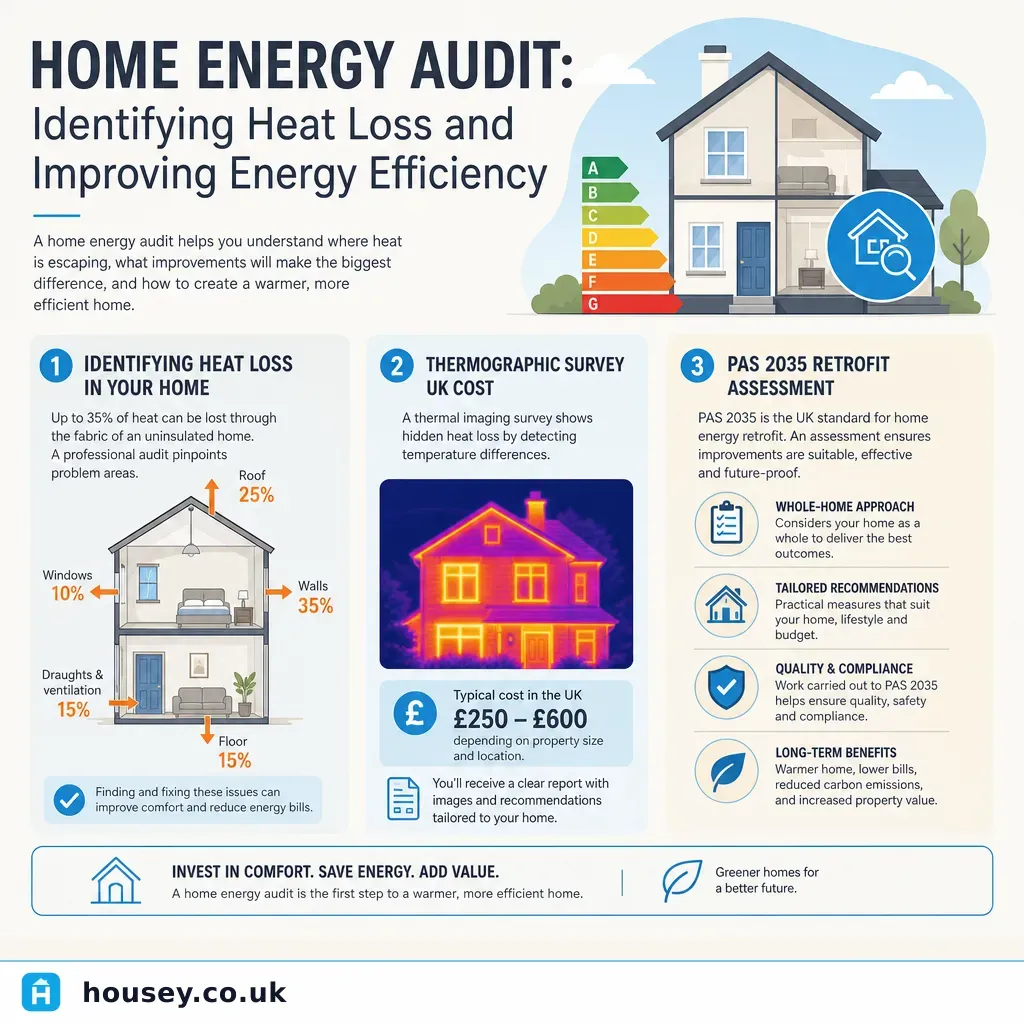
Home Energy Audit: Identifying Heat Loss and Improving Energy Efficiency
A home energy audit is a structured assessment of where your property loses heat and how efficiently it uses energy.
 Energy & Retrofit
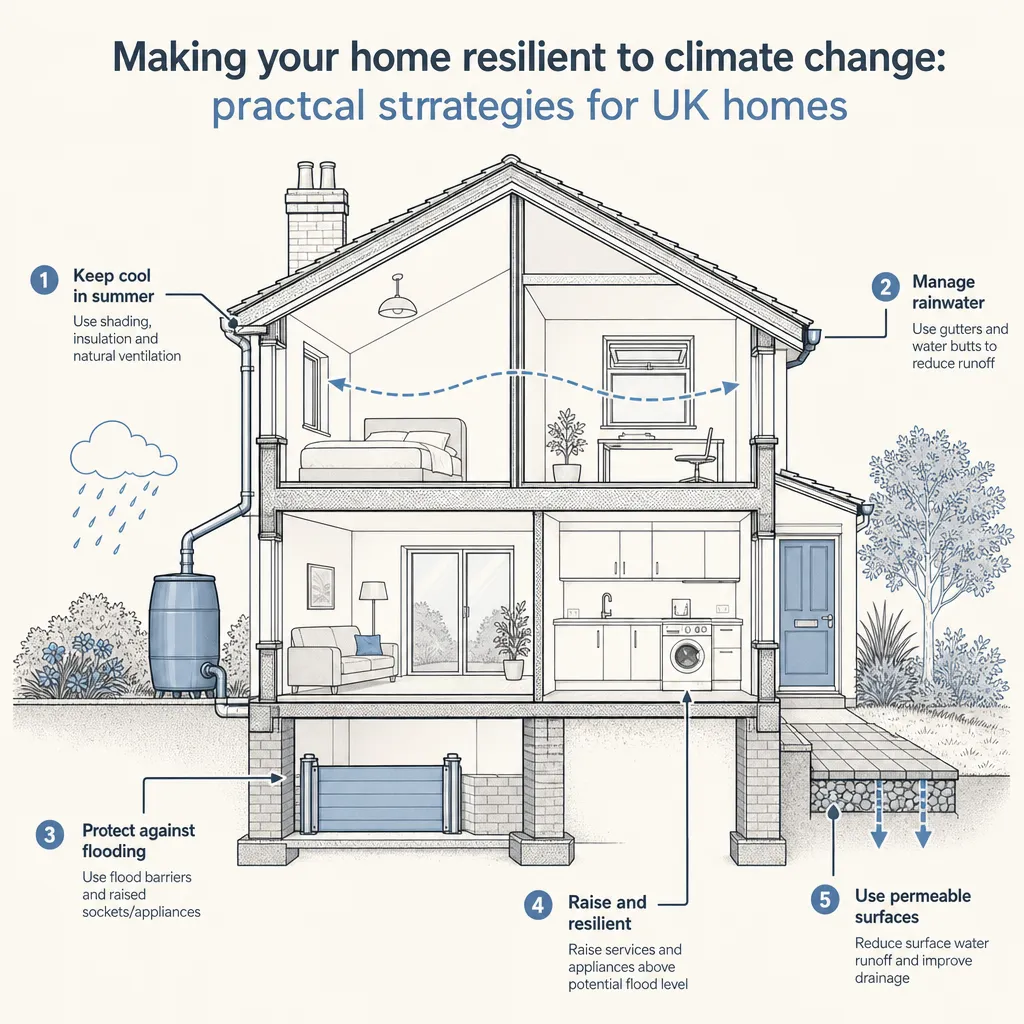
Making your home resilient to climate change: practical strategies
UK homeowners can improve climate resilience by addressing flood risk, overheating, and energy efficiency together.
 Energy & Retrofit
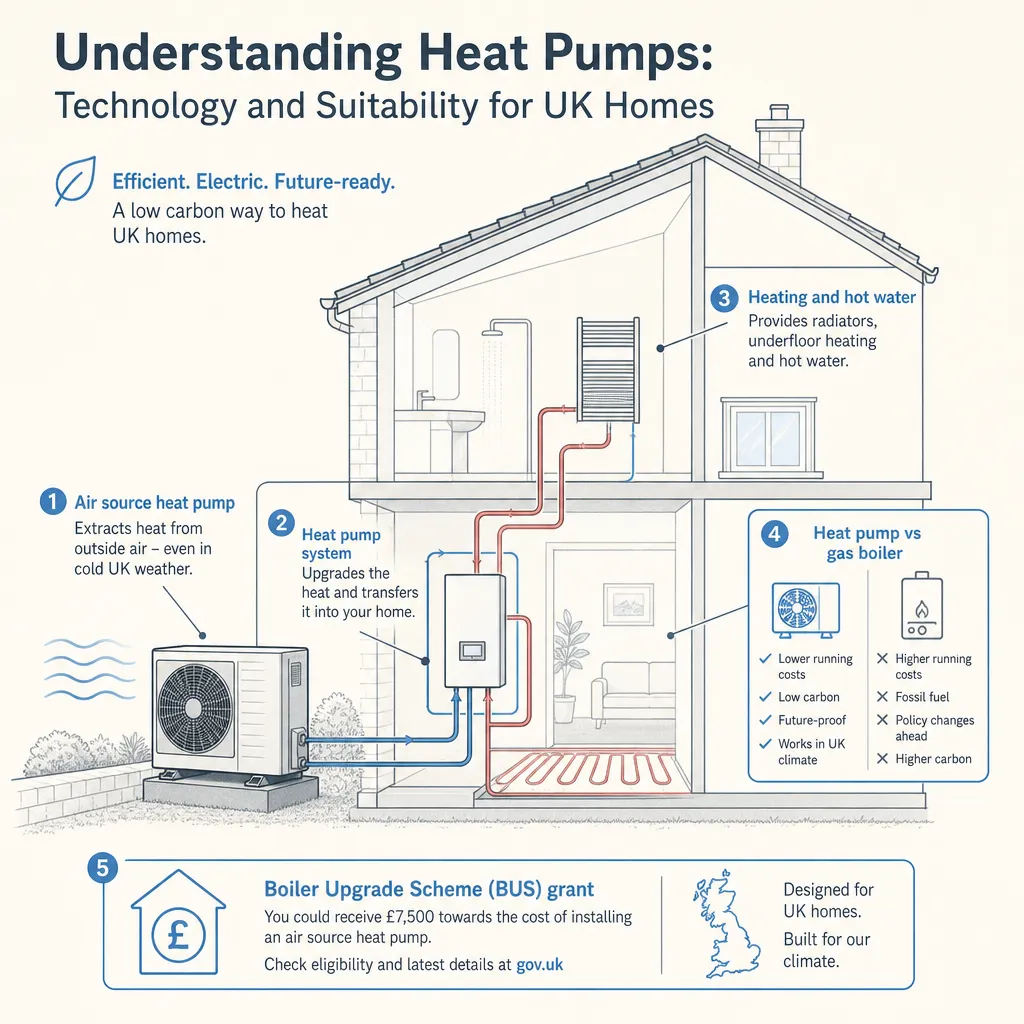
Understanding Heat Pumps: Technology and Suitability for UK Homes
Heat pumps extract heat from the air or ground and transfer it indoors, typically achieving efficiencies of 250–400% compared to a conventional boiler's near 100%.