Reducing Energy Costs: Heating and Gas Efficiency Strategies for UK Homes
By Housey · Last reviewed 30th of May 2026
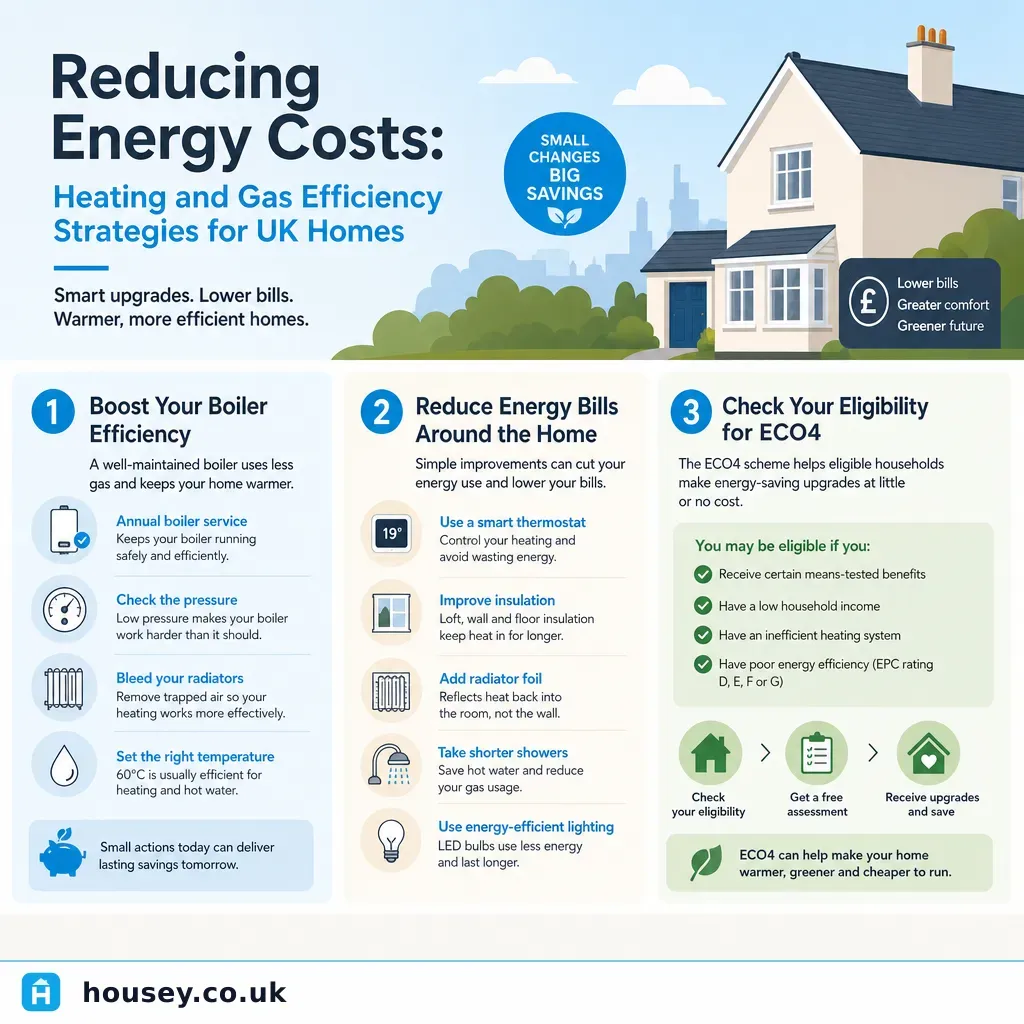
Reducing Energy Costs: Heating and Gas Efficiency Strategies for UK Homes
Heating accounts for the single largest share of most UK household energy bills — roughly 55–60% of annual spending, according to Energy Saving Trust analysis. With energy prices remaining elevated following the turbulence of recent years, many homeowners are scrutinising their systems and habits more closely than before. Whether you own a 1930s semi with solid walls, a post-war flat on district heating, or a newer home with a combi boiler, the same principles apply: improve the thermal envelope, optimise heating controls, and ensure your system runs as efficiently as possible.
Key points
- Setting a combi boiler's flow temperature to 55–60°C (rather than the factory default of 75–80°C) can improve seasonal efficiency by around 6–8%, particularly in homes with modern radiators sized for lower-temperature operation.
- Loft insulation topped up to 270 mm of mineral wool can save approximately £150 per year in a semi-detached home, according to Energy Saving Trust cost modelling (2024).
- The ECO4 scheme funds insulation and first-time central heating for eligible low-income households; eligibility includes receipt of qualifying benefits or referral via the local authority flex mechanism.
- All gas boiler work — servicing, repair, replacement, or new connections — must be carried out by a Gas Safe registered engineer; this is a legal requirement under the Gas Safety (Installation and Use) Regulations 1998.
- Smart thermostat systems with room-by-room control can reduce heating energy use by up to 25% compared with fixed-programme controls, according to BEIS-funded research.
Which heating upgrade is worth prioritising?
Not every home benefits equally from every measure. Before spending money, identify where heat is being lost and how efficiently your current system runs.
- Choose boiler flow temperature adjustment first if you have a combi or system boiler installed after 2010. This costs nothing to adjust (check your manual or ask at your next Gas Safe service) and can deliver immediate savings.
- Move to insulation if your loft has less than 270 mm of mineral wool or your cavity walls have never been filled. These are the highest-impact interventions for most UK homes.
- Consider controls upgrades — smart thermostat, thermostatic radiator valves — if your boiler is under 15 years old and already well-maintained. Replacing a working boiler purely to save energy rarely recovers its cost within a reasonable payback period.
- Explore a heat pump if your home already has good insulation (EPC band C or above after improvements) and your boiler is approaching end of life. A heat pump survey will assess suitability before you commit.
- Ask about ECO4 or GBIS funding if your household income is modest or you receive qualifying benefits — you may be entitled to fully funded insulation or heating upgrades.
Insulation options and what they typically save
Measure | Typical annual saving (semi-detached) | Indicative installed cost (2024) | Best for |
|---|---|---|---|
Loft insulation (top-up to 270 mm) | ~£150 | £300–£600 (free via ECO4/GBIS) | Most homes with accessible loft |
Cavity wall insulation | ~£200 | £500–£1,500 | Post-1920 cavity-wall homes |
Solid wall insulation (external) | ~£370 | £8,000–£22,000 | Pre-1920 solid-wall homes |
Solid wall insulation (internal) | ~£270 | £5,500–£11,000 | Where external cladding is impractical |
Floor insulation | £40–£70 | £500–£1,500 | Suspended timber floors |
Double glazing (replacing single) | £110–£115 | £3,000–£10,000 | Single-glazed properties |
Indicative UK costs and savings, last reviewed 2026-05-30. Source: Energy Saving Trust. Savings vary by property size, fuel tariff, occupancy, and local climate.
Solid wall insulation must be installed by a TrustMark-registered, PAS 2030:2019-certified contractor to comply with Building Regulations Part L and to access government funding. Poor installation can cause moisture problems — a ventilation and condensation assessment is advisable before and after any airtightness-improving measure.
How to optimise a gas boiler without major works
Many combi boilers leave the factory set to a flow temperature of 75–80°C. Reducing this to 55–60°C allows the boiler to run in condensing mode more often, improving seasonal efficiency. This is particularly effective in homes with larger radiators or underfloor heating.
- Locate the flow temperature control on your boiler. Most modern models (Worcester Bosch, Ideal, Vaillant) have a setting labelled 'flow temperature' or 'CH flow temp' in the menu or on the front panel.
- Set the heating circuit to 60°C for radiator systems, or 45–50°C if you have underfloor heating.
- Check your home still reaches the desired room temperature within a reasonable time. If not, increase slightly and retest over a few days.
- Have the boiler serviced annually by a Gas Safe registered engineer to confirm efficiency, flue condition, and safe operation.
Do not reduce the domestic hot water temperature below 60°C on a stored hot water cylinder — this creates a risk of Legionella bacteria growth. On a combi boiler the hot water circuit is separate from the heating circuit and should remain at 60°C.
Homeowner checklist: quick wins before you call a contractor
Work through these steps before commissioning a major upgrade:
When to get professional help
Consult a qualified professional if:
- Your boiler is over 15 years old or has a SEDBUK efficiency rating below 86% — replacement with an A-rated condensing boiler could significantly reduce running costs
- Rooms consistently fail to reach temperature despite the boiler working normally, which may indicate undersized radiators, a failing pump, or a heat distribution problem
- You are considering solid wall insulation or a heat pump — both require detailed assessment to avoid moisture or performance problems
- You notice condensation, damp, or mould appearing after any insulation measure — inadequate ventilation is a known risk when airtightness improves without sufficient air exchange
How Housey can help
Housey connects you with vetted energy-efficiency consultants who can assess your home's current performance, identify the highest-impact measures, and advise on grant eligibility. If a heat pump survey is appropriate for your property, Housey can match you with qualified assessors who produce MCS-compliant reports. For homes where improved airtightness has raised condensation concerns, ventilation and condensation assessments are also available through the platform.
Frequently asked questions
Does reducing boiler flow temperature affect hot water pressure or comfort?
For combi boilers, the flow temperature for central heating and for domestic hot water are controlled separately. Reducing the heating flow temperature will not reduce your shower pressure or hot water temperature. You may notice radiators take slightly longer to warm a room in very cold weather, which can usually be addressed by extending your heating programme by 20–30 minutes.
Is cavity wall insulation always suitable for UK homes?
No. Cavity wall insulation is only appropriate where the cavity is clear, the outer leaf is in good condition, and the property's exposure rating is suitable. In highly exposed locations or where brickwork is defective, it can cause dampness. A surveyor or insulation assessor should inspect the property first. Some homes had insulation retrofitted in earlier decades that has since failed — unexplained damp may indicate this.
What is the Great British Insulation Scheme and who qualifies?
The Great British Insulation Scheme requires energy suppliers to fund insulation for eligible households. Group A covers homes in Council Tax bands A–D in England (A–E in Scotland and Wales) with an EPC of D or below. Group B includes households receiving qualifying benefits, regardless of EPC rating. GOV.UK provides current eligibility criteria and explains how to apply via your energy supplier.
How much can a smart thermostat actually save on heating bills?
Savings depend on your current controls and behaviour. BEIS-commissioned research found reductions of 8–25% in heating energy use compared with basic programmer controls. Homes already running efficient schedules save less; those with a simple on/off programmer and no weather compensation typically save more. Payback is usually one to three years for a mid-range system, varying with installation cost and energy tariff.
Sources and further reading
- Home insulation — Energy Saving Trust
- Find energy grants for your home and heating — GOV.UK
- Great British Insulation Scheme — GOV.UK
- Gas Safe Register — Gas Safe Register
Useful next reads
 Energy & Retrofit
Why Your Home Feels Cold and How to Improve Thermal Comfort
A home that feels cold despite adequate heating is usually losing warmth through poorly insulated walls, a draughty roof or floor, single glazing, or a heating system that needs balancing or servicing.
 Energy & Retrofit
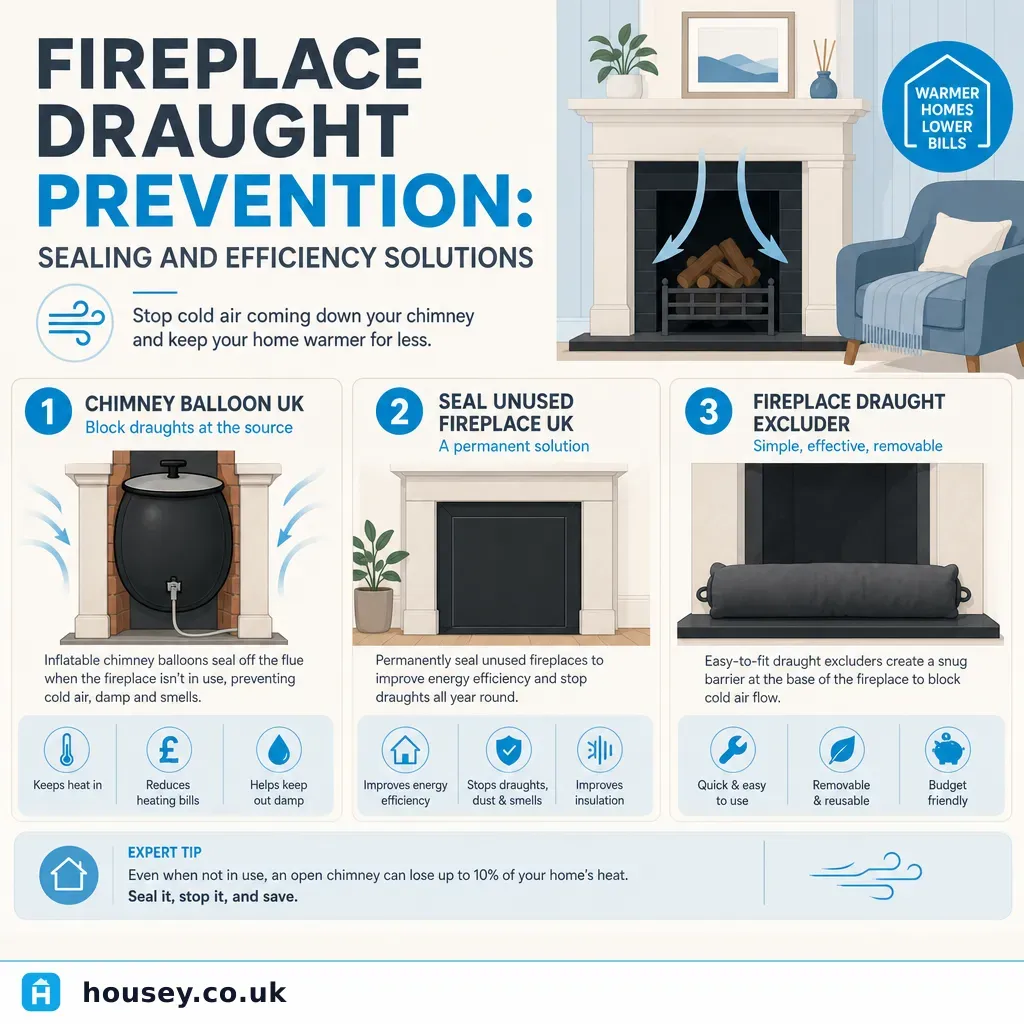
Fireplace Draught Prevention: Sealing and Efficiency Solutions
Draughts from fireplaces and chimneys are a significant source of heat loss in UK homes, particularly in Victorian and Edwardian properties.
 Energy & Retrofit
Government Warm Homes Scheme: Energy Upgrades and Support for UK Homeowners
The Warm Homes Plan coordinates several UK government energy upgrade schemes.
 Energy & Retrofit
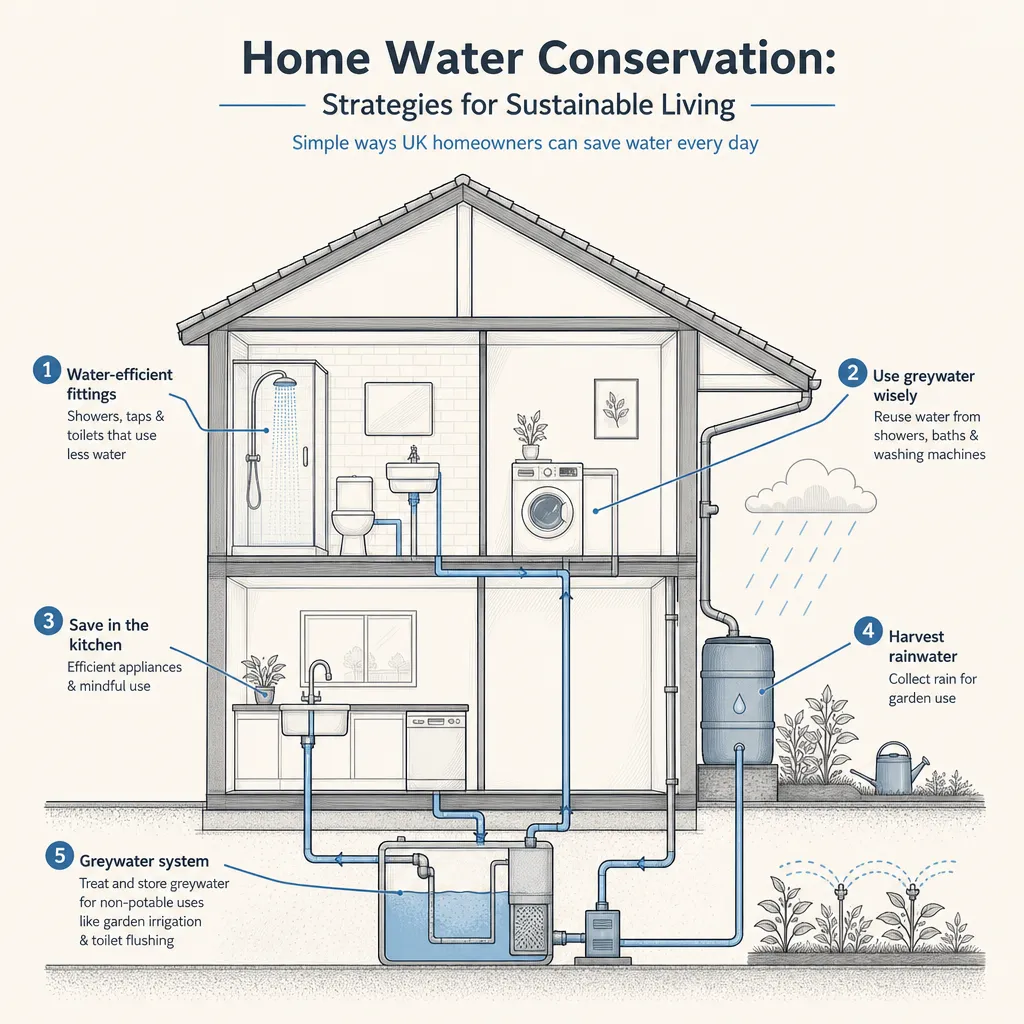
Home Water Conservation: Strategies for Sustainable Living
UK households use an average of around 142 litres per person per day.
 Energy & Retrofit
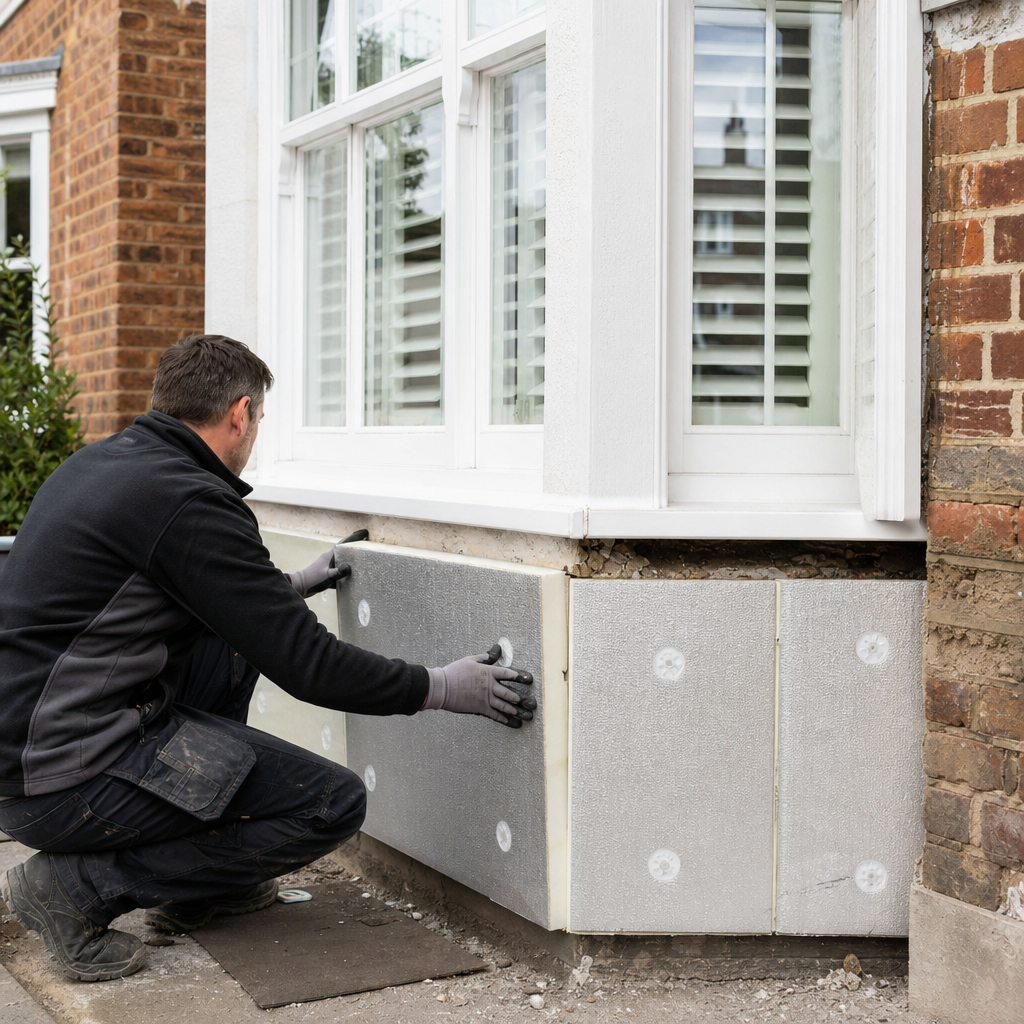
Insulating Solid Masonry Walls Under Bay Windows: Technical Guidance
Insulating solid masonry walls under bay windows requires specialist detailing at angled wall faces, window reveals, and the bay floor and ceiling junctions.