Solar Panel Grants and Funding: Maximising Clean Energy Investment
By Housey · Last reviewed 19th of May 2026
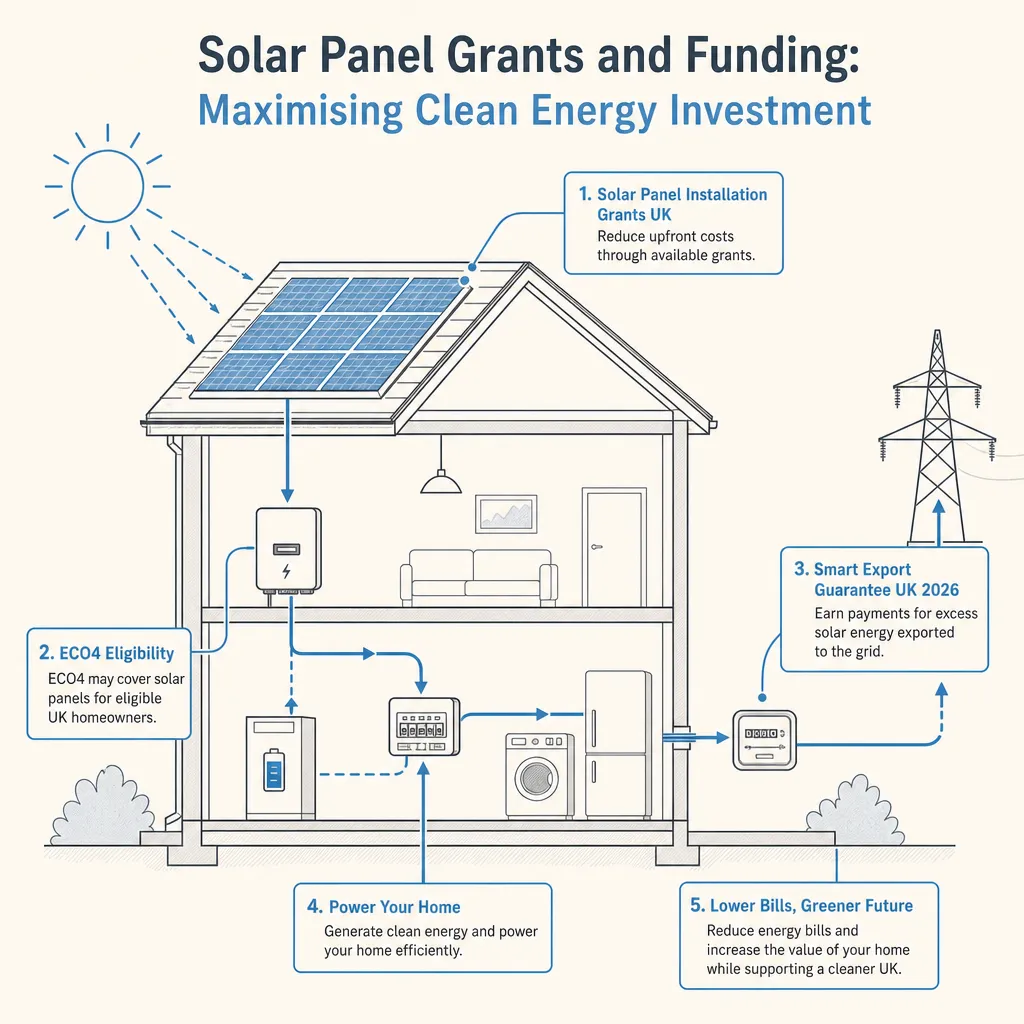
Solar Panel Grants and Funding: Maximising Clean Energy Investment
The upfront cost of a domestic solar PV system remains a significant outlay for most UK households, yet several grant schemes, tax reliefs, and export payments can meaningfully reduce the net investment — and ongoing running costs. Whether you are planning a first installation on a 1930s semi or adding battery storage to an existing array, understanding which support mechanisms are currently open, who qualifies, and how to combine them is the essential first step before approaching any installer.
Key points
- The Feed-in Tariff (FIT) closed to new applicants in April 2019; existing recipients continue to receive payments for the 20-year duration of their original tariff contract.
- The Smart Export Guarantee (SEG), introduced in January 2020, requires licensed energy suppliers with 150,000 or more domestic customers to offer at least one export tariff for surplus solar electricity.
- ECO4 (Energy Company Obligation 4) can fund free or heavily subsidised solar panels for eligible low-income and vulnerable households, with the scheme running until March 2026.
- Solar panel installations benefit from 0% VAT (reduced from 20%) until at least March 2027 under HMRC's energy-saving materials relief.
- MCS-accredited installers are required for SEG tariff eligibility and the majority of public grant schemes; verify accreditation before signing any contract.
What solar funding is currently available in the UK?
The funding landscape for solar PV has changed substantially since the Feed-in Tariff closed. Several mechanisms remain open or are being expanded under the Warm Homes Plan.
Scheme | Who it is for | What it covers | Status (May 2026) |
|---|---|---|---|
Smart Export Guarantee (SEG) | Most homeowners with MCS-certified solar | Export payments for surplus electricity | Open — rates vary by supplier |
ECO4 | Low-income and fuel-poor households (EPC D–G) | Free or subsidised solar and insulation | Open until March 2026 |
Great British Insulation Scheme (GBIS) | Fuel-poor households, EPC D–G | Insulation primarily; some linked solar support | Open — delivered through energy suppliers |
Home Upgrade Grant Phase 2 (HUG2) | Off-gas-grid, low-income homes | Solar PV, insulation, heat pumps | Phase 2 ended; successor schemes pending |
0% VAT on solar materials | All homeowners having solar installed | Reduces installation cost by approximately 17% | Confirmed to March 2027 |
Solar Together (selected councils) | Any homeowner in participating areas | Group-buy discount on systems | Check your local authority |
Sources: Ofgem SEG guidance; GOV.UK ECO4; HMRC energy-saving materials VAT relief. Indicative information correct as of May 2026; scheme details and eligibility can change.
The Smart Export Guarantee explained
The SEG obliges licensed electricity suppliers with 150,000 or more customers to offer at least one export tariff, though rates and structures vary considerably. As of May 2026, export rates from major suppliers range from roughly 4p to 24p per kilowatt-hour depending on whether the tariff is fixed, variable, or time-of-use. Octopus Energy, E.ON, EDF, and Ovo each offer SEG tariffs; smaller suppliers are not obliged to participate.
To be eligible for SEG payments:
- Your installer must hold current MCS accreditation and your system must be MCS-certified.
- Your property must have an export meter or a smart meter capable of recording export separately from consumption.
- You must apply directly to an energy supplier — SEG registration is not automatic on commissioning.
The SEG differs from the old FIT in a critical way: FIT paid for all electricity generated, whether used or exported. SEG pays only for what you actually export to the grid, making self-consumption more important to your return.
ECO4: who qualifies and how to apply
ECO4 is delivered through energy suppliers and local authorities. Eligibility is means-tested and linked to your property's Energy Performance Certificate (EPC) band.
You may qualify if you:
- Receive certain means-tested benefits (Universal Credit, Pension Credit, Child Tax Credit, income-based Employment and Support Allowance, among others)
- Live in a property with an EPC rating of D, E, F, or G
- Are referred through your local authority's flexible eligibility pathway, which some councils use for low-income households not receiving qualifying benefits
Application routes include contacting your energy supplier directly, applying via a local authority referral, or using an ECO4 broker. Be aware that some ECO4 brokers earn referral fees that can inflate costs for any top-up works falling outside the grant scope. Compare quotes where a co-payment is required.
Which option suits your situation?
- Choose the Smart Export Guarantee if your system is already MCS-certified or you are planning a new MCS-certified installation — register with a participating supplier promptly on commissioning.
- Explore ECO4 if you receive means-tested benefits, or your property is rated EPC D–G and your household income is below average — contact your energy supplier or local authority.
- Check Solar Together if your local authority participates and you want a straightforward, group-priced installation without independently evaluating multiple installers.
- Factor in 0% VAT as a baseline saving regardless of other funding — it applies to materials and installation for residential solar PV until at least March 2027.
- Ask about battery storage grants — several local authority and regional schemes, particularly in Wales and Scotland, offer additional support for storage alongside solar.
- Consult a retrofit coordinator if your property has complex fabric issues (solid walls, inadequate ventilation, listed status) — solar is usually best installed after fabric improvements are addressed under PAS 2035.
What a solar survey covers
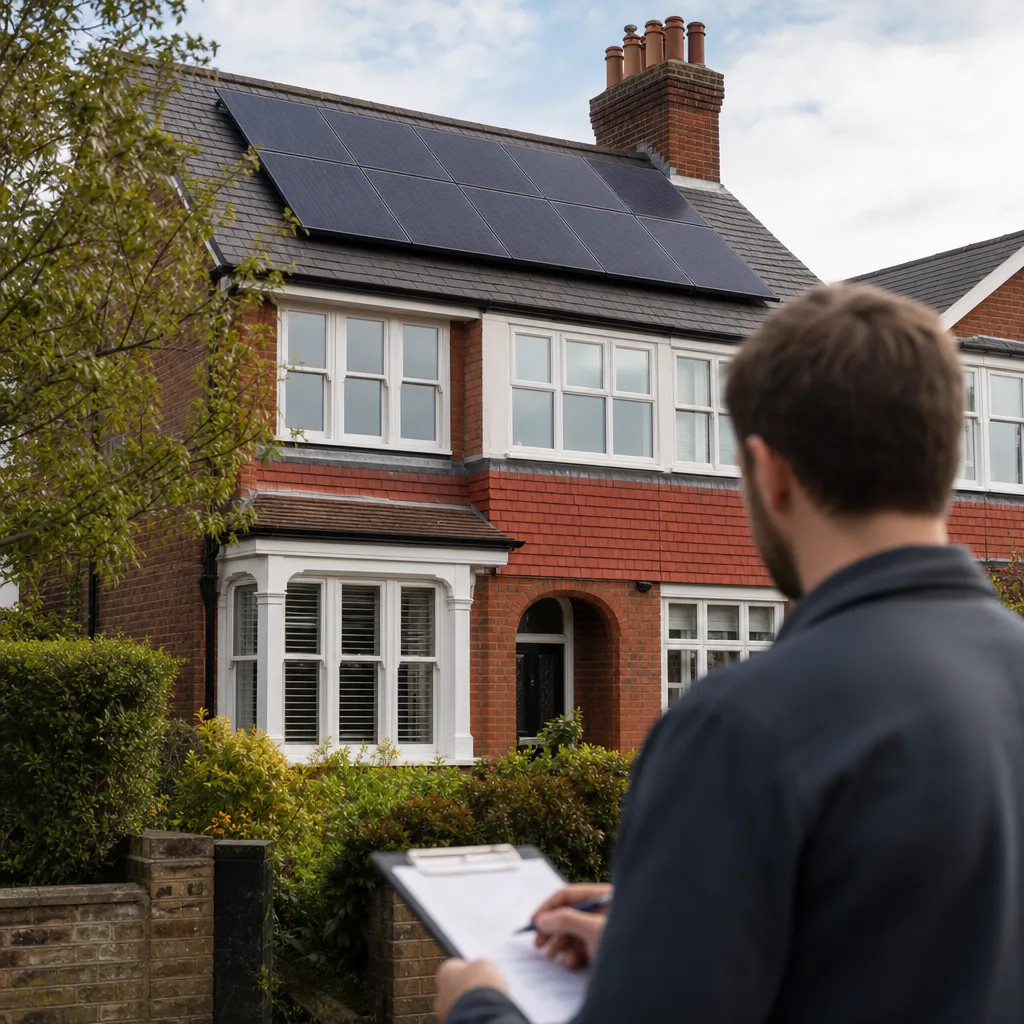
Before any grant application or installer quotation, a solar survey assesses your property's suitability. A thorough survey typically includes:
- Roof orientation, pitch, and shading analysis across different seasons
- Structural assessment confirming the roof can bear panel weight
- Estimation of current energy consumption and likely annual generation output
- Compatibility review of the existing electrical installation and consumer unit capacity
- EPC band confirmation, relevant where ECO4 eligibility depends on it
- Battery storage options and indicative payback modelling
The survey output informs both your grant eligibility and the accuracy of installer quotations. Without it, quotes may rely on assumptions that can substantially affect both cost and performance projections.
Homeowner checklist: before you sign an installation contract
When to get professional help
Most domestic solar installations are straightforward, but professional assessment is particularly advisable if:
- Your roof is older than 20 years, shows visible damage, or is in an unusual material such as clay pantile, natural slate, or thatch
- Your home is in a conservation area or is a listed building, where permitted development rights for solar may not apply
- The property is a leasehold flat with a shared roof, where freeholder or management company consent may be required before installation
- You are relying on ECO4 or another grant and need an accurate EPC assessment to confirm eligibility
- Your electrical installation appears old or has limited consumer unit capacity
How Housey can help
Housey connects you with qualified professionals for each stage of your solar project. A solar survey can confirm your roof's suitability and likely generation output before you commit to a purchase. If solar forms part of a broader home-improvement plan, a retrofit assessment will map all appropriate measures for your property, and an energy-efficiency consultant can advise on which funding streams to prioritise.
Frequently asked questions
Is the Feed-in Tariff still available for new solar installations?
No. The Feed-in Tariff (FIT) closed to new applicants in April 2019. Existing recipients continue to receive payments for the 20-year duration of their original tariff contract. New solar installations should register for the Smart Export Guarantee (SEG) instead.
Do I need planning permission to install solar panels on my home?
In most cases, solar panels on a house roof are permitted development in England and do not need planning permission, provided they do not protrude more than 200mm from the roof surface. Restrictions apply for listed buildings, properties in certain conservation areas, and national park locations. Always check with your local planning authority if you are uncertain.
Can I claim the Smart Export Guarantee if my installer was not MCS-accredited?
No. MCS accreditation of the installer and MCS certification of the system are both prerequisites for SEG eligibility. Verify MCS accreditation before instructing an installer — retrospective certification is not possible.
What is the typical payback period for solar PV in the UK?
Payback periods vary by system size, energy usage, roof orientation, and export tariff received. Energy Saving Trust guidance (2025) suggests a typical payback of 10–15 years for a self-funded system, reducing with ECO4 support or the 0% VAT saving. Battery storage generally extends payback but increases self-consumption rates.
Does solar PV improve my home's EPC rating?
Yes. A solar PV installation typically improves an EPC rating, often moving a property from band D to C or better, depending on system size and existing fabric performance. An improved EPC can affect eligibility for green mortgage products and, for rental properties, compliance with minimum energy efficiency standards.
Sources and further reading
- Smart Export Guarantee (SEG) — Ofgem
- Energy Company Obligation (ECO4) — GOV.UK
- VAT relief on energy-saving materials — HMRC
- Solar panels guide — Energy Saving Trust
- MCS certified installer search — MCS
Useful next reads
 Energy & Retrofit
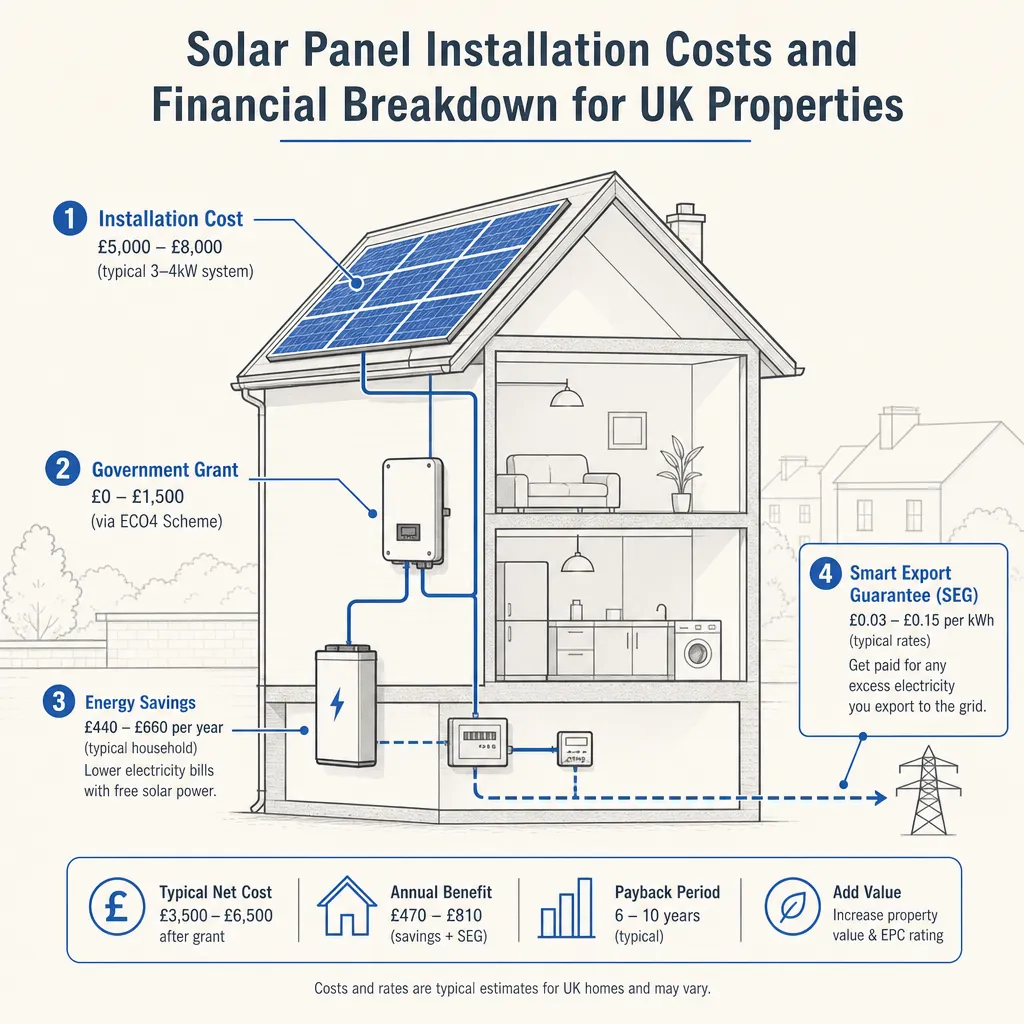
Solar Panel Installation Costs and Financial Breakdown for UK Properties
A typical domestic solar panel system (3.
 Energy & Retrofit
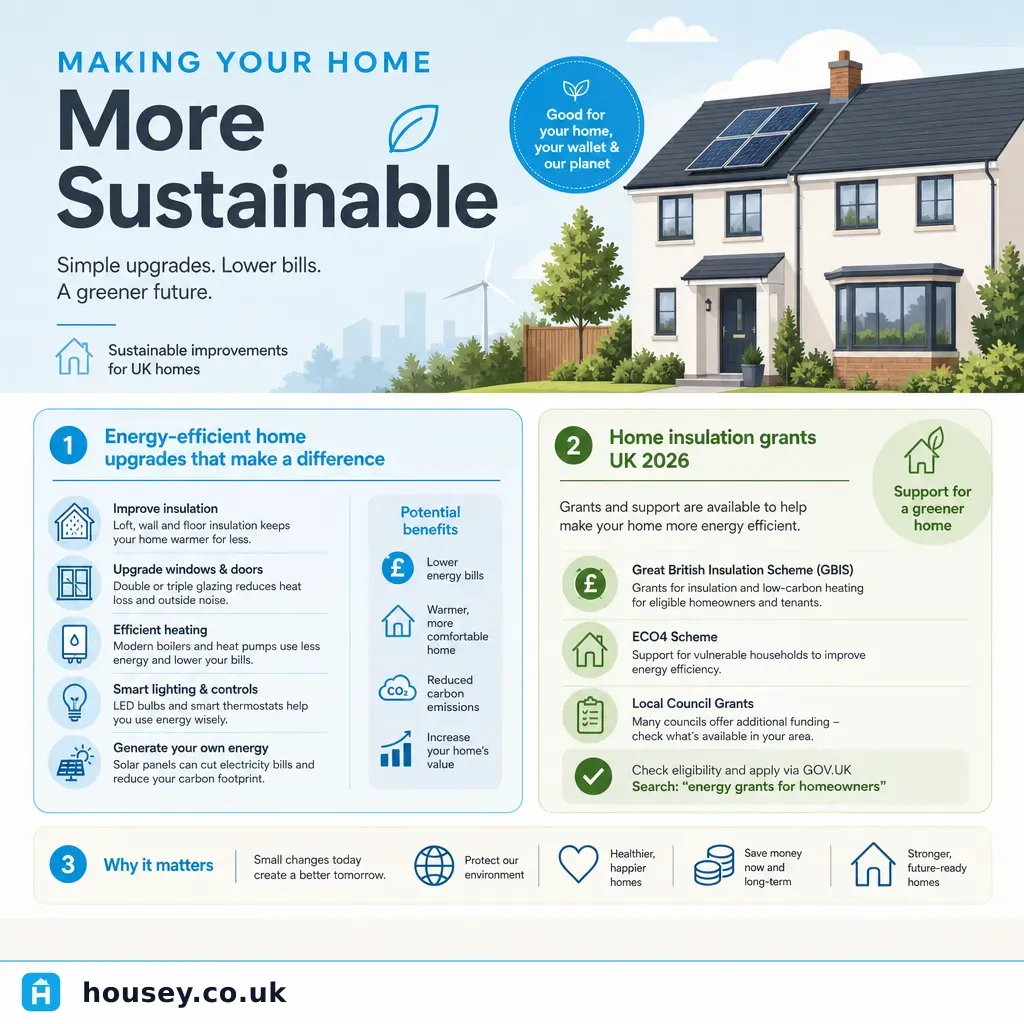
Making your home more sustainable
Making a UK home more sustainable usually starts with fabric-first improvements such as insulation, draught-proofing, and efficient glazing before adding renewable energy systems like solar panels or a heat pump.
 Energy & Retrofit
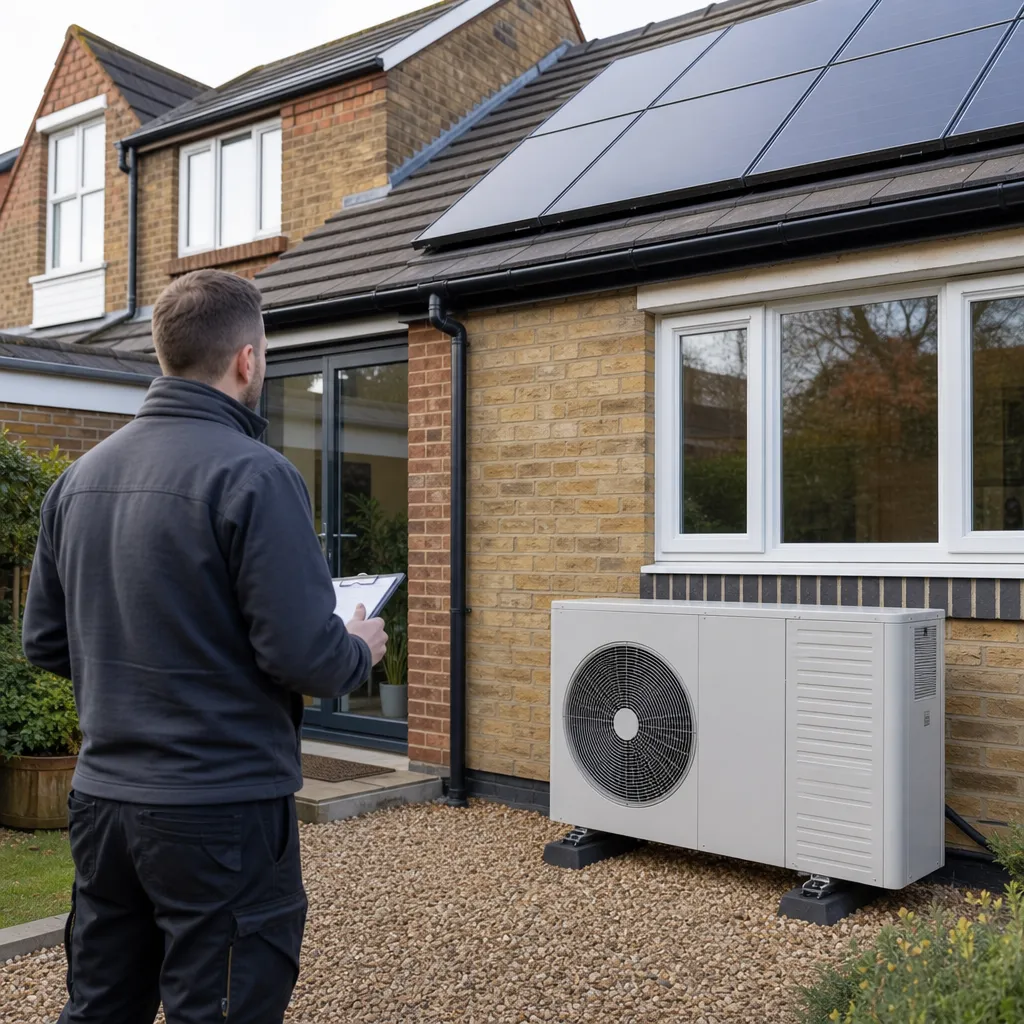
Renewable Energy Systems and Property Value: Solar Panels and Heat Pumps
Solar panels can add a modest 1–4% to UK property values in the right conditions, particularly when they improve the EPC rating.
 Energy & Retrofit
Do Solar Panels Increase Property Value?
Solar panels generally add value to UK properties, with research suggesting an uplift of 0.
 Energy & Retrofit
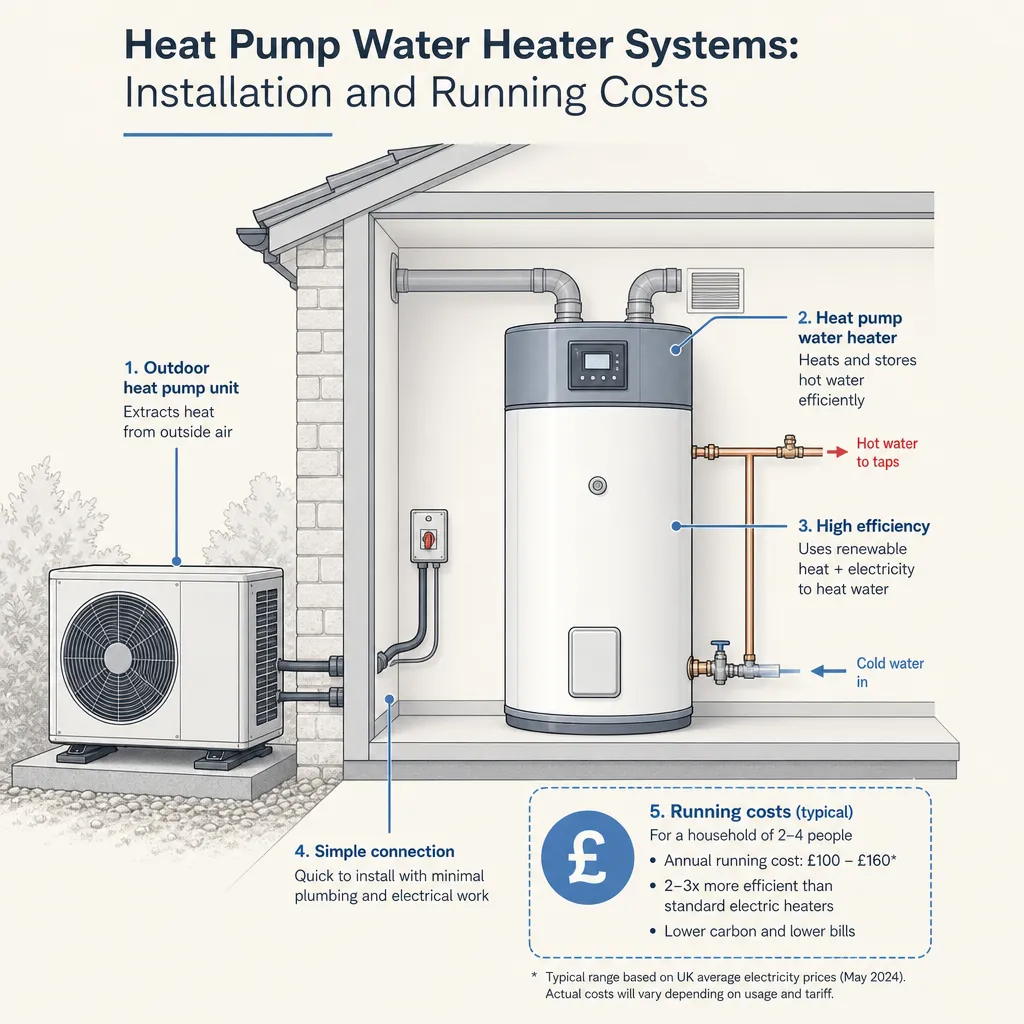
Heat Pump Water Heater Systems: Installation and Running Costs
A heat pump water heater extracts heat from surrounding air to warm your domestic hot water cylinder, achieving a Coefficient of Performance of 2.