Architectural Showcase: Grand Design Properties and Premium Homes
By Housey · Last reviewed 31st of May 2026
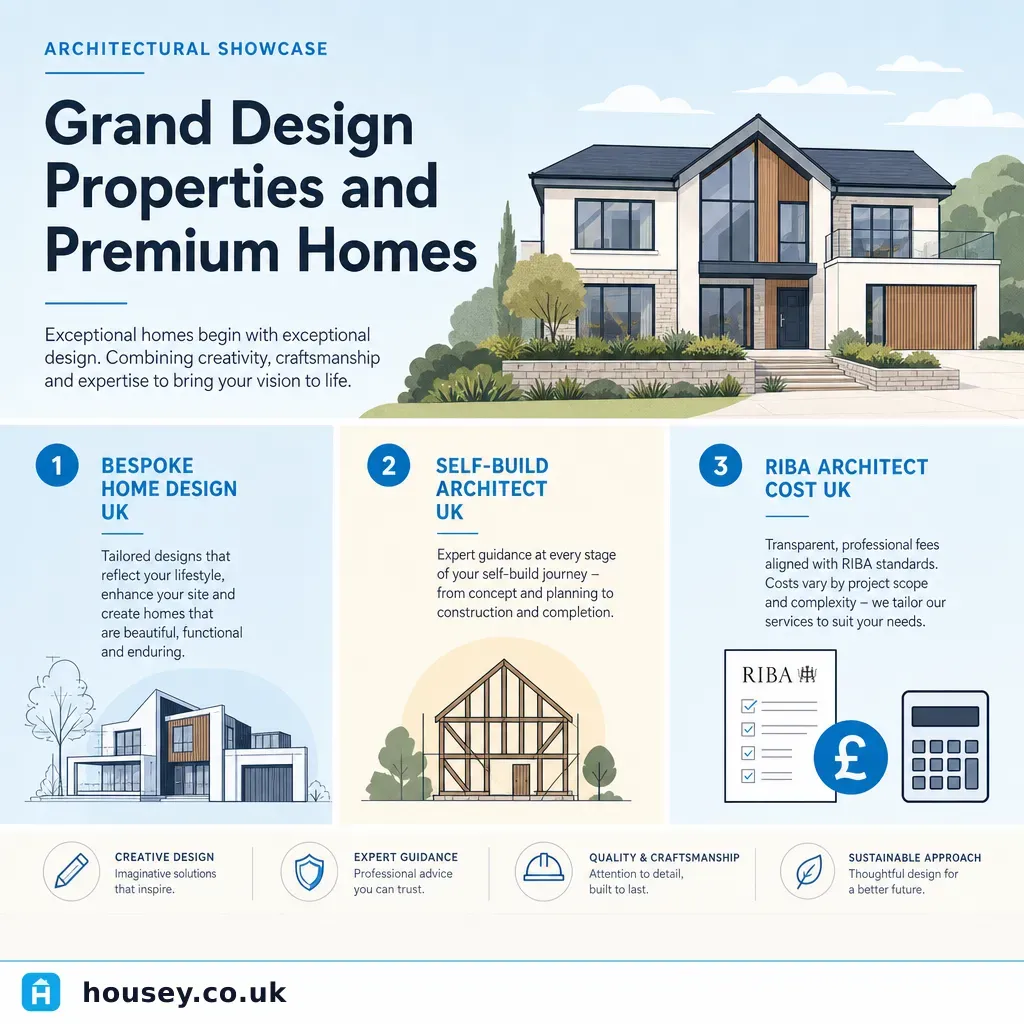
Architectural Showcase: Grand Design Properties and Premium Homes
Commissioning a bespoke home or undertaking a major architectural project is one of the most ambitious decisions a UK homeowner or self-builder can make. Whether the starting point is a plot of land, a dilapidated barn, or an existing property requiring complete transformation, the process involves navigating planning law, engaging a team of design professionals, and managing a project that can span several years. The financial stakes, regulatory complexity, and personal investment are all considerable.
Key points
- RIBA architects operate across eight defined Plan of Work stages (Stage 0 to Stage 7), from strategic definition through to post-occupancy evaluation — most bespoke home commissions span Stages 1 to 6.
- Under the Self-Build and Custom Housebuilding Act 2015, local authorities with a population over 30,000 must maintain a register of self-build demand and grant sufficient development permissions to meet it.
- Planning permission for a wholly new dwelling or a substantial replacement dwelling is almost always required; permitted development rights rarely apply to new standalone structures or demolish-and-rebuild schemes.
- A measured building survey of an existing structure or site is typically required before detailed design work can begin, providing the accurate dimensional data on which architects base their drawings and cost plans.
- Design and access statements are required for most planning applications in England, explaining how the proposal responds to the site, its character, and accessibility requirements under the Town and Country Planning (Development Management Procedure) Order 2015.
What defines a grand design or premium home?
In UK property terms, a grand design or premium home is broadly any single dwelling architecturally designed to a bespoke brief rather than built to a standard developer layout. This can mean a new-build on a greenfield or brownfield plot, a conversion of a non-residential building (barn, church, water tower, industrial unit), or a substantial reconstruction of an existing home to a completely different design.
Common architectural features associated with premium homes include:
- Large-format glazing and structural glass elements, including frameless systems and automated rooflights
- Open-plan living areas with double- or triple-height volumes
- Flat or sedum (green) roofs in contemporary schemes
- Exposed structural elements: engineered timber frames, steel beams, board-marked concrete soffits
- Passive House (Passivhaus) or low-energy design principles integrated from the outset
- Smart-home technology — lighting, heating, security, and audio-visual — designed into the specification from the start
The design of such homes is typically led by an architect registered with the Architects Registration Board (ARB) and, in many cases, a member of the Royal Institute of British Architects (RIBA).
The design and planning process: stage by stage
Stage 1 — Site appraisal and brief
Before any design work begins, a thorough site appraisal is essential. This typically includes:
- A topographical survey of the land to establish levels and site boundaries
- A measured building survey if an existing structure is being adapted or demolished — this records precise dimensions and condition before works begin, forming the baseline for all design drawings
- A pre-application planning enquiry with the local planning authority (LPA) to gauge its likely attitude towards a new or replacement dwelling
- Checks for planning constraints: conservation area, listed building status, Green Belt, flood zone, protected trees, and registered rights of way
Stage 2 — Concept design and planning application
The architect develops concept designs — usually two or three options — and refines them into a preferred scheme. For most standalone new homes and all replacements of non-residential buildings, a full planning application is required. Applications must typically be accompanied by:
- A design and access statement
- Site location and block plans at 1:1250 and 1:500
- Architectural drawings: elevations, floor plans, and sections at 1:100
- Supporting reports where triggered: heritage impact assessment, ecological survey, flood risk assessment, arboricultural report
Planning decisions for full applications typically take eight weeks from validation in England, though complex or contested applications routinely exceed this.
Stage 3 — Technical design and Building Regulations
Once planning permission is granted, the architect produces detailed technical drawings for Building Regulations approval. For premium homes, this stage routinely involves structural engineers, mechanical and electrical (M&E) consultants, and sometimes a Passivhaus designer or acoustic consultant. Building Regulations approval can be sought through a local authority building control body or a Registered Building Inspector under the Building Safety Act 2022.
Which professionals do you need?
Professional | Role | When to engage |
|---|---|---|
RIBA architect | Concept design, planning, technical design, contract administration | From site appraisal onwards |
Structural engineer | Foundation design, structural frame, load calculations | From technical design stage |
Measured building surveyor | Accurate dimensional survey of existing structure or site | Before detailed design begins |
Topographical surveyor | Land levels and site features survey | Before design begins |
Planning consultant | Pre-application advice, complex or contentious applications | Early — especially for Green Belt, conservation area, or listed building sites |
M&E consultant | Heating, ventilation, electrical, and smart-home specification | Technical design stage |
Party wall surveyor | Party Wall etc. Act 1996 obligations if within 3–6 m of a neighbour's structure | Before site works begin |
A worked UK property scenario
Situation: A couple own a 1960s detached bungalow on a generous suburban plot in the south-east of England. The bungalow is in poor condition. They want to demolish it and build a contemporary two-storey home with a large glazed rear section and a sedum roof.
How the project progressed:
- Pre-application enquiry with the LPA confirmed no objection in principle to a replacement dwelling of similar footprint, but the LPA asked the design to relate to the streetscene.
- A measured building survey of the bungalow was commissioned to record its dimensions accurately before demolition and inform the site model.
- The architect produced three concept options; a scheme with a traditional street frontage and a contemporary glazed rear was selected.
- A full planning application was submitted with a design and access statement and an ecological survey — a bat survey was required because the roof space had potential roosting habitat.
- Planning permission was granted after 11 weeks, with conditions including materials approval and a Construction Management Plan.
- A Building Regulations Full Plans application was submitted; a structural engineer was appointed for foundation design and the steel frame specification.
- Contractor appointed via competitive tender; on-site duration approximately 14 months.
What to ask before appointing an architect
- Are you registered with the Architects Registration Board (ARB)?
- Are you a RIBA member, and do you follow the RIBA Plan of Work?
- Have you completed projects of similar scale, type, and planning complexity?
- What is your fee structure — percentage of construction cost, lump sum, or time charge?
- Does your appointment include contract administration and site visits during construction?
- How do you handle planning conditions and discharge of conditions?
- Can you provide references from previous clients on comparable bespoke projects?
- What level of professional indemnity insurance do you carry, and for how many years after completion?
When to get professional help
A grand design project almost always requires professional engagement from the outset. Certain situations call for additional specialist input beyond the core architect:
- Conservation area or listed building: a heritage consultant and, for listed building consent applications, a conservation architect with specific listed building experience
- Green Belt site: a specialist planning consultant — new dwellings face significant policy resistance, and permitted development rights are restricted or removed
- Complex ground conditions: a geotechnical engineer for foundation assessment, soil testing, and specialist foundation design
- Proximity to neighbours: a party wall surveyor as soon as the design is sufficiently developed to assess proximity to shared boundaries and foundations
- Ecological constraints: protected species surveys (bats, great crested newts, barn owls) are seasonal — plan these well in advance of your target planning submission date
How Housey can help
If you are at the pre-design stage of a bespoke or premium home project, commissioning a measured building survey is one of the earliest practical steps — it gives your architect the accurate dimensional data they need to develop a feasible, costed design. Housey connects homeowners and self-builders with qualified surveyors across the UK.
Frequently asked questions
Do I need a registered architect for a grand design home, or can I use a designer?
Only individuals registered with the Architects Registration Board (ARB) may legally use the title 'architect' in the UK. Architectural designers who are not ARB-registered can legally produce plans, but for complex bespoke projects requiring planning permission and Building Regulations approval, a chartered architect typically offers greater accountability, professional indemnity insurance, and technical expertise.
How long does it take to build a bespoke home in the UK?
From initial brief to moving in, a bespoke home typically takes two to five years. Planning alone can take six months to a year or more for complex or contested sites. On site, allow at least 12–18 months for a substantial new dwelling. Barn conversions and smaller plots can be quicker; contentious or technically complex projects take longer.
What is a measured building survey and when is it needed for a self-build?
A measured building survey produces accurate scaled drawings — floor plans, elevations, and sections — of an existing building using laser scanning or traditional measurement. It is needed whenever an architect is designing works to or a replacement for an existing structure, giving the designer reliable dimensional data before any design work is costed or submitted for planning.
Can I get a self-build mortgage for a grand design project in the UK?
Yes. Specialist self-build mortgage products are available from lenders including Ecology Building Society and Buildstore-partnered lenders, as well as some high-street banks. Funds are typically released in stages as the build progresses rather than as a lump sum. Seek advice from a specialist self-build mortgage broker early, as criteria and stage-release schedules vary significantly between lenders.
Sources and further reading
- RIBA Plan of Work 2020 — Royal Institute of British Architects
- Self-Build and Custom Housebuilding Act 2015 — legislation.gov.uk
- Planning permission: when you need it — GOV.UK
- Check the Architects Register — Architects Registration Board
- Custom and Self Build Portal — NaCSBA
Useful next reads
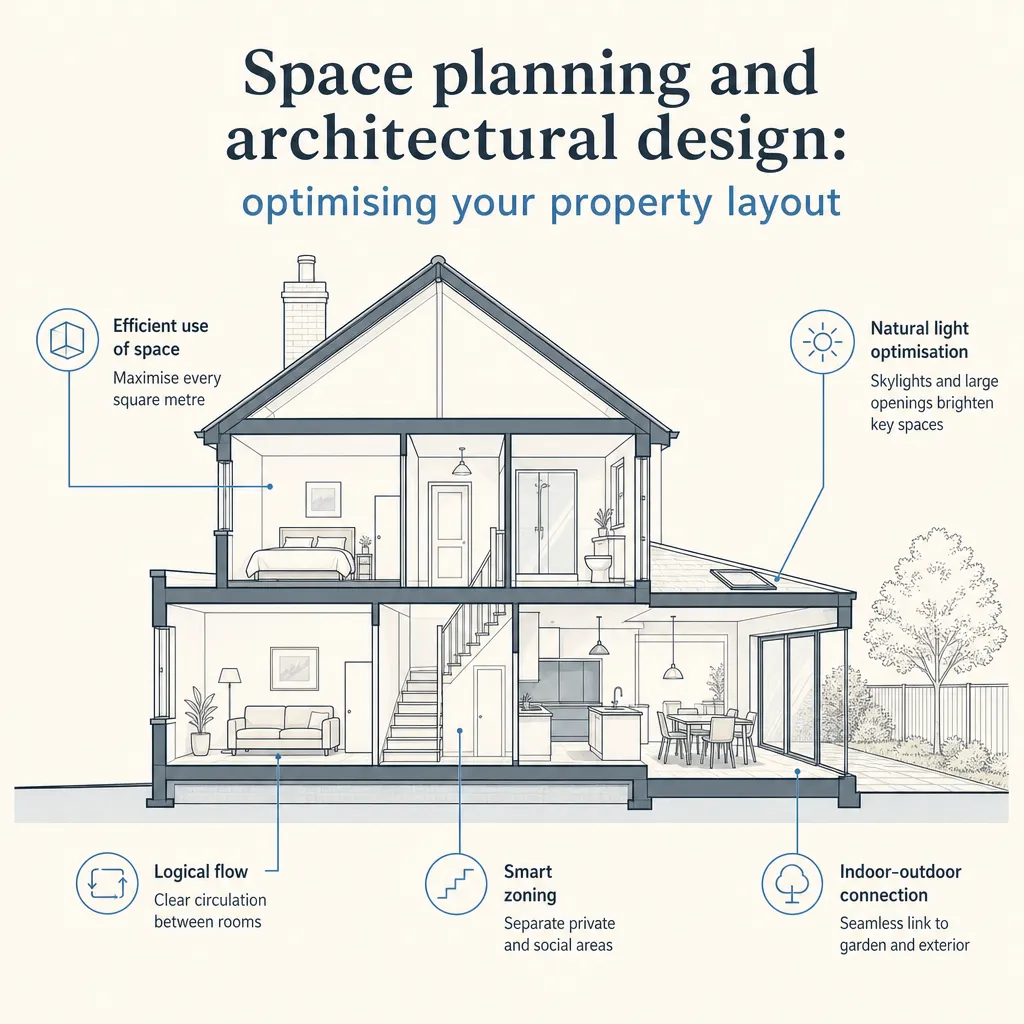 Planning & Pre-Build
Space planning and architectural design: optimising your property layout
Space planning defines how rooms, circulation routes, and services are arranged within a property to make the best use of available area.
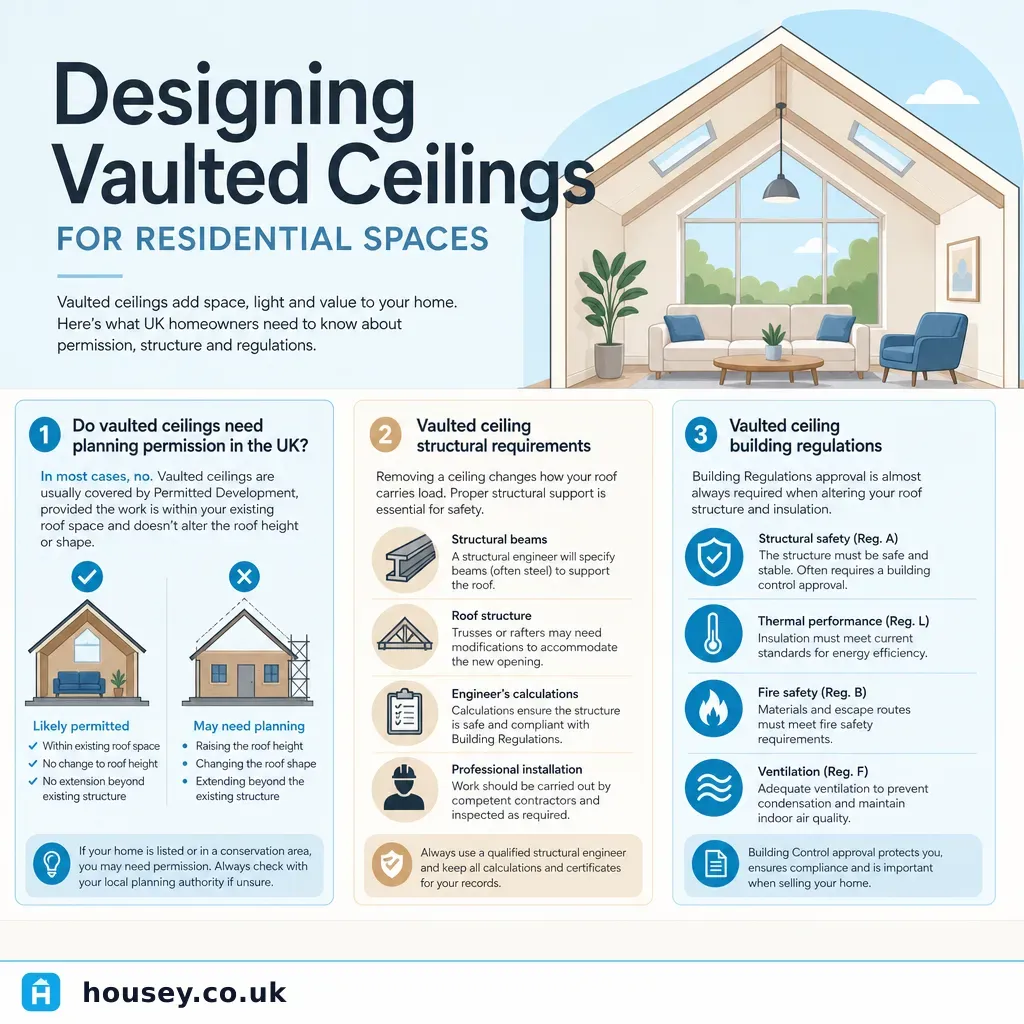 Planning & Pre-Build
Designing vaulted ceilings for residential spaces
Creating a vaulted ceiling in an existing home involves restructuring the roof timbers that form the structural triangle, which always requires a structural engineer's calculations and Building Regulations approval under Approved Document A.
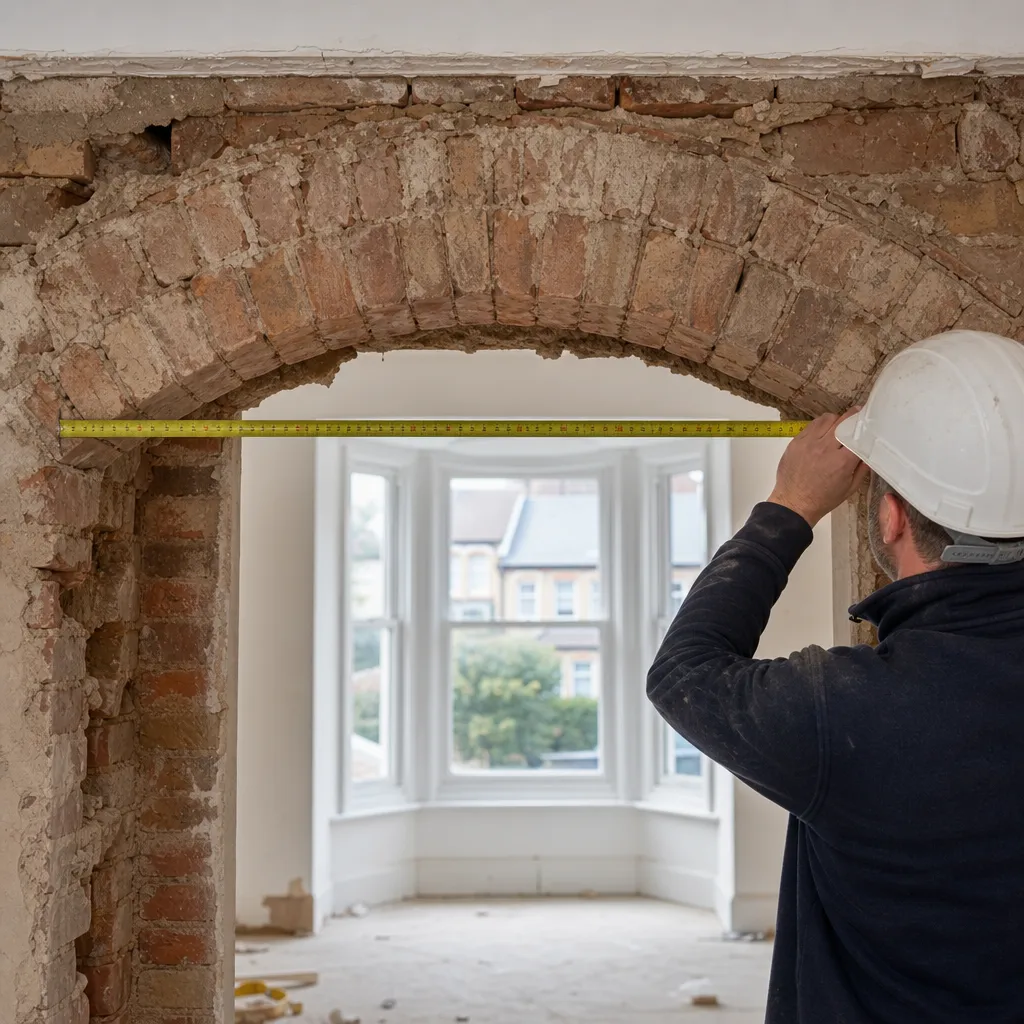 Planning & Pre-Build
Structural Arching in Walls: Load Distribution and Design
Structural arching occurs when masonry redistributes compressive loads in a triangular or parabolic path around an opening, reducing the load on the lintel below.
 Planning & Pre-Build
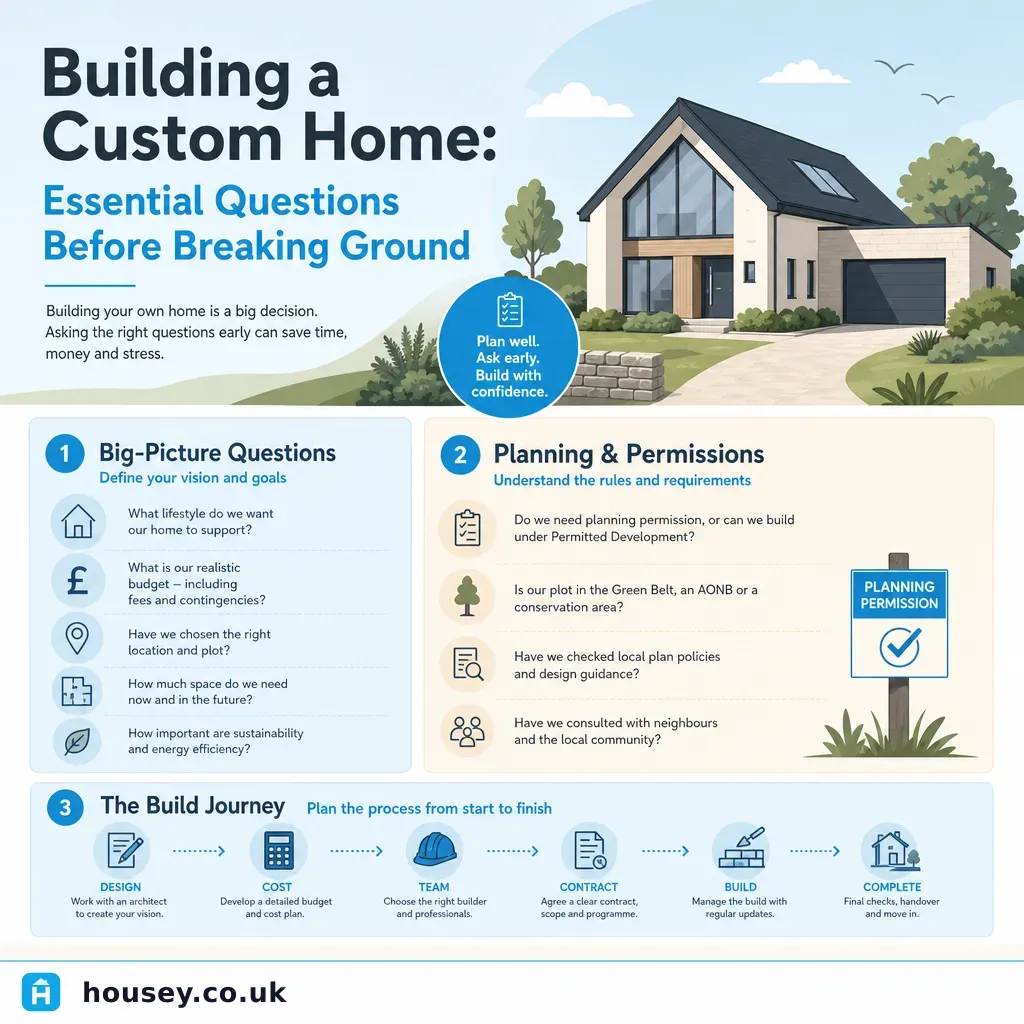
Building a Custom Home: Essential Questions Before Breaking Ground
Building a custom home in the UK requires planning permission, separate Building Regulations approval, and a professional team typically including an architect or architectural technologist, structural engineer, and building control body.
 Planning & Pre-Build
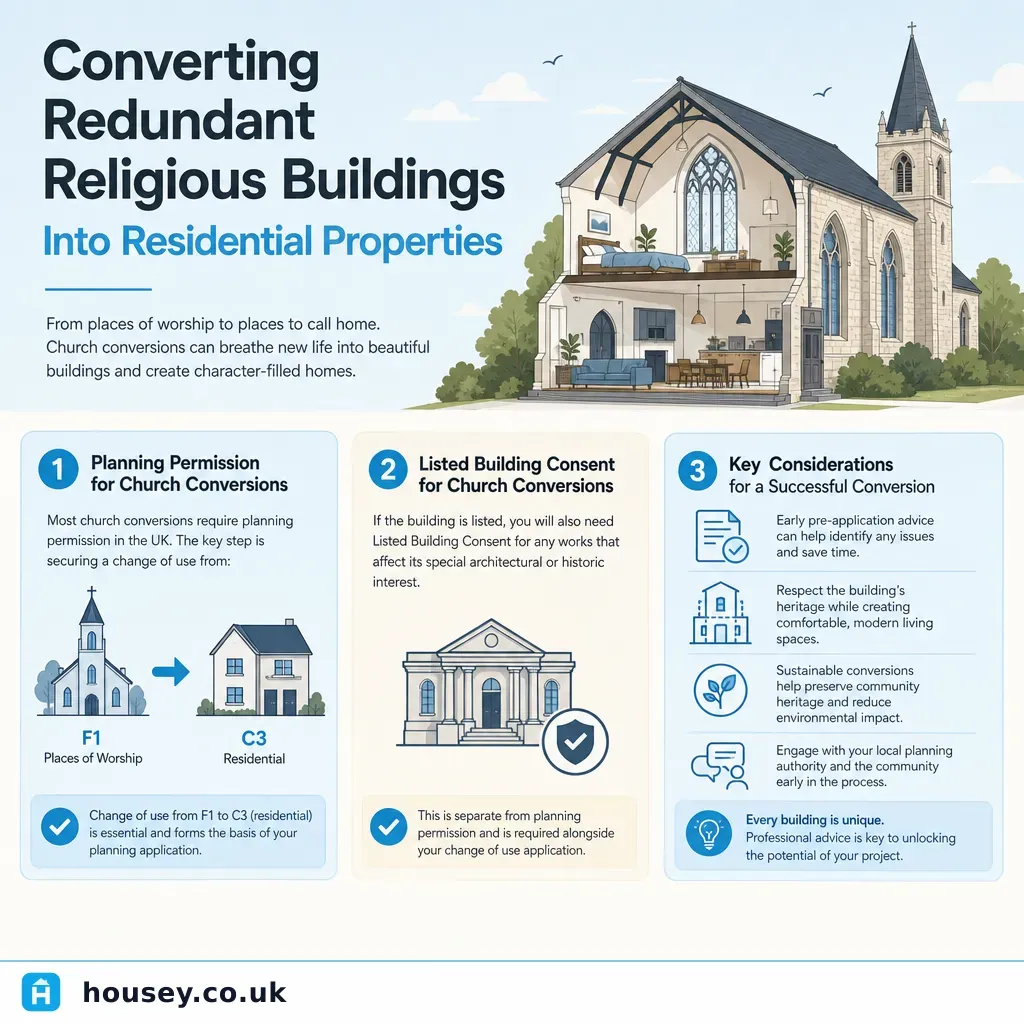
Converting Redundant Religious Buildings Into Residential Properties
Converting a redundant religious building to residential use in the UK requires planning permission for change of use from Use Class F.