Green Roof Installation: Costs, Benefits and Design Considerations
By Housey · Last reviewed 7th of May 2026
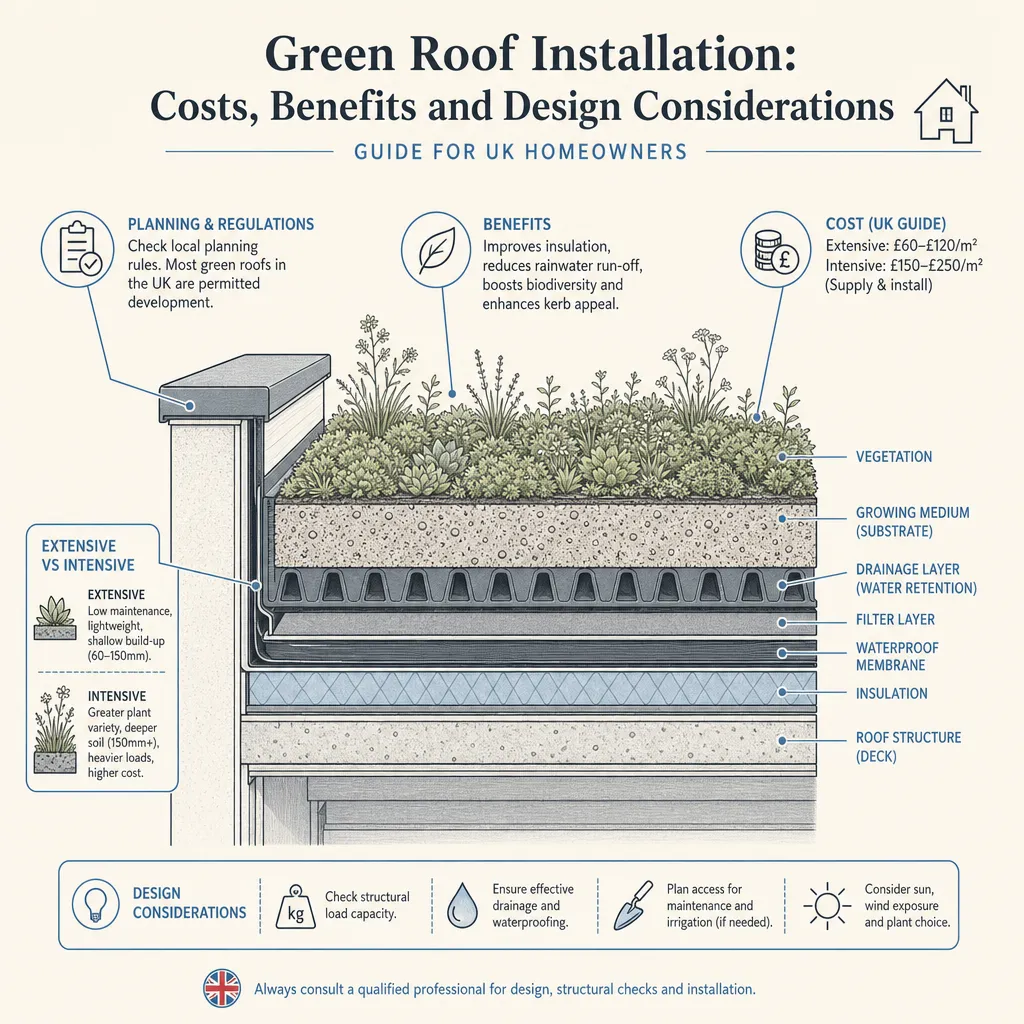
Green Roof Installation: Costs, Benefits and Design Considerations
Green roofs — also called living roofs — are increasingly specified on UK extensions, flat-roof garages, garden rooms, and new-build homes, driven partly by biodiversity net gain requirements under the Environment Act 2021 and local planning policies encouraging sustainable drainage. The project involves structural, waterproofing, drainage, horticultural, and planning considerations that must all be resolved before a contractor starts work.
Key points
- Extensive green roofs with 60–150 mm substrate typically cost £50–£150 per m² installed; intensive systems with 150 mm–1,500 mm substrate typically cost £100–£500+ per m² (Indicative UK costs, last reviewed 2026-05-07).
- A saturated extensive roof adds approximately 60–150 kg/m² of dead load; intensive systems can add 150–1,000+ kg/m² — a structural engineer must confirm capacity before installation.
- From February 2024, most planning applications in England must demonstrate mandatory biodiversity net gain (BNG) of at least 10% under the Environment Act 2021; a green roof can contribute measurable habitat units.
- Building Regulations Part A (structure) and Part C (moisture resistance) typically apply to green roofs installed over habitable rooms.
Extensive vs intensive: which type suits your project?
The two main categories differ in substrate depth, weight, cost, maintenance, and planting range.
Feature | Extensive | Intensive |
|---|---|---|
Substrate depth | 60–150 mm | 150 mm–1,500 mm |
Weight (saturated) | 60–150 kg/m² | 150–1,000+ kg/m² |
Typical plants | Sedum, moss, wildflowers | Grasses, shrubs, small trees |
Maintenance | Low (1–2 visits/year) | Regular (watering, mowing) |
Indicative installed cost | £50–£150/m² | £100–£500+/m² |
Best suited to | Extensions, garages, garden rooms | Roof terraces, eco-homes |
Indicative UK costs, last reviewed 2026-05-07. Costs vary by region, access, and specification.
A third option — a brown or biodiverse roof — uses crushed aggregate and minimal planting to recreate brownfield habitat, often at lower cost. Ecologists most commonly specify these to satisfy urban planning conditions.
Which type should you choose?
- Choose extensive sedum or wildflower if your structure is a standard flat-roof extension with limited spare load capacity and you want low maintenance.
- Choose intensive if you want an accessible planted terrace or higher biodiversity value, and your structure is confirmed capable of the additional load.
- Specify a brown or biodiverse roof if a BNG assessment or planning condition specifically requires brownfield habitat.
- Consult a structural engineer before retrofitting any green roof onto an existing structure.
How much does a green roof cost in the UK?
System | Typical installed cost (per m²) |
|---|---|
Sedum blanket (extensive, pre-grown) | £80–£150 |
Wildflower or meadow (extensive, plug planted) | £50–£120 |
Intensive planted terrace | £150–£500+ |
Brown or biodiverse roof | £40–£100 |
Indicative UK costs, last reviewed 2026-05-07. Obtain at least three quotes before committing.
Additional costs to budget for: structural engineer's assessment (typically £400–£1,200); irrigation for intensive systems (£500–£2,000+); scaffolding and access; ongoing maintenance contracts (£150–£500/year for extensive systems, more for intensive).
Planning permission and building regulations
Installing a green roof is generally treated as a change of material and may fall within permitted development rights, unless the property is listed, in a conservation area, or subject to an Article 4 direction. For new extensions that already require planning permission, including the green roof in the drawings can positively support approval in areas where sustainability is a local planning objective.
Building regulations typically apply. Approved Document A (structure) requires the roof and supporting elements to bear the additional load. Approved Document C requires root-resistant waterproofing. Approved Document L sets U-value standards the roof build-up must independently meet. Consult your building control body at design stage.
Always check with your local planning authority before proceeding if the property is listed or in a conservation area.
Homeowner checklist: before specifying a green roof
Red flags when getting green roof quotes
- No mention of a structural assessment or request to see existing structural drawings.
- Waterproofing not specified as root-resistant or FLL-compliant.
- No drainage layer specification — drainage is critical to plant survival and membrane longevity.
- Unusually low m² price with no substrate depth breakdown.
- Installer unable to provide references from completed projects.
- No discussion of building regulations compliance or certification.
When to get professional help
A green roof project typically needs a specialist roofer with documented green roof experience alongside a structural engineer's sign-off. Also involve:
- A planning consultant or local planning authority if the property is listed, in a conservation area, or if a planning application is being prepared.
- An ecologist if the roof must satisfy BNG requirements — a habitat unit calculation using the Defra Biodiversity Metric may be required.
- A building control surveyor to confirm regulatory scope and agree inspection stages.
Do not proceed based solely on a contractor's assurance that no structural or regulatory work is needed.
How Housey can help
Housey connects you with experienced professionals at every stage of a green roof project. You can find a specialist roofer for installation quotes, arrange a structural engineering assessment to confirm your roof's load capacity, or commission an environmental survey for biodiversity net gain if your project has a planning ecology requirement.
Frequently asked questions
Does a green roof need planning permission?
Installing a green roof on an existing flat roof may fall within permitted development rights, but this depends on location, visibility, and whether the property is listed or in a conservation area. For new extensions already requiring planning permission, include the green roof in the application. Always check with your local planning authority before starting work.
How long does a green roof last?
A well-specified green roof with a root-resistant membrane typically lasts 40–60 years, often outlasting conventional flat-roof coverings. The planting layer protects the membrane from UV degradation and thermal cycling. Regular maintenance visits to check drainage outlets and remove invasive species help extend this lifespan further.
Can any flat roof support a green roof?
Not necessarily. The additional dead load when substrate is saturated must be within the capacity of the existing deck, joists, walls, and foundations. A structural engineer should assess the existing construction before any green roof is specified. Timber-joist flat roofs on extensions may need strengthening depending on joist size, span, and condition.
Do I need a maintenance contract for a green roof?
Extensive sedum roofs typically require one or two visits per year to remove weeds and check drainage outlets. Many installers offer annual maintenance contracts. Intensive systems need more frequent attention. Neglecting maintenance can cause drainage blockages and membrane failures, and may void the installer's warranty.
Sources and further reading
- Biodiversity net gain: overview — GOV.UK
- GRO Green Roof Code of Best Practice — Green Roof Organisation
- Environment Act 2021 — legislation.gov.uk
- Flood and Water Management Act 2010 — legislation.gov.uk
- Approved Document A: Structure — GOV.UK
- Historic England: technical advice on buildings — Historic England
Useful next reads
 Improvement & Build
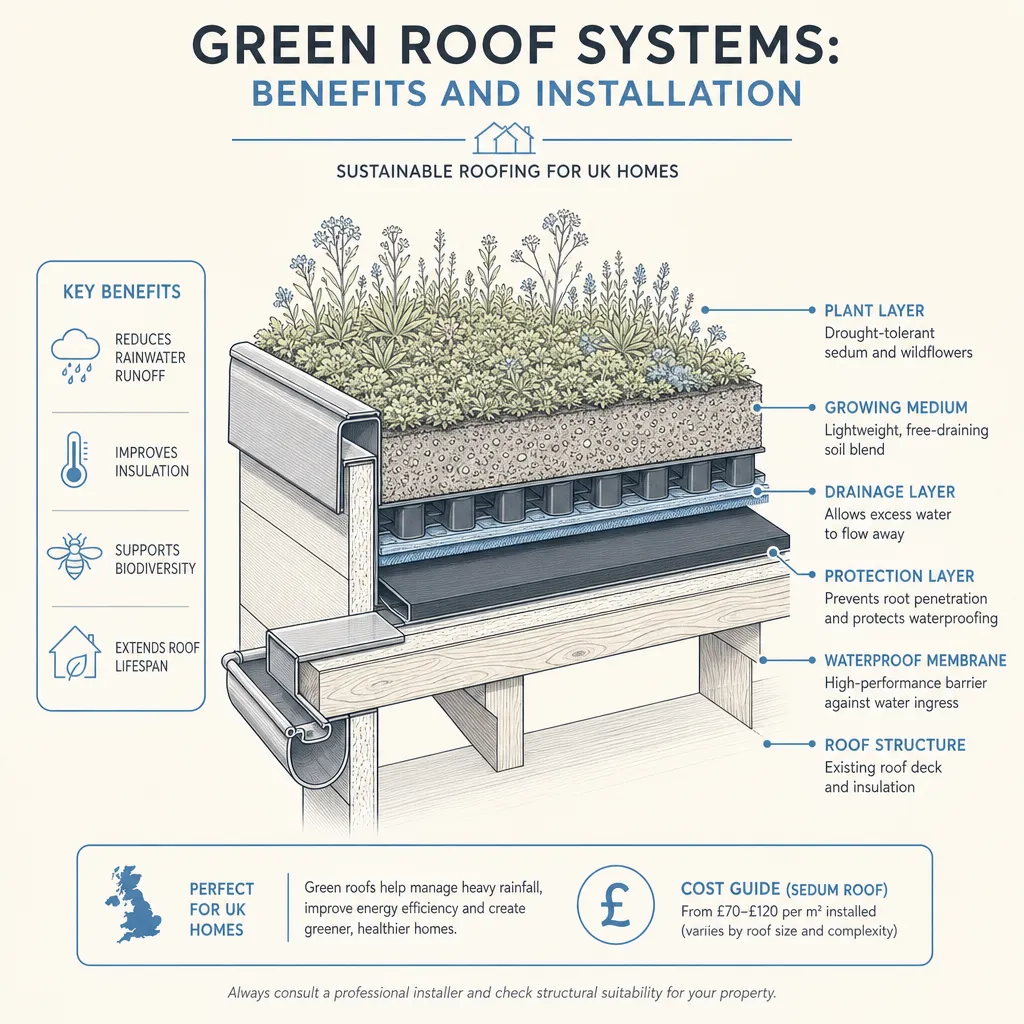
Green Roof Systems: Benefits and Installation
Green roof systems come in three main types: extensive (shallow sedum or wildflower planting, lightweight at 60–150 kg/m² when saturated), semi-intensive, and intensive (deeper substrate, suited to roof gardens).
 Improvement & Build
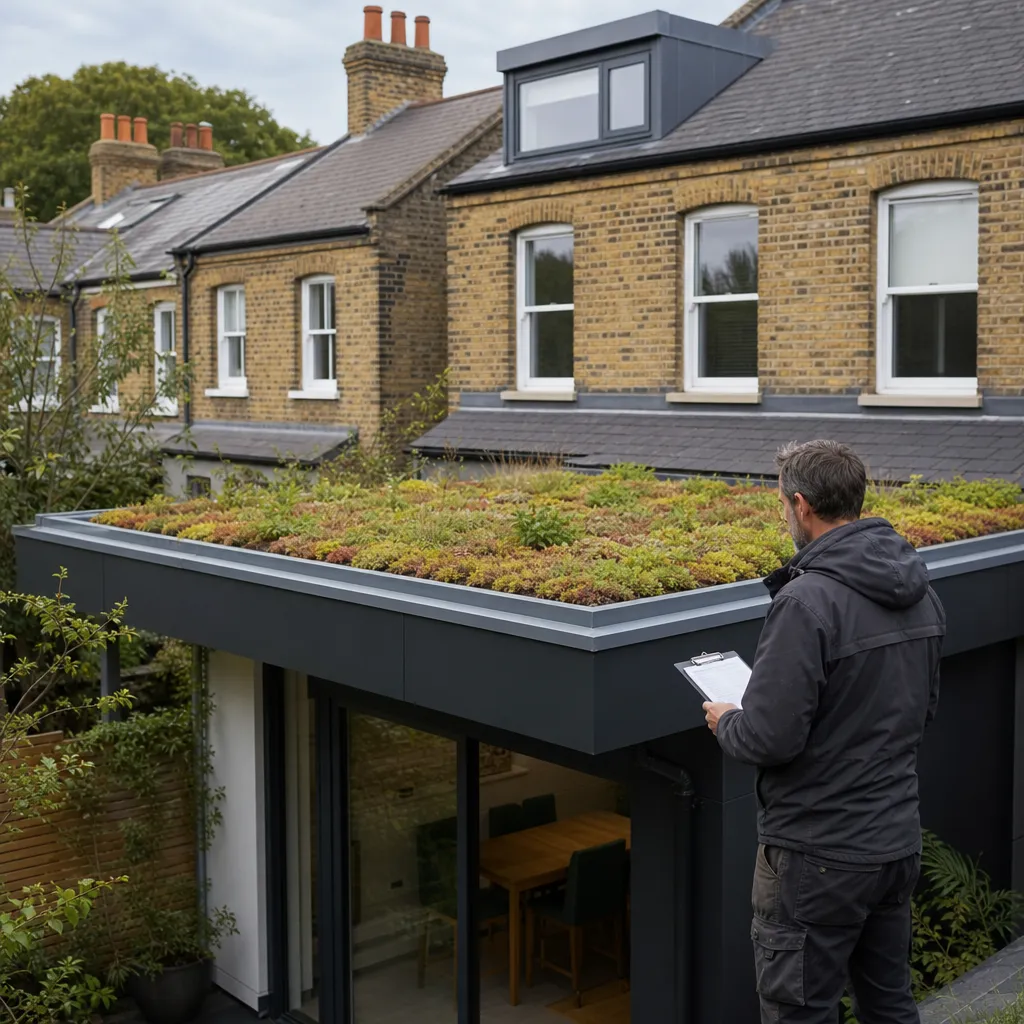
Exterior Colour Schemes for Green Roofs: Design Coordination
Warm greys, earth tones, natural timber, and dark charcoals tend to work best with green or living roofs, complementing the seasonal shift from vivid green in summer to bronze and straw in autumn and winter.
 Improvement & Build
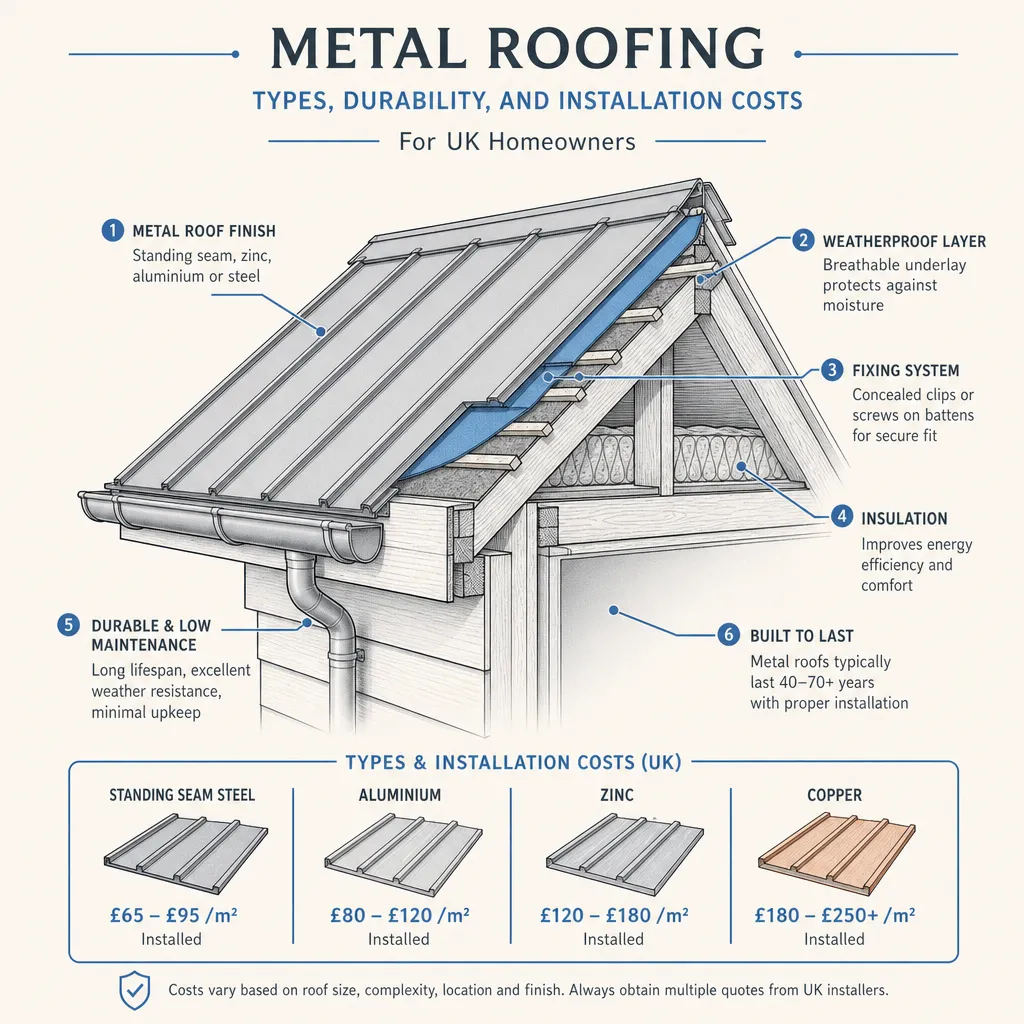
Metal Roofing: Types, Durability, and Installation Costs
Metal roofing in the UK includes standing seam, corrugated sheet, and metal tile systems in steel, aluminium, zinc, or copper.
 Improvement & Build
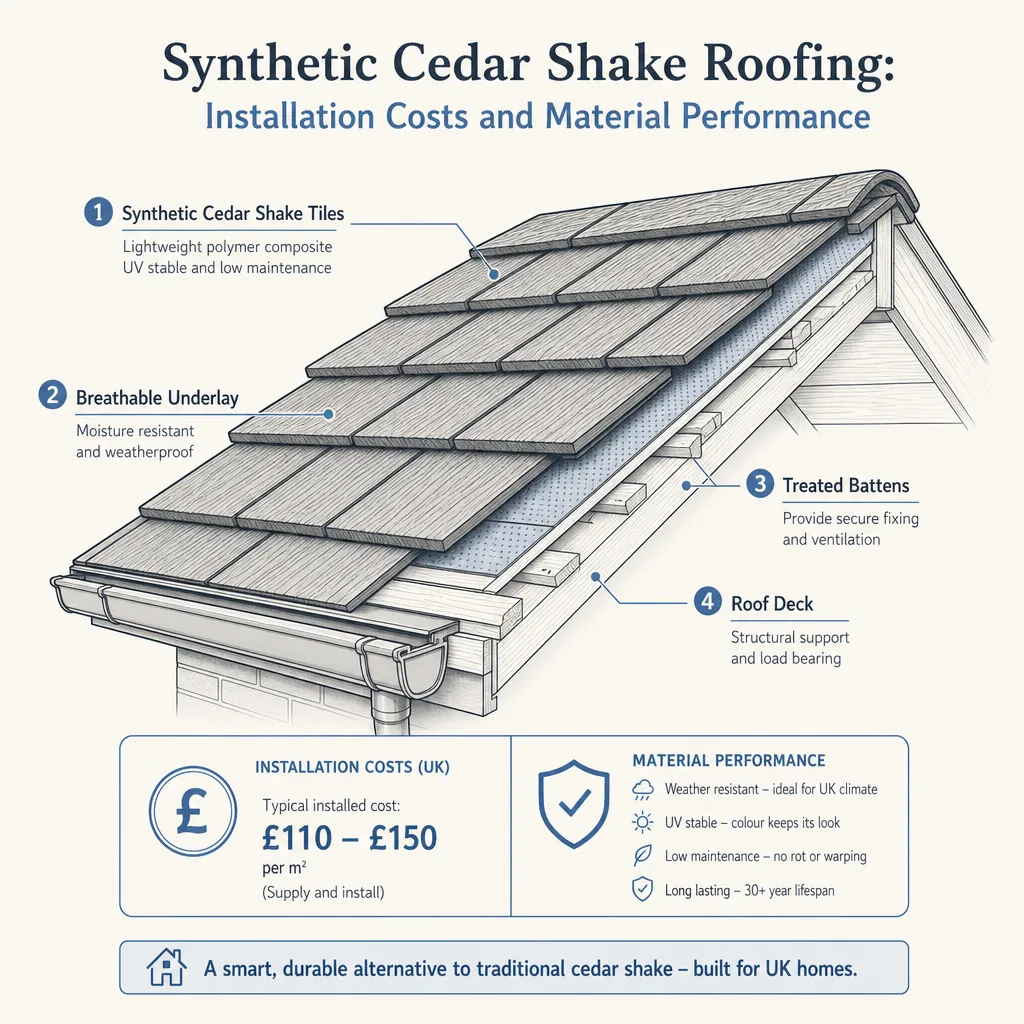
Synthetic Cedar Shake Roofing: Installation Costs and Material Performance
Synthetic cedar shake roofing uses polymer composite, rubber, or fibre-cement tiles to replicate the look of natural cedar wood shingles.
 Improvement & Build
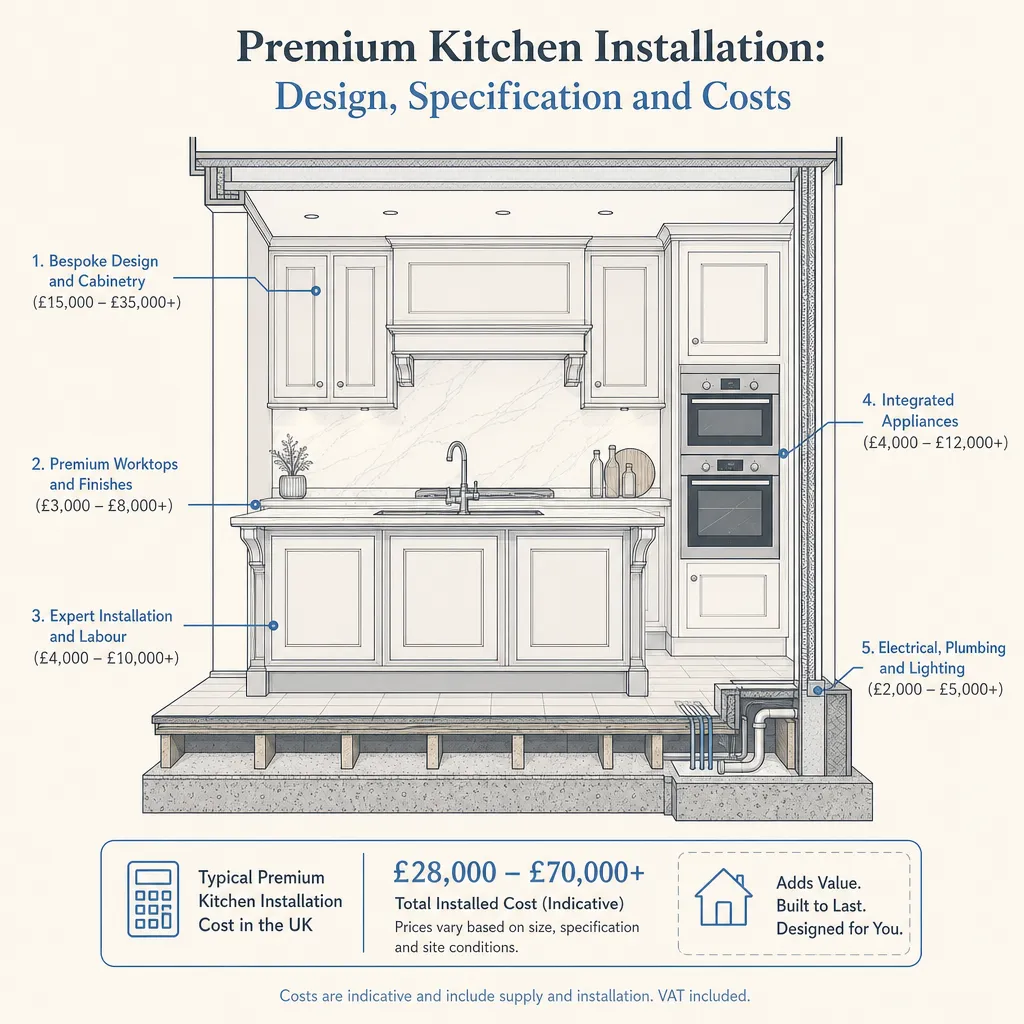
Premium Kitchen Installation: Design, Specification and Costs
A premium kitchen in the UK typically costs £20,000–£80,000 or more installed, depending on cabinetry specification, worktop material, appliance brands, and whether structural changes are needed.