Ground Source Heat Pump Installation: System Costs and Benefits
By Housey · Last reviewed 7th of May 2026
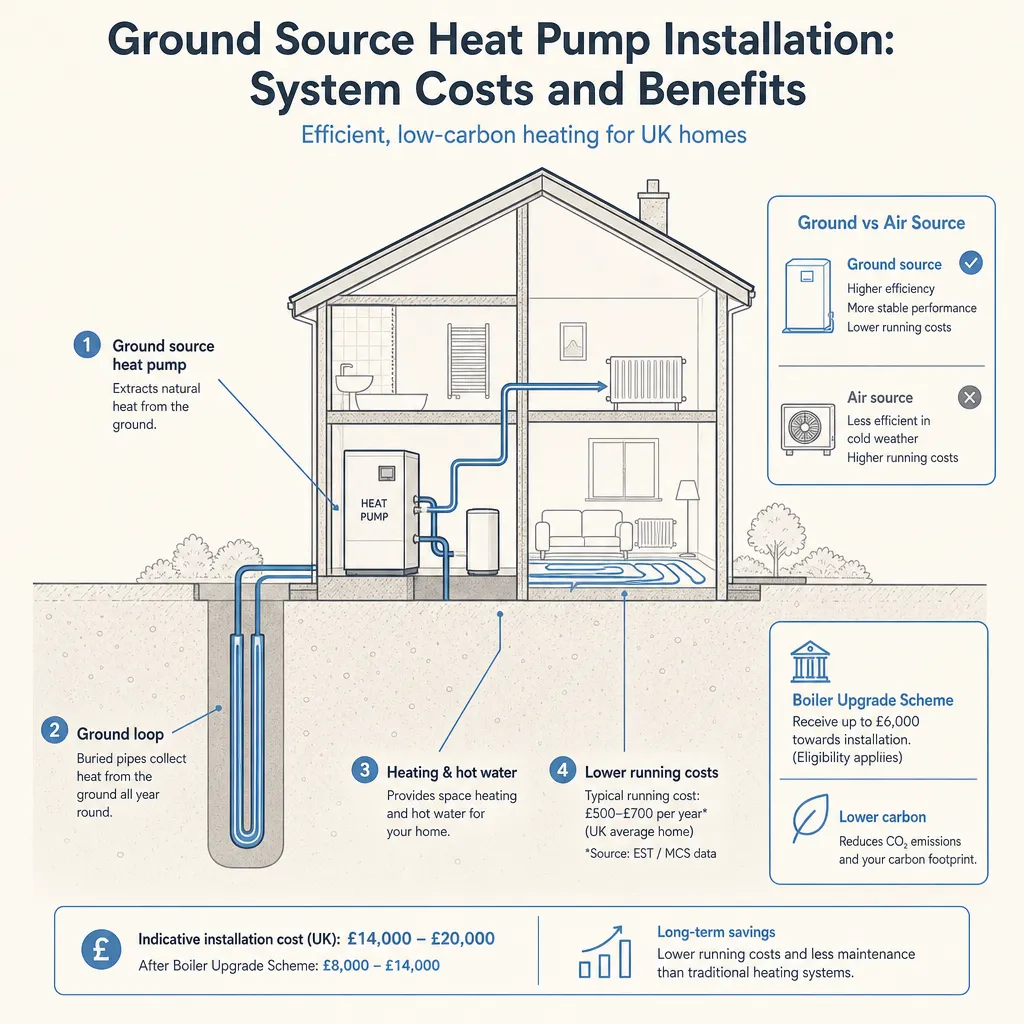
Ground Source Heat Pump Installation: System Costs and Benefits
Ground source heat pumps (GSHPs) sit at the premium end of the UK's low-carbon heating market, with installed costs and site requirements well beyond most other systems. The decision to install one typically arises during a major heating system replacement, a whole-house retrofit, or a new self-build specification — moments when the stakes of a poorly sized or mismatched system are highest.
Key points
- Ground source heat pumps typically achieve a Seasonal Coefficient of Performance (SCOP) of 3.0–4.5, meaning they deliver three to four and a half units of heat for every unit of electricity consumed, depending on ground conditions and system design.
- The Boiler Upgrade Scheme (BUS) offers a £7,500 grant toward a ground source or water source heat pump for eligible homes in England and Wales, administered by Ofgem; the grant is claimed by the MCS-certified installer on your behalf.
- Horizontal ground loops typically require two to three times the heated floor area of the property in accessible garden space; vertical boreholes need far less land but cost significantly more to drill.
- All BUS-eligible installations must be carried out by an MCS-certified heat pump installer and must comply with the MCS 3005 heat pump design and installation standard.
- GSHPs work most efficiently at low flow temperatures of 35–45°C, making them best suited to underfloor heating or oversized radiators — fitting one to a standard small-bore radiator system without upgrades will compromise running costs and efficiency.
How a ground source heat pump works
A GSHP moves heat from the ground — which maintains a relatively stable temperature of around 8–12°C year-round in the UK — into your home's heating and hot water system. The key components are:
- Ground loop or borehole: Fluid-filled pipes buried in the ground absorb latent heat from the surrounding soil, rock, or groundwater.
- Heat pump unit: A refrigerant circuit compresses the absorbed heat to a usable temperature — similar in principle to a refrigerator operating in reverse.
- Heat emitters: Distributes heat throughout the home via underfloor heating, oversized radiators, or a combination of both.
- Hot water cylinder: A dedicated cylinder stores domestic hot water; this is almost always required alongside a GSHP installation.
The system's efficiency depends heavily on how well the ground collector is sized, how low the flow temperature to the heat emitters can be set, and how well-insulated the building fabric is. A poorly insulated home with high heat loss will force the heat pump to work harder, reducing its SCOP and increasing running costs.
Horizontal ground loops vs. vertical boreholes
Feature | Horizontal ground loop | Vertical borehole |
|---|---|---|
Land requirement | High — typically 200–800 m² of accessible garden | Low — small surface footprint per borehole |
Typical installation depth | 1.2–2 m below ground surface | 50–200 m per borehole |
Indicative collector cost | Lower (trenching with mini-digger) | Higher (specialist drilling rig required) |
Best for | Properties with large, accessible, reasonably level gardens | Smaller plots, rocky ground, or where trenching is impractical |
Ground investigation needed | Desktop soil assessment usually sufficient | Geotechnical survey or thermal response test recommended |
Garden disruption during installation | Significant — garden reinstated afterwards | Minimal surface footprint once borehole head is capped |
What does a ground source heat pump cost?
Indicative UK costs, last reviewed 2026-05-07. Costs vary substantially by property size, ground type, collector configuration, emitter system, and installer. Obtain at least three quotes from MCS-certified installers.
System type | Indicative installed cost (before grant) | After £7,500 BUS grant |
|---|---|---|
Horizontal loop, 3-bedroom home | £20,000 – £30,000 | £12,500 – £22,500 |
Vertical borehole, 1–2 boreholes | £25,000 – £45,000+ | £17,500 – £37,500+ |
These ranges typically include the heat pump unit, ground collector, hot water cylinder, controls, and installation labour. They do not include radiator upgrades, underfloor heating installation, or electrical supply upgrades, which may add £2,000–£10,000 or more depending on the scope of changes needed.
Key cost drivers:
- Property size and heat loss: The heat pump unit must be correctly sized to the building's calculated heat loss (to BS EN 12831). Larger homes require larger, more expensive units.
- Ground type: Clay soils conduct heat better than sandy or dry soils; hard rock typically requires borehole drilling rather than horizontal trenching.
- Emitter system: Upgrading from small-bore radiators to underfloor heating adds cost but improves efficiency and may be necessary for the system to perform as designed.
- Hot water demand: High domestic hot water usage may require a larger cylinder or an additional immersion backup element.
- Electrical supply: A GSHP typically draws 3–6 kW; some older properties may require a consumer unit upgrade or increased supply fuse from the network operator.
- Location: Installer availability and labour rates vary by region across the UK.
Grants and financial support
Boiler Upgrade Scheme (BUS)
The BUS provides a one-off capital grant to reduce the upfront cost of installing a qualifying low-carbon heating system. For ground source and water source heat pumps, the grant is £7,500 (check Ofgem's BUS page for the current amount, as scheme terms are periodically reviewed). Key eligibility conditions:
- The property must be in England or Wales (Scotland has its own separate schemes via the Scottish Government).
- The existing primary heating system must be replaced — not merely supplemented — by the heat pump.
- The installer must hold current MCS certification.
- Any recommended loft or cavity wall insulation measure (where technically feasible) must either be installed or have a valid exemption.
- The grant application is made by the installer on your behalf before installation begins.
Other potential support
- ECO4 scheme: May fund heat pump installations for eligible low-income households or those receiving certain benefits; administered via energy suppliers. Check current eligibility at GOV.UK.
- 0% VAT on heat pumps: Residential heat pump installations currently attract 0% VAT in the UK. Check current HMRC guidance, as VAT reliefs can be amended.
- Smart Export Guarantee (SEG): If solar PV is also installed, surplus electricity can be exported and paid for by energy suppliers.
Running costs and what to expect
A well-sized GSHP should reduce heating bills for homes currently using oil, LPG, or direct electric heating. The comparison with mains gas is less straightforward — because electricity unit costs are higher than gas unit costs in most UK tariffs — but the higher efficiency of a GSHP partially offsets this.
Factors that materially affect running costs:
- SCOP of the installed system: A higher SCOP means lower electricity consumption per unit of heat delivered.
- Electricity tariff: Economy tariffs (such as Economy 7 or heat-pump-specific tariffs from some suppliers) can significantly reduce annual operating costs.
- Building fabric insulation level: Better-insulated homes need less heat, which reduces the load on the system and keeps SCOP high.
- Flow temperature: The lower the flow temperature to the emitters, the more efficiently the heat pump runs. A well-commissioned system with optimised controls makes a meaningful difference.
- Hot water usage: Heating domestic hot water to legionella-safe temperatures (60°C) reduces efficiency; some systems use an immersion heater for this duty.
The Energy Saving Trust publishes indicative running cost comparisons for different heating fuel types, which can help with a like-for-like estimate for your current fuel.
Is your property suitable for a ground source heat pump?
Not every property is suited to a GSHP. Key suitability factors include available land, ground conditions, existing insulation, and current heating fuel. A professional heat pump survey will assess all of these systematically.
Decision tree: is a GSHP right for your home?
- Do you have sufficient accessible outdoor space for horizontal loops? (Typically 200–800 m² of garden) → If yes, a horizontal loop may be viable; commission a heat loss calculation.
- No suitable garden space, but willing to invest in drilling? → A vertical borehole may be an option; consider a geotechnical investigation first.
- Is the property well-insulated, or are you committed to improving the building fabric first? → GSHPs perform best in well-insulated homes; address fabric before finalising system sizing.
- Are you currently on mains gas? → The financial case is narrower; ask your installer to model running costs under current and forecast tariffs.
- Is the property listed or in a conservation area? → Consult your local planning authority; external ground works may require consent.
- Is the property a new-build or has underfloor heating already installed? → Likely well-suited; good insulation and low-temperature emitters are usually already present.
- Unsure about any of the above? → Commission a professional assessment before making any commitment.
Important limitations
This article provides general information about ground source heat pump systems in the UK. Every property has different heat loss characteristics, ground conditions, and hot water demands. System sizing, design, installer quality, and building fabric all materially affect performance and running costs. Nothing in this article constitutes a substitute for a professional heat pump assessment, a full heat loss calculation to BS EN 12831, or advice from an MCS-certified installer or qualified Retrofit Coordinator under PAS 2035.
Grant eligibility conditions and amounts are subject to change. Always verify current scheme terms directly with Ofgem and GOV.UK before making financial decisions based on grant availability.
What to ask a qualified professional
Before instructing an MCS-certified installer or commissioning a ground investigation, ask:
- What heat loss calculation method will you use — and will you produce a BS EN 12831 or MCS 3005-compliant design report?
- What SCOP are you designing for, and what ground temperature and soil conductivity assumptions underpin that figure?
- Is horizontal trenching or a vertical borehole more appropriate for my plot and soil type, and what is the evidential basis for that recommendation?
- Do I need to upgrade my emitter system (radiators or underfloor heating) for the GSHP to operate at the designed efficiency?
- Will you handle the Boiler Upgrade Scheme application and all MCS documentation on my behalf?
- What monitoring, commissioning report, and handover training will I receive?
- What are the estimated annual running costs under current electricity tariffs — and how sensitive is that figure to tariff changes or changes in my hot water usage?
When to get professional help
A ground source heat pump is a significant, long-lived investment. Seek professional input from an MCS-certified installer, a retrofit assessor, or a qualified heat pump specialist before making any commitment if:
- You have not had a full heat loss calculation carried out for the property.
- You are unsure whether your home's insulation levels make a GSHP a viable or cost-effective choice.
- Your property has unusual ground conditions — made ground, contaminated land, high water table, or rock close to the surface.
- You are considering a borehole installation and have not investigated the geotechnical conditions of the site.
- Your property is listed or in a conservation area where external ground works may require consent.
- You are replacing a system with significant remaining life and are uncertain whether the economics justify early replacement.
How Housey can help
Housey can connect you with MCS-certified professionals to carry out a heat pump survey and assess your property's suitability in detail. If you are undertaking a wider retrofit, a retrofit assessor can advise on fabric improvements alongside heating system selection. For borehole installations, a geotechnical investigation can reduce the risk of unexpected drilling costs and help your installer design the ground array with confidence.
Frequently asked questions
How long does a ground source heat pump last?
The heat pump unit itself typically has a design life of 20–25 years with annual servicing. Ground loops or boreholes are designed to last 50 years or more. Regular maintenance — usually an annual service by a qualified engineer — is important for warranty compliance and sustained efficiency. Check manufacturer warranty terms carefully when comparing installer quotes.
Do I need planning permission for a ground source heat pump in England?
In England, ground source heat pump installation including trenching or borehole works is generally permitted development for a house. However, if your property is listed, in a conservation area, or if works would affect a protected garden feature, check with your local planning authority before starting. In Scotland and Wales, separate permitted development rules apply.
Can a ground source heat pump provide all my hot water?
A GSHP can meet most domestic hot water demand, but efficiency reduces at higher water temperatures. Most systems include an immersion heater in the cylinder as a backup for peak demand or legionella prevention cycles. A qualified installer will design the system to balance hot water performance with running cost, taking your household's usage profile into account.
What maintenance does a ground source heat pump need?
Annual servicing by a qualified engineer is recommended — and usually required to maintain the manufacturer's warranty. The ground loop requires minimal maintenance once installed. Refrigerant circuits must only be handled by an F-Gas certified engineer. Check expansion vessel pressure periodically, keep the heat pump unit accessible, and monitor system efficiency via built-in metering where fitted.
Is a ground source heat pump a good option if I currently have a gas boiler?
A GSHP replaces rather than supplements the primary heat source. For mains gas properties, model running costs carefully — gas unit rates are typically lower than electricity unit rates. However, for off-gas properties (oil or LPG) or homes with access to economy electricity tariffs, the financial case is often more compelling. An MCS installer should model both options transparently.
Sources and further reading
- Boiler Upgrade Scheme: guidance for homeowners — Ofgem
- Ground source heat pumps — Energy Saving Trust
- MCS standards and certification — MCS
- Approved Document L: Conservation of fuel and power — GOV.UK
- Heat pump ready programme — GOV.UK
Useful next reads
 Energy & Retrofit
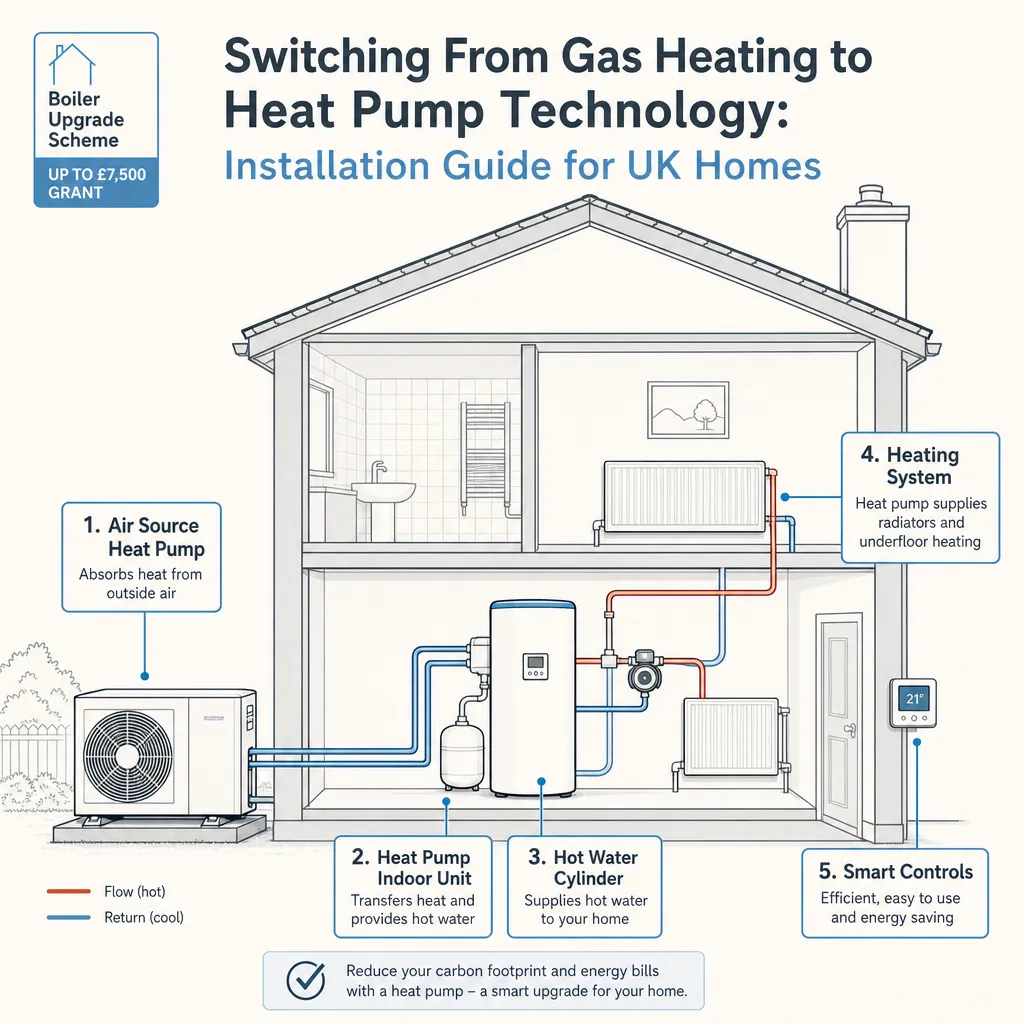
Switching From Gas Heating to Heat Pump Technology: Installation Guide
Switching from gas to a heat pump requires a heat loss calculation, correctly sized equipment, and often radiator upgrades before installation.
 Energy & Retrofit
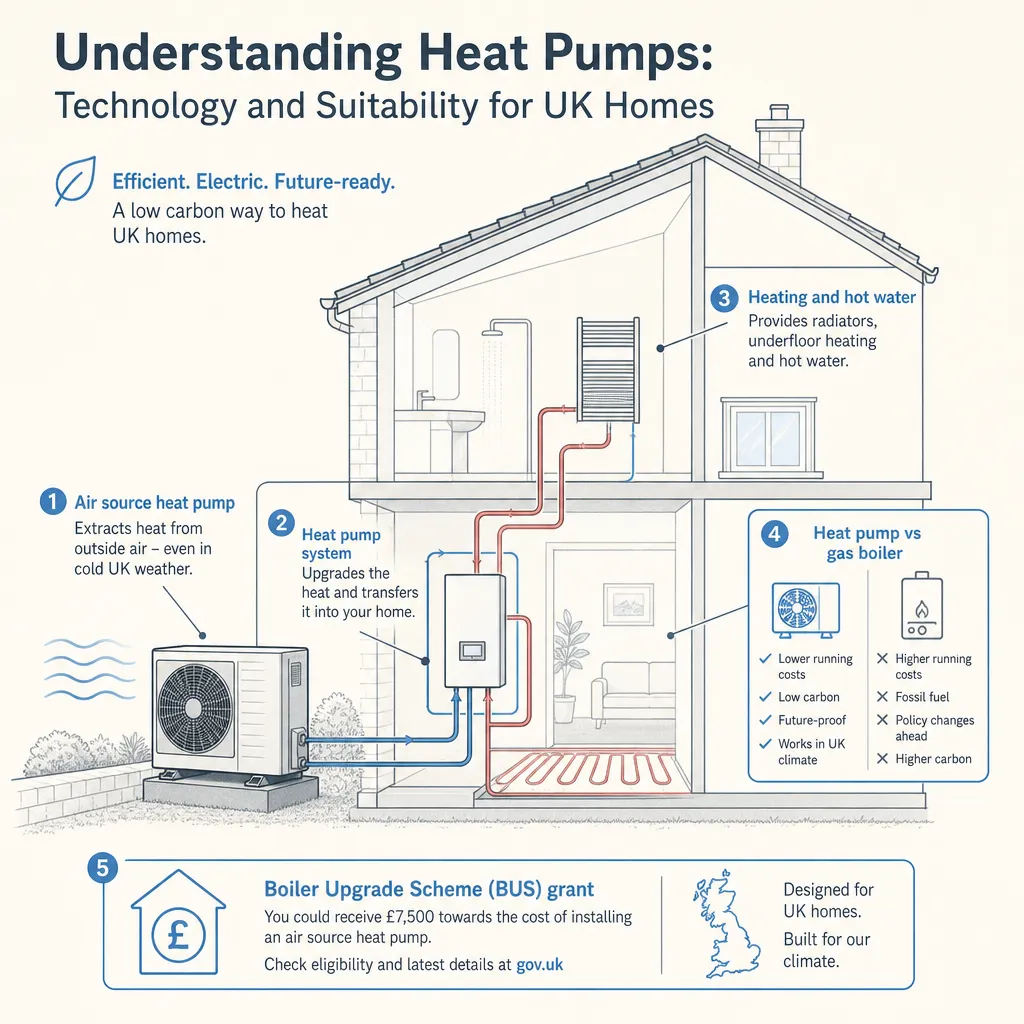
Understanding Heat Pumps: Technology and Suitability for UK Homes
Heat pumps extract heat from the air or ground and transfer it indoors, typically achieving efficiencies of 250–400% compared to a conventional boiler's near 100%.
 Energy & Retrofit
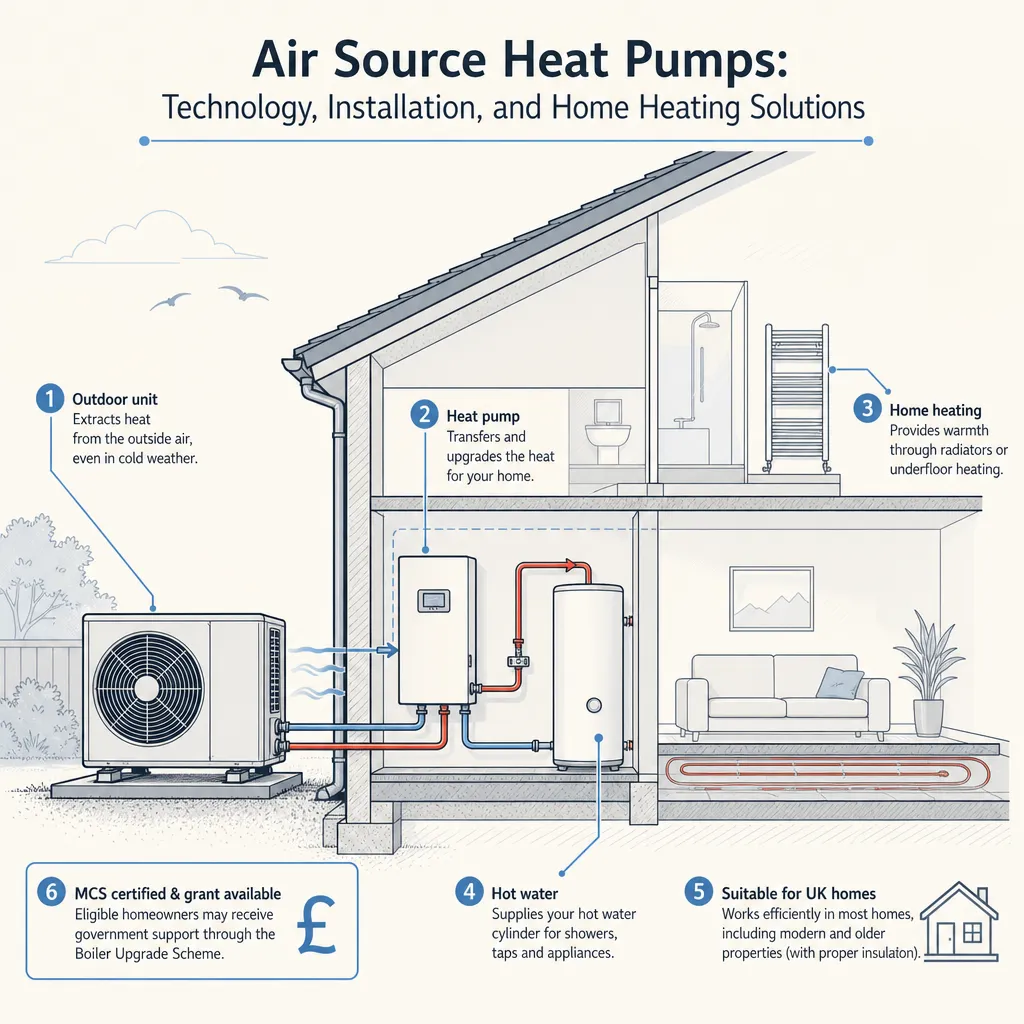
Air Source Heat Pumps: Technology, Installation, and Home Heating Solutions
An air source heat pump extracts heat from outdoor air and transfers it indoors via a refrigerant cycle, typically delivering 2.
 Energy & Retrofit
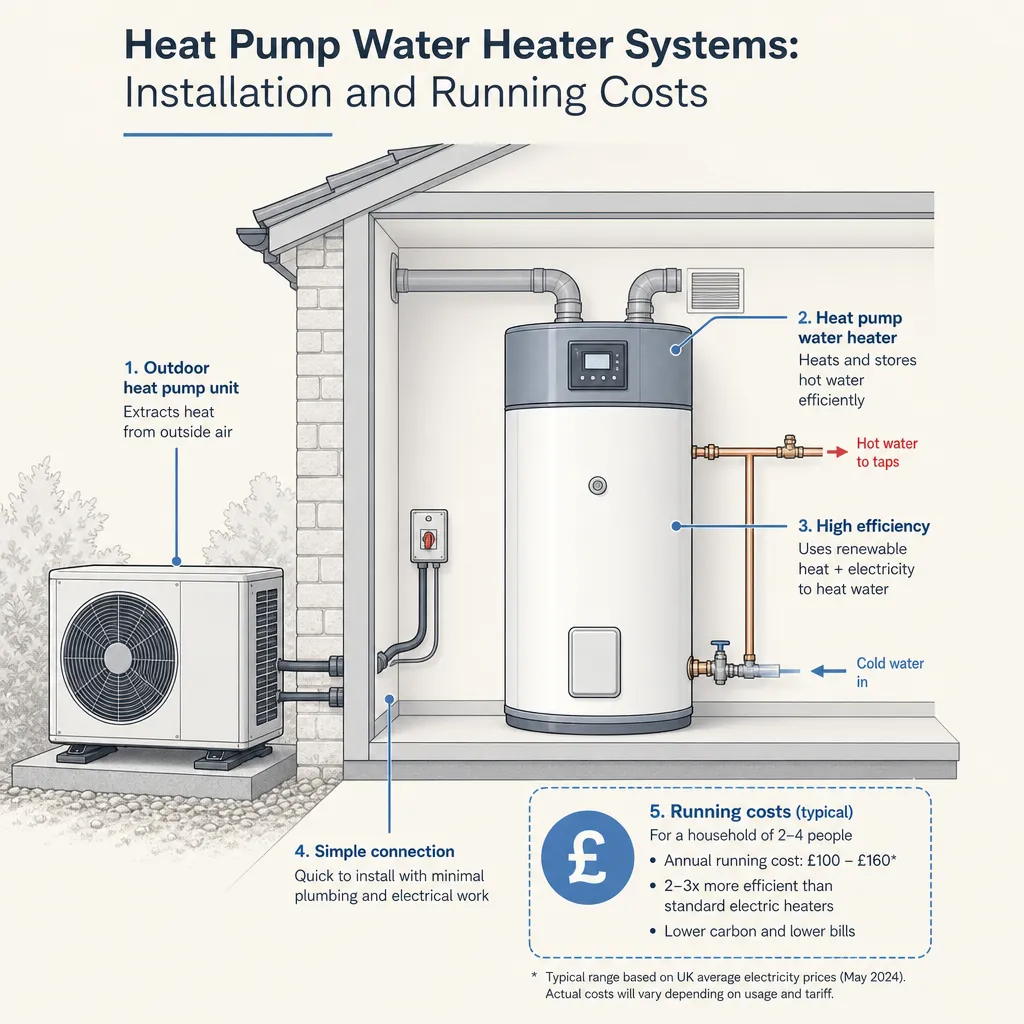
Heat Pump Water Heater Systems: Installation and Running Costs
A heat pump water heater extracts heat from surrounding air to warm your domestic hot water cylinder, achieving a Coefficient of Performance of 2.
 Energy & Retrofit
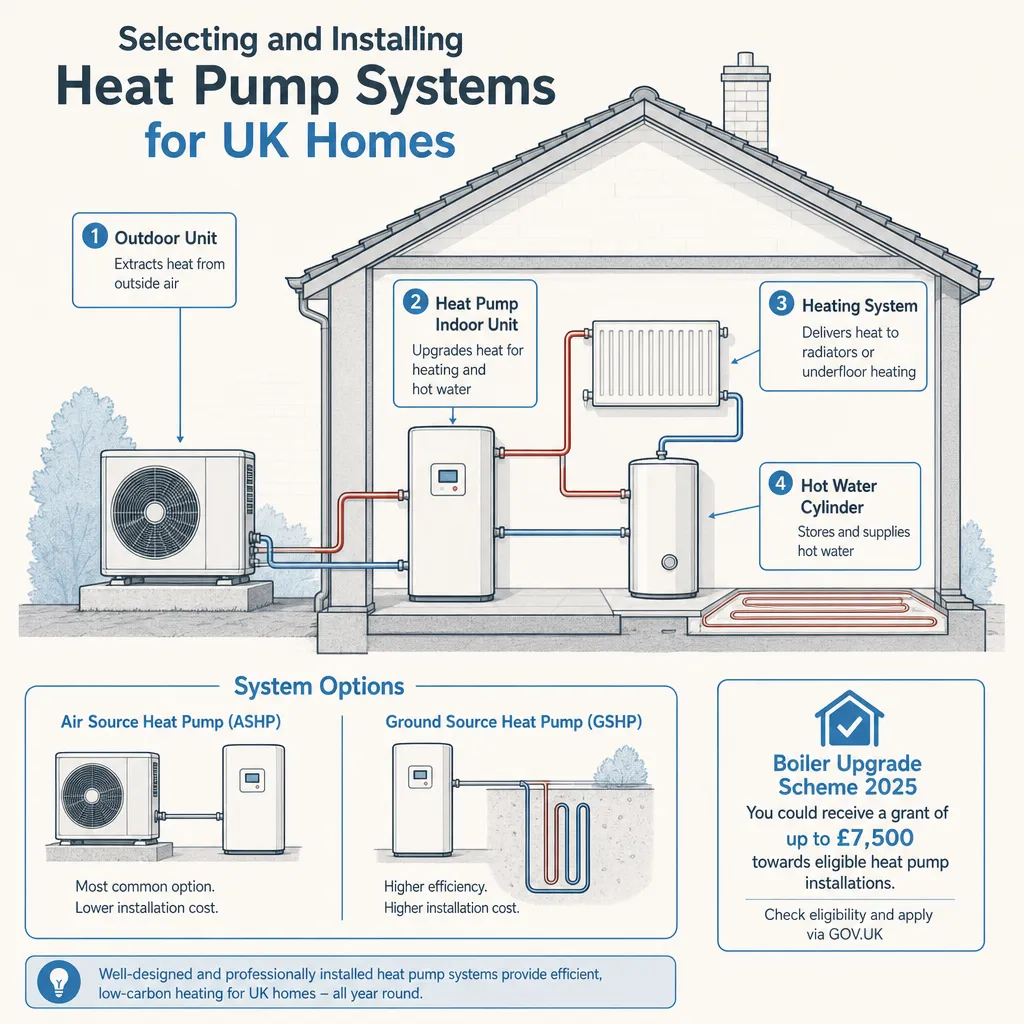
Selecting and Installing Heat Pump Systems for UK Homes
Selecting a heat pump for a UK home requires a site-specific heat loss calculation, an assessment of existing heat emitters, and a check on fabric insulation before any system is chosen.