Selecting and Installing Heat Pump Systems for UK Homes
By Housey · Last reviewed 30th of May 2026
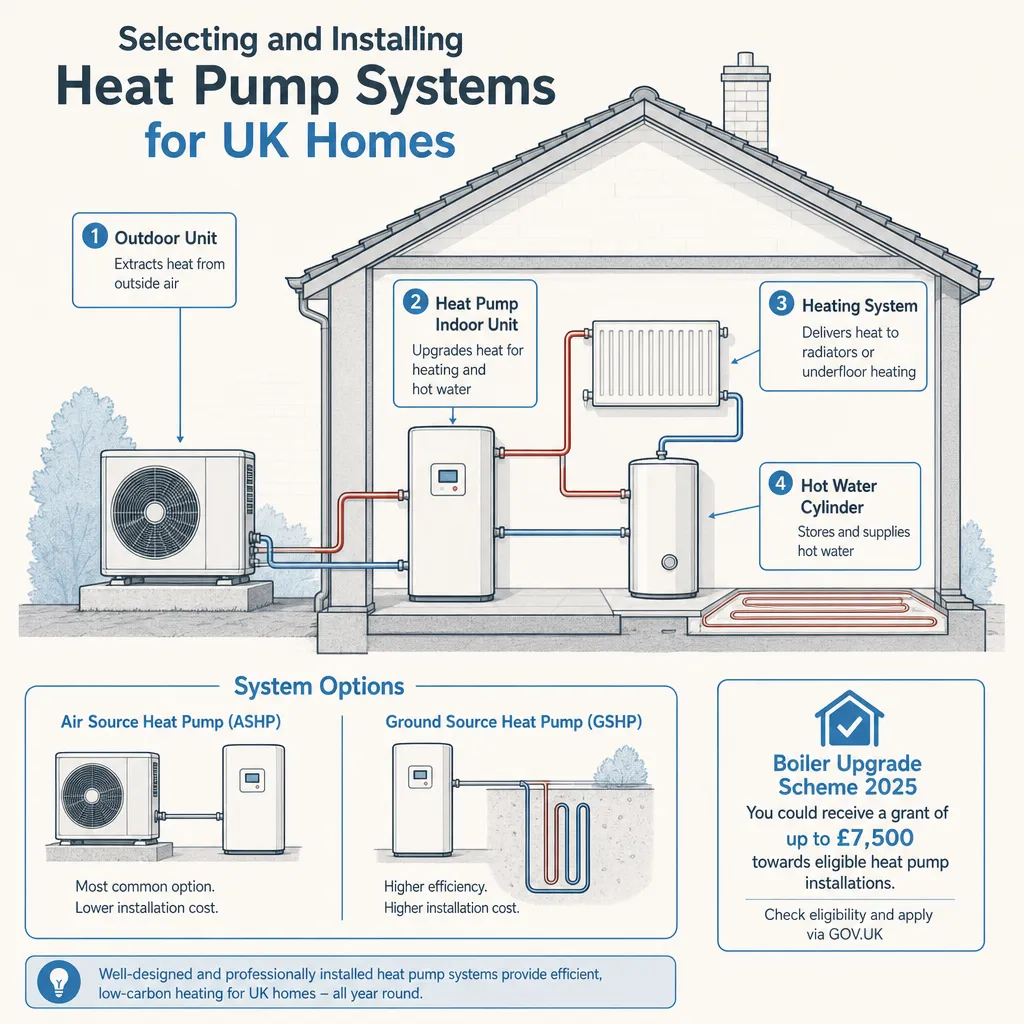
Selecting and Installing Heat Pump Systems for UK Homes
Heat pumps are central to the UK government's strategy for decarbonising home heating, backed by grant funding through the Boiler Upgrade Scheme and a growing base of MCS-certified installers. For an existing UK property, however, selecting and sizing a heat pump correctly requires assessing heat loss, fabric insulation, existing heat distribution, and local planning conditions — none of which can be determined reliably without a site-specific assessment. Getting the selection wrong can result in an expensive installation that struggles to heat the home efficiently or keep running costs within acceptable bounds.
Key points
- The Boiler Upgrade Scheme (BUS), administered by Ofgem, offers a £7,500 grant towards the installed cost of an air source heat pump (ASHP) or ground source heat pump (GSHP) in England and Wales, applied directly to the installer's invoice; the installing contractor must be MCS certified.
- Heat pump sizing must be based on a room-by-room heat loss calculation, typically to BS EN 12831 or the MCS 021 methodology; oversizing a heat pump causes short-cycling and reduces efficiency — it is not a safer option.
- Air source heat pumps on most domestic properties in England usually qualify as permitted development under Schedule 2, Part 14, Class G of the Town and Country Planning (General Permitted Development) (England) Order 2015, subject to conditions including a maximum noise level of 42dB(A) at 1 metre from a neighbour's window or door.
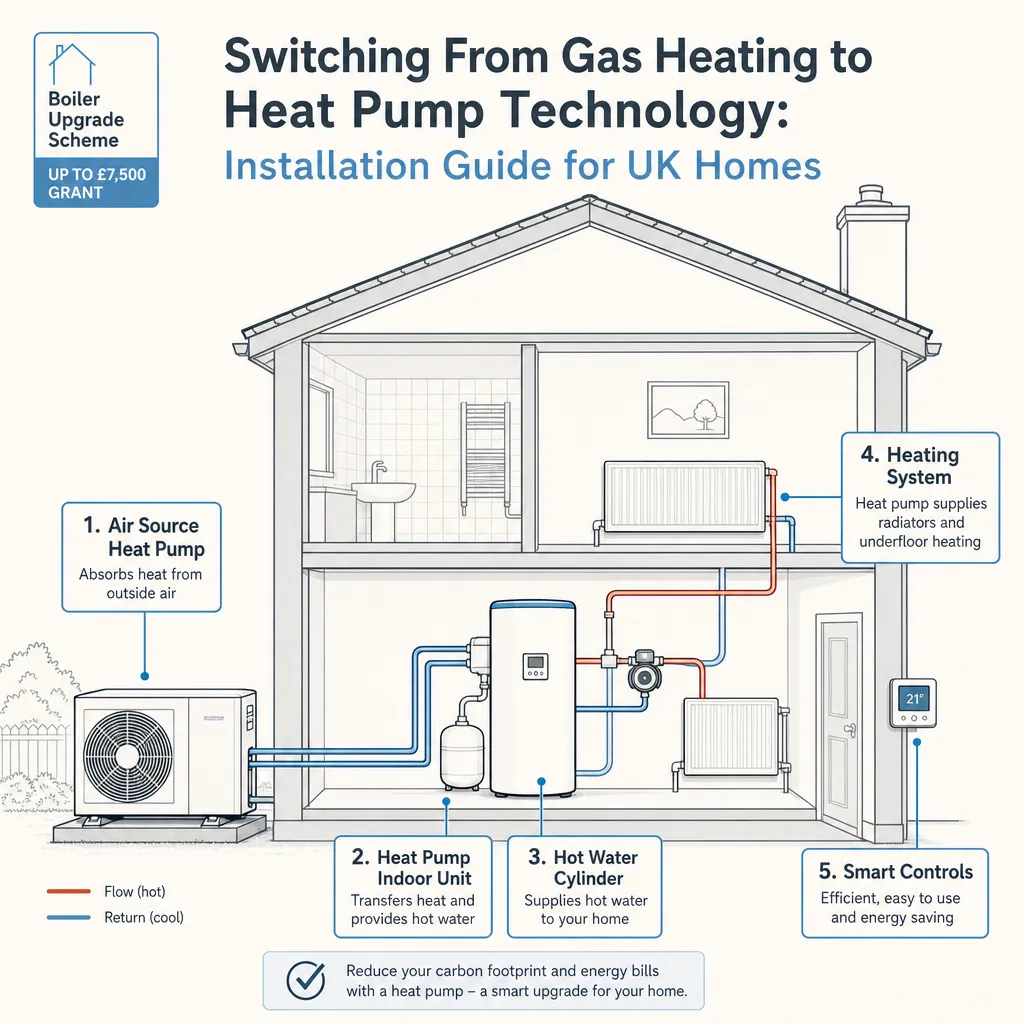
- Heat pumps operate most efficiently at lower flow temperatures (35–50°C); properties with radiators sized for gas boiler flow temperatures of 65–80°C may require radiator upgrades or additional insulation to reach acceptable efficiency.
- PAS 2035 — the UK standard for whole-house retrofit — recommends a fabric-first approach: address insulation, draughtproofing, and ventilation before installing a heat pump to reduce heat demand and maximise Seasonal Coefficient of Performance (SCOP).
ASHP vs GSHP: which system suits your home?
Air source heat pumps (ASHPs) and ground source heat pumps (GSHPs) both extract heat from the environment and transfer it into your home, but they use different heat sources and suit different property types.
Feature | Air Source Heat Pump (ASHP) | Ground Source Heat Pump (GSHP) |
|---|---|---|
Heat source | Outdoor air | Ground (borehole or horizontal collector loop) |
Typical SCOP | 2.5–3.5 | 3.0–4.5 |
Ground area needed | None (external unit only) | Substantial (horizontal loop) or borehole drilling |
Installation disruption | Low to moderate | High (significant groundworks) |
BUS grant (2024–25) | £7,500 | £7,500 |
Permitted development (England)? | Usually yes, subject to conditions | Planning often required for borehole drilling |
Best for | Most UK homes with outdoor space for the unit | Rural properties with large gardens or suitable geology |
Main limitation | Efficiency drops in very cold weather; noise near boundaries | Higher upfront cost; not suitable for all ground types |
Is your home suitable for a heat pump?
A heat pump should not be specified without a proper site assessment. The following factors determine suitability:
Decision guide:
- Proceed with an assessment if your home has loft and cavity wall insulation (or solid walls that could be insulated), and you have outdoor space for an ASHP unit (typically 0.8–1.5m × 0.5–1.0m footprint, positioned away from boundaries).
- Prioritise fabric improvements first if your property has uninsulated solid walls or single glazing — a retrofit assessment following PAS 2035 can guide a phased improvement plan before heat pump installation.
- Consider GSHP if you have a large garden (approximately 300–400 m² minimum for horizontal collectors) or accessible land, and the higher upfront cost is manageable.
- Consult your local planning authority first if your property is listed, in a conservation area, or in a noise-sensitive location.
- Seek specialist advice if you already have underfloor heating — low-temperature radiant systems are naturally well-matched to heat pump flow temperatures.
What heat pump sizing involves
Correct sizing is the most critical technical decision and must not be estimated from property size alone. A qualified MCS-certified installer or heat pump surveyor should carry out a room-by-room heat loss calculation:
- Measure room volumes and record construction U-values (walls, roof, floor, windows).
- Calculate design heat loss in watts for the property at the design external temperature — typically -3°C for most of England, lower in Scotland and northern regions.
- Select heat pump output to match (not exceed) the design heat loss; oversizing causes short-cycling and reduced SCOP.
- Assess heat emitters (radiators or underfloor heating) for compatibility with lower flow temperatures — radiators undersized for 45°C flow will not adequately heat the room.
- Plan hot water provision — most systems require a separate hot water cylinder (typically 200–300 litres); replacing a combi boiler with a heat pump requires additional space.
The Boiler Upgrade Scheme: key conditions
The BUS is administered by Ofgem and provides vouchers to eligible homeowners in England and Wales. Key conditions as of 2025:
- The property must have a valid EPC with no outstanding recommendation for loft or cavity wall insulation (unless impractical to install).
- The installing contractor must be MCS certified, and the equipment must be MCS-certified product.
- The £7,500 grant is deducted from the installer's invoice; you pay the remaining balance.
- Applications are submitted by the installer on your behalf before installation begins; retrospective applications are not permitted.
Scotland has separate schemes through Home Energy Scotland. Wales has the Nest programme and the Optimised Retrofit Programme. Always verify current scheme availability with your installer or an energy-efficiency consultant.
Important limitations
This article provides general information about heat pump selection and installation for UK homeowners. Decisions about heat pump sizing, system design, and property suitability must be made by a qualified, MCS-certified installer or engineer carrying out a site-specific heat loss assessment. Rules on permitted development, grant eligibility, and scheme conditions change; always verify current guidance from Ofgem (for BUS), your local planning authority, and MCS before committing to any installation. Nothing in this article constitutes structural, planning, or engineering advice.
What to ask a qualified professional
Before instructing an MCS-certified installer or heat pump surveyor, ask:
- Can you provide a room-by-room heat loss calculation to BS EN 12831 or MCS 021?
- What SCOP are you projecting, and what assumptions — insulation levels, design flow temperature — underpin that figure?
- Will any existing radiators need upgrading, and is that included in the quoted price?
- Is hot water cylinder provision included? What size cylinder is specified and where will it be located?
- Will you apply for the BUS grant on my behalf, and is the equipment and installation eligible?
- Is a permitted development check or planning application required for this installation?
- What MCS certificate and Benchmark commissioning record will I receive at completion?
- Are you TrustMark registered?
When to get professional help
Heat pump installation is specialist work that must be carried out by a qualified, MCS-certified contractor. The following situations require professional input before any purchase decisions are made:
- You have a solid-wall property with no existing insulation — fabric improvements should precede heat pump installation, or efficiency will be significantly below projections.
- Your property is listed or in a conservation area — permitted development rights may not apply, and planning consent may be required before any external unit is installed.
- Your post-installation heating bills are higher than projected — request a performance review against the design SCOP before the one-year review period closes.
- You are considering a GSHP — always obtain a ground suitability assessment before any groundworks are commissioned.
- You are applying for any grant scheme — eligibility conditions change and must be confirmed by the installer before work begins.
How Housey can help
Housey connects homeowners with qualified professionals at every stage of the heat pump journey. Start with a heat pump survey to understand your options, work with an energy-efficiency consultant to plan fabric improvements, or commission a full retrofit assessment to develop a whole-house improvement plan before selecting a system.
Frequently asked questions
How much does an air source heat pump cost in the UK?
Indicative UK costs, last reviewed 2026-05-30. A fully installed ASHP for a typical 3–4 bedroom UK home is broadly in the range of £10,000–£18,000 before the BUS grant, depending on system size, radiator upgrades required, and cylinder installation. After the £7,500 BUS grant, net costs are typically £3,000–£10,000. These are indicative figures; request at least three quotes from MCS-certified installers, as costs vary significantly by property size and location.
Can a heat pump replace my gas boiler like-for-like?
Not always without modification. Heat pumps typically deliver flow temperatures of 35–55°C, whereas gas boilers run at 65–80°C. Radiators sized for a gas boiler may be undersized for heat pump operation — the heat loss calculation will identify which rooms need larger radiators. Most properties also require a separate hot water cylinder, as heat pumps are not suited to instantaneous hot water delivery in the way a combi boiler is.
Will a heat pump work in a cold UK winter?
Modern ASHPs are designed to operate at outdoor temperatures as low as -15°C to -20°C, though efficiency (SCOP) falls as outdoor temperature decreases. For most UK climates, a well-sized ASHP will heat the home adequately throughout winter. Many systems include a backup electric resistance element that activates during extreme cold; your installer should explain when this activates and what it costs to run.
Do I need to change my radiators for a heat pump?
Not necessarily. The installer's heat loss calculation will show whether existing radiators can deliver adequate heat output at lower flow temperatures (typically 45–50°C). If not, options include fitting larger radiators to affected rooms or adding extra panels. Underfloor heating is naturally suited to heat pump flow temperatures and generally requires no modification — making it a good pairing for heat pump installations.
Sources and further reading
- Boiler Upgrade Scheme guidance — GOV.UK / Ofgem: eligibility, application process, and current grant levels
- MCS heat pump standards and guidance — MCS: MCS 021 heat pump design and installation standard
- PAS 2035: Retrofitting dwellings for improved energy efficiency — BSI: whole-house retrofit standard
- Permitted development rights for householders — technical guidance — GOV.UK: Class G permitted development conditions for heat pumps
- Energy Saving Trust: Air source heat pumps — Energy Saving Trust: guidance on ASHP suitability and indicative costs
Useful next reads
 Energy & Retrofit
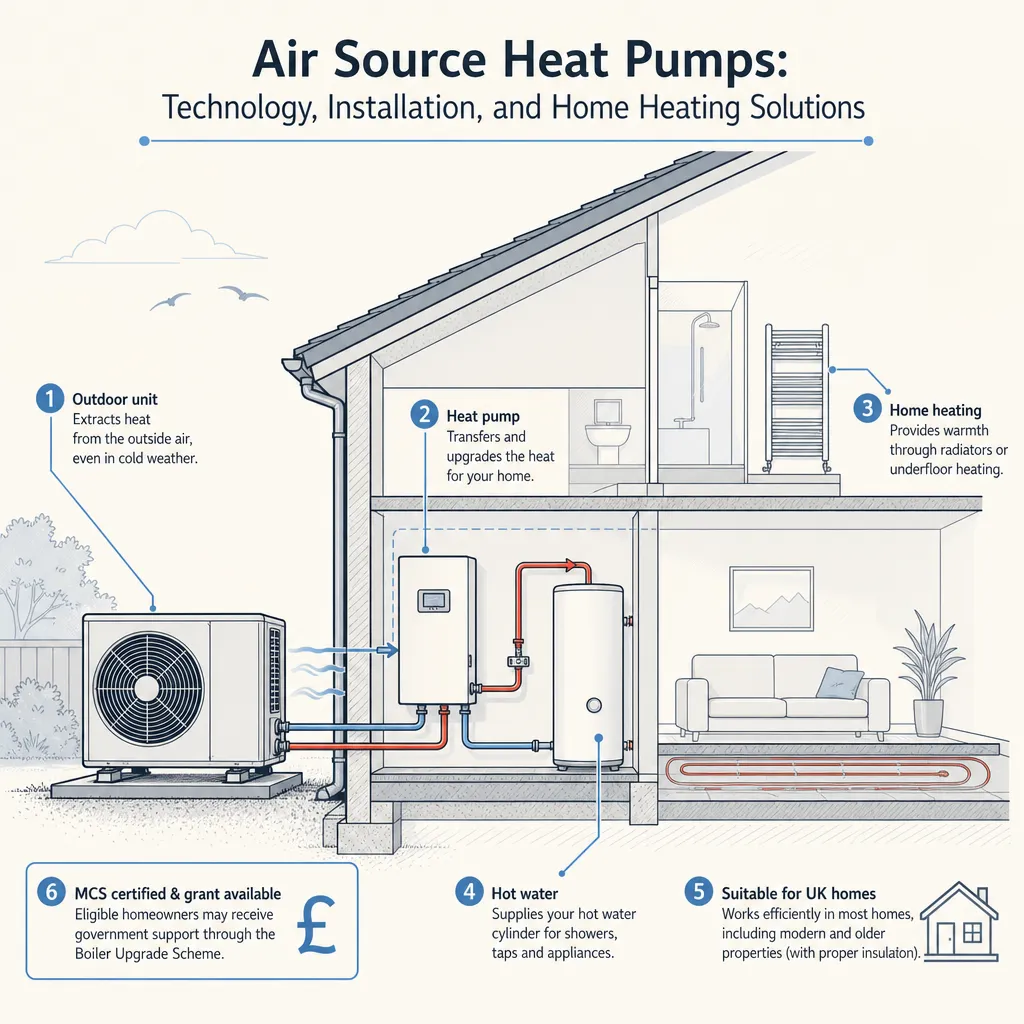
Air Source Heat Pumps: Technology, Installation, and Home Heating Solutions
An air source heat pump extracts heat from outdoor air and transfers it indoors via a refrigerant cycle, typically delivering 2.
 Energy & Retrofit
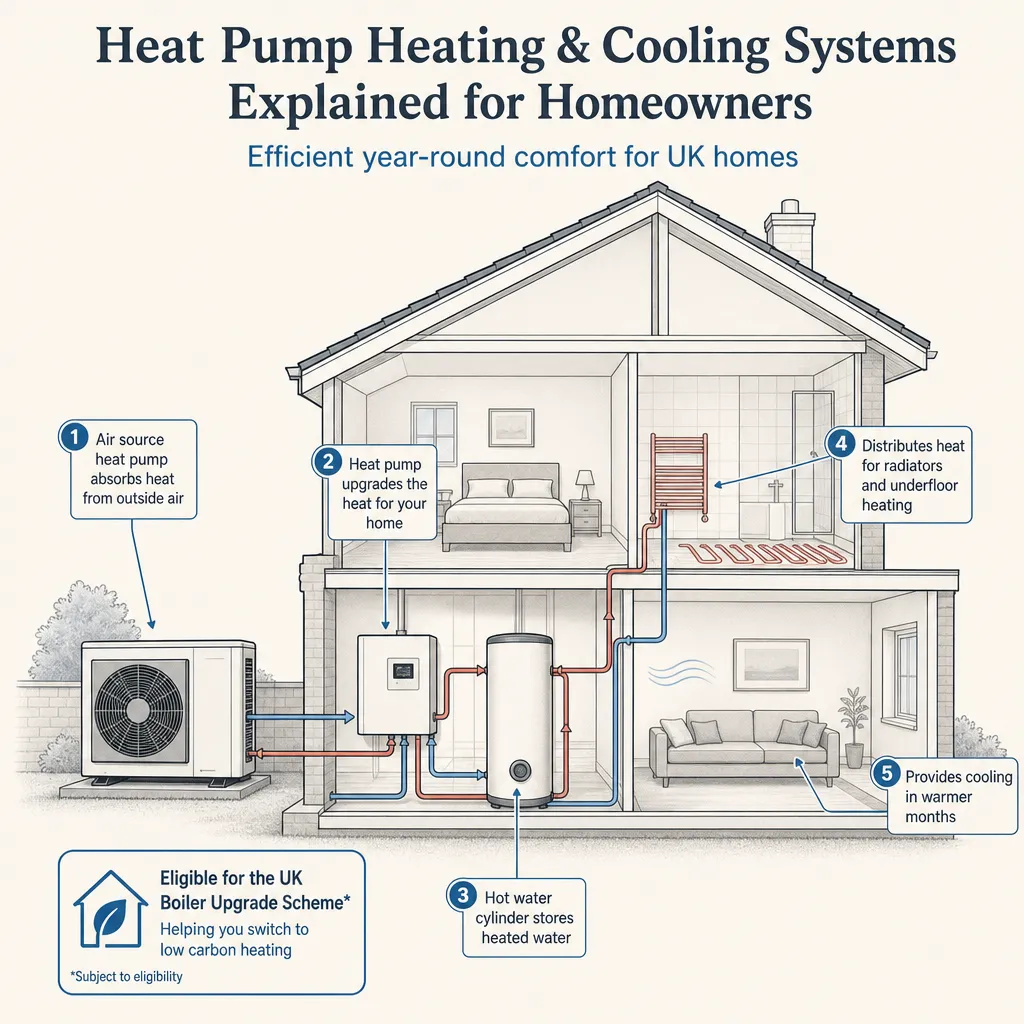
Heat pump heating and cooling systems explained for homeowners
A heat pump extracts heat from air or ground and transfers it indoors for heating, and can reverse the process for cooling.
 Energy & Retrofit
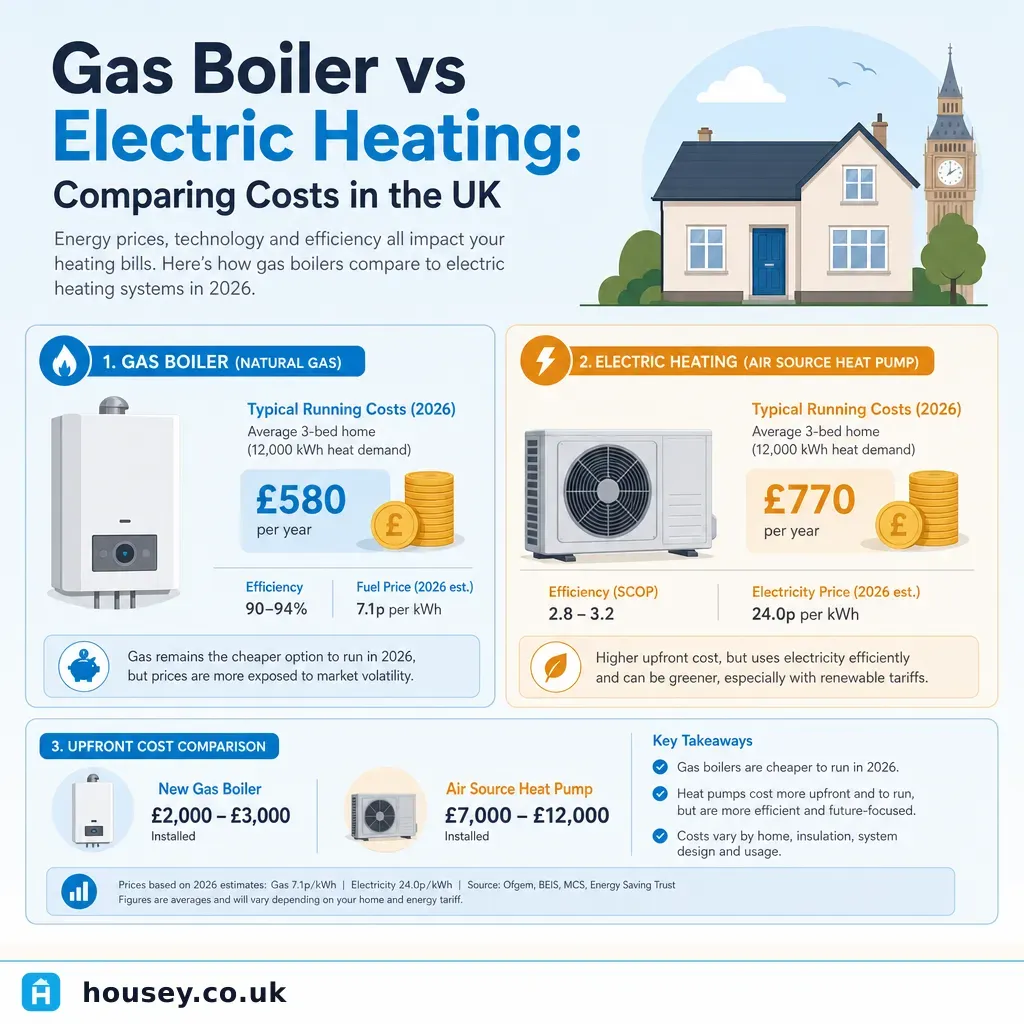
Gas Boiler vs Electric Heating: Comparing Costs in the UK
Gas boilers currently cost around 6.
 Energy & Retrofit
Reducing Heating Costs Through Property Energy Efficiency
Reducing heating costs starts with identifying where heat is lost — typically walls (30–35%), roof (20–25%), and windows.
 Energy & Retrofit
Switching From Gas Heating to Heat Pump Technology: Installation Guide
Switching from gas to a heat pump requires a heat loss calculation, correctly sized equipment, and often radiator upgrades before installation.