Heat Pump Water Heater Systems: Installation and Running Costs
By Housey · Last reviewed 7th of May 2026
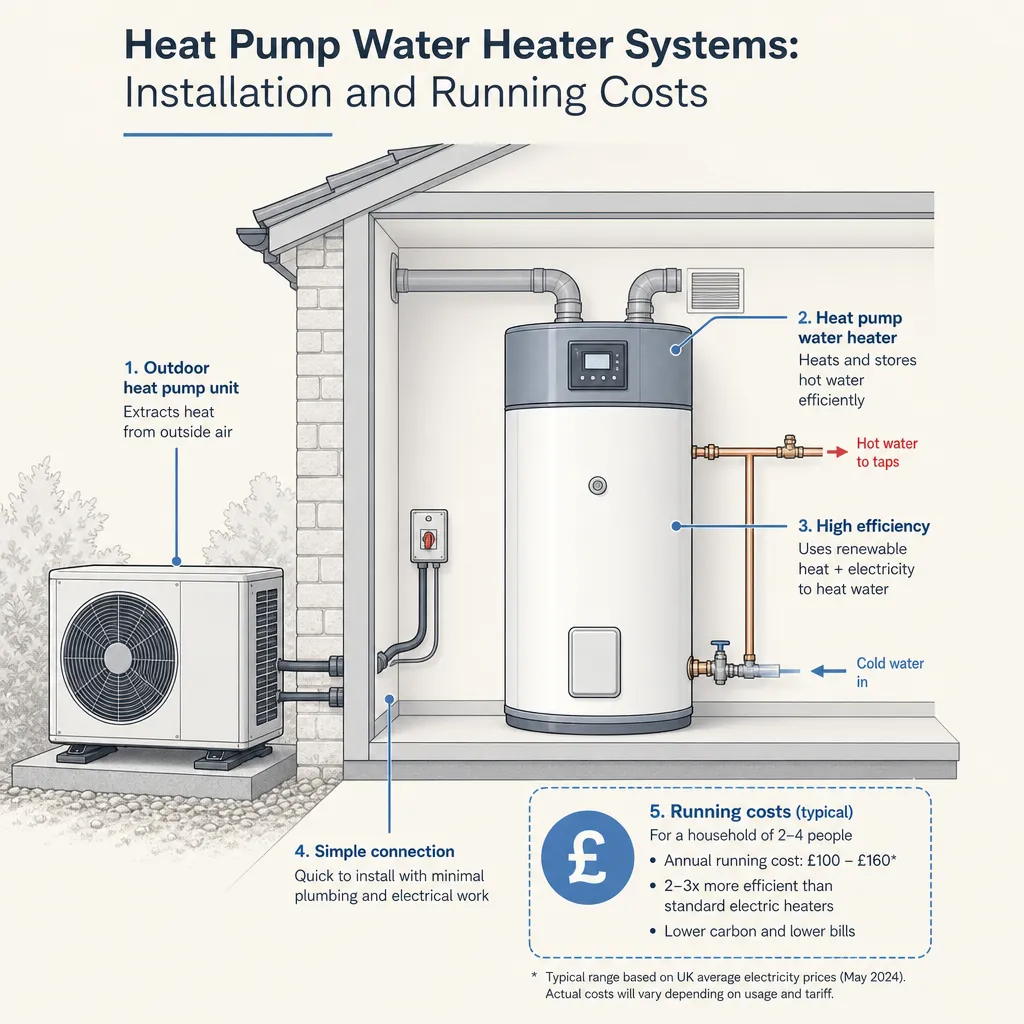
Heat Pump Water Heater Systems: Installation and Running Costs
Heat pump water heaters (HPWHs) are becoming an increasingly common choice for UK homeowners looking to reduce hot water bills without replacing their entire heating system. They sit at the intersection of heat pump technology and domestic hot water provision — a combination that raises practical questions about sizing, siting, running costs, and whether grant support applies. The decision typically arises during a retrofit project, when upgrading an ageing immersion cylinder, or alongside a solar PV installation.
Key points
- Heat pump water heaters achieve a Coefficient of Performance (CoP) of 2.5–4.0, meaning each unit of electricity produces 2.5–4.0 units of heat — significantly more efficient than a direct electric immersion heater (CoP 1.0).
- Indicative installed costs range from approximately £1,500 to £4,500 for a standalone unit, depending on cylinder capacity, brand, and installation complexity (Indicative UK costs, last reviewed 2026-05-07).
- The Boiler Upgrade Scheme (BUS) provides £7,500 towards eligible air source heat pump installations in England and Wales, but eligibility for standalone hot water heat pumps varies — always verify current criteria via GOV.UK and confirm with an MCS-accredited installer.
- MCS (Microgeneration Certification Scheme) accreditation is required for any installer whose work must qualify for government grants or incentives; verify installer status at mcscertified.com before instructing.
- PAS 2035 sets the UK framework for energy retrofit works in existing homes; a retrofit assessor can identify whether a HPWH is appropriate given your property's insulation level, ventilation conditions, and intended sequencing of measures.
What is a heat pump water heater?
A heat pump water heater extracts heat from the surrounding air using a refrigerant cycle — similar to a refrigerator in reverse — and transfers that heat to water stored in an integrated cylinder. Most units house the heat pump mechanism, cylinder, and controls in a single floor-standing cabinet, typically 60–80 cm wide and 180–210 cm tall.
They differ from a full air source heat pump (ASHP) system in that they provide domestic hot water only, not space heating. This makes them well suited to properties that already have a separate heating system — a gas boiler, a whole-house heat pump, or a wood-burning stove — but want to reduce the cost and carbon impact of hot water production independently.
System type comparison
Type | How it works | Best suited to |
|---|---|---|
Standalone HPWH | Self-contained unit with built-in cylinder | Replacing an immersion heater or ageing unvented cylinder |
Hot water via full ASHP | Hot water heated through the main heat pump system | New whole-system installations replacing a gas boiler |
Solar PV-assisted HPWH | Unit runs preferentially using PV surplus electricity | Homes with existing solar panels seeking further hot water savings |
Installation: space, electrical, and plumbing requirements
A standalone heat pump water heater has more specific siting requirements than a conventional cylinder. A qualified installer should carry out a heat pump survey to assess your property's suitability before works are agreed.
Space and ambient conditions:
- Most units need a room or cupboard with at least 10–15 m³ of air volume to extract heat from effectively; a poorly ventilated airing cupboard will reduce performance and may trigger defrost cycles more frequently.
- Units typically operate between 5°C and 35°C ambient air temperature — a utility room, kitchen, or heated garage are common installation locations.
- The unit dehumidifies the surrounding air as it extracts heat, producing condensate that must drain to a suitable gully or drain; a condensate pump may be required where gravity drainage is not possible.
Electrical requirements:
- Most units require a dedicated 13A or 16A circuit from the consumer unit.
- A qualified electrician should assess consumer unit capacity before installation — this is separate from the heat pump installer's scope in many cases.
Plumbing requirements:
- Standard cylinder connections apply: cold water in, hot water out, expansion vessel, and pressure relief valve with tundish.
- Retrofitting into a small airing cupboard is often not viable without ventilation modifications; a utility room or ground-floor plant space is usually preferable.
Running costs: what to expect
Running costs depend on the unit's CoP, your electricity tariff, and your household's hot water demand. The indicative figures below assume a four-person household with a 200–250 litre cylinder.
Indicative cost comparison (Indicative UK costs, last reviewed 2026-05-07):
Hot water source | Annual electricity use | Estimated cost at 24p/kWh |
|---|---|---|
HPWH at CoP 3.0 | ~700–850 kWh | ~£170–£205/year |
Direct electric immersion (CoP 1.0) | ~2,000–2,500 kWh | ~£480–£600/year |
Electricity tariffs vary widely. Smart tariffs such as Octopus Agile or an Economy 7 arrangement can reduce running costs further if the unit is programmed to run at off-peak times.
Running cost drivers
Factor | Lower running cost | Higher running cost |
|---|---|---|
Electricity tariff | Smart or off-peak overnight rate | Standard single-rate tariff |
Ambient room temperature | Warm utility room (15–20°C year-round) | Cold unheated garage in winter |
Household hot water demand | 1–2 person household, 150 litre cylinder | 4+ people, large 300 litre cylinder |
Unit CoP | 3.5–4.0 | 2.5 or below |
Cylinder insulation | Well-insulated integrated factory unit | Poorly insulated retrofit tank |
Grant support and incentives
The Boiler Upgrade Scheme (BUS), administered by Ofgem, provides £7,500 towards eligible air source heat pump installations in England and Wales. Whether a standalone hot water heat pump qualifies depends on current scheme rules — eligibility has historically focused on systems that also provide space heating to replace a fossil-fuel boiler. Always verify current eligibility directly via GOV.UK BUS guidance before assuming any grant applies to a HPWH-only installation.
The ECO4 scheme supports energy efficiency improvements for eligible low-income and fuel-poor households; check with your energy supplier or local council for current qualifying criteria and whether heat pump water heaters are included under active funding rounds.
Any installer applying for grant support on your behalf must hold current MCS accreditation. Verify their status at mcscertified.com before signing a contract.
Decision guide: is a heat pump water heater right for your home?
- Choose a standalone HPWH if you currently heat water with a direct electric immersion heater, have adequate siting space (10–15 m³ minimum air volume), and want to reduce hot water costs without changing your space heating system.
- Choose an integrated ASHP system if you are replacing your gas boiler entirely and want to address both space heating and hot water in a single installation — a full system assessment is required.
- Consider a solar PV diverter first if you already have solar panels — a diverter (solar immersion controller) can use generation surplus to heat water at near-zero marginal cost and may be a lower-risk first step before investing in a HPWH.
- Commission a retrofit assessment if your property has solid walls, poor ventilation, or existing moisture concerns — PAS 2035 guidance may recommend fabric improvements before adding heat pump technology.
- Defer the decision if your property is already scheduled for a broader energy assessment; a PAS 2035 retrofit coordinator can advise on the correct sequencing of measures to avoid creating ventilation or moisture problems.
- Ask a specialist if the unit will be sited in an unheated outbuilding or garage where winter ambient temperatures regularly fall below 5°C — performance and defrost frequency will be affected and an alternative siting or supplementary heat source may be needed.
Important limitations
This article provides general information about heat pump water heater technology and indicative UK costs. It is not a substitute for a site-specific assessment by a qualified professional. Installed performance, running costs, and grant eligibility depend on your property's construction type, insulation levels, electrical infrastructure, plumbing configuration, ventilation provision, and local ambient conditions. Scheme funding levels and eligibility criteria change — always check current GOV.UK guidance and consult an MCS-accredited professional before committing to installation.
What to ask a qualified professional
Before instructing an MCS-accredited installer, ask the following:
- Are you MCS-accredited for heat pump water heater installations, and may I verify this on the MCS website?
- What cylinder capacity and unit model do you recommend for my household size, and what is the basis for that recommendation?
- Where exactly will the unit be sited, what air volume is available, and how will condensate be managed?
- What electrical work is required, and will a separate qualified electrician be needed to install the dedicated circuit?
- Does this specific installation qualify for the Boiler Upgrade Scheme or any other current grant or incentive?
- What CoP should I realistically expect in my chosen installation location, including during winter months?
- What warranty do you offer on the unit and your installation work, and what does your servicing arrangement cover?
When to get professional help
Involve an MCS-accredited heat pump installer or a PAS 2035 retrofit assessor before committing to installation if:
- You are unsure whether your property layout, siting options, or electrical supply is suitable for the unit you are considering.
- You intend to claim the Boiler Upgrade Scheme grant — eligibility must be confirmed before installation, not after.
- Your home has existing moisture, condensation, or inadequate ventilation — adding a HPWH can exacerbate these issues if not properly assessed.
- You are considering combining a HPWH with solar PV, battery storage, or a smart tariff — system integration benefits from coordinated design.
- You are unsure whether a HPWH or a full ASHP system is the more appropriate long-term solution for your property.
How Housey can help
Housey connects UK homeowners with qualified, vetted professionals. If you want to check whether your property is suitable for a heat pump water heater, start with a heat pump survey to assess siting, electrical, and plumbing feasibility — or commission a retrofit assessment to review your home's energy efficiency as a whole and identify the right sequence of measures before committing to any single technology.
Frequently asked questions
Can a heat pump water heater replace my gas boiler?
A standalone heat pump water heater provides domestic hot water only — it does not replace the space heating function of a gas boiler. If you want to move away from gas entirely, a full air source or ground source heat pump system would be required. A combination approach pairing a HPWH with an alternative space heating system is possible; an MCS-accredited installer can advise on the right solution for your property.
How long does a heat pump water heater installation take?
Most standalone installations take one to two days. Complexity increases if the electrical supply needs upgrading, new plumbing runs are required, or condensate drainage needs significant routing. Your installer should provide a clear programme before work starts, including any preparatory electrical or plumbing works that may add time or cost to the overall project.
Do I need planning permission for a heat pump water heater?
Standalone units installed inside the property do not require planning permission. If the unit or associated external components are visible from the street, or the property is listed or in a conservation area, check with your local planning authority before proceeding. Internal installations in standard residential dwellings in England are generally covered under permitted development rights.
What maintenance does a heat pump water heater need?
Most manufacturers recommend annual servicing: checking refrigerant pressure, cleaning the air filter, inspecting electrical connections, and testing the pressure relief valve. Many MCS-accredited installers offer annual service contracts. Regular maintenance supports the manufacturer warranty and helps sustain CoP performance across the unit's operational lifespan of 10 to 15 years.
How long do heat pump water heaters last?
Heat pump water heaters typically have a lifespan of 10 to 15 years for the heat pump components, with the cylinder potentially lasting longer. Regular servicing extends operational life. Check the manufacturer warranty before purchase — most offer two to five years on parts, with some brands providing extended warranty options at additional cost.
Sources and further reading
- Boiler Upgrade Scheme guidance — GOV.UK
- Heat pumps explained — Energy Saving Trust
- MCS certified installer search — MCS
- PAS 2035: Retrofitting dwellings for improved energy efficiency — BSI
- ECO4 scheme: Energy Company Obligation — GOV.UK
Useful next reads
 Energy & Retrofit
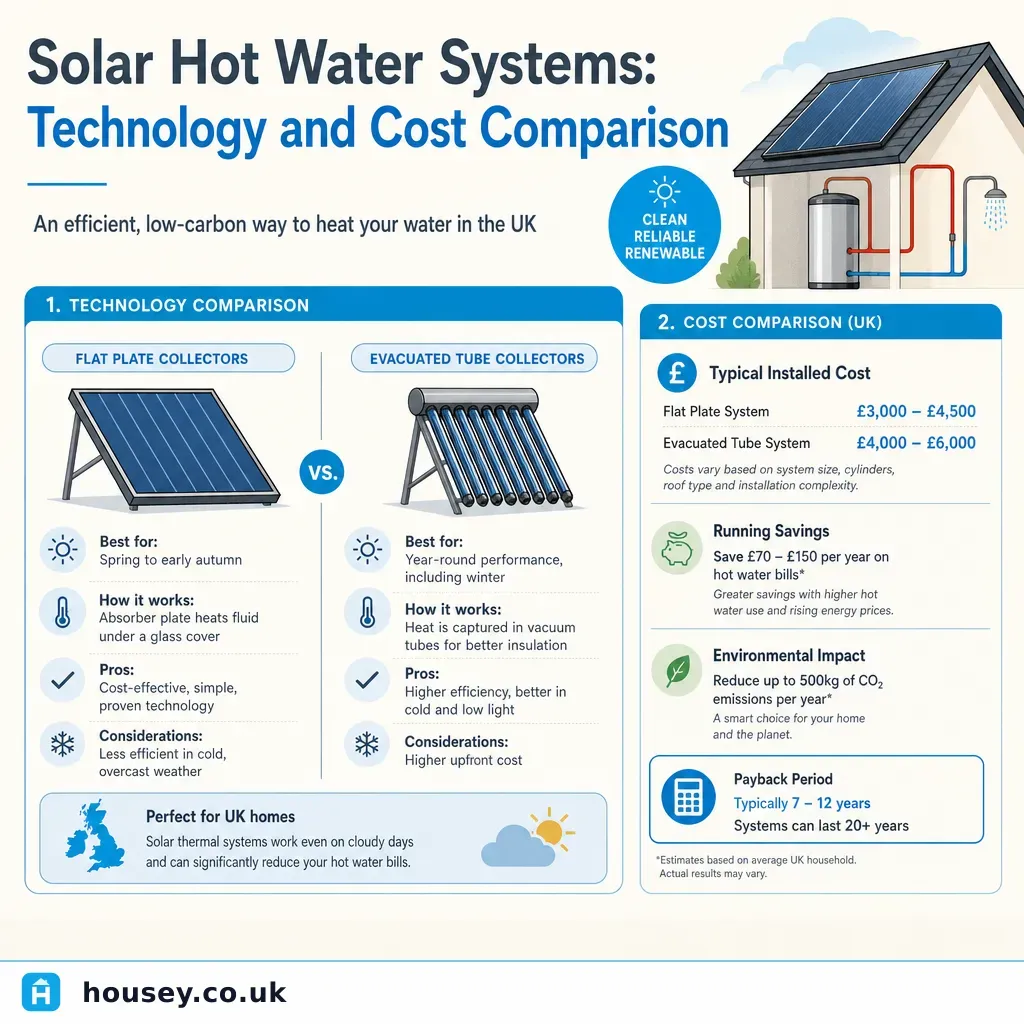
Solar Hot Water Systems: Technology and Cost Comparison
Solar thermal systems use roof-mounted collectors to heat domestic hot water via a glycol circuit and twin-coil cylinder.
 Energy & Retrofit
Making your home more sustainable
Making a UK home more sustainable usually starts with fabric-first improvements such as insulation, draught-proofing, and efficient glazing before adding renewable energy systems like solar panels or a heat pump.
 Energy & Retrofit
Solar Panel Grants and Funding: Maximising Clean Energy Investment
Several UK solar funding schemes are currently open: the Smart Export Guarantee pays homeowners for surplus electricity exported to the grid, ECO4 can fund free or subsidised panels for eligible low-income households, and 0% VAT on installation applies until at least March 2027.
 Energy & Retrofit
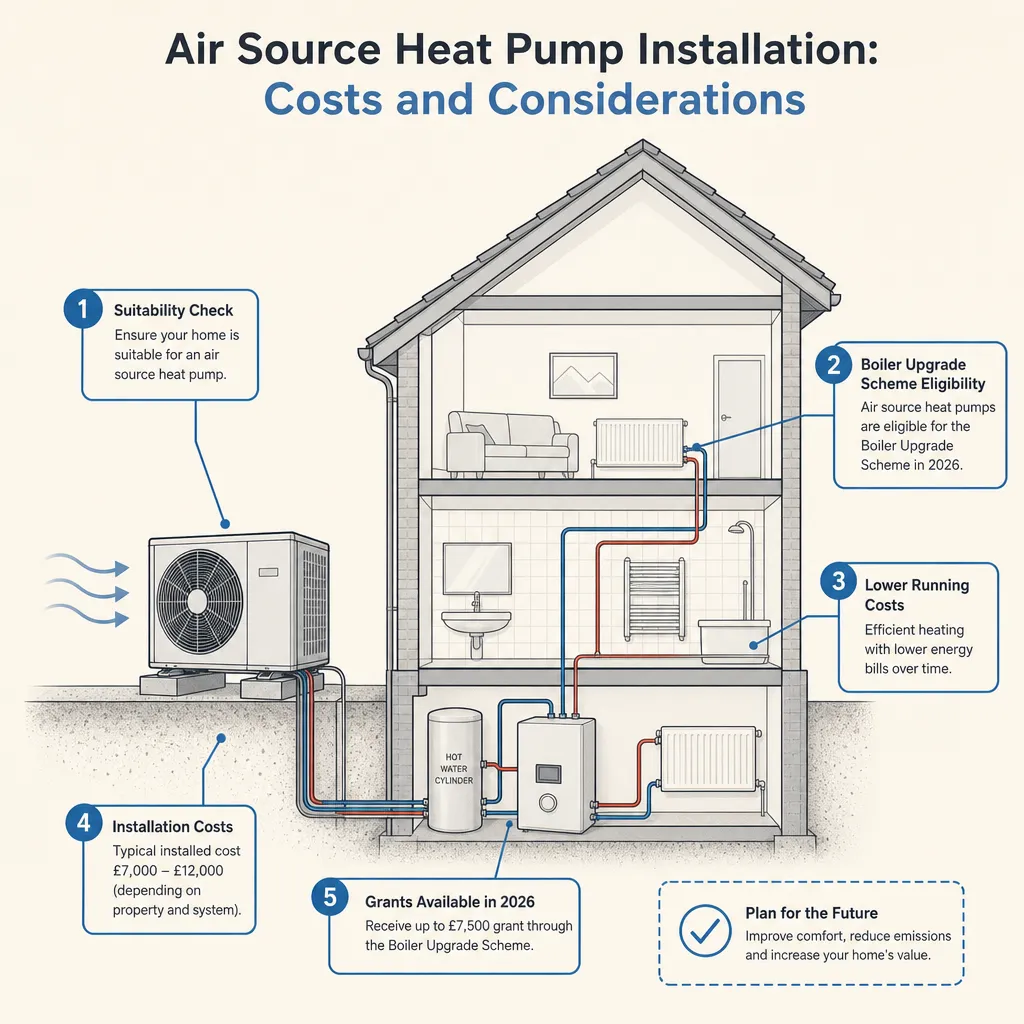
Air Source Heat Pump Installation: Costs and Considerations
Air source heat pump installation in the UK typically costs £8,000–£15,000 before the £7,500 Boiler Upgrade Scheme grant, available through MCS-certified installers in England and Wales.
 Energy & Retrofit
Designing and Building High-Performance Sustainable Homes with Eco-Friendly Systems
High-performance sustainable homes in the UK follow a fabric-first approach: maximise insulation and airtightness before adding low-carbon heating such as heat pumps, then layer in renewables like solar PV.