Ground-Source Heat Pump Systems: Capabilities and Performance Trade-offs
By Housey · Last reviewed 30th of May 2026
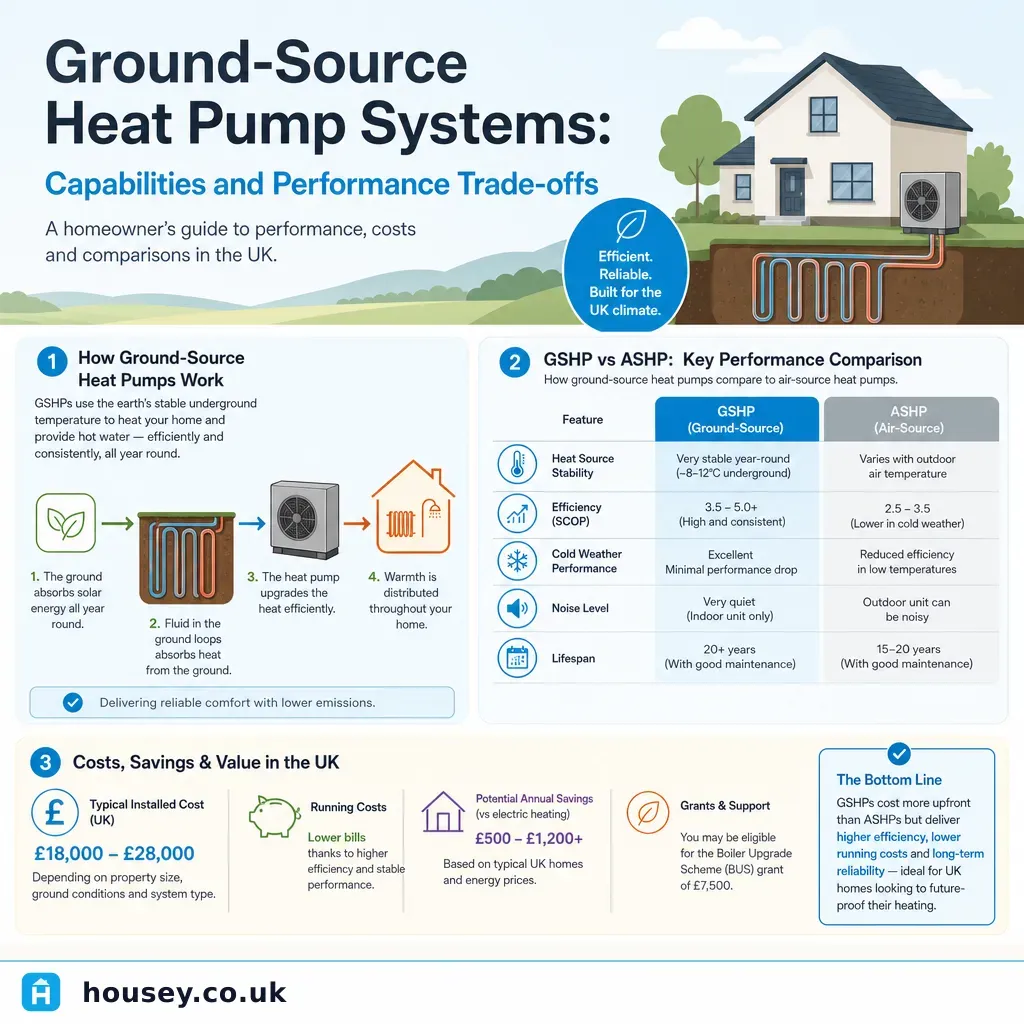
Ground-Source Heat Pump Systems: Capabilities and Performance Trade-offs
Ground-source heat pumps (GSHPs) are increasingly considered by UK homeowners undertaking deep energy retrofits, drawn by the prospect of lower running costs and eligibility for the Boiler Upgrade Scheme (BUS) grant. Deciding whether a GSHP is appropriate for your property — rather than an air-source alternative or a different heating system — requires an honest site assessment covering land availability, property fabric, heat distribution infrastructure, and upfront budget before any installer is appointed.
Key points
- GSHPs typically achieve a Coefficient of Performance (COP) of 3.5–4.5, delivering 3.5–4.5 units of heat per unit of electricity consumed — generally higher than air-source heat pumps (ASHPs) in sustained cold conditions.
- The Boiler Upgrade Scheme (BUS) offers £7,500 towards an eligible GSHP installation; only MCS-certified installers can claim this grant on your behalf — verify current amounts and eligibility at GOV.UK.
- Horizontal ground loops require approximately 10–15 m² of trenchable land per kW of heating output; vertical boreholes drilled to 100–150 m depth suit smaller plots but cost significantly more to install.
- Most heat pump guidance recommends achieving an EPC of D or better before installation to ensure the system can meet demand without excessive electricity use.
- Indicative installed costs range from approximately £15,000 to £35,000+, depending on loop type, ground conditions, and system size (indicative UK costs, last reviewed 2026-05-30; obtain MCS-certified quotes for your specific property).
How ground-source heat pumps work
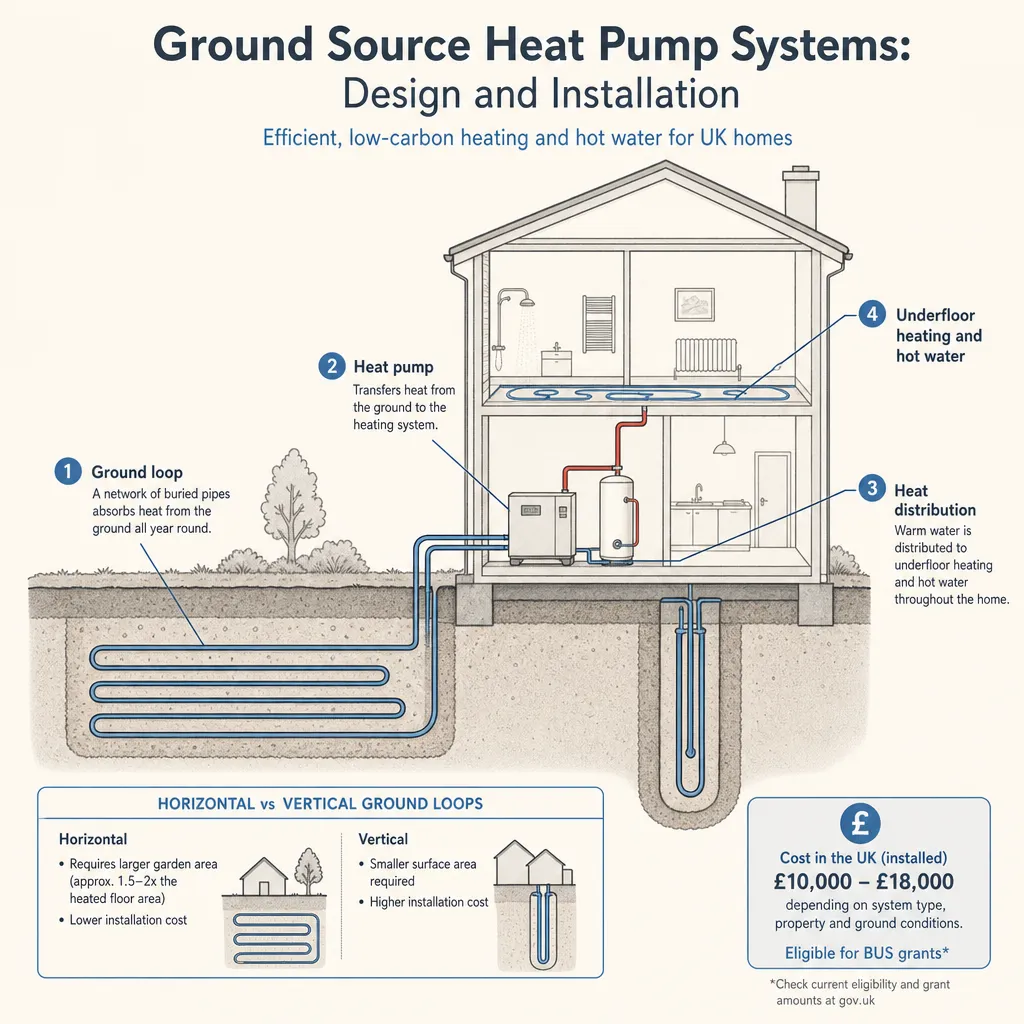
A GSHP extracts low-grade thermal energy from the ground via a buried loop — a network of pipes filled with a water/antifreeze mixture. A heat exchanger and refrigerant circuit upgrades this energy to a temperature useful for space heating and domestic hot water. Because UK ground temperatures remain relatively stable at approximately 8–12°C year-round, GSHPs deliver consistent performance regardless of outdoor air temperature — a key advantage over air-source alternatives during sustained cold periods.
Ground loop configurations include:
- Horizontal loops: laid in shallow trenches at 1–1.5 m depth, requiring significant garden area but lower drilling costs.
- Vertical boreholes: drilled to 100–150 m depth, suited to smaller plots but considerably more costly to install.
- Pond or lake loops: pipes laid in a nearby body of water — less common in domestic settings and subject to environmental consents.
GSHP vs ASHP: which suits your property?
Feature | Ground-source heat pump (GSHP) | Air-source heat pump (ASHP) |
|---|---|---|
Heat source | Ground (stable ~8–12°C year-round) | Outdoor air (varies seasonally) |
Typical seasonal COP | 3.5–4.5 | 2.5–3.5 |
Land requirement | High (horizontal loops) or borehole drilling required | Minimal — outdoor unit only |
Indicative installed cost | £15,000–£35,000+ | £8,000–£18,000 |
BUS grant (2025/26) | £7,500 | £7,500 |
Noise | Very low (indoor unit only) | Moderate (outdoor fan unit) |
Installation disruption | Significant groundworks | Relatively low |
Best suited to | Rural or larger properties with land; high heating demand | Smaller gardens; urban settings; well-insulated homes |
Indicative UK costs, last reviewed 2026-05-30. Verify current BUS grant amounts at GOV.UK before proceeding.
Which system should you choose?
- Choose a GSHP if you have sufficient garden area for horizontal loops (or budget for vertical boreholes), a well-insulated property (EPC D or better), and a heating demand that will reward the higher COP over a longer payback period.
- Choose an ASHP if land is limited, your budget is tighter, or your property is well insulated and the difference in seasonal COP is not material to projected running costs.
- Consult a PAS 2035 Retrofit Coordinator first if your property is solid-walled, pre-1919, or shows signs of condensation or moisture risk — fabric improvements may be required before any heat pump is correctly sized.
- Instruct an MCS-certified designer for a heat loss calculation to BS EN 12831 before sizing any system — oversizing wastes money and reduces efficiency.
- Check with the Environment Agency (England) or Natural Resources Wales if vertical boreholes are planned — registration under the Environmental Permitting Regulations 2016 may be required.
Performance factors that affect real-world efficiency
Published COP figures can be misleading if the system is not correctly designed for the property:
- Flow temperature: GSHPs work most efficiently delivering heat at 35–45°C, suited to underfloor heating or oversized radiators. Operating at 55–60°C for conventional radiators substantially reduces efficiency and increases running costs.
- System design and balancing: correct sizing and hydraulic balancing matter as much as the heat pump unit itself — a poorly designed system will underperform regardless of the equipment specified.
- Ground conditions: clay soils transfer heat more effectively than sandy or dry soils, affecting the length of loop required for a given heating output.
- Domestic hot water: periodic heating above 50°C is required to manage Legionella risk; this reduces COP and should be accounted for in system design and energy cost projections.
Important limitations
This article provides general guidance only and is not a substitute for a site-specific assessment by a qualified professional. Heat pump sizing, ground loop design, and fabric suitability vary considerably by property. Only MCS-certified designers and installers can produce designs eligible for the Boiler Upgrade Scheme grant. Grant amounts, planning conditions, and environmental permit requirements may change — always verify current requirements on GOV.UK and with the Environment Agency before proceeding.
What to ask a qualified professional
Before instructing a GSHP designer or installer, ask:
- What is the calculated heat loss for my property, and which standard was used (BS EN 12831)?
- Is a PAS 2035 fabric-first assessment recommended before the system is sized?
- What flow temperature are you designing to, and will existing radiators need upgrading?
- Is MCS certification confirmed, and is Boiler Upgrade Scheme grant administration included in your service?
- What ground loop configuration do you recommend, and why is it appropriate for my plot?
- Have you assessed soil type and thermal conductivity, and does this affect loop sizing?
- Does borehole drilling require Environment Agency registration or an environmental permit for my site?
- What are the estimated seasonal coefficient of performance (SCOP) figures for my specific property?
- What is the total installed cost including groundworks, cylinder, controls, and commissioning?
- What warranty terms apply to the heat pump unit and to the installation itself?
When this becomes urgent
Seek professional assessment before starting any work, and act with particular care if:
- Your property has an EPC rating of E, F, or G — fabric improvements are almost certainly needed before a heat pump can operate efficiently.
- The property is solid-walled, hard-to-insulate, or shows signs of damp, condensation, or inadequate ventilation — retrofit moisture risk must be assessed under PAS 2035 before any system is specified.
- You plan to drill vertical boreholes — ground condition assessments and regulatory checks must be completed before any drilling begins.
- A previous heating system has failed and there is pressure to act quickly — a GSHP cannot be installed as a like-for-like emergency swap and requires upfront design work.
How Housey can help
Housey connects homeowners with professionals who can carry out heat pump surveys and provide independent guidance from qualified energy-efficiency consultants — helping you establish whether a GSHP is genuinely viable for your property before committing to significant groundworks or equipment expenditure.
Frequently asked questions
Do I need planning permission for a ground-source heat pump?
In most cases, GSHPs are permitted development in England and Wales and do not require planning permission, provided conditions are met — for example, the property is not listed and is not in a designated area. Vertical borehole drilling may require a separate environmental permit from the Environment Agency. Always check with your local planning authority and the Environment Agency before work begins.
Is my home suitable for a ground-source heat pump?
Suitability depends on insulation levels, available land or borehole access, the existing heat distribution system (underfloor heating or appropriately sized radiators), and overall heating demand. An MCS-certified heat pump designer should carry out a heat loss survey and site assessment to BS EN 12831 to confirm suitability before any commitment is made.
What is the Boiler Upgrade Scheme and how do I apply?
The Boiler Upgrade Scheme (BUS) provides a grant — £7,500 for GSHPs as of 2025/26; verify current amounts at GOV.UK — towards an eligible heat pump installation. The grant is claimed by the MCS-certified installer on your behalf. To qualify, you must own the property, hold a valid EPC with no outstanding loft or cavity wall insulation recommendations, and use an MCS-certified installer.
Sources and further reading
- Boiler Upgrade Scheme – GOV.UK — GOV.UK / DESNZ
- Ground source heat pumps – Energy Saving Trust — Energy Saving Trust
- MCS – Microgeneration Certification Scheme — MCS
- Environmental permits for ground source heat pump systems — Environment Agency / GOV.UK
- PAS 2035 – Retrofitting dwellings for improved energy efficiency — BSI / TrustMark
Useful next reads
 Energy & Retrofit
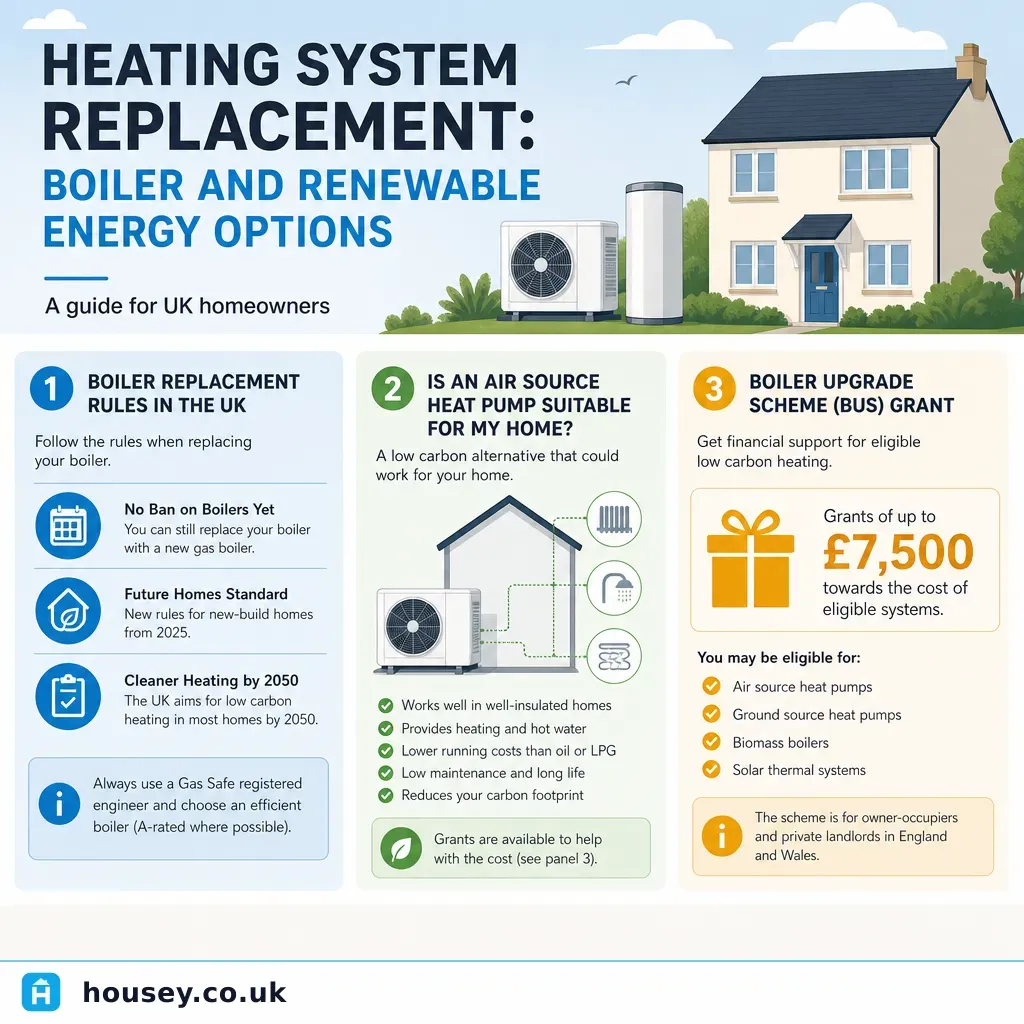
Heating System Replacement: Boiler and Renewable Energy Options
When replacing a heating system in the UK, a new gas boiler must comply with Boiler Plus (Part L) and be fitted by a Gas Safe registered engineer.
 Energy & Retrofit
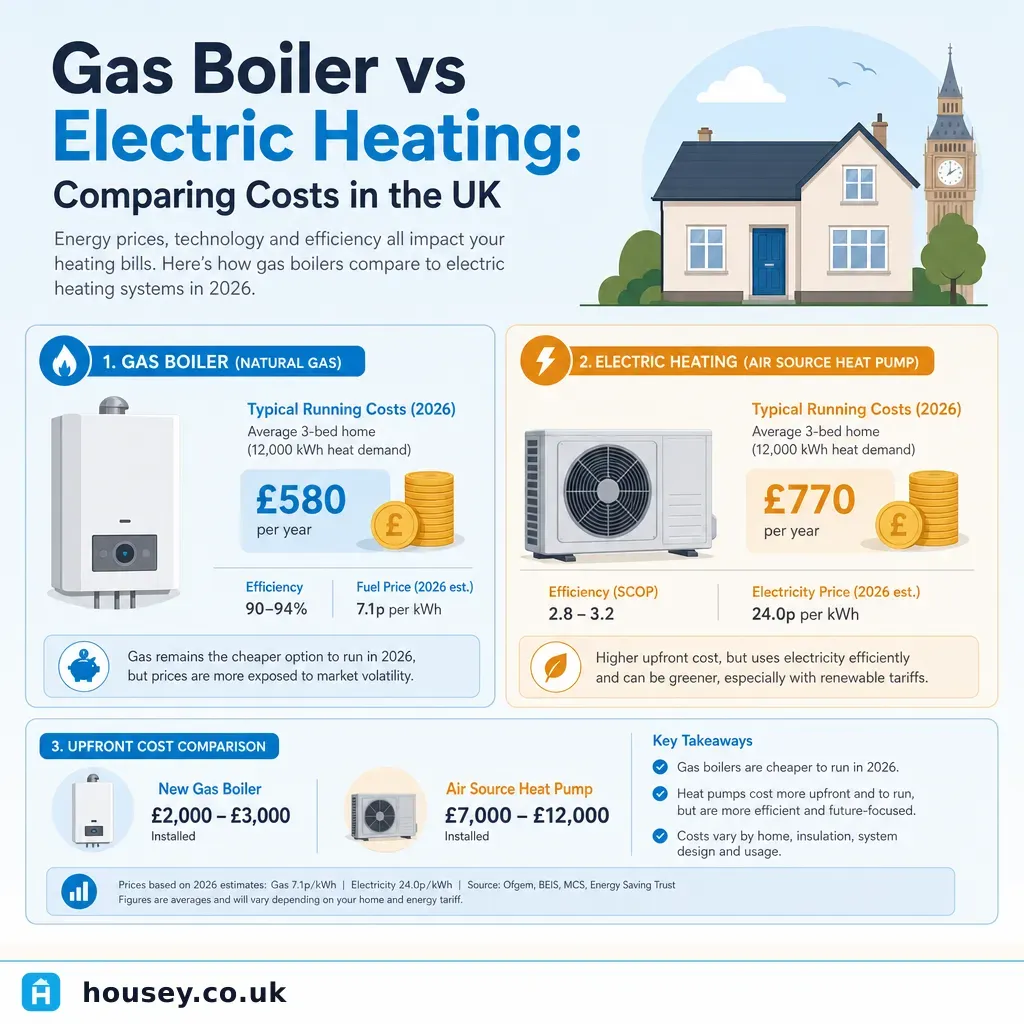
Gas Boiler vs Electric Heating: Comparing Costs in the UK
Gas boilers currently cost around 6.
 Energy & Retrofit
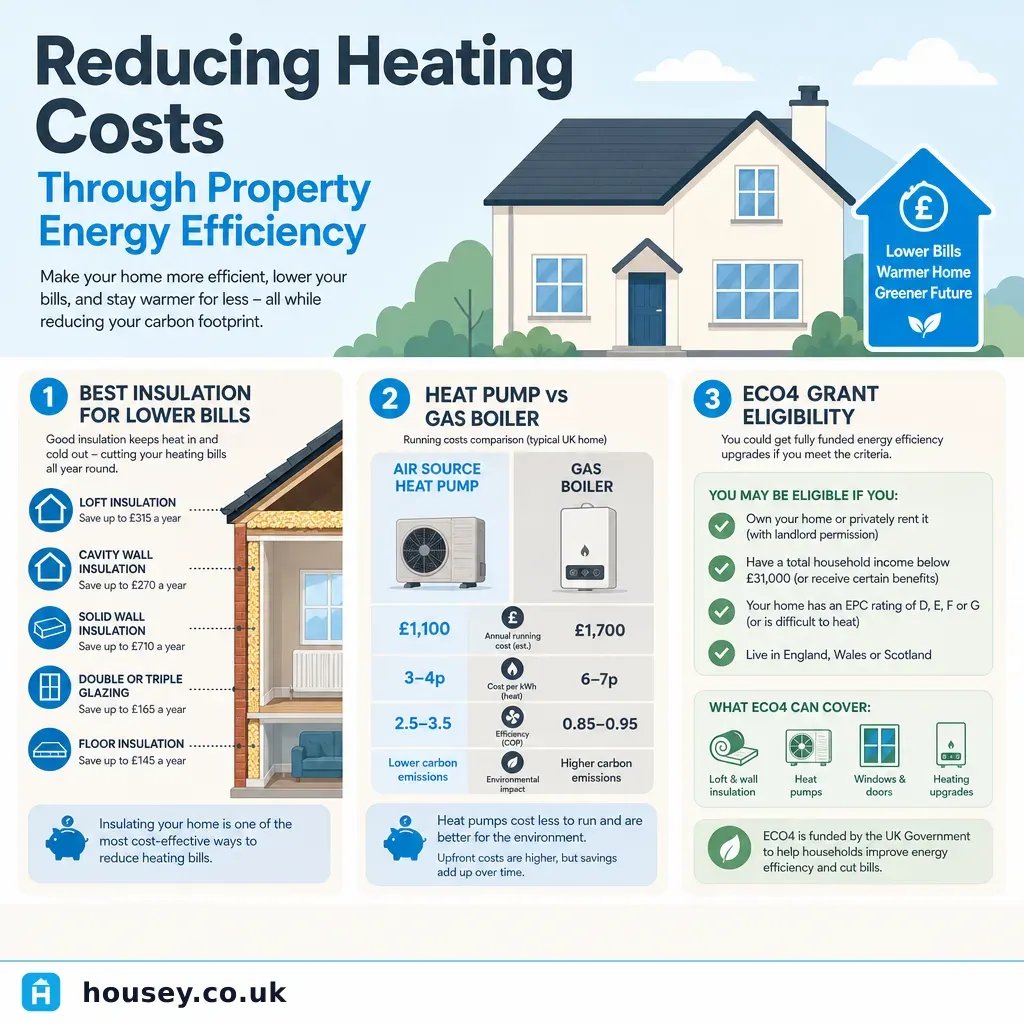
Reducing Heating Costs Through Property Energy Efficiency
Reducing heating costs starts with identifying where heat is lost — typically walls (30–35%), roof (20–25%), and windows.
 Energy & Retrofit
Ground Source Heat Pump Systems: Design and Installation
Ground source heat pumps extract heat from the earth through buried loops or boreholes, then upgrade it for space heating and hot water.
 Energy & Retrofit
Making your home more sustainable
Making a UK home more sustainable usually starts with fabric-first improvements such as insulation, draught-proofing, and efficient glazing before adding renewable energy systems like solar panels or a heat pump.