Heat Pump Installation: Common Questions and Answers
By Housey · Last reviewed 10th of May 2026
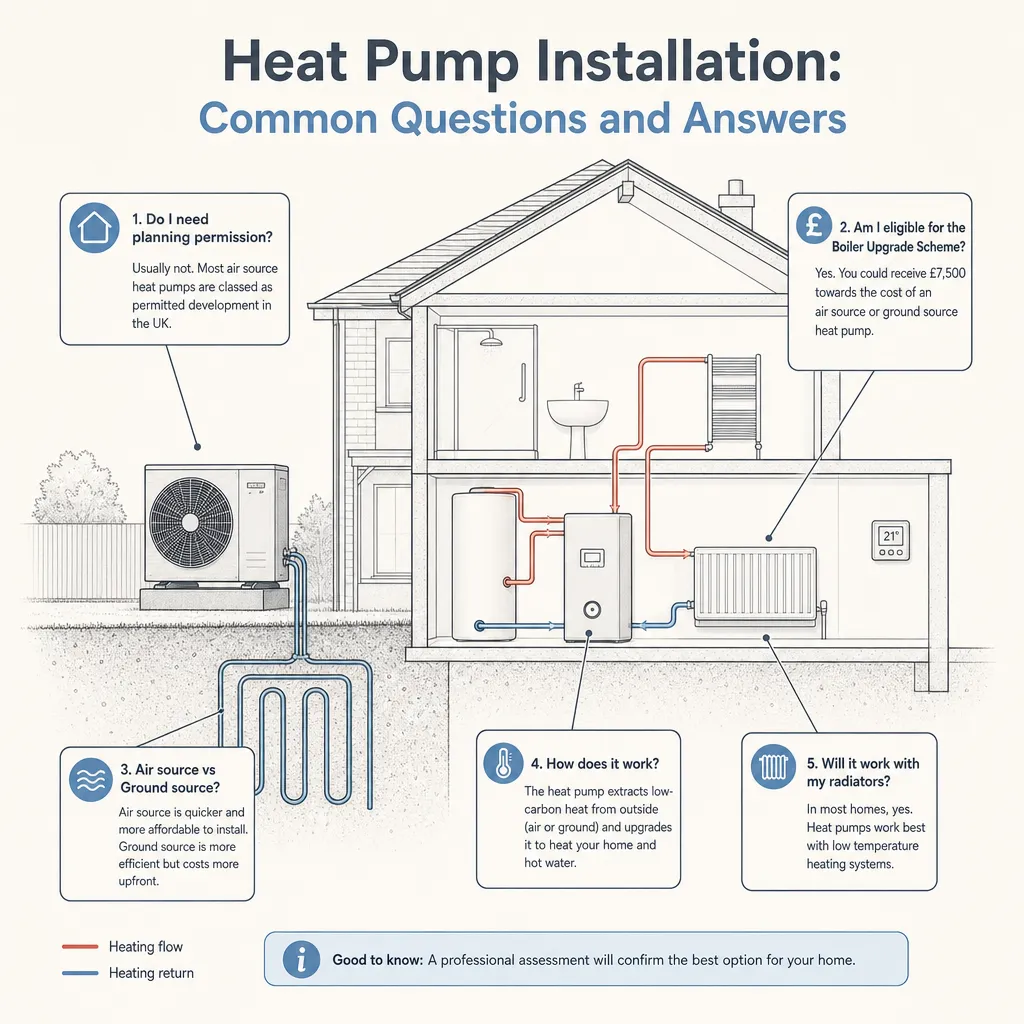
Heat Pump Installation: Common Questions and Answers
Heat pumps are increasingly central to UK home heating plans, particularly as the government moves towards ending new gas boiler installations from 2035. For homeowners weighing up air-source or ground-source options — often prompted by a boiler replacement or a retrofit project — the questions accumulate quickly. Understanding the basics before speaking to installers puts you in a stronger position to evaluate quotes, check eligibility, and avoid common pitfalls.
Key points
- The Boiler Upgrade Scheme (BUS) offers a £7,500 grant towards an air-source or ground-source heat pump in England and Wales — check GOV.UK for current availability and grant amounts.
- MCS certification is required for both the installer and the heat pump model for any installation to qualify for the BUS grant.
- A heat loss calculation to BS EN 12831 is an essential pre-installation step — it determines the correct system size and identifies whether radiators need upgrading.
- Air-source heat pumps (ASHPs) typically achieve a Coefficient of Performance (COP) of 2.5–4, producing 2.5–4 units of heat per unit of electricity consumed.
- Most detached and semi-detached houses in England benefit from permitted development rights for ASHPs, but listed buildings, flats, and some conservation area properties need a full planning application.
Do I need planning permission for a heat pump?
Air-source heat pumps benefit from permitted development rights for householders in England, meaning no formal planning application is required provided siting conditions in the Town and Country Planning (General Permitted Development) (England) Order 2015 are met. Key conditions include:
- The unit must be at least 1 metre from the property boundary.
- No more than one ASHP per property.
- It must not be installed on a wall or roof facing a highway.
- The property must not be a flat, a listed building, or in certain protected areas including some conservation areas.
Permitted development rights differ across Wales, Scotland, and Northern Ireland. Check with your local planning authority (LPA) before proceeding. Ground-source heat pumps generally do not require planning permission, but any borehole may need an abstraction licence or consent from the Environment Agency.
Air-source vs ground-source: which suits your property?
Feature | Air-Source Heat Pump (ASHP) | Ground-Source Heat Pump (GSHP) |
|---|---|---|
Best for | Most homes with outdoor space for a unit | Larger plots with garden for ground loops or borehole |
Typical installed cost | £8,000–£15,000 (indicative) | £15,000–£30,000+ (indicative) |
Typical COP | 2.5–3.5 | 3.0–4.5 |
Noise | Low hum from outdoor unit | Very quiet; unit usually indoors |
Space required | Wall or ground-mounted outdoor unit | Ground loop (large garden) or borehole |
BUS grant eligible | Yes (£7,500) | Yes (£7,500) |
Installation disruption | Low–moderate | High (excavation or borehole drilling) |
Planning usually needed | No, subject to conditions | No, but borehole may need Environment Agency consent |
Indicative UK costs, last reviewed 2026-05-10. Costs vary by property, installer, and scope of associated works such as radiator upgrades. Always obtain multiple quotes.
Which heat pump should you choose?
Use this decision guide before speaking to installers:
- Choose an ASHP if you have suitable external wall or garden space for an outdoor unit, your property is a detached or semi-detached house, and you want to avoid extensive groundworks.
- Choose a GSHP if you have a large plot or suitable land, can accommodate excavation or borehole drilling, and want a quieter system with a potentially higher COP over the long term.
- Request a heat loss survey first regardless of which type interests you — no installer should specify or size a system without one.
- Check with your LPA if your property is listed, in a conservation area, or is a flat before assuming permitted development applies.
- Confirm MCS certification for both installer and equipment if you intend to apply for the Boiler Upgrade Scheme.
- Ask a structural engineer or retrofit assessor if your property has poor insulation and you are unsure whether it is worth proceeding before improving the fabric first.
Is my home suitable for a heat pump?
Heat pumps operate most efficiently in well-insulated homes. A property with high heat loss requires an oversized, more expensive system and will likely have higher running costs. Before installation, consider:
- Insulation levels: Loft insulation of at least 270 mm is recommended by the Energy Saving Trust. Solid-walled properties — common in Victorian and Edwardian terraces — may benefit from external or internal wall insulation.
- Radiator sizing: Heat pumps typically operate at flow temperatures of 35–55°C, compared to 70–80°C for a gas boiler. Existing radiators may need replacing with larger models to deliver the same heat output.
- Hot water cylinder: Most heat pump systems require a hot water storage cylinder. Properties on a combi boiler will need one fitted.
- Electrical supply: An ASHP requires a suitable electrical connection — your installer should confirm whether any upgrades are needed.
A heat loss calculation to BS EN 12831 must be carried out before any system is specified.
What does the Boiler Upgrade Scheme cover?
The Boiler Upgrade Scheme (BUS) is administered by Ofgem on behalf of the Department for Energy Security and Net Zero (DESNZ). It provides a £7,500 grant for both air-source and ground-source heat pumps. The grant is applied by your MCS-certified installer at point of sale — you pay the net balance.
Key eligibility conditions:
- The property must be in England or Wales.
- The existing heating system must be fossil-fuel-based.
- The EPC must not show outstanding cavity wall or loft insulation recommendations (some exemptions exist).
- Both the installer and the heat pump product must be MCS certified.
The BUS operates on annual budget allocation. Always verify current grant amounts and scheme availability on GOV.UK before making decisions.
What happens during a heat pump survey?
A heat pump survey — sometimes called a heat loss assessment — is a technical site visit before any quote is finalised. The assessor will:
- Measure room dimensions and assess insulation values for walls, floors, ceilings, and windows.
- Calculate the total heat loss of the property in kilowatts.
- Determine the correct heat pump output size for the property.
- Identify whether radiators, pipework, or a hot water cylinder need upgrading.
- Advise on siting the outdoor unit and routing pipework through the building.
Without this survey, no installer can responsibly size the system. An undersized heat pump will struggle in cold weather; an oversized unit will short-cycle and may affect BUS eligibility. Arranging a qualified heat pump survey through Housey before obtaining installation quotes is a good way to enter the process with independent data.
Important limitations
This article is general guidance only. Heat pump suitability, system sizing, grant eligibility, and planning requirements depend on your specific property, location, existing heating system, and insulation levels. Grant amounts and scheme conditions are subject to change — always verify with GOV.UK. An MCS-certified installer or an independent retrofit assessor should carry out a full site assessment before any decisions are made. Nothing in this article constitutes advice on a specific installation.
What to ask a qualified professional
Before accepting any heat pump installation quote, ask:
- Are you MCS certified, and is the heat pump model you are proposing MCS listed?
- Will you carry out a full heat loss calculation to BS EN 12831 before sizing the system?
- What radiator, pipework, and hot water cylinder changes are included in the quote, and what is excluded?
- Will you handle the Boiler Upgrade Scheme application on my behalf?
- What is the estimated Seasonal Coefficient of Performance (SCOP) for my property with this system?
- What annual maintenance does the system require, and do you offer a service contract?
- What warranties apply to the heat pump unit and to the installation itself?
When to get professional help
Always use a qualified, MCS-certified professional for heat pump installation. Seek independent advice before proceeding if:
- A quote does not include a site visit or heat loss calculation.
- An installer recommends a specific system without visiting the property.
- Your EPC lists outstanding insulation recommendations and you are unsure whether BUS exemptions apply.
- Your property is listed, in a conservation area, or is a flat.
- You are considering a GSHP with borehole drilling — a geological survey may also be required.
How Housey can help
Housey connects homeowners with qualified professionals for independent heat pump surveys, helping you get a properly assessed system specification before committing to any installer. A thorough heat loss survey is the essential foundation of a reliable installation.
Frequently asked questions
Can I install a heat pump myself?
No — to qualify for the Boiler Upgrade Scheme, installation must be carried out by an MCS-certified installer. Heat pump work involves refrigerant handling (requiring F-gas certification), electrical work, and pipework all requiring qualified trades. DIY installation would also likely void manufacturer warranties and disqualify the property from grant funding.
Do heat pumps work in older UK homes?
Heat pumps can work in older properties, but retrofitting is more complex than in newer homes. A heat loss survey identifies what insulation improvements and radiator upgrades are needed first. Victorian terraces with solid walls may require additional investment before a heat pump operates efficiently and cost-effectively.
Does a heat pump need a hot water cylinder?
Most heat pump systems require a hot water storage cylinder, as heat pumps are not designed to deliver instant hot water the way a combi boiler does. Properties currently on a combi boiler will need a cylinder added. The appropriate size depends on household demand and system design, and should be specified during the survey stage.
Will a heat pump reduce my energy bills?
This depends on your current fuel, tariff, insulation levels, and system sizing. Heat pumps can reduce bills compared to direct electric heating but may cost more to run than a modern gas boiler at current electricity-to-gas price ratios. The Energy Saving Trust publishes guidance on expected running costs for different UK property types.
How long does a heat pump last?
A well-maintained heat pump typically lasts 15–25 years. Annual servicing by a qualified engineer helps maintain efficiency and prolongs lifespan. The outdoor unit on an air-source heat pump is exposed to the elements, so periodic checks of the casing and refrigerant circuit are recommended as part of a service plan.
Sources and further reading
- Boiler Upgrade Scheme guidance — GOV.UK
- Heat pump advice and running costs — Energy Saving Trust
- MCS certification scheme — Microgeneration Certification Scheme
- Boiler Upgrade Scheme administration — Ofgem
- Permitted development rights: technical guidance — GOV.UK
Useful next reads
 Energy & Retrofit
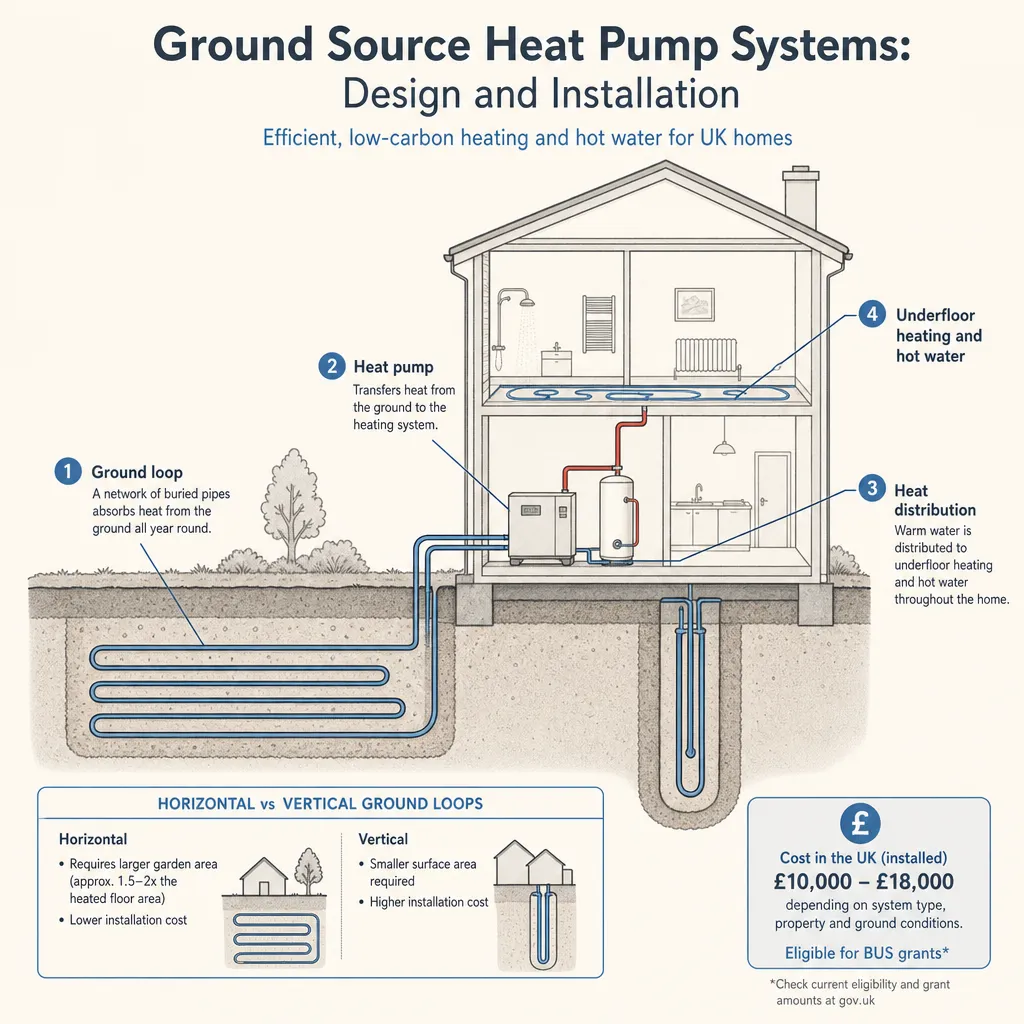
Ground Source Heat Pump Systems: Design and Installation
Ground source heat pumps extract heat from the earth through buried loops or boreholes, then upgrade it for space heating and hot water.
 Energy & Retrofit
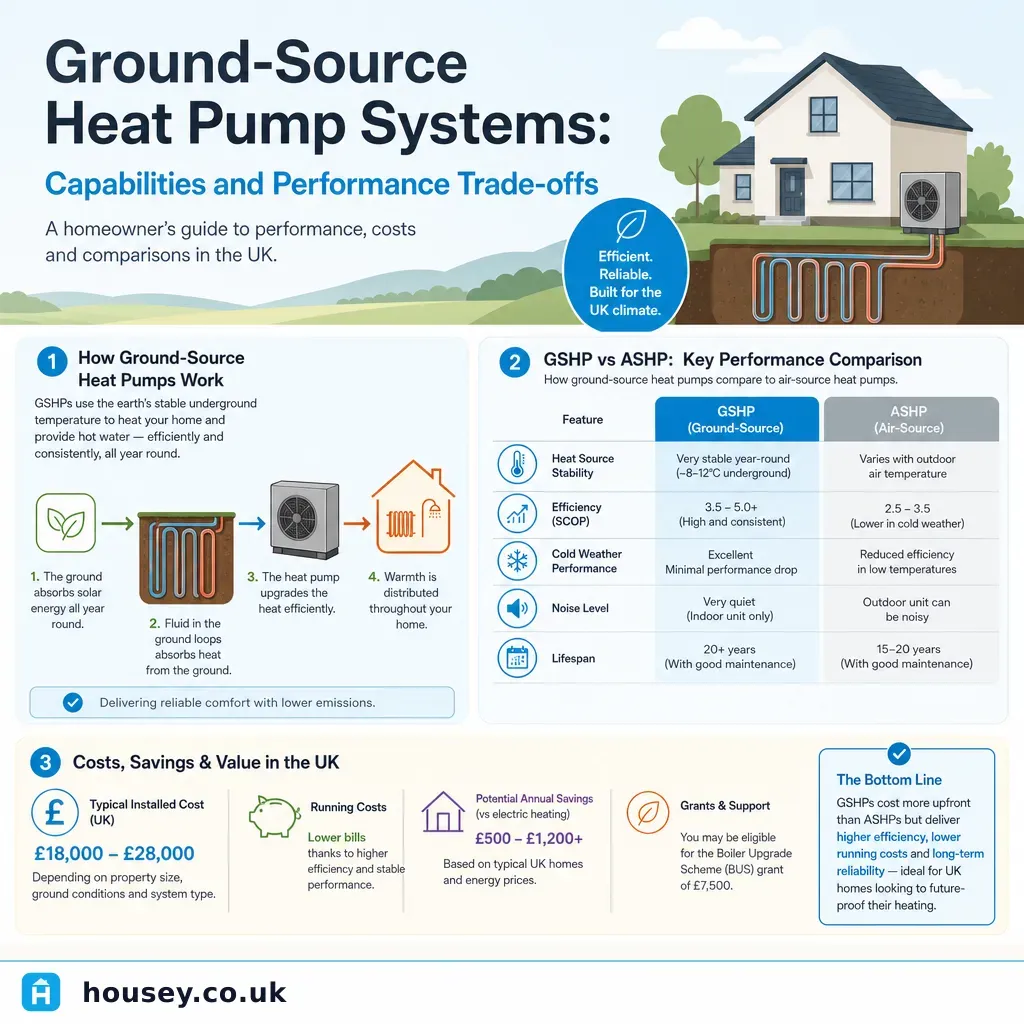
Ground-Source Heat Pump Systems: Capabilities and Performance Trade-offs
A ground-source heat pump extracts heat from the ground via buried loops, typically achieving a COP of 3.
 Energy & Retrofit
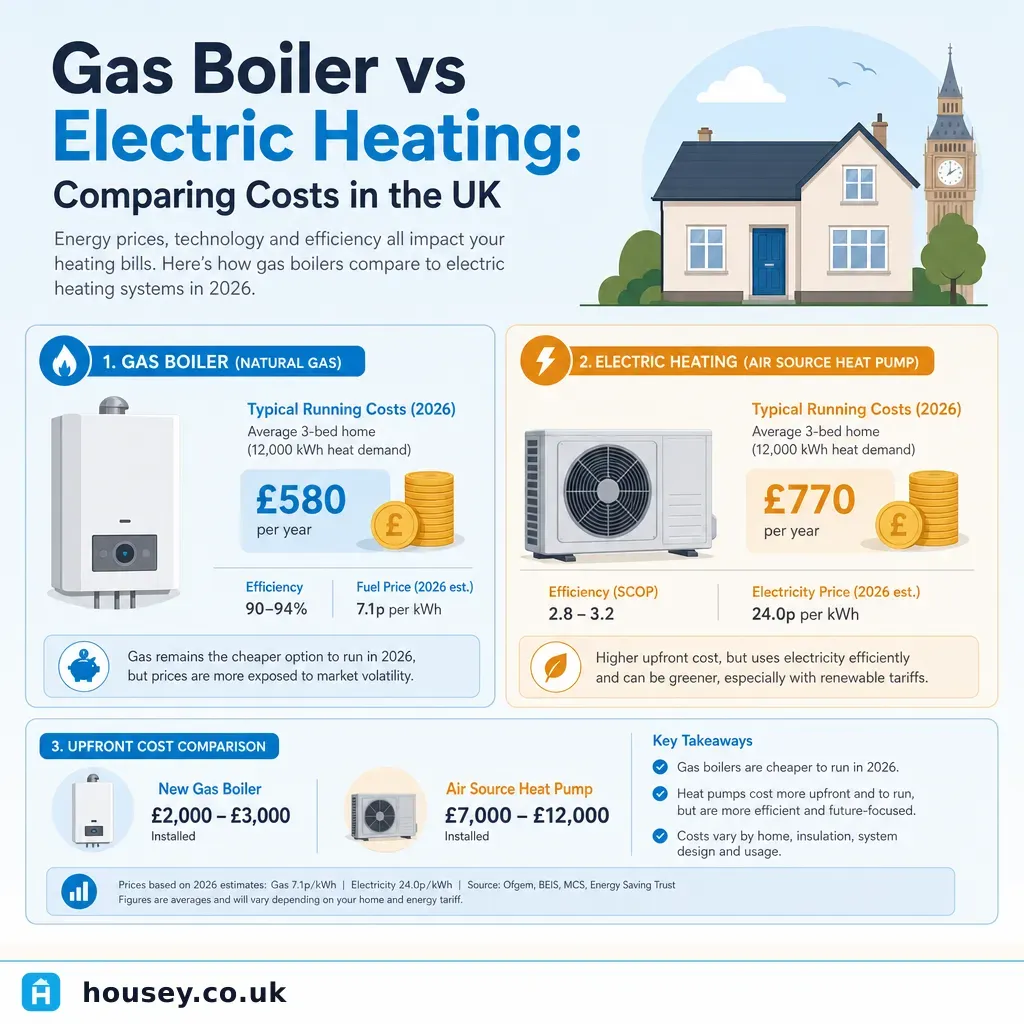
Gas Boiler vs Electric Heating: Comparing Costs in the UK
Gas boilers currently cost around 6.
 Energy & Retrofit
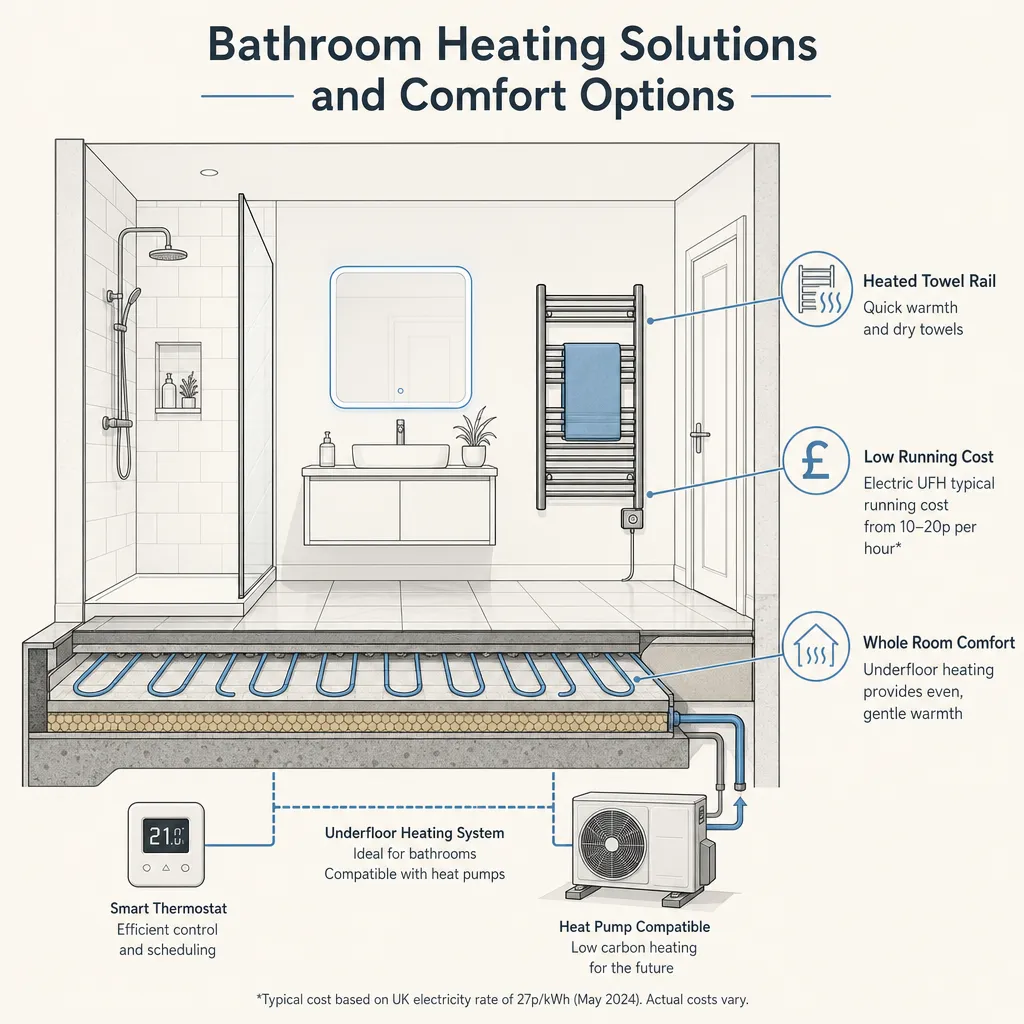
Bathroom Heating Solutions and Comfort Options
UK bathrooms can be heated using electric towel rails, wet radiators on the central heating circuit, electric or wet underfloor heating, or infrared panels.
 Energy & Retrofit
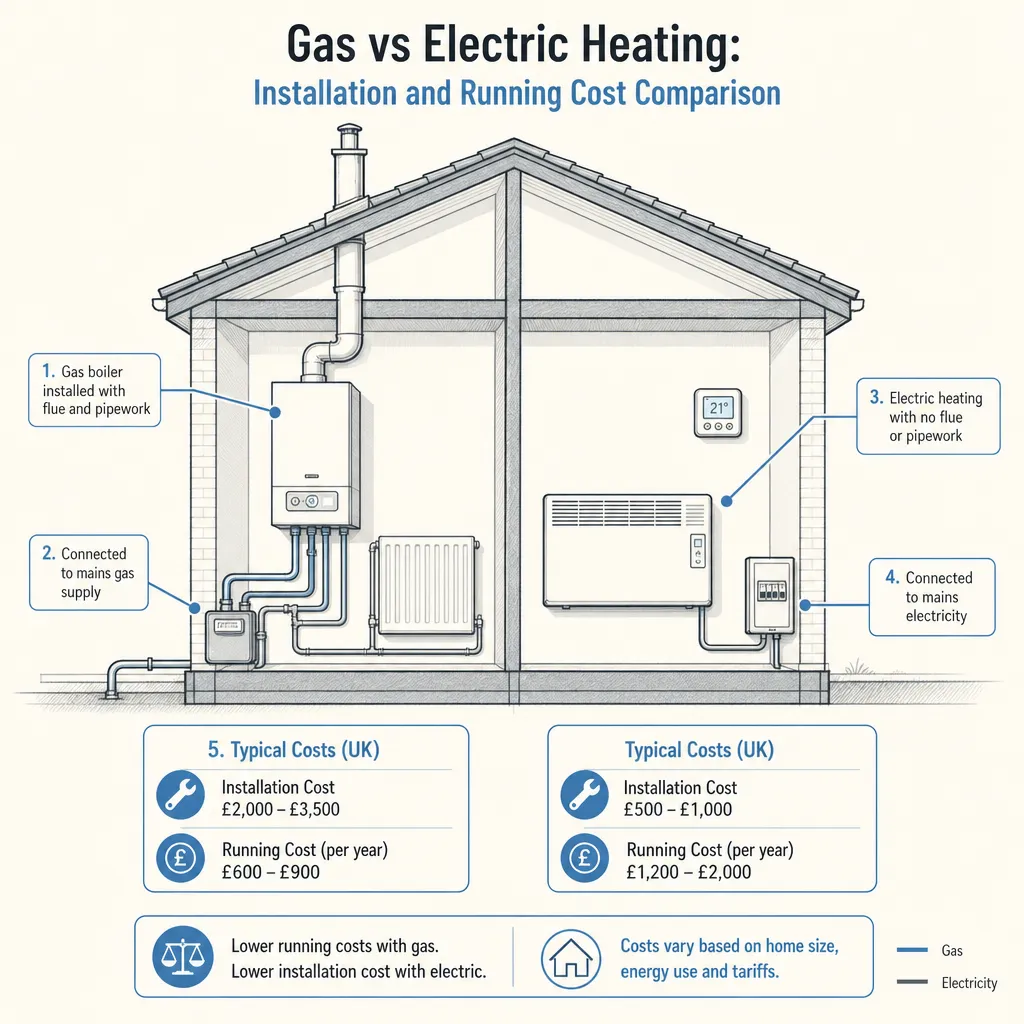
Gas vs Electric Heating: Installation and Running Cost Comparison
Gas central heating usually has lower running costs per kWh than direct electric heating in the UK, though heat pumps can change that equation.