How Building Regulation Changes Drive Demand for Insulation Services
By Housey · Last reviewed 30th of May 2026
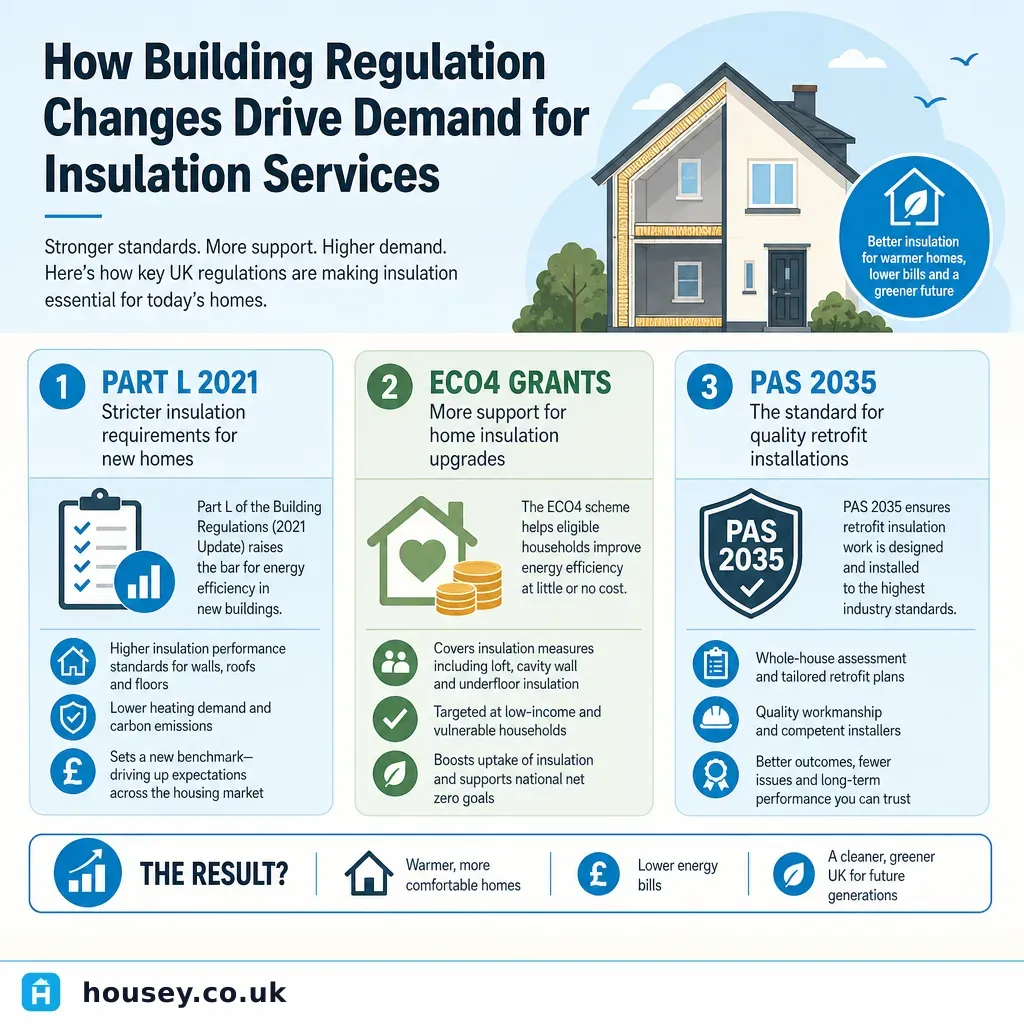
How Building Regulation Changes Drive Demand for Insulation Services
The UK's insulation market has been reshaped significantly over the past five years by a combination of tightening Building Regulations, government retrofit schemes, and landlord energy obligations. Whether you are buying an older property, planning an extension, or letting out a home, understanding which rules apply — and when — helps you plan works correctly and avoid costly compliance gaps.
Key points
- Approved Document L (Part L) of the Building Regulations sets maximum U-values for walls, roofs, and floors in new builds and extensions — the 2021 update requires external walls in new dwellings to achieve ≤0.18 W/m²K.
- ECO4 (Energy Company Obligation 4) runs until March 2026 with a total obligation value of approximately £4 billion, funding insulation and heating upgrades for low-income and fuel-poor households.
- PAS 2035:2019 (revised 2023) is the mandatory framework for all publicly funded domestic retrofit, requiring a qualified Retrofit Assessor to produce a Retrofit Assessment before insulation or heating work begins.
- Minimum Energy Efficiency Standards (MEES) currently require privately rented properties in England and Wales to hold an EPC rating of E or above; the Government has proposed tightening this to EPC C for new tenancies by 2030.
- The Future Homes Standard — expected to apply to new homes from around 2025–2027 — will require new dwellings to produce 75–80% fewer carbon emissions than those built to 2013 standards, driving significantly higher insulation specification throughout.
Why Building Regulations directly affect insulation demand
Building Regulations Part L (Conservation of Fuel and Power) sits at the heart of insulation demand for new builds, extensions, and material changes of use. When the 2021 update to Approved Document L came into force in June 2022, it raised minimum thermal performance requirements across the board. For new dwellings, walls must achieve a U-value of no worse than 0.18 W/m²K, roofs 0.11 W/m²K, and ground floors 0.13 W/m²K.
For homeowners adding an extension, the regulations require that all new thermal elements meet current standards — and that any existing elements being altered or newly exposed are also upgraded to current thresholds where technically and economically feasible. This "consequential improvement" duty means that an extension project can trigger insulation upgrades to adjacent walls or a poorly performing roof.
The forthcoming Future Homes Standard will go further still. Proposed rules would eliminate fossil fuel heating from new homes and require fabric performance that supports heat pump operation — meaning significantly higher levels of insulation will become the standard across all new residential construction.
ECO4 and publicly funded retrofit: how PAS 2035 shapes the market
For existing homes — especially those built before 1980 — publicly funded schemes such as ECO4 and the Great British Insulation Scheme (GBIS) have become the primary route to insulation upgrades for many households. Both schemes are governed by PAS 2035, which specifies:
- A Retrofit Assessment must be carried out by a qualified Retrofit Assessor before any insulation or heating measures are recommended.
- A Retrofit Coordinator (TrustMark-registered) must oversee medium and large retrofit projects.
- Work must be carried out by installers registered under TrustMark, MCS, or an equivalent recognised scheme.
This framework creates structured demand for insulation installers who hold the right accreditations, because unregistered firms cannot legally carry out ECO4-funded work.
The Great British Insulation Scheme, launched in 2023, targets homes rated EPC D–G and offers subsidised cavity wall, loft, and solid wall insulation. For households in eligible Council Tax bands, the scheme can cover the full cost of installation.
Which regulation applies to your situation?
Understanding which rules apply depends on whether your home is a new build, an existing property undergoing works, or a rental. The table below summarises the main regulatory triggers.
Scenario | Applicable regulation | Key requirement | Who you typically need |
|---|---|---|---|
New build or extension | Building Regulations Part L (Approved Document L 2021) | U-values: walls ≤0.18, roofs ≤0.11, floors ≤0.13 W/m²K | Building control, insulation installer |
ECO4 or GBIS funded retrofit | PAS 2035:2023 | Retrofit Assessment before work; TrustMark-registered installer | Retrofit Assessor, Retrofit Coordinator |
Privately rented home | MEES (EPC minimum E; proposed C by 2030) | Valid EPC; insulation or other measures to achieve rating | Energy assessor, insulation installer |
Listed building or conservation area | Approved Document L with heritage exemptions | May require alternative materials or local authority consent | Conservation officer, specialist installer |
Owner-occupied retrofit (self-funded) | No mandatory standard unless publicly funded | Best practice: follow PAS 2035 voluntarily | Insulation assessor, installer |
Homeowner checklist: preparing for insulation works
Before engaging an insulation installer or applying for grant funding, work through this checklist to avoid common delays.
How the rental market is amplifying insulation demand
For private landlords, the proposed tightening of MEES to EPC C by 2030 for new tenancies is expected to create a substantial wave of retrofit demand. A significant proportion of rental properties currently sit below EPC C, with solid-wall homes — which make up a large share of pre-1919 housing stock — often the hardest and most expensive to upgrade.
Solid wall insulation (either internal or external) typically costs considerably more than cavity wall or loft insulation, and the market for skilled installers with experience in both approaches is growing. For landlords in England and Wales, the cost cap under MEES will determine whether a landlord can claim an exemption or must proceed with works. Checking the current threshold with an energy-efficiency consultant before committing to a programme is advisable.
When to get professional help
Insulation decisions — particularly in older or unusual properties — are not always straightforward. Seek professional advice if:
- Your home has solid walls, a flat roof, or non-standard construction.
- You are planning insulation alongside a ventilation or heating system change.
- Your property is listed or in a conservation area.
- You are unsure whether your works require building control sign-off.
- You have noticed signs of damp or condensation — adding insulation to a moisture-affected property without proper assessment can worsen the problem.
How Housey can help
Housey connects homeowners and landlords with qualified insulation installers and professionals offering insulation assessments who hold the accreditations required for PAS 2035 and ECO4-funded work. If you want to understand your property's energy performance before committing to any works, an energy-efficiency consultant can help you prioritise measures and navigate grant eligibility.
Frequently asked questions
Do I need building control sign-off for insulation work?
For new extensions and new builds, yes — Part L compliance is checked as part of building control. For retrofit insulation on existing walls or roofs, building control notification is not usually required unless you are making a material change of use. ECO4 and GBIS funded work is managed through TrustMark and the PAS 2035 framework.
What is the difference between ECO4 and the Great British Insulation Scheme?
ECO4 is an obligation placed on large energy suppliers to fund measures for fuel-poor households, covering both insulation and heating upgrades. The Great British Insulation Scheme (GBIS) is a separate government programme targeting insulation specifically for homes rated EPC D–G. Eligibility criteria differ, so it is worth checking both to see which applies to your property.
Can I install insulation myself and still comply with Part L?
Owner-occupiers can carry out some insulation work themselves, but compliance with Part L is still required for notifiable work such as extensions. Self-installed insulation does not qualify for ECO4 or GBIS grant funding, which require TrustMark-registered installers. For any funded project or where building control is involved, use a qualified and accredited contractor.
What does a Retrofit Assessment involve under PAS 2035?
A Retrofit Assessment involves a site inspection, a review of the existing EPC, and an evaluation of construction type, ventilation, moisture risk, and structural condition. The assessor produces a written report recommending appropriate measures in the correct sequence — ensuring insulation does not create condensation or ventilation problems. The assessment must be completed before any publicly funded work begins.
Sources and further reading
- Approved Document L (2021): Conservation of Fuel and Power — GOV.UK
- Energy Company Obligation (ECO4) scheme — GOV.UK / Ofgem
- Great British Insulation Scheme — GOV.UK
- PAS 2035:2019+A1:2023 — Retrofitting dwellings for improved energy efficiency — BSI Group
- Minimum energy efficiency standards: private rented sector — GOV.UK
Useful next reads
 Energy & Retrofit
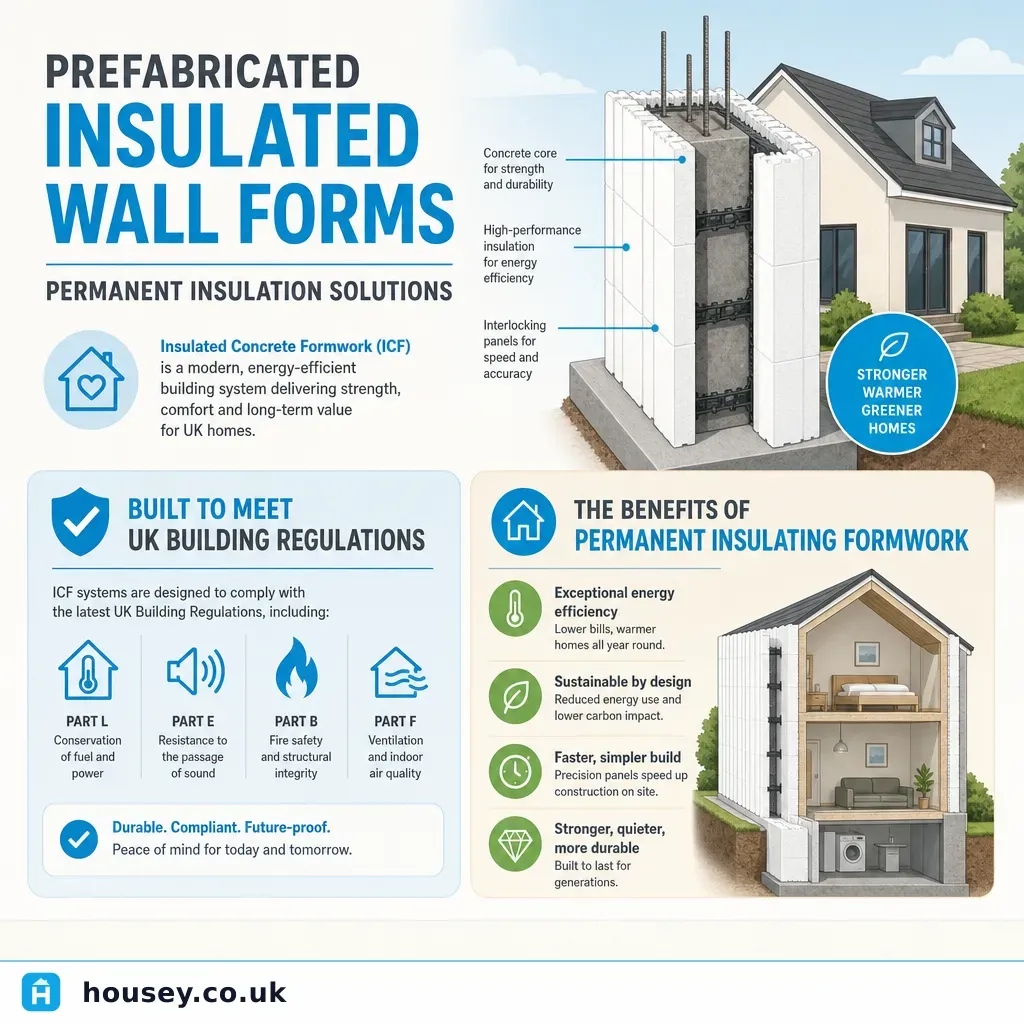
Prefabricated Insulated Wall Forms: Permanent Insulation Solutions
Prefabricated insulated wall forms — including ICF and SIPs systems — deliver high thermal performance by combining permanent insulation with structural concrete or timber in a single wall assembly.
 Energy & Retrofit
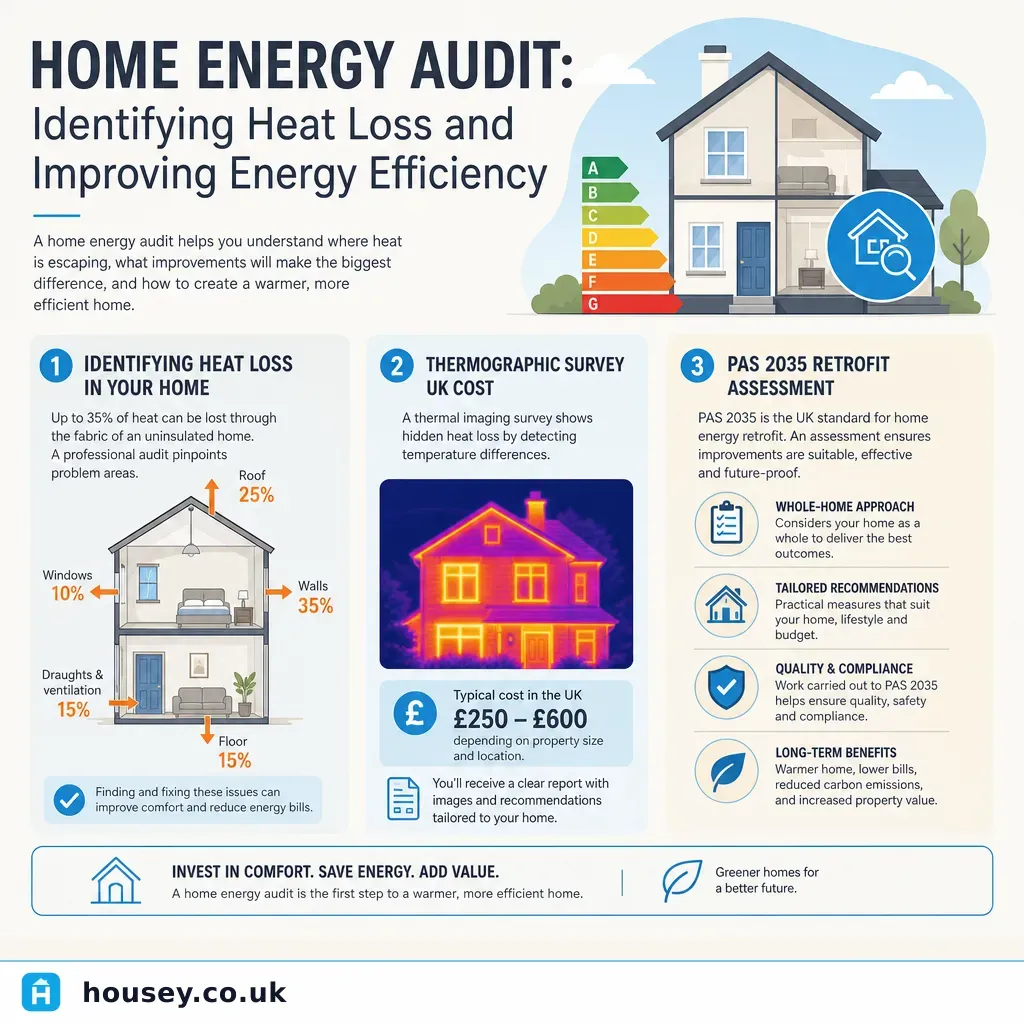
Home Energy Audit: Identifying Heat Loss and Improving Energy Efficiency
A home energy audit is a structured assessment of where your property loses heat and how efficiently it uses energy.
 Energy & Retrofit
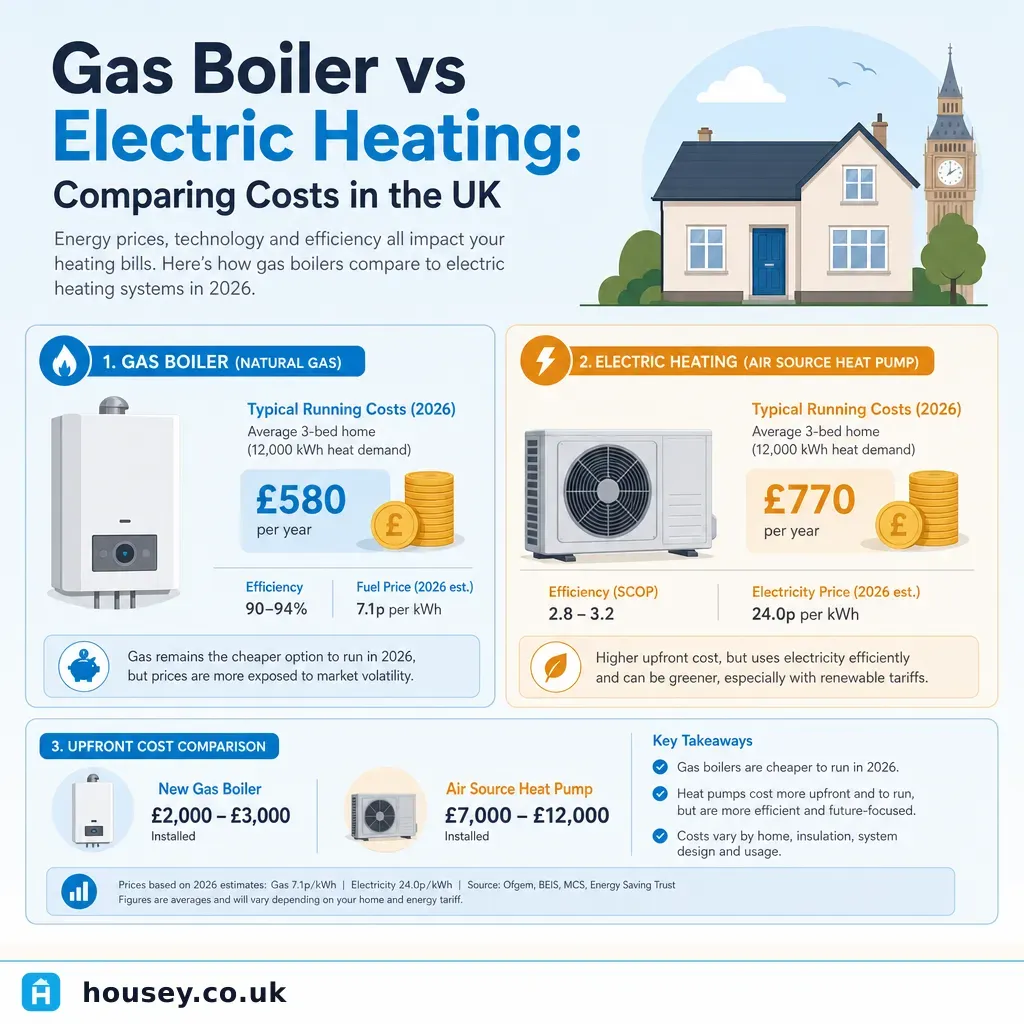
Gas Boiler vs Electric Heating: Comparing Costs in the UK
Gas boilers currently cost around 6.
 Energy & Retrofit
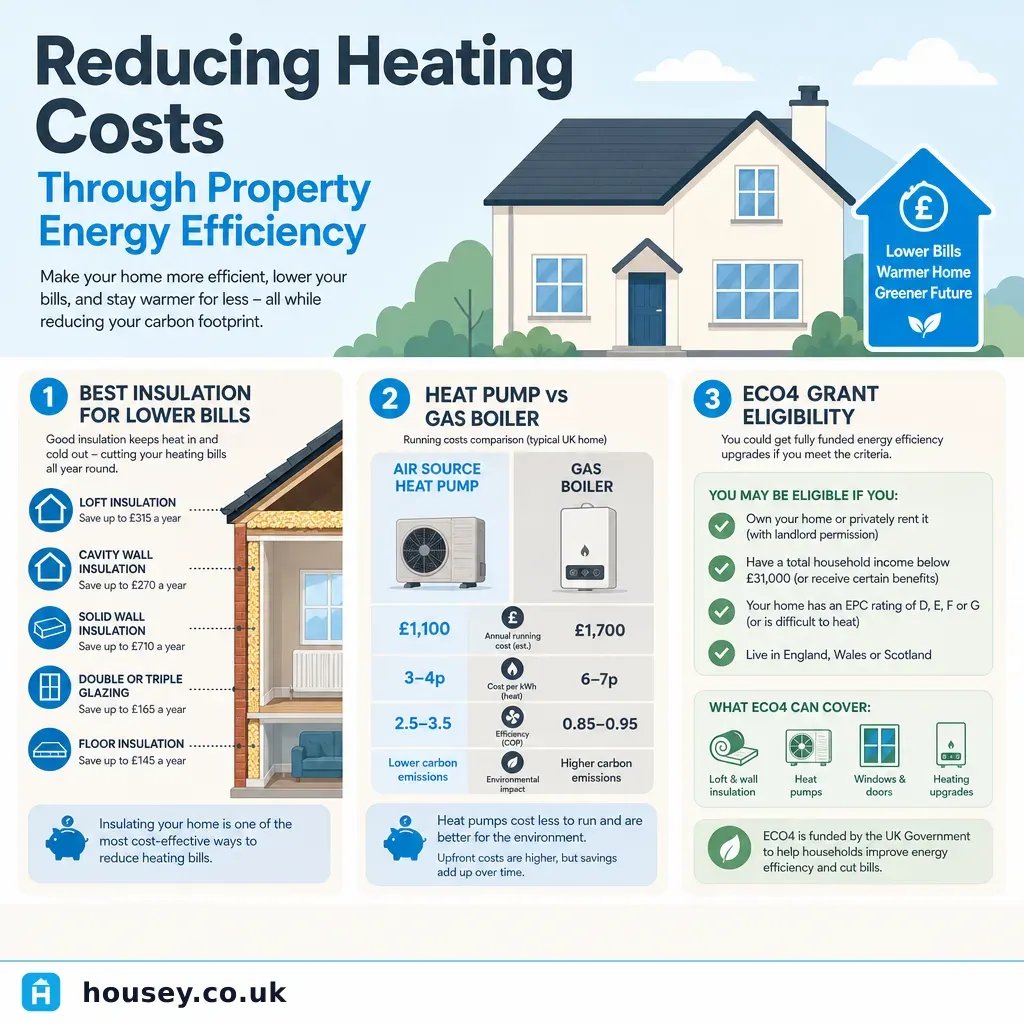
Reducing Heating Costs Through Property Energy Efficiency
Reducing heating costs starts with identifying where heat is lost — typically walls (30–35%), roof (20–25%), and windows.
 Energy & Retrofit
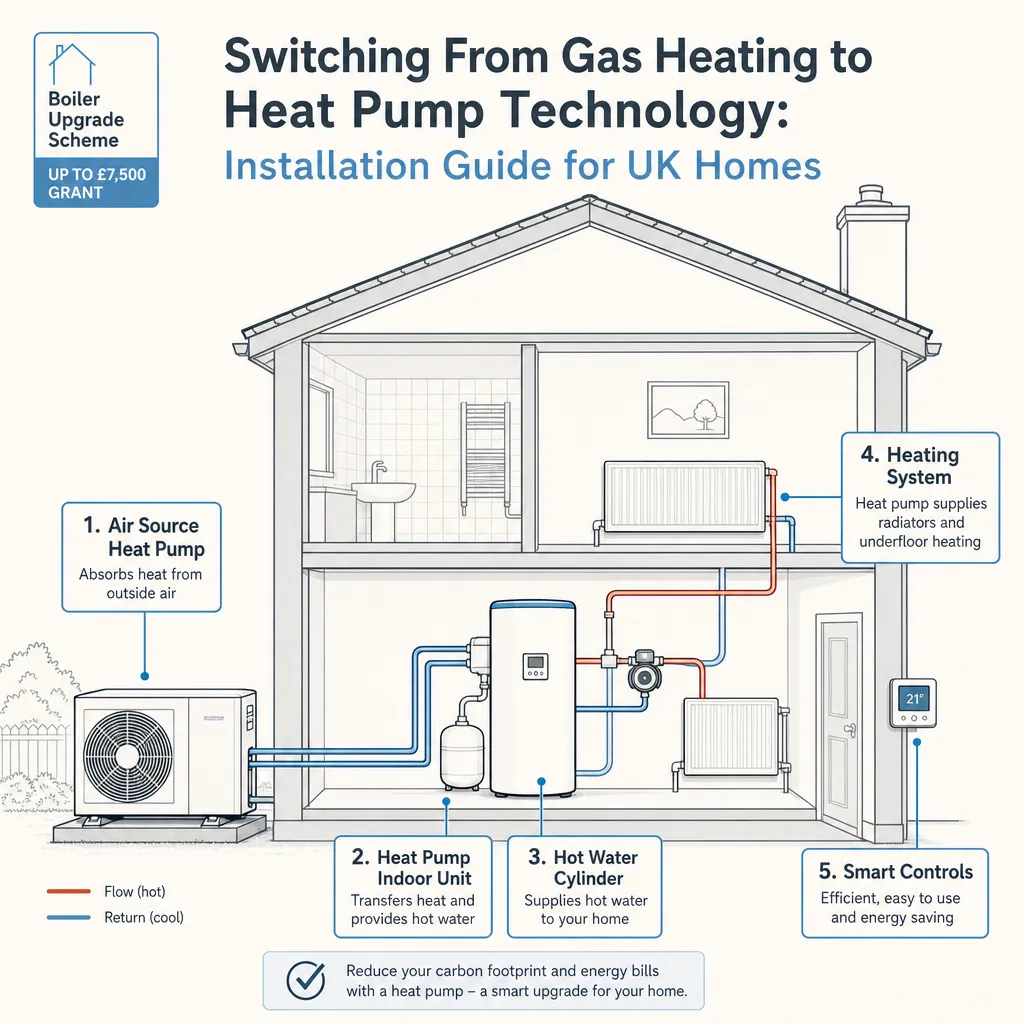
Switching From Gas Heating to Heat Pump Technology: Installation Guide
Switching from gas to a heat pump requires a heat loss calculation, correctly sized equipment, and often radiator upgrades before installation.