Growth Expectations Across UK Building and Property Services Industries
By Housey · Last reviewed 30th of May 2026

Growth Expectations Across UK Building and Property Services Industries
If you are planning a home improvement project — whether an extension, a roof replacement, or a full renovation — the condition of the building trades market affects your experience directly: how quickly you can find an available contractor, what they are likely to charge, and whether they can begin on your preferred date. UK construction output, trade capacity, and homeowner demand all move together, and understanding the broad market conditions helps you plan more realistically and negotiate from a stronger position.
Key points
- The Construction Products Association (CPA) publishes quarterly construction forecasts that distinguish between new housing, commercial, and repair, maintenance, and improvement (RMI) activity — RMI typically shows stronger resilience than new build during economic downturns.
- The CITB's Construction Skills Network (CSN) publishes five-year regional forecasts for construction output and the skilled workforce needed to deliver it, broken down by trade and geography.
- Private housing RMI — which covers most homeowner improvement work — is more closely correlated with house prices, mortgage availability, and consumer confidence than with planning consent volumes.
- Roofing and fenestration (windows and doors) are among the trade sectors that track private RMI demand most closely, alongside general building, plastering, and extensions.
- Trade labour shortages are a persistent structural issue in UK construction; vacancies in skilled trades such as plasterers, electricians, and roofers typically rise when RMI demand strengthens.
New build vs repair and maintenance: different growth stories
UK construction is not one market — it is several, with meaningfully different drivers:
Segment | Primary demand driver | Typical growth pattern | Main risks |
|---|---|---|---|
Private new housing | Mortgage rates, house prices, planning consent | Cyclical; sensitive to interest rate changes | Planning delays, land cost, viability |
Affordable and social housing | Government spending, grant funding | Policy-dependent | Budget cuts, procurement lead times |
Private housing RMI | Consumer confidence, house prices, EPC compliance | More stable; tends to hold up in downturns | Labour shortages, material inflation |
Commercial construction | Business investment, office and retail demand | Volatile; sector-specific | Economic slowdown, changing work patterns |
Infrastructure | Government capital spending | Long-term, less cyclical | Political change, procurement delays |
For homeowners, the relevant segment is almost always private housing RMI. This covers extensions, loft conversions, re-roofing, window replacement, bathroom and kitchen renovations, and insulation upgrades. When new build slows (as it often does when mortgage rates rise), many building firms redirect capacity into the RMI market — which can temporarily increase trade availability and moderate price pressure for homeowners.
Which trades are seeing the strongest demand?
Trade sector demand shifts over time, but several sectors show consistent activity linked to both homeowner improvement and regulatory pressure:
- Roofing: Driven by a combination of ageing UK housing stock, storm damage repair, and growing interest in solar PV and green roof installations. Re-roofing on interwar and post-war stock is a significant volume driver across most UK regions.
- Windows and doors: Replacement demand is partly driven by energy efficiency requirements — particularly the trajectory of Minimum Energy Efficiency Standards (MEES) for rental properties and wider EPC upgrade interest from owner-occupiers. The GOV.UK MEES landlord guidance sets out the current EPC E threshold for rented homes.
- Extensions and conversions: Permitted development rights for householders — including the larger home extension scheme for single-storey rear extensions — have helped sustain demand on semi-detached and terraced homes where planning consent would otherwise be required.
- Damp-proofing, insulation, and ventilation: Growing demand from retrofit activity, partly supported by ECO4 and the Great British Insulation Scheme, has increased workloads for specialist contractors in this area.
- Electrical work: Landlord compliance requirements for Electrical Installation Condition Reports (EICRs) and rising demand for EV home charger installations are creating consistent volume for NICEIC and NAPIT-registered electricians.
How planning policy and economic conditions shape builder workloads
Builder capacity and pricing are downstream of broader market conditions. Several factors affect what homeowners experience at the point of commissioning work:
Interest rates and mortgage availability: Higher rates typically suppress private new housing starts, which can redirect some builders toward RMI. However, high rates also dampen homeowner spending confidence, so RMI is not immune to economic headwinds.
Energy costs and retrofit policy: When energy bills rise sharply, homeowner interest in insulation and low-carbon heating tends to increase. Government grant schemes such as ECO4 shape which retrofit trades are busiest and in which regions.
Planning reform: The government's target of 1.5 million new homes over the current Parliament places pressure on planning resources and construction capacity. If housebuilding accelerates materially, skilled labour and key materials may be drawn toward new build, potentially tightening RMI availability.
Workforce supply: CITB data consistently highlights skills shortages in key trades. Apprenticeship starts, post-Brexit changes to labour supply, and an ageing trade workforce all affect the long-term availability of skilled contractors.
What market conditions mean for homeowners
When planning a renovation or extension, current market conditions affect your project in practical ways.
Decision tree: how to read the market before committing
- If trade demand is high (long waiting lists, multiple contractors declining to quote): build more time into your programme; aim to secure quotes and fix your contractor earlier in the process than you might otherwise.
- If trade demand is lower (contractors actively seeking work, multiple respondents to quote requests): you may have more pricing leverage, but do not sacrifice quality for the lowest number — due diligence on your contractor matters at every stage of the market cycle.
- If material costs are rising sharply: fix material specifications and costs at contract stage where possible; use a detailed schedule of works with agreed product specifications to limit substitution risk.
- If skills shortages are particularly acute in your required trade: consider whether a design-and-build firm that manages its own supply chain and subcontractor relationships might offer more reliable programme certainty.
Red flags in the market: what to watch for
The following are warning signs regardless of where the broader market sits:
- A contractor quoting substantially below all others — in any market, this warrants scrutiny; in a busy market it can indicate financial distress or planned corner-cutting.
- Quote validity periods of 24–48 hours with strong pressure to sign — legitimate in a rising-cost environment, but also a common pressure tactic used independently of genuine cost risk.
- Contractors unable to provide a realistic start date or programme — normal in strong demand periods, but flag it if they also cannot commit to a start window at all.
- Requests for a large upfront deposit before materials are confirmed or planning secured — industry standard is staged payments tied to progress milestones, not front-loaded lump sums.
- Reluctance to provide a written contract — any significant building work should be covered by a written agreement, however informal the contractor seems.
When to get professional help
Consider involving a professional contract administrator, quantity surveyor, or project manager if:
- Your project budget exceeds £50,000, where formal contract management materially reduces financial and programme risk.
- You are uncertain whether contractor pricing reflects current market conditions — a quantity surveyor can benchmark quotes against cost data.
- You are experiencing significant variations, disputes, or programme overruns mid-project.
- You need reliable programme management across multiple trades, particularly where sequencing is critical.
How Housey can help
Housey helps you compare vetted local extension builders, roofers, window and door installers, and design-and-build firms — so you can assess availability and pricing across multiple contractors in your area without relying on cold-call referrals.
Frequently asked questions
How does the UK construction market affect how long I will wait for a builder?
In periods of strong demand, skilled tradespeople can be booked out 3–6 months in advance, particularly for extensions, re-roofing, and specialist trades. In slower periods, availability is often much shorter. Getting multiple quotes early — and being flexible on start dates — is the most practical way to manage this uncertainty regardless of market conditions.
Does builder confidence affect what I will pay for renovation work?
It can. In a buoyant market, fewer contractors feel pressure to compete aggressively on price. In a quieter market, pricing tends to be more competitive. However, the relationship is not mechanical — local factors, trade specialisation, and individual contractor circumstances all matter more than national market sentiment for any single residential project.
Where can I find reliable UK construction market forecasts?
The Construction Products Association publishes quarterly industry forecasts at cpagroup.co.uk. CITB's Construction Skills Network data is published at citb.co.uk and covers regional workforce and output projections. The Office for National Statistics publishes official construction output data monthly. Some commercial data providers such as Glenigan and Barbour ABI also publish market data, though full access is usually subscription-based.
Sources and further reading
- Construction Products Association forecasts — Construction Products Association
- CITB Construction Skills Network — CITB
- Permitted development rights for householders: technical guidance — GOV.UK
- Energy Company Obligation (ECO4) scheme — GOV.UK
- Output in the construction industry — Office for National Statistics
Useful next reads
 Improvement & Build
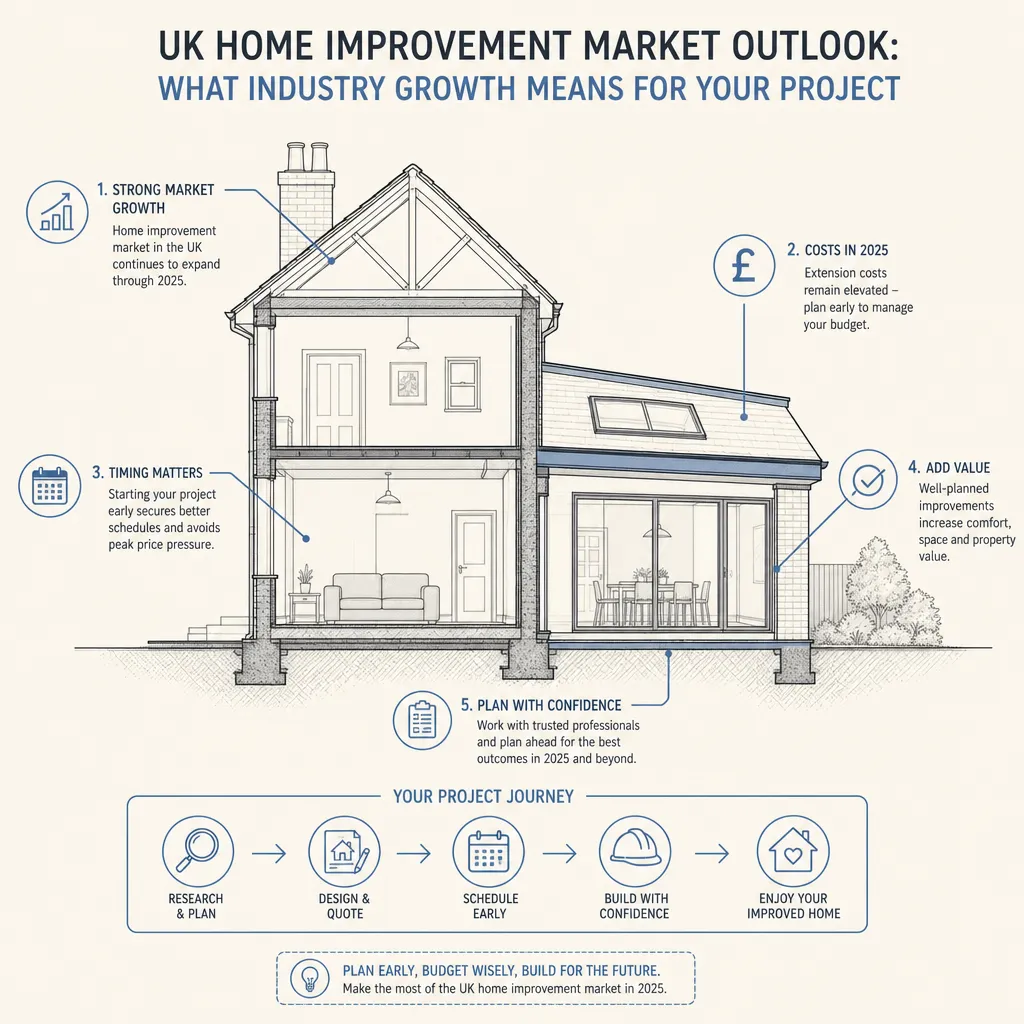
UK Home Improvement Market Outlook: What Industry Growth Means for Your Project
During periods of growth in the UK home improvement market, contractor lead times lengthen, material costs rise, and builders become more selective about which projects they tender for.
 Improvement & Build
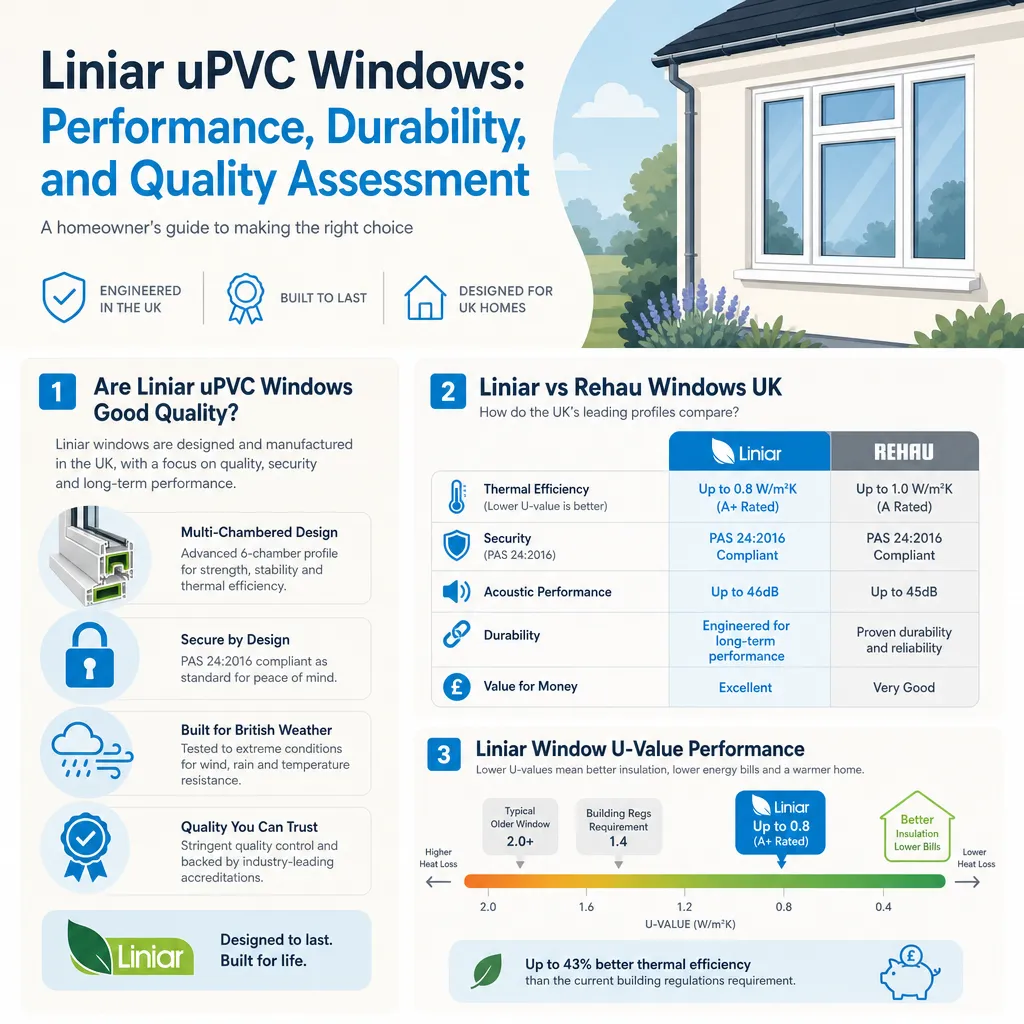
Liniar uPVC Windows: Performance, Durability, and Quality Assessment
Liniar uPVC window profiles are manufactured in the UK using multi-chambered, foamed frames.
 Improvement & Build
Garden Tap Installation with Hot and Cold Water: Plumbing Options
Adding a cold garden tap is a common DIY project, but routing hot water outdoors requires a plumber to connect to your domestic hot water system and comply with the Water Supply (Water Fittings) Regulations 1999.
 Improvement & Build
Sealing and Maintaining Historic Leaded Glass Windows: Preservation and Performance
Leaded glass windows are maintained using traditional linseed oil cement — not silicone or modern sealants, which prevent natural movement in the lead came.
 Improvement & Build
Greenhouse Construction: Glass Versus Polycarbonate Materials
Glass transmits around 90% of available light and lasts indefinitely if unbroken, but insulates poorly and shatters into sharp fragments.