Renewable Energy Solutions: Solar, Heat Pumps, and Home Battery Storage
By Housey · Last reviewed 24th of May 2026
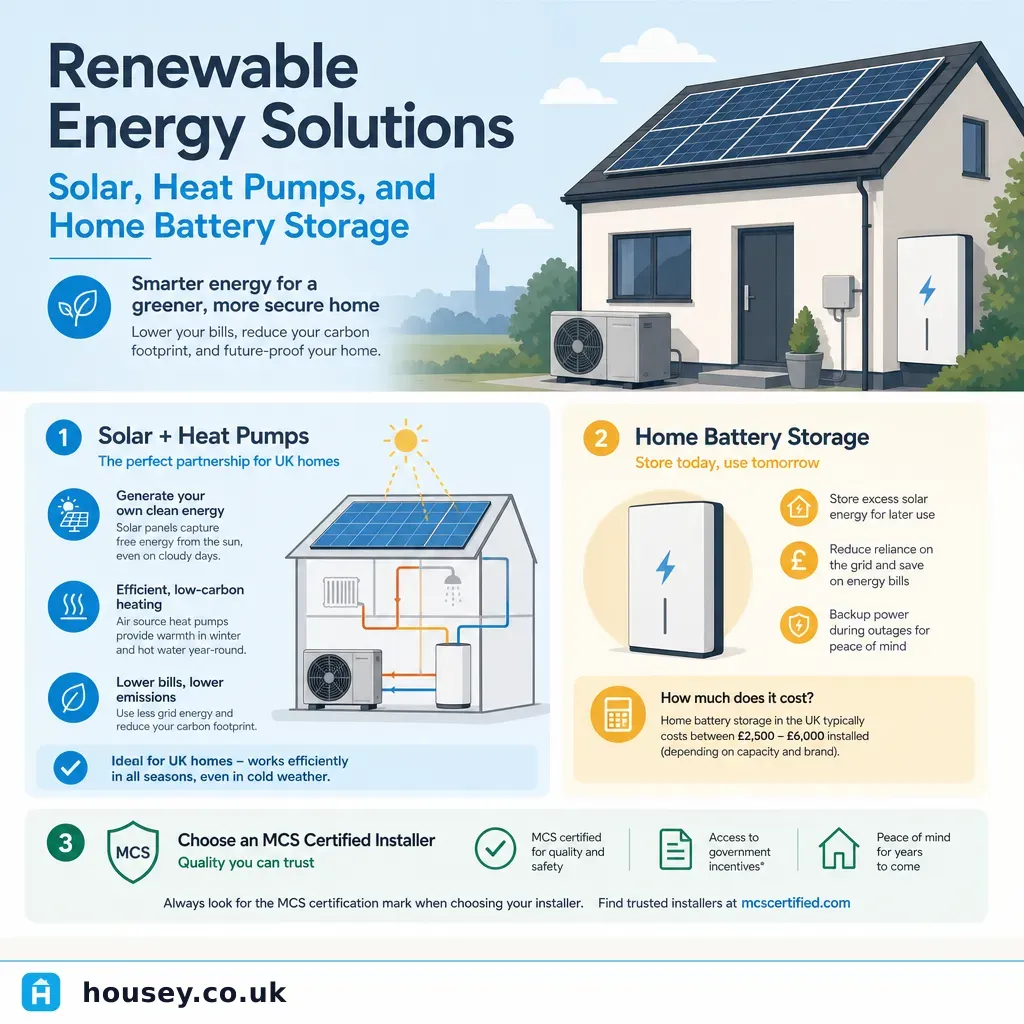
Renewable Energy Solutions: Solar, Heat Pumps, and Home Battery Storage
Rising energy bills and the UK's legally binding net-zero commitments have made renewable technology a serious consideration for a growing number of homeowners. Whether you are weighing up solar photovoltaic (PV) panels, an air source heat pump, or a home battery storage system — or wondering how they work together — the decisions involved are significant financially and technically. Each system interacts with your property's construction, energy use patterns, and local grid infrastructure in ways that a professional survey should clarify before you commit.
Key points
- Solar PV panels must be installed by a Micro-generation Certification Scheme (MCS)-certified installer to qualify for the Smart Export Guarantee (SEG), which pays you for surplus electricity exported to the grid.
- The Boiler Upgrade Scheme (BUS) offers a £7,500 grant towards an air source or ground source heat pump for eligible properties in England and Wales (correct as of May 2026 — check GOV.UK for current figures).
- Heat pump sizing must be based on a formal heat loss calculation to MCS 3005 or EN 12831 standards — sizing based on existing boiler output alone frequently leads to oversizing and poor efficiency.
- Home battery storage qualifies for 0% VAT when installed in a UK residential property.
- Solar PV, battery storage, and heat pumps can be combined effectively, but the systems need to be designed together — poorly integrated installations often fail to deliver the savings projected at the point of sale.
Solar PV panels: what UK homeowners need to know
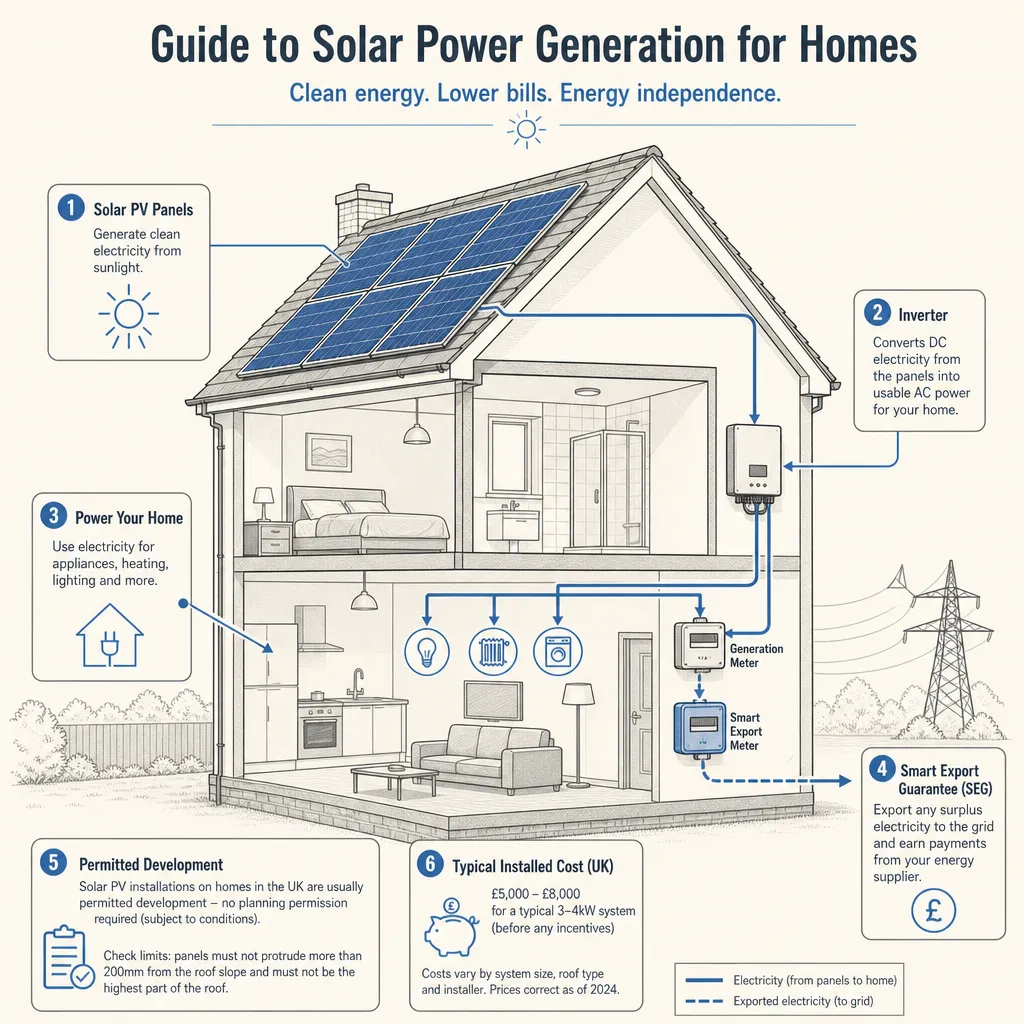
Solar photovoltaic panels convert daylight into electricity. A typical UK domestic installation ranges from 3 kWp to 6 kWp depending on available roof space and household demand. South-facing roofs at a pitch of around 30–35 degrees offer the best annual yield, but east- and west-facing installations can still be viable — particularly when paired with battery storage to capture morning or afternoon generation.
MCS certification and the Smart Export Guarantee
Any installer carrying out a solar PV installation must be MCS-certified for the system to qualify for the Smart Export Guarantee (SEG). The SEG, regulated by Ofgem, requires energy suppliers with more than 150,000 customers to offer export tariffs to eligible small-scale generators. Rates vary by supplier and are not fixed, so compare offers at the point of installation.
Planning permission
Solar panels on a residential dwelling are usually permitted development in England, Scotland, and Wales, provided they do not protrude more than 200 mm beyond the roof surface and the installation will be removed when no longer needed. Exceptions apply to listed buildings and some conservation areas — check with your local planning authority before proceeding.
Indicative costs (last reviewed 2026-05-24): A 4 kWp solar PV system with installation typically ranges from £6,000 to £9,000 depending on roof access, panel specification, and region. Costs vary — obtain at least three quotes.
Air source heat pumps: suitability, sizing, and grants
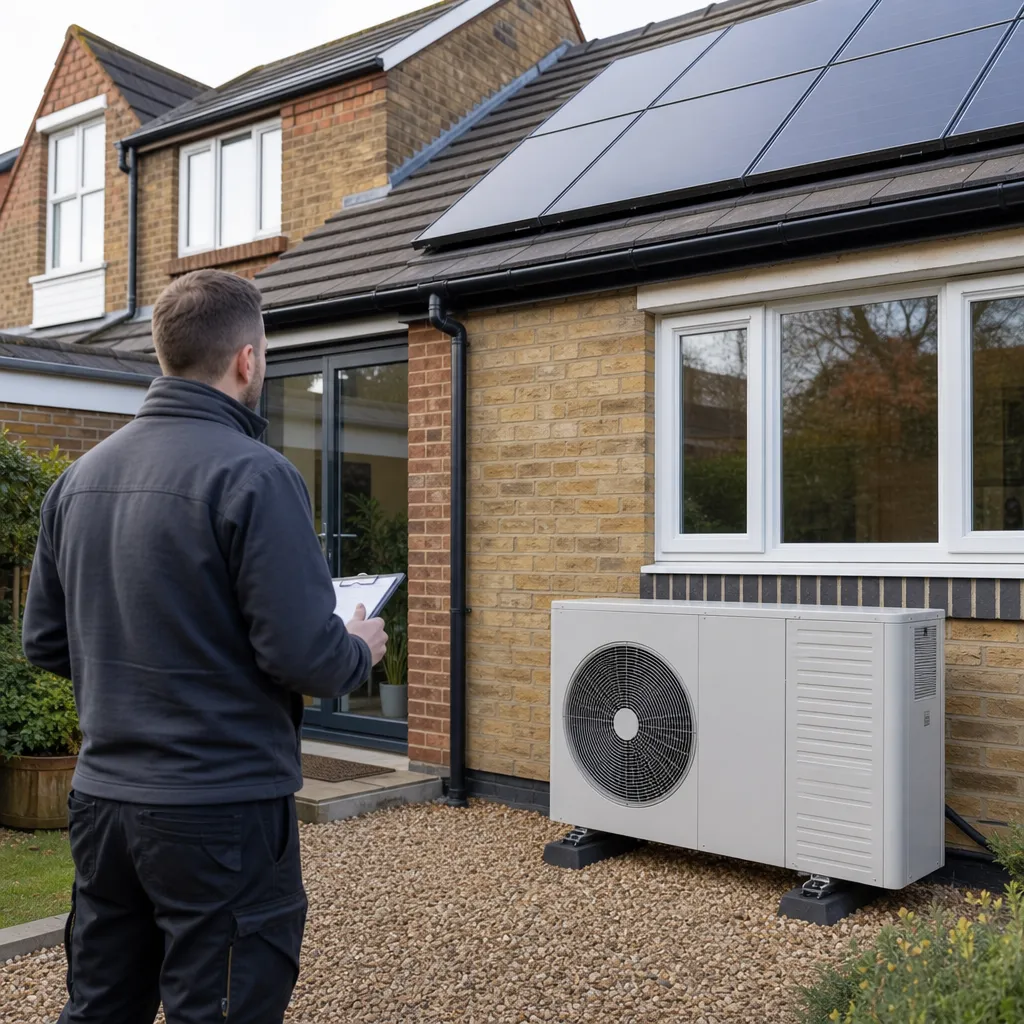
An air source heat pump (ASHP) extracts heat energy from outdoor air and transfers it into your home via a wet central heating system. It can operate at outdoor temperatures as low as -15°C, though efficiency — measured as the Coefficient of Performance (COP) — falls in colder weather.
Is your home suitable?
Heat pumps work most efficiently in well-insulated homes with low-temperature heat distribution — typically underfloor heating or adequately sized radiators. A 1970s semi-detached with uninsulated cavity walls and standard radiators may need fabric improvements before a heat pump can operate at acceptable efficiency. A professional heat pump survey should assess insulation levels, existing heating system, hot water demand, and heat emitter sizing before any commitment is made.
The Boiler Upgrade Scheme (BUS)
The BUS offers a £7,500 grant per property for air source and ground source heat pumps in England and Wales. To access the grant, the installer must be MCS-certified and the property must have a valid Energy Performance Certificate (EPC) with no outstanding recommendations for loft or cavity wall insulation — or evidence that those measures are unsuitable. Current eligibility criteria are available at GOV.UK.
Heat loss calculation — a non-negotiable step
Heat pump sizing must be based on a formal heat loss calculation to MCS 3005 or EN 12831 standards. This accounts for the property's floor area, construction type, insulation levels, window glazing, and local climate data. Do not accept a sizing recommendation based on existing boiler output alone — this frequently leads to oversizing, which reduces efficiency and increases running costs.
Indicative costs (last reviewed 2026-05-24): An air source heat pump supply and installation in a three-bedroom UK home typically ranges from £10,000 to £18,000 before the BUS grant. Costs vary significantly by property type and contractor.
Home battery storage: making the most of your energy
A home battery system stores surplus electricity generated by solar panels during the day for use in the evening or overnight, reducing dependence on grid electricity at peak-price periods. Batteries can also be charged from the grid during off-peak periods under time-of-use tariffs such as Octopus Go or Economy 7, offering bill savings even without solar.
Capacity and technology
Most residential batteries range from 5 kWh to 15 kWh of usable capacity. Lithium iron phosphate (LFP) chemistry is increasingly standard for home use due to its safety profile and long cycle life. Battery storage qualifies for 0% VAT when installed at a UK residential property.
Standalone or combined with solar?
Battery storage is most cost-effective alongside a solar PV system. Standalone grid-tied battery installations can still deliver savings under time-of-use tariffs but typically have longer payback periods. System capacity should be sized to your actual daily consumption patterns, not a generic household average.
Which renewable technology suits your home?
- Choose solar PV if your roof is south- to west-facing, your home is occupied during the day, and you want to reduce electricity bills without major heating system changes.
- Add battery storage if you generate more solar electricity than you consume during daylight hours, or if you have a time-of-use electricity tariff and want to shift consumption to cheaper overnight periods.
- Consider a heat pump if your boiler is approaching end of life, your home is well insulated or you plan to insulate it, and you have a wet central heating system with radiators you are willing to assess or upsize.
- Combine solar, battery, and heat pump if you are planning a comprehensive retrofit — but have the systems designed together by a qualified installer or Retrofit Coordinator, not added independently as separate projects.
- Ask a qualified professional first if you live in a flat, own a listed building, have a non-standard or north-facing roof structure, or are uncertain about your home's heat loss characteristics.
Comparing renewable technologies at a glance
Technology | Best suited to | Grant or incentive | MCS required? | Key risk if poorly specified |
|---|---|---|---|---|
Solar PV | Well-oriented roof, daytime electricity users | Smart Export Guarantee (SEG) | Yes | Undersized for demand; roof structural issues |
Air source heat pump | Well-insulated home, wet heating system | Boiler Upgrade Scheme (£7,500) | Yes | Oversizing or undersizing; inefficient without good fabric |
Home battery storage | Solar PV owners; time-of-use tariff users | 0% VAT | Not mandatory but advisable | Undersized for consumption; poor system integration |
Ground source heat pump | Larger plot with available land, good insulation | Boiler Upgrade Scheme (£7,500) | Yes | High upfront cost; ground survey required |
Important limitations
This article provides general information about renewable energy technologies for UK homeowners and does not constitute technical, financial, or planning advice. Grant eligibility criteria, technology specifications, and regulations change — always verify current information directly with the relevant government scheme and an MCS-certified installer. Heat pump sizing in particular must be carried out by a qualified professional using a recognised methodology; no information in this article substitutes for a site-specific heat loss assessment.
When to get professional help
A survey or professional assessment is particularly important if:
- You are considering a heat pump and your home was built before 1990 without significant insulation upgrades.
- You want to combine multiple technologies and need them designed as an integrated system.
- Your roof is north-facing, has structural concerns, or has limited unobstructed area.
- Your property is listed or in a conservation area where planning constraints may apply to external installations.
- You have been offered a price significantly below the typical market range — this often indicates a system that has not been properly sized or specified.
What to ask a qualified professional
Before instructing any renewable energy installer, ask:
- Are you MCS-certified for this specific technology, and can I verify your certificate number at mcscertified.com?
- For heat pumps: will you carry out a full heat loss calculation to MCS 3005 or EN 12831 before sizing the system?
- What annual performance can I realistically expect, and what assumptions underpin your estimate?
- What are the projected running costs compared to my current system, and how have you calculated this?
- Is this installation eligible for the Boiler Upgrade Scheme or Smart Export Guarantee, and will you handle registration?
- What installer guarantee and product warranties apply, and what is the process if the system underperforms?
- Is VAT included in your quoted price?
- Do you carry professional indemnity and public liability insurance?
How Housey can help
Housey connects homeowners with qualified professionals across the full renewable energy spectrum. Whether you want a solar survey to assess roof suitability, a heat pump survey to determine whether your home is ready, or quotes from battery storage installers, you can compare verified, MCS-aware professionals in one place. If you are also planning an electric vehicle charger alongside your solar installation, EV charger installers are available through Housey too.
Frequently asked questions
Can I get a grant for solar panels in the UK?
There is currently no direct capital grant for solar PV panels available to most homeowners in Great Britain (correct as of May 2026). However, solar PV qualifies for the Smart Export Guarantee (SEG), which requires larger energy suppliers to pay you for surplus electricity exported to the grid. Rates vary by supplier. Some local authority or energy company schemes may offer additional support — check GOV.UK for current guidance.
How long does a heat pump take to pay back its installation cost?
Payback periods vary considerably depending on insulation levels, system efficiency, energy tariffs, and whether the Boiler Upgrade Scheme grant was applied. In a well-insulated home using the BUS grant, indicative payback periods of 8–15 years are sometimes cited, though these depend heavily on assumptions used. Always ask an installer to model payback specifically for your property and current tariff.
Do I need planning permission for solar panels?
In most cases, solar panels on a residential roof in England, Scotland, and Wales are permitted development and do not require a planning application, provided they do not protrude more than 200 mm beyond the roof plane and are not installed on a wall facing a highway. Listed buildings and properties in some conservation areas are exceptions — always check with your local planning authority before installation.
Can a heat pump work with my existing radiators?
Existing radiators can often be retained, but they may need to be assessed or upsized. Heat pumps typically operate at lower flow temperatures (45–55°C) than gas boilers (70–80°C), so smaller or older radiators may not deliver adequate heat output. A competent installer will calculate whether each radiator is adequate at the survey stage — this assessment should happen before installation, not after.
Sources and further reading
- Boiler Upgrade Scheme — apply for a grant — GOV.UK
- Smart Export Guarantee — Ofgem
- MCS — Micro-generation Certification Scheme — MCS
- Heat pumps — Energy Saving Trust
- Solar panels — Energy Saving Trust
- Home battery storage — Energy Saving Trust
Useful next reads
 Energy & Retrofit
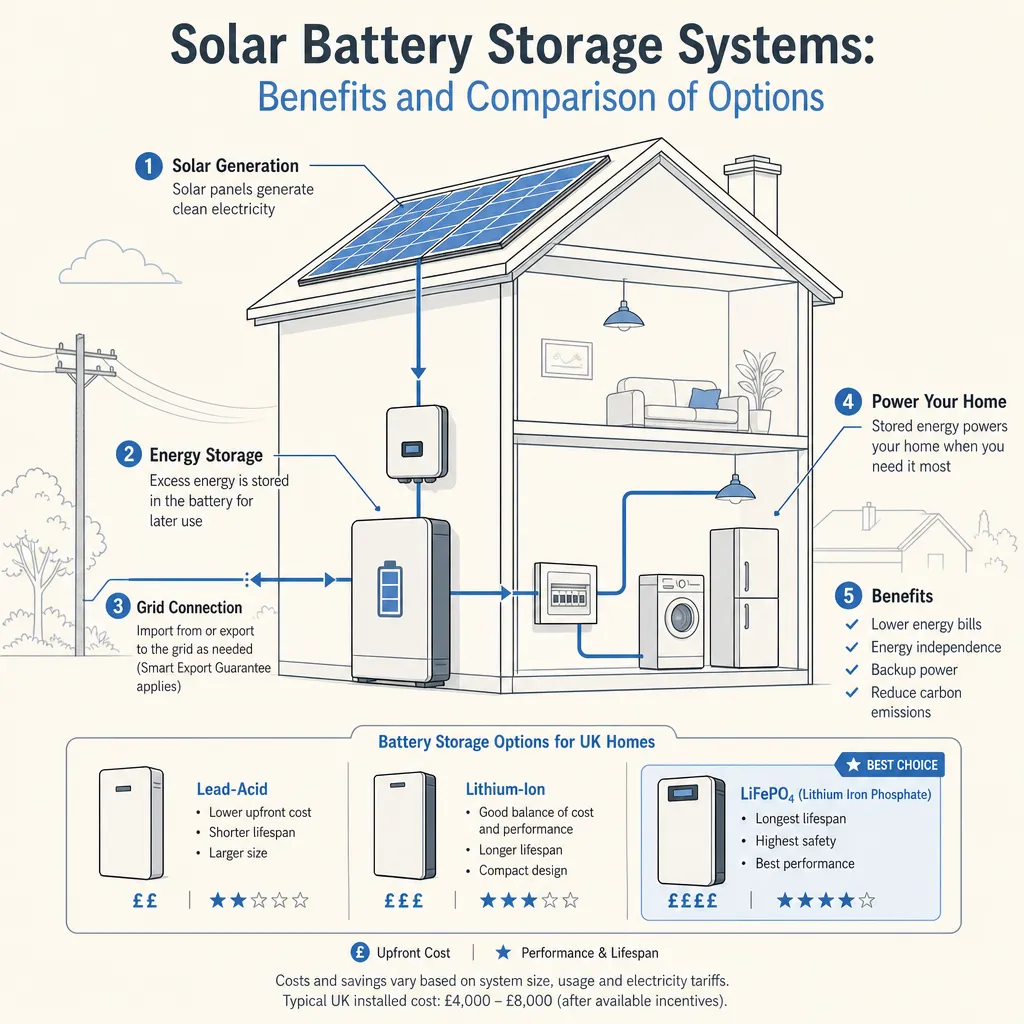
Solar Battery Storage Systems: Benefits and Comparison of Options
A solar battery storage system captures surplus electricity from your solar panels and stores it for use in the evenings, overnight, or on cloudy days.
 Energy & Retrofit
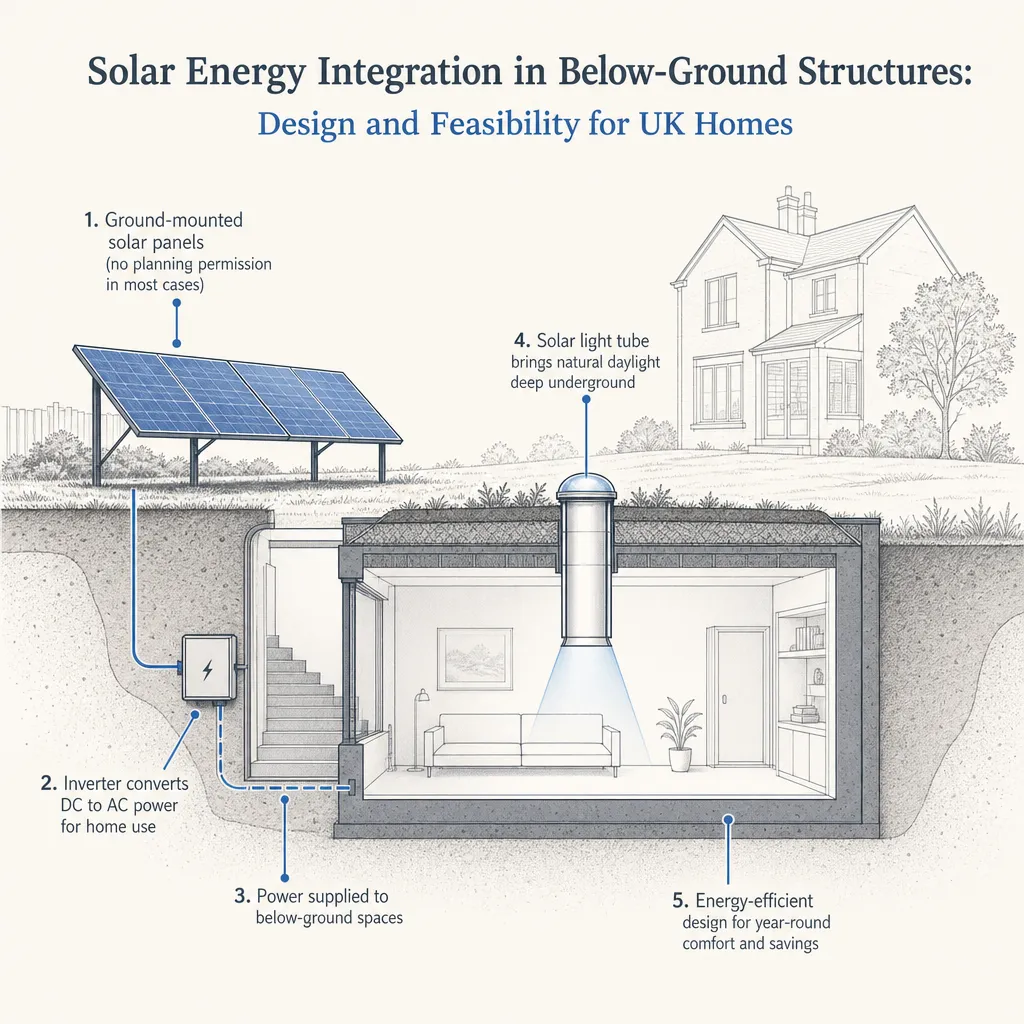
Solar Energy Integration in Below-Ground Structures: Design and Feasibility
Below-ground structures cannot host solar panels on their own roofs but can use surface-mounted panels connected via cable runs, solar light tubes for daylighting, and battery storage.
 Energy & Retrofit
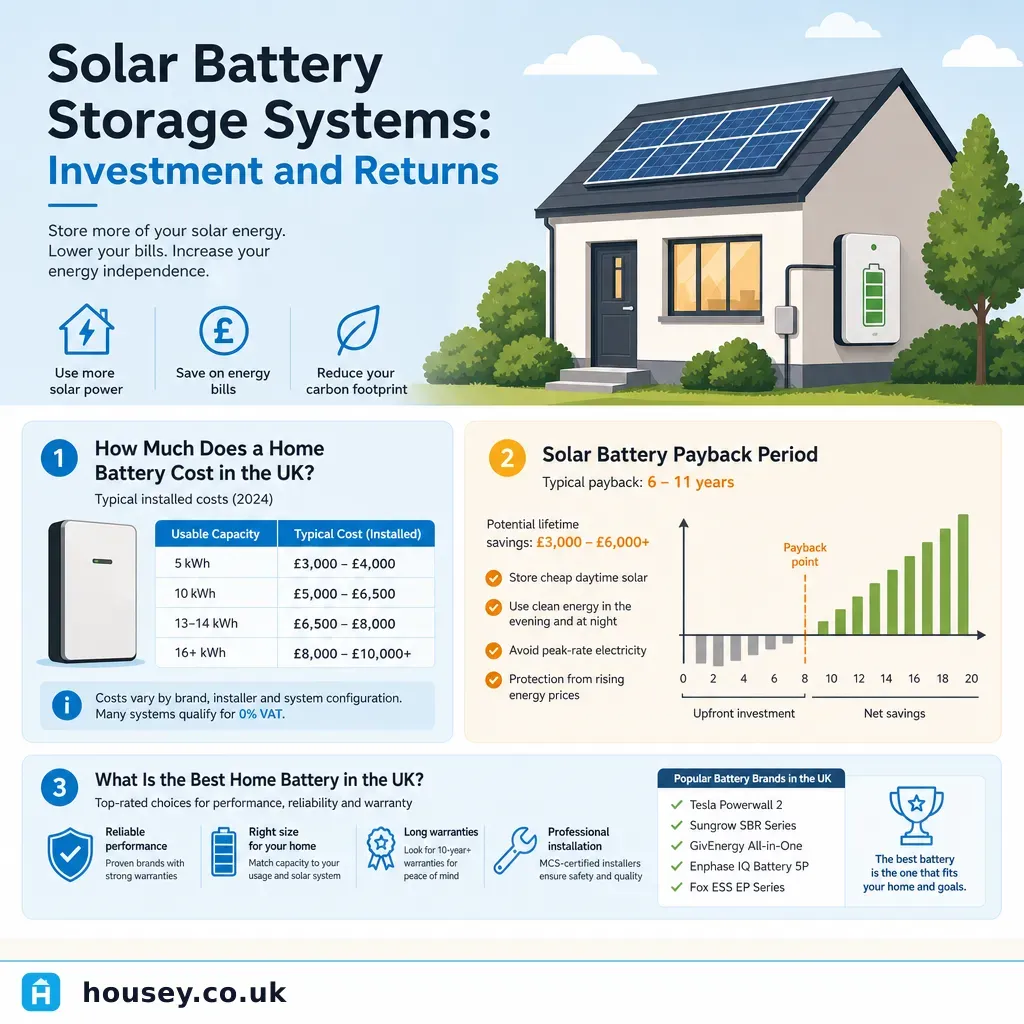
Solar Battery Storage Systems: Investment and Returns
A home battery storage system stores surplus solar energy for use in the evening, reducing grid electricity imports.
 Energy & Retrofit
Renewable Energy Systems and Property Value: Solar Panels and Heat Pumps
Solar panels can add a modest 1–4% to UK property values in the right conditions, particularly when they improve the EPC rating.
 Energy & Retrofit
Guide to Solar Power Generation for Homes
Solar photovoltaic (PV) panels convert daylight into electricity and export surplus to the grid via the Smart Export Guarantee (SEG).