Health and Safety Considerations When Selecting Green Insulation Products
By Housey · Last reviewed 30th of May 2026
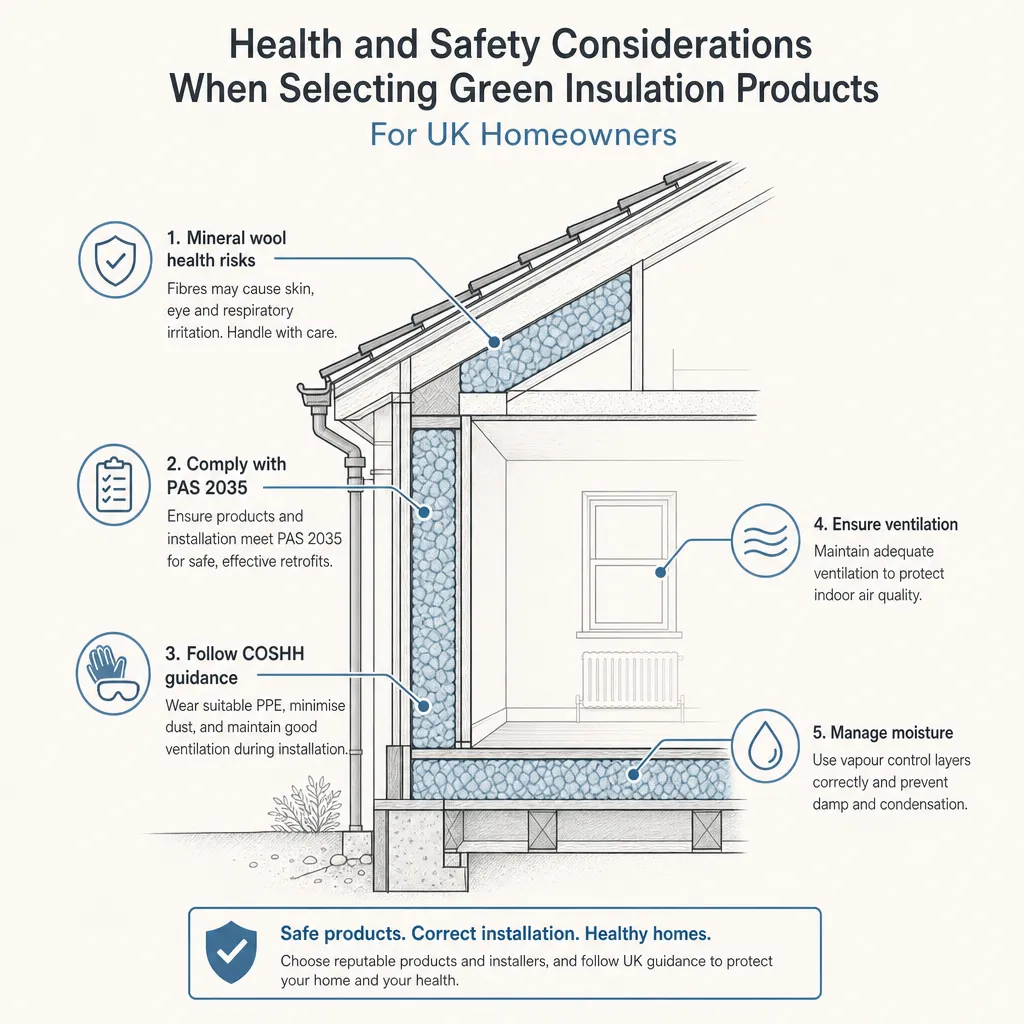
Health and Safety Considerations When Selecting Green Insulation Products
Choosing insulation for a UK home retrofit involves more than selecting the product with the lowest U-value or the highest recycled content claim. Different insulation materials carry different handling risks, installation requirements, and long-term health implications — both for the installers who fit them and for the occupants who will live with them. Understanding these considerations before specifying or purchasing any product is part of making a genuinely informed retrofit decision.
Key points
- Under the Control of Substances Hazardous to Health (COSHH) Regulations 2002, installers must carry out a risk assessment before handling any insulation material, including natural and plant-based products.
- Man-made vitreous fibres (MMVF), including mineral wool (glass wool and rock wool), are classified as potential respiratory irritants; the Health and Safety Executive (HSE) publishes specific guidance on safe handling and PPE requirements in document EH46.
- PAS 2035:2023 — the UK standard governing domestic retrofit — requires that moisture risk is assessed and managed across the whole building fabric before any insulation measure is specified or installed.
- Natural insulation materials such as sheep wool and hemp are not inherently risk-free; most contain boron-based flame retardants that are mild irritants requiring basic PPE during installation.
- UKCA or CE marking on insulation products confirms conformity with relevant BS EN product standards; absence of marking should prompt verification before installation proceeds.
Types of green insulation and their health profiles
"Green insulation" is not a regulated term in the UK. It is commonly applied to products made from recycled, natural, or bio-based materials, or products with lower embodied carbon than conventional expanded polystyrene or foil-faced polyisocyanurate. The main product categories and their relevant health considerations are:
Product | Base material | Key health considerations | PPE typically required |
|---|---|---|---|
Mineral wool (glass/rock) | Recycled glass or volcanic rock | Respiratory irritant (MMVF); skin and eye irritation during cutting | FFP2 dust mask, gloves, goggles, long sleeves |
Sheep wool batts | Natural wool, boron-treated | Boron flame retardant — irritant to eyes and airways | Gloves, dust mask in enclosed spaces |
Hemp or flax batts | Plant fibre with binder | Generally low risk; airborne dust in confined spaces; binder chemicals vary by product | Dust mask, gloves |
Blown cellulose | Post-consumer paper plus borate | Borate irritant; blown-in application creates significant airborne dust | P3 respirator and goggles essential for blown application |
Cork board | Natural cork | Very low risk profile; dust generated when cutting | Standard dust mask when cutting or shaping |
Aerogel blanket | Silica-based | Silica dust if damaged or trimmed — risk of respirable crystalline silica (RCS) | FFP3 mask if cutting; follow manufacturer MSDS closely |
Spray polyurethane foam (SPF) | Synthetic isocyanate | Isocyanate sensitisation risk during application — serious occupational health concern | Full PPE including supplied air respirator for installer; occupants must vacate during application |
Moisture risk: the hidden health concern in retrofit insulation
The most significant health risk associated with insulation selection in UK homes is often not the material itself — it is the moisture consequences of specifying the wrong product for the construction type. Adding insulation changes the thermal and vapour behaviour of a wall, floor, or roof assembly. If warm, humid internal air reaches a cold surface within the construction, interstitial condensation forms. Mould growth follows, and certain mould species — including Stachybotrys chartarum and Aspergillus fumigatus — are associated with respiratory illness, allergic reactions, and aggravation of asthma.
PAS 2035:2023 specifically requires:
- A retrofit assessment by a qualified Retrofit Assessor before any insulation measure is specified.
- A moisture risk assessment for any insulation measure that alters the vapour balance of the building fabric.
- A ventilation strategy to be considered as part of any insulation package — particularly for internal wall insulation (IWI) and floor insulation in older solid-wall homes.
For solid-wall homes — typically pre-1920 stock built with lime mortar and breathable wall construction — certain vapour-impermeable insulation types carry a heightened risk of interstitial condensation and structural moisture damage. Closed-cell spray foam applied directly to the inner face of a solid wall without an air gap, or foil-faced rigid boards without a designed ventilation cavity, are frequently flagged by retrofit assessors as incompatible with this construction type.
Red flags when selecting insulation products or installers
Before instructing any insulation contractor, treat the following as warning signs that require clarification before proceeding:
- No COSHH risk assessment or method statement available on request.
- An installer recommending a product without conducting or reviewing a moisture risk assessment for the specific property and wall construction type.
- No mention of ventilation assessment in the scope of works — particularly for whole-house insulation retrofits or internal wall insulation.
- MSDS (Material Safety Data Sheet) unavailable or not provided on request — required for any product containing hazardous substances.
- Spray foam insulation being proposed for a loft without discussion of mortgage lender implications — many lenders currently instruct valuers to flag spray foam as non-standard construction, which can affect resale and remortgage.
- Claims that a product is "chemical-free" or "completely safe" without substantiation — no insulation material is entirely without handling consideration.
- No TrustMark registration or equivalent accreditation for ECO4-funded or grant-funded work.
Homeowner checklist before insulation is installed
Use this checklist before instructing an insulation installer on any retrofit project:
Important limitations
This article provides general guidance on health and safety considerations for green insulation products in UK domestic settings. Rules, product specifications, and health guidance change regularly — always check the current position of the HSE and relevant product manufacturer before instructing work. Nothing in this article constitutes professional health and safety, structural, or design advice. The suitability of any insulation product for a specific property depends on its construction type, existing ventilation, moisture conditions, orientation, and occupant needs — factors that can only be properly assessed by a qualified professional inspecting the property in person. Always obtain a retrofit assessment and follow PAS 2035 guidance before undertaking significant insulation works.
What to ask a qualified professional
Before instructing an insulation installer or retrofit coordinator, ask the following:
- Are you TrustMark-registered, and does your registration specifically cover this product and installation method?
- Have you conducted or reviewed a moisture risk assessment for this property and this insulation specification?
- What is the ventilation strategy for this property as part of the proposed insulation works?
- Can I see the MSDS and COSHH risk assessment for every product you plan to install?
- How will you protect occupants — particularly children, older adults, or those with respiratory conditions — during and immediately after installation?
- What warranty do you provide, and does it specifically cover moisture-related damage or interstitial condensation arising from the installation?
- Is this installation eligible for ECO4 or Great British Insulation Scheme funding, and if so, who audits the installation for compliance with PAS 2030/2035?
When to get professional help
- If you are unsure which insulation product is appropriate for your property's wall construction — particularly a solid-wall or mixed-construction home — arrange an insulation assessment from a qualified Retrofit Assessor (PAS 2030-certified) before specifying any product.
- If a member of your household has a diagnosed respiratory condition, seek independent advice on product selection before installation begins, and ensure the installer's method statement accounts for occupant vulnerability.
- If an installer cannot or will not provide a method statement, COSHH assessment, or MSDS on request, do not proceed.
- If spray foam is being proposed for your loft, obtain independent structural and valuation advice before instructing the installer — the Building Research Establishment (BRE) and RICS have both published guidance noting the potential impact on mortgageability and property value.
How Housey can help
Housey connects UK homeowners with vetted insulation installers who hold relevant TrustMark and scheme accreditations, and with professionals who can carry out insulation assessments to ensure the right product is specified for your property's construction type, moisture risk profile, and ventilation requirements.
Frequently asked questions
Is mineral wool insulation safe to live with once installed?
Yes. Man-made vitreous fibres (MMVF) — glass wool and rock wool — are classified as potentially hazardous during handling and cutting, when fibres become airborne. Once installed and enclosed behind boarding or a membrane, they do not present an ongoing health risk to occupants under normal conditions. The HSE's occupational exposure guidance applies to those carrying out installation work, not to occupants of finished buildings.
Can I install green insulation myself?
Some products — including loft rolls and rigid boards — are marketed for DIY installation and can be fitted safely following manufacturer guidance and using appropriate PPE. Blown cellulose, spray foam, and external wall insulation systems should only be installed by trained, accredited installers. For any work forming part of a building regulations application or government-funded retrofit scheme, professional installation and certification are required.
What does PAS 2035 mean for an insulation project?
PAS 2035 is the BSI standard governing domestic retrofit in the UK. It requires insulation measures to be preceded by a whole-house retrofit assessment identifying moisture risk, ventilation needs, and the correct sequencing of measures. Work funded through ECO4 or the Great British Insulation Scheme must be delivered in accordance with PAS 2030 and PAS 2035 by TrustMark-registered contractors who can provide the relevant completion documentation.
Is sheep wool insulation safer than mineral wool?
Sheep wool does not carry the same respiratory irritant classification as man-made mineral fibres, but most products are treated with boron-based flame retardants which are mild irritants to eyes and the respiratory tract. For DIY installation in enclosed spaces, a dust mask and gloves are recommended. It is generally considered lower risk to handle than glass or rock wool, but it is not risk-free and should not be handled without basic PPE.
Sources and further reading
- HSE guidance on man-made vitreous fibres (MMVF) — Health and Safety Executive
- PAS 2035:2023 — Retrofitting dwellings for improved energy efficiency — BSI Group
- ECO4 scheme guidance — GOV.UK
- BRE guidance on spray foam insulation in residential properties — Building Research Establishment
- RICS guidance note: spray polyurethane foam (SPF) insulation — Royal Institution of Chartered Surveyors
- TrustMark — find registered retrofit installers — TrustMark
Useful next reads
 Energy & Retrofit
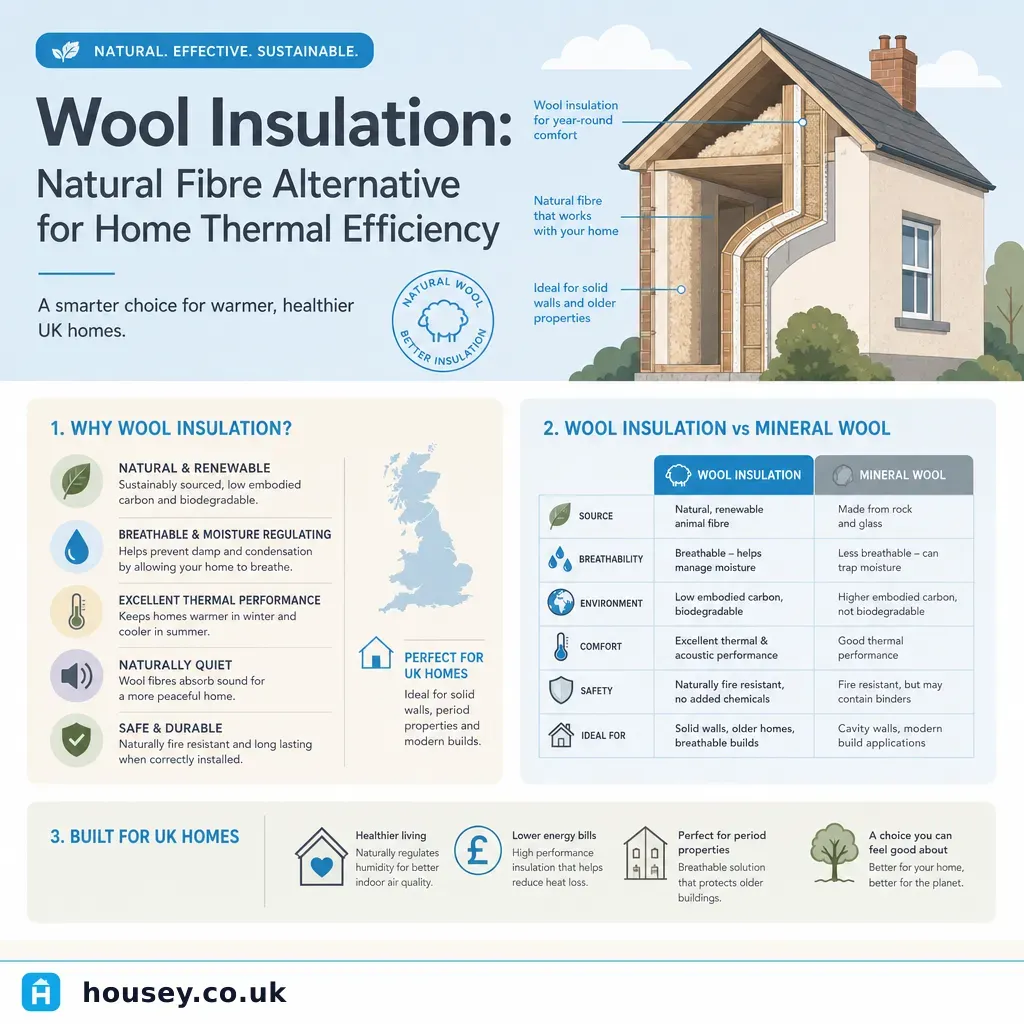
Wool Insulation: Natural Fibre Alternative for Home Thermal Efficiency
Sheep wool insulation achieves a thermal conductivity of 0.
 Energy & Retrofit
Sustainable Building Materials for Home Projects and Retrofits
Sustainable building materials for UK homes range from low-embodied-carbon insulation — wood fibre, sheep's wool, hemp — to FSC-certified structural timber and reclaimed stone or brick.
 Energy & Retrofit
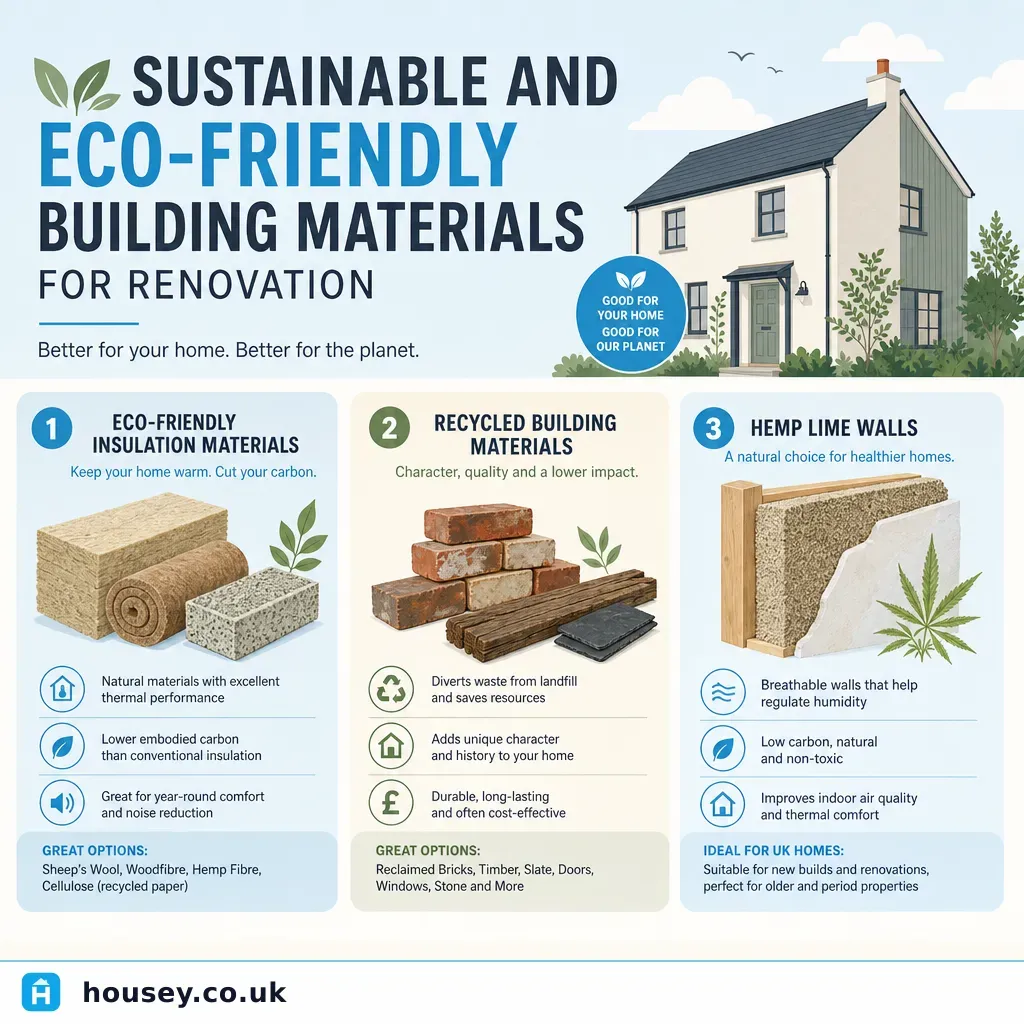
Sustainable and Eco-Friendly Building Materials for Renovation
Sustainable building materials for renovation include hemp lime, sheep's wool insulation, FSC-certified timber, and reclaimed brick.
 Energy & Retrofit
Insulating Solid Masonry Walls Under Bay Windows: Technical Guidance
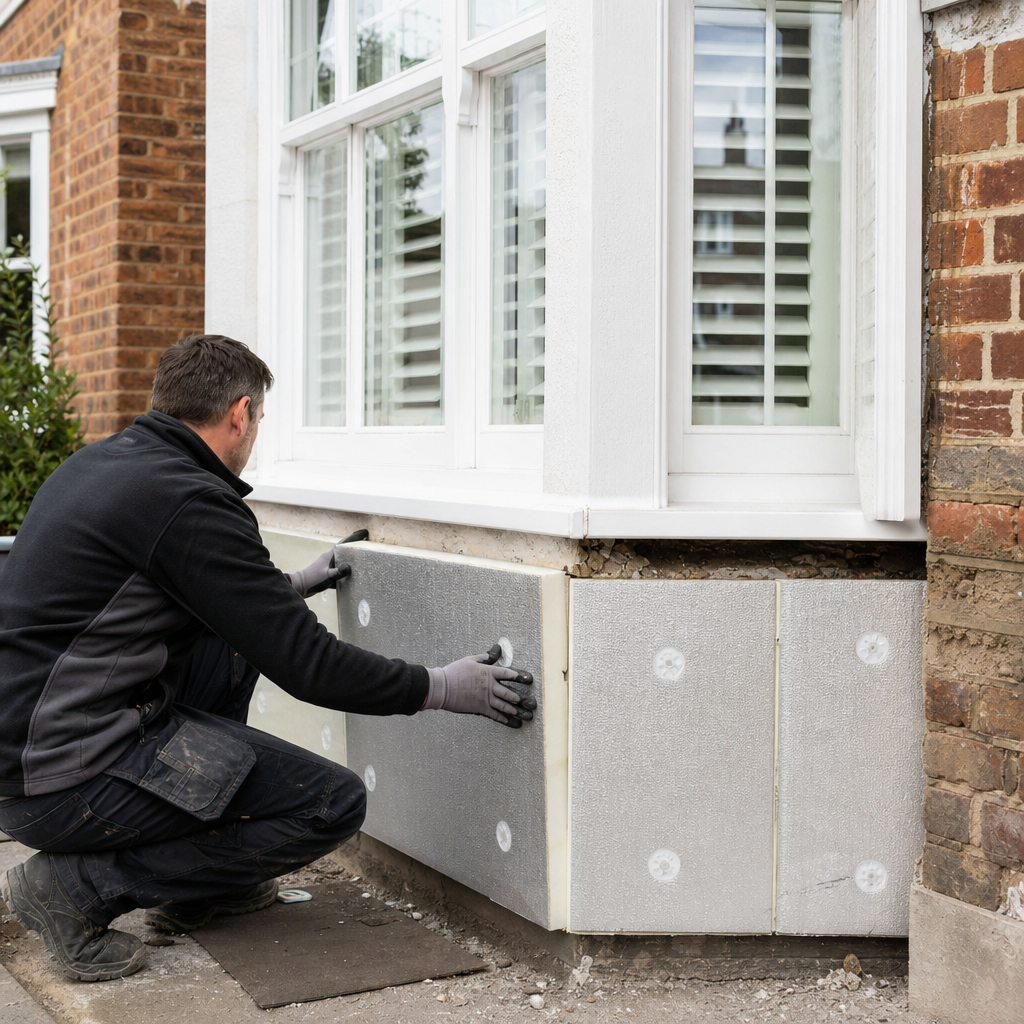
Insulating solid masonry walls under bay windows requires specialist detailing at angled wall faces, window reveals, and the bay floor and ceiling junctions.
 Energy & Retrofit
Prefabricated Insulated Wall Forms: Permanent Insulation Solutions
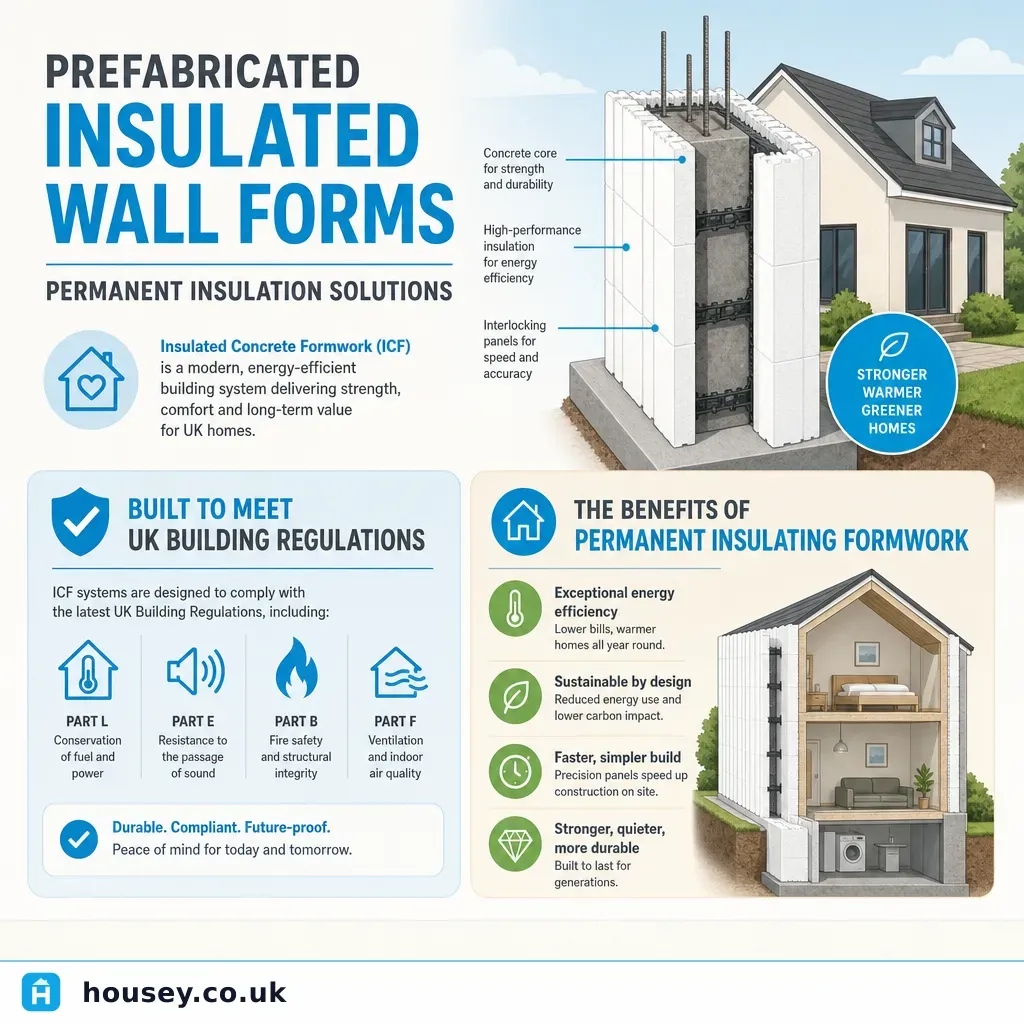
Prefabricated insulated wall forms — including ICF and SIPs systems — deliver high thermal performance by combining permanent insulation with structural concrete or timber in a single wall assembly.