Sustainable Building Materials for Home Projects and Retrofits
By Housey · Last reviewed 24th of May 2026
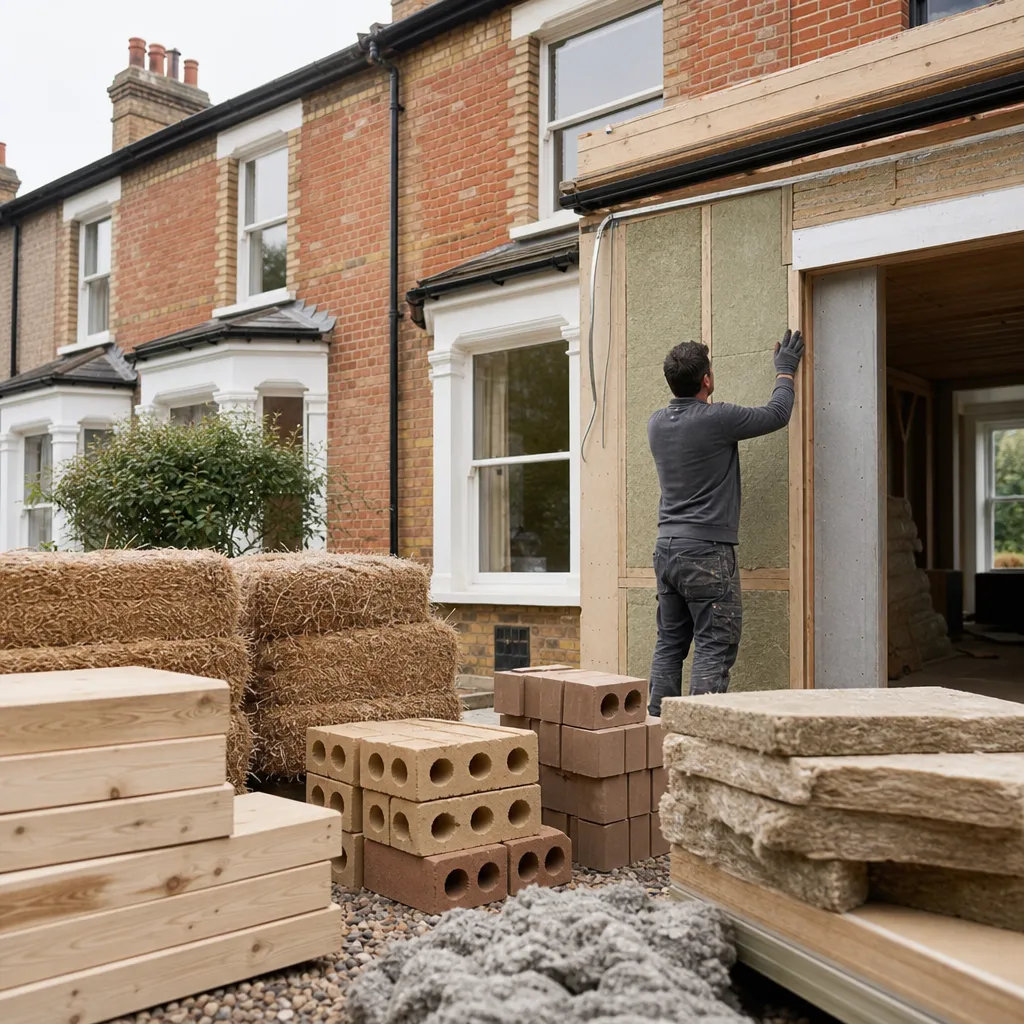
Sustainable Building Materials for Home Projects and Retrofits
As UK homeowners balance rising construction costs against environmental concerns and tightening energy regulations, the choice of building materials has become more than a practical decision — it shapes long-term running costs, thermal performance, indoor air quality, and a property's embodied carbon footprint. Whether you are planning a new extension, insulating a solid-wall Victorian terrace, or undertaking a full retrofit under PAS 2035, understanding the properties, trade-offs, and certifications of sustainable materials is increasingly important.
Key points
- Embodied carbon — the CO₂ emitted during material manufacture, transport, and construction — accounts for roughly 28% of UK building sector emissions, according to the UK Green Building Council.
- PAS 2035:2023, the publicly available specification for whole-dwelling retrofit, requires a retrofit assessor to evaluate moisture risk before recommending insulation materials for any dwelling.
- Timber-frame construction using FSC or PEFC-certified timber typically has significantly lower embodied carbon than equivalent masonry, particularly when engineered products such as cross-laminated timber (CLT) are specified.
- Aerogel blanket insulation achieves the highest thermal resistance per unit thickness of any widely available product, with lambda values of around 0.013–0.018 W/mK — relevant where wall thickness is tightly constrained.
- Products carrying the BRE Green Guide A or A+ rating have been independently assessed for environmental impact across the full product lifecycle, from raw material extraction through to end-of-life disposal.
Why material choice matters for sustainable UK homes
Choosing sustainable materials is not only about reducing environmental impact — it also affects thermal performance (U-values and thermal mass), moisture management, indoor air quality, durability, and future compliance with energy regulations. Building Regulations Approved Document L sets minimum thermal performance standards for new work and extensions. Voluntary standards such as the AECB Carbonlite programme and the Passivhaus Institut criteria go significantly further. Materials that perform well on sustainability grounds often also deliver lower operational energy costs over the building's lifetime, making the choice financially as well as environmentally sound.
Insulation materials: comparing sustainable options
Insulation is typically the highest-impact material decision in a retrofit, directly determining heat loss, comfort, and energy bills. The table below compares the most widely available sustainable insulation options for UK homes:
Material | Typical lambda (W/mK) | Best for | Moisture behaviour | Embodied carbon | Key certification |
|---|---|---|---|---|---|
Mineral wool (rock or glass) | 0.033–0.044 | Loft, cavity wall, stud partitions | Low sensitivity | Low–medium | BBA, BRE A/A+ |
Rigid PIR or PUR board | 0.022–0.028 | Floor, flat roof, internal solid walls | Low sensitivity | High | BBA |
EPS (expanded polystyrene) | 0.031–0.038 | EWI systems, floor slab | Low sensitivity | Medium | BBA, BRE |
Wood fibre board or batts | 0.038–0.050 | Solid-wall internal or external, breathing walls | Hygroscopic buffering | Very low | BBA, BRE A/A+ |
Hemp or flax batts | 0.038–0.042 | Stud walls, internal partitions | Hygroscopic buffering | Very low | KIWA, BBA |
Sheep's wool | 0.035–0.040 | Loft, stud walls | Hygroscopic buffering | Very low | BBA |
Aerogel blanket | 0.013–0.018 | Space-constrained retrofits, solid walls | Low sensitivity | High | Various |
Cellulose (recycled paper) | 0.037–0.042 | Loft, stud walls blown or batts | Moderate sensitivity | Very low | BBA |
Expanded cork | 0.036–0.045 | Internal or external walls, floor | Low sensitivity | Very low | BBA |
Lambda values are indicative manufacturer ranges. Always use BBA-certified products and confirm suitability with a qualified retrofit assessor or insulation installer before specifying.
Moisture and vapour: a critical consideration
In older UK homes — particularly those with solid brick or stone walls — the choice of insulation interacts critically with the building's ability to manage moisture. Fitting a vapour-impermeable insulation such as rigid PIR board to the internal face of a solid wall can cause interstitial condensation, where moisture becomes trapped within the wall construction, leading to mould growth, timber rot, and structural damage over time.
PAS 2035 requires a retrofit assessor to complete a moisture risk evaluation before specifying insulation in these situations. Materials with high vapour permeability and hygroscopic buffering capacity — wood fibre, hemp, sheep's wool — are often better suited to solid-wall retrofits in older UK homes. Correct specification depends on the wall construction, internal conditions, and ventilation strategy of the specific dwelling.
Do not specify insulation for a solid wall without a professional moisture risk assessment — this is one of the most common causes of retrofit failure in older UK properties.
Structural and cladding materials for eco builds and extensions
Timber frame
Timber-frame extensions, garden rooms, and annexes offer lower embodied carbon than equivalent masonry structures. Softwood framing from FSC-certified or PEFC-certified sources confirms the timber originates from sustainably managed forests. Engineered wood products — cross-laminated timber (CLT), glulam, and laminated veneer lumber (LVL) — enable larger structural spans with less material and can be specified with Chain of Custody certification.
Timber structures must satisfy Building Regulations Part A (structure) and Part B (fire safety). Extensions over 15 m² generally require building control approval, and permitted development rights may also apply depending on size and location.
Reclaimed and recycled materials
Reclaimed bricks, stone, and structural timbers have near-zero embodied carbon — their manufacturing emissions were expended during original production. Sourcing from reputable reclamation yards that provide grading certificates is important for structural applications. Building control officers will typically require evidence of material quality before accepting reclaimed materials in load-bearing roles.
Lime mortars and renders
Traditional lime mortars — hydraulic and non-hydraulic — are appropriate for older solid-wall buildings. They are breathable, flexible, and compatible with historic masonry. Portland cement mortars used in older walls can trap moisture and cause spalling and structural damage. In conservation areas and on listed buildings, lime is often the only acceptable binder, and the local conservation officer should be consulted before specifying any render or pointing material.
Finishes, floors, and fittings: lower-impact options
- Flooring: Cork, bamboo, reclaimed hardwood timber, and linoleum — made from linseed oil, wood flour, jute, and natural pigments — are well-established low-impact options. Reclaimed timber has already expended its embodied carbon. Avoid laminate flooring with high volatile organic compound (VOC) emissions where indoor air quality is a priority.
- Paints: Water-based paints have significantly lower VOC content than solvent-based alternatives. Natural paints — clay, chalk, and casein — have very low environmental impact and are appropriate for breathable wall surfaces in older properties.
- External render systems: External wall insulation systems combine an insulation board with an outer render finish. Mineral or silicone renders allow vapour transmission; acrylic renders are less breathable. Where moisture management is critical, mineral or lime-based finish coats are preferable.
How to verify sustainability credentials
Not all products marketed as eco-friendly or natural carry independently verified performance data. Use the following checklist before specifying a material for any UK home project:
What to check before specifying a sustainable building material
- BBA (British Board of Agrément) certificate: Independent technical assessment of the product's suitability and performance in UK conditions.
- BRE Green Guide rating (A+ to E): Full lifecycle environmental impact assessment from the Building Research Establishment.
- FSC or PEFC certification: For timber, board products, and paper-based insulation — Chain of Custody verification confirms sustainable forest origin.
- Environmental Product Declaration (EPD): ISO 14025-compliant carbon and lifecycle data, increasingly required on larger or specification-led projects.
- TrustMark or MCS registration: Relevant when commissioning insulation, heat pump, or solar PV installation — confirms installer competency and quality standards.
- UKGBC membership or alignment: A useful signal for manufacturers making broader sustainability commitments, though not a substitute for product-level certification.
When to get professional help
- Before specifying insulation for a solid wall, timber-framed structure, or flat roof, commission a retrofit assessment from a PAS 2035-accredited retrofit assessor — moisture risk evaluation is a mandatory part of this process and can prevent costly failure.
- For structural timber or reclaimed structural materials, engage a structural engineer to confirm grading and load capacity before use in a load-bearing application.
- For listed buildings or those in conservation areas, consult your local planning authority's conservation officer before specifying external materials — certain changes require Listed Building Consent.
- For embodied carbon modelling or whole-house performance calculations, an energy-efficiency consultant can use tools such as SAP or PHPP to assess the impact of specification choices.
How Housey can help
Housey connects homeowners and renovators with qualified professionals experienced in sustainable building approaches across the UK. Whether you need a retrofit assessment to underpin a whole-house improvement plan, a vetted insulation installer experienced with natural and breathable materials, or advice from an energy-efficiency consultant on specification choices and scheme eligibility, Housey can match you with experienced local professionals who understand UK building stock and regulations.
Frequently asked questions
Do I need Building Regulations approval for changing insulation in a retrofit?
Building Regulations Part L (England) applies when you carry out controlled fitting work on the thermal envelope — including adding insulation to walls, roofs, or floors. Some works are notifiable to building control and require a plans application or building notice. Some installers hold Competent Person Scheme registration, allowing them to self-certify certain works. Always confirm requirements with your local building control body or installer before starting work.
Is sheep's wool insulation as effective as mineral wool?
Sheep's wool has a thermal conductivity of around 0.035–0.040 W/mK, comparable to standard mineral wool. Its advantages are very low embodied carbon, good hygroscopic moisture-buffering behaviour, and high vapour permeability — making it well-suited to retrofit applications in older UK homes where breathability matters. It is typically more expensive per m² than mineral wool. Always use BBA-certified products and confirm suitability with a qualified installer or retrofit assessor.
Can I use reclaimed bricks for a new extension?
Yes, subject to structural suitability and building control acceptance. Reclaimed facing bricks from pre-1960 buildings are often of high quality. Confirm they are frost-resistant for external use, use lime-compatible mortar where the brick porosity requires it, and source from reputable reclamation yards that can supply grading information. Your building control officer may require evidence of structural grade for load-bearing applications.
What is embodied carbon and why does it matter for building materials?
Embodied carbon refers to the greenhouse gas emissions generated during material extraction, manufacture, transport, and installation. The UK Green Building Council estimates embodied carbon represents around 28% of UK construction sector emissions. As buildings become more operationally efficient, embodied carbon becomes proportionally more significant. Choosing lower-embodied-carbon materials reduces this impact before the building is even occupied.
Does using sustainable materials affect planning permission?
Most sustainable material choices do not in themselves require planning permission — planning primarily concerns physical changes to a building's massing, use, and external appearance. However, external cladding or render changes, including EWI systems, may need consent in conservation areas or on listed buildings. Always check with your local planning authority before making material changes to the exterior of a property in a sensitive area.
Sources and further reading
- Embodied carbon: making the case in construction — UK Green Building Council
- PAS 2035:2023 – Retrofitting dwellings for improved energy efficiency — BSI Group
- BRE Green Guide to Specification — Building Research Establishment
- Approved Document L: Conservation of fuel and power — GOV.UK
- FSC UK: Responsible forestry — Forest Stewardship Council UK
- Building materials and traditional buildings — Historic England
Useful next reads
 Energy & Retrofit
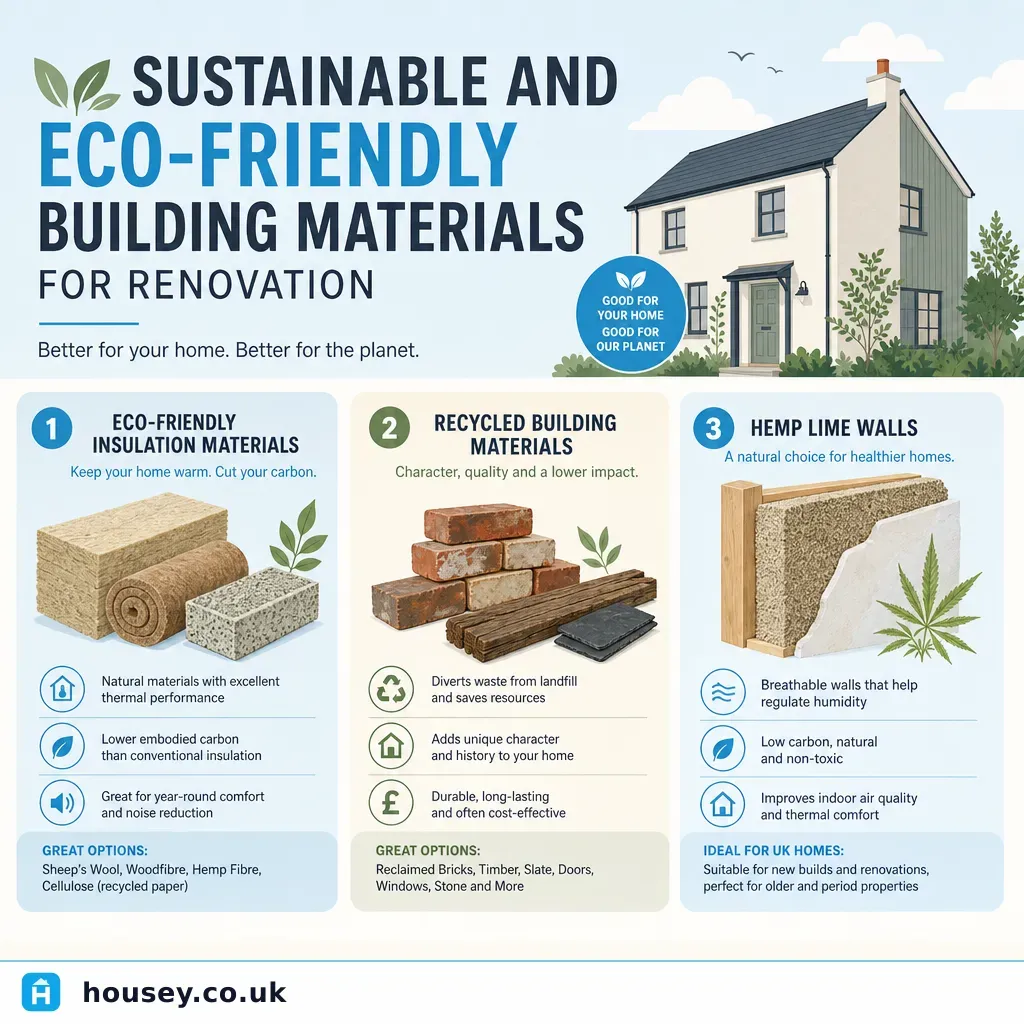
Sustainable and Eco-Friendly Building Materials for Renovation
Sustainable building materials for renovation include hemp lime, sheep's wool insulation, FSC-certified timber, and reclaimed brick.
 Energy & Retrofit
The Rise of Green-Rated Homes: Energy Efficiency, Sustainability, and Long-Term Property Value
Homes with higher EPC ratings typically sell faster and can command a premium of up to 10% over equivalent lower-rated properties.
 Energy & Retrofit
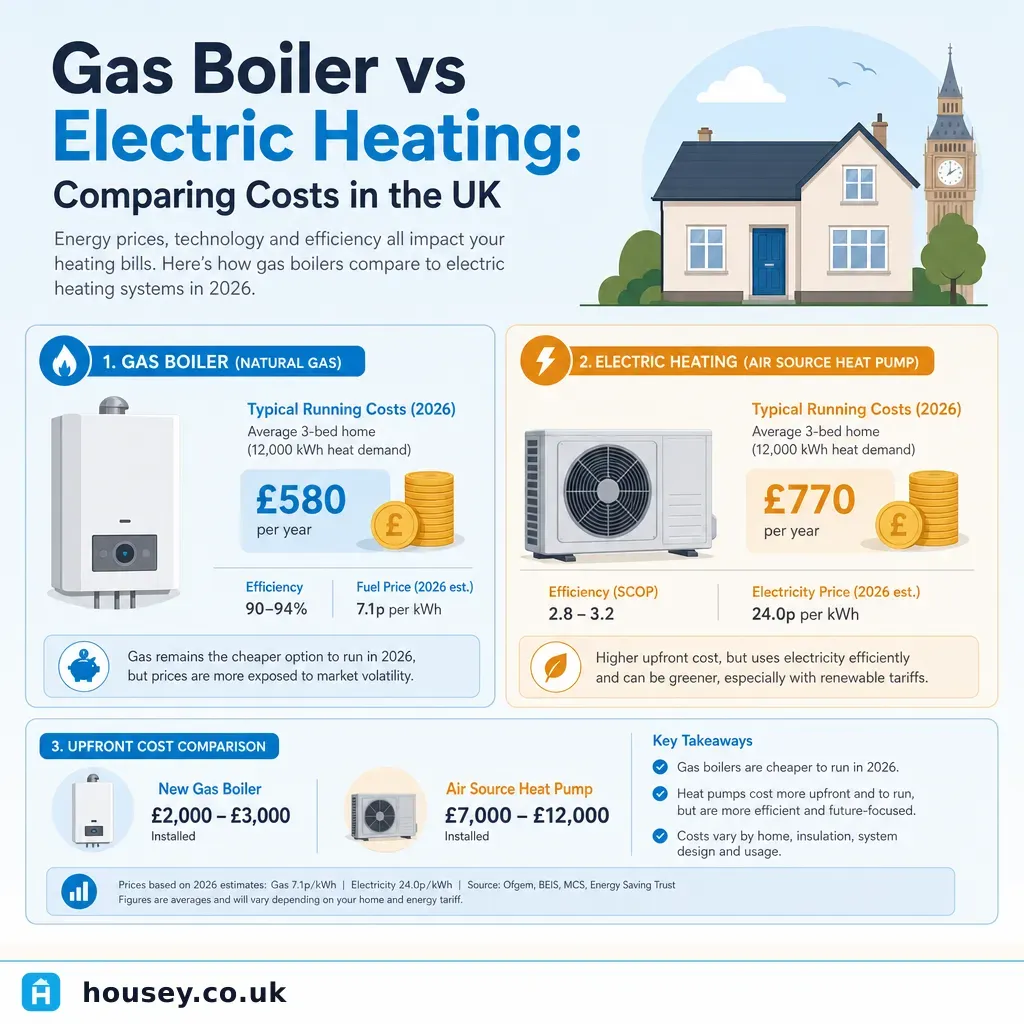
Gas Boiler vs Electric Heating: Comparing Costs in the UK
Gas boilers currently cost around 6.
 Energy & Retrofit
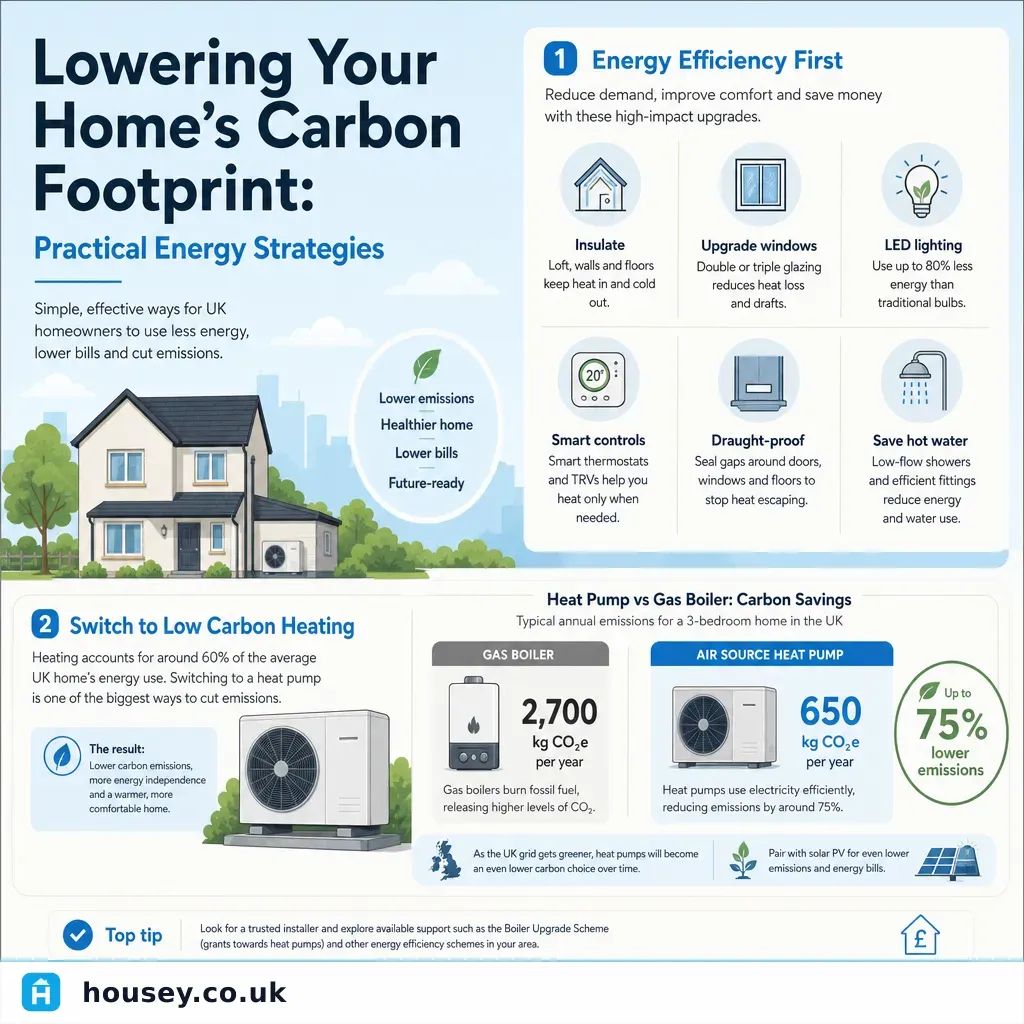
Lowering Your Home's Carbon Footprint: Practical Energy Strategies
UK homes produce around 19% of national greenhouse gas emissions, mostly from gas heating.
 Energy & Retrofit
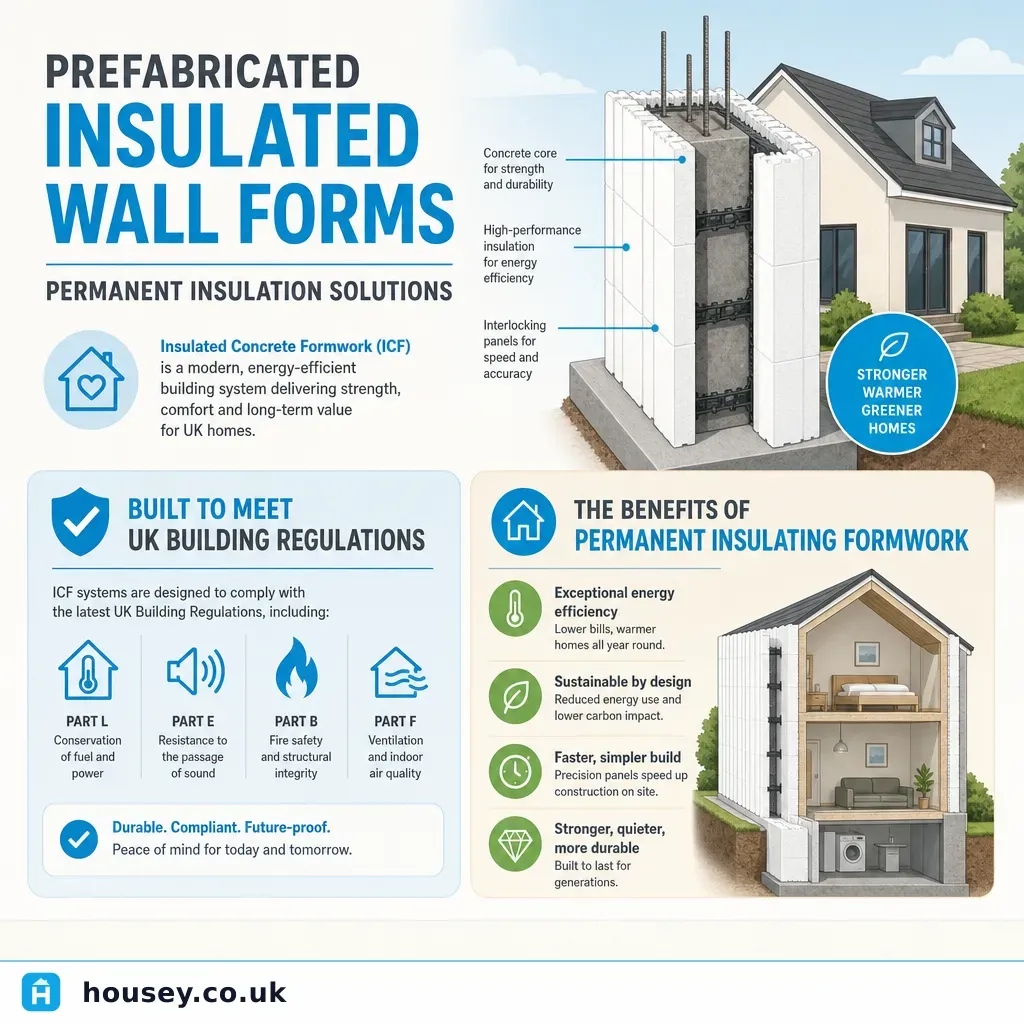
Prefabricated Insulated Wall Forms: Permanent Insulation Solutions
Prefabricated insulated wall forms — including ICF and SIPs systems — deliver high thermal performance by combining permanent insulation with structural concrete or timber in a single wall assembly.