Residential Wind Turbines: Feasibility and Energy Generation
By Housey · Last reviewed 12th of May 2026
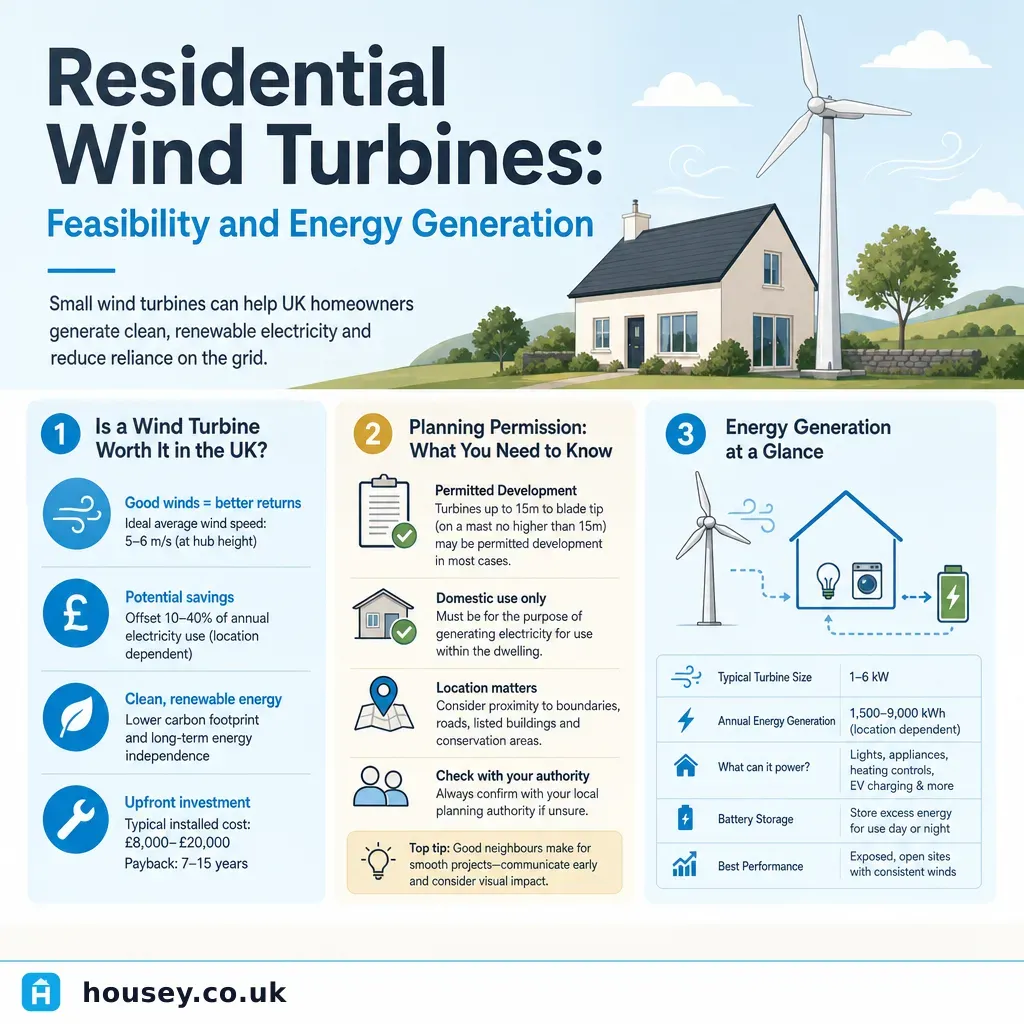
Residential Wind Turbines: Feasibility and Energy Generation
Wind turbines attract the attention of UK homeowners looking to generate their own electricity, but the difference between a well-sited and a poorly sited installation is dramatic — more so than with almost any other domestic renewable technology. Small wind turbines are particularly sensitive to local wind speed, site exposure, and proximity to buildings and trees. Understanding what separates a feasible project from a costly disappointment is essential before approaching installers or submitting any planning application.
Key points
- The Energy Saving Trust recommends a mean annual wind speed of at least 5–6 m/s for a residential turbine to generate a meaningful return; most UK urban areas fall well below this threshold.
- Pole-mounted turbines (2.5–6 kW) generate significantly more electricity than building-mounted turbines (0.5–2.5 kW) and are generally the better choice where open land is available.
- Planning permission is required for most residential wind turbines; permitted development rights for building-mounted turbines are subject to strict conditions under the Town and Country Planning (General Permitted Development) (England) Order 2015, Schedule 2, Part 14.
- Installers must hold Microgeneration Certification Scheme (MCS) accreditation for you to access the Smart Export Guarantee (SEG), which pays for surplus electricity exported to the grid.
- Indicative installed costs for a 2.5–6 kW pole-mounted turbine range from £15,000 to £30,000+, with payback periods of 6–25 years depending on site wind speed. (Indicative UK costs, last reviewed 2026-05-12; quotes vary.)
Is your site suitable for a wind turbine?
The single most important factor for residential wind energy is wind speed at your specific site. Wind resource mapping tools — including those provided by the Energy Saving Trust — can give a rough indication, but a professional assessment using calibrated on-site equipment over several months provides far more reliable data.
Urban and suburban sites typically have turbulent, variable wind with a mean annual speed below 4 m/s — too low for a cost-effective turbine. Buildings, trees, and varying terrain cause turbulence that reduces output and accelerates mechanical wear.
Rural, upland, coastal, and open farmland sites can offer mean annual wind speeds above 6 m/s, where turbines become genuinely viable.
Site feasibility decision tree
Use this to decide whether a residential wind turbine is worth investigating further:
- Is your property in an urban or suburban area with nearby buildings and trees? → A turbine is unlikely to be cost-effective. Consider solar PV instead.
- Is your mean annual wind speed below 5 m/s? → Output will be low and payback extended. Seek professional wind assessment before proceeding.
- Do you have open land (at least 0.4 ha) away from obstacles? → A pole-mounted turbine may be feasible. Commission a wind resource assessment and planning pre-application enquiry.
- Is your property listed or in a conservation area? → Permitted development rights do not apply; planning permission is required, and consent is unlikely for most turbine types.
- Is a 2.5–6 kW turbine within your budget (£15,000–£30,000+ installed)? → Proceed to formal site assessment and MCS-accredited installer consultation.
- Unsure? → Ask an MCS-accredited installer for a no-obligation feasibility check before spending on surveys.
Planning permission for residential wind turbines
Most residential wind turbines require a planning application. Permitted development (PD) rights for microgeneration equipment exist in England under Part 14 of the Town and Country Planning (General Permitted Development) (England) Order 2015, but the conditions for wind turbines are restrictive:
- Only one building-mounted turbine is allowed per dwelling under PD.
- The turbine must not project more than 3 m above the highest part of the roof, or more than 3 m above the point of attachment.
- Permitted development does not apply to Article 2(3) land — National Parks, Areas of Outstanding Natural Beauty, the Broads, World Heritage Sites, conservation areas, or listed buildings.
- A noise condition applies: the turbine must not exceed 42 dB(A) at the nearest non-associated residential façade.
- The turbine must be removed when it is no longer needed.
Separate rules apply in Wales, Scotland, and Northern Ireland — always check with your local planning authority (LPA) before starting work. In Scotland, micro-wind permitted development rules are set out under the Town and Country Planning (General Permitted Development) (Scotland) Amendment Order 2011.
For pole-mounted turbines, a full planning application is almost always required. Pre-application discussions with your LPA are advisable and can save time and cost.
Building-mounted vs pole-mounted turbines
Feature | Building-mounted turbine | Pole-mounted turbine |
|---|---|---|
Typical capacity | 0.5–2.5 kW | 2.5–6 kW |
Best for | Properties without open land | Rural or open sites with a good wind resource |
Typical annual output (good site) | 500–1,500 kWh | 2,500–9,000 kWh |
Planning | May fall under permitted development; conditions apply | Usually requires full planning application |
Vibration and noise | Can transfer vibration to structure; greater turbulence effects | Less turbulence; generally quieter in practice |
Indicative installed cost | £2,000–£5,000 | £15,000–£30,000+ |
Typical payback | Rarely cost-effective for most UK sites | 6–25 years depending on site wind speed |
Indicative UK costs, last reviewed 2026-05-12. Quotes vary by installer, site access, foundation requirements, and grid connection work.
Energy output and the Smart Export Guarantee
A 6 kW turbine at a good UK site (mean annual wind speed of 6 m/s) might generate approximately 9,000 kWh per year — roughly equivalent to average UK household electricity consumption. A 2.5 kW turbine at the same site might produce 3,500–4,500 kWh per year.
Surplus electricity can be exported to the grid and paid for under the Smart Export Guarantee (SEG). To qualify, your installation must use an MCS-certified installer and MCS-certified equipment. Export tariff rates are set by individual licensed energy suppliers and vary; check Ofgem's SEG guidance for current information.
There are currently no direct UK government grants specifically for residential wind turbines (as of 2026-05-12). The Energy Company Obligation (ECO4) covers heat and insulation measures, not wind energy. Some devolved programmes in Wales and Scotland may offer support — check the relevant government websites.
Noise, neighbours, and other considerations
Wind turbines generate mechanical noise (from the generator and gearbox) and aerodynamic noise (from blade rotation). Modern small turbines are generally quieter than older designs, but noise remains a material planning consideration.
Government planning practice guidance references the ETSU-R-97 methodology for wind turbine noise assessment in planning applications. Your LPA will typically require a noise assessment for any turbine that requires planning permission.
Before proceeding, also consider:
- Neighbours' reactions: Objections from nearby residents are common and can influence planning outcomes.
- Property value: Evidence on wind turbines and residential property values is mixed; RICS guidance addresses renewable energy and valuation.
- Restrictive covenants: Check your title deeds for any covenants prohibiting external structures of this type.
- Ongoing maintenance: Turbines require periodic inspection and servicing; factor these costs into any financial case.
When to get professional help
Always involve qualified professionals before committing to a residential wind turbine installation:
- Commission a wind resource assessment from a specialist before purchasing equipment — ideally using calibrated on-site measurement over at least three months.
- Use only an MCS-accredited installer to ensure SEG eligibility and quality standards.
- Consult your local planning authority for pre-application advice before submitting an application for a pole-mounted turbine.
- If the property is listed or in a conservation area, engage a heritage or planning consultant before proceeding.
- Check your title deeds and, if leasehold, your lease for any restrictions on external structures.
Seek professional advice immediately if:
- The property is leasehold or a flat — installation will require freeholder consent and possibly leaseholder agreement.
- The site is within or adjacent to a National Park, AONB, or conservation area.
- Your nearest neighbour's property is within 50 m of the proposed turbine location.
How Housey can help
Housey connects UK homeowners with energy professionals who can assess your property's suitability for renewable energy installations. Whether you are evaluating wind, solar PV, or heat pump options, finding the right professional early avoids costly feasibility mistakes and helps you choose the most appropriate technology for your site and budget.
Frequently asked questions
Do I need planning permission for a home wind turbine?
In most cases, yes. Building-mounted turbines may fall under permitted development rights in England, but strict conditions apply — including limits on size, height, noise, and location. Pole-mounted turbines almost always require a full planning application. Rules differ in Wales, Scotland, and Northern Ireland. Always check with your local planning authority before starting work.
How much electricity can a residential wind turbine generate?
A 2.5–6 kW pole-mounted turbine at a good UK site (mean annual wind speed 6 m/s) might generate 3,500–9,000 kWh per year. A building-mounted turbine in an urban area may generate only 500–1,000 kWh. Output depends heavily on site-specific wind conditions — professional wind assessment gives the most reliable estimate.
How long does it take for a home wind turbine to pay back its cost?
Payback periods vary widely: 6–12 years for well-sited rural installations and potentially 20+ years (or never) for poorly sited turbines. The Energy Saving Trust provides a payback calculator as a starting point, but a detailed financial model from an MCS-accredited installer is more reliable for your specific site.
Can I install a wind turbine in a conservation area or on a listed building?
Permitted development rights for wind turbines do not apply in conservation areas, National Parks, Areas of Outstanding Natural Beauty, or on listed buildings. A full planning application is required, and consent is rarely granted for wind turbines in these locations. Seek pre-application advice from your local planning authority before proceeding.
Sources and further reading
- Wind turbines — Energy Saving Trust
- Microgeneration Certification Scheme — MCS
- Smart Export Guarantee — Ofgem
- Renewable and low carbon energy planning guidance — GOV.UK
- Town and Country Planning (General Permitted Development) (England) Order 2015 — legislation.gov.uk
Useful next reads
 Energy & Retrofit
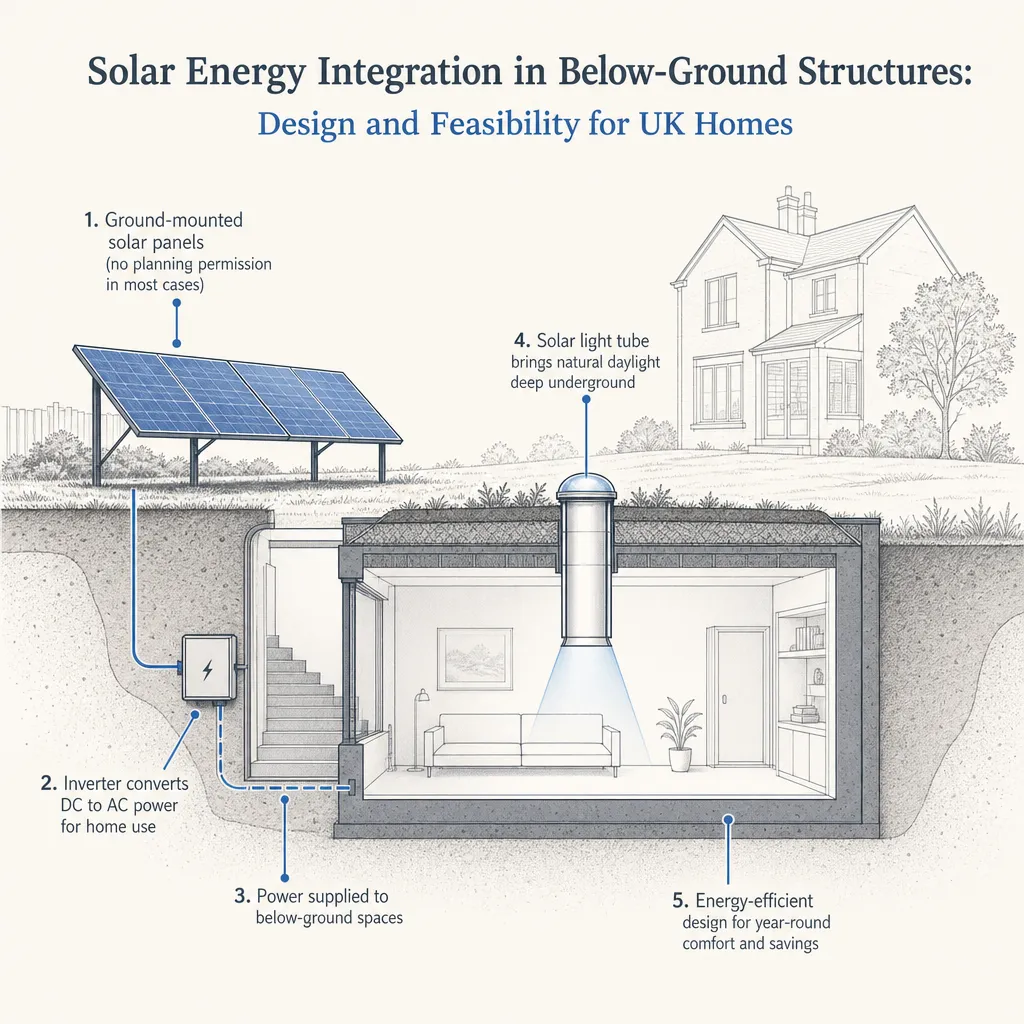
Solar Energy Integration in Below-Ground Structures: Design and Feasibility
Below-ground structures cannot host solar panels on their own roofs but can use surface-mounted panels connected via cable runs, solar light tubes for daylighting, and battery storage.
 Energy & Retrofit
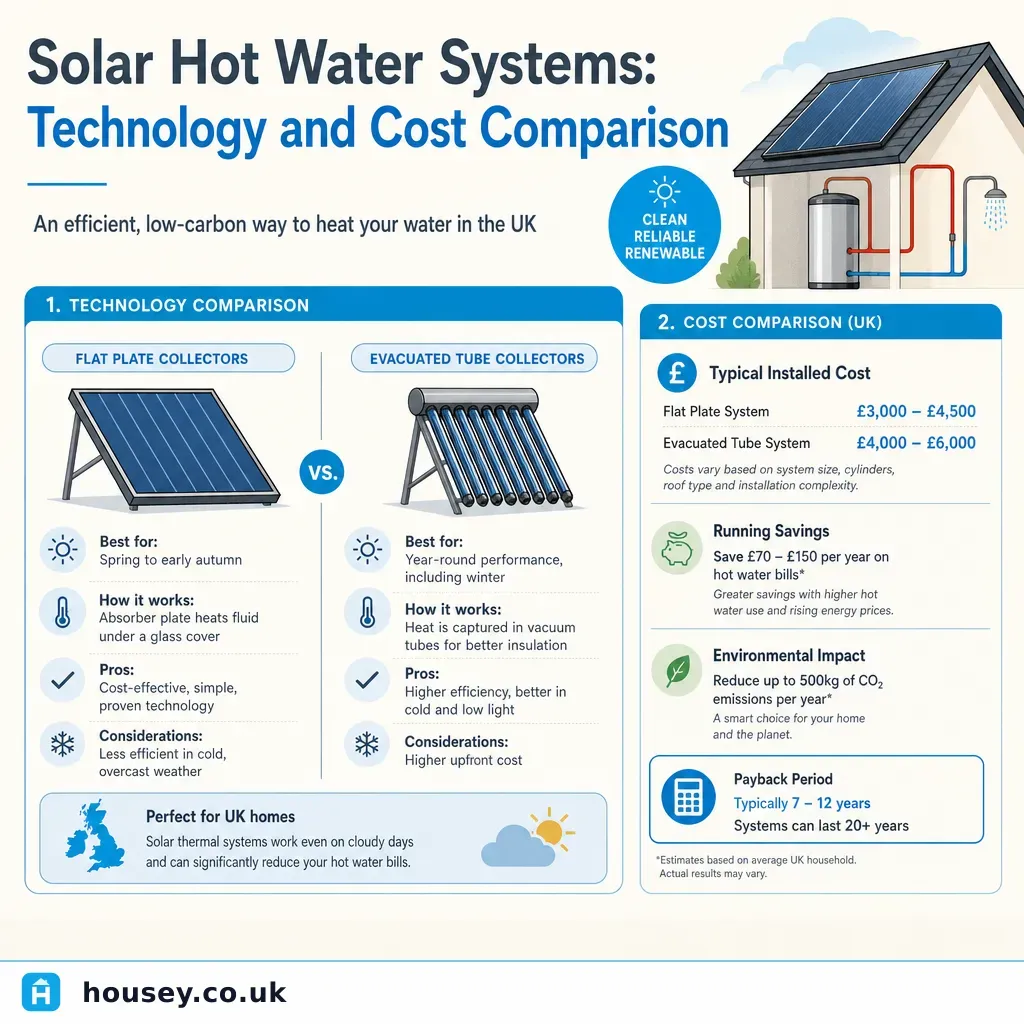
Solar Hot Water Systems: Technology and Cost Comparison
Solar thermal systems use roof-mounted collectors to heat domestic hot water via a glycol circuit and twin-coil cylinder.
 Energy & Retrofit
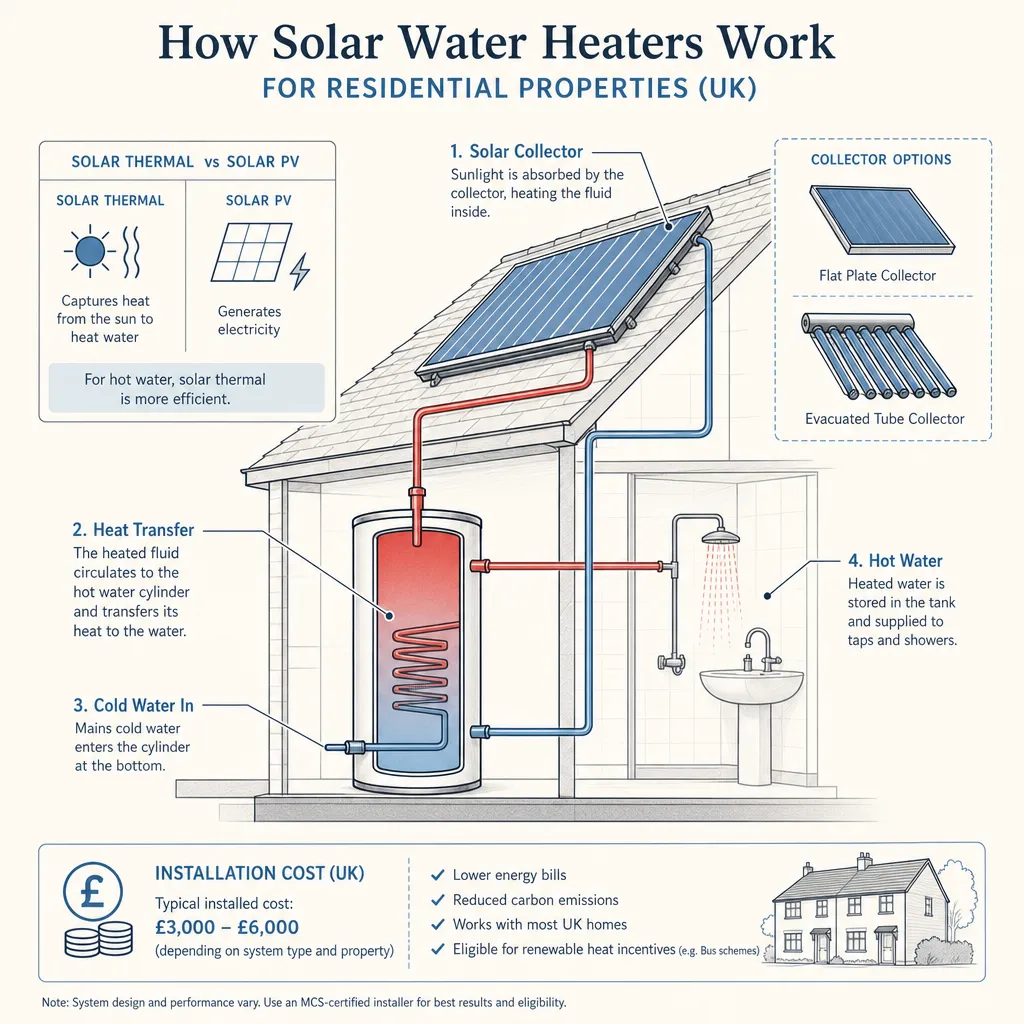
How Solar Water Heaters Work for Residential Properties
Solar water heaters use roof-mounted collectors to capture heat from sunlight and transfer it to a hot water cylinder via a fluid circuit.
 Energy & Retrofit
Renewable Energy Technologies for Homes
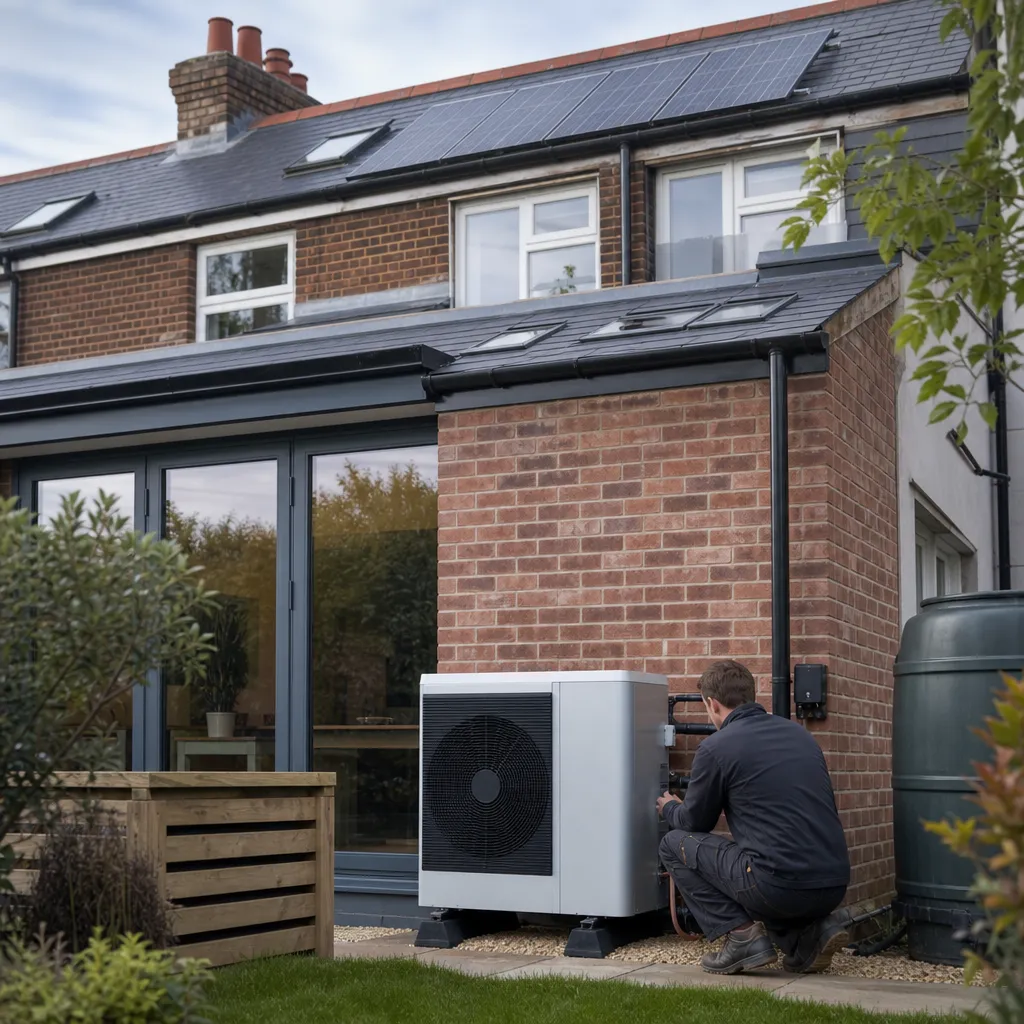
UK homes can choose from solar photovoltaic panels, air source heat pumps, ground source heat pumps, and battery storage as the main residential renewable technologies.
 Energy & Retrofit
Making your home more sustainable
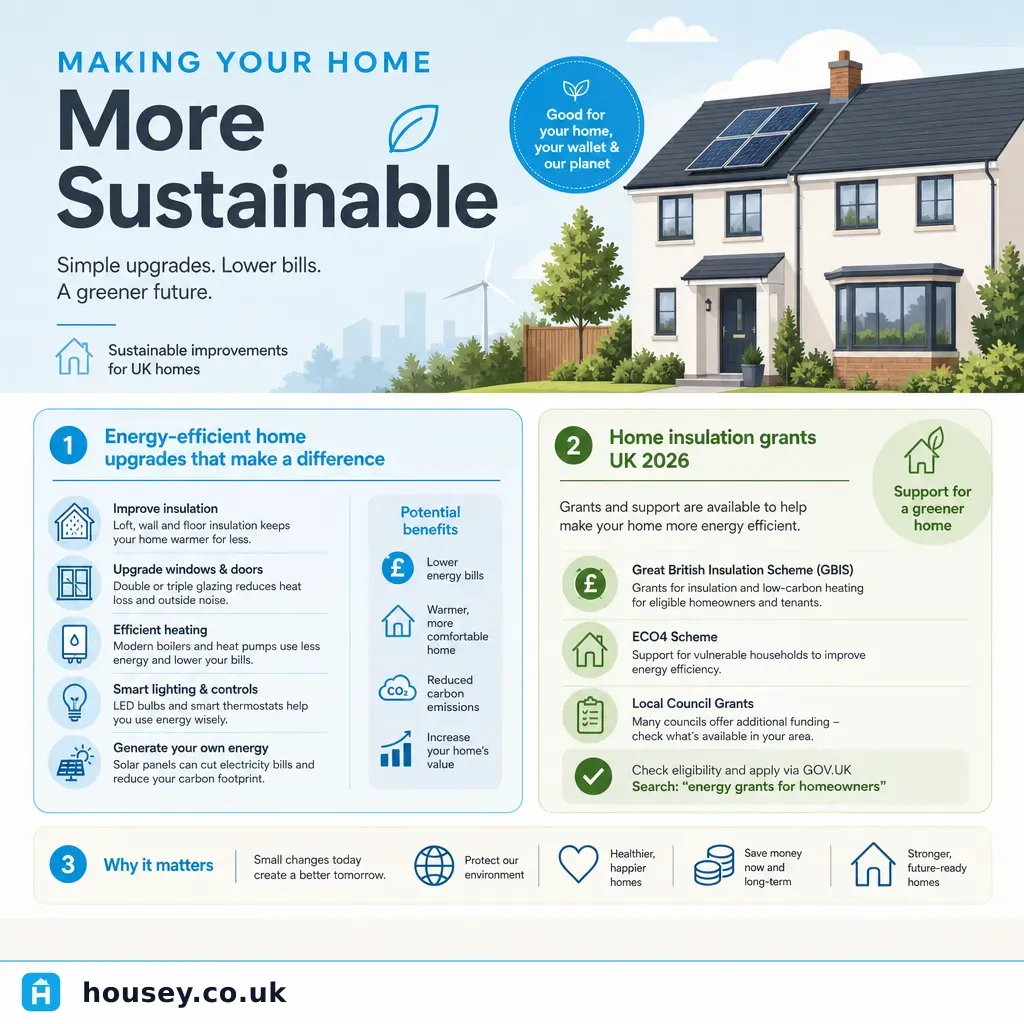
Making a UK home more sustainable usually starts with fabric-first improvements such as insulation, draught-proofing, and efficient glazing before adding renewable energy systems like solar panels or a heat pump.