Heat Pump Performance and Energy Efficiency Ratings
By Housey · Last reviewed 11th of May 2026
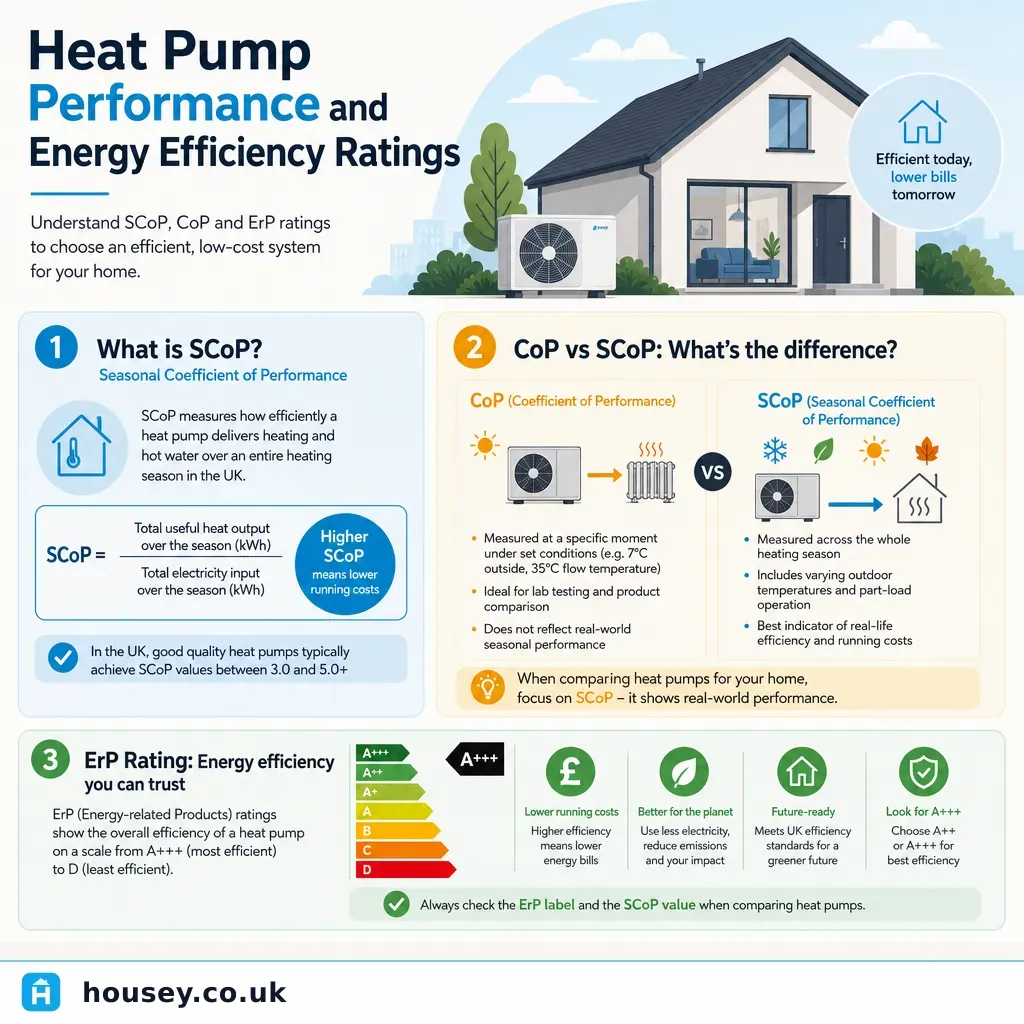
Heat Pump Performance and Energy Efficiency Ratings
Heat pumps are increasingly mainstream in UK homes, supported by the Boiler Upgrade Scheme and growing regulatory pressure to move away from gas boilers. But unlike a gas boiler — where efficiency is expressed as a single percentage — heat pump performance involves several interrelated metrics that can be confusing: CoP, SCoP, SPF, and ErP ratings all appear in product literature, and the real-world figure your system achieves often differs considerably from the manufacturer's headline number. Understanding these ratings helps you evaluate quotes, compare products, and hold your installer to account.
Key points
- The Seasonal Coefficient of Performance (SCoP) is the most useful single efficiency figure for comparing heat pumps: it reflects annual average heat output per unit of electricity consumed, accounting for varying outdoor temperatures throughout the year.
- UK-installed air source heat pumps (ASHPs) achieved average real-world seasonal performance factors (SPFs) of around 2.5–3.5 in field trials published by the Department for Energy Security and Net Zero (DESNZ).
- Ground source heat pumps (GSHPs) typically achieve higher SCoPs of 3.5–4.5+ due to more stable ground temperatures, but carry significantly higher upfront installation costs.
- The Boiler Upgrade Scheme (BUS) provides a £7,500 grant towards an ASHP or GSHP installed by an MCS-certified installer, subject to property eligibility — check GOV.UK for current criteria, as these can change.
- Heat pump efficiency is highly sensitive to system design: low-temperature distribution systems (underfloor heating or oversized radiators) and correct heat loss calculations carried out to BS EN 12831 are essential to achieving rated SCoPs in practice.
What CoP, SCoP, and SPF actually mean
CoP (Coefficient of Performance) is an instantaneous measure: if a heat pump delivers 3 kW of heat for every 1 kW of electricity consumed at a specific moment, its CoP is 3. Most manufacturers quote CoP at a defined test condition — typically outdoor air at 7°C and a flow temperature of 35°C — which is more favourable than typical UK winter conditions.
SCoP (Seasonal Coefficient of Performance) averages performance across a full year of varying temperatures and load conditions. This is the figure required under the UK Energy-related Products (ErP) Regulations for product labelling and is a far more useful indicator of real-world running costs than a single-point CoP. SCoP is calculated for a defined climate zone; the UK typically falls into the average climate zone used in ErP calculations.
SPF (Seasonal Performance Factor) is a closely related metric used in UK monitoring frameworks and by MCS. It is calculated from actual metered heat output divided by actual electrical consumption over a monitoring period, making it the most accurate measure of how a specific installed system is performing in practice.
If your installed system's SPF falls significantly below the manufacturer's quoted SCoP, this may indicate sizing errors, an elevated flow temperature, or insufficient building insulation — all issues worth raising with your installer or an independent assessor.
Energy labels: ErP ratings for heat pumps
Under the UK Energy-related Products Regulations (retained from EU law after Brexit), heat pumps sold in Great Britain must display an energy label. Space heaters incorporating heat pumps are rated on a scale from G to A+++:
ErP Rating | Typical SCoP range | Context |
|---|---|---|
A+++ | SCoP above 5.1 | High-end GSHPs; best available |
A++ | SCoP 4.6–5.1 | Premium GSHPs and high-performance ASHPs |
A+ | SCoP 3.9–4.6 | Good quality modern ASHPs |
A | SCoP 3.5–3.9 | Standard efficient ASHPs |
B–D | SCoP below 3.5 | Older or lower-specification units |
ErP ratings are based on standardised test conditions, not real-world UK installation. An A++ label does not guarantee that level of performance in your specific property — design and installation quality matter enormously.
ASHP versus GSHP: performance and practicality compared
Factor | Air Source Heat Pump (ASHP) | Ground Source Heat Pump (GSHP) |
|---|---|---|
Typical real-world SCoP/SPF | 2.5–3.5 | 3.5–4.5+ |
Best for | Most UK homes; moderate heat demand | Larger or rural properties with land for ground loops or borehole |
Not ideal for | Poorly insulated homes; high required flow temperatures | Tight urban plots; limited budgets |
Indicative install cost (2026) | £8,000–£15,000 | £15,000–£30,000+ |
BUS grant available | Yes — £7,500 | Yes — £7,500 |
Cold weather performance | CoP reduces below 0°C outdoor | More stable year-round (ground temp ~10–12°C) |
Planning permission | Usually permitted development | May require consent; check local authority |
MCS required for grant | Yes | Yes |
Indicative UK costs, last reviewed 2026-05-11.
How system design affects real-world efficiency
The manufacturer's SCoP is quoted at specific flow temperatures. The higher the flow temperature required, the lower the real-world CoP:
- At 35°C flow temperature (underfloor heating or low-temperature radiators): CoP may reach 3.5–4.5 for a modern ASHP.
- At 55°C flow temperature (standard radiator system): CoP typically falls to 2.0–2.8 for the same unit.
- At 70°C (old-style cast-iron radiators): many ASHPs cannot maintain adequate performance or efficiency.
This is why heat loss calculations — carried out to BS EN 12831 by your installer before any sizing decisions — are so important. An undersized heat pump running at elevated flow temperatures to compensate will underperform and cost more to run than a correctly designed system. A well-specified ASHP should heat your home at 45°C or below in most UK conditions, achievable in homes with reasonable insulation and properly sized emitters.
MCS certification and the Boiler Upgrade Scheme
The Microgeneration Certification Scheme (MCS) sets quality standards for heat pump installation in the UK. An MCS-certified installer must:
- Carry out a heat loss calculation before sizing the system.
- Specify the correct heat pump, emitters, and controls for the property.
- Commission the system and issue an MCS certificate on completion.
MCS certification is required to access the Boiler Upgrade Scheme grant of £7,500 for both ASHPs and GSHPs. Properties must also have a valid EPC in place. Always check GOV.UK's Boiler Upgrade Scheme guidance for current eligibility criteria, as these are subject to change.
When to get professional help
Heat pump sizing and system design require specialist assessment — a rule of thumb or boiler-to-heat-pump kilowatt substitution is not sufficient. If a quote does not include a formal heat loss calculation, treat this as a red flag. An independent heat pump survey can assess your home's readiness and suitability before you commit to any installer. If you are unsure whether insulation improvements should come first, an energy-efficiency consultant can model the whole-house picture.
Important limitations
This article provides general information about heat pump efficiency metrics and how they relate to system design in UK homes. It is not a substitute for a site-specific heat loss assessment by an MCS-certified installer or an independent energy consultant. Heat pump performance varies considerably depending on your property's insulation, heating distribution system, local climate, hot water demand, and occupancy patterns. Cost and performance figures are indicative ranges only (last reviewed 2026-05-11) and should not be used as the basis for financial decisions without professional quotes and a formal energy assessment.
What to ask a qualified professional
Before accepting any heat pump quote, ask your installer or assessor:
- What is the calculated heat loss for my property in kilowatts, and what methodology was used?
- What SCoP does the specified system achieve at the flow temperature you are designing for?
- What flow temperature is the system designed to operate at, and will my existing radiators need to be upgraded?
- Is the heat pump MCS-certified, and will I receive an MCS certificate and the heat loss calculation on completion?
- Am I eligible for the Boiler Upgrade Scheme grant, and will you manage the application?
- What are the estimated annual running costs compared to my current heating system, and what assumptions underpin that figure?
- What warranty does the unit carry, and what are the annual service and maintenance requirements?
How Housey can help
Housey connects homeowners with qualified professionals for heat pump surveys and with energy-efficiency consultants who can advise on whether your property is ready for a heat pump and which system type is likely to deliver the best real-world performance.
Frequently asked questions
What is a good SCoP for a heat pump in the UK?
A real-world SPF of 2.5 or above is generally considered the minimum for a heat pump to be more efficient than a modern condensing gas boiler, accounting for the relative cost and carbon intensity of electricity versus gas. Good modern ASHP installations in well-designed systems typically achieve SPFs of 3.0–3.8. Ask your installer what SPF the proposed system is designed to deliver.
Can a heat pump replace a gas boiler in an older UK home?
It depends significantly on the property. Solid-wall Victorian terraces and pre-1970s homes with limited insulation often have high heat loss and radiators sized for high flow temperatures, making heat pump installation more complex. Fabric improvements — loft insulation, draught-proofing, and ideally wall insulation — typically improve heat pump performance considerably. An energy assessment is advisable before deciding.
Does a heat pump work in very cold UK weather?
Modern ASHPs operate efficiently down to outdoor temperatures of around -15°C to -20°C, though CoP reduces as temperature falls. Most of the UK rarely sees prolonged temperatures below -5°C, so cold-weather performance is seldom a limiting factor. Your installer should verify the system meets peak heat demand at the design outdoor temperature for your location.
Is a ground source heat pump worth the extra cost?
GSHPs typically deliver higher SCoPs than ASHPs due to stable ground temperatures, but installation costs are roughly double, and you need sufficient land for ground loops or a borehole. For most UK homes, an ASHP offers the better cost-benefit ratio at current grant levels. An energy consultant can model both options for your specific property before you decide.
Sources and further reading
- Apply for the Boiler Upgrade Scheme — GOV.UK / DESNZ
- MCS — Microgeneration Certification Scheme — MCS
- Heat pumps explained — Energy Saving Trust
- Heat pump field trial data — Department for Energy Security and Net Zero
- UK Energy-related Products Regulations 2021 — legislation.gov.uk
Useful next reads
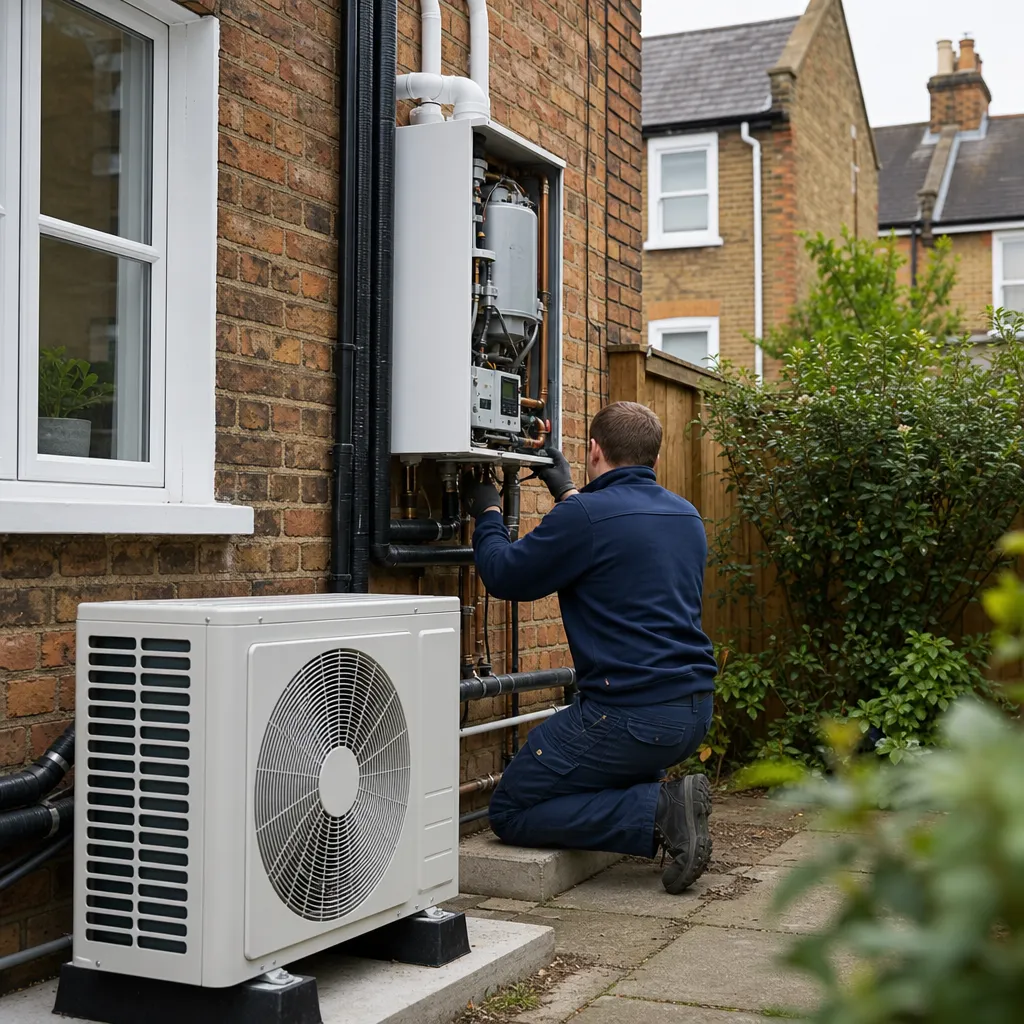 Energy & Retrofit
Heat Pump and Boiler Hybrid Systems: Optimising Efficiency in UK Homes
A hybrid heat pump system pairs an air source heat pump with a gas boiler, letting the heat pump handle most heating loads while the boiler activates during very cold weather.
 Energy & Retrofit
Mini Split Air Conditioning: Installation Costs and Performance
A mini-split (ductless) air conditioning unit costs roughly £1,500–£4,000 installed for a single room in the UK.
 Energy & Retrofit
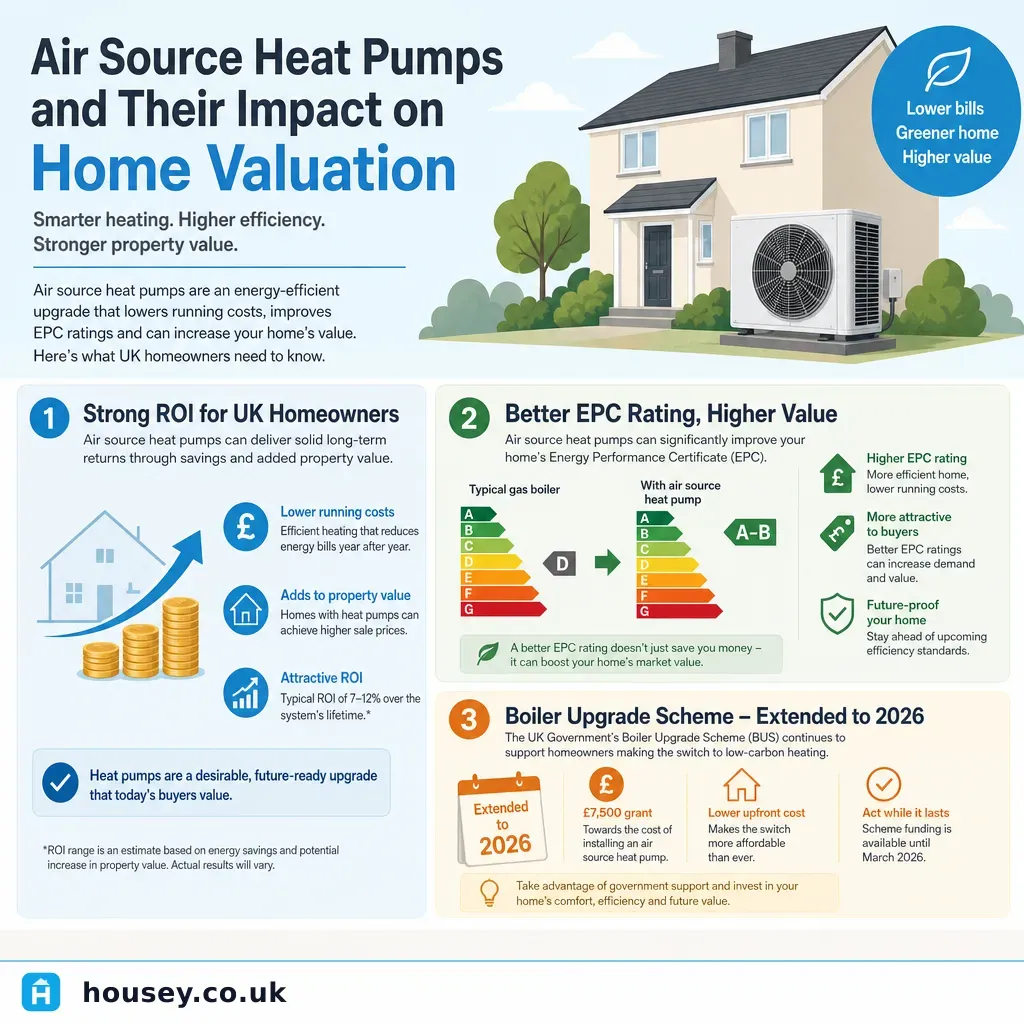
Air Source Heat Pumps and Their Impact on Home Valuation
An air source heat pump can improve your home's EPC rating, which may positively influence its market value — particularly as mortgage lenders and buyers increasingly factor in energy performance.
 Energy & Retrofit
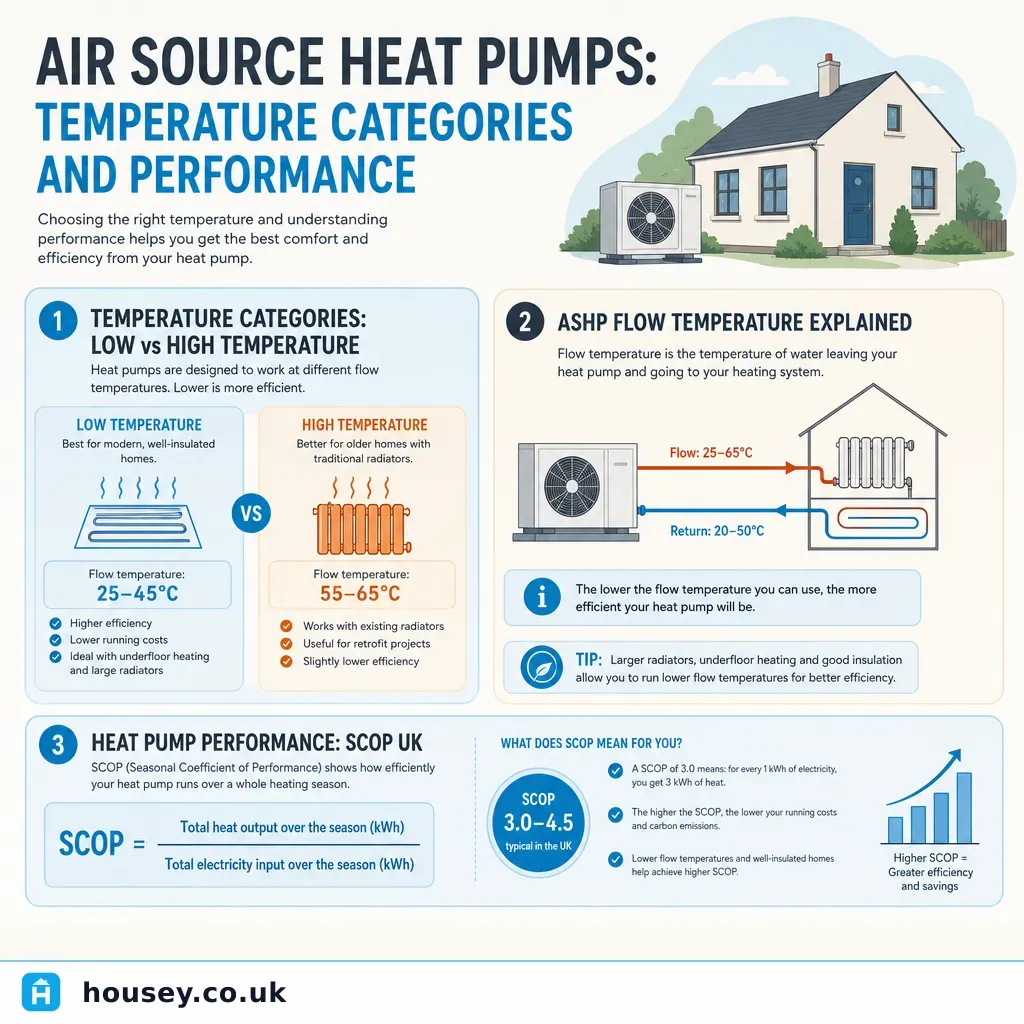
Air Source Heat Pumps: Temperature Categories and Performance
Air source heat pumps are typically classified as low temperature (flow temperatures of 35–55°C) or high temperature (up to 65–80°C).
 Energy & Retrofit
Diagnosing Heat Pump Performance Issues: Why Cooling Fails
Heat pump cooling failure is usually caused by refrigerant loss, a dirty air filter, a blocked outdoor unit, incorrect controller settings, or an undersized system.