Solar Hot Water Systems: Technology and Cost Comparison
By Housey · Last reviewed 10th of May 2026
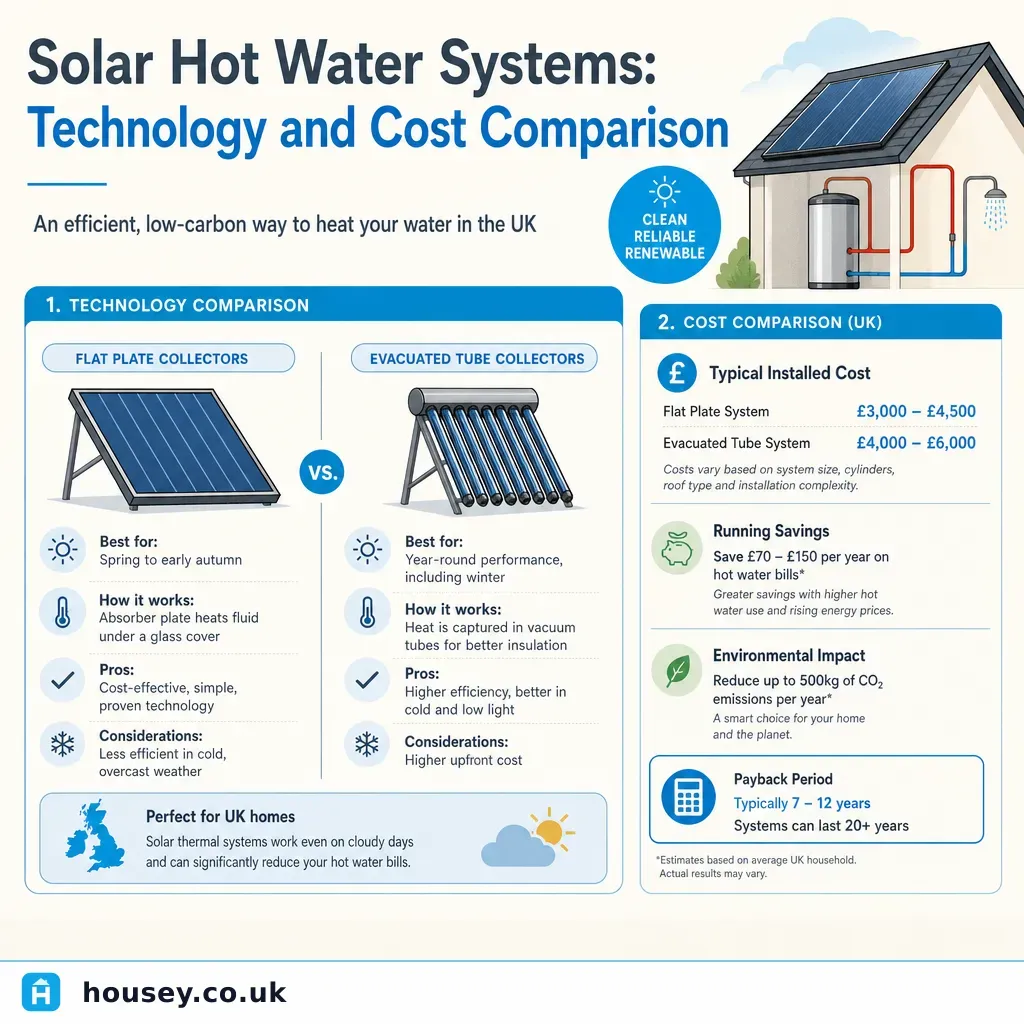
Solar Hot Water Systems: Technology and Cost Comparison
Solar thermal systems use roof-mounted collectors to heat domestic hot water — a mature renewable technology that frequently receives less attention than solar PV. They are most cost-effective for off-gas properties relying on oil, LPG, or direct electric heating, and for households with consistently high daily hot water demand.
Key points
- The two main collector types — flat plate and evacuated tube — differ in performance in diffuse light, appearance, and cost, making the choice property-specific.
- A well-sized solar thermal system meets an estimated 40–60% of a household's annual hot water demand, according to the Energy Saving Trust.
- Installations must comply with Building Regulations Approved Document G (sanitation and hot water safety) and require a twin-coil hot water cylinder.
- MCS-certified installers are required for grid-connection compliance and eligibility for any applicable government scheme.
- Solar thermal delivers the strongest financial return where electricity or oil currently provides hot water — not where mains gas is the primary fuel.
How solar thermal systems work
A solar collector absorbs heat from solar radiation — including on overcast days — and transfers it via a glycol heat-transfer fluid through a sealed circuit to a twin-coil hot water cylinder. The lower coil carries solar heat; the upper coil connects to your boiler or immersion heater as backup. A differential temperature controller (DTC) manages the pump, circulating fluid only when the collector is warmer than the cylinder water. The system produces heat, not electricity, and operates year-round in the UK.
Flat plate vs evacuated tube collectors
Feature | Flat plate | Evacuated tube |
|---|---|---|
Performance in full sun | High | High |
Performance in diffuse or cloudy light | Moderate | Better — vacuum insulation reduces heat loss |
Roof pitch flexibility | 30–50° fixed | Adjustable on mounting frame |
Aesthetic | Lower profile; neater appearance | More prominent glass tubes |
Typical installed cost (2-person household) | £3,000–£5,000 | £4,000–£6,000 |
Best suited to | South-facing roofs in moderate climates | Northern England, Scotland, shadier sites |
Indicative UK costs, last reviewed 2026-05-10. Costs vary by installer, region, roof access, and cylinder specification.
System sizing: what do you need?
For most UK households: approximately 1–2 m² of flat plate collector per person (slightly less for evacuated tube given higher efficiency per m²), and a twin-coil indirect cylinder of 150–300 litres. Most existing direct cylinders lack a solar coil and will need replacing. Standard combi boilers cannot accept a solar thermal circuit without modification — confirm compatibility at the survey stage before committing to any work.
Decision tree: which system suits your property?
- Choose flat plate if your roof faces due south (within ±30°) at a pitch of 30–50° and you prefer a lower-profile installation.
- Choose evacuated tube if your roof faces south-east or south-west, you are in northern England or Scotland, or your site has partial shading for part of the day.
- Consider a solar PV diverter instead if you already have a solar PV array — a diverter such as an iBoost or myenergi Eddi redirects surplus generation to an immersion heater at very low additional cost, without a separate sealed circuit.
- Consult an MCS-certified installer if your roof is flat or non-standard in construction, or if you are unsure about cylinder or boiler compatibility.
- Do not install solar thermal if household hot water demand is very low — payback will be impractically long.
Homeowner checklist: before commissioning a solar thermal system
Running costs and savings
Annual savings depend on the fuel type solar thermal is replacing. Indicative figures (Energy Saving Trust, last reviewed 2026-05-10):
- Replacing electric immersion heating: approximately £290–£420 per year.
- Replacing oil-fired hot water: approximately £110–£180 per year.
- Replacing mains gas hot water: approximately £70–£110 per year.
Payback is shortest — typically 8–12 years — when replacing direct electric heating. Replacing mains gas can extend payback beyond 25 years, which means solar thermal makes the strongest financial case for off-gas properties.
Planning permission
In England, solar thermal panels on a house roof are usually permitted development under the Town and Country Planning (General Permitted Development) (England) Order 2015, provided panels do not protrude more than 200 mm from the roof surface. Listed buildings require listed building consent before installation. Conservation area properties may face restrictions — check with your Local Planning Authority before proceeding.
When to get professional help
Solar thermal must be installed by an MCS-certified installer, who will survey the roof, design and size the system, notify Building Regulations Part G, and issue a commissioning certificate. Seek additional professional advice when:
- Your property is listed or in a conservation area, where planning consent may be required.
- The roof requires structural work before panels can be fitted.
- You are combining solar thermal with a heat pump, where system interaction needs careful design to avoid inefficiency or safety issues.
How Housey can help
Housey connects you with MCS-certified specialists through our solar surveys service, which assesses roof orientation, shading, and cylinder compatibility. Our energy-efficiency consultants can advise independently on whether flat plate, evacuated tube, or a solar PV diverter is the most cost-effective choice for your property and usage profile.
Frequently asked questions
Does solar thermal work in the UK climate?
Yes — solar thermal systems work on diffuse daylight, not just direct sunshine, generating useful heat year-round. Output is lower in winter but still pre-heats incoming cold water, reducing boiler or immersion workload. The Energy Saving Trust estimates a well-sized system meets 40–60% of annual hot water demand.
Can I get a grant for solar thermal in the UK?
The Renewable Heat Incentive (RHI) is now closed to new applicants. As of May 2026, check the Energy Saving Trust and GOV.UK for any successor schemes. Some local authority programmes and ECO4 may offer support for eligible households — eligibility criteria vary.
How often does a solar thermal system need servicing?
Most manufacturers recommend an annual check of glycol concentration and system pressure, and a full service every 3–5 years. The glycol heat-transfer fluid typically needs replacing every 5–7 years. A qualified heating engineer or MCS-certified solar installer can carry out this work.
Will solar thermal work with my combi boiler?
Standard combi boilers cannot typically be connected directly to a solar thermal system because they do not use a stored hot water cylinder. Solar-compatible combi boilers exist, or your installer may recommend switching to a system boiler with a twin-coil cylinder. Raise this explicitly at the survey stage.
What happens if the system overheats in summer?
Overheating management is built into well-designed solar thermal systems. The glycol fluid is formulated to handle stagnation temperatures safely. Some systems incorporate a heat dump radiator or passive stagnation management. Ask your installer specifically how their proposed design handles summer overheating before agreeing to work.
Sources and further reading
- Solar water heating — Energy Saving Trust — Energy Saving Trust
- Building Regulations Approved Document G: Sanitation, hot water safety and water efficiency — GOV.UK
- Permitted development rights for householders — GOV.UK
- MCS certified installer search — Microgeneration Certification Scheme
- Domestic Renewable Heat Incentive — GOV.UK
Useful next reads
 Energy & Retrofit
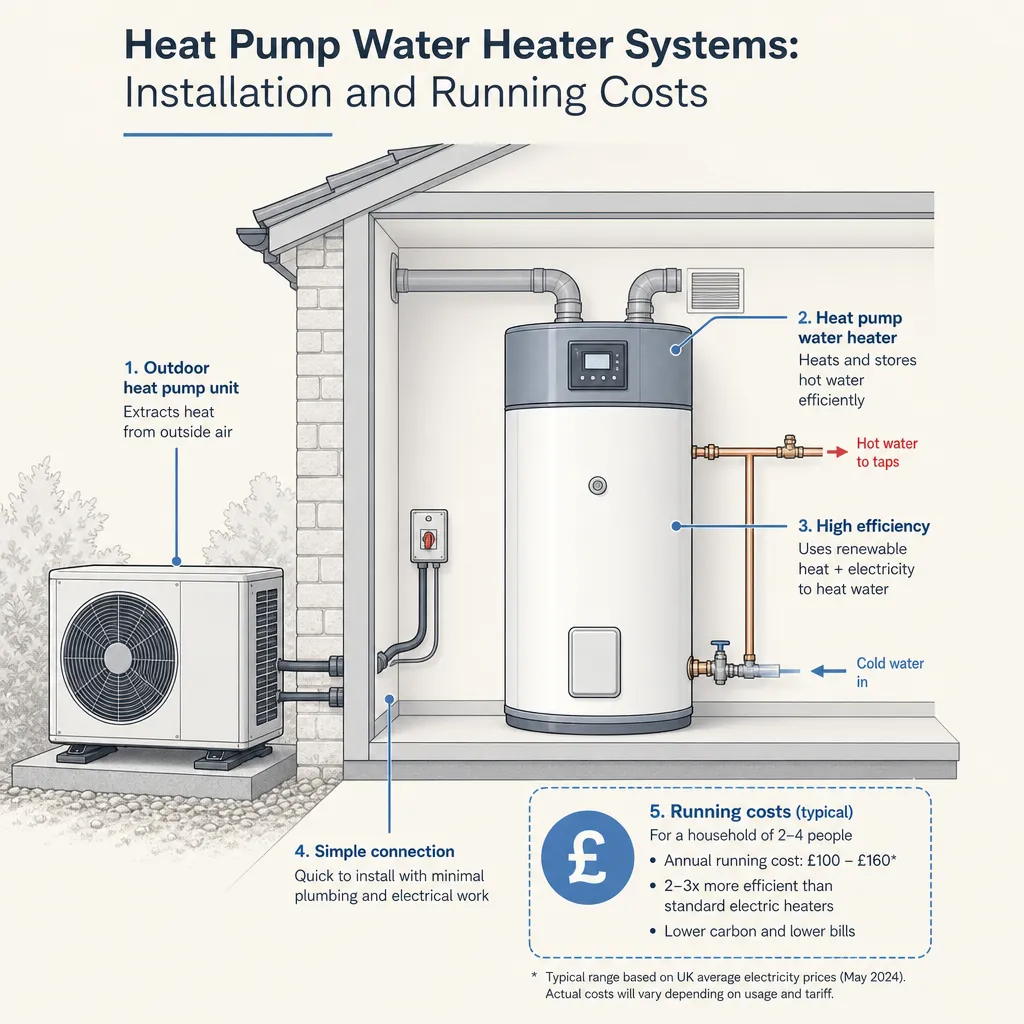
Heat Pump Water Heater Systems: Installation and Running Costs
A heat pump water heater extracts heat from surrounding air to warm your domestic hot water cylinder, achieving a Coefficient of Performance of 2.
 Energy & Retrofit
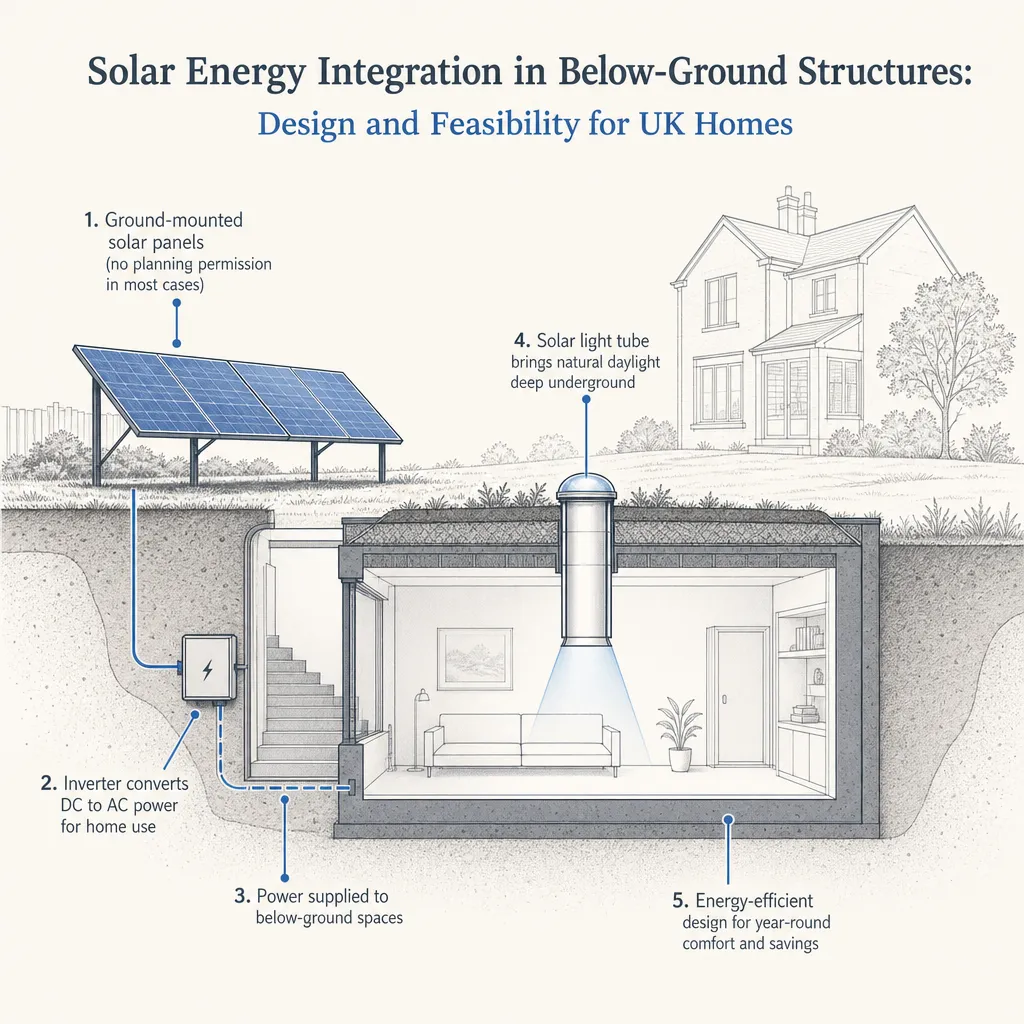
Solar Energy Integration in Below-Ground Structures: Design and Feasibility
Below-ground structures cannot host solar panels on their own roofs but can use surface-mounted panels connected via cable runs, solar light tubes for daylighting, and battery storage.
 Energy & Retrofit
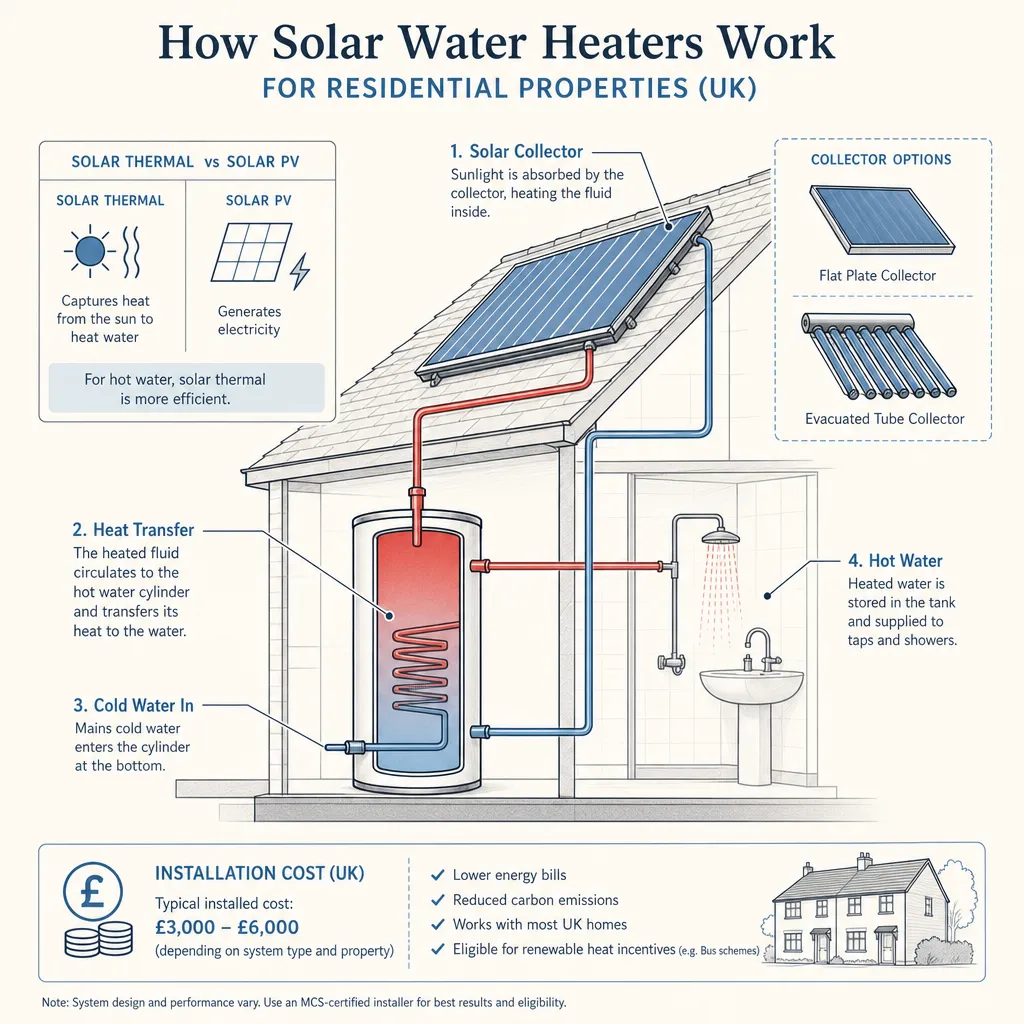
How Solar Water Heaters Work for Residential Properties
Solar water heaters use roof-mounted collectors to capture heat from sunlight and transfer it to a hot water cylinder via a fluid circuit.
 Energy & Retrofit
Renewable Energy Technologies for Homes
UK homes can choose from solar photovoltaic panels, air source heat pumps, ground source heat pumps, and battery storage as the main residential renewable technologies.
 Energy & Retrofit
Making your home more sustainable
Making a UK home more sustainable usually starts with fabric-first improvements such as insulation, draught-proofing, and efficient glazing before adding renewable energy systems like solar panels or a heat pump.