Comparing Heat Pumps and Air Conditioning: Technology and Costs
By Housey · Last reviewed 7th of May 2026
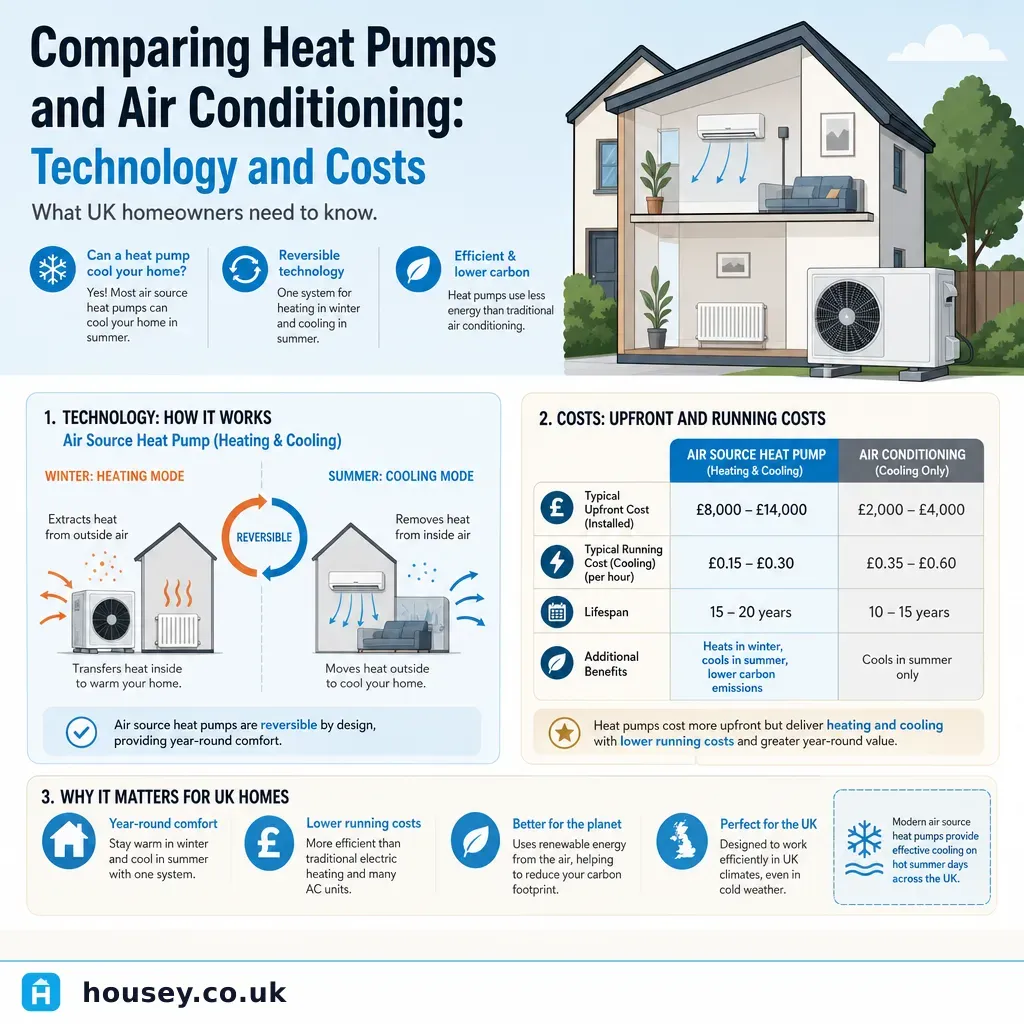
Comparing Heat Pumps and Air Conditioning: Technology and Costs
The question of heat pump versus air conditioning typically arises when UK homeowners are planning a boiler replacement, looking to address summer overheating, or weighing the options for a whole-house energy retrofit. While both technologies share the same underlying refrigeration principle, they are designed for different primary purposes — and in the UK context, these differences have meaningful implications for upfront costs, running bills, grant eligibility, and planning requirements.
Key points
- A reversible heat pump uses the refrigeration cycle in both directions, providing heating in winter and cooling in summer from a single outdoor unit; a conventional air conditioner only cools.
- Air-source heat pumps installed under the Boiler Upgrade Scheme (BUS) attract a £7,500 grant (2025–26 tariff); no equivalent UK grant is available for cooling-only air conditioning systems.
- Permitted development rights for air-source heat pumps in England are governed by The Town and Country Planning (General Permitted Development) (England) Order 2015, with specific noise and siting conditions; cooling-only units fall under different PD criteria.
- The Coefficient of Performance (COP) of a well-installed air-source heat pump typically ranges from 2.5 to 4.0, delivering 2.5–4 units of heat per unit of electricity; split-system air conditioners have a comparable cooling efficiency (EER), but provide no heating benefit.
- Installing cooling-only air conditioning alongside a gas boiler means running two separate energy systems, which may cost more annually than a single well-specified reversible heat pump.
How the technology works
The refrigeration cycle
Both heat pumps and air conditioning units operate on the same physical principle: a refrigerant fluid is compressed and expanded in a sealed circuit to move heat energy from one location to another. In a standard air conditioning unit, heat is extracted from inside the building and discharged outside — that is its only direction of operation.
A heat pump does something different: it extracts low-grade heat from outside air (or the ground) and upgrades it to a usable temperature for space heating and hot water. A reversible heat pump — sometimes called a reverse-cycle heat pump — can switch direction seasonally, removing heat from indoors in summer just as a conventional air conditioner does.
Not all heat pumps sold in the UK include active cooling as standard. Some models are heating-only. Confirming cooling capability before purchase is important if year-round comfort is a goal.
System types relevant to UK homes
System type | Heats? | Cools? | Typical UK application |
|---|---|---|---|
Air-source heat pump (heating only) | Yes | No | Replacing a gas boiler; radiators or underfloor heating |
Reversible air-source heat pump | Yes | Yes | Heating and summer cooling from one outdoor unit |
Split-system air conditioner | No | Yes only | Single-room summer cooling |
Multi-split air conditioner | No | Yes only | Multiple rooms from one outdoor unit |
Ground-source heat pump | Yes | Some models | Larger homes with suitable land; lower flow temperatures |
Comparing installation and running costs
Installation costs
System | Typical installed cost (UK) | Key notes |
|---|---|---|
Air-source heat pump (heating only) | £8,000–£13,000 | BUS grant of £7,500 may apply; MCS-certified installer required |
Reversible ASHP with active cooling | £9,000–£16,000 | Additional cost for fan-coil units or active cooling controls |
Split-system air conditioning (single room) | £1,000–£2,500 | Cooling only; F-Gas registered installer required |
Multi-split air conditioning (2–4 rooms) | £3,500–£8,000 | Cooling only; no heating function |
Indicative UK costs, last reviewed 2026-05-07. Costs vary by installer, region, property size, and specification. Obtain at least two quotes.
Running costs
A well-installed heat pump typically delivers more energy than it consumes, due to its high COP. At a COP of 3.0, every 1 kWh of electricity provides 3 kWh of heat. Running costs depend on your electricity tariff, the efficiency of your particular unit, and how well your home retains heat.
Cooling-only air conditioning units have a similar efficiency ratio (expressed as EER or SEER) for their cooling function. The key financial point for UK homeowners is that installing cooling-only air conditioning alongside an existing gas boiler means paying separately for two heating and cooling systems. A reversible heat pump that handles both functions may offer lower combined annual running costs, depending on usage patterns and how well the system is sized for the property.
Which option should you choose?
- Choose a reversible air-source heat pump if you want to replace your boiler, benefit from the BUS grant, and gain summer cooling capability — subject to a professional assessment of your home's suitability.
- Choose a heating-only air-source heat pump if cooling is not a priority, you want the simplest installation, and wish to keep upfront costs as low as possible.
- Consider cooling-only split-system air conditioning if you already have a modern, efficient heating system and are only addressing summer overheating in one or two rooms.
- Ask a heat pump surveyor before committing if you have solid walls, older radiators, or limited insulation — your home fabric significantly affects heat pump sizing and efficiency, and an undersized system will underperform.
- Check with your local planning authority before any installation if your property is listed, in a conservation area, or a flat — standard permitted development rules may not apply.
- Request a retrofit assessment if you are also planning insulation, ventilation, or other energy improvements, as these interact closely with heat pump performance and sizing.
Noise, planning, and siting considerations
Both heat pump outdoor units and air conditioning condensers generate noise during operation. Under permitted development rules for air-source heat pumps in England, the unit must not be installed on a wall or roof facing a highway, and noise levels must comply with MCS 020 guidance. Cooling-only air conditioning units fall under separate permitted development criteria.
In Scotland, Wales, and Northern Ireland, permitted development rules differ from those in England. Always check with your local planning authority before proceeding, particularly for flats, listed buildings, and conservation area properties.
When to get professional help
A professional assessment is strongly recommended before choosing between a heat pump and an air conditioning system, particularly if:
- Your home was built before 1970 with solid walls or limited insulation
- You are unsure whether your current radiators are large enough for heat pump flow temperatures
- You live in a listed building, conservation area, or flat with shared external walls
- You want to understand the effect on your Energy Performance Certificate (EPC) rating
- You are considering using the BUS grant, which requires an MCS-certified installer and an eligible property
How Housey can help
Before committing to a heat pump or air conditioning installation, an independent assessment helps you avoid a poorly sized or unsuitable system. Housey can connect you with engineers offering heat pump surveys to assess your home's suitability and existing system condition, and retrofit assessments if you are planning broader energy improvements alongside a heating or cooling system change.
Frequently asked questions
Can a heat pump replace air conditioning in the UK?
A reversible air-source heat pump can provide heating in winter and cooling in summer from a single outdoor unit, replacing both your boiler and a separate air conditioning system. However, not all UK heat pump models include active cooling as standard — some are heating-only. Check the product specification with your installer and confirm that your indoor heat emitters are compatible with the system's cooling mode before purchasing.
Is a heat pump cheaper to run than air conditioning for cooling?
Running costs for cooling depend on the unit's efficiency rating (EER or SEER), your electricity tariff, and usage patterns. A heat pump in cooling mode typically has efficiency comparable to a good split-system air conditioner. The broader financial case for a heat pump is that the same unit also handles heating year-round, meaning you avoid running and maintaining two separate energy systems, which often reduces total annual costs.
Do heat pumps cool as effectively as dedicated air conditioning?
For temperatures typical of UK summers, a well-specified reversible heat pump in cooling mode is generally sufficient to maintain comfortable indoor conditions. Dedicated split-system air conditioners may respond slightly faster during extreme heat events, but the difference is rarely significant in the UK climate. Cooling effectiveness also depends on building fabric — a well-insulated, shaded home is far easier and cheaper to cool regardless of the system used.
Do I need planning permission to install a heat pump or air conditioning unit?
Most air-source heat pump installations in England benefit from permitted development rights under the Town and Country Planning (General Permitted Development) (England) Order 2015, provided siting and noise conditions are met. Cooling-only air conditioning units fall under different permitted development criteria. Listed buildings, conservation area properties, and flats often cannot use standard permitted development rights. Always confirm with your local planning authority before starting work.
Sources and further reading
- Heat pumps: guidance for homeowners — GOV.UK
- Boiler Upgrade Scheme — GOV.UK
- Heat pumps explained — Energy Saving Trust
- MCS standards and installer certification — MCS
- Permitted development rights: technical guidance for householders — GOV.UK Planning Portal
Useful next reads
 Energy & Retrofit
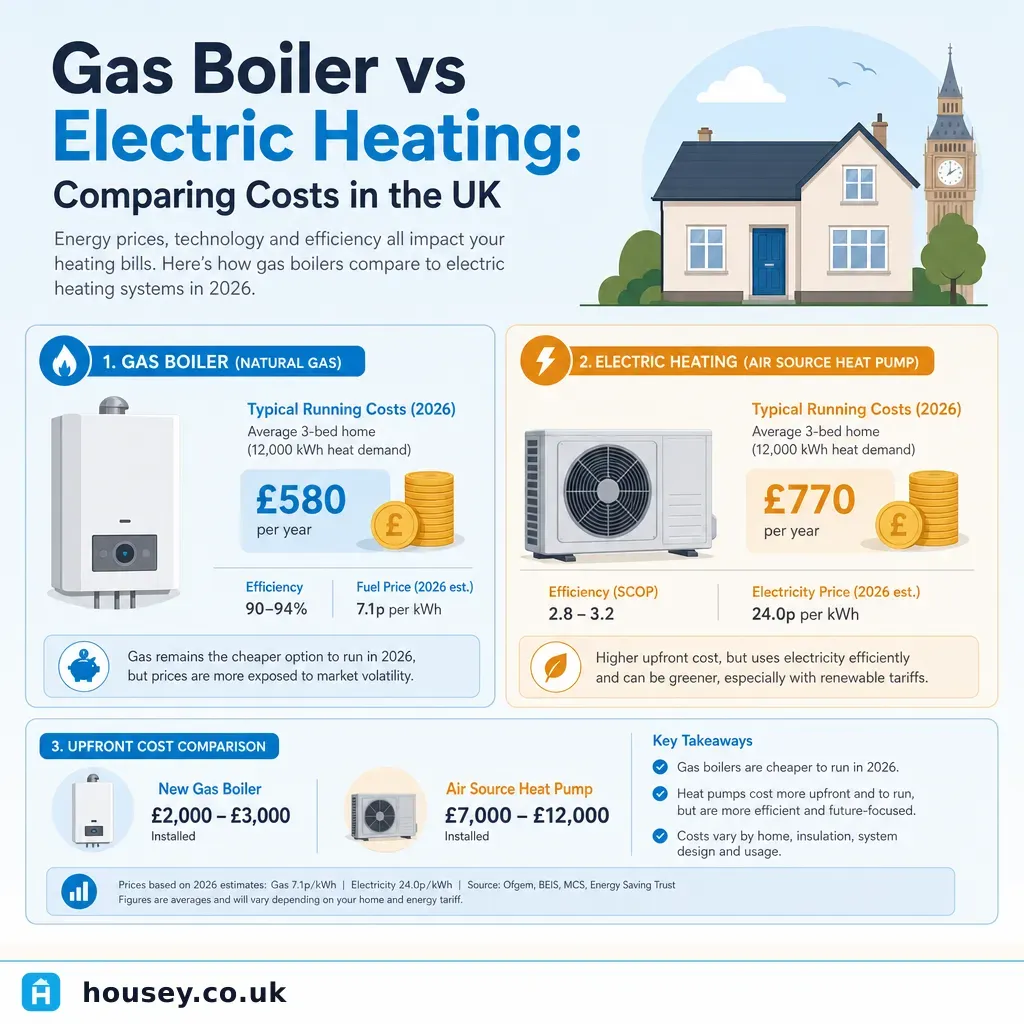
Gas Boiler vs Electric Heating: Comparing Costs in the UK
Gas boilers currently cost around 6.
 Energy & Retrofit
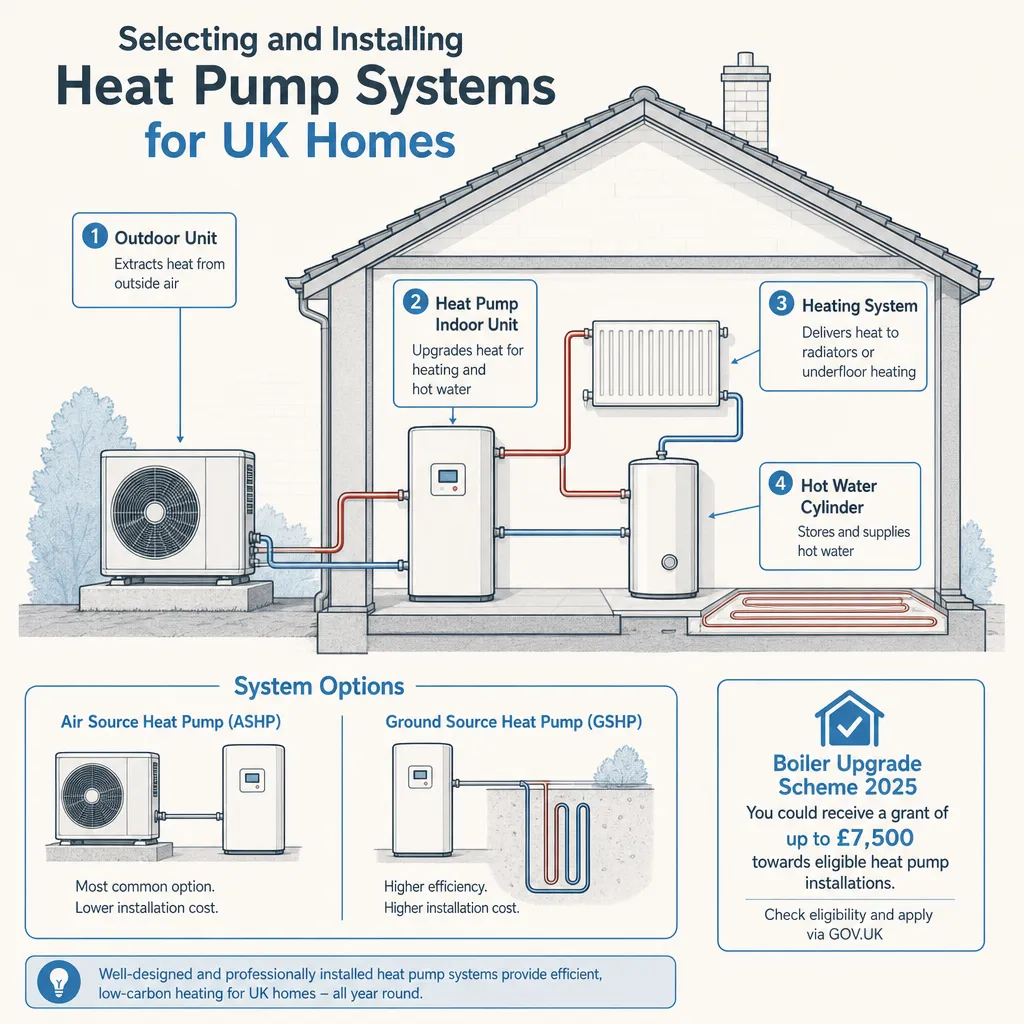
Selecting and Installing Heat Pump Systems for UK Homes
Selecting a heat pump for a UK home requires a site-specific heat loss calculation, an assessment of existing heat emitters, and a check on fabric insulation before any system is chosen.
 Energy & Retrofit
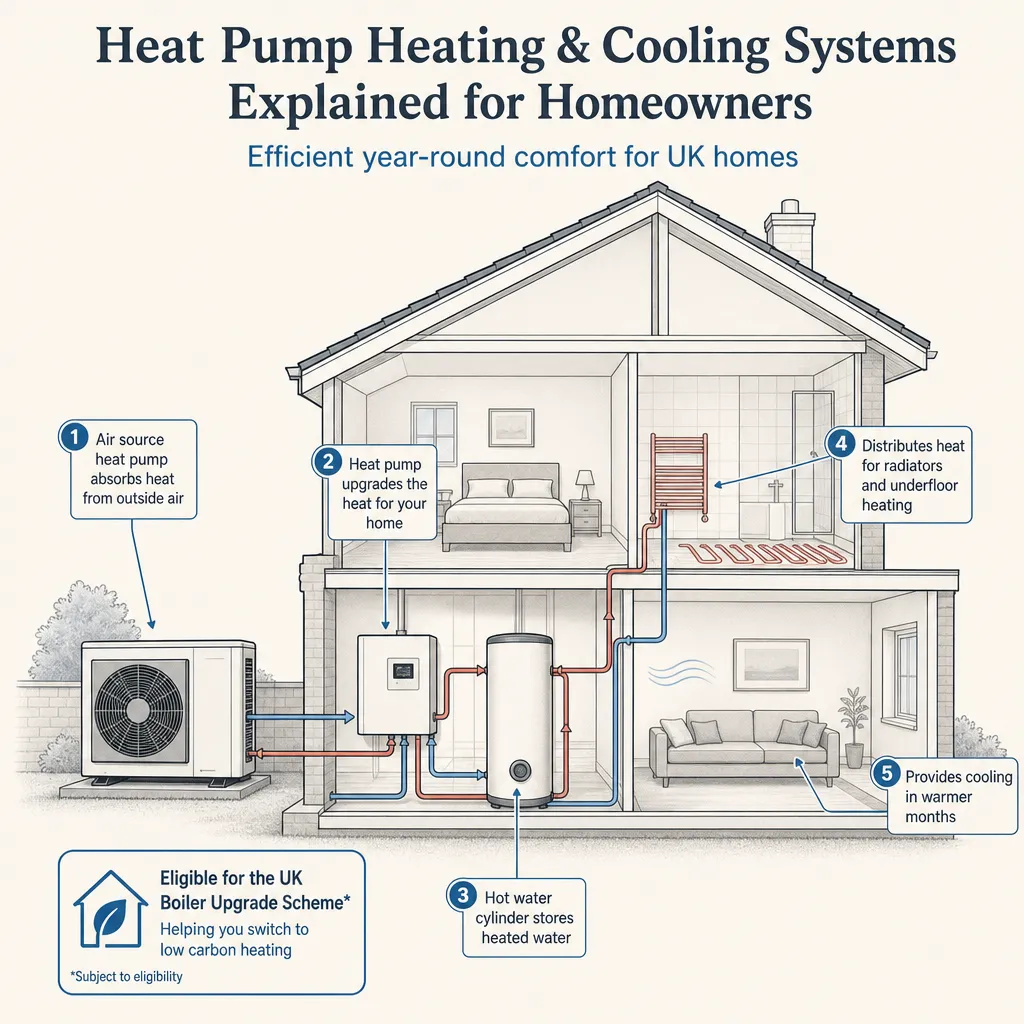
Heat pump heating and cooling systems explained for homeowners
A heat pump extracts heat from air or ground and transfers it indoors for heating, and can reverse the process for cooling.
 Energy & Retrofit
Reducing Heating Costs Through Property Energy Efficiency
Reducing heating costs starts with identifying where heat is lost — typically walls (30–35%), roof (20–25%), and windows.
 Energy & Retrofit
Gas vs Electric Heating: Installation and Running Cost Comparison
Gas central heating usually has lower running costs per kWh than direct electric heating in the UK, though heat pumps can change that equation.