High-Performance Doors and Windows for Energy Saving
By Housey · Last reviewed 11th of May 2026
High-Performance Doors and Windows for Energy Saving
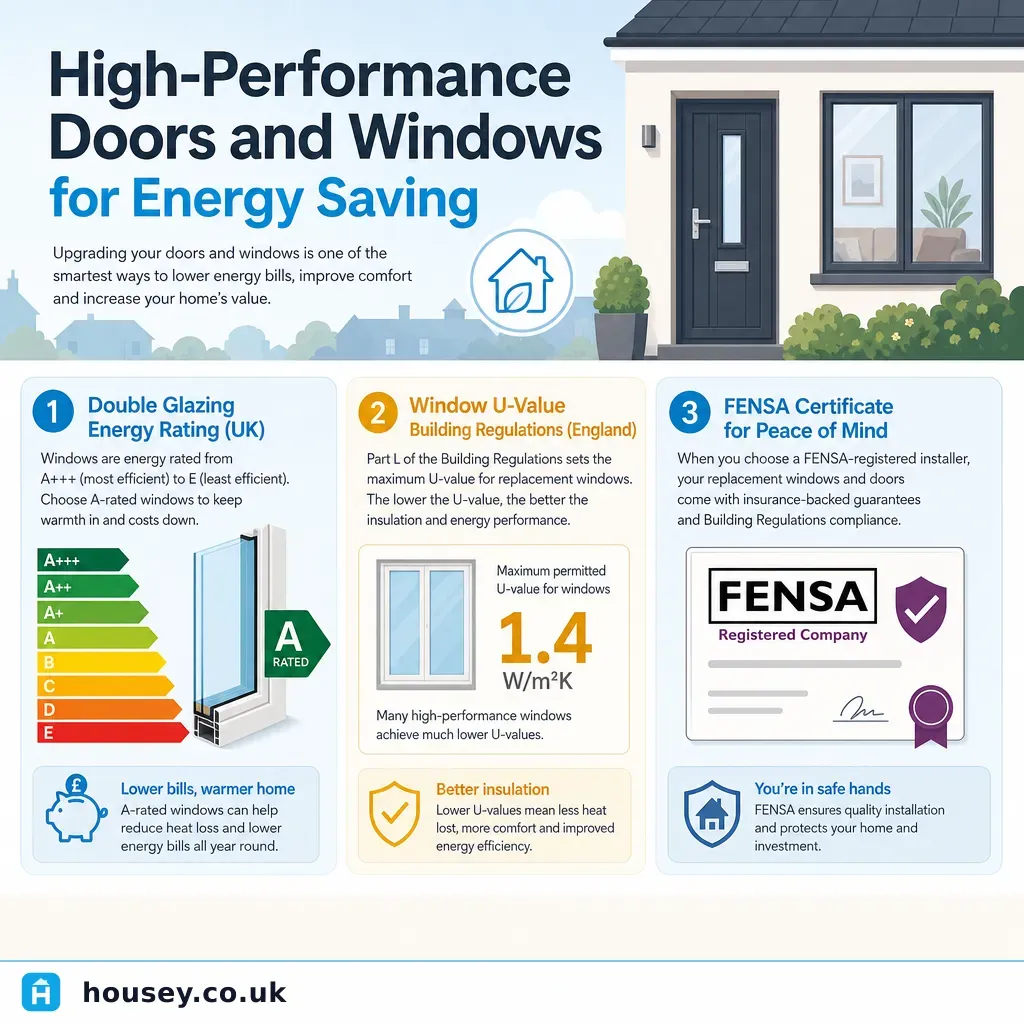
Windows and doors account for around 25% of heat loss in a typical UK home, making them a significant target in any energy retrofit programme. Whether you are improving a draughty Victorian terrace, renovating a 1930s semi, or fitting out an extension, the choice of glazing and door specification directly affects your EPC rating, heating bills, and indoor comfort. Building Regulations set minimum performance standards for replacements in England, but high-performance products go considerably further — and the gap between a compliant product and a well-specified one is meaningful over a 20-year installation life.
Key points
- Building Regulations Approved Document L requires replacement windows in England to achieve a minimum whole-window U-value of 1.6 W/m²K, or Window Energy Rating (WER) Band C.
- The WER scheme, operated by the British Fenestration Rating Council (BFRC), runs from Band G to Band A++; most modern double-glazed units with low-emissivity glass and argon fill achieve Band A or above.
- Low-emissivity (low-e) glass coatings reduce radiant heat loss from warm interior panes without significantly reducing visible light transmission.
- Warm-edge spacer bars — using foam, plastic, or stainless steel instead of aluminium between panes — reduce heat loss at the perimeter of the unit and lower the risk of condensation at the glass edge.
- FENSA-registered and CERTASS-registered installers can self-certify compliance with Building Regulations, avoiding the need for a separate building control application.
How windows and doors lose heat — and how good products address it
Heat escapes through windows and doors in three main ways: conduction through the glass and frame, convection within the air gap between panes, and radiation from warm interior surfaces towards cold exterior glass. High-performance products address all three.
U-value explained. The U-value measures how quickly heat passes through a material or assembly, expressed in watts per square metre per degree Kelvin (W/m²K). A lower value means better insulation. Single glazing typically has a U-value of around 5.0 W/m²K. Standard unimproved double glazing sits at around 2.8 W/m²K. Compliant replacement double glazing must achieve 1.6 W/m²K or better; quality products often reach 1.2 W/m²K.
Low-e glass and gas fills. Coating the inner pane with a thin metallic low-emissivity layer reflects radiant heat back into the room. Replacing the air gap with argon or krypton gas further reduces convective losses within the unit. Both features are standard across mid-range and above products in the UK market.
Frame materials and their effect on performance. uPVC frames are the most common in UK homes and provide good thermal performance at moderate cost. Timber frames perform well if properly sealed and maintained, and are well suited to period properties. Aluminium frames are thermally weaker unless fitted with a thermal break. Composite frames — combining timber internally with aluminium externally — offer excellent performance alongside low external maintenance.
Double glazing vs triple glazing: which is right for your home?
Feature | Double glazing | Triple glazing |
|---|---|---|
Typical whole-window U-value | 1.0–1.6 W/m²K | 0.6–1.0 W/m²K |
Approximate cost | Baseline | 20–40% more |
Weight | Standard | Heavier — check frame and lintel capacity |
Best for | Most UK retrofits and replacement programmes | New builds, Passivhaus, high-insulation retrofits |
Solar gain | Moderate | Reduced — may increase heating demand in winter |
Main risk if wrong choice | Missed performance opportunity | Diminishing returns if walls remain poorly insulated |
Triple glazing delivers the most benefit when the rest of the building fabric — walls, roof, and floor — is also well insulated. Fitting triple-glazed units in a solid-wall Victorian terrace without addressing the walls is unlikely to be the most cost-effective retrofit step.
Indicative UK figures, last reviewed 2026-05-11. Costs vary significantly by product, frame type, and installer.
What to look for in energy-efficient external doors
External doors — front doors, back doors, and French or bi-fold doors — can contribute significantly to heat loss if poorly specified. Key performance considerations for UK doors include:
- U-value and Door Energy Rating (DER): Approved Document L requires replacement doors in England to achieve a maximum of 1.8 W/m²K. Regulations differ slightly in Scotland, Wales, and Northern Ireland — check the relevant approved documents for the applicable nation.
- Glazed panels: Any glazed area in an external door should use a sealed unit specification equivalent to compliant replacement windows — low-e glass, warm-edge spacers, and gas fill.
- Threshold and perimeter seals: Draught-proofing at the threshold, sides, and letterbox can have a disproportionate impact on air permeability and should not be overlooked.
- Composite doors — a glass-reinforced plastic skin over an insulated foam core — typically outperform solid timber and standard uPVC doors on both thermal performance and security ratings.
Homeowner checklist: before you instruct an installer
Before placing an order with a window or door installer, work through the following:
When to get professional help
Replacing windows and doors is generally a straightforward home improvement, but professional advice is worth seeking when:
- Your property is listed or in a conservation area — consult your local planning authority and possibly a conservation architect before ordering.
- You notice condensation between panes, persistent damp near frames, or mould on window reveals — new glazing will not resolve an underlying ventilation or moisture problem.
- You are planning a whole-house retrofit — fitting windows before insulating walls can sometimes be a less cost-effective use of budget; an independent view helps sequence works correctly.
- You are unsure whether a structural lintel above any opening can support the weight of new, heavier frames.
An independent energy-efficiency assessment can help you decide whether glazing upgrades are the right first step or whether other measures should come first.
How Housey can help
Housey connects you with vetted, FENSA-registered window and door installers working in your area, as well as insulation assessors and energy-efficiency consultants if you want a whole-house view before committing to specific products.
Frequently asked questions
Do I need planning permission to replace my windows in the UK?
In most cases, replacing windows with visually similar units is permitted development and does not require planning permission. The main exceptions are listed buildings, properties in conservation areas, and some flats. Always confirm with your local planning authority before ordering, as enforcement action can require removal of non-compliant windows at the homeowner's cost.
What is a FENSA certificate and why does it matter?
FENSA is a government-authorised scheme allowing registered installers to self-certify Building Regulations compliance for window and door replacements. Solicitors routinely ask for this certificate during property sales. If your installer is not FENSA or CERTASS registered, you must apply for building control approval separately before work begins — not retrospectively.
Can I get a grant for replacing windows or doors?
Window and door upgrades can qualify under ECO4 or the Great British Insulation Scheme if you receive certain means-tested benefits or if your home has a low EPC rating. They are more commonly funded as part of a whole-house package than as a standalone measure. Check current eligibility on GOV.UK or speak to a Housey energy consultant before applying.
What Window Energy Rating should I look for?
Any compliant replacement window in England must achieve Band C or above on the WER scheme, equivalent to a maximum whole-window U-value of 1.6 W/m²K. Mid-range products typically achieve Band A or above. Ask the installer for the product's specific BFRC certificate or energy label rather than relying on general marketing descriptions to confirm what you are buying.
Sources and further reading
- Approved Document L: Conservation of Fuel and Power — GOV.UK
- FENSA scheme information for homeowners — FENSA
- British Fenestration Rating Council — BFRC
- Windows and doors guidance — Energy Saving Trust
- ECO4 scheme overview — GOV.UK
Useful next reads
 Energy & Retrofit
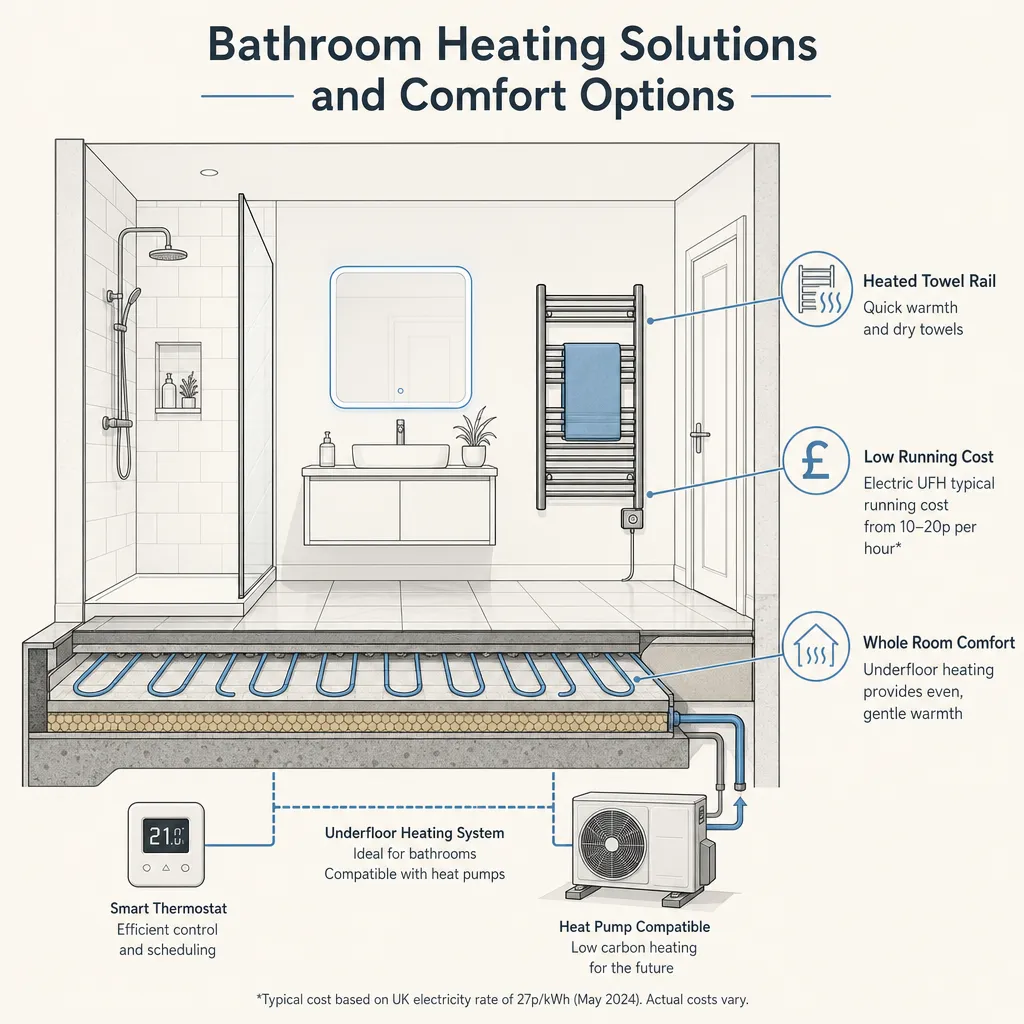
Bathroom Heating Solutions and Comfort Options
UK bathrooms can be heated using electric towel rails, wet radiators on the central heating circuit, electric or wet underfloor heating, or infrared panels.
 Energy & Retrofit
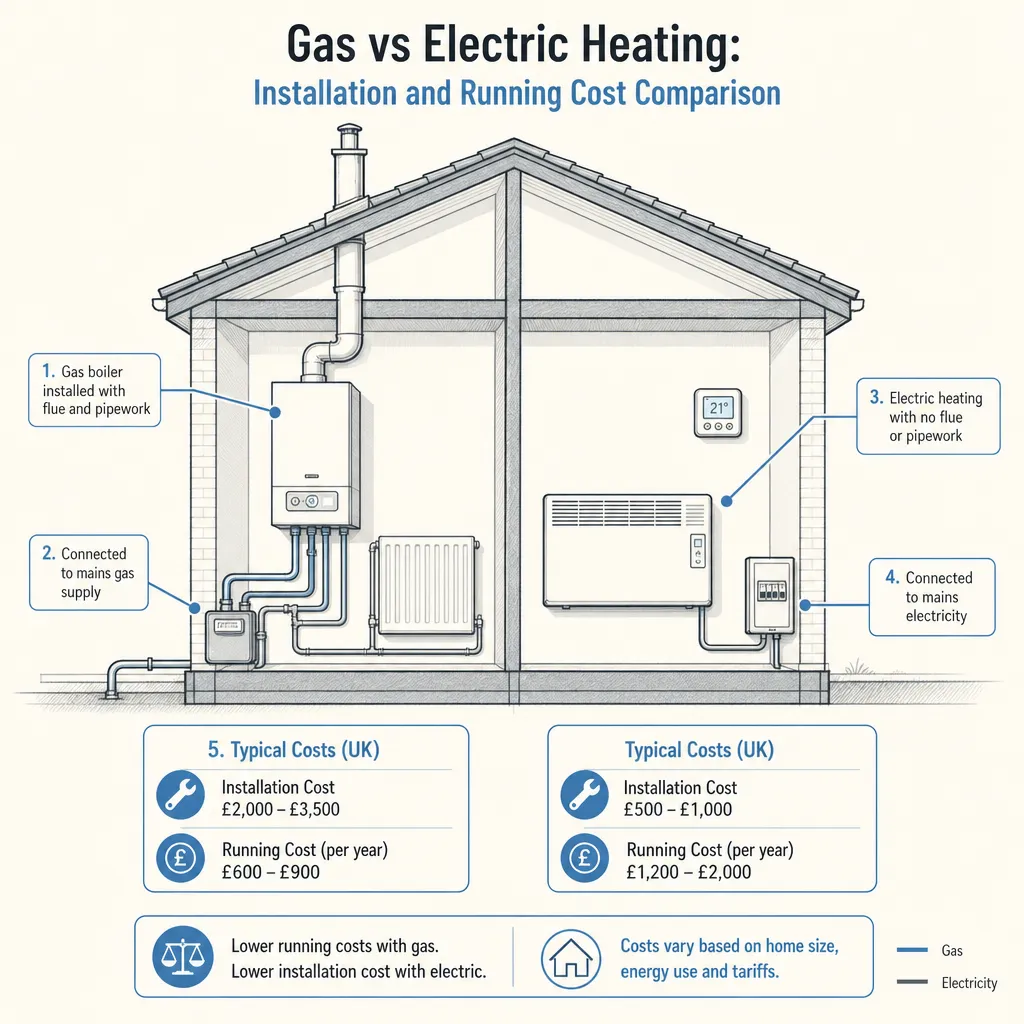
Gas vs Electric Heating: Installation and Running Cost Comparison
Gas central heating usually has lower running costs per kWh than direct electric heating in the UK, though heat pumps can change that equation.
 Energy & Retrofit
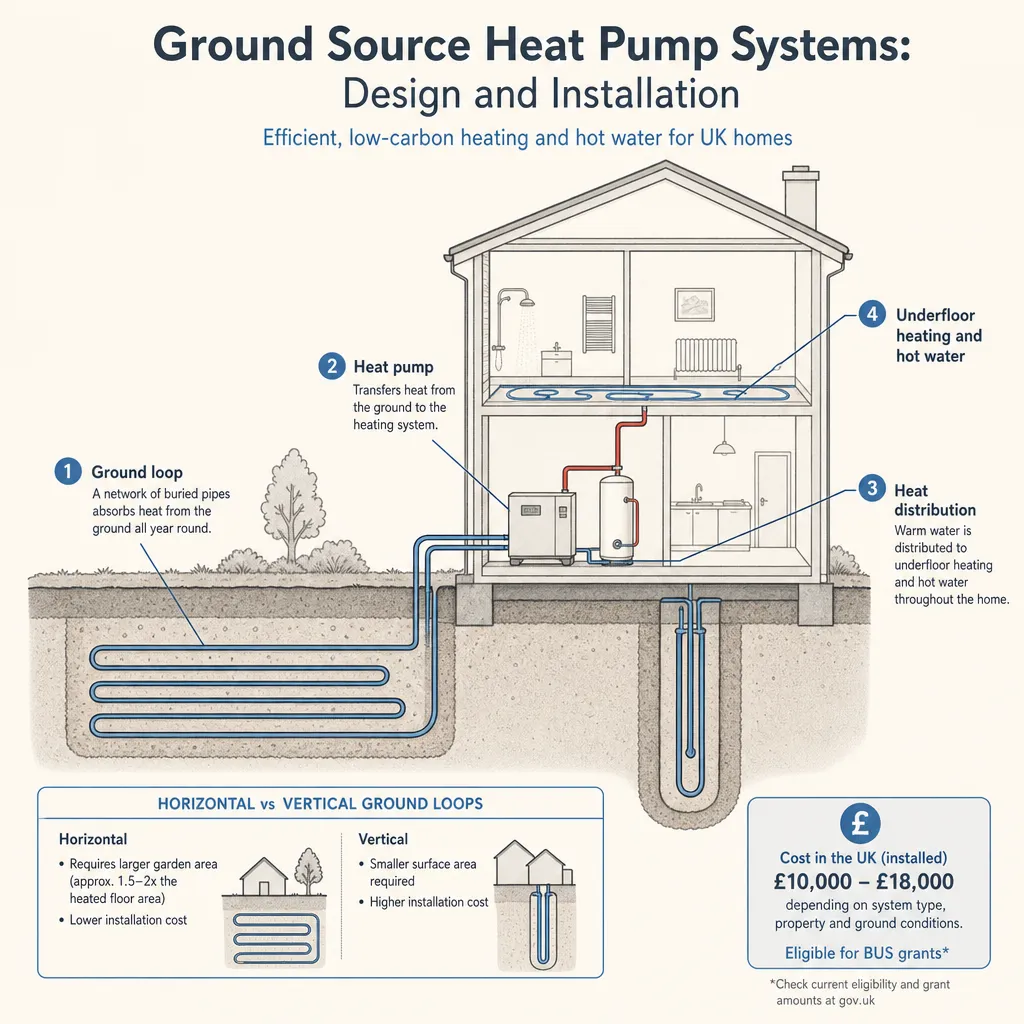
Ground Source Heat Pump Systems: Design and Installation
Ground source heat pumps extract heat from the earth through buried loops or boreholes, then upgrade it for space heating and hot water.
 Energy & Retrofit
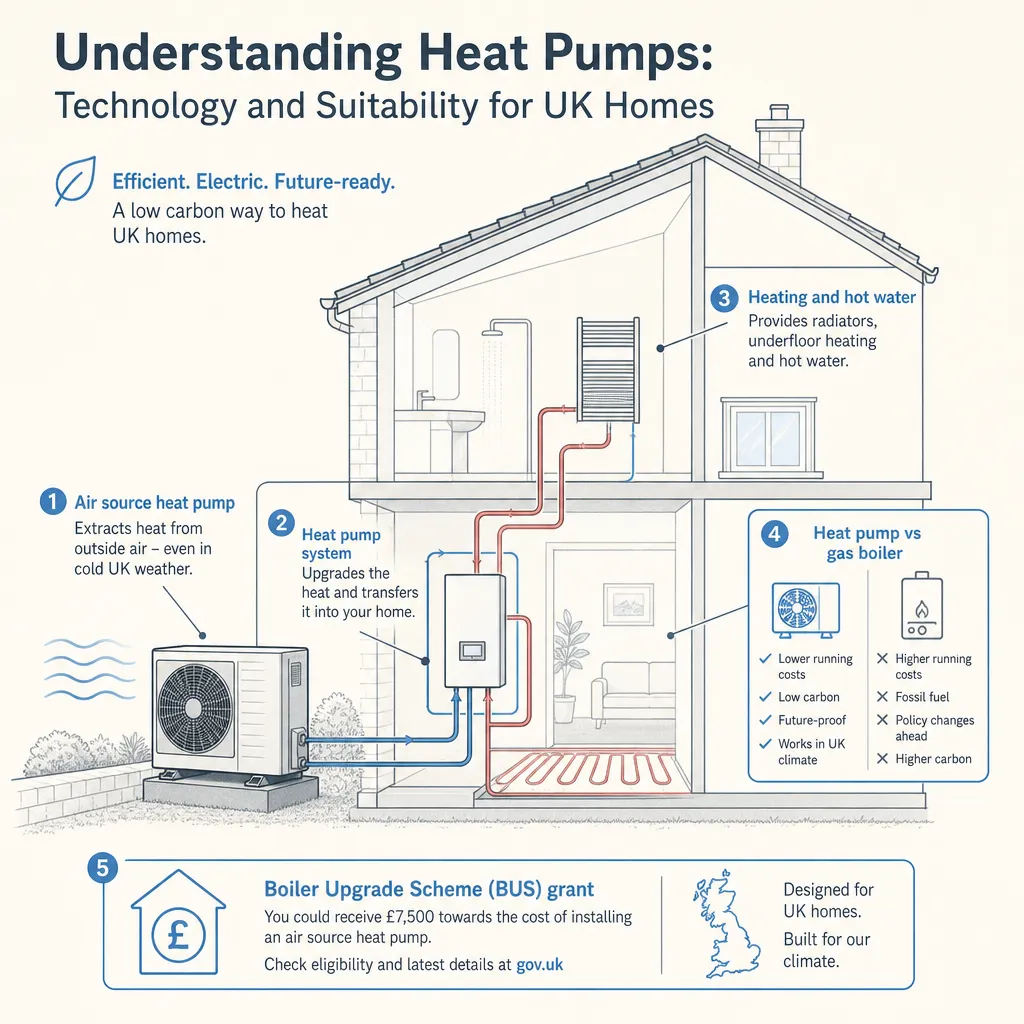
Understanding Heat Pumps: Technology and Suitability for UK Homes
Heat pumps extract heat from the air or ground and transfer it indoors, typically achieving efficiencies of 250–400% compared to a conventional boiler's near 100%.
 Energy & Retrofit
Optimising Heating Systems for Energy Efficiency
Optimising a UK heating system usually involves improving controls such as smart thermostats and thermostatic radiator valves, ensuring the boiler or heat pump is correctly sized, and upgrading radiators or pipework where needed.